J. L. BELL is a Massachusetts writer who specializes in (among other things) the start of the American Revolution in and around Boston. He is particularly interested in the experiences of children in 1765-75. He has published scholarly papers and popular articles for both children and adults. He was consultant for an episode of History Detectives, and contributed to a display at Minute Man National Historic Park.

Subscribe thru Follow.it


•••••••••••••••••


Friday, April 04, 2014

The Other Fleet Brothers: “brought up to work at press and case”

Last week I spoke to the Freedom Trail Foundation guides as they were preparing for a new season leading people around Boston.

I talked about newspapers and the people who printed them—a group that included not only white men but women (Margaret Draper), children (apprentices like Benjamin Russell and Peter Edes), and blacks—and for that last group I couldn’t offer any specifics beyond Isaiah Thomas’s memory of a man carving woodcuts for a rival printer.

But then I dug a little deeper, finding some information I should have remembered reading and some that appears to have been lately brought to light—and perhaps a detail that’s new.

Here’s the initial statement from the “Memoir of Isaiah Thomas” published by a descendant in 1874:
At this period there were few persons in Boston who could “cut” on wood or type metal. Thomas Fleet, the printer of the Boston Evening Post, was also a rival of [young Isaiah’s master Zechariah] Fowle in the printing of ballads. Fleet had a negro who illustrated his ballads by cuts. Young Thomas was induced to try his hand in decorating those printed by Fowle. He “cut” about an hundred plates, rude and coarse indeed, “but nearly a match,” he says, “for those done by the negro.”
Thomas had had more to say in his History of Printing in America, first published in 1810. In his entry on Thomas Fleet (1685-1758), he wrote:
But the principal performances of Fleet, until he began the publication of a news paper, consisted of pamphlets, for booksellers, small books for children and ballads. He made a profit on the latter, which was sufficient to support his family reputably. He owned several negroes, one of which worked at the printing business, both at the press and at setting types; he was an ingenious man, and cut, on wooden blocks, all the pictures which decorated the ballads and small books of his master.

Fleet had also two negro boys born in his house; sons, I believe, to the man just mentioned, whom he brought up to work at press and case; one named Pompey and the other Cesar; they were young when their master died; but, they remained in the family and continued to labor regularly in the printing house with the sons of mr. Fleet, who succeeded their father, until the constitution of Massachusetts, adopted in 1780, made them freemen.
Pompey and Caesar were very common names for male slaves in New England, almost cliché, but at least Thomas left names to look for.

In 1924, the Colonial Society of Massachusetts published a short article by Samuel Eliot Morison that quoted from Thomas Fleet’s 1759 estate inventory in a footnote. Among the people that printer owned at his death were:
  • Pompey, 14 years old, [value] £40
  • Caesar, 11 years old, £33.6.8
Isaiah Thomas himself was ten years old in 1759, apprenticed to Fowle. Thus, Pompey and Caesar Fleet were in some ways his peers, in some ways his rivals, and in some ways—since they were legally the property of another man—in a completely different category. Isaiah ran away from his master, absconding to Halifax at the age of eighteen. Caesar and Pompey remained bound to their master’s sons, Thomas and John Fleet.

TOMORROW: Pompey and Caesar’s father.

[The photograph above shows some of the printing staff at Colonial Williamsburg.]

Thursday, April 03, 2014

Memories of History Camp

Remember last month’s History Camp? If you weren’t able to make it, you can still partake of some of the program through the videos that organizer Lee Wright has just posted on YouTube.

Here I am talking about “The Boston Bankruptcy That Led to the American Revolution” (about forty minutes with questions).

Here’s Liz Covart on “How the Patriots Almost Lost the Battle of Saratoga.”

And here’s a panel I missed: “Employment Options for History Lovers.”

Wednesday, April 02, 2014

Bullock on Politeness and Politics, 8 Apr.

On Tuesday, 8 April, Prof. Steve Bullock of the Worcester Polytechnic Institute will present a seminar at the American Antiquarian Society in Worcester titled “Revolutionary Passages: The Dissolution of the Politics of Politeness.” Here’s his précis of the talk:
Although politics and politeness seem quite distinct today, America’s eighteenth-century leaders saw things differently. A powerful tradition stretching from the Glorious Revolution to the American Revolution considered polished self-presentation crucial to exercising power, winning consent, and even limiting authoritarian rule. This paper considers the end of that vision, the dissolution of the connection between government and gentility in the Revolutionary years, through an examination of a range of evidence including Jefferson’s critique of slavery and the Adamses’ discussion of women’s rights.
Steve Bullock is most widely known for Revolutionary Brotherhood: Freemasonry and the Transformation of the American Social Order, his study of the Freemasons’ movement in early America. He’s been examining eighteenth-century manners and their political implications from many angles, including studies of the notorious imposter Tom Bell and the hot-tempered colonial governor Francis Nicholson.

This seminar series is co-sponsored by the history departments of Brown University, Clark University, and the University of Connecticut. This session will begin at 5:00 P.M. in the Elmarion Room of the A.A.S.’s Goddard Daniels House at 190 Salisbury Street, and will be followed by dinner in Worcester for interested attendees. If you plan to attend, please email Paul Erickson at the society no later than Monday, 7 April. That would be only polite, after all.

Tuesday, April 01, 2014

“The defiling and provoking nature of such a Foolish practice”

On 1 Apr 1708, Samuel Sewall (1652-1730), merchant, judge, and eventually chief justice of Massachusetts, wrote to Boston schoolmasters Ezekiel Cheever and Nathaniel Williams:

What an abuse of precious Time; what a Profanation! . . . I have heard a child of Six years old say within these 2 or 3 days; That one must tell a man his Shoes were unbuckled (when they were indeed buckled) and then he would stoop down to buckle them; and then he was an April Fool. . . . Insinuate into your Scholars, the defiling and provoking nature of such a Foolish practice; and take them off from it.
Eleven years later this topic still weighed on Sewall’s mind, and in his diary recorded a lecture to his fourteen-year-old grandson and a younger boarder:
In the morning I dehorted Sam. Hirst and Grindal Rawson from playing Idle Tricks because ’twas first of April; They were the biggest fools that did so.
One starts to sense that someone had once told Judge Sewall that his shoes were unbuckled when they were in fact buckled.

(A version of this item appeared on Boston 1775 in April 2007.)

Monday, March 31, 2014

The Print Record of Pickled Olives in Early America

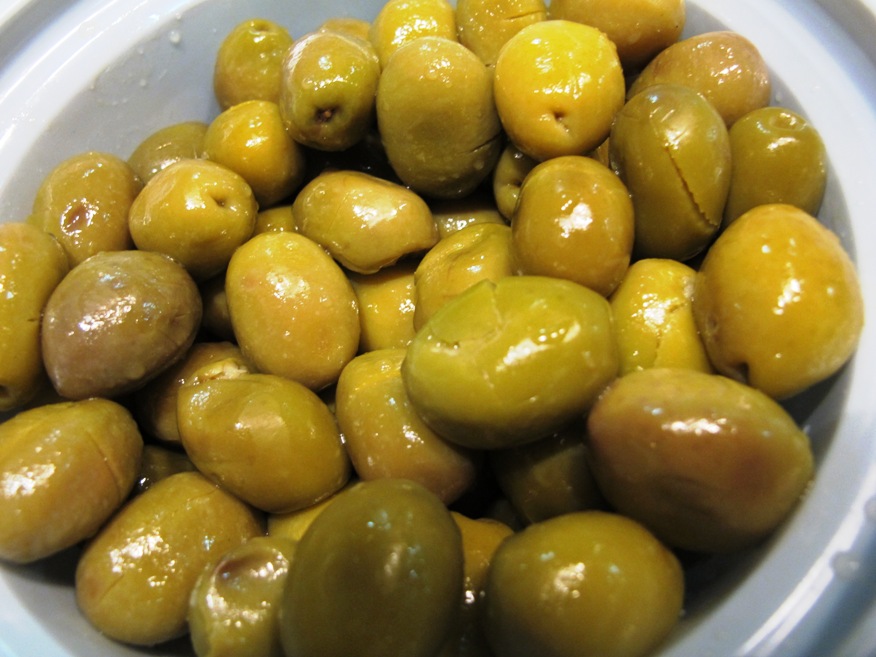
Yesterday I recounted an anecdote about Henry Knox’s first, unhappy encounter with pickled olives. And I wondered whether those were truly an exotic delicacy in North America.

I went to Readex’s Early American Newspapers database for more information on this question. Its search function confirms that pickled olives weren’t advertised or widely discussed in America until after the Revolution, and then appear to have been a special import.

The only mention of “pickled olives” in American newspapers before independence is a 2 Apr 1767 item in the New York Gazette, reprinting a article in the Quebec Gazette, which in turn quoted from Henry Baker’s Employment for the Microscope, published in London in 1753. That quotation described treating a woman after accidental arsenic poisoning with an emetic, and it compared her resulting excrement to pickled olives.

Moving on.

In the 18 July 1785 Connecticut Courant, a Hartford merchant named Daniel Smith announced that he’d just put on sale a very wide assortment of imported goods, including “pickled Olives and Capers.” The 22 Dec 1788 State Gazette of South Carolina had an advertisement from the mercantile firm of Crouch and Trezevant offering, among other things, “Pickled Olives and Girkins.”

Finally, in the New York Daily Advertiser starting on 31 July 1797 the Coster brothers ran an ad about a ship just arrived from Bourdeaux. Among its goods were “pickled olives, capers anchovies.” That was during the decade when Martha Washington reportedly served pickled olives to Knox, Secretary of War.

In that same year, Samuel Deane of Bowdoin College published a book titled The New-England Farmer, or Georgic Dictionary, in which he encouraged American farmers to plant olive trees. “The oil and pickled olives brought from thence [Europe], amount to more than a trifle, which ought to be saved if practicable.” By that point pickled olives were clearly known in America, but Deane still had to argue that their import from Europe amounted to “more than a trifle,” so they probably weren’t widely consumed.

Sunday, March 30, 2014

What Henry Knox Would Not Eat

The Westbrook (Maine) Historical Society preserves this story about Henry Knox and Martha Washington, apparently first published in the Narragansett Sun newspaper of Portland on 12 Dec 1895 (P.D.F. download):
An anecdote that is vouched for as true by high authority is worth recording. At one of those elegant dinners given by Washington after he had come to the presidency, and which were presided over by his estimable wife, the pickled olives, now so common, but at that time almost unknown, were passed to Gen. Knox. The first trial of the new relish was quite enough for the valiant Secretary of War, who quickly taking the obnoxious fruit from his mouth, thus addressed himself to his hostess, “Please, Madam, may I put this d___ thing on the floor?”
I can easily fit this anecdote in with what lots of other sources describe as Knox’s easy friendship with the Washingtons. But is there any way to test its authenticity?

One question is whether pickled olives were still unfamiliar by the 1790s. A 1749 London edition of A Treatise on Foreign Vegetables, by Dr. Ralph Thicknesse (1719-1790), includes this entry:
Pickled Olives, being eaten before Meals, says Schroder, provoke an Appetite, raise and comfort a moist Stomach, and move the Belly.
Richard Bradley’s Treatise on Husbandry and Gardening, as published in 1723, discusses cherries treated “to imitate pickled olives,” suggesting that the latter had become popular somewhere.

But that was in Britain. Had pickled olives made their way to the colonies? In 1759, George Washington sent an invoice to his London merchant that included: “1 Case of Pickles to consist of Anchovies—Capers, Olives—Salid Oyl & 1 Bottle India Mangoes…” That’s the closest match to the phrase “pickled olive(s)” that I found in all of the Founders’ papers digitized at the National Archives and the Library of Congress. But Washington ordered “French olives” regularly in the 1750s. Was pickling taken for granted?

TOMORROW: Evidence from newspapers.

Saturday, March 29, 2014

Lectures in Framingham in April

Framingham State University and the Framingham Public Library have been sponsoring a free series of ten “Lifelong Learning Lectures.” Two of the remaining talks are about networks spreading news during the Revolutionary period.

Thursday, 3 April
“Liberty’s News: How the Media Shaped the American Revolution”
Prof. Joseph M. Adelman
This talk explores the influence of the media business on political debate during the American Revolution. (Eighteenth-century media meant printers, the mail, and unabashed gossips, of course, but Joe is active in using new media today through the Junto Blog and Publick Occurrences 2.0.)

Thursday, 10 April
“Paul Revere’s Ride”
Prof. Gary Hylander
On the night of April 18 of 1775, Paul Revere and dozens of other night riders carried the Lexington alarm into the countryside. Rather than a spontaneous uprising, the local militia were carefully organized and well led.

Both lectures start at 7:00 P.M. in the Costin Room of the Framingham Public Library, 49 Lexington Street. No registration is required. There will be refreshments.

Friday, March 28, 2014

When William Pitt Was a Little S—t

This blog dedicated to William Pitt the Younger (1759-1806, shown here in about 1783) recently quoted from the memoirs of Frederick Reynolds (1764-1841), a playwright who met Pitt in the early 1770s when they were both boys from Britain’s upper classes:
His Lordship [William Pitt the Elder, Lord Chatham], I remember, was very kind to me, and on quitting the room with my father, desired his son William Pitt, then a boy about four years older than I was, to remain with, and amuse me, during their absence.

Somehow, I did not feel quite bold on being left alone with this young gentleman. For a time, he never spoke, till at last, slyly glancing at him, to learn who was to commence the conversation, and observing mischief gathering in the corner of his eye, I retired to the window; “but gained nothing by my motion.”

He silently approached, and sharply tapping me on the shoulder, cried jeeringly, as he pointed to my feet, “So, my little hero, do you usually walk in spurs?”—

“Walk?” I replied: “I rode here on my own pony.”

“Your own pony!”—He repeated with affected astonishment; “Your own pony? Upon my word!—and pray, what colour may he be?—probably blue, pink, or pompadour?

At this moment, the present Lord Chatham [John Pitt, 2nd Lord Chatham, and William’s older brother by three years] entering the room, the tormentor exclaimed, “I give you joy, brother, for you are now standing in the presence of no less a personage then the proprietor of the pompadour pony!

His brother frowned at him, and I was bursting with rage and vexation, when he coolly turned towards me, and said, “Your life is too valuable to be sported with. I hope you ride in armour?

“Be quiet, William—don’t trifle so,” cried his brother.

“I am serious, John,” he replied; “and if for the benefit of the present race he will preserve his life, I will take care it shall not be lost to posterity, for as my father intends writing a history of the late and present reigns mark my word, my little proprietor, I will find a niche for you, and your pompadour pony in the History of England.”

I could no longer restrain my spleen, and fairly stamped with passion to his great amusement. At this moment, the door opening, my facetious tormentor instantly cantered to the opposite side of the room, after the manner of a broken down pony, and then placing his finger on his lips, as if to forbid all tale-telling, disappeared at the other entrance.

In course, every feeling of rage was smothered in the presence of the great Lord Chatham, and my father having taken his leave, mounted his horse, and trotted through the Park; I following on my pony, and delighting in my escape.

But as I reached the gates, I was crossed in my path “by the fiend again,”—but, agreeably crossed, for he shook me by the hand with much good-humour, playfully asked my pardon, and then added, patting my pony, “He should at all times be happy to find both of us accommodation at Hayes [the family seat], instead of a niche in the History of England.”
(Hat tips to @anoondayeclipse and @2nerdyhistgirls.)

Thursday, March 27, 2014

Finding Your Way Around in April

Here are a couple of events coming up in April that offer opportunities to improve one’s knowledge of greater Boston in space and time.

On Saturday, 5 April, local historian Charles Bahne will lead a walking tour of Revolutionary Cambridge for the Cambridge Center for Adult Education. The course description says:
Cambridge was the focus of both military and political activity at the dawn of the American Revolution. Redcoats marched through the town on their way to Lexington and Concord; two months later, generals met in Harvard Square to plan for the Battle of Bunker Hill. Here George Washington formed the Continental Army, won his first victory, and dealt with his first traitor. This tour will view surviving sites of the Revolutionary War in Harvard Square, Harvard Yard, and Brattle Street, and will discuss events that occurred elsewhere in Cambridge between 1774 and 1778.
This class on the move costs $46. Registrants should meet in the courtyard at 42 Brattle Street (home at different times to William Brattle and Thomas Mifflin) at 10:00 A.M. on Saturday and be prepared to move around for the next two hours. In case of extreme weather, call the Cambridge Center at 617-547-6789 for information and a rain date.

On Thursday, 17 April, the University of Massachusetts Boston’s Public History Track will host an event titled “Making the Atlas of Boston History—a forthcoming historical atlas of Boston.” This book will be “only the second historical atlas about a U.S. city, and the only such atlas authored primarily by historians.” Find out more about the project at its website.

The speakers will be:
  • Nancy S. Seasholes, Director and Editor, Atlas of Boston History
  • Susan Wilson, House Historian, Omni Parker House, Boston
  • Sam Bass Warner, Jr., Professor of American Urban History (emeritus), Boston University and Massachusetts Institute of Technology
That talk is scheduled to start at 6:00 P.M. in Room 11B of the Healey Library, University of Massachusetts Boston. It is free and open to the public. A reception will follow.

Wednesday, March 26, 2014

140 Revolutionary Characters

The Journal of the American Revolution is in the middle of one of its group interviews, and today’s question was a challenge to “describe the American Revolution in 140 characters or less.” Check out the various answers at AllThingsLiberty.com.

That reminded me of Slate magazine’s public challenge back in 2010 to summarize the Declaration of Independence in 124 characters or less, leaving room for the #TinyDeclaration hashtag in a Twitter posting.

For reasons that became obvious, I had to share that news back then:

The third runner-up, for straddling the delicate balance between the literal and humorous: @Boston1775: “We seek independence based on noble and universal ideas combined with petty and one-sided grievances.”

The second runner-up, for his direct and confrontational tweet, goes to @TJMonticello: “All peeps are equal. Sick and tired of your tyrannical BS. Seeking independence. Your permission requested, not required.”

The first runner-up, for both historical accuracy and a Twitter-worthy modernization of communication, goes to @badanes: “Our Rights from Creator (h/t @JLocke). Life, Liberty, PoH FTW! Your transgressions = FAIL. GTFO, @GeorgeIII. -HANCOCK et al.”

And finally, our winner—according to his Twitter bio, a former writer for Conan O’Brien and The Daily Show—is @ApocalypseHow, for reminding us that brevity is the soul of wit: “Bye George, we’ve got it.”
My favorite not on this list came from @NEHgov: “Dear George, it’s not you. It’s U.S.”

Tuesday, March 25, 2014

Arrrrr

In 2007, the British author Colin Woodard published The Republic of Pirates: Being the True and Surprising Story of the Caribbean Pirates and the Man who Brought Them Down.

I therefore suspect that it was with mixed feelings that Woodard greeted the news in the very next year that researchers were uncovering important new sources on Caribbean piracy in the early 1700s. Trent University historian Arne Bialuschewski found several eyewitness reports from former captives in Jamaican archives. Mike Daniel of the Maritime Research Institute in Florida discovered an eyewitness report of how Blackbeard captured a French ship named the Rose Emelye in Nantes.

Now Woodard has drawn on those newly recognized documents and his own research to expand our knowledge of Blackbeard and his comrades in this article for Smithsonian magazine. He reports:
Blackbeard first appears in the historical record in early December 1716. . . . Of his life before then we still know very little. He went by Edward Thatch—not “Teach” as many historians have said, apparently repeating an error made by the Boston News-Letter [at that time the only newspaper in North America]. He may have been from the English port of Bristol (as the General History [of the Robberies and Murders of the Most Notorious Pyrates] says), where the name Thatch appears in early 18th-century census rolls. . . . The only eyewitness description—that of former captive Henry Bostock, originally preserved among the official papers of the British Leeward Islands colony—describes him as “a tall Spare Man with a very black beard which he wore very long.”

Despite his infamous reputation, Blackbeard was remarkably judicious in his use of force. In the dozens of eyewitness accounts of his victims, there is not a single instance in which he killed anyone prior to his final, fatal battle with the Royal Navy.
I haven’t read widely about pirates, so I learned a lot from Woodard’s article. For example, there was no documented “walking the plank” in that period of piracy. The earliest appearance of the practice or phrase was in the dying confession of George Geery, alias George Wood:
Such afterwards as shewed the least reluctance to their [i.e., the piratical mutineers’] wicked designs and cruel actions, or were any way suspected for a breach of faith with them, they either hung at the yard-arm, towed them along side, till quite dead, as a terrifying example to the rest, or obliged them to walk on a plank, extended from the ship’s side, over the Sea, into which they were turned, when at the extreme end.
Geery also claimed that he’d gotten the nickname “Justice” on that ship “from his abhorrence to the cruelties he saw exercised there by the pirating crew,” yet somehow he avoided these fates. Instead, he was executed on 22 Nov 1769 for robbing a ship off the English coast of “several hats.”

Monday, March 24, 2014

Half a Royal Artillery Cartridge Pouch

Occasionally I trumpet about finding some obscure account of the Revolution or new link between documents. I don’t do much work with artifacts of the period (the powder horns I’ve studied are basically documents in conical form). But the same thrill of discovery applies to that side of historical study.

Joel Bohy is a specialist in military artifacts for the Skinner auction house, and he’s been assembling objects for an upcoming exhibit at the Concord Museum and the Lexington Historical Society. Recently Joel told this story:
In November 2010, I was at the Arlington Historical Society, studying the events of April 19th, 1775, that sparked the Revolutionary war in America. The Museum Director asked me if I was interested in seeing a British belt which had purportedly been taken on April 19th during the British retreat through West Cambridge, MA (now the city of Arlington). As soon as she opened the box, I realized it was not a belt, but a Royal Artillery cartridge pouch flap and strap, missing the leather pouch, wooden cartridge block, and brass insignia. [Joel’s reproduction of such a pouch appears above.] . . .

I knew that there were four of these pouches from the 1770s extant. One had been donated to the Charleston Museum in the 1950s and could also be traced back to April 19, 1775. Another appeared at the Gettysburg Antique Arms and Militaria show in 2009. There are also two examples in England, one at the National Army Museum, and another at the Royal Artillery Museum. Now I had uncovered the fifth. But where were the missing pouch, block, and brass insignia?

I found a clue on the back of the strap. A note written there stated that the pouch had been taken from a dead British soldier on April 19, 1775. (Records indicate that no member of the Royal Artillery unit was killed that day. A soldier may have tossed the pouch aside during the hasty retreat back to Boston.) The note also explained that in 1856, George Gray, a member of the First Congregational Church of West Cambridge, had cut the brass tabs and buckles from the pouch strap. These had been placed into a box with other objects related to the church’s history, and the box was buried during a ceremony on July 4, 1856. After more research, I learned that the church had burned in the 1970s, and a lead box filled with artifacts had been found. Did the pieces cut from the strap survive the fire?
Click on over to Skinner for the end of the story.

Sunday, March 23, 2014

Molly Stark, Medford, and Myths

Gen. John Stark’s wife Elizabeth, nicknamed Molly, became a very popular historical figure during the Colonial Revival of the late nineteenth and early twentieth centuries.

She served New Hampshire and (given the Battle of Bennington, though it was actually fought inside New York) Vermont as a local heroine. Anecdotes managed to portray her both as a gentle hostess and nurse and as a brave, hardy frontier woman.

Among those anecdotes was her own tale of watching Col. Stark climb Copp’s Hill at the end of the siege of Boston to be sure that the British had actually evacuated, as I quoted yesterday. In 1909 the Daughters of the American Revolution’s American Monthly Magazine recounted that story as it had appeared in the Stark family memoir. However, other books and periodicals retold the story in new ways.

The center of those retellings was Medford’s Royall House (shown above). Col. Stark appropriated that mansion in the spring of 1775 as his headquarters, though the details of his family’s story of that move are unreliable. I can’t tell how long Stark lived there. His regiment was eventually stationed on Winter Hill. Gen. George Washington’s letters and other documents show that Gen. Charles Lee and later Gen. John Sullivan used the Royall house as their headquarters later in the siege, but it had room for lots of officers. By bringing Molly Stark into the mansion full of military men, its guardians made both her and the site seem more domestic.

In retelling the story of how Mrs. Stark had watched her husband’s military action from afar, those authors took her off her horse and put her in (or on) the Royall House. In 1915 House Beautiful told its readers, “The steep, narrow staircase to the attic is called the ‘Molly Stark’ staircase, because it was up these steps she ran to watch the evacuation of Boston by the British.” Robert Shackleton’s Book of Boston (1916) stated:
In this house General Stark early made his headquarters; and his wife, pleasantly remembered as “Molly Stark,” watched from the roof the topmasts of the British ships, in the distance, as they moved out of the harbor at the evacuation of Boston.
That wasn’t precisely what the Stark family memoir had described Mrs. Stark watching, but at least it was on the same date.

Other authors changed the event. In Historic Shrines of America (1918), John T. Faris wrote:
Under the direction of Molly Stark the house maintained its reputation for hospitality, and she did her best to make the place the abode of patriotism. On the day when the British evacuated Boston she promised her husband to signal to him from the roof the movements of the enemy. Passing on with his soldiers to Dorchester Heights, he anxiously awaited the news sent to him by his faithful Molly.
The Continental Army moved onto the Dorchester peninsula on the night of 4-5 March, almost two weeks before the evacuation. Stark’s New Hampshire regiments weren’t involved; they were helping to hold the northern wing of the siege lines. And if it’s hard to imagine Molly Stark seeing the British fleet sail from Boston harbor, picture her signaling to her husband all the way over in Dorchester.

Meanwhile, in 1913 the Massachusetts Library Club Bulletin said of the Royall House, “It is rumored, but not confirmed, that Molly Stark watched the battle of Bunker Hill from its windows.” In March 1921 the Medford Historical Register noted a particular upper window as where, “it is said, Molly Stark looked anxiously on the eventful day of Bunker hill.” That was, of course, months earlier.

Obviously, I don’t think those disparate stories are reliable, and I’m still looking for solid evidence that Col. Stark’s wife visited him in the Royall House.

Saturday, March 22, 2014

Mrs. Stark’s Story of the Evacuation

A Facebook discussion with folks at the Royall House and Slave Quarters in Medford led me to this page from the Memoir and Official Correspondence of Gen. John Stark (1860), preserving a story that Elizabeth (Molly) Stark (1737-1814) told her descendants about the end of the siege of Boston.

The anecdote starts with Gen. George Washington and the American forces getting impatient at the British military’s slow departure from Boston in March 1776 and ordering an assault on the town.
He ordered a strong force to enter the town by way of Roxbury neck, while at the same time a force, under the command of Colonel Stark, was directed to pass over on rafts and carry the battery on Copp’s hill.

The wife of Colonel Stark was at this time in the camp on a visit; and was directed by him to mount on horseback, after the embarkation of the troops, and remain in sight to watch the result. If the party were fired upon, she was directed to ride into the country, spread the alarm, and arouse the people.

The troops effected their passage over the river unmolested. She observed them land, advance up the height and take possession of the battery. The enemy’s rear guard were then embarking at the end of Long wharf.

The troops, on entering the works, found the guns loaded, and lighted matches lying beside them, indicating that mischief had been intended; but, for some reason, the design had not been carried out. . . .

The wife of General Stark has often related this incident.
In this case, we know from Gen. John Sullivan’s 19 Mar 1776 letter that the Continental Army didn’t assault Boston at the end of the siege. Seeing the British ships leaving on 17 March, a small party scouted the fortifications on Bunker’s Hill, found them abandoned, then got news from the men who ran the ferry across the Charles River. Gen. Israel Putnam led a force across the river onto the western side of the Boston peninsula. There was no real need for anyone to be ready to “spread the alarm, and arouse the people.”

In fact, Washington’s general orders had already called for Col. Stark to lead his regiments south to Norwich, Connecticut, on 15 March, though he may not have left until the following day.

In addition, Gen. Washington’s description of what the British left behind in Boston and detailed inventories don’t mention loaded cannon with lighted matches found on Copp’s Hill.

Elizabeth Stark’s story thus appears to be what I call a “grandmother’s tale,” supposedly an eyewitness account of the Revolution passed down to young relatives that, either in the telling or the retelling, portrays the actions of one family’s ancestors as braver, nobler, or more important than contemporaneous accounts say.

Was there any real basis for this story? Perhaps at some point Elizabeth Stark did sit on horseback, watching her husband and his men carrying out some mission, and transferred that anxious moment to the significant day at the end of the siege of Boston. Unfortunately, there are a lot of stories told about her now, and very little documentation for them.

TOMORROW: How this story appears to have grown in the 1900s.

Friday, March 21, 2014

A Miniature Henry Knox

In Dealings with the Dead (1856), Lucius Manlius Sargent told this anecdote about the Rev. Mather Byles, Sr., a Loyalist minister who stayed in Boston after the siege and became notorious for being unable to resist a pun:
He was intimate with General [Henry] Knox, who was a bookseller, before the war. When the American troops took possession of the town, after the evacuation, Knox, who had become quite corpulent, marched in, at the head of his artillery.

As he passed on, Byles, who thought himself privileged, on old scores, exclaimed, loud enough to be heard—“I never saw an ox fatter in my life.” But Knox was not in the vein. He felt offended by this freedom, especially from Byles, who was then well known to be a tory; and replied, in uncourtly terms, that he was a “—— fool.”
That anecdote has been republished in biographies of both Knox and Byles, and in other books as well. It’s too good to resist.

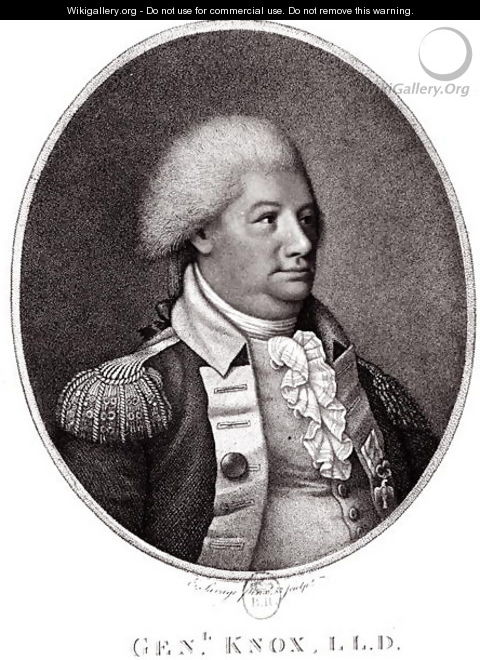
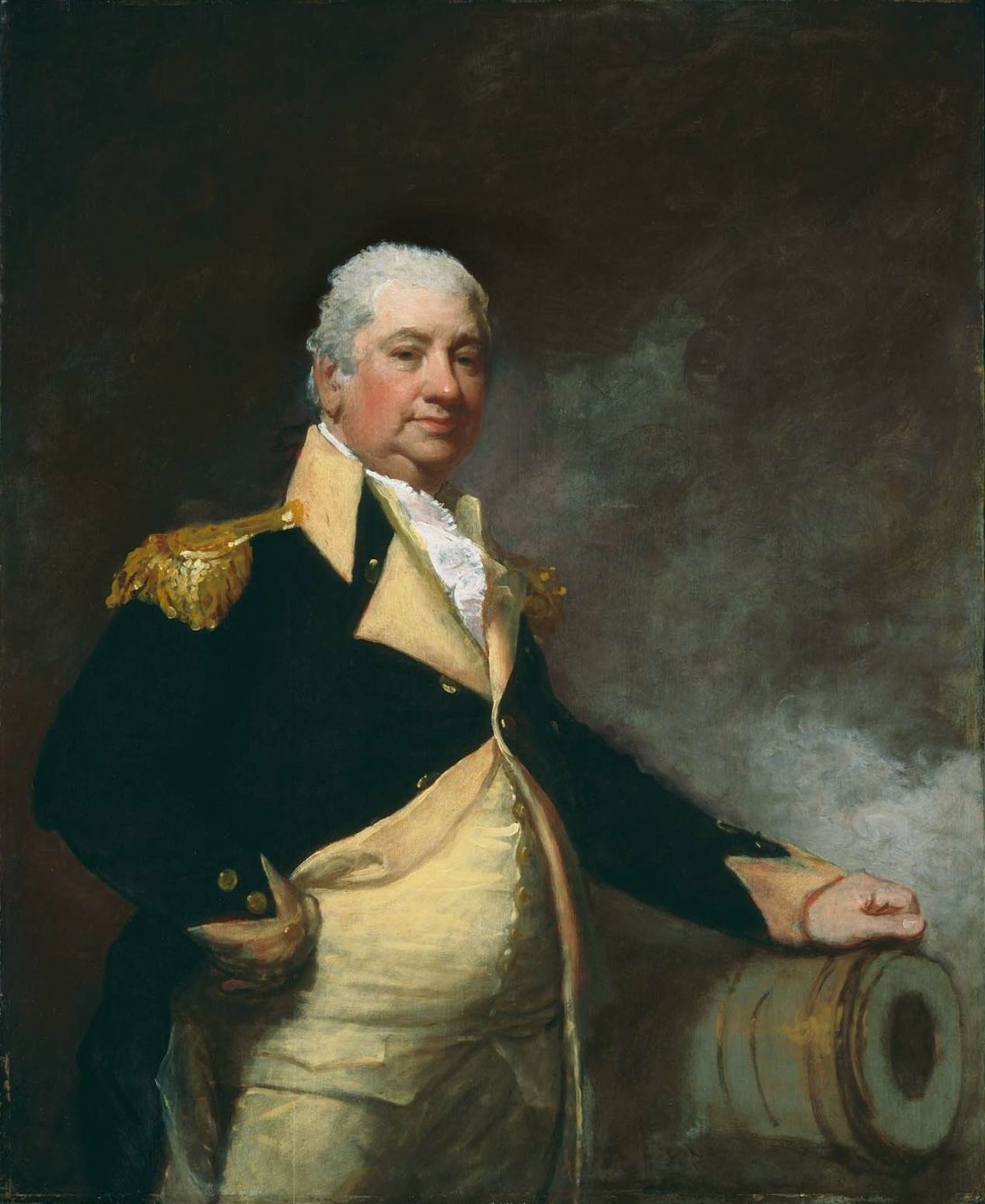
But I’ve long wondered whether Henry Knox was really that fat at the time. The picture above shows a miniature of Gen. Knox by Charles Willson Peale, dated 1778 and now in the collection of the Metropolitan Museum of Art. In this image Knox, while not miniature, doesn’t appear any fatter than many other gentlemen of his time.

When Peale painted Knox again around 1784, the general’s face had grown noticeably more jowly.

That might have been a peak point for Knox’s weight because on 18 May 1788 Abigail Smith wrote to her mother, Abigail Adams: “The General is not half so fat as he was.” (In his 1873 biography of the general, Francis S. Drake combined this remark with what Smith wrote about Lucy Knox on 15 June 1788.) At that time Smith was returning to America after some years in Europe, so she was comparing Knox in 1788 with him a few years earlier.

Knox’s later portraits by Edward Savage around 1790 and and Gilbert Stuart are also on the heavy side. (Mid-nineteenth-century American artists shaved down Knox’s belly like magazine art directors using Photoshop.) There’s no question Knox was a big man, but in 1776, when he was still in his mid-twenties, was he truly as fat as an ox?

Thursday, March 20, 2014

Dorchester Heights, Sixty Years Later

W. H. Bartlett painted This watercolor in 1836, showing the view of Boston from the top of Dorchester Heights. Two years later it was adapted into this engraving; the Boston Public Library shared both on its Flickr page. There was also a color print, and later artists copied the image.

In the background is the skyline of Boston, topped by the dome of the State House on Beacon Hill. Some church steeples stick up as well. In the foreground are the remains of the earthworks built on Dorchester Heights in 1776, though most of what we see was probably built during the War of 1812 when the site was refortified. I suspect the decorative arch was more recent.

There was still a lot of water between this vantage point and Boston, but already some of the buildings in Dorchester were rising into the view. The sheep grazing inside the earthworks show how farmers had already reclaimed this land for their purposes. Indeed, the only reason this site remained undeveloped, sixty years after the British military left Boston, was probably because the hilltop was inconvenient to plow or build on.

In the nineteenth century most of those hills were cut down, and their tops went into the shallow waters between Dorchester and Boston to create part of South Boston. By 1898 there was little of the original topography left, and the state commissioned a monument on the remaining peak.

Wednesday, March 19, 2014

Washington “lamenting the disappointment”

Most Americans viewed the British evacuation of Boston in March 1776 as a triumph. The colonies’ third-largest port had been liberated without major loss of life or property. Most British forces in North America had withdrawn from the thirteen colonies represented in the Continental Congress.

The Congress even voted to have a medal struck for Gen. George Washington, a rare honor (full story here).

But how did Washington himself view the development? On 27 March, he wrote a letter to neighbor Landon Carter about the British action:
Upon their discovery of it [i.e., the fortification on Dorchester Heights] next Morning great preparations were made for attacking us with their whole force but not being ready before the Afternoon and the Weather getting very tempestuous much Blood was Saved, and a very important blow (to one Side or the other) prevented—

That this remarkable Interposition of Providence was designed to answer some wise purpose I have no doubt of but as the proposed end of the Manouvre was to draw the Enemy to an Ingagement under disadvantageous circumstances—as a premeditated Plan was laid for this purpose—and seemd to be succeeding to my utmost wish—and as no Men could be better disposed to make the Appeal than ours seemd Upon that occasion I can scarce forbear lamenting the disappointment as we were prepared for them at all points and had a chosen Corps of 4000 Men with Boats ready to push into Boston upon a signal given if the Enemy should have sent out large detachments—

However they thinking (as we have since been informed) that we had got too formidably Posted before the Storm abated (for we Workd through the whole of it) to be much hurt by them, and apprehending great annoyance from us resolved upon a precipitate retreat & accordingly Imbarkd in as much hurry, and as much confusion as ever Troops did on the 17th Instt not having got their Transports half fitted & leaving Kings property in Boston to the amount as is supposed of thirty of £40,000 in Provisions, Stores, &ca among which many Pieces of Cannon some Mortars & a number of Shot Shells &ca are left—
On 31 March, the general repeated his language in a letter to his brother John Augustine Washington:
I can scarce forbear lamenting the disappointment, unless the dispute is drawing to an Accomodation, and the Sword going to be Sheathed.
Washington had wanted a battle for two reasons:
  • He hoped to hurt the British forces as much as at the Battle of Bunker Hill, thus convincing the government in London that the war would be too costly to continue.
  • He viewed that sort of battlefield victory as the only way for a military leader to gain honor and fame.
Over the next two years Washington kept setting up situations which he thought would force the British army to attack his troops head-on so the Continentals could inflict heavy casualties: at Brooklyn, on Manhattan, at Brandywine. Most of the time the Continental Army came off worse from those confrontations.

Only after Valley Forge did the American commander abandon his hope of battlefield glory in favor of outlasting the king’s forces—what his generals called his Fabian strategy. Washington learned that it was more disappointing to lose a big battle than not to fight it.

Tuesday, March 18, 2014

“Who Goes There?” “St. Patrick.” “Really?”

As I quoted yesterday, Gen. George Washington’s orderly book records that on 17 Mar 1776 the Continental Army countersign—the main password for anyone in the army trying to pass a guard or sentry—was “St. Patrick.”

Since October, the army had a system for transmitting that password (and a higher-level password, called the parole) down from headquarters to all parts of the army besieging Boston.

However, the orderly book of Gen. Artemas Ward (shown here), second-in-command of the army around Boston and directly overseeing the troops in Roxbury and Dorchester, states that the countersign for that day was “Evacuate.”

Usually, of course, on any given day the whole army was supposed to be using the same passwords. That’s really the point. So we might ask what was wrong with Gen. Ward’s staff.

Except that that wasn’t the only discrepancy between the two generals’ orderly books that month. Here’s how they compare a few days earlier:
Date in book   Gen. Washington’s    Gen. Ward’s
11 Mar Niagara/Thompson Niagara/Thompson   
12 Mar Niagara/Thompson Fairfax/Kent
13 Mar Fairfax/Kent Georgia/Amboy
14 Mar [blank] Lewis/Armstrong
15 Mar Augustine/Bristol Augustine/Bristol
Washington’s general orders, as written down at his headquarters, have repetitions and skips in the passwords. Ward’s orderly book looks more, well, orderly: each day a new pair of passwords. So which document is more reliable about 17 March?

Who was keeping the records at Washington’s headquarters? One man involved was the mustermaster general, then serving as the commander-in-chief’s chief aide: Stephen Moylan. He was one of the very few Irish Catholic officers in the Continental Army, and he had a sense of humor. Might he have influenced the choice of “St. Patrick,” or slipped that name into the record?

We can ask whether Gen. Washington was likely to have used that name as a password, even on 17 March. Certainly Gen. Ward, a traditional Congregationalist Yankee, wouldn’t have chosen the name of a Catholic saint. On most days the Continental countersign was a common British surname or place. Both possibilities for 17 March—“St. Patrick” and “Evacuate”—would have been breaks in that pattern, clearly chosen to highlight a memorable day.

Might the American commanders have given out two countersigns that day to the two wings of the Continental Army, or to the troops inside and outside Boston? Had the rejoicing over finally winning the siege made those men less worried about security? Did transcribers of one or the other document misread it? All are possibilities.

So was the American password on 17 Mar 1776 really “St. Patrick”? I think the most complete answer is “yes and no.” But there’s certainly enough evidence in the official transcript of Washington’s general orders to validate the claim.

Monday, March 17, 2014

Was “St. Patrick” the Continental Password for 17 March 1776?

Was the Continental Army’s password for 17 Mar 1776 “St. Patrick,” as the South Boston Parade’s website says?

The security system that both British and Continental armies used involved two passwords: a “parole” and a “countersign.” Thomas Simes’s Treatise on Military Science (London, 1780) explained:
An hour before night, the Commanding Officer of the grand-guard is to give out the parole, to all the Officers depending upon him, together with the countersign, or signal, that when the posts are visited in the night-time, they may be able to distinguish with certainty their own rounds, and the enemy be prevented from imposing upon them. . . .

The centries are to challenge in proper time, and to demand the countersign before they permit any one to approach within the distance of forty paces; nor must they on any account, suffer persons to pass, ’till they are become perfectly well convinced, they don’t belong to the enemy.

The centries, when they have challenged any person, but receive no answer, are immediately to demand the countersign; and if they still receive no answer, they are directly to fire: For which reason, the Officers are to examine the arms of every relief, see that they are in proper order, well primed, the powder dry, and the hammer-stalls taken off.
The countersign was thus the password that anyone had to murmur to the sentries in order to pass the lines. The parole was the super-secret password, meant to be known only to the sentries and those officers authorized to give them orders. A sentry’s job was not to let anyone pass without hearing the countersign and not to take orders from anyone who didn’t know the parole. The Continental Army around Boston formalized its system for distributing passwords each evening on 8 Oct 1775.

Gen. George Washington’s general orders on the last day of the siege of Boston, as officially preserved and transcribed here, start:
Head Quarters, Cambridge, March 17th 1776.
Parole Boston.
Countersign St Patrick.
Thus, there’s authoritative evidence that that day’s countersign, or password, was indeed “St. Patrick.”

TOMORROW: But there’s also conflicting evidence.

Sunday, March 16, 2014

The South Boston Parade’s Legend of John Henry Knox

Today the St. Patrick’s Day Parade is scheduled in South Boston, sponsored by the local Allied War Veteran’s Council under the leadership of John “Wacko” Hurley.

A while back, a nice person from one of greater Boston’s history museums contacted me, aghast at the parade’s “History” webpage. That page declares:
The History and the Defined Truth of the South Boston, St. Patrick's Day Parade

General John Henry Knox brought the 55 cannons captured at Fort Ticonderoga. In March, the troops positioned the cannons on
Dorchester Heights.

They had cut down trees to cannon size, hollow them out and blacken them over fire to look like cannons. Surprise was just around the corner..

On March 17th, 1776, orders were given that if you wish to pass through the continental lines, the password was "St. Patrick". The British had seen all the cannons on the Heights and left Boston.

During the American Revolutionary War, the Continental Congress appointed general officers to lead the Continental Army. They were usually distinguished community leaders and statesmen, and several had served as provincial officers in the British Army. While there were some general officers who were promoted to the grade from lower ranks, most held their ranks by initial appointment and then with such appointment at the pleasure of the Congress, to be expired or revoked at the end of a particular campaign.

More History to be inserted here and down...
Even beyond the non-sequiturs, shifting tenses, and poor punctuation, this page contains an awful lot of sheer bunk. John Henry Knox was a nineteenth-century British politician. The officer who hauled 58 artillery pieces (not 55) to Boston from Fort Ticonderoga and (the usually omitted) Crown Point in New York was Col. Henry Knox. At History Camp we joked about a hybrid of John Henry and Henry Knox building a railroad through the Berkshires.

Not all those cannon went onto the Dorchester peninsula, but some did. However, there’s no evidence for the besieging army creating fake cannon out of tree trunks; in the right circumstances that ruse might keep an enemy from advancing toward a particular position, but it wouldn’t help at all in what the Continentals wanted to do—make the Crown forces leave Boston.

The name of Michael Bare appears in the midst of that copy, probably as a credit for the photo of the Dorchester Heights monument. Bare devoted a lot of time and energy to sharing the history of Evacuation Day before his death in 2010. This text is not an appropriate tribute to him.

I suspect that the whole website was constructed in haste and left unfinished. The F.A.Q. and Contact Us pages lead to a 404 message with dummy text in Latin. Given how the parade organizers say their event is all about veterans and families, surely they planned to add information about veterans’ services and family activities. Right now there’s only a honking big link pointing to a list of South Boston bars. (That page lists Sam Adams Beer, which I understand has canceled its sponsorship this year.)

When I first saw this South Boston Parade webpage, I thought of dropping the organization a line with some corrected copy. But as planning for this year’s parade unfolded, it became clear that the organizers don’t want outside advice or participation. So I decided just to share this “History and Defined Truth” here. Happy holiday.

TOMORROW: Was the American password on 17 March really “St. Patrick”?