J. L. BELL is a Massachusetts writer who specializes in (among other things) the start of the American Revolution in and around Boston. He is particularly interested in the experiences of children in 1765-75. He has published scholarly papers and popular articles for both children and adults. He was consultant for an episode of History Detectives, and contributed to a display at Minute Man National Historic Park.

Subscribe thru Follow.it


•••••••••••••••••


Tuesday, June 08, 2021

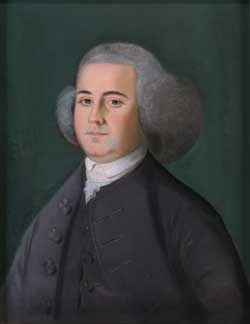
A Portrait of a Gentleman at Matawan

Earlier this year the Asbury Park Press published an article about a man who owned the Matawan, New Jersey, house of the poet and journalist Philip Freneau and started looking for a reported portrait of Freneau as a young man by John Singleton Copley.

The Frick Art Reference Library listed such a painting in the collection of the Plimpton family. It was put up for auction in 2018 as “Portrait of a Gentleman” and “attributed to Circle of Copley,” but failed to sell at the estimated price of $5-7,000.

The homeowner contacted the Plimptons and convinced them to donate the portrait to the Matawan Historical Society. On retrieving the canvas, he discovered that “The nameplate on the frame identified the subject as Philip Freneau, and the artist as John Singleton Copley.”

The local newspaper presents this as evidence of an exciting rediscovery of an authentic portrait. It’s merely evidence that at some point that painting was labeled and sold as Copley’s portrait of Freneau.

But we knew that already. The American Art Annual for 1923 reported that painting had sold the previous year for $260. Undoubtedly its price was higher for having the names of a famous artist and a famous subject attached—but by whom? There’s no evidence Copley made such a portrait and no mention of this canvas before that date.

In the 1920s, as I discussed back here, the Copley Gallery in Boston sold a lot of eighteenth-century portraits as products of colonial America. Those canvases probably showed little-known British gentlemen as painted by little-known British portraitists. But their value increased if rich Americans believed they came from the few artists working in North America before the Revolution and showed people whose names appeared in our history books.

In 1941 Lewis Leary published the biography That Rascal Freneau: A Study in Literary Failure. In a footnote he wrote:
Another “Freneau portrait,” listed in the Frick Art Reference Library, 1121 14Q, as by Copley, represents a young man dressed in the attire of a dandy of about 1770. It is not mentioned by Barbara Neville Parker and Ann Bolling Wheeler, John Singleton Copley, American Portraits in Oil, Pastel and Miniatures with Biographical Sketches, Boston, 1938. The portrait is at present part of the George A. Plimpton Collection, Columbia University Library. “I cannot find,” says Mrs. Plimpton in a letter (June 24, 1938) to the writer, “that we have anything but the dealer’s word for the authenticity of the Freneau portrait.” I have been convinced that it is neither by Copley nor of Freneau. 
The Frick Art Reference Library continues to list that painting as “not by Copley.” As for the “Circle of Copley,” in 1770 that circle consisted entirely of Henry Pelham, who didn’t travel with his stepbrother to the New York area when he supposedly painted this canvas.

Monday, June 07, 2021

“Stories of women hatching financial plans”

Sara T. Damiano, author of the new book To Her Credit: Women, Finance, and the Law in Eighteenth-Century New England Cities, shared some reflections on her research on the Johns Hopkins University Press blog:
In places like colonial Boston, MA and Newport, RI, economic networks hinged on personal borrowing and lending, and the county courts were a key arena for enforcing financial obligations. Among the hundreds of cases handled per quarterly or semi-annual term, more than three-quarters concerned debts. The vast majority of these were routine and uncontested. In such debt suits, lawyers and court clerks tracked financial obligations and legal actions, and so they largely produced skeletal, formulaic records. During my earliest forays into historical research, I breezed past these debt suits. I looked instead for the rare bulging files that, I then thought, yielded more interesting stories.

Over time, I became more curious about what I and other historians meant when, echoing the language of our sources, we used seemingly straightforward verbs. How, precisely, did one go about collecting a debt in early America? What were the practical mechanics of paying one’s creditor? How did one sue or respond to a lawsuit? And, if I attended to the eighteenth-century people who in fact carried out these activities, how could that change our understanding of early America? . . .

Over time, I realized that terse, legalistic phrases bespoke complex negotiations occurring outside the courtroom. Creditors’ legal filings, for example, consistently noted that they had “often requested” payment, and that debtors had “always refused” to settle. Drafted by lawyers, such phrasing established debtors’ failure to meet their contractual obligations. Yet, once I began linking such language to details from other, well-documented lawsuits, I began to view these ubiquitous phrases as windows onto women’s extensive labor outside of court.
The bulging files could shed light on what had probably happened before all the routine cases, Damiano reasoned.
Behind lawyers’ insistence that creditors had “often requested” payment lay stories of women hatching financial plans, travelling through their communities and regions, and confronting others. One of these women was Margaret Fuller, an unmarried woman from Providence, Rhode Island. In February of 1730, Fuller loaned the moderate sum of six pounds to a Newport mason, Thomas Howes.

Howes’s debt came due in May of 1730, and Fuller took an overnight trip to collect. She hired a boatman to carry her down the Providence River and across Narragansett Bay. Upon arriving in Newport, Fuller demanded payment from Howes. Lacking cash, Howes offered a barrel of sugar, which Fuller accepted. She and her boatman picked up the barrel from a tavern the following day.

While in Newport, Fuller travelled the city on foot, making several social and business calls. During each, she informed other men and women of her arrangement with Howes. When Fuller later decided that the sugar was insufficient payment and sued Howes, these Newport residents testified about her activities.
Damiano also argues that women, while a small fraction (10%) of the litigants in debt suits, represented a larger portion of the commercial economy. Read the whole essay here.

Sunday, June 06, 2021

“I told Cushing as Ruggles told Tyler”

Yesterday I quoted a long anecdote that John Adams wrote out in 1789 about a discussion between two Massachusetts politicians seventeen years earlier.

The specifics of Adams’s anecdotes aren’t always reliable when he was trying to make a point about politics or personalities or, in this case, both.

Adams dated that exchange to 1772. At that time one of the men he quoted, Timothy Ruggles, no longer had a seat in the Massachusetts General Court. He lived in Hardwick, in western Worcester County. The Boston merchant John Rowe recorded several encounters with Ruggles in the late 1760s but none in the early 1770s, suggesting he didn’t routinely visit the coast. So how likely was Ruggles to be socializing with Royall Tyler and other Boston Whigs in 1772?

As it turns out, however, Adams also left us solid evidence that he had heard (or heard about) that exchange between Ruggles and Tyler by the end of 1772.

On 1 Jan 1773, Adams recorded this event in his diary:
This Evening my Friend Mr. [Samuel] Pemberton invited me and I went with him, to spend the Evening with Jere. Wheelwright. Mr. Wheelwright is a Gentleman of a liberal Education about 50 Years of Age, and constantly confined to his Chamber by Lameness. A Fortune of about two hundred a Year enables him to entertain his few Friends very handsomely, and he has them regularly at his Chamber every Tuesday and Fryday Evening.
Wheelwright (1717-1784) was a wealthy heir who graduated from Harvard College in 1736. On receiving his master’s degree three years later, he delivered a speech against slavery, its effect diluted by being in Latin. After that he enjoyed a long life of wealthy obscurity, keeping out of religious and political controversies. Among Wheelwright’s properties were “the Hills at New-Boston,” which we now call the crest of the Beacon Hill neighborhood, and settlements in New Hampshire and Maine.

In Sibley’s Harvard Graduates, Clifford K. Shipton wrote:
About 1770 one of Wheelwright’s legs was so badly broken by the upsetting of his riding chair that he was confined to his chamber for the rest of his life. Having an income of about £200 a year, he moved into comfortable quarters in Newton from which, during his remaining years, he surveyed the world with intelligent curiosity.
Wheelwright kept notes on current events in his almanac diaries for more than forty-five years. Only one folder’s worth of that work survives at the Massachusetts Historical Society. He never married or had children.

Back to Adams’s diary entry, which describes a New Year’s visit to Wheelwright’s house. (Shipton identified “Mr. Swift” as John Swift, Harvard 1733; Adams doesn’t mention that man in his papers while Samuel Swift was a good friend and a link between him and Wheelwright, so I put Samuel Swift in this party.) Adams wrote:
The Speaker [Thomas Cushing], Dr. [Joseph] Warren and Mr. [Samuel] Swift were there— And We Six had a very pleasant Evening. Our Conversation turned upon the Distress of Rhode Island [during the Gaspee investigation], upon the Judges Dependency [salary grants from the tea tax], the late numerous Town Meetings, upon [William] Brattles Publication in [Richard] Drapers Paper [the Boston News-Letter] of Yesterday, and upon each others Characters. We were very free, especially upon one another.

I told Cushing as Ruggles told Tyler, that I never knew a Pendulum swing so clear.

Warren told me, that Pemberton said I was the proudest and cunningest Fellow, he ever knew.

We all rallied Pemberton, upon the late Appointment of Tommy Hutchinson [the governor’s son] to be a Judge of the common Bench, and pretended to insist upon it that he was disappointed, and had lost all his late Trimming, and Lukewarmness and Toryism.

Warren thought I was rather a cautious Man, but that he could not say I ever trimmed. When I spoke at all I always spoke my Sentiments. This was a little soothing to my proud Heart, no doubt.
Thus, by the time of this gathering Adams definitely knew that Ruggles got off a good line about Tyler and was happy to borrow it to tease Cushing. Perhaps the original conversation happened earlier than 1772, and perhaps it didn’t really start with Dr. Thomas Young, but it happened.

Now I can’t imagine anything more antsy for John Adams than waiting for his colleagues to tease him and having to chuckle about it.

Saturday, June 05, 2021

Adams on Ruggles on Young

On 8 Feb 1789, John Adams wrote to Dr. Benjamin Rush about the creation of Pennsylvania’s wartime constitution, which was too simple and radical for his tastes.

Adams listed Dr. Thomas Young, whom he had known in Boston, as one of the four men principly responsible for that constitution. He told Rush their characters “should be analyzed and developed in a manner that would give offence.” And to that end, he wrote:
Let me give you the character of one of them, (Young) in a conversation which really passed in 1772 between Timothy Ruggles, & Royal Tyler.
Ruggles (shown here) was a lawyer and legislator from Hardwick, a general in the provincial militia, chief judge of his county’s court of common pleas, and a one-time speaker of the Massachusetts house. He was charming enough to maintain friendships even when he differed from people politically.

In 1765 Ruggles chaired the Stamp Act Congress but refused to sign its protest against the law. From then on he was counted as a friend of the royal government. He maintained enough local popularity to be elected to the General Court as late as 1770, but after that he didn’t return to state government until the mandamus Council of 1774.

As for Royall Tyler, he was a Boston politician notorious for actually seeking votes, especially from tradesmen. While Tyler was generally populist in his politics, it was hard to pin him down on specific policies or actions, and he could loudly deny having said things that many people had heard him say. By the 1770s Tyler was on the Massachusetts Council, a thorn in the royal governors’ sides.

According to Adams, Ruggles and Tyler had this conversation about Dr. Young:
Ruggles. That Tom Young is a firebrand, an incendiary, an eternal fisher in troubled waters. Boston will never be in peace while that fellow is in it. He is a scourge, a pestilence, a judgement.

Tyler. come! come! dont abuse Dr. Young; He is a necessary man in the Town of Boston. He is in the city, what you are in the House of Rep: a useful man.

Ruggles. useful for what?

Tyler. I was yesterday in a watch makers shop, and looked over his shoulder while he put a watch together: The springs and wheels, were all clean, and in good order, every one in its place as far as I could see, but the watch would not go: the artist at length with his thumb and forefinger groping in the dust, upon his shop board took up a little dirty pin, scarcely visible to my naked sight, blew off the dust and screwed it into a certain part of the wheelwork, the watch then click’d in an instant, and went very well.—

This little dirty screw are you in the Legislature and Dr Young in the town of Boston.

Here was a loud roar of Laughter at Ruggles’s expence; but his wit has seldom failed him as his power of face; with all the gravity of a Judge he replied,

Ruggles. Since you are upon clock work, I’l tell you what: you resemble, the Pendulum—eternaly vibrating from one side to the other; but I must do you the justice to say, I never knew one swing so clear.

the answer hit the character so exactly, that the tide of laughter was now turned the contrary way.

We have had my dear sir, in all the States in the course of the late revolution, two many of these little Pins who have acquired the reputation of great wheels and main springs.
In 1970 David Freeman Hawke used the phrase “eternal fisher in troubled waters” in the title of an article about Dr. Young. The idiom “to fish in troubled waters” meant to wade into a troublesome situation, especially for one’s own advantage. Young wasn’t out for himself, but he didn’t shy from trouble.

TOMORROW: But did this conversation actually happen?

Friday, June 04, 2021

John Adams on Hutchinson’s Death

John Adams was caustic about a lot of people, including sometime political allies. But his longest and deepest hatred appears to have been for Thomas Hutchinson.

Adams’s early legal and political career coincided with Hutchinson’s rise to being chief justice and then governor of Massachusetts, on top of his long tenure as lieutenant governor.

He came to see Hutchinson as the province’s arch-villain, even worse than Francis Bernard and other officials sent from Britain because he was betraying his own society.

Adams’s enmity colored how he recalled events later in life, such as the “writs of assistance” case and his work defending sailors for the murder of Lt. Henry Panton. He even blamed Hutchinson for helping to break up his friendship with Jonathan Sewall.

As early as the day after Boston’s first anti-Stamp Act protest, Adams wrote that Hutchinson had a “very ambitious and avaricious Disposition.” In 1772 he accused the governor of playing on “the Passions and Prejudices, the Follies and Vices of great Men in order to obtain their Smiles, Esteem and Patronage.” After the war arrived, Adams blamed the “mazy Windings of Hutchinsons Heart, and the serpentine Wiles of his Head.”

That enmity lasted into Hutchinson’s life as a pensioned exile in London. On 24 Mar 1780 Adams, then an American diplomat in Paris, wrote with undisguised pleasure about the supposed signs of the former governor’s downfall:
from several late Paragraphs in the Papers, and from Mr. [Charles James] Fox’s severe Observations in the House of Commons upon Governor Hutchinson, calling him in Substance, “The Firebrand” that lighted up all the Fire between the two Countries, it seems pretty clear, that it is in Contemplation to take away all these Salaries and Pensions.
That didn’t happen.

Hutchinson passed away on 3 June, as I related yesterday. Two weeks later, Adams passed on the news to the Congress:
Governor Hutchinson is dead. Whether the late popular Insurrections [the Gordon Riots], or whether the Resolutions of Congress of the eighteenth of March respecting their Finances, by suddenly extinguishing the last Rays of his hopes, put a sudden End to his life, or whether it was owing to any other Cause, I know not. He was born to be the Cause and the Victim of popular Fury, Outrage and Conflagrations.
Adams didn’t list the likelihood that Hutchinson died because he was in his late sixties and in poor health. Indeed, on that same 17 June Adams expressed no doubt about the cause in a private letter to his wife: “Governor Hutchinson fell down dead at the first appearance of Mobs.”

In fact, Elisha Hutchinson’s account makes clear that his father “conversed well and freely upon the riot in London,” and wasn’t greatly concerned about it. But that wasn’t the story John Adams wanted to believe.

Thursday, June 03, 2021

The Death of Thomas Hutchinson

Thomas Hutchinson was born on 9 Sept 1711 to a wealthy Boston merchant. His father valued education so much that he funded the building of a new Latin School in the family’s North End neighborhood. Naturally, of course, that school benefited the Hutchinson boys.

Thomas went on to Harvard College and then a mercantile career of his own. But his real interests lay in two other professions:
  • researching and writing history, culminating in the two volumes of his History of the Province of Massachusetts-Bay and a manuscript for a third, published in the 1800s.
  • politics.
Hutchinson served significant terms as a Boston selectman, representative and then speaker in the Massachusetts General Court, probate court judge, advocate for the province in London and in intercolonial discussions, Council member, lieutenant governor, chief justice of the Superior Court, and finally governor.

One of his major accomplishments was stabilizing Massachusetts currency by using the Crown’s specie payment after the Louisburg expedition to pay off old notes and then limiting the amount of new debt the province took on each year. He also took credit for keeping Boston as the provincial capital after the Town House burned in 1747.

Hutchinson became unpopular among Boston politicians for holding so many offices at once along with his relatives the Oliver brothers, and for siding with the royal establishment on so many issues. Sometimes he actually opposed London policies, as with the Stamp Act, but he usually did so privately and, if he lost that internal argument, insisted publicly that people had a duty to follow the law.

In late 1769 Hutchinson became the acting governor after the departure of Sir Francis Bernard. Once the Crown officially made him governor, he lasted about three years before being replaced by Gen. Thomas Gage. By then hugely unpopular at home, Hutchinson sailed to London.

At first the former governor was viewed as a valuable advisor on the American situation. But as war broke out and went on, the government sought him out less and less. He remained the leader of the Massachusetts Loyalists in exile.

In 1780 Hutchinson was in his sixty-eighth year, not in good health. His sons Thomas, Jr., and Elisha and his daughter Sarah with her husband, Dr. Peter Oliver, had joined him in London. His beloved younger daughter Peggy had died there in 1777.

On 2 June, the Gordon Riots began in London. I wrote about them back here. Elisha Hutchinson described events of the next day in an account published with his father’s diary and letters in 1886:
Governor slept tolerably well, as he had done for several nights past; arose as usual at 8 o’clock, shaved himself, and eat his breakfast, and we all told him that his countenance had a more healthy appearance, and if he was not better, we had no reason to conclude that he had lost ground.

He conversed well and freely upon the riot in London the day before, and upon different subjects, ’till the time for going out in the coach; at intervals however, expressing his expectations of dying very soon, repeating texts of Scripture, with short ejaculations to Heaven. He called for a shirt, telling Ryley his servant, that he must die clean.

I usually walked down the stairs before him, but he got up suddenly from his chair, and walked out of the room, leaving the Doctor and I behind. We went into the room next the road; saw him whilst he was walking from the steps of the door to the coach, (a few yds. distance), hold out his hands to Ryley, and caught hold of him, to whom he said “Help me!” and appeared to be fainting.

I went down with the Doctor. The other servants had come to support him from falling, and had got him to the door of the house. They lifted him into a chair in the Servants‘ Hall or entrance into the house, but his head had fell, and his hands and f[eet?], his eyes diste[nded?] rolled up.

The Doctor could feel no pulse: he applied volatiles to his nostrils, which seemed to have little or no effect: a be[d] in the mean time was bro’t, and put on the floor, on which he was laid, after which, with one or two gaspes, he resigned his Soul to God who gave it.
Hutchinson was buried in the churchyard of Croydon Parish in London, three thousand miles from home.

TOMORROW: John Adams, speaking ill.

Wednesday, June 02, 2021

“Frantic reactions to the teaching of history”

Back in February, Prof. Michael Leroy Oberg of the State University of New York at Geneseo wrote an op-ed essay for the Syracuse Republican addressing legislative pressures to limit what public school history teachers could teach.

Oberg wrote:

Frantic reactions to the teaching of history are commonplace. Teaching history is always political. Debate over what stories to include and what to exclude are fundamental to the very enterprise of history. It is impossible to include everything, so choices have to be made, and those choices can easily spark debate and discord.

There always has existed a tension between history as civic education (aimed at the production of patriotic and law-abiding citizens) and history as an academic discipline (the critical study of continuity and change, measured across time and space, in peoples, institutions and cultures).
The accurate study of history may make it harder for teachers and other adults to promote admiration for the society being studied. However, if the goal of education is improvement of that society, then studying the actual history is a necessary part of the process.

Since this essay appeared, several state legislatures have taken up and in some cases passed bills aiming to limit how history is taught in specific ways. Despite concurrent complaints from the political right about historical figures or voices being “cancelled,” that same wing is trying to define what can’t be taught in public schools and colleges.

The particular bogeymen held up by sponsors of those bills are the New York Times’s Pulitzer Prize-winning “1619 Project” and “critical race theory,” which the laws rarely define (and if they do, never as the concept’s actual originators did). Obviously the tender spot is the undeniable history of racial discrimination in America.

Oberg saw the initiatives coming this year as the latest manifestation of a long pattern:
The [modern] Republican Party’s positions have been consistent. Republicans argued against “multiculturalism” in the 1980s, against the National History Standards in the 1990s, and current efforts to write and teach a more inclusive history. Always, they stand opposed to discussions of slavery, violence and dispossession. . . .

As a result, if you argue, as nearly every historian does, that enslavement was central to the growth and development of the United States, that the Constitution as an instrument of governance protected the institution of slavery and hard-wired its governing institutions for control by slavers, you are anathema to today’s Republican Party. If you assert that this country could not have developed in the way that it did without a systematic program of Native American dispossession, your loyalty is suspect.
In fact, if people are truly loyal to the idea that, as Abraham Lincoln said, the U.S. of A. is “dedicated to the proposition that all men [and women] are created equal,” then they should accept the meaning of the word “proposition.” That is a hypothesis to be proven, a challenge to be met, an ongoing responsibility to fix problems.

Limiting how teachers discuss the history of race discrimination in America would be simply giving up on that proposition. It would confirm that American society is inherently, irreparably racist—exactly the idea that the people pushing these new laws ostensibly object to.

Tuesday, June 01, 2021

Ferling Reputations for Clinton and Cornwallis

I claim only a basic knowledge of the southern campaigns of the Revolutionary War, but I’ve long had the impression that these are the standard assessments of two British commanders:
  • Gen. Lord Cornwallis, despite losing at Yorktown, was a competent commander dealing with a nearly impossible mission and undercut by lack of resources from New York.
  • Gen. Sir Henry Clinton was a whiny, self-justifying subordinate who wheedled his way into being commander-in-chief; he was then over his head and bears the blame for not sending Cornwallis enough resources.
John Ferling has just written a new book about that part of the war which, according to Thomas E. Ricks in the New York Times Book Review, turns those judgments on their head:
In WINNING INDEPENDENCE: The Decisive Years of the Revolutionary War, 1778-1781 (Bloomsbury, $40), the veteran historian John Ferling sets out to redeem the reputation of Sir Henry Clinton, the British general who lost that war. As Ferling notes, the conventional view is that Clinton was “capricious, indecisive, overly cautious, muddled and confused, persistently inactive, lacking a strategic vision or a master plan and fatally inhibited by his subliminal sense of inadequacy.” The enjoyment of reading this huge volume is watching Ferling make his case that Clinton was instead “an accomplished, diligent and thoughtful commander.”

Writing with admirable clarity, Ferling contends that Clinton’s “Southern strategy” of shifting the focus of British military operations to Georgia and the Carolinas was an intelligent move. It might have succeeded, he calculates, had Gen. Charles Cornwallis, who led that effort in the field, not been both mendacious and insubordinate.

Had the Southern gambit worked, Ferling states, the British might have been able to retain much of the South in a peace settlement — perhaps holding on to Georgia, Florida and the Carolinas — and so whittle down the new United States into a precarious position for survival. But Cornwallis undercut Clinton’s strategy by disregarding orders and marching off to Virginia and then getting trapped there, at Yorktown, by the arrival of a French fleet. In the clumsy hands of Cornwallis, Ferling charges, the South became “a quagmire for the British.”
As I recall, many traditional assessments of Cornwallis went on to point out that he was a competent commander in India later in his career. I wonder if wider regret about British imperialism in India makes that seem less of an accomplishment.

Monday, May 31, 2021

The Story of a Grave in Medford

In 1849 John Russell was digging a cellar and fence on land in Medford that belonged to Nathaniel Holmes Bishop. He turned up some human bones.

Russell took those remains home and showed them to neighbors. It’s unclear what evidence led to this conclusion, but people settled on the idea that those were “the bones of Revolutionary soldiers.”

Later that year the Medford selectmen paid the sexton Jacob Brooks $2.50 to bury the bones in a box in the town graveyard on Salem Street. But the town didn’t pay for that site to be marked.

[ADDENDUM: In 1855 Charles Brooks wrote in his town history:

Before the battle of Bunker Hill, General [John] Stark fixed his head-quarters at Medford, in the house built by Mr. Jonathan Wade, near the Medford House, on the east side of the street. After the battle, twenty-five of the general’s men, who had been killed, were brought here, and buried in the field, about fifty or sixty rods north of Gravelly Bridge. Their bones have been discovered recently.
Stark was still a colonel in 1775. Other sources put his headquarters in the Isaac Royall House or the Admiral Vernon tavern, though of course he moved around. It’s not clear where Brooks received his information.]

Decades later, the Daughters of the American Revolution was eager to honor the graves of all Revolutionary War veterans. (Those markers were often credited to the Sons of the American Revolution, but it looks like the D.A.R. did a lot of the work involved.)

Eliza M. Gill, a town hall clerk, seretary of the Medford Historical Society, and founder of the local Sarah Bradlee Fulton chapter of the D.A.R., led the effort to identify all the local graves—including those not previously marked. It was well known that some regiments from New Hampshire had arrived in town early in the war and made their camps there.

A local man named Jacob Winslow Vining came forward with a story. He was Jacob Brooks’s grandson, born in 1848. Sometime in his youth, he had been helping his grandfather mow the Salem Street cemetery. The old sexton pointed out a bare spot, described burying the box of bones there, and told the boy to remember it. “Some time some one will want to know,” Grandpa Brooks reportedly said.

No one asked Vining about that information for decades, and he never told the story until Gill came looking for Revolutionary graves. Then he took her to that spot in the Salem Street cemetery.

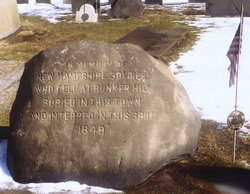
On behalf of the S.A.R. of New Hampshire, Alvin Burleigh of Plymouth picked out a local boulder and shipped it to Medford. The D.A.R. chapter arranged for that stone to be lettered, placed on the proper spot in the burying-ground, and dedicated on 29 Oct 1904, fifty-five years after the bones had been reinterred.

The boulder reads:
in memory of
New Hampshire soldiers
who fell at Bunker Hill
buried in this town
and interred in this spot
1849.
The 1904 ceremonies included a short “dedicatory exercise” on the site, an assembly at the Royall House hosted by Medford’s mayor, and a historical address by Eliza M. Gill.

But were the remains buried under that boulder actually from casualties of Bunker Hill? Col. John Stark’s and James Reed’s regiments did suffer losses at that fight, probably two dozen dead. But how many of those bodies were they able to remove from the field? A few men did later die of their wounds. In addition, men from regiments stationed in Medford no doubt died in camp over the ensuing months.

It’s not clear how many bones John Russell dug up in 1849, or how people then determined that they came from the Revolution. But we can’t doubt the determination of the people of Medford in that year, and in 1904, to honor the men who came a long way to the siege lines and fell in the war.

Sunday, May 30, 2021

The Service of Pvt. Amos Harrington

Earlier this month I wrote about Lt. Col. Abijah Brown, and how a Continental Army court-martial in October 1775 found him guilty of “employing Harrington for fourteen days, and Clarke for eighteen days, out of Camp, upon his own business.”

In other words, while those two enlisted men were supposed to be on the siege lines with the rest of Col. Benjamin Ruggles Woodbridge’s regiment, Brown actually had them working on his farm in Waltham.

It was a pleasant surprise to be able to identify one of those men from army records. He was Pvt. Amos Harrington of Waltham. That’s the only man named Harrington in the Woodbridge regiment, and of course his home town matches Lt. Col. Brown’s.

Amos Harrington was born in Waltham on 18 Nov 1755, making him almost twenty years old when he became a legal matter.

On 19 April, he marched with Capt. Abraham Peirce’s Waltham militia company. The alarm reached Waltham late, so its men didn’t engage with the British troops that day, but on orders from regimental colonel Thomas Gardner they “served as guards until Saturday, the fourth day after the fight at Concord.”

As of 30 Sept 1775, Amos Harrington was listed in Capt. Seth Murray’s company in Col. Woodbridge’s regiment, assigned to Prospect Hill. Whether he was actually there or not during the harvest season was another question.

Harrington appears to have gone home at the end of the year, but then he mobilized with his local company from 4 to 8 March 1776. At Gen. George Washington’s request, Massachusetts called up militia troops to support the push onto Dorchester Heights and reinforce the lines against possible counterattack.

On 10 Oct 1779 Amos Harrington married his cousin Esther, and their first son arrived less than six months later. According to Frederick Lewis Weis’s Harrington genealogy quoted at this Find a Grave page, they had ten children in all, three dying in infancy. Esther died in October 1794, several months after giving birth to her last daughter, who survived her.

After that, I lose track of Pvt. Amos Harrington. He never applied for a Revolutionary War pension, suggesting that he died before the law made those available for nearly all veterans.

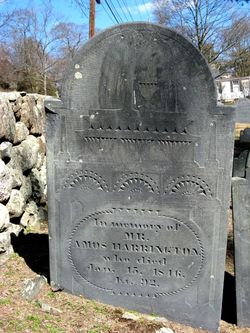
Weis’s genealogy says Harrington died in Weston on 15 Jan 1846. However, Weston vital records make clear that was another man of the same name, born in that town in 1754 and still “single” when he died. He was called up for militia service under Capt. Jonathan Fisk in August 1777, as Gen. John Burgoyne was coming down from Canada. I put his gravestone above.

I’d been hoping the Amos Harrington from Waltham did indeed live into the Polk administration, apply for a pension, and leave some comment about his service under (and work for) Lt. Col. Brown in 1775. But no such luck.

Saturday, May 29, 2021

Preservation Panel at Old South, 29 May

This afternoon Revolutionary Spaces is hosting an online panel discussion about the making of one of its landmark buildings: “Boston Beyond: Old South Meeting House’s Global Construction.”

The event description says:
For nearly 300 years, Old South Meeting House has stood in Boston as a testament to its construction and preservation. While the building itself is at the epicenter of America’s founding stories, the history of its construction is far more global.

The enduring assumption for Old South Meeting South, and buildings like it, is a narrative locked into patriotism and hyper-locality. Beyond Boston: Old South Meeting House’s Global Construction will engage our panelists in discussions on the global materials economy in the 18th century, the role of slavery and servitude in the construction of New England’s most iconic buildings, and the emergence of a domestic, regional style born from international influence.

Our panelists are experts in 18th-century architecture with specialties ranging from forgotten New England Histories, Georgian English architecture, and transatlantic building materials.
Those panelists are:
This discussion will start at 2:00 P.M. today. To register, go to this webpage. The event is part of Preservation Month, and made possible by a grant from the Lowell Institute.

Friday, May 28, 2021

Asians in Eighteenth-Century Massachusetts

South Indians were enslaved in North America well before the two Continental Army soldiers I discussed yesterday.

The 9 June 1757 Boston News-Letter included this advertisement:

Ran-away from his Master, Ebenezer Webster, of Bradford in the County of Essex, a black Slave, Native of the East-Indies, named James; speaks good English, about 21 Years of Age, wears long bushy Hair, of middling Stature, has a Scar on the left side of his Forehead which enters under his Hair: Had on a light Oznabrigs Coat, a brown homespun Jacket, with brass Buttons, black plush Breeches, a pair of new Pumps, a new Felt Hat, and a white Linnen Shirt.—He formerly belong’d to Mr. Elijah Collins of Boston.

Whoever has taken up the said Servant, or may take him up, and convey him to his said Master, or to Mr. Benjamin Harrod, of Boston, shall have THREE DOLLARS Reward, and all necessary Charges paid.—

All Masters of Vessels and others are hereby caution’d not to conceal or carry off the said Slave, as they would avoid the Penalty of the Law.

Dated, June 7th. 1757.
The same ad ran in both the News-Letter and the Boston Gazette for three more weeks. (I found a pointer to this ad at Ned Hector’s website.)

The China Trade brought another set of Asians to New England—people from China and surrounding countries. The New England Historical Society blog picked up on research by documentary filmmaker Qian Huang about a Chinese youth who died in Boston harbor in 1798.

John Boit (1774-1829) was part of America’s mercantile exploration of the Pacific starting in his own teens. In 1794 he took command of the sloop Union out of Newport, arriving in Canton in late 1795.

While in China, Boit took on a teen-aged boy whom he called “Chow” and his family remembered also as “Libei”—most likely named Zhou Libei. The young captain referred to Chow as “My faithful servant.”

Boit continued sailing the Union west, across the Indian Ocean and around the Cape of Good Hope into the Atlantic. The sloop arrived back in Boston in July 1796, the first single-masted ship known to have circumnavigated the globe.

Capt. Boit and his “faithful servant” continued to sail for another couple of years, visiting Mauritius before returning to North America. In late 1798 Boit agreed to take the schooner Mac to Cape Verde.

In September, while the Mac was still in Boston harbor and Boston was in the middle of a yellow fever epidemic, Chow fell from the ship’s mast and died. His death was listed in town records on 12 September under the name “Chow Mandarin.” The expensive, well preserved gravestone that Capt. Boit purchased for Chow stands in the Central Burying-Ground and reads:
Here lies Interr’d the Body
of CHOW MANDERIEN
a Native of China
Aged 19 years whose death
was occasioned on the 11th Sepr.
1798 by a fall from the Mast head
of the Ship Mac of Boston
This Stone is erected to his Memory
by his affectionate Master
JOHN BOIT Junr.

Thursday, May 27, 2021

Asians in the Continental Army

The Museum of the American Revolution in Philadelphia just shared a blog post about evidence of Asian soldiers in the Revolutionary War.

This doesn’t mean the thousands of soldiers who fought battles in India when the British, the French, and their local allies went to war there. That’s another seldom-told story.

Rather, interpreter Daniel Sieh quoted two sources showing how Continental Army officers identified certain enlisted men as from South Asia:
  • “Charles Peters…is an East-India Indian, formerly the property of Mr. Thomlinson in Newbern.” —advertisement for deserters, North-Carolina Gazette, 15 May 1778.
  • John Newton, a barber from “Bengaul, yellow complexion, talks good English” —size roll of Capt. Matthias Ogden’s company in the First New Jersey Regiment, 1779-82.
It’s intriguing to note that on 13 July 1776 Dixon and Hunter’s Virginia Gazette included this advertisement for a man named John Newton of the same age and skills as the “Bengaul” in Ogden’s company:
a Servant Man named JOHN NEWTON, about 20 Years of Age, 5 Feet 5 or 6 Inches high, slender made, is an Isiatic Indian by Birth, has been about twelve Months in Virginia, but lived ten Years (as he says) in England, in the Service of Sir Charles Whitworth.

He wears long black Hair, which inclines to curl, tied behind, and pinned up at the Sides; has a very sour Look, and his Lips project remarkably forward. He left his Master on the Road from Williamsburg, between King William Courthouse and Todd’s Bridge, where he was left behind to come on slowly with a tired Horse (which I have been informed is since dead) but has never made his Appearance at Home. . . .

He has been at Richmond, Williamsburg, and in other Parts of the Country, in the Service of Mr. George Rootes of Frederick, and Colonel [Thomas?] Blackburn of Prince William, of whom I had him; and as he is a good Barber and Hair-Dresser, it is possible he may endeavour to follow those Occupations as a free man.
The same notice appeared in other Williamsburg newspapers through September, some referring to Newton as simply “an Indian by birth.” (I first learned of that first ad through Ned Hector’s webpage.)

Sir Charles Whitworth was a Member of Parliament remembered for his use of statistics.

As for Charles Peters, Sieh writes:
Historian Justin Clement has done extensive research into Peters’s years of servitude, court battle for freedom, and subsequent military service. At his querying, historian Todd Braisted discovered that Charles Peters was born around 1757 in Madras (present-day Chennai, India). We can posit that he was born in territory controlled by the British East India Company, and that he was sent as an enslaved person to the Carolinas, where he joined the Continental Army and gained his freedom.

Unfortunately, Peters’s story gets a bit murky after his desertion, and while he occasionally appears in later records, we are still researching what happened to him next. He may have rejoined the Revolutionary forces in time for the reorganization of the North Carolina Line in the spring of 1778. We have tantalizing evidence that Peters participated in the Siege of Charleston, became a prisoner-of-war, and even joined a Loyalist regiment, after which time he died in Kingston, Jamaica.
I must note that, according to the 7 Aug 1783 Pennsylvania Packet, a “pioneer” in the Duke of Cumberland’s regiment named Charles Peters was killed on Jamaica; his murderer, Pvt. John Griffin, was hanged in June 1783.

As Sieh says, both Peters and Newton came to America enslaved. Both had been assigned British names that don’t indicate Asian origin; we need other sources to learn where they came from. And both made multiple moves to gain their freedom.

(It’s a delight to see so many familiar names contributing to the research on these two men: John U. Rees, Don N. Hagist, Robert A. Selig, and Todd W. Braisted.)

Wednesday, May 26, 2021

“Thereby prevent Inoculation amongst them”

On 25 May 1776, the New York provincial congress sent Gen. George Washington its report about Continental Army officers undergoing inoculation against smallpox.

The congress’s inquiry was instigated by information from Dr. Isaac Foster of the army, acting on orders from Gen. Israel Putnam, so Washington was probably already aware of the basics. But he deferred to the civil government on how to deal with the inoculator, Dr. Azor Betts.

Both the Patriot government and the commander-in-chief had issued orders against such inoculation. They didn’t fear the treatment absolutely. Rather, they worried that unregulated inoculations could end up spreading the disease or weakening the army just as the British military might reappear.

Washington responded to the New York government’s concerns by inserting that report into his general orders for the next day, followed by his own public messages:
The General presents his Compliments to the Honorable The Provincial Congress, and General Committee, is much obliged to them, for their care, in endeavouring to prevent the spreading of the Small-pox (by Inoculation or any other way) in this City, or in the Continental Army, which might prove fatal to the army, if allowed of, at this critical time, when there is reason to expect they may soon be called to action; and orders that the Officers take the strictest care, to examine into the state of their respective Corps, and thereby prevent Inoculation amongst them; which, if any Soldier should presume upon, he must expect the severest punishment.

Any Officer in the Continental Army, who shall suffer himself to be inoculated, will be cashiered and turned out of the army, and have his name published in the News papers throughout the Continent, as an Enemy and Traitor to his country.

Upon the first appearance of any eruption, the Officer discovering of it in any Soldiers, is to give information to the regimental Surgeon, and the Surgeon make report of the same, to the Director General of the hospital.
That certainly sounds tough. But so far as I can tell, it was mostly for show.

As I described back here, none of the officers found to have gotten inoculated appear to have been punished. Nor are there more penalties noted in the general orders. No names were “published in the News papers throughout the Continent.”

What’s more, in the very same period that Gen. Washington was issuing these orders, his wife Martha was being inoculated for smallpox in Philadelphia. Early the next month he wrote to his brother:
Mrs Washington is now under Innoculation in this City; & will, I expect, have the Small pox favourably—this is the 13th day, and she has very few Pustules—she would have wrote to my Sister but thought it prudent not to do so, notwithstanding there could be but little danger in conveying the Infection in this Manner.
Again, it wasn’t the inoculation process that Washington feared. It was the possible side effects, medical and social. The general didn’t want to risk adverse public opinion—hence the very loud and stern reply to the provincial congress.

But Washington couldn’t smother the epidemic. On 2 June, Gen. John Thomas died of smallpox near Chambly in Canada. Despite being a doctor, he had never contracted the disease or been inoculated against it. Many other men in the northern Continental Army were also ill or dying, destroying the Americans’ only chance to take Canada before Britain sent reinforcements.

This small controversy over inoculation in New York in May 1776 showed how men in the Continental Army were pushing back against the official non-inoculation policy. They understood that isolation and hoping for the best wasn’t going to work. In early 1777 Gen. Washington finally came around to a new strategy for protecting his army from smallpox; that story will be part of Andrew Wehrman’s upcoming book The Contagion of Liberty.

Tuesday, May 25, 2021

“Confined in the New Goal of the city of New York”

The four Massachusetts men I named yesterday weren’t the only Continental officers trying to be inoculated against smallpox in May 1776.

Members of the New York committee investigating that incident spoke with Glorianna Betts, wife of the inoculating doctor. She revealed “That Lieut. Seymour from Long Island had informed her, that seven persons of the Army (Officers as she understood) on Long Island, were taking mercurial preparations, and as he supposed, were inoculated, or preparing to be inoculated for the small pox.”

Mrs. Betts was probably trying to win favor for her husband, either by pointing out that officers wanted to be inoculated or by giving up someone else to the authorities.

It didn’t work. The New York government was already familiar with Dr. Betts, having locked him up in January for denigrating the provincial and Continental Congresses. On 3 April the committee of safety had freed him on the condition that he
will not bear arms against the inhabitants of the American Colonies, or do any other act inimical to the liberties of the United Colonies, or contrary to the resolutions of Congress, during the present controversy between Great Britain and the American Colonies
The doctor also had to pay his “expenses while in confinement” and give a bond for £200 for “future good behaviour.”

Yet less than two months later, Dr. Betts had gone back to his “business” of smallpox inoculation despite knowing it was against the provincial and army rules. He thus potentially spread the disease, weakened the army, and panicked the local population. No surprise, the New York congress locked him up again.

The next we hear from Dr. Betts is on 14 June, when he petitioned the congress:
That your petitioner hath been for some time past Confined in the New Goal of the city of New York.

That the cause of his confinement is that he hath violated a Resolve of the Honorable Provincial Congress, he having inoculated some officers in the service of this Country.

That your petitioner meant not to injure those gentlemen who were inoculated, nor to show any contempt to your worshipfull house, but ardently wished to render his best services to those who had the Command in relieving them from those fears which people in general have who are subject to that disorder.

That your petitioner is extreamely sorry for the offence he hath given his countrymen and your honorable Body in particular, and prays that he may be released from his confinement and suffered to go at large, and your petitioner doth hereby promise and engage that he will not for the future by word or deed counteract the orders of your Honorable house
Five days later he petitioned again, adding:
That he is in great distress owing to the great Expense he for a long time past hath been to lay in Confinement, his being out of Business and having a large Family; That he is sorry for his imprudent Conduct and sincerly wishes that the Colonies may Injoy the present glorious strougle and Injoy their rights and Liberties uninviolated and their present Contest be crouned with success.

That the Petitioner is willing and desirous to be removed out of the Goal and to be permitted to live in the Country. He would therefore Humbly pray to be removed to the North Castle in west Chester County and have the Liberty of riding Ten or fifteen miles into the Country to visit his Patients, he will especially give security not to exceed the Limets assigned to him and in all things to observe the orders of this Honourable House.
That offer appears to have been acceptable to the Patriot government. As of 14 July, Dr. Betts was listed as “dischd. gave Bond.”

Years later, Betts rewrote this episode in his testimony to the Loyalists Commission. He didn’t mention treating Continental Army officers, apologizing, or offering to live in rural exile. Instead, his claim was:
After his return from Œsopus the Claimt. was tried by the Provincial Congress for carrying Intelligence to ye Enemies & was sentenced to die, and was lying in Gaol under that sentence just as the Brit. troops came.
Curiously, he also testified that he “Made his escape just before New York was taken.” I guess if you’re going to make up why you were put in jail, you might as well make up a jailbreak as well.

In any event, once the British military took Manhattan in the fall of 1776, Dr. Betts became a firm Loyalist inside the city. He “Had a Warrant as a Capt.’s Lieut. in the King’s American Rangers,” recruiting men, and was also “made Surgeon of Queen’s Rangers by Genl. [William] Howe.”

In May 1783, Azor and Glorianna Betts and their children came to St. John, New Brunswick. He resumed his practice “in the Physical Line,” later moving to Kingston at the urging of settlers there. Reportedly he continued to treat people against smallpox, switching to the new vaccine method.

Dr. Betts died in Digby, Nova Scotia, in 1811, according to a family gravestone. (Printed sources say he died in 1809.) Glorianna Betts died in St. John in 1815.

TOMORROW: Back in New York…

Monday, May 24, 2021

The Continental Officers Inoculated in May 1776

On 24 May 1776, Dr. Isaac Foster of the Continental Army discovered that Dr. Azor Betts had inoculated four officers against smallpox, and also against Gen. George Washington’s orders.

Those men were identified in the commander’s papers as “Lt Colonel Moulton, Capt. Parks, Doctor Hart and Lieut. Brown.”

It might be no surprise those all appear to be Massachusetts officers. Not only did Massachusetts supply the bulk of the Continental Army in early 1776, but its officers still tended to follow their own counsel.

Lt. Col. Johnson Moulton (d. 1793) came from York in the district of Maine. He gained the rank of captain during the French and Indian War, and on 21 Apr 1775 he led a militia company south toward Boston. When he and those men returned home after four days, Moulton discovered that James Scamman had already started to recruit a regiment from the area, which proceeded to the siege of Boston.

In May, Moulton presented Gen. Artemas Ward with a letter from some neighbors suggesting he should be colonel and Scamman his second-in-command. Instead, the Massachusetts Provincial Congress went with Col. Scamman and Lt. Col. Moulton. Then Scamman behaved embarrassingly at the Battle of Bunker Hill. Though acquitted of the charge of “backwardness,” he left the Continental Army at the end of the year.

Moulton remained with the army, but he also remained a lieutenant colonel, assigned to the 7th Continental Regiment under Col. William Prescott. Immediately after the British evacuated Boston, Washington ordered that regiment to head to New York and start fortifying the city. On 7 April they were assigned to build breastworks on Governor’s Island.

(There was another lieutenant colonel named Moulton in the New York campaign: Stephen Moulton of Stafford, Connecticut, captured at White Plains. But in May he was representing his town in the Connecticut assembly, so he couldn’t have been getting inoculated in New York.)

Warham Parks (1752–1801) of Westfield and the Harvard College class of 1773 was a captain in Col. Ebenezer Learned’s 3d Continental Regiment. He became a major in the 4th Massachusetts Regiment at the start of 1777.

After being wounded at the Battle of Saratoga, Parks resigned his commission the following March. Washington personally asked him to remain, but he replied, “I am bound in Conciense & honor to Resign my Small Command to those who have health of Body & firmness of mind Sufficient to Carry them through the hardship and dangers of a Soldiers Life.”

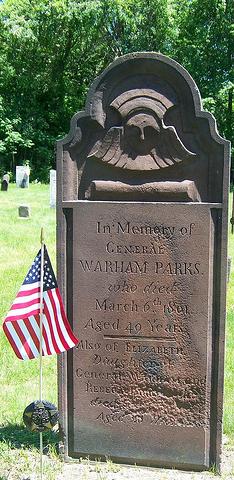
Parks returned to his home town, married, and started to win elected and appointed offices. In 1782 he became the brigadier general of the Hampshire County militia and also presided over the court-martial that Col. Paul Revere requested after the Penobscot expedition. His second wife was a daughter of Nathaniel Gorham, president of the Continental Congress in 1786. Parks’s grave marker appears above.

Dr. John Hart (1751–1836) was born in Ipswich and moved to Maine for medical training and his early practice. He became surgeon in Col. Prescott’s regiment in May 1775 and served in that and other Continental regiments until June 1784. After the war he settled in Reading, served in the state senate, and was active in the Massachusetts Society of the Cincinnati.

(Again, it’s possible this patient was Dr. Josiah Hart of Connecticut instead, but the surgeon in Prescott’s regiment seems more likely.)

As for “Lieut. Brown,” that man is impossible to identify with certainty. As of January 1776 Prescott’s regiment contained:
  • 1st Lt. Benjamin Brown (1745–1821) of Myrifield (later incorporated as Rowe), who later became a captain and served until July 1779.
  • 1st Lt. Joshua Brown (1742-1817) of Stow, a veteran of the last war and another captain until mid-1779.
  • 2nd Lt. Samuel Brown (1752-1819) of Concord. (Not be confused with Lt. Samuel Brown [1749-1828] of Acton, who was a prisoner at Québec at this time.)
What does identifying those men tell us about their choice to inoculate? First, most of them (or all, if the lieutenant was Benjamin Brown) came from parts of Massachusetts remote from Boston. They were thus less likely to have been exposed to smallpox or had a chance to be inoculated against it.

Second, these were officers, not enlisted men. One was a second-in-command of a regiment. Another was a doctor himself. They had all reenlisted in the Continental Army and would continue to serve on many campaigns. They were clearly committed to the cause. There’s little doubt they sought inoculation so as to be more useful for the army, not less.

Third, none of these four men died from the inoculation. At the end of June they were healthier than before.

Finally, and perhaps most important, there’s no record that these men were punished for convincing Dr. Betts to inoculate them. Some were promoted in the next couple of years. Gen. Washington even asked one to remain in the army. Even though they had disobeyed the commander-in-chief’s order, the commander-in-chief appears to have forgiven them.

TOMORROW: Who took the blame.

Sunday, May 23, 2021

“To return to a proper sence of his Duty to his Country”

On 23 Jan 1776, the New York committee of safety sent Dr. Azor Betts and two other men to the local committee in charge of Kingston in Ulster County.

The provincial committee told their colleagues to lock those men in the town jail since their “wicked practices forbid their being permitted to go at large.”

In the case of Dr. Betts, the “wicked practices” appear to have been saying nasty things about the New York committee of safety and other Patriot authorities.

Kingston’s jail was in the part of town that later broke off as Esopus, the original Native name for the area. On 20 February Dr. Betts sent a petition to the New York provincial congress from “Esopus Gaol”:
your Petitioner fully sensible of his former indiscresions begs leave to return to a proper sence of his Duty to his Country, and your Petitioner further most solemnly assures the Congress, that it shall be his future most earnest study, to convince every individual of his most steady adherence to the utmost of his abilitys in promoting the Liberties of America.

That your Petitioner still flatters himself his crime is not of so atrocious a Nature but that his pardon may be anounced on a due submission, as such he most humbly leaves his case to their tender consideration and should he be so happy to experience their forgivness and protection, it will by him with a most thankfull heart ever be acknowledged and your Petitioner as in duty bound shall ever pray.
The head of the Kingston committee forwarded that on, explaining, “we are entirely strengers to his former conduct.” Betts had “made offers to sign a Recantion and make oath for his futur behaviour,” but the locals deferred to the provincial congress about what to do with him.

Evidently the congress did nothing because a month later, on 25 March, Dr. Betts sent another petition in even more abject language:
I flatter myself my present melancholy situation will be a sufficient pardon for this intrusion but where can the wretched fly for shelter but to those where the power of extricating them is lodged, by the last Post Gentlemen, I troubled you with a Petition the purport of which I am willing most solemnly to adhear to, and as the inevitable ruin of myself and Familly must be the certain Issue of my Confinement, therefore trust to your Clemency for my Enlargement wch. if I am so happy to obtain shall ever with gratitude be rememberd by Gentlemen yr. very obedt. Humble servt.
AZOR BETTS
Dr. Betts’s pleas finally prompted some action, and the Patriot authorities released him in the spring of 1776. He later told the Loyalists Commission what he found on returning home:
About the time of his first confinment by order of the Committee, the Rebel Barrack Master went and broke open his house.

His Books, his Medicines & furniture were lost at that time. The damage done to him was at least £50.
The Continental military probably wanted Betts’s medical resources for their surgeons. After all, there was a war on. 

Dr. Betts was soon back to treating patients. In particular, as described yesterday, in late May he inoculated four men from the Continental Army against smallpox against Gen. George Washington’s express orders.

On 24 May the General Committee of the City of New-York summoned Betts to explain his action. He
allowed the charge against him, and offer’d in his vindication—that he had been repeatedly applied to by the officers of the Continental Army to inoculate them, that he refused, but being overpersuaded, he at last inoculated the persons abovementioned.
That might have gone over better if Dr. Betts wasn’t already suspected of opposing the Continental cause.

TOMORROW: The four inoculatees.

Saturday, May 22, 2021

“Azor Betts be sent to Ulster county jail”

As I quoted yesterday, on 20 May 1776 Gen. George Washington ordered that no one associated with the Continental Army should be inoculated against smallpox.

Four days later, Dr. Isaac Foster appeared before the General Committee of the City of New York and reported:
that information was given to General [Israel] Putnam, that several persons had been inoculated, at the house of one Fisher, in Stone Street, contrary to a resolve of the Provincial Congress of this Colony, he, the examinant (agreeable to Genl Putnam’s order) immediately went to the house of the above mentioned Fisher, where he discovered that Lt Colonel Moulton, Capt. Parks, Doctor Hart and Lieut. Brown had been inoculated by Doctor Azor Betts.
The committee already knew about Dr. Betts.

Back in January, Christopher Duyckinck, the chairman of the city’s committee of mechanics, had accused Betts of
having, in his presence, damned the Congresses and Committees, both Continental and Provincial, and said that they were a set of damned rascals, and acted only to feather their own nests, and not to serve their country; that they had shut up his shop, but that he hoped to see the day when he would shut them up, or overturn them
Duyckinck mentioned a “Captain Buchanan and others as witnesses to support the charge.”

Now Duyckinck was a radical. He himself had defied the committee’s authority, called one member “a usurper and a coward,” and even seized that man’s watch. But Duyckinck had then made some sort of partial apology (while still keeping the watch), and there was no question he supported the Patriot resistance. So when he pointed his finger at Betts, the committee listened.

Betts had come to New York from Norwalk, Connecticut, where he was born in 1740, the seventh child of Nathan and Mary Betts. About 1764 he married Glorianna Purdy of White Plains, and their first child came shortly afterward—or before, according to some online genealogies. By the time the war broke out, Dr. Betts was the father of several children and practicing medicine in or near New York City.

The committee summoned Betts to answer the accusation. He didn’t “deny the charge or desire any other witnesses to be called.” He said he expected Buchanan to corroborate Duyckinck’s testimony. The doctor’s only defense was “that he did not mean to include all the members of Congresses and Committees, and supposes there are some good men among them.”

Not surprisingly, that didn’t mollify the New York committee of safety. [ADDENDUM: And its journal shows members heard from other witnesses:
Capt. John Buchanan says he heard Azor Betts damn the Congresses and committeee, and say they had taken the bread out of his mouth; that his business was inoculation; that the said Azor Betts has taken great pains to prevent Joseph Hunt, an ensign in Capt. [Nathaniel] Tylee’s company, from taking his commission.

Peletiah Haws gives the like testimony as to Azor Betts.]
On 17 January the members resolved that “Azor Betts be sent to Ulster county jail, to be there confined in close jail until the further orders of the continental or provincial Congress, or of this committee."

Years later, Betts told the Loyalists Commission that he had been “confined by a Committee for carrying Intelligence on Board the Duchess of Gordon & Asia. [Gov. William Tryon’s base of operations in late 1775 and early 1776], and for attempting to spike same at King’s Bridge.” However, at that time he had reasons to burnish his services to the Crown. The New York Patriots’ records don’t suggest any suspicion that Dr. Betts was a spy, [unlike other men examined the same day]. Rather, the committee of safety locked him up just for saying nasty things about them.

TOMORROW: Dr. Betts in and out of jail.

(The image above is a broadside Christopher Duyckinck had printed in April 1776 during local elections. I have no idea what he was on about, but it gives a sense of the man’s political style.)

Friday, May 21, 2021

“No Person whatever, belonging to the Army, is to be innoculated for the Small-Pox”

This being the two-week anniversary of my second vaccination against Covid-19, I’m going to celebrate by looking at a controversy around inoculation in 1776.

By then it was no longer controversial that inoculation programs helped protect individuals and communities against smallpox. But people still had reasons for fear.

Inoculated people developed the disease—a mild, non-fatal case, they hoped—and were infectious for several days, including some days before visible symptoms. Furthermore, doctors worried that clothing and other goods might be contaminated and spread the pox. Therefore, people wanted any inoculation program to keep its patients strictly isolated until they had fully recovered, and to take other measure to prevent uncontrolled infection.

On top of that, for an army commander, the benefits of having troops inoculated against smallpox had to be weighed against the risk of taking large numbers of men out of action for about four weeks, leaving the force vulnerable to a non-viral attack.

Gen. George Washington didn’t have to worry about smallpox personally. He’d contracted the disease in the “natural way” as a teenager and was therefore immune. But he worried about his troops and the general population, even accusing the British commanders inside Boston of sending out infectious people during the siege.

Smallpox was already damaging another part of the Continental Army. After Gen. Richard Montgomery failed to take Québec at the end of December 1775, the Continental Congress responded by sending even more soldiers into Canada, with Gen. John Thomas to command them. But that American army was steadily disintegrating, and the worst foe wasn’t the small royal force in Québec but the smallpox epidemic.

Meanwhile, Gen. Washington had moved his larger portion of the Continental Army from Massachusetts to New York. He worried that the British would attack that city before his defenses were ready. As usual, he feared he didn’t have enough troops, and he didn’t want to lose any to either epidemic or inoculation.

On 20 May, Washington’s general orders therefore declared:
No Person whatever, belonging to the Army, is to be innoculated for the Small-Pox—those who have already undergone that operation, or who may be seized with Symptoms of that disorder, are immediately to be removed to the Hospital provided for that purpose on Montresors’-Island. Any disobedience to this order, will be most severely punished—As it is at present of the utmost importance, that the spreading of that distemper, in the Army and City, should be prevented.
Montresor’s Island sat at the mouth of the Harlem River to the east of Manhattan, far enough from the city to serve as a smallpox hospital. Since 1772 it had been the property of Capt. John Montresor, the chief engineer of the British army in North America. (After the war Montresor’s Island was renamed Randall’s Island, and in the twentieth century it was connected to two other islands nearby.)

It took only four days for the authorities to hear about men in the Continental Army disobeying Washington’s order.

TOMORROW: A suspicious doctor.