J. L. BELL is a Massachusetts writer who specializes in (among other things) the start of the American Revolution in and around Boston. He is particularly interested in the experiences of children in 1765-75. He has published scholarly papers and popular articles for both children and adults. He was consultant for an episode of History Detectives, and contributed to a display at Minute Man National Historic Park.

Subscribe thru Follow.it


•••••••••••••••••


Saturday, August 10, 2024

“One Harris is lately come from Bermuda”

Here’s a story I ran across in preparing my History Camp Boston 2024 presentation on the British colonies beyond the thirteen represented at the Second Continental Congress.

As I’ve written about before, at a council of war in Cambridge on 3 Aug 1775 Gen. George Washington learned that the Continental Army had only 38 barrels of gunpowder in reserve and not, as he’d thought based on previous reports, more than 400 casks.

That crisis produced some wild schemes for obtaining gunpowder quickly. The council endorsed the idea of a raid on Nova Scotia, which was soon abandoned but led to a couple of other enterprises: the army launching the schooner Hannah and the ships transporting Col. Benedict Arnold’s force from Newburyport to Maine.

The next day, Washington set a somewhat less wild idea in motion with a letter to Gov. Nicholas Cooke of Rhode Island:
I am now, Sir, in strict Confidence to acquaint you that our Necessities in the Articles of Powder & Lead are so great as to require an immediate Supply—I must earnestly intreat you will fall on some Measures to forward every Pound of each in the Colony which can possibly be spared—

It is not within the Propriety & Safety of such a Correspondence to say what I might upon this Subject: It is sufficient that the Case loudly calls for the most strenuous Exertions of every Friend of his Country and does not admit the least Delay—No Quantity however small is beneath Notice, & should any arrive I beg it may be forwarded as soon as possible—But a Supply of this kind is so precarious not only from the Danger of the Enemy but the Oppy of purchasing that I have revolved in my Mind every other possible Chance & listned to every Proposition on this Subject which could give the smallest Hope—

Among others I have had one made which has some Weight with me as well the General Officers to whom I have proposed it. One Harris is lately come from Bermuda, where there is a very considerable Magazine of Powder in a remote Part of the Island, & the Inhabitants well disposed not only to our Cause in General, but to assist in this Enterprize in particular:

We understand there are two armed Vessels in your Province commanded by Men of known Activity & Spirit: One of which it is proposed to dispatch on this Errand with such other Assistance as may be requisite: Harris is to go along as the Conductor of the Enterprize & to avail ourselves of his Knowledge of the Island but without any Command:

I am very sensible that at first View this Project may appear hazardous, & its Success must depend upon the Concurrence of many Circumstances but we are in a Situation which requires us to run all Risques—No Danger is to be considered when put in Competition with the Magnitude of the Cause & the absolute Necessity we are under of increasing our Stock—Enterprizes which appear chimerical often prove successful for that very Circumstance
The general concluded that letter: “Since writing the above Col: [Elisha] Porter has undertaken to assist in the Matter or to provide some suitable Person to accompany Harris to you who will communicate all Circumstances to you.”

TOMORROW: Who was “One Harris”?
Friday, August 09, 2024

“Mr. Adams Goes to Philadelphia” in Quincy, 10–11 Aug.

This weekend, 10–11 August, the Adams National Historical Park will commemorate John Adams’s departure for the First Continental Congress in Philadelphia.

The event description says:
Special programming for the 250th anniversary of the First Continental Congress will be held at the Adams Farm at Penn’s Hill, located at 141 Franklin Street in Quincy.

Ranger talks focused on the role of John Adams in the First Continental Congress will take place outside of the John Adams and John Quincy Adams Birthplaces at the Adams Farm at Penn’s Hill on both Saturday and Sunday at 10 am, 12 noon, and 2 pm.

John Adams, portrayed by Michael Lepage, will be on-site at the Adams Farm at Penn’s Hill throughout the day on both Saturday and Sunday. Visitors can talk with Adams as he prepares for his journey to Philadelphia and for the First Continental Congress.
These are outdoor events, free to the public and weather-dependent. The nearest public restrooms are at the Adams National Historical Park Visitor Center at 1250 Hancock Street.

I’ve seen some Bicentennial-era books say John Adams had never left Massachusetts before this trip. In fact, he regularly traversed New Hampshire while appearing in front of Massachusetts’s county courts since some of those counties were in Maine.

Adams also spent time at a spa in Connecticut in 1771, after concluding his year in the Massachusetts assembly. His diary of those days is transcribed here.

This trip to Philadelphia was, however, the first time Adams had traveled outside of New England. He visited two cities larger than Boston and met colleagues from as far away as Charleston, South Carolina. In August 1774, Adams might well have been feeling a little trepidatious about his trip.

Thursday, August 08, 2024

History Camp Boston 2024: Be There, Get the T-Shirt

History Camp Boston 2024 is happening this weekend. Hundreds of people have signed up for the full day of presentations by fellow history fans.

While some of the Sunday tours are full, I understand there’s still room in the Suffolk University Law School building for more folks to come on Saturday.

The History Camp Boston website now shows the preliminary schedule for the day. My presentation “Beyond the Thirteen: The American Colonies That Stayed with Britain” is in the opening time slot at 9:30 A.M.

I’m not a morning person, but there’s an advantage to speaking early: I’ll be able to relax, focus on other speakers, and enjoy the rest of the day. As you’ll see, there are lots of sessions about the Revolutionary era!

But my work won’t really be done. In the final time slot, at 4:30 P.M., I’ll be speaking alongside History Camp founder Lee Wright and Scott Nadler from Santa Fe about upcoming Pursuit of History weekends, like the days we organized in April. The first will be in Santa Fe this October.

History Camp Boston’s Saturday session will once again take place at 120 Tremont Street, within sight of the Park Street T station. Doors will open at 8:00 A.M., and there’s a welcome session at 9:00. That gathering will end at 5:30 P.M., but folks can choose to attend Revolution’s Edge at the Old North Church an hour later.

As for the Sunday tours, a fourth was added, making:
  • Boston’s Innovation Trail 
  • Beacon Hill’s 19th Century African American Community 
  • Witches, Privateers, and Bankers: Five Centuries of North Shore History in Beverly
  • A Town Torn Apart: Patriots vs. Loyalists in the American Revolution in Hingham [full]
Can’t wait to see what History Camp Boston comes up with for next year!

Wednesday, August 07, 2024

“He had had Hopes of proceeding with them to the Congress”

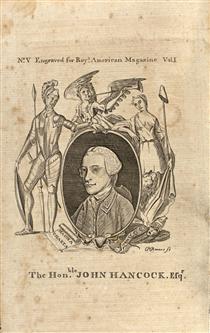
As I wrote yesterday, in June 1774 the Massachusetts General Court put James Bowdoin (shown here, as a younger man) atop its list of delegates to the First Continental Congress.

Two months later, however, Bowdoin declined the position. According to the 15 Aug 1774 Boston Gazette:
Some Days before the Departures of the Committee for the Congress, Mr. BOWDOIN sent them a Letter acquainting them, That he had had Hopes of proceeding with them to the Congress, but Mrs. BOWDOIN’s ill State of Health, occasioned by a long continued Slow Fever, necessitated him to lay aside all Thoughts of it.
Curiously, the same day’s Boston Evening-Post replaced the words “Mrs. BOWDOIN’s” with “his,” thus reporting that Bowdoin himself was sick. The Boston Post-Boy and later Massachusetts newspapers read the same as the Boston Gazette, indicating the Fleets’ paper was wrong.

On 10 September, Bowdoin repeated that explanation to his son-in-law John Temple, writing of “ye. Congress at Phila., to wch. Mrs. Bowdoin’s illness prevented my going.” Months later, he would complain about his own infirmities preventing him from doing all the political work he wanted to handle, but not in 1774.

Decades afterward, John Adams told Timothy Pickering that “Mr Bowdoin was chosen at the head of the Massachusetts delegation to Congress,” but “His relations thought his great fortune ought not to be hazarded.” That’s just the sort of pressure that the older John Adams prided himself on resisting and sometimes projected onto others.

The contemporaneous evidence suggests that, despite typesetting errors and Adams aspersions, Bowdoin really did stay home because of his wife Elizabeth’s sickness. Of course, that sickness could have been brought on by worrying about her husband and the family fortune.

Bowdoin dropping out opened up a slot in the Massachusetts delegation where John Hancock would have fit nicely. He and Bowdoin were both wealthy and respected Boston merchants. By late July, local newspapers reported, Hancock had recovered from a serious illness and was up and about. He would have loved being called to duty as a delegate by popular acclaim even more than being chosen in the first place.

But perhaps Hancock still didn’t feel up to a long journey. Or perhaps his colleagues saw no way to make him an official provincial delegate since Gen. Thomas Gage had dissolved the General Court and there was no substitute legislature yet.

Whatever the exact reasons, Hancock never attended the First Continental Congress. (But in the spring of 1775 he arrived at the Second as a star. Just as he liked.)

Tuesday, August 06, 2024

Hancock and the First Continental Congress

Sometime in early June 1774, as I discussed yesterday, John Hancock became sick.

That month he was not in evidence at Salem during the sitting of the Massachusetts General Court.

The main business of that legislative session, as I recounted in June, was to choose delegates to the new Continental Congress in Philadelphia.

Hancock’s absence, and the fact that his colleagues understood him to be seriously ill, help to explain why he wasn’t selected as one of Massachusetts’s delegates.

Later in his career, Hancock gained a reputation for claiming illness when he faced a political task he’d rather not tackle.
  • He was too ill to remain as governor when the post-war debt crisis was hitting western Massachusetts farmers (but happily returned to that office after the Shays Rebellion was over).
  • He was too ill to attend most of Massachusetts’s convention on ratifying the U.S. Constitution (until he could enter with a crucial speech supporting the document with changes).
  • He was too ill to wait on President George Washington in Boston (though eventually he was dramatically carried into that meeting).
But this 1774 illness doesn’t look like one of those moments. Representing beleaguered Massachusetts in front of the continent’s leading gentlemen, amassing political capital without tough decisions—that sort of politics Hancock loved. It would have been out of character for him to duck going to Philadelphia.

But with Hancock home sick, the General Court chose a delegation of “the Hon. James Bowdoin, Esq; the Hon. Thomas Cushing, Esq; Mr. Samuel Adams, John Adams, Esq; and Robert Treat Paine, Esq”.

Of that group, Bowdoin and Cushing had the same profile as Hancock: wealthy, educated, well-mannered Boston merchants who were spending most of their time on politics. Those two men were older and higher-ranking in government, however. So it’s conceivable that Hancock would have been left off this list anyway, in favor of men with more seniority.

But then Bowdoin decided he couldn’t go.

TOMORROW: An opening? 

Monday, August 05, 2024

“John Hancock, Esq; lay past all hopes of recovery”

By 1774, John Hancock was a well known Massachusetts Whig.

Newspapers in other colonies reported on him, though not always correctly. This item appeared in the Norwich Packet on 2 June:
By a Gentleman that arrived here Yesterday, from New-York, we are informed, that a Vessel from London had brought Intelligence, that…General [Thomas] Gage is ordered to send the Honourable John Hancock, of Boston, to England in Irons.
That peril wasn’t why Hancock didn’t attend the Salem session of the Massachusetts General Court, though. Instead, he became seriously ill.

The earliest public mention of this illness that I’ve found appeared in Rivington’s New-York Gazetteer. The issue was dated 22 June, but this item was dated 23 June, suggesting the newspaper may have been printed late: “By accounts from Boston we are told, that John Hancock, Esq; is in a very bad state of health…”

Things escalated quickly. John Holt’s New-York Journal stated on 7 July: “We have the melancholy news from Boston, that the Hon. John Hancock, Esq; lay past all hopes of recovery.”

And William Goddard’s Maryland Journal, 16 July:
The last Boston Mail brings us the melancholy News that the Honourable JOHN HANCOCK, Esq; that distinguished Patriot and amiable Gentleman, who has been long indisposed, lay, to the inexpressible Grief of his affectionate Countrymen, past all Hopes of Recovery.
However, by then Bostonians could read good news in Isaiah Thomas’s 15 July Massachusetts Spy (delayed one day from its usual Thursday publication, probably because that had been proclaimed a “day of fasting and prayer”):
It is with pleasure we can inform the public that the Hon. John Hancock, has so far recovered his health as to be able to take an airing in his chariot.
The following Monday, 18 July, Edes and Gill’s Boston Gazette shared inside information on Hancock’s health:
It is with the greatest Pleasure, we can inform tha Publick, that the Hon. JOHN HANCOCK, Esq; has so far recovered his Health, as to be able to walk abroad; and in the Course of the past Week, has twice honored this Office with his presence. He likewise attended divine Service Yesterday.
Boston Post-Boy printers Mills and Hicks backed the Crown government, but even they shared that day’s news, albeit with less enthusiasm: “The Hon. John Hancock, Esq; is so far recovered from his long Indisposition, as that he Yesterday attended Divine Service.”

The update reached Rivington’s New-York Gazetteer on 21 July: “We hear from Boston, that the Hon. John Hancock, Esq; is now perfectly recovered; and is engaged in returning visits received from his numerous acquaintance during his late illness.”

Finally, on 18 August the Massachusetts Spy reported on a dinner in Roxbury celebrating the first public protest against the Stamp Act in 1765. It quoted several toasts, and the eighth was: “Recovered and confirmed Health to that worthy Patriot the Honourable John Hancock, Esq.” No other local was called out by name.

TOMORROW: The consequence of that illness.

Sunday, August 04, 2024

John Hancock’s Busy Spring and Silent Summer

On 5 Mar 1774, Bostonians applauded John Hancock as he delivered that year’s oration commemorating the Boston Massacre.

The next week, he led the Company of Cadets as an honor guard in the funeral procession of Lt. Gov. Andrew Oliver.

Later that month, the town reelected Hancock as a selectman, and another town meeting in May sent him to the Massachusetts General Court once more.

On 17 May, Hancock was once again at the head of the Cadets, welcoming the new governor, Gen. Thomas Gage. As with the Oliver funeral, not all of Hancock’s political allies liked that, but he insisted he was obliged to respect royal offices even if he opposed the men who held them.

Hancock was present when the legislature convened in Boston on 25 May. The next day, he was named to a committee to consider Gov. Gage’s speech stating he would move the General Court to Salem.

But Hancock doesn’t appear to have gone to Salem himself. His name is nowhere in the assembly’s official record of that short session, and usually he was quite active on committees and in carrying news from the house to the Council and governor.

Furthermore, Hancock also didn’t attend meetings of the Boston selectmen between 9 March, right after his oration, through 8 September. In that period town clerk William Cooper usually recorded which selectmen were at each meeting.

The one possible exception was on 20 July, when Cooper’s notes say all seven selectmen had a special session on Deer Island. But those notes are strange, recording that the board approved paying certain men but leaving blanks for how much. So it’s conceivable that page isn’t accurate.

On 12 August, the Boston selectmen received “a Billet” from the governor, summoning them to the Province House the next day. Gen. Gage entered and, “without any ceremony of any kind,” told the men he’d just received the Massachusetts Government Act and Boston would need his approval before convening another town meeting.

The selectmen answered that “we had no need of calling a Town Meeting for we had two now alive by Adjournment, one of them to be some time this month, the other to be held in October.” This response made Gage look “serious” and say “he must think upon that.” The governor spoke, according to Cooper’s notes, “with some degree of temper.”

Hancock was the only selectmen not present for that important conversation.

TOMORROW: Where was John Hancock in the summer of 1774?

Saturday, August 03, 2024

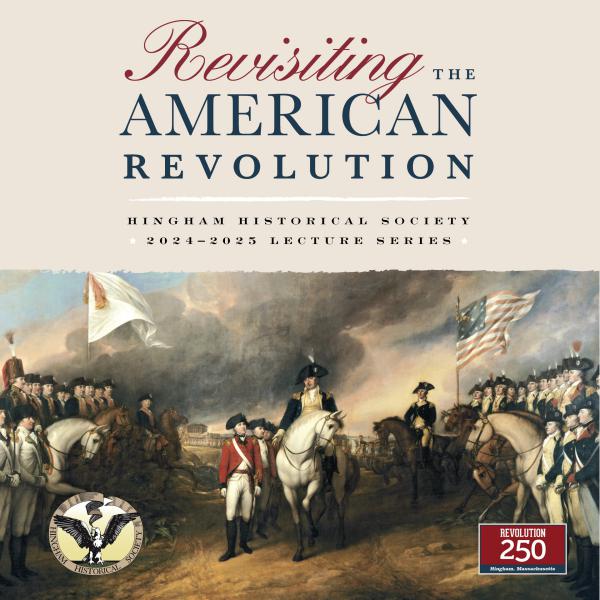
“Revisiting the American Revolution” Lecture Series in Hingham

The Hingham Historical Society is hosting a series of seven lectures from September through April 2025 on the theme of “Revisiting the American Revolution.”

I’m honored to be one of those speakers, and a bit humbled to see the others in the lineup.

15 September
1774: The Long Year of Revolution
Mary Beth Norton

Norton is the Mary Donlon Alger Professor of American History Emerita at Cornell University, where she taught from 1971 to 2018. She has written seven books about early American history, including Liberty’s Daughters: The Revolutionary Experience of American Women, 1750-1800 and In the Devil’s Snare: The Salem Witchcraft Crisis of 1692. She was a coauthor of A People and A Nation, one of the leading U.S. history textbooks. Her most recent work, the basis for this talk, won the 2021 George Washington Prize.

27 October
Making Thirteen Clocks Strike as One: Race, Fear, and the American Founding
Robert Parkinson

Parkinson is Professor of History at Binghamton University. He is the author of The Common Cause: Creating Race and Nation in the American Revolution, and most recently, Heart of American Darkness: Bewilderment and Horror on the Early Frontier.

17 November
The Spies in Henry Barnes’s House
J.L. Bell

Bell is the author of The Road to Concord: How Four Stolen Cannon Ignited the Revolutionary War, a National Park Service report on Gen. George Washington in Cambridge, and numerous articles. He maintains the Boston 1775 website, offering daily postings of history, analysis, and unabashed gossip about the American Revolution in New England.

8 December
From Hingham to Yorktown: The Military Campaigns of General Benjamin Lincoln
Robert Allison

Allison is a professor of history at Suffolk University. His books include a biography of American naval hero Stephen Decatur, and short books on the history of Boston and the American Revolution, and an edition of The Interesting Narrative of Olaudah Equiano, or Gustavus Vassa, the African. Two of his classes, “Before 1776: Life in Colonial America,” and “The Age of Benjamin Franklin” are available from The Great Courses. As chair of Revolution 250, a consortium of organizations planning Revolutionary commemorations in Massachusetts, he hosts its weekly podcast, and he is president of the Colonial Society of Massachusetts.

26 January 2025
Hingham’s Revolutionary Canteens
Joel Bohy

Bohy is the director of Historic Arms & Militaria at Bruneau and Co. Auctioneers and a frequent appraiser of Arms & Militaria on the PBS series Antiques Roadshow. His is also an active member of several societies of collectors and historians, an instructor for Advanced Metal Detecting for the Archeologist, and an advisory board member of American Veterans Archaeological Recovery. Growing up in Concord, Massachusetts, helped lead to Bohy’s passion for historic arms & militaria, conflict archaeology, and artifacts like Hingham’s historic Revolutionary War canteens.

9 March
How to Radicalize a Moderate: John Hancock and the Outbreak of the Revolutionary War
Brooke Barbier

Barbier is a public historian with a Ph.D. in American History from Boston College. She is the author of King Hancock: The Radical Influence of a Moderate Founding Father and Boston in the American Revolution: A Town Versus an Empire. Because she believes beer makes history even better, she founded Ye Olde Tavern Tours in 2013, a popular guided outing along Boston’s renowned Freedom Trail.

6 April
The Declaration of Independence: A Guide for Our Times
Danielle Allen

Allen is James Bryant Conant University Professor at Harvard University and Director of the Allen Lab for Democracy Renovation at Harvard Kennedy School’s Ash Center for Democratic Governance and Innovation. She is a professor of political philosophy, ethics, and public policy. She is also a seasoned nonprofit leader, democracy advocate, tech ethicist, distinguished author, and mom. Her many books include the widely acclaimed Our Declaration: A Reading of the Declaration of Independence in Defense of Equality, and she writes a column on constitutional democracy for the Washington Post.

All these talks will take place live beginning at 3:00 P.M. on a Saturday at the Hingham Heritage Museum, and also be streamed online. The society is now selling subscriptions to the entire series for prices ranging from $175 for someone who’s already a member to $675 for someone who wants to become a society Steward. The subscription price for non-members is $200, or about $29 apiece.

Friday, August 02, 2024

“Redcoats & Rebels” in Sturbridge, 3–4 Aug.

New England’s largest Revolutionary War reenactment will take place this weekend, 3-4 August, at Old Sturbridge Village.

“Redcoats & Rebels” has been an annual event for many years now, attracting large crowds of participants and spectators. The museum village therefore asks people to obtain tickets before showing up. (Members can reserve their slots.)

The event promises:
hundreds of costumed Revolutionary War reenactors, both soldiers and civilians, encamped on the Village Common.

Visitors can explore our exhibits and galleries, watch demonstrations, and talk with our costumed historians about everyday life in early New England. In addition, visitors can tour the camps, witness recreated skirmishes and battles, see special presentations, chat with guest craftspeople, and enjoy fife and drum music.
The Village will open to visitors from 9:30 A.M. to 5:00 P.M. each day, and visitors can “mingle with the troops” until 8:00 P.M. on Saturday.

For a little more information, including the food available on the weekend, go to this page.

Thursday, August 01, 2024

“The Majority were four to One against them”

On 28 June 1774, the Boston town meeting witnessed “long Debates” about the committee of correspondence’s call for a non-consumption agreement, according to town clerk William Cooper’s record.

In his diary the merchant John Rowe confirmed, “The Debates very warm on both sides.” Unlike the previous day, alas, he didn’t record any of the speakers.

But the group urging a repudiation of the committee consisted mainly of major merchants, some with positions within the royal government. They worried that this boycott, on top of the Boston Port Bill, would doom the town’s economy.

The leaders of the Whigs, in reply, argued that standing up to Parliament’s Coercive Acts by not buying any more from Britain was their best way to force the repeal of those laws.

Eventually the meeting held a vote on the merchants’ motion to censure. Cooper recorded that “a great Majority” voted against repudiating the committee.

Rowe expressed disappointment, at least in his diary:
the Committee are wrong in the matter. The Merchants have taken up against them, they have in my Opinion exceeded their Power & the Motion was Put that they should be dismissed. the Gentlemen that made & supported this Motion could not Obtain their Vote, the Majority were four to One against them.

this affair will cause much evil one against the other. I wish for Peace in this Town I fear the Consequences.
The Whigs then sought to affirm the town’s support for the committee by offering their own motion:
That the Town bear open Testimony that they are abundantly satisfied of the upright Intentions, and much approve the honest Zeal of the Comittee of Correspondence & desire that they would persevere with their usual Activity & Firmness, continuing stedfast in the Way of well Doing
A “Vast” majority approved that.

After that, Samuel Adams returned to the chair, the committee on employing the poor said they were once again not ready to report, and the meeting adjourned until July.

That was the last attempt of the Boston Loyalists and/or merchants to curb the Whigs electorally, and they fell far short. Which wasn’t a surprise. The Whigs won every vote along the way, even on matters like which men would go ask if the gathering could move to the Old South Meeting-House.

The Boston town meeting would remain stalwart and implacably opposed to the royal administration until the war began.

COMING UP: Protests against the protest.

Wednesday, July 31, 2024

“On the Conduct of the Comittee of Correspondence”

When John Andrews complained to his out-of-town relative about the Solemn League and Covenant, he didn’t know what he was talking about. And that was part of his complaint.

The Boston committee of correspondence sent its draft non-consumption agreement to all towns in Massachusetts and to allies outside of the colony on 8 June. But it didn’t make those documents public within Boston.

Andrews later wrote:
it was not known to be in being in this town (but by the few who promoted it) till near a month after it had been circulated through the country: in which time it went through whole towns with the greatest avidity, every adult of both sexes putting their names to it, saving a very few.

It was sent out in printed copies by the Clerk to the Committee. W[illiam]. Cooper, who accompanied it with a letter intimating that the measure was in general adopted here, whereas upon enquiry I can’t find that a single person in the town has signed it—and the only excuse they now make for so absurd a piece of conduct is, that it originated altogether from the country, without any of their advice or interposition; thinking so palpable a falsehood will remove the just prejudices of the more rational and judicious people among us.
By the time Andrews composed that letter, Boston’s Loyalist-leaning newspapers had published the text of the Solemn League and Covenant. But, as I concluded back here, that 23 June publication reflected the Worcester version. The Boston committee would thus have been accurate to say “it originated…from the country.”

“Altogether” would have been misleading to say since most of the Worcester text echoed Boston’s. But I rather suspect that Andrews inserted that adverb. He tended to exaggerate details, such as that it took “near a month” for the non-consumption agreement to appear in Boston rather than fifteen days.

Still, Andrews was far from alone in his anger at the committee of correspondence. On 17–18 June, as I recounted back here, Boston had a town meeting to hash out the situation. Voters ended up endorsing the committee, but that was before people had read its work.

A week later, everyone in Boston had been able to see the Solemn League and Covenant (Worcester edition) and the letter Cooper had sent. The Loyalists and merchants demanded another session of the ongoing town meeting on the morning of Monday, 27 June.

As described back here, that meeting brought in so many people it moved to Old South.

The complaints led to a motion “that some Censure be now passed By the Town on the Conduct of the Comittee of Correspondence; and that said Committee be annihilated.” Some leading politicians and traders spoke for and against that proposal.

In fact, the discussion went on for so long that the day grew “dark” (in late June!). And still the proponents of the motion said “they had farther to offer.” Cooper as town clerk put on record that those men had been “patiently heard.” The meeting voted to adjourn for the day and pick up their discussion on Tuesday at 10:00 A.M.

TOMORROW: The final vote.

Tuesday, July 30, 2024

“Not a topsail vessel to be seen”

Dissecting the multiple texts of the Solemn League and Covenant boycott and following the Rev. Ebenezer Parkman’s uncomfortable wriggling around that issue in Westboro pulled me past the debate over that document in Boston.

So I’m going back to mid-June 1774. Many of Boston’s merchants thought the top priority should be finding a way to lift the Port Bill, even if that meant (as George Erving and John Amory proposed) raising money privately to pay the cost of the tea destroyed in December.

The town’s political leaders, on the other hand, felt that standing up to Parliament’s oppressive laws was more important than regaining some expedient advantages in business.

The merchant John Andrews, who normally supported the Whigs (albeit at an ironic distance), joined their opponents on this issue. He saw the town’s economic situation as dire, as he wrote in a 12 June letter to a relative in Philadelphia:
Our wharfs are intirely deserted; not a topsail vessel to be seen either there or in the harbour, save the ships of war and transport, the latter of which land their passengers in this town tomorrow.

Four regiments are already arriv’d, and four more are expected. How they are to be disposed of, can’t say. Its gave out, that if ye. General Court don’t provide barracks for ’em, they are to be quarter’d on ye. inhabitants in ye. fall: if so, am determin’d not to stay in it.
Only five days after Andrews wrote, Gen. Thomas Gage dissolved the Massachusetts General Court, as recounted here. That legislature never had a chance to provide quarters for the troops in Boston—or to refuse to.

Nonetheless, those soldiers were never housed in private homes, nor did Gage invoke the revised Quartering Act to put them into “uninhabited buildings” and taverns. Instead, the royal government built barracks and rented buildings from willing landlords, including warehouses empty because of the lack of trade.

Andrews still thought royal officials were being too strict:
The executors of the [Boston Port] Act seem to strain points beyond what was ever intended, for they make all ye. vessels, both with grain and wood, entirely unload at Marblehead before they’ll permit ’em to come in here, which conduct, in regard to ye. article of wood has already greatly enhanced the price, and the masters say they won’t come at all, if they are to be always put to such trouble, as they are oblig’d to hire another vessel to unload into, and then to return it back again, as they have no wharves to admit of their landing it on.

Nor will they suffer any article of merchandize to be brought or carry’d over Charles river ferry, that we are oblig’d to pay for 28 miles land carriage to get our goods from Marblehead or Salem. Could fill up a number of sheets to enumerate all our difficulties.
Nonetheless, at this time Andrews saved his worst criticism for Boston’s zealous Whigs, “those who have govern’d the town for years past and were in a great measure the authors of all our evils, by their injudicious conduct.” Now those men were supposedly threatening to finish off the town’s trade with the Solemn League and Covenant.

TOMORROW: Back to town meeting.

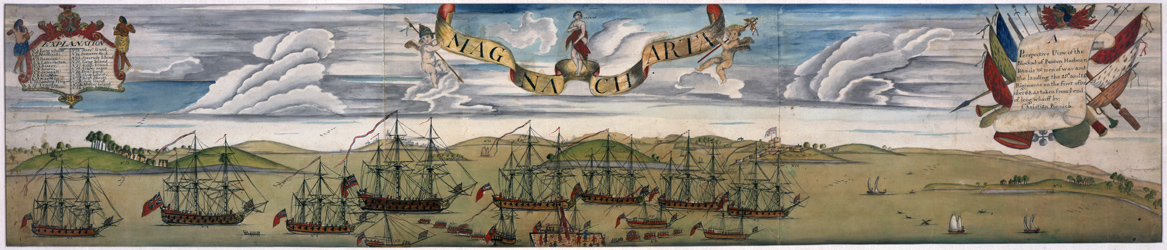
(The picture above, courtesy of the Massachusetts Historical Society, is one version of Christian Remick’s painting of the Crown fleet in Boston harbor as seen from Long Wharf in 1768.)

Monday, July 29, 2024

“Instead of the Agreement which the people have signed”

By the first week of July 1774, people in Westboro had started to sign the Solemn League and Covenant, promising not only not to buy goods from Britain but not to do business with anyone who did.

The town’s minister, the Rev. Ebenezer Parkman, had shown that he didn’t think that was a good idea. He wasn’t coming out and condemning this latest boycott, either, though. He just wanted to avoid controversy.

Supporters of the non-consumption movement kept up pressure on Parkman, presumably because if he came out on their side it would be even easier to sign up everyone else in town. Members of Westboro’s committee of correspondence visited Parkman again on 7 July, as he recorded in his diary:
Messrs. Daniel Hardy, Edwards Whipple etc. here. The former is disturbed that I would not so much as read, at the late Town-Meeting, what their Committee had prepared to be signed. I gave him some Reason for my refusing: namely that I was aware that if I heard it, I must either approve or condemn it — but do which I will, I must of necessity be blamed.

If I approved of their Draught, I must have exposed my Self to the resentments of Authority which I must teach all Men to avoid: for I must teach and injoin that “every soul be subject to the higher powers” — “to obey Magistrates” — as Rom. 13.1 and Tit. 3.1. If I Should dislike it, I was aware that they would not be easily turned aside notwithstanding from what they had done. I was not o’ mind to render my Self Obnoxious either way.
Soon Parkman received word from his son that “at Boston and other Towns, they did not conform to the Governors late proclamation etc.” Gov. Thomas Gage’s threats were having little effect.

Rather than openly oppose the boycott, some people suggested that communities shouldn’t commit to any action until they heard what the upcoming Continental Congress recommended. But that body wouldn’t meet for another two months. Some towns instead added clauses to their Solemn League and Covenant votes saying that they could revisit the details based on that congress’s resolves.

Parkman continued to try his own delaying tactics on 18 July:
The Town Met again on the Article of Signing the Engagement to break off the Commercial Dealings with Great Britain. They Send their Committee to Me to let me see what they have drawn up; and if I pleased in Order to my Signing it. I sent my Regards to the Town, with my Request, that it might be suffered in my Hands a little while for my Review, and I will make them Some Return before or at their next Meeting.
Nine days later, Dr. James Hawes of the town committee and his wife visited the minister in the afternoon. Avoiding another political sore spot, Parkman offered chocolate instead of tea. Hawes left a copy of Westboro’s agreement.

The next day, Parkman wrote:
Transcribed the Towns Agreement for my own use. I cannot, as it is, like it: It is ill draughted.
Ah, there was the problem! The prose. (Not.)

On 1 August, the minister once again recorded a gathering “on the Affair of Subscribing the Agreement” that didn’t make it onto the official record of town meetings. His own son Breck “found it necessary to subscribe,” he wrote.

By this point Parkman had come up with his own form of the pledge (which I don’t think survives). But the men of Westboro no longer cared about what their minister thought. “I went to the Meeting House with a paper fit to be subscribed and read it to a Number of persons,” he wrote; “but the Town were busy and did not call for it.”

At that same meeting, Westboro agreed to help pay for the Massachusetts delegates’ expenses going to Philadelphia; that money was being collected outside the province’s regular taxation process to avoid the governor’s veto. Ministers were usually exempt from taxation, but Parkman wrote: “I sent my Quota thereto.” He was willing to avoid this extralegal equivalent of tax to avoid controversy. (This was also the day Calvin Piper got badly hurt falling from a horse.)

Finally Parkman recognized he wouldn’t convince anyone but himself about the boycott. On 4 August he wrote:
N.B. Instead of the Agreement which the people have signed, I have drawn up what I think may be more Safe for me, if I shall be obliged to Sign any thing.
The town had yet another unrecorded meeting “upon some of their Liberty Affairs” on 8 August. Four days later, Parkman stated that he had received an issue of the Boston Gazette with news of the Massachusetts Government Act.

For years the province’s Whigs had been warning people that there was a conspiracy to take away people’s legal rights. This new law curbed town meetings, eliminated the elected Council, increased the royal governor’s appointive powers, and limited jury pools. The radicals’ dire warnings, which moderates like Parkman had thought overblown, appeared to be coming true. In his diary he wrote: “May God Sanctifie to us this heavy stroke! and help us rightly to improve such privilege and Libertys as remain!”

Sunday, July 28, 2024

“I prayed they would not be hasty in signing”

Gen. Thomas Gage’s 30 June 1774 proclamation against the Solemn League and Covenant boycott reached the town of Westboro on 2 July.

The Rev. Ebenezer Parkman wrote in his diary: “N.B. Governor Gage has issued out a Proclamation against Combinations—Assemblys for signing a solemn League and Covenant etc.”

By that point, the townspeople had been debating the call for a strict non-consumption pact for two weeks. They were looking at both the Boston and Worcester versions. Their new committee of correspondence had already spoken with Parkman, as well as hearing from the Rev. Nathan Stone of Southboro.

So what effect did the governor’s royal proclamation have? It certainly slowed down one important person in town, but he was already leery of anything that might be controversial. That person was the Rev. Mr. Parkman himself.

On 4 July he wrote about a meeting never entered into the official town record:
Town Meet on the Affair of signing some Draught, for the public Relief. Old Mr. Whitney and Capt. Jonas Brigham are sent to me to desire me to go and assist ‘em, by prayer and advice. Went and prayed.

After prayer the Moderator (Mr. Daniel Forbes) requested me to communicate to them my Thoughts, if I had prepared something etc. I told him I had made no formal Draught: but read the Introduction and some other parts of my Remarks on the Covenant from Boston. Also what I wrote at Bottom of the Letter signed William Cooper.

Sundry persons urged my tarrying and advising them with respect to what their own Committee had drawn up, but I answered that I did not care to meddle with it; for I conceived it was not safe for me to do it, Safe either for me or for them, especially by reason of the Governors Proclamation. I craved the Liberty to retire; not but that I was heartily ready and willing to improve my small Abilitys to my utmost in their service.

It was asked me whether I would read their paper if it were Sent Me. I did not refuse to do that in [onelay?] for them and I said I had no desire or Intention to offend any one of them all, not the least; but intreated, and challenged the Liberty of Briton and a New Englandman: and I prayed they would not be hasty in signing every thing; I could not advise to signing any Thing Seeing there was no immediate Necessity; Boston itself had not and their meeting was adjourned to the 19th.

I conceived they would know better how to conduct if they waited a while, and had better perhaps till after the proposed Congress. I observed that there was not such an Alternative as was mentioned in the Covenant, viz. of Suffering Blood-shed or slavery, unless we would withdraw Commerce with Great Britain; for by the News from Newport it appeared that their Messengers to the Congress would propose a general Address and Supplication to the King from all the Colonys jointly.

Before I retired I openly declared, for the Ease and satisfaction of all their minds, that I had signed no paper of Address or Recommendation of the late Governor and that I could not but take it ill that numbers of persons had been ready to take up a Reproach against their Neighbour.

When I retired, they, as I understood went on to ripen for signing, and that many did sign.
Despite Parkman’s clear reluctance, men at that (unofficial) gathering joined the boycott. Two days later, the minister continued to fret: “all Conversations are upon the Governors Proclamation prohibiting Combinations and Covenants against Great Britain.” But, like Gage, he had lost his sway over his parishioners. Now he was trying to preserve his standing.

TOMORROW: Holding out to the last.

(The picture above shows the Jonah Warren House in Westboro, the oldest part estimated to have been built in the 1720s.)

Saturday, July 27, 2024

“An unwarrantable, hostile, and traiterous Combination”

As I’ve been recounting, in June 1774 leaders of the Massachusetts General Court were maneuvering to send delegates to the Continental Congress before Gov. Thomas Gage could learn of their plan and dissolve the assembly.

The Boston town meeting was working through a dispute with a group of influential citizens, mostly merchants, who thought its committee of correspondence was out of control.

That committee had promoted a sweeping boycott of British goods and any shopkeepers who continued to sell such goods, which it called a Solemn League and Covenant. The Worcester committee of correspondence sent out a revised proposal that got more traction in the countryside.

Then Gov. Gage weighed in. On 29 June, from his office in Salem, he issued “A PROCLAMATION For discouraging certain illegal Combinations”:
Whereas certain Persons, calling themselves a Committee of Correspondence for the Town of Boston, have lately presumed to make, or cause to be made, a certain unlawful Instrument, purporting to be A Solemn League and Covenant, intended to be signed by the Inhabitants of this Province; whereby they are most solemnly to covenant and engage, to suspend all commercial Intercourse with the Island of Great Britain, until certain Acts of the British Parliament shall be repealed:

And whereas printed Copies of the said unlawful Instrument have been transmitted, by the aforesaid Committee of Correspondence, so called, to the several Towns in this Province, accompanied with a scandalous, traiterous, and seditious Letter, calculated to inflame the Minds of the People, to disturb them with ill-grounded Fears and Jealousies, and to excite them to enter into an unwarrantable, hostile, and traiterous Combination, to distress the British Nation by interrupting, obstructing, and destroying her Trade with the Colonies, contrary to their Allegiance due to the King; and to the Form and Effect of divers Statutes made for securing, encouraging, protecting, and regulating the said Trade; and destructive of the lawful Authority of the British Parliament, and of the Peace, good Order, and Safety of the Community:

And whereas the Inhabitants of this Province, not duly considering the high Criminality, and dangerous Consequences to themselves of such alarming and unprecedented Combinations, may incautiously be tempted to join in the aforesaid unlawful League and Covenant, and thereby expose themselves to the fatal Consequences of being considered as the declared and open enemies of the King, Parliament, and Kingdom of Great Britain:—

In observance therefore of my duty to the King; in Tenderness to the Inhabitants of this Province; and to the End that none who may hereafter engage in such dangerous Combinations, may plead, in Excuse of their Conduct, that they were ignorant of the Crime in which they were involving themselves; I have thought fit to issue this Proclamation, hereby earnestly cautioning all Persons whatsoever within this Province against signing the aforesaid, or a similar Covenant, or in any Manner entering into, or being concerned in such unlawful, hostile, and traitorous Combinations, as they would avoid the Pains and Penalties due to such aggravated and dangerous Offences.

And I do hereby strictly enjoin and command all Magistrates and other Officers, within the several Counties in this Province, that they take effectual Care to apprehend and secure for Trial, all and every Person who may hereafter presume to publish, or offer to others to be signed, or shall themselves sign the aforesaid, or a similar Covenant, or be in any wise aiding, abetting, advising, or assisting therein.

And the respective Sheriffs of the several Counties within this Province are hereby required to cause this Proclamation forthwith to be posted up, in some public Place, in each Town, within their respective Districts.
Boycotts had been a non-violent way for Americans to show their displeasure with Parliament since the Stamp Act. I’m not convinced “non-importation” had much real effect on British government policy—a new set of ministers with new ideas about the easiest way to raise revenue seems to have been a bigger factor in the repeal of the Stamp Tax and most of the Townshend duties. But colonists certainly viewed those consumer actions as useful.

Now Gen. Gage was declaring such campaigns illegal. He cited imperial trade policy but no Massachusetts law. One could make the argument that because official town committees were organizing this boycott, it had become a legitimate target for the governor’s action.

But Gage wasn’t just telling local officials to stay in their lanes. He was threatening to prosecute anyone who signed the covenant, suggesting they were “enemies of the King, Parliament, and Kingdom of Great Britain.” The general was literally trying to dictate people’s choices about where to shop and what to shop for.

TOMORROW: What effect did that have?

Friday, July 26, 2024

“They came to hear my Sentiments of the Covenant”

The town of Westboro provides a good look at how one rural community responded to the invitations from Boston and Worcester to join the Solemn League and Covenant boycott in the summer of 1774.

The Boston committee of correspondence sent out its call on 8 June. Five days later, the Rev. Ebenezer Parkman (shown here) wrote in his diary:
Town Meeting to consider a Letter from the Town Clerk of Boston and there is come also a printed Covenant for them to Sign, in which they are to join with Others, and Solemnly bind themselves to renounce all Trade with Great Britain till the Bill for blocking up the Harbour of Boston Shall be repealed.

N.B. Little is said about supplicating the Throne of Grace on this Great Occasion. But they Chose a Committee to consider what is best to be done, and report to the Town.
The town meeting record for that day shows that Westboro set up a committee of correspondence. Legally, the warrant for that meeting didn’t mention the proposed non-consumption agreement, only Boston’s 12 May plea for support. But Parkman’s diary shows the Solemn League and Covenant was part of the discussion.

It’s notable that most of that 13 June meeting addressed military preparation, approving the purchase of a “4 Pounder and 4 Hundred Wt of Ball,” a carriage for that artillery piece, and gunpowder, and generally getting ready for “an allarum.” In “this dark and distressing Time of Perplexity,” the town majority already saw armed defense as worth spending money on.

Westboro didn’t record another town meeting until October, when men chose representatives to the Massachusetts Provincial Congress. But Parkman’s diary shows how his parishioners continued to discuss the non-consumption agreement—two committee members visited him the next day. 

On 17 June, the minister wrote that six of the town’s committee came to him:
They came to hear my Sentiments of the Covenant which they had received from Boston and another from Worcester, which I, in part gave them. It was Said from among the Committee that they Should be glad I would be at the Town meeting, when they were to report.
Parkman then stated—and underscored—that on the afternoon of 20 June “The Town Meet on the Affair of Signing a Covenant of Non-importation etc.” That gathering didn’t make it into the official record. Perhaps it was deemed a committee meeting, or perhaps conversations without votes weren’t thought to need an official record.

Jonathan Bond, the first man designated for the town’s committee of correspondence, visited Parkman on 27 June:
Deacon Bond came and delivered me 4 Papers of the public affairs relative to Signing a Covenant etc. I copyed the Covenant with alterations.
Parkman probably diluted the text, given his reluctance for confrontation. The next day, the deacon’s son came by:
Thomas Bond here about the Boston papers, Covenant etc. Read him my Draughts: he Seems to fall in with them. He carrys back those I borrowed.
With Parkman’s blessing Westboro observed a fast on Thursday, 30 June. The Rev. Nathan Stone came from Southborough to preach. Parkman wrote:
Mr. Stone preached a.m. on Deut. 29.24.25. [Even all nations shall say, Wherefore hath the Lord done thus unto this land? what meaneth the heat of this great anger? Then men shall say, Because they have forsaken the covenant of the Lord God of their fathers, which he made with them when he brought them forth out of the land of Egypt]

N.B. At the End of the Sermon he delivered his Mind concerning the Covenant that is going about the Country to be Signed in all places by all persons, on highest Penalty. May God add His Blessing!
Discussions continued on 1 July:
N.B. Mr. Daniel Forbes one of the Committee of Correspondence here. Shewed him my Remarks on the Covenant etc. He desires me to let Dr. [James] Hawes (who is another) See some of my papers concerning those Matters.
But then another voice entered the conversation.

TOMORROW: Here comes the general.

Thursday, July 25, 2024

Sorting Out the Solemn League and Covenants

In his 1915 study of the Solemn League and Covenant for the Colonial Society of Massachusetts, Albert Matthews concluded that the text of that boycott agreement he called Form A was the original text from the Boston committee of correspondence, and Form B the variation from Worcester.

Matthews based that conclusion on several points:
(1) As the form sent out from Boston was frequently, if not generally, regarded as too drastic, it is reasonable to infer that the more drastic of the two forms was the one sent out from Boston, and of the two forms A and B, A is the more drastic.

(2) Every town in Massachusetts received a copy of the Boston form. Westford is in Middlesex County and so presumably would have received only the Boston form. The document [from Westford] exhibited to-day is form A.

(3) Every town in Worcester County received a copy of the Boston form and also a copy of the Worcester form. At the bottom of the broadside (form B) owned by the American Antiquarian Society is written, in the hand of Isaiah Thomas, the words “This came from Sutton.” Since Sutton is in Worcester County, the Sutton document might conceivably be either the Boston form or the Worcester form; but as a matter of fact the Sutton document is form B, and so presumably is the Worcester form.

(4) Five newspapers were published in Boston in 1774, but only two of these printed the Solemn League and Covenant,…and this is form A. It is reasonable to assume that the only form printed in the Boston papers was the form sent out by the Boston Committee of Correspondence.
When I started this series of postings, I thought that was convincing. But as I looked at Matthews’s sources and others, I found myself coming to the opposite conclusion.

Here are some points Matthews missed. First, he assumed that people objected to the Boston committee’s draft as “too drastic,” and indeed the merchants of the town did make that complaint. But in a footnote Matthews acknowledged that organizers in Worcester had circulated “even more drastic” language, so we have to consider the possibility that those men thought the Boston draft wasn’t drastic enough.

Matthews assumed that the Worcester committee sent its draft only to other towns in Worcester County. But he quoted evidence that Braintree considered text “much like the Worcester covenant” on 27 June and Falmouth (now Portland, Maine) had received “the non-importation Agreement form’d at Worcester” by 30 June.

The Boston News-Letter did indeed print Form A, but it prefaced it this way: “The foregoing is a Copy of a Covenant, which I am told great Pains are now taking to promote in the Country.” The newspaper didn’t specify the agreement that followed was the Boston committee’s proposal. Rather, the phrase “in the Country” hinted at a rural origin.

The 22 June Pennsylvania Journal printed Form B below “a Circular Letter, written by the Committee of the Town of BOSTON,” suggesting that printer William Bradford had received them together. The Boston text sent on 8 June most likely reached Bradford days before the Worcester text sent on 13 June. Even if he had both in hand, Bradford clearly cited documents from Boston.

We know that the Boston committee spread its text outside of Massachusetts. Silas Deane wrote a letter responding to a copy in Wethersfield, Connecticut, on 13 June, before he could have received the Worcester committee’s version. That appears to have been Form B. [Deane’s letter casts doubt on that book’s assertion that Wethersfield actually adopted the Solemn League on 15 June; I’ve found no official town action.] Form B was also the basis of the Portsmouth, New Hampshire, variation (Form C).

In contrast, we don’t know that the Worcester committee sent its text outside Massachusetts. Its letter referred to recipients as “fellow-countrymen,” which in this period usually meant people from the same colony.

Finally, here are two facts that Matthews acknowledged but set aside. A copy of Form A at the Massachusetts Historical Society is labeled “Worcester Covenant.” The printer’s type and watermark of that copy match the printed letter issued by Worcester’s committee on 13 June—though Matthews explained that away by saying all these documents must have been printed in Boston since Isaiah Thomas hadn’t yet set up the first press in Worcester.

Looking at all that evidence, I reconstruct the sequence of events this way:
  • late May and early June: The Boston committee of correspondence and Worcester County radicals both drafted calls for a stronger boycott on British goods until the Boston Port Bill was repealed.
  • 8 June: The Boston committee sent out its printed circular letter and suggested Solemn League and Covenant (Form B) to all towns in Massachusetts and to allies in other colonies.
  • by 10 June: After feedback from Worcester, if not other places, the Boston committee sent a second printed circular letter approving other language as long as it led to the same broad boycott.
  • 13 June: The Worcester committee of correspondence wrote a new Solemn League and Covenant (Form A) based mostly on the Boston text but incorporating some of its earlier draft and sent that out with a printed circular letter to all towns in Massachusetts.
  • 20 June: Worcester formally adopted its form of the Solemn League and Covenant.
  • 22 June: The Pennsylvania Journal printed the Boston committee’s draft.
  • 23 June: The Boston News-Letter printed the Worcester committee’s draft, saying it was being promoted “in the Country.”
  • 27 June: Braintree adopted the Solemn League and Covenant in a form “much like the Worcester covenant,” according to the 30 June Massachusetts Spy.
  • before 28 June: The Portsmouth, New Hampshire, committee of correspondence sent out its variation on the Boston draft (Form C).
  • 30 June: Falmouth considered “the non-importation Agreement form’d at Worcester” and decided to ask other towns what they were doing.
  • 4 July: Westford adopted the Solemn League and Covenant with the Worcester text and started gathering signatures.
  • 14 July: Attleboro adopted the Solemn League and Covenant with the Worcester text and started gathering signatures.
In sum, Worcester’s version of the Solemn League and Covenant became the standard text within Massachusetts while Boston’s version spread outside the colony. This was an early example of Worcester’s radicals (who were, of course, not living under military occupation) being more confrontational than the usual troublemakers in Boston.

TOMORROW: One town’s debate.

Wednesday, July 24, 2024

“The enclosed covenant is by no means inconsistent”

Having returned from a busy convention in California, I’m going back to the Solemn League and Covenant of June 1774.

Or, more accurately, the multiple overlapping boycott covenants that appeared in print that month, first in broadsides and then in the 22 June Pennsylvania Journal and the 23 June Boston News-Letter.

Albert Matthews discussed two texts in 1915, calling them Form B and Form A, respectively.

He briefly mentioned a third variation, which I’ll call Form C. This was a revision of Form B created and distributed by the committee of correspondence in Portsmouth, New Hampshire, by the end of June 1774. The Library of Congress displays a copy here.

Another copy of Form C survives in the papers of the Rev. Jeremy Belknap at the Massachusetts Historical Society; he cautioned his parishioners in Dover, New Hampshire, against signing on until they’d heard from what would be the Continental Congress.

According to Frederick Chase’s History of Dartmouth College and the Town of Hanover, the voters of Plainfield, New Hampshire, did adopt the text of Form C on 28 July. Town histories of Mason and Wilton, New Hampshire, show those towns adopted Form C while adding a proviso that signers could vote to revise its terms.

We can thus think of Form C as the New Hampshire variation on a document that originated in Massachusetts. But the big question remains: Which of Form A and Form B was the Boston original?

In early June, as the Boston committee of correspondence finalized its text, Whigs in Worcester County were also thinking about a boycott. In a footnote, Matthews shared evidence that William Henshaw (1735-1820, shown above) of Leicester and Timothy Bigelow (1739–1790) of Worcester privately circulated a draft non-consumption agreement. At the bottom of a copy at the American Antiquarian Society, Henshaw wrote: “It is thought best not to sign any agreement yet, as it is expected we shall have the plan of a General one from Boston very soon.”

We thus know that there was a text in Worcester before the town received the Boston committee’s Solemn League and Covenant broadsides, mailed on 8 June. Furthermore, Matthews deemed that draft text to be “still more drastic” in wording than either Form A or Form B.

On 10 June, as I discussed back here, the Boston committee sent out a second circular letter saying they didn’t mean to suggest that all towns adopt their language. Some organizers must have asked to use other language—but we don’t know if those people wanted the pledge to be more strident or less.

Three days later, Worcester’s committee of correspondence issued its own printed letter, signed by chairman William Young. The state archives shares a copy received by the selectmen in Southboro. The Worcester committee noted how “the committee of Boston in their last letter have informed us that they do not mean to dictate to us,” and concluded “the enclosed covenant is by no means inconsistent with the spirit or intention of the form sent out by them.”

Thus, on 18 June Worcester sent out its own text, different in some respects from Boston’s. A week later, the town formally adopted that language.

But was that Form A or Form B?

TOMORROW: Who’s pushing who?

Tuesday, July 23, 2024

“So they painted the little maid”

The Discover Quincy website now says in its description of the Dorothy Quincy Homestead in Quincy:
The childhood home of Dorothy Quincy, who became Mrs. John Hancock; the second President of the Continental Congress, first signer of the Declaration of Independence and the first Governor of Massachusetts.
There’s no mention of any other Dorothy Quincy.

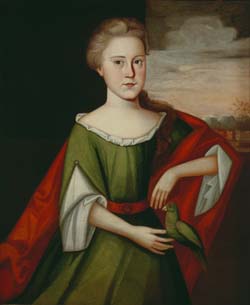
But there was (at least) one, and records are clear that that house was named after an earlier woman named Dorothy Quincy (1709–1762, shown here courtesy of the Massachusetts Historical Society). She was an aunt of the woman who married Hancock.

The earlier Dorothy Quincy married the merchant and mill-owner Edward Jackson. One of their children was the merchant and politician Jonathan Jackson. The other child, a daughter named Mary Jackson, married the Boston merchant and politician Oliver Wendell.

A portrait of young Dorothy (Quincy) Jackson descended in the Wendell family to Dr. Oliver Wendell Holmes, Sr., who became a very popular author. He wrote about the painting and its subject in “Dorothy Q.: A Family Portrait” in 1871. That poem begins:
Grandmother’s mother: her age, I guess,
Thirteen summers, or something less;
Girlish bust, but womanly air;
Smooth, square forehead with uprolled hair;
Lips that lover has never kissed;
Taper fingers and slender wrist;
Hanging sleeves of stiff brocade;
So they painted the little maid.

On her hand a parrot green
Sits unmoving and broods serene.
Hold up the canvas full in view,—
Look! there's a rent the light shines through,
Dark with a century’s fringe of dust,—
That was a Red-Coat’s rapier-thrust!
Such is the tale the lady old,
Dorothy’s daughter’s daughter, told. . . .
This was one of several poems Holmes wrote about the memory of the Revolution and its shadow on his time, such as “The Last Leaf” and “Under the Washington Elm.” He was so good at creating images and phrases that people overlook how he often simultaneously raised questions about those icons.

But Holmes wasn’t correct on the painting’s subject, either. His footnote for this poem said:
Dorothy was the daughter of Judge Edmund Quincy, and the niece of Josiah Quincy, junior, the young patriot and orator who died just before the American Revolution, of which he was one of the most eloquent and effective promoters. . . . The canvas of the painting was so much decayed that it had to be replaced by a new one, in doing which the rapier thrust was of course filled up.
Dorothy (Quincy) Jackson’s father was an Edmund Quincy, but a later Edmund Quincy was the father of the later Dorothy Quincy. That Dorothy Quincy did have an uncle named Josiah Quincy, but a later Josiah Quincy was the Patriot who died in 1775. So the confusion is understandable.

Nonetheless, it’s worth maintaining the knowledge of how the Dorothy Quincy Homestead got its name. It represents a confluence of the Colonial Revival and the Fireside Poets, and it stood for decades of family history. Discover Quincy’s current write-up is all about big names from the Revolutionary years only.

Monday, July 22, 2024

“Over-emphasized the early conflict in the northern colonies”?

Last month Gene Procknow reviewed Alan Pell Crawford’s This Fierce People: The Untold Story of America’s Revolutionary War in the South, just published.

Procknow reports that Crawford
asserts that Revolutionary War historians have over-emphasized the early conflict in the northern colonies, leaving the impression that the conflict was “George Washington’s War.” As evidence, he cites that a more significant percentage of the eight-year war occurred in the southern colonies, while Washington’s army remained relatively inactive in the north.
He praises the book’s focus on particular individuals’ experiences, starting with the Bavarian-French volunteer Baron de Kalb. That allows the book to cover “over one hundred battles” vividly without bogging down in details.

“Storytelling is the veteran journalist and political analyst’s strong suit,” Procknow says of Crawford. “The book is laced with vignettes that engender reader interest and comprehension.”

However, the review also faults Crawford for repeating details from secondary sources not backed up by contemporaneous evidence, citing multiple examples, from Gen. Horatio Gates’s purported nickname to important details of the Battle of Guildford Court House.