J. L. BELL is a Massachusetts writer who specializes in (among other things) the start of the American Revolution in and around Boston. He is particularly interested in the experiences of children in 1765-75. He has published scholarly papers and popular articles for both children and adults. He was consultant for an episode of History Detectives, and contributed to a display at Minute Man National Historic Park.
J. L. Bell will be one of the panelists in the discussion of “A Knock at the Door: Three Centuries of Governmental Search and Seizure” at the Old State House in Boston on 4 November. How does James Otis, Jr.’s argument against the London government’s writs of assistance connect to the Fourth Amendment of the U.S. Constitution, and what is the status of that protection today?
Hear J. L. Bell “Gossiping About the Gores” at Old South Meeting House, archived by the WBGH Forum Network. (And follow along with the handout.) This talk, delivered in January 2009, follows one Boston family from the 1760s through the 1820s. Striving in society, divided by politics, and occasionally star-crossed by love, the Gores provide a lively view of life during the American Revolution.
Hear J. L. Bell discuss John Adams with Mike Pesca, host of N.P.R.’s The Bryant Park Project, in April 2008.
Check out the online exhibit about the 5th of November in Boston that J. L. Bell assembled for the Bostonian Society. People in Britain celebrated that date as Guy Fawkes’ Day, but in Boston it was “Pope-Night”—a literal riot of bigotry, violence, and giant puppets of the Pope!
J. L. Bell’s article “A Bankruptcy in Boston, 1765” appears in the fourth-quarter 2008 issue of Massachusetts Banker. You can download a copy of the entire magazine for free from this page.
J. L. Bell’s article “‘I Never Used to Go Out with a Weapon’: Law Enforcement on the Streets of Prerevolutionary Boston,” about town watchmen, British army officers, and the Boston Massacre, is available in the Dublin Seminar volume Life on the Streets and Commons.
Children in Colonial America, edited by Prof. James Marten and published by N.Y.U. Press, features J. L. Bell’s chapter “From Saucy Boys to Sons of Liberty: Politicizing Youth in Pre-Revolutionary Boston.”

Monday, April 30, 2007

What People Read About the “Liberty Tree Flag”

Last Friday, I posted a baker’s dozen contemporaneous reports on flags at Boston’s Liberty Tree in the 1760s. Two of those quotes turn out to be particularly significant, I think, and I’ll return to them later. But now I’m going to jump ahead to when the Bostonian Society’s “Liberty Tree Flag” is definitely documented.

The red and white banner came to the society in 1893 from John C. Fernald. Earlier in that year he had loaned it to the Columbian Exposition in Chicago, where the official catalogue of items in the U.S. Government Building listed it as:

10. Liberty Tree Flag—
Part of the original flag which waved over the Liberty Tree on Boston Common in 1775. Loaned and collected by John C. Fernald, Boston, Mass.
In the same display were several weapons said to have been carried in the Battle of Bunker Hill and the sword of Col. James Barrett, senior provincial officer during the fight at Concord.

Fernald told the Bostonian Society that he’d purchased the flag from a granddaughter of a wireworker named Samuel Adams, who had died in 1855 at the age of ninety-six. Apparently the statement that it had flown on Liberty Tree had come down through the generations of that family.

How reliable was Fernald’s information? In some ways, it clearly wasn’t. Liberty Tree was never “on Boston Common”—it was at the corner of modern Washington and Boylston Streets. There were thousands of army troops in Boston throughout 1775, making a mass meeting of Sons of Liberty very unlikely in that year. But those details might have been mistaken assumptions about Revolutionary Boston, off by just a few blocks and a few years.

The Chicago catalogue’s statement that the cloth was only “Part of the original flag” implies that Fernald thought the original was larger, probably much larger. Does that support the theory that the banner originally had thirteen stripes? Or is this more likely another mistaken assumption, distorted by hindsight?

Who was Samuel Adams, wireworker? I haven’t unearthed any information about him, but I’ve just started digging. If the information about his death is correct, then he was born in 1759 and still a teenager in 1775, when Liberty Tree was chopped down. That would make him an unlikely guardian of the Patriots’ flag, but perhaps he inherited the cloth from his father or master.

I did find one curious passage in Charles Francis Adams’s 1871 biography of his grandfather, John Adams:
in the town meeting or the body meeting,...all assembled on an equal footing. And Samuel Adams, the journeyman wireworker, living on perhaps fifty cents earned every week-day, was entitled to his say as freely, though he might not be heard so readily, as his namesake whilst engaged in combining the far more important wires of the corresponding committees.
The Samuel Adams who died in 1855 would have been too young to speak in town meetings when the more famous Samuel Adams was managing the town’s Committee of Correspondence. So was this mention of a wireworker with that name just a literary coincidence?

I think that information published in the late 1800s might be very significant to understanding the “Liberty Tree Flag.” Those publications were the lens through which people viewed the past. They determined what people expected in Revolutionary artifacts.

Which brings me to those two particular quotations from Friday. Most came from newspapers. While those newspapers survived in Massachusetts libraries, I don’t think they’d yet been collected in complete runs (much less turned into a digital database). Few, if any, historians had read through all the issues of the late 1760s to find all mentions of Liberty Tree. As for the two quotes from John Rowe’s diary, that document wasn’t published until 1895.

So that leaves two items from my Friday list: the reports to London from Gov. Francis Bernard and the Customs Commissioners, describing “a Flag-Staff, which went through the Tree, and a good deal above the Top of the Tree,” and “a red flag.” Those documents were printed in 1769, having been leaked in London. The resulting pamphlet remained in Boston’s archives, much easier to find and read than the newspapers.

The historian Richard Frothingham drew on that source for his 1865 Life and Times of Joseph Warren. On page 61, he wrote, “A red flag was now hoisted above Liberty Tree,” and, “there was a larger assemblage at Liberty Tree, over which still waved the red flag, than had ever been seen in the town.” Though Frothingham noted Union flags at other Whig demonstrations, that page contains his only description of a flag at Liberty Tree. George H. Preble’s History of the Flag of the United States (1872) offered the same information, probably based on Frothingham.

Thus, the best-informed Americans during the Centennial of 1876 and through 1893 probably all thought that the flag at Liberty Tree was red—not, as in most of the newspaper reports from the 1760s, a British Union flag. Which certainly made it easier to believe that a certain red-and-white, seven-feet-by-thirteen banner was that flag.

Sunday, April 29, 2007

Liberty Tree at the Theater in 1857

Boston 1775 interrupts its meditation on the Liberty Tree Flag for a commercial announcement—well, a commercial for a play that was touring Massachusetts venues like the “Boston Museum” in 1857. Or, in the words of its broadsides, the troupe offered a:

Great Local Patriotic Play of the Revolution, in three acts, called the
LIBERTY
TREE

or the
BOSTON TEA PARTY!
This might have been an update of the 1832 play The Liberty Tree, or Boston Boys of ’76; both contain a Yankee character named “Bill Ball,” originally played by Boston playwright Joseph Stevens Jones (1811-1877). However, that character plays only a small role in the action, according to the broadsides’ summary, so this might be a new play written to capitalize on memories of its predecessor.

The major characters are:
  • among the Americans, “Gordon, a Patriot”; “Nat Hinge, an old Northender”; “Peter Gummery, Gordon’s Negro”; and “McJig, an Irish Serjeant.”
  • among the “English” (as the broadside labels them), “Elton, a Government Officer”; “Colonel Worston”; and “Pilky, a Tory.”
Like a lot of American entertainment before World War 2 (and perhaps afterward), The Liberty Tree seems to depend on ethnic stereotypes. The characterization gets particularly bigoted around the Peter Gummery character, including the racist terms of the time. Yet that same character pops up so often in the summary that many in the audience must have come to see him. That interest in ethnicity dovetails with the post-Revolutionary obsession with explaining how Americans are different from British, directly opposite the message Boston’s Liberty Tree was originally supposed to convey.

But without further ado, here is the “Programme of Scenery and Incidents” for The Liberty Tree:
Part First—Scene 1—Shipyard at North End Discontent of the People. Peter’s opinion of things in general. Nat Hinge and his chest of Tools. A spy well treated. Scene 2--Old Triangular Warehouse in Dock Square. The British Soldiers and the Yankee Printer. The uses and abuses of a Leg Mutton. Loss of Uniforms. The First Retreat. Scene 3—House of Mr. Gordon. Opinion of an American Patriot. “This town, Boston, where the Tree of Liberty flourishes, emblem of its name, shall give the word, at which all shall rise who own the name of Freeman, and pluck the bright jewel America, from the Crown of England.” Scene 4—Interior of Hinge’s House. Cutting the crown off. “Darn these Buttons.”—Scene 5—Elton’s House. The American Patriot and the British Subject. Scene 6—THE LIBERTY TREE! Assembling of the people. The plan and the RESOLVE. Scene 7--GRIFFIN’S WHARF! Resolution of the people. ”The work’s begun, Americans, complete it!!” THE BOSTON TEA PARTY.

Part Second—Scene 1—Apartment at Colonel Worston’s.
British tuition and Yankee politeness. “Where did you come from?” “Concord and Lexington.” The disguise and the ESCAPE. Scene 2—Gordon’s House. The father and his child. Scene 3—Apartment. The American women at work for their patriot husbands and fathers. Gummery’s opinion of matrimony subjects. “The Boston Boys have heard drums and guns too, and are not much scared at either.” PATRIOTIC SONG—Hinge—“Our Country is our Ship.” Scene 5--OLD SOUTH CHURCH, seen from Milk Street. Boston Boys going to work. The ROGUE’S MARCH. The Tory’s Ride. Scene 6--SHIP YARD.—In the distance, Charlestown in Flames. The attack and retreat. The Tory treated to a coat of TAR and FEATHERS.

Part Third—Scene 1—Street in Boston. Peter Gummery and his Irish Friend, McJig. “The greatest Nigger in the World—I’se General Washington’s Nigger.” SONG—Gummery—“Old George and de Boston Tea Party” Scene 2—Colonel Worston’s House. The consultation. Respect your enemies. Scene 3—Room in Hinge’s House. “Bad news! no dinner to-day, the guns have frightened all the fish—true American fish won’t bite while there’s a red coat in town.” “There’s a Yankee wife for somebody.” Scene 4—PILKEY’S HOUSE. Preparations for breakfast. How about that Cow? Pilkey’s illness. The doctor and his prescription. Knowledge of anatomy. Scene 6—DOCK SQUARE. The assault. The rescue. The forced retreat.—Scene 5—Room in GORDON’S HOUSE. GRAND PANORAMA! Entrance of WASHINGTON! HIS STAFF AND AMERICAN ARMY TO THE GOOD OLD TOWN OF BOSTON. Tableau.
And curtain.

Friday, April 27, 2007

Newspapers on the Flag at Liberty Tree

In my last posting, I promised a look at what Boston’s colonial newspapers said about flags at Liberty Tree. This was my contribution to Monday’s discussion of the “Liberty Tree Flag” at the Old State House Museum (though museum director Rainey Tisdale uncovered one of the crucial quotes below).

Boston Evening-Post, 16 Sept 1765:

At the South Part of the Town the Great Trees for which many have so great Veneration, were decorated with the Ensigns of Loyalty, and the Colours embroidered with several Mottos.
Boston Post-Boy, 19 May 1766:
On the Tree of Liberty waves the British Standard
Boston Evening-Post, 26 May 1766:
The Tree decorated with flags and Streamers, and all round the Town, on the Tops of Houses, were displayed Colours and Pendants
Boston Gazette, 23 Mar 1767:
the venerable Elm of Liberty was variegated with a Multitude of Streamers most beautifully disposed among it’s Branches
Merchant John Rowe’s diary, 14 Aug 1767:
This day the Colours were displayed on the Tree of Liberty & ab[out] Sixty People Sons of Liberty met at One of Clock & Drank the Kings Health.
Customs Commissioners’ report to the Treasury in London, 15 June 1768:
a red flag was hoisted yesterday in the afternoon at Liberty Tree, and continued flying this morning, and that about 10 o’clock this morning a great number of people, supposed to be near 2000, met, and after choosing a moderator adjourned to Faneuil Hall ’till 3 o’clock in the afternoon.
Gov. Francis Bernard’s report to the Earl of Hillsborough, Secretary of State, 16 June 1768:
In August last, just before the Commencement of the present Troubles, they erected a Flag-Staff, which went through the Tree, and a good deal above the Top of the Tree. Upon this they hoist a Flag as a Signal for the Sons of Liberty, as they are called. . . .

Upon this Staff the Flag was flying early in the Morning on Tuesday; at the Time appointed there were assembled they say at least 4,000 Men, many having come out of the Country for that Purpose; some of the principal Gentlemen of the town attended in order to engage the lower People to concur in Measures for Peace and Quiet.
These two confidential reports and some others were later leaked back to Boston by people in London sympathetic to the Massachusetts Whigs. (A leak of similar letters from Gov. Thomas Hutchinson and others came through Benjamin Franklin in 1774, derailing both men’s careers.) Boston printers published those documents in a pamphlet and newspapers, convincing many people that the governor and Customs officials were indeed hostile to local liberties and dishonest about their intentions. But I digress.

Boston Post-Boy, 20 June 1768:
Early on Tuesday Morning the Colours were flying on Liberty Tree; and at the Hour appointed, vast Numbers of Inhabitants appeared at and near the Hall; but the Weather being wet and uncomfortable in the Streets, they adjourned to Faneuil-Hall
Boston Evening-Post, 22 Aug 1768:
At the Dawn, the British Flag was displayed on the Tree of Liberty
The Boston Whigs’ ”Journal of the Times” dispatches for newspapers in other towns, 20 Mar 1769:
The British flag was displayed on Liberty Tree, and at noon a number of gentlemen met in the hall under the same, and the greatest order and decorum observed by the company.
John Rowe’s diary again, 1 Aug 1769:
The Flag hoisted on Liberty Tree—the Bells Ringing—Great Joy to the People.
New York Gazette, 7 Aug 1769, probably quoting a newspaper from Boston:
The Union Flagg was displayed from LIBERTY-TREE, where it was kept flying ’till Friday—Colours were also flung out from most of the Vessels in the Harbour—And from the Tops of the Houses in Town.
New York Gazette, 28 Aug 1769, again probably a quoted report:
Monday last being the 14th of August, the Anniversary was celebrated by the Sons of Liberty: In the morning the British flag was displayed on Liberty Tree, under the shade of which at noon the true-born Sons met, and fourteen toasts were drunk
So contemporaneous sources confirm that Whig organizers would fly a flag from the pole near Liberty Tree on celebratory occasions and to summon public meetings. But none of those sources describe a red and white striped flag like the Bostonian Society’s “Liberty Tree Flag.”

Instead, almost every source that describes the flag at or around Liberty Tree says it was a British or Union flag—a symbol of the Empire. The Customs Commissioners wrote of “a red flag” in June 1768, but I wonder if they didn’t mean a “Union Flag with a red field” or red ensign, which other sources confirm was displayed in the colonies before the Revolution. I doubt it was an all-red flag; Boston required such a banner to be flown outside of houses where people had smallpox, so that would hardly be an effective way to summon people.

Flying a symbol of Great Britain from Liberty Tree fits the American Whigs’ political platform through 1775. They weren’t saying, “We’re Americans, and the British are oppressing us”—that message wouldn’t come until the war had started. No, the Whigs were shouting as loud as they could, “We’re British, and a few corrupt politicians in London are oppressing us!” By hoisting the British or Union flag, they proclaimed their loyalty to the king and claimed their rights as British subjects.

COMING UP: What people read about the flag at Liberty Tree in the late 1800s.

Thursday, April 26, 2007

What Could Nine Stripes Mean?

Yesterday I started to write about the Bostonian Society’s “Liberty Tree Flag” and its ongoing efforts to authenticate that banner as one which indeed flew from Boston’s Liberty Tree to signal popular meetings.

That flag has nine vertical stripes, alternating red and white, as shown here. It’s natural to ask, therefore, what those stripes might symbolize. That was the topic of Dr. Whitney Smith’s talk at the Old State House Museum on Monday evening.

But first, some of the earlier explanations proffered for the nine stripes. David Martucci’s essay on American Revolutionary flags quotes one (without, I should say, endorsing it):

According to Standards and Colors of the American Revolution by Edward W. Richardson (University of Pennsylvania Press & the Pennsylvania Society of Sons of the Revolution and its Color Guard, 1982) the nine stripes could correspond to nine segments of the cut up rattlesnake in the cartoon (representing New England, New York, New Jersey, Pennsylvania, Maryland, Virginia, North Carolina, South Carolina and Georgia).
Unfortunately, Benjamin Franklin’s 1754 cartoon calling for colonial unity shows a snake in eight pieces. (He didn’t include Georgia, and treated Delaware as part of Pennsylvania.)

Delegates from nine colonies attended the Stamp Act Congress of October 1765, around the same time that Boston’s Whigs gave Liberty Tree its political name. So could the flag have nine stripes to symbolize those nine colonies? I doubt the Whigs would have done that because some colonies not at the congress had nonetheless opposed the Stamp Act, including close neighbor New Hampshire; Virginia, oldest and largest of Britain’s American colonies; and Nova Scotia. When you see yourself in a titanic struggle for your political liberties, you don’t want to alienate your friends.

Another possible explanation is that the “Liberty Tree Flag” is only part of the original banner. It might have contained more vertical stripes. It might even be just a scrap of a much larger flag with thirteen horizontal stripes, the common arrangement of early national flags. But that would have been a huge, heavy banner, probably impractical for this use. And there doesn’t seem to be any physical or documentary evidence suggesting that this banner was only a minor part of the original.

In his public lecture, Dr. Smith offered an ingenious new theory: the four white stripes and five red stripes represented the number 45. Any American Whig of the 1760s would have immediately recognized that number as a reference to issue No. 45 of John Wilkes’s magazine The North-Briton, which landed him and some of his associates in jail in London for sedition.

American Whigs indeed adopted the number 45 as one of their symbols for resistance to unjust government from London. In 1768, a group of Whig businessmen commissioned Paul Revere to create a punch bowl for them, and among the many political mottoes engraved on it was:
No 45.
Wilkes & Liberty
In fact, the men even seem to have called the whole bowl “Number 45.” Merchant John Rowe wrote in his diary for 1 Aug 1768: “Spent the evening at Mr. Barber’s Insurance Office & the Silver Bowl was this evening for the first time introduced, No. 45. Weighs 45 ounces & holds 45 gills”. (Nathaniel Barber’s name is one of those inscribed on the bowl.) Now dubbed the “Sons of Liberty Bowl,” this artifact is at Boston’s Museum of Fine Arts.

Probably the most memorable American use of the number 45 came two years later in New York, after Alexander McDougall was put in jail for criticizing the royal government in a broadside—a freedom of press issue much like Wilkes’s. Then someone noticed that the proceedings against McDougall fell on page 45 of the legislative record. Coincidence? They thought not. Mary Louise Booth’s 1867 History of the City of New York states:
...on the forty-fifth day of the year,...forty-five of the Liberty Boys went in procession to the New Jail, where they dined with him on forty-five beef-steaks cut from a bullock forty-five months old, and, after drinking forty-five toasts with a number of friends who joined them after dinner, separated, vowing eternal fidelity to the common cause.
On another occasion, McDougall was reportedly visited by forty-five virgins singing him either (according to different sources) forty-five songs or the 45th Psalm. Historians seem to enjoy this episode particularly because it offers the chance to quote an anonymous Tory’s suggestion that all those virgins were forty-five years old.

We can even connect the number 45 to Liberty Tree. On the evening of 19 May 1766, the next issue of the Boston News-Letter reported, there were forty-five lanterns hung on Liberty Tree. However, that same item also indicates that the town’s Whigs were moving on to higher numbers. They thought their tree “would have made a more loyal and striking Appearance if [the number of lanterns] increased to the glorious Majority of 108.” So they loaded up the tree with more than twice as many lanterns the next night. Even Revere’s punch bowl features the number 92 more prominently than Wilkes’s 45.

(What, for goodness’ sake, was the significance of 108 or 92? I’m guessing that the “glorious Majority of 108” referred to the margin of victory when the House of Commons voted 275-167 to repeal the Stamp Act in early 1766. As for 92, after Gov. Francis Bernard insisted the Massachusetts House rescind its vote against the Townshend Act in 1768, ninety-two legislators refused to comply.)

So what do all those numbers mean to the “Liberty Tree Flag”? While American Whigs did adopt the number 45, I’m unaware of any other time they used four and five stripes to symbolize it—that would have required more explanation than, say, embroidering “45” on the cloth. Also, when Whigs celebrated 45, they weren’t shy about proclaiming that symbolism and what it meant in their newspapers.

TOMORROW: What Boston newspapers said about the flag on Liberty Tree.

Wednesday, April 25, 2007

Studying the Old State House's Liberty Tree Flag

Monday evening I attended an event I’d mentioned last week: a lecture at the Bostonian Society’s Old State House Museum about a banner in its collection called the “Liberty Tree Flag.”

Among flag historians and collectors there, I had the pleasure of meeting not only lecturer Whitney Smith, but also Peter Ansoff (after years of exchanging emails) and Ben Zaricor. Historians of Boston in the audience included Alfred F. Young, Marty Blatt of Boston National Historical Park, and Charles Bahne. And representing our host, the Bostonian Society, were executive director Brian LeMay, museum director Rainey Tisdale, public events manager Samantha Nelson, and many other staffers and members.

The Old State House’s “Liberty Tree Flag” isn’t a banner that depicts a Liberty Tree or pine tree, like several examples from the first years of the Revolutionary War. Rather, according to the statements of the woman who donated the flag to the Bostonian Society in the 1890s, this was the flag that Boston’s Sons of Liberty had flown from the pole beside Liberty Tree when they wanted to assemble a crowd for a public meeting.

The flag is made of wool, seven feet by thirteen feet, and assembled from nine vertical stripes of alternating red and white. Its design, shown above, appears in many discussions of the evolution of American flag. In dating from 1766-1775, when the British army chopped down Liberty Tree, this banner would represent the first prominent use of stripes in American Revolutionary symbolism.

However, the flag’s donor offered no documentation for its age or usage, nor an explanation of how the flag had come into her family. The banner she donated was probably the same displayed at the Columbian Exposition in Chicago in 1893, and perhaps one of the two exhibited at Old South Meeting-House during the Centennial as having flown from the Liberty Tree flagpole. But was it really hoisted in 1766-75?

The Bostonian Society, to its great credit, is now trying to authenticate that flag, and for a few days I’ll cogitate on the various issues the investigation is raising. One very important step was an examination of the flag by textile expert Fonda Thompson. She wasn’t at the event on Monday, by Tisdale shared one of her preliminary findings: the “Liberty Tree Flag” is made of fabric from a machine loom, not a hand loom.

At one point, that finding would have made scholars conclude that the flag couldn’t have been around before 1775. But more recent research has apparently found that there were water-powered machine-looms in Britain as early as the first half of the 18th century. So it’s possible that the wool was woven in Britain well before the 1760s. Thompson wishes to explore whether the manufacturing details she spotted in the “Liberty Tree Flag” match pre-Industrial Revolution examples of machine-woven cloth.

There would be political implications if the Sons of Liberty flew a flag made from imported fabric. After the Townshend duties of 1767, Boston’s Whigs discouraged almost all imports from Britain and promoted domestic manufacturing instead. For example, when tanner William Dawes, Jr., married for the first time in May 1768, the Boston Gazette devoted an unusual amount of ink to the event:

Last Tuesday was married, Mr. WILLIAM DAWES, to Mrs. MEHITABLE MAY, both of this Town, and Yesterday made a handsome Appearance, dress’d wholly in the Manufactures of this Country, wherein he did honor to himself, and merits the Respect of the Province...
To be completely consistent with their political position, the Whigs shouldn’t have flown a flag made of British cloth, hand-woven or machine-woven.

However, there wasn’t a lot of North American cloth to go around. The Dawes-May wedding item was a “man bites dog” story, making news precisely because the bridegroom’s clothing was unusual. Out of thousands of men in Boston in 1768, Dawes was one of the very few to appear dressed wholly in domestic cloth. So if the Sons of Liberty’s only flag was made from ordinary cloth—which meant cloth shipped from Britain—then they might simply have lived with that contradiction. After all, it would have been imported before they called their boycott, right?

On the other hand, though some machine-woven cloth could have been in Boston before 1775, the great majority of cloth in that century was hand-woven. I think Thompson’s finding about the flag’s weaving makes it less likely that the “Liberty Tree Flag” is as old as Liberty Tree.

TOMORROW: What those nine stripes could mean.

Tuesday, April 24, 2007

Hanged by the Neck on the Neck

Spring, or possibly even summer, has finally arrived in Boston, and yesterday was lovely for walking around the city, visiting the Old State House for discussions and lectures on the city’s Revolutionary past. More about the museum’s “Liberty Tree Flag” later in the week.

In the morning Jane Kamensky of Brandeis asked me “a Boston 1775 question”: Where were Boston’s gallows in that period? Specifically, were people hanged inside or outside the town proper?

The 1769 map of Boston shows the gallows on the Neck leading from the town to the rest of the province, just outside the fortified gates on the east side of the road. But that map was based on a copperplate engraved decades before, and it was impossible for the reprinter to correct it, so he just left the gallows where they were.

According to Annie Haven Thwing’s Crooked and Narrow Streets of Boston, Sheriff Stephen Greenleaf had erected a new set of gallows on the Neck in 1765. These were on the west side of the road, “on a little rising spot of ground, and beyond the clay pond.” Either way, the gallows were “beyond the pale” that defined the inhabited part of Boston. You had to leave town to be executed.

In the pre-Revolutionary period, the gallows seem to have been used for more symbolic executions than actual ones. In 1764 merchant John Rowe reported in his diary that at the end of a fatal Pope Night the “South End people got the Battle (many were hurt & and bruised on both sides) & burnt Both of them [i.e., both sides’ effigies] at the Gallows on the Neck. Several thousand people following them, hallowing & c.”

According to shoemaker George R. T. Hewes in A Retrospect of the Boston Tea-Party, an angry 1774 seized a Customs official who had attacked Hewes, tarred and feathered him, whipped him through town to the gallows on the Neck, whipped him another 39 times, “and then, after putting one end of a rope about his neck, and throwing the other end over the gallows, told him to remember he had come within one of being hanged.”

Richard Frothingham’s Life and Times of Joseph Warren offers this anecdote about the doctor and Patriot organizer, presumably from 1774-75:

One day he was passing the place at the Neck where the gallows stood, and met three [British army] officers, one of whom insultingly said, “Go on, Warren: you will soon come to the gallows.” Warren turned, walked up to the officers, and calmly asked who it was that uttered these words, but received no reply.
That story came from James Spear Loring’s The Hundred Boston Orators, who credited Warren’s nephew Dr. John Collins Warren.

Perhaps more reliable because it doesn’t even pretend to be true is this joke from “the Gleaner,” a pseudonym Nathaniel Ingersoll Bowditch used for his newspaper writings in the mid-1800s:
Two friends riding into town, one of whom, looking at the gallows said jocosely, “Where would you be now if everybody had their deserts?”

And the reply was, “I should be riding into town alone.”

Sunday, April 22, 2007

The Many Faces of George Washington

The new issue of the online early American history magazine Common-Place features Catherine E. Kelly’s article about the numerous engraved portraits of George Washington published in the late 1700s and early 1800s. She writes:

Questions about the authenticity of Washington’s likenesses initially emerged when he attained international renown as commander in chief of the Continental Army and “fictitious portraits” found their way into the marketplace. Capitalizing on Washington’s celebrity status, confidence-men-cum-artists unloaded bogus prints on unsuspecting consumers by sticking the head of some other person (real or imagined) atop a suitably dressed and posed body.

The most famous of the fictitious portraits, the so-called Campbell engravings, used various military props along with the tagline “Done from an Original Drawn from the Life by Alexander Campbell of Williamsburg in Virginia” to authenticate themselves. Variations of Campbell’s fake likeness were published in London between 1775 and 1778 and seem to have circulated mostly in Europe, although at least a few made their way back to the United States. One was presented to Washington himself, who wryly observed that the commander in chief appeared to be a “very formidable figure [with] . . . a sufficient portion of terror in the countenance.”
Those early pictures were a news medium, promising to show Europeans the leader of this distant rebellion. After winning the war, Washington became famous and beloved in America, producing a market for his portraits based on admiration and even idolization. Washington the military man gave way to Washington the statesman and eventually Washington the icon.
Well into the nineteenth century, some Americans continued to believe that an authentic portrait of Washington, be it an oil painting, a print, or a bust, had the power to reawaken and even create powerful sentiments about the founding father and by extension, the republic itself.
Not mentioned in this article on prints is another form of nineteenth-century portraiture, made possible by the Jacquard loom: a picture of a person woven on a loom in contrasting threads rather than printed. Earlier this month there was an unsuccessful eBay auction for one such portrait of Washington. I remember seeing one of these in a house museum somewhere around here—I think it was the Golden Ball Tavern in Weston, Massachusetts.

Saturday, April 21, 2007

Timothy Newell on the Outbreak of War

In 1775, Timothy Newell was one of Boston’s seven selectmen and a deacon of the wealthy Brattle Street Meeting-House (where the Rev. Dr. Samuel Cooper presided). He wasn’t heavily involved in the political resistance, like his fellow selectman and congregant John Hancock. Rather, Newell seems to have seen his wartime responsibility as looking after Boston and his place of worship. He remained in town through the siege, keeping notes about public events. The resulting diary is somewhat impersonal, but a valuable record of how Boston officials experienced the first months of the Revolutionary War.

Sometime in the following decades, the Rev. Dr. Jeremy Belknap, founder of the Massachusetts Historical Society, made a transcript of Newell’s document, and the society published it in 1852. I’ll quote Newell’s comments over the next several months, trying to time each entry for exactly 232 years after he wrote, to provide a sense of the siege.

Here, a couple of days late, is Newell’s account of how the war began:

1775. April 19th. At 10 of the clock last night, the Kings Troops marched out from the bottom of the Common, crossed over to Phip’s farm, marched on till they came to Lexington and proceeded to Concord where they were sent to distroy Magazines of Provisions, &c. After doing some damage by spiking up and destroying cannon &c. they halted and were soon attacked by our People, upon which they retreated, being about 800. Men commanded by Major Pitcairn of the Marines.
Maj. John Pitcairn was near the head of the column, and thus the senior officer during the skirmish on Lexington green. However. Lt.-Col. Francis Smith actually commanded the mission until the arrival of Earl Percy, who was a full colonel, with the reinforcement column.
Upon their retreat they were joined by a Brigade commanded by Lord Percy who continued the retreat and were beat by our People from thence, down to Charlestown, which fight was continued till sunset. Our People behaved with the utmost bravery—about thirty of our People were killed and wounded, and fifty of the Kings Troops. The next day they came over to Boston. (Double the number of Kings Troops to our People, were in action that day) and blessed be God who most remarkably appeared in our favor.
Newell’s numbers are estimates based on incomplete reports, obviously, and in one respect quite wrong. It’s now thought that on 19 April 1775 the provincial militia had 50 men killed, 39 wounded, and another 5 missing. The regular troops had 73 killed, 174 wounded, and 26 missing, some of those deserters.

More important, by the end of the day the provincials had twice as many men in the field as the army, contrary to Newell’s comment about “Double the number of Kings Troops” (which I suspect was an addition to his original sentence, hence the parentheses in the transcript). Newell, like many other Americans, preferred to think of their men as fighting against the odds, meaning any success showed that God was on their side. But the great strength of the Patriots throughout the war was their superior number. They didn’t have the training and weaponry of the British army, but they had more potential fighting men and more sympathetic supporters on the continent.

Newell’s original manuscript is now on sale for $75,000 through Kaller Historical Documents. Click on that link and search for “Newell.”

Friday, April 20, 2007

Special Lecture at Old State House, 23 April 2007

The Bostonian Society has announced a Special Lowell Lecture on “Boston’s Liberty Tree Flag,” free to the public on Monday, 23 April 2007, at 6:30 P.M. in the Old State House Museum (shown here).

This flag isn’t one of those banners with a picture of Liberty Tree or a pine tree on it, but rather one that was said to have flown from a pole beside Liberty Tree when the Whigs wanted to assemble a public meeting there. Documents from the 1760s, particularly a letter from Gov. Francis Bernard, indicate that there was such a flag. The question is whether the artifact in the Bostonian Society’s collection is likely to be that flag.

Here’s the museum’s announcement:

This spring, thanks to a grant from the Massachusetts Chapter of the Society of the Cincinnati, the Bostonian Society has been conducting research to further authenticate its Liberty Tree flag. This flag, which measures seven by thirteen feet and has nine stripes (five red, four white), is thought to have hung at Boston’s Liberty Tree in the years leading up to the American Revolution. If its authenticity can be verified, it may very well be the oldest red-and-white-striped flag in the American context.

In February 2007 the flag was sent to Fonda Thomsen, a textile conservator known for her work in dating American flags. Thomsen is analyzing the flag’s fabric and construction in an attempt to definitively determine when it was made. Meanwhile, noted flag historian Whitney Smith has been researching the flag’s history and context in relation to Boston’s Liberty Tree.

At this special lecture, Smith will present the results of the research project, and explain how they impact our understanding of the flag, the tree, and Boston during the American Revolution.
Part of this research involved reading several emails from me, which means the Old State House Museum curators got much more than they’d bargained for. See you there!

Thursday, April 19, 2007

What Were Gen. Gage's Troops Looking For?

As I discussed yesterday, in early 1775 the government in London instructed Gen. Thomas Gage to arrest the leaders of the Massachusetts Provincial Congress in order to stamp out the rebellion against royal authority in New England. And it looks like someone sent those Patriots leaders a warning about those orders.

But why did Gen. Gage actually send troops to Lexington and Concord? What were those soldiers looking for, 232 years ago today?

Two versions of Gage’s orders for the march on 18-19 April 1775 have survived. In General Gage’s Informers, novelist and historian Allen French suggested these were first and final drafts. The final draft, which appears here, starts:

Having received intelligence, that a quantity of Ammunition, Provisions, Artillery, Tents and small Arms, have been collected at Concord, for the Avowed Purpose of raising and supporting a Rebellion against His Majesty, you will March with a Corps of Grenadiers and Light Infantry, put under your Command, with the utmost expedition and Secrecy to Concord, where you will seize and distroy all Artillery, Ammunition, Provisions, Tents, Small Arms, and all Military Stores whatever. But you will take care that the Soldiers do not plunder the Inhabitants, or hurt private property.

You have a Draught of Concord, on which is marked the Houses, Barns, &c, which contain the above military Stores. You will order a Trunion to be knocked off each Gun, but if its found impracticable on any, they must be spiked, and the Carriages destroyed. The Powder and flower must be shook out of the Barrels into the River, the Tents burnt, Pork or Beef destroyed in the best way you can devise. And the Men may put Balls of lead in their pockets, throwing them by degrees into Ponds, Ditches &c., but no Quantity together, so that they may be recovered afterwards. If you meet any Brass Artillery, you will order their muzzles to be beat in so as to render them useless.
The other draft offers even more detail about where the troops should search for weapons in Concord, information which might have been rendered out of date before Gage wrote his final orders, so he left it out.

Neither draft makes any mention of arresting leaders of the Provincial Congress; these documents were entirely focused on military ordnance in Concord. Furthermore, Gage’s intelligence files, now at the University of Michigan’s Clements Library, show the information he gathered was also focused on weapons around the province, particularly artillery, but not about the locations of Patriot politicians. In September 1774, December 1774, and February 1775, the general had sent troops to Cambridge, Portsmouth, and Salem to secure weapons. He never, as I noted yesterday, arrested any Whig leaders, even those he could get to in Boston.

Despite that documentary record, however, some American authors continue to write that Gage had two objectives for the April march: destroying military stores in Concord, and capturing John Hancock and Samuel Adams in Lexington. (Here are some examples.) It might have made sense in the 1800s to assume the British commander wanted to arrest Hancock and Adams. After all, the column did come close to the parsonage in Lexington where those men had been staying.

But now we have evidence in Gage’s own handwriting about just what he wanted. And all along American historians knew that British officers and soldiers never moved from Lexington green toward that parsonage on the morning of 19 April 1775, even after they had routed the local militia. The column marched through Lexington simply because it was on their way to Concord, not because they were looking for anyone.

Wednesday, April 18, 2007

How Much Did Boston's Patriots Know About Gen. Gage's Orders?

Two hundred thirty-two years ago tonight, British troops in Boston were preparing to cross the Charles River, the first leg of their mission to Concord. William Dawes, Jr., was already riding toward Lexington with a warning for Patriot leaders about that march.

But even before that night, Boston’s Whigs knew that Gen. Thomas Gage (shown here, in a portrait by Copley) was about to take serious action. They just didn’t know what action he was about to take. In fact, they may have had a better idea of what the general’s superiors in London had ordered him to do than of what he was actually planning for himself.

On 12 Apr 1775, the Falcon arrived with orders for Gen. Gage from his government superiors in London. Two days later, the Nautilus brought another copy of those orders. In those papers the Earl of Dartmouth, as Secretary of State, told Gage:

The first & essential step to be taken toward re-establishing government, would be to arrest the principal actors and abettors in the Provincial Congress (whose proceedings appear in every light to acts of treason and rebellion).
Gage had earlier warned that such arrests could bring on armed rebellion. Dartmouth, believing the opposition was “a rude rabble, without plan, without concert, and without conduct,” insisted that removing their leaders would quash the uprising.

But Gage didn’t arrest any political leader before the war broke out (and had no good opportunity to do so afterward, either). Years later, he explained his situation to the historian George Chalmers this way:
On the arrival of two vessels at Marblehead, on the 8th of April, 1775, an unusual hurry and commotion was perceived among the disaffected. It being on a Sunday morning, Dr. Cooper, a notorious rebel, was officiating in his meeting-house, and, on notice given him, pretended sudden sickness, went home, and sent to another clergyman to do his duty in the evening. He, with every other chief of the faction, left Boston before night, and never returned to it.

The cause, at the time unknown, was discovered on the 14th of said month, when a vessel arrived with Government dispatches, which contained directions to seize the persons of certain notorious rebels. It was too late. They had received timely notice of their danger, and were fled.
I think Gage was wrong on the details, and perhaps too eager to portray himself as powerless to carry out his orders, but I think he was accurate on the basic fact: the Boston Patriots had some warning about what the London government had decided.

The Rev. Dr. Samuel Cooper did suddenly leave Boston, on 10 April. In his diary he described “having received Several Menaces and Insults, particularly at Mrs. Davis[’s tavern?] having a scurrilous Song offered me by an Officer,” and seems to have planned to return for “my dear Child, all my [silver] Plate, Books and Furniture.” But he didn’t. Furthermore, his brother William, the longtime town clerk and another firm Whig, joined him in Weston before the 18th.

Other leaders seem to have made up their minds even before those putative ships at Marblehead. Writing from the Provincial Congress meeting in Concord on the 7th, James Warren said:
The Inhabitants of Boston are on the move. H. and A. go no more into that Garrison, the female Connections of the first come out early this morning and measures are taken relative to those of the last.
Samuel Adams, John Hancock, and Hancock’s aunt and fiancée stayed in the parsonage at Lexington rather than revisit occupied Boston. However, Adams didn’t get his wife and family out of town before the war began.

On the night of 16 April, Massachusetts Spy printer Isaiah Thomas slipped out of town with the help of blacksmith Timothy Bigelow, a leader of the resistance at Worcester. (Printer Benjamin Edes also escaped from town with some printing equipment, but he seems to have departed after the war began.)

That’s not to say that Boston had no Patriot leaders left on 18 April 1775, but their ranks were certainly thin. James Bowdoin was home sick, and probably too well born and too old to either get involved in the dirty work of rebellion or to be arrested if he had been. Dr. Benjamin Church, Jr., was also in town—but since he was spying for Gage, the general had no reason to arrest him. Paul Revere and other politically active mechanics were everywhere, but they still seem to have been deferring to genteel leaders.

So at this moment the Patriot cause really rested on the shoulders of Dr. Joseph Warren. He gathered the decisive intelligence about the army’s march. He sent Dawes off to Lexington and told Revere to send his signal from Old North Church. And he stayed in Boston until after the troops had marched. Jacob Rogers of Charlestown would write of 19 April:
About ten in the morning I met Doctor Warren riding hastily out of town, and asked him if the news was true of the men’s being killed at Lexington; he assured me it was. I replied I was very glad our people had not fired first, as it would have given the king’s troops a handle to execute their project of desolation. He rode on.
So two mysteries about the start of the Revolutionary War that intrigue me are:
  • Who was sending the Boston Patriots accurate intelligence about the British government’s plans? Sympathizers in London had leaked documents to the Americans for years, but this seems to have been a particular warning.
  • If Gen. Gage had arrested Dr. Warren as Lord Dartmouth had told him to, and used Dr. Church to bottle up the remaining Patriots in Boston, could the march to Concord have succeeded?

Tuesday, April 17, 2007

Drying Off After Patriots' Day

With the arrival of a storm that caused a few deaths elsewhere in New England, organizers wisely canceled or postponed most of the Patriots’ Day activities scheduled for Sunday and Monday morning.

One group that started their traditional march to Concord early Monday was the Acton Minutemen. As the Boston Globe reported:

Four yellow Acton school buses had been following the group as a precaution, and almost two hours into the walk the Acton police had some strong advice.

“He made it very clear,” [commander Alan] St. Lawrence recalled. “‘Get on the bus. You can’t march to Concord.’”
Always better to have everyone still around to make the 51st annual march next year. The thumbnail above, taken by Joanne Rath and run on the front page of the Globe, is also from Acton; it shows Randy Wilson marching out the storm in the town’s parade.

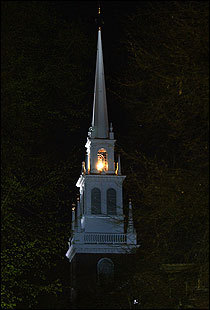
There are still events planned for 19 April, the actual anniversary of the Battle of Lexington and Concord, and the following weekend. In addition, I’ve heard that the Bunker Hill Monument’s new illumination system is scheduled to be unveiled this Friday, 20 April, at dusk, but I haven’t found any official announcement about that. Mark Garfinkel of the Boston Herald captured the spire’s new nighttime look during a test this winter.

[ADDENDUM: The Woburn Historical Society has rescheduled its “Pathways of the Patriots” event to Sunday, 22 April, 1:00 to 3:00 P.M.]

Monday, April 16, 2007

Israel Bissell and the Press

Today’s Patriots’ Day posting comes via the Associated Press, which is distributing David Weber’s dispatch on Israel Bissell spreading the news of the Battle of Lexington on 19 April 1775. The first modern expert cited in the story is, well, myself. (Here’s the Hartford Courant link in case the Boston Globe version is unavailable.)

The edited article states:

Dozens of other messengers also raced on horseback to spread the word, making it likely that Revere was a composite of these brave men, said J.L. Bell, a Massachusetts writer who specializes in Revolutionary War-era Boston.
Of course, the historical Paul Revere was real, and an individual, and quite significant in how things turned out. My comment here on Boston 1775 was that Henry W. Longfellow’s Revere, waking “every Middlesex village and farm” including Concord, was a composite. But that’s the difference between narrative poetry and history.

The A.P. story doesn’t quite make clear how Revere (and William Dawes, and Dr. Samuel Prescott, and many other men) rode on the night of 18-19 April 1775, before and during the British march. They spread the word of what the army might do to Massachusetts provincial leaders and supplies, and summoned militia units in response.

Israel Bissell set out for the south on the morning of 19 April after the skirmish at Lexington had occurred and while the army was in Concord. His job was to spread the news of what the army had done, as the Massachusetts Provincial Congress wanted that news spread. Bissell was a professional post rider, or long-distance mail carrier, and he had an official commission from the congress to carry out that job. His news went into many newspapers and printed broadsides along the way.

Bissell rode much further than Revere and Dawes, eventually reaching Philadelphia. But unlike those Bostonians, he didn’t have British officers trying to stop him. Those three riders and the many anonymous men who also carried the messages were all important nodes in the Patriot communication system, but they had different jobs to do at different times.

Sunday, April 15, 2007

Dr. Thomas Bolton Answers Dr. Warren's Oration

It took nine days for Boston’s printers to issue a pamphlet of Dr. Joseph Warren’s oration on the Boston Massacre in March 1775. When it appeared, the British military officers in town made a parodic reply. Merchant John Andrews described the scene in a letter:

Last Wensday, the day the oration was publish’d, a vast number of Officers assembled in King street, when they proceeded to the choice of a moderator and seven out of their number to represent the select men, the latter of whom with the moderator went into the Coffee house balcony, where was provided a fellow apparrell’d in a black gown with a rusty grey wigg and fox tail hanging to it, together with bands on—who deliver’d an oration from the balcony to a crowd of few else beside gaping officers.
That “fellow” was Thomas Bolton (or Boulton), a Loyalist physician. He had reportedly left Salem after being attacked and perhaps even tarred and feathered—at least he said so later. Bolton served as a surgeon for the Royal Navy during the war, and may already have been doing so in March 1775.

Dr. Bolton’s oration was eventually printed in the same format as Warren’s—perhaps in New York or after the war had begun, because it would have taken a brave Boston printer to issue it without the protection of martial law. It’s a delightful source for fans of invective and gossip. Take this one sentence alone. It’s an apologia, as Warren had delivered at the start of his own speech (“You will not now expect the elegance, the learning, the fire, the enrapturing strains of eloquence which charmed you when a LOVELL, a CHURCH, or a HANCOCK spake”). But Bolton gets so much more personal about the Patriots:
I cannot boast the ignorance of Hancock, the insolence of Adams, the absurdity of Rowe, the arrogance of Lee, the vicious life and untimely death of Mollineaux, the turged bombast of Warren, the treason of Quincy, the Hypocrisy of Cooper, nor the Principals of Young...
And then Dr. Bolton got nasty.

He said John Hancock “courted popularity and fame almost as Long as he did ——— Miss ——— Miss ——— or Mr. Bernards Cook maid, Betty Price.” (At least two other Loyalists also accused Hancock of having affairs with serving-women, though one said he hadn’t actually been able to complete the job.)

About Dr. Thomas Young, the outspoken deist who had moved to Newport the previous September:
I can only refer you to——his own countenance, wherein you may read his true and genuine disposition. Suffice it to say, this man stands accused of rebellion, not only against his Sovereign, but against his God;—and he makes a mock at the merits of his Redeemer, and uses his God only to swear by.
Bolton accused merchant John Rowe of having “invented the new method of making Tea,” a reference to Rowe’s offhand remark during the tea crisis about mixing tea and saltwater. Rowe was desperately trying to stay on friendly terms with both political sides, at least until he was sure which way to jump. He went home and wrote in his diary: “This day an oration was delivered by a Dirty Scoundrell from Mrs. Cordis Balcony wherein many Characters were unfairly Represented & much abus’d & mine among the Rest.”

The published speech spent extra space attacking the Rev. Dr. Samuel Cooper of the Brattle Street Meeting, adding several lines in verse about the man (shown above). Bolton insinuated that Cooper was not only a hypocrite but a ladies’ man—something rumored around town for years. The physician also made a cryptic comment about the Seventh Commandment; according to Cooper’s modern biographer, Charles W. Akers, a penciled note on a copy at Brown University says that arose because “Dr. Cooper’s Wife is a Noted Thief.”

Finally, there are Bolton’s remarks on William Molineux, the radical merchant who had died suddenly the previous October:
The fifth of these chiefs is now no more—his name was Mollineaux, he had an aversion to all order, civil or Ecclesiastic, he swore the King was a Tyrant, the Queen a Whore, the prince a Bastard, the Bishops Papists—and the houses of Lords & Commons a Den of theives—through the Strength of his own Villainy, and the Laudanum of Doctor Warren, he quitted this Planet and went to a secondary one, in search of Liberty.
So, according to Bolton, one Patriot leader had supplied the poison that another had taken to commit suicide. Nice.

Saturday, April 14, 2007

Dr. Joseph Warren Dresses for an Oration

One of the more picturesque confrontations that led up to the Battle of Lexington and Concord was Dr. Joseph Warren’s oration in memory of the Boston Massacre on 6 March 1775. (The actual anniversary was on the 5th, but that was a Sunday.) The online history magazine Common-Place has published Prof. Eran Shalev’s article on Dr. Warren’s style that day, which sets the scene this way:

On the morning of March 6, 1775, Joseph Warren, a physician-turned-revolutionary leader, stopped his one-chair carriage in front of Boston’s Old South Church [known then as Old South Meeting-House, as I discussed yesterday]. Warren climbed down from the carriage, followed by a servant holding a small bundle. The two men crossed the street and entered an apothecary’s shop. When Warren came out of the store he wore a Roman toga. He now crossed the street once more and burst into the swarming Old South to deliver the fourth annual Boston Massacre oration.
Prof. Shalev seems to imply that Dr. Warren wore only a toga. I strongly believe more witnesses would have commented on the doctor’s undress if he’d fully adopted Roman dress—and undress. Indeed, Judge Peter Oliver made a big deal later of how Warren had been “a bare legged milk Boy” while growing up in Roxbury. How could he have resisted describing the man making a public speech wearing nothing but a blanket? The New York Gazetteer noted that Warren still wore his “breeches,” at least. It was early March in New England, after all.

I rather think the doctor made his sartorial point by wearing a Roman toga over contemporary genteel dress, as in William Rush’s statue of Washington or this similar example by Sir Francis Chantrey, now in the Massachusetts State House.

As Shalev’s account proceeds, it’s weakened by some factual errors, small and medium-sized. This wasn’t the fourth annual oration on the Massacre. There were two in 1771, one on the anniversary offered by radical Dr. Thomas Young, and a second a few weeks later that the town officially requested from a more mainstream Whig, schoolteacher James Lovell. Dr. Warren first spoke in 1772; Dr. Benjamin Church, Jr., in 1773; and John Hancock in 1774. So Dr. Warren’s 1775 oration was, depending on how we count, the fifth or sixth.

Furthermore, Samuel Adams never delivered one of those speeches, contrary to the article. Adams generally worked in town meetings or behind the scenes. As his 1898 biographer James K. Hosmer wrote, “He was always in speech straightforward and sensible, and upon occasion could be impressive, but his endowment was not that of the mouth of gold.” Adams had a tremor that affected his hands and voice, which neurologist Elan Louis has concluded was an essential tremor.

The article’s implication that in 1772 Dr. Warren was “a member of the Committee of Safety, a board of selectmen who dealt with security issues,” seems to confuse various groups. The selectmen were the town’s seven highest officials, elected each March to serve the full year and usually reelected for the next as well. The town meeting also appointed committees for various tasks. Immediately after the Boston Massacre, Boston created a committee of safety to demand that the governor remove the army regiments from the center of town, and Warren served on it. But that was an ad hoc committee, disbanding after it had accomplished its purpose. Later, in 1775, Warren served on a stronger and longer-lived Committee of Safety, created by the Massachusetts Provincial Congress to organize military resistance against the Crown.

Prof. Shalov ends his article with the tumultuous ending of the 1775 oration:
After Warren stepped from the pulpit, Samuel Adams stood up and asked for a volunteer to deliver next year’s commemorative oration. Adams apparently took the opportunity to reinforce colonists’ sense that the events of 1770 represented an entirely unjust massacre. Not surprisingly, the redcoats, according to MacKenzie, “began to hiss,” and someone mistakenly heard the words “Fire! Fire!”
I think a better picture comes from Shalov’s original source, the diary of Lt. Frederick Mackenzie of the 23rd Regiment (Royal Welch Fusiliers):
As this meeting was called an Adjournment of a former Town meeting, as soon as the Oration was ended, Mr. Saml. Adams came forward from a Pew in which he and the other Select men sat [sic—Adams wasn’t a Selectman, but Mackenzie was from out of town], very near the Pulpit, and moved, “that the thanks of the Town should be presented to Doctor Warren for his Elegant and Spirited Oration, and that another Oration should be delivered on the 5th of March next, to commemorate the Bloody Massacre of the 5th of March 1770.”
For Bostonians, the word “bloody” was an accurate description of the shootings on King Street. For late-eighteenth-century British gentlemen, however, the word was quite rude. Adams probably knew that, as did the crowds who called British soldiers “bloodybacks.” And, Mackenzie went on to write, the British officers in Warren’s audience took the bait:
On this several Officers began to hiss; others cried out, “Oh! fie! Oh! fie!” and a great bustle ensued. As everyone was now in motion, intending to go out, there was a good deal of noise, and the exclamation was mistaken for the cry of Fire! Fire! Numbers immediately called out Fire! Fire! which created a Scene of the greatest confusion imaginable.
Again, British and Bostonians suffered from being separated by a common language.

Here’s the text of Warren’s oration. Note that the doctor avoided the word “bloody” even as he wallowed in scenes of gore:
...behold thy murdered husband gasping on the ground, and to complete the pompous show of wretchedness, bring in each hand thy infant children to bewail their father's fate. Take heed, ye orphan babes, lest, whilst your streaming eyes are fixed upon the ghastly corpse, your feet glide on the stones bespattered with your father’s brains. Enough! this tragedy need not be heightened by an infant weltering in the blood of him that gave it birth.
(For the record, not one of the fatalities of the Massacre is known to have had a wife or children.)

Friday, April 13, 2007

From Which Steeple Did Those Two Lanterns Shine?

Boston 1775 reader Bill Welsch, of the American Revolution Round Table–Richmond, has written:

have you considered discussing the controversy over in which steeple the signal lanterns were hung? I’ve read and have copies of material by Frothingham, Watson, Weldon, Booth, Zellner, Fitch, Babcock, and Fischer debating Christ Church versus the Second Church.
Bill refers to a little historic controversy that boiled up in the late 1800s after Henry W. Longfellow’s poem “Paul Revere’s Ride” made the signal from the church steeple so famous. Longfellow took that detail from a letter Revere had written in 1798, which said he arranged for those two lanterns to be hung in the “North Church Steeple.” The poet believed that meant Christ Church in the North End, which he visited for research in 1860.

In his History of the Siege of Boston (first printed in 1849, reprinted in 1872), Richard P. Frothingham had echoed Revere’s phrase about the “North Church steeple” [p. 58]. However, later in that book it becomes clear that Frothingham considered “Old North Church” [p. 282] or “Old North Chapel” [p. 328] to be Boston’s Second Congregationalist Meeting-House, which the British army pulled down for firewood in December 1775.

In 1873, the rector of Christ Church announced that Frothingham was mistaken. The historian replied in 1876 with a pamphlet titled The Alarm on the Night of April 18, 1775, making a more explicit case that Revere’s “North Church” was the Second Meeting-House. John Lee Watson and Charles Deane answered the next year in Paul Revere’s Signal: The True Story of the Signal Lanterns in Christ Church, Boston. You can trace the rest of this debate in Bill Welsch’s list of authors above.

It’s true that the Second Meeting was known as “Old North” in Revere’s time, to distinguish it from the “New North” meeting under the Rev. Dr. Andrew Eliot (as well as the “New Brick Meeting” under Rev. Ebenezer Pemberton, which had broken away from the New North). The loss of the Old North building prompted its congregation to unite with the New Brick Meeting during the war.

However, the scholarly consensus is clear that hanging those lanterns in the Second Meeting-House was one of Frothingham’s rare mistakes. (His history of the siege is still the most thorough study of the first campaign of the Revolutionary War, more than a century and a half later.)

The key to Revere’s identification, I believe, is his word “Church.” In the 1700s, Bostonians were still fairly consistent about distinguishing between Congregationalist “meeting-houses” and Anglican “churches.” When Revere wrote “North Church,” he meant the one and only Episcopal church in the North End, formally Christ Church. Its steeple, helped by the terrain, soared above the neighborhood. As a teenager, Revere had signed up for a little society of bell-ringers for that church, even though his family weren’t Anglicans, so he knew the building well. In contrast, when Revere and his neighbors spoke of the Second Meeting, they usually called it “Old North Meeting” or “Mr. [John] Lathrop’s Meeting.”

By the time Frothingham was writing in the late 1800s, however, the meeting-house/church distinction had faded. (He himself was a Universalist.) The congregation of Old South Meeting-House officially became Old South Church when they moved to their new building, but in his book Frothingham had referred to that institution as both a church and a meeting-house. Similarly, he called Old North Meeting a “Church” and a “Chapel,” which no one had called it in the previous century. (The only “chapel” in pre-Revolutionary Boston was King’s Chapel.)

Meanwhile, the “North Church” Paul Revere knew continued to stand tall in the North End, eventually lasting long enough to inherit the nickname “Old North.” Which only added to the confusion.

Thursday, April 12, 2007

Who Got the Message from Old North Church?

At a members’ event at Old South Meeting-House last month, one of Susan Wilson’s trivia questions was something like: “In ‘One if by land and two if by sea,’ what does ‘sea’ refer to?” The assembled body decided that the answer is:

the Charles River estuary,
also known as the Back Bay
before it was filled in
But that’s much harder to rhyme than “sea,” even for a writer of verse as skilled as Henry W. Longfellow.

Longfellow’s poem depicts Paul Revere going on to say, “And I on the opposite shore will be.” That’s not historically accurate. Revere arranged to send the signal about Gen. Thomas Gage’s plan across the water to Charlestown. He didn’t need to watch for the lights in the steeple of Old North Church since he already knew the information they transmitted.

In Revere’s own words:
The Sunday before, by desire of Dr. [Joseph] Warren, I had been to Lexington, to Mess. [John] Hancock and [Samuel] Adams, who were at the Rev. Mr. [Jonas] Clark’s [the minister at Lexington]. I returned at Night thro Charlestown; there I agreed with a Col. [William] Conant, and some other Gentlemen, that if the British went out by Water, we would shew two Lanthorns in the North Church Steeple; and if by Land, one, as a Signal; for we were aprehensive it would be dificult to Cross the Charles River, or git over Boston neck.
As a backup plan, Revere later crossed the river to Charlestown himself. He wrote:
two friends rowed me across Charles River, a little to the eastward where the Somerset Man of War lay. It was then young flood, the Ship was winding, and the moon was Rising. They landed me on Charlestown side. When I got into Town, I met Col. Conant, and several others; they said they had seen our signals. I told them what was Acting, and went to git me a Horse; I got a Horse of Deacon [John] Larkin.
It’s significant that there was no horse waiting at the shore or wharf for Revere. Instead, the Charlestown Patriots had sent off a different rider as soon as they saw the signal from Boston. Spreading the word that way was the whole point of the warning: it wasn’t much good to alert Charlestown that the army was about to land in Cambridge and march west.

According to an undated memorandum later written by Richard Devens, a leading Charlestown Patriot, after seeing the lantern signal:
I then sent off an express to inform Messrs. [Elbridge] Gerry, &c., and Messrs. Hancock and A.,...that the enemy were certainly coming out.
Gerry and his colleagues from the Provincial Congress’s Committee of Safety and Supplies were at an inn in Cambridge. (D. H. Fischer’s Paul Revere’s Ride offers a different wording of this memorandum, which doesn’t match the cited source: Richard Frothingham’s 1872 History of the Siege of Boston. So I’m quoting Frothingham.)

So who was that Charlestown express rider? And what happened to him? (The rider was almost certainly a “him,” the legend of Sybil Ludington notwithstanding.) That’s another mystery about the Battle of Lexington and Concord.

We have a partial answer for the second question, but little for the first. That rider was probably stopped by British officers along the way. Revere encountered the same obstacle:
While the Horse was preparing, Richard Devens, Esq. who was one of the Committee of Safty, came to me, and told me, that he came down the Road from Lexington, after Sundown, that evening; that He met ten British Officers, all well mounted, and armed, going up the Road.

I set off upon a very good Horse; it was then about 11 o’Clock, and very pleasant. After I had passed Charlestown Neck, and got nearly opposite where Mark [a man executed for a murder in 1755] was hung in chains, I saw two men on Horse back, under a Tree. When I got near them, I discovered they were British officers. One tryed to git a head of Me, and the other to take me. I turned my Horse very quick, and Galloped towards Charlestown neck, and then pushed for the Medford Road.
By changing his route and taking a more northern road west, Revere skirted the patrols and made it through to Lexington. Here’s a map of his ride, showing where he first spotted British officers and turned back.

The Charlestown rider probably hadn’t been so quick. Those same officers probably “pulled him over.” And what did they do with him then? When other officers captured Revere later in the night, they held him at gunpoint in a field (along with three riders from Lexington and a disabled peddler named Allen), took away Deacon Larkin’s horse, and finally let him go so they could move more quickly. The Charlestown rider probably also had to walk back home, having accomplished nothing, and no one seems to have recorded his name.

Wednesday, April 11, 2007

Who Tipped Off Paul Revere?

Next week brings the anniversary and commemoration of the Battle of Lexington and Concord (not in that order), so I’ll devote some postings to mysteries and myths of that event. And just as I’ve previously defined “myths,” I should explain what I mean by “mysteries”: basically, stuff I’d like to know more about. These questions seem significant to me, though they might have had little bearing on how things turned out.

And the first mystery to ponder is: Who was Paul Revere’s counter-counterspy in November 1774? In 1798, the founder of the Massachusetts Historical Society asked Revere about his experiences in the months, days, and hours leading up to the war. In his reply, Revere described how he and other craftsmen collected information on the British military, and how a counterspy seemed to relay their intelligence to Gen. Thomas Gage:

In the Fall of 1774 and Winter of 1775 I was one of upwards of thirty, cheifly mechanics, who formed our selves in to a Committee for the purpose of watching the Movements of the British Soldiers, and gaining every intelegence of the movements of the Tories.

We held our meetings at the Green-Dragon Tavern [owned by the St. Andrew’s Lodge of Freemasons]. We were so carefull that our meetings should be kept Secret; that every time we met, every person swore upon the Bible, that they would not discover any of our transactions, But to Messrs. [John] HANCOCK, [Samuel] ADAMS, Doctors [Joseph] WARREN, [Benjamin] CHURCH, and one or two more.

About November, when things began to grow Serious, a Gentleman who had Conections with the Tory party, but was a Whig at heart, acquainted me, that our meetings were discovered, and mentioned the identical words that were spoken among us the Night before. . . . We removed to another place, which we thought was more secure: but here we found that all our transactions were communicated to Governor Gage. (This came to me through the then Secretary [Thomas] Flucker; He told it to the Gentleman mentioned above). It was then a common opinion, that there was a Traytor in the provincial Congress, and that Gage was posessed of all their Secrets.
The full letter is transcribed on the M. H. S. website.

Revere devoted lots of space in this letter to Dr. Benjamin Church, Jr., who he and other Massachusetts Patriots had sadly come to believe was Gage’s double agent. In late 1775 the doctor was caught sending coded letters into Boston. The Americans didn’t have enough evidence to be certain of his guilt, though, so the next year they banished him from America. Church sailed away, and his ship disappeared at sea. Not until the 1900s, when Gen. Gage’s intelligence files came to the University of Michigan and were opened to scholars, did Americans have definitive evidence that Church was indeed passing information to the British commander in early 1775, and perhaps in the fall of 1774 as Revere believed.

But who alerted Revere and his comrades that Gage was onto them? Obviously, Revere knew and trusted that man, but in his letter he took pains not to state his name. Instead, he left these clues:
  • “a Gentleman who had Conections with the Tory party, but was a Whig at heart”
  • “This came to me through the then Secretary Flucker; He told it to the Gentleman mentioned above.”
Flucker (shown above; click on the thumbnail for a larger image, courtesy of Bowdoin College) was number three in the Massachusetts royal government’s executive branch. I’ve found a couple of other anecdotes of him gossiping. But in this case he revealed a very important secret, and must have trusted the man he spoke to. Who was he?

A number of authors have posited that that gentleman was Henry Knox, who in June 1774 had married Flucker’s daughter Lucy. When I first read this hypothesis (I think it was in Esther Forbes’s Paul Revere and the World He Lived In), I thought it was an interesting possibility, but also perhaps an example of picking out the most interesting possibility from all the equally likely possibilities. Was it like spotting a familiar face in a crowd and focusing on it, ignoring all the other faces? We remember Henry Knox; we don’t remember other gentlemen whom Flucker might have spoken to. And didn’t most people write of Knox as a firm Whig? If Flucker knew his son-in-law was on the opposite political side, why would he have revealed this news?

But the more I’ve read about Knox, the more I lean toward accepting this theory. We’ll probably never know, but he does seem like the most likely candidate. He had the family connection to Flucker. He also had an appointment as a militia officer, and his London Book-Store was said to have customers from the royal government and army as well as the Whig upper class.

And was Knox known as a Whig before the war? He doesn’t appear on any of the surviving lists of politically active men: the North End Caucus, the Boston Committee of Correspondence, even the far-too-lengthy lists of men at the Tea Party. Knox was at the Boston Massacre, warning Capt. Thomas Preston not to have his men fire, and testified for the prosecution (i.e., the Whig side) in Preston’s trial. But his testimony was so helpful to the captain that when the soldiers went on trial their attorneys called him as a defense witness.

All in all, I think in late 1774 Knox’s political views may not have been obvious. He was still only twenty-four years old. He hadn’t held public office. His business relied on upper-class patronage. He’d connected himself by marriage to a top government appointee, which meant that under the Crown’s system of patronage politics he might eventually have been in line for some royal appointments himself. Given his son-in-law’s position, Flucker might well have felt safe speaking candidly to him.

After the war started, Henry and Lucy Knox slipped out of Boston. The exact date is uncertain, but the earliest biography of him (published by Francis S. Drake in 1873) says the couple arrived at the provincial lines one year after their marriage, meaning 16 June 1775. At that point, Henry had committed himself to the Patriot cause. His wife never saw the rest of her family again.

Knox had a remarkable rise in the Continental Army after leaving Boston. Drake says he volunteered his services to Gen. Artemas Ward on the day of the Battle of Bunker Hill and, though not involved in that fighting, “was actively engaged in reconnoitering service.” By 5 July, Knox was laying out fortifications in Roxbury and had met Gen. Charles Lee and the newly arrived commander-in-chief, Gen. George Washington. In November, Washington recommended that Congress make Knox colonel of the artillery regiment, appointing him above the regiment’s senior officers, most of them older and more experienced, and other hopefuls.

Part of Knox’s rise was no doubt due to his intelligence and charm. The artillery regiment had demonstrated a lot of dysfunction, so appointing someone totally new turned out to be a good idea. But Knox’s strongest support came from Massachusetts Whigs, as seen in John Adams’s letters to James Warren on 23 July 1775 and to Knox himself on 11 Nov. Did those men see Knox as committed to their cause and deserving of support for a reason they couldn’t spell out? Had he quietly provided crucial intelligence before the war?

If that was so, why would Revere have still kept his informant’s name secret in 1798, after the war ended and Flucker died, both in 1783? By then Knox was a retired Secretary of War, managing large tracts of land in Maine that Lucy had inherited from her father. It may have seemed unseemly to describe Knox as taking advantage of his father-in-law’s trust. But perhaps Revere’s dropped Flucker’s name in his letter as a clue that he expected contemporaries to pick up.

Tuesday, April 10, 2007

The Market for Originality in History

Last month, Brooks Simpson at Civil Warriors wrote:

Over the last decade or so I’ve pondered whether readers of historical works as a rule value originality and fresh thinking. . . . do more occasional readers – the folks who claim to be avid readers (and in some cases claim to be actual historians) based on a rather meager menu of reading – really care? I’m not so sure.
To which Kevin Levin at Civil War Memory replied:
I will go further and suggest that most consumers of Civil War histories care little for originality because they do not understand the concept as it is understood at the ground-level. . . . it comes down to training in analytical thinking, critical review of primary sources, as well as a strong background in historiography. . . . Let’s face it, somewhere around 80-90% of the literature in our field is unoriginal and usually involves a simple rehashing of what has already been said.
Which made me consider if the same applies to Revolutionary-era history.

I come from a background in book publishing rather than grad school, which gives me a different slant on the question. I think most regular readers of history want new knowledge. Publishers send most history books into the marketplace with the promise that they tell an unknown or forgotten story, use little-known sources, or upend dominant ideas. Even readers who think “revisionism” is a conspiracy to undermine the nation rather than an essential element of studying the past seem to gravitate toward books that promise something new and different. I’ve come to expect books’ marketing copy to play up the originality of their ones. (I drafted enough book jackets myself.)

But that doesn’t mean most books actually deliver on that promise. And, as Levin stated, most general readers don’t have the background to judge original thinking or research. But then I’m not familiar with the latest innovations in insurance, or geotechnical engineering, or knitting, or many other fields where I have no experience. (Often historians themselves are in the same boat as laypeople when it comes to books on periods they haven’t studied; specialization has its costs.)

I agree with Simpson and Levin that many U.S. history books, particularly in military history, retell familiar stories in familiar ways, despite readers’ interest in new knowledge. I see several intertwining reasons. The market for American history, probably like the market for any nation’s own history, includes “heritage” readers—folks who want the past to make us feel good about ourselves. And that limits the topics and conclusions they’ll support with their dollars.

I suspect that some history fans read many books on a topic in the same way other readers enjoy mystery novels or other genre literature: to have a somewhat new experience within a familiar frame. A mystery that doesn’t include a dead body, a detective, or a solution would be disappointing, and so would a history of the Revolution that doesn’t make a big deal of Trenton or Saratoga.

In addition, I think a good narrative has its own appeal, and some historical events or types of events lend themselves to a traditional story structure better than others. In a battle, the stakes are high, the action is relatively quick, and there are clear winners and losers. In sum, a battle makes a good story, and as a result military history appeals to story-seeking readers more than, say, economic development over several generations. That increases the market for books that describe a battle from start to finish instead of arguing for a new interpretation of documents.

And that brings us to the question of what originality means. Levin went on to say:
Sometimes we get the old uncovering of a long lost skirmish that somehow rises to the level of decisive moment in a campaign or perhaps even the war. In other cases we read that x's actions did or did not lead to victory or defeat. While some of these studies may give us something to think about it does not necessarily rise to the level of originality. Most of these books involve little or no creativity in the interpretation of sources.
I think that’s true, but it’s also worth examining whether “creativity in the interpretation of sources” is the only yardstick of original historiography. Or is that simply the yardstick that academia privileges? (Or prefers, if you prefer.)

I’ve come to think the measure of originality for historical writing is whether it prompts readers to think in new ways about the past. As I remarked above, not all readers really want to do that. But for those who are up for it (or ambushed by it), the historian’s innovations within the field may be less important than that effect.

An analogy to science and engineering might fit here. Scientists seek discoveries for the sake of discovery. Engineers, in seeking practical solutions to problems, apply scientific discoveries where needed. Some of those applications are quite creative, but they don’t involve scientific discovery. Applying the insights of other historians to a familiar period or event may not involve much conceptual creativity, but it can still produce interesting, ground-breaking work for readers.

Another form of originality separate from the interpretation of sources lies in how authors present historical information. Even within a traditional narrative approach, there are many ways to narrate the same events, and some of those ways can prompt readers to look at the past differently—perhaps when they least expect it.

Monday, April 09, 2007

Jefferson, Kosciuszko, and a Matter of Money

One of Boston 1775’s earliest readers sent me this announcement of a seminar at the McNeil Center for Early American Studies at the University of Pennsylvania a couple of weeks back. I found both the topic and its treatment interesting:

Thomas Jefferson and Tadeuz Kosciuszko:
Slavery and Freedom, Honor and Betrayal


Gary B. Nash, UCLA, and Graham Russell Hodges, Colgate University

Thaddeus Kosciuszko’s return to the United States in 1797 initiates the narrative we present in this paper. Although crippled by deep wounds, Kosciuszko returned in triumph to reside in Philadelphia as a revolutionary hero. Americans applauded him for his leadership in Poland’s vain uprising from 1792 to 1794. Americans cherished him in the hearts and memories that linked his glory during the American Revolution with their anxieties over the conservative policies of President John Adams. Kosciuszko had more than adulation in mind; he intended to collect some $12,000 plus interest in overdue pay from the American Revolution. The American Congress, aware of his enormous popular appeal, quickly voted to allot the back pay, which, with interest rose to over $15,000.

Kosciuszko remained in Philadelphia, where he befriended Vice President Thomas Jefferson. The pair talked of Poland, France, liberty and slavery long into the night on numerous occasions in the winter of 1797-1798. International anxieties promoted secret actions. Kosciuszko was worried about the newly passed Alien and Sedition Acts and wanted to travel to Paris to gather support for the revitalization of Poland. Jefferson was distraught over the possibility of war between the United States and France and asked Kosciuszko to act as a covert ambassador.

What to do with Kosciuszko’s pension? He gave Jefferson power of attorney; the two men drafted an extraordinary will that gave the American Patriot the power to use the cash to purchase, manumit, educate and give land and cattle to as many enslaved people as could be afforded. Jefferson even had the right to “buy” his own enslaved people and free them. It was a solemn pact between two noble men.

Our narrative then jumps two decades to the time of Kosciuszko’s death in late 1817 and Jefferson’s realization that his promise was now due. We then discuss at length Jefferson’s decision to relinquish executorship of the estate, now worth in excess of $20,000. Nonetheless, we view Jefferson’s eventual decision to shed his oath of honor to Kosciuszko as a betrayal of a promise rich in potential to shift American attitudes about slavery, While Jefferson’s attitudes about black potentials for American citizenship have long been considered, we consider his inaction in this affair of honor deeply troubling for a man deemed America’s greatest symbol of liberty.
Not mentioned in this summary is who took over Kosciuszko’s assets after Jefferson stepped away. How well were the Polish freedom-fighter’s wishes carried out? According to Prof. D. Benjamin Barros’s PropertyProfBlog, the estate was still being litigated in 1834, years after Jefferson had died. (Prof. Barros’s posting also contains the text of Kosciuszko’s will. Thanks to Prof. Mary L. Dudziak’s Legal History Blog and Google for helping me find that.)

I think it’s getting fairly late for American historians to be shocked, shocked at Jefferson’s reluctance to consider African-Americans as equals and work toward their emancipation. Especially at the end of his life, when his debts became more burdensome, Jefferson clearly froze the principles of liberty he wrote about, always putting off emancipation and often arguing against other men’s more immediate plans. Nevertheless, in this case Jefferson’s reluctance might also have been motivated by feeling not up to the administrative tasks. Financial management was not, after all, his strength.

(Today’s illustration, courtesy of the Library of Congress, is a portrait of Jefferson after a painting by Kosciuszko.)

Sunday, April 08, 2007

Adding Liberty Tree Site to the Freedom Trail?

Last week, Boston’s Weekly Dig ran a story by Matthew Wilding about plans for expanding Liberty Tree Park in Boston, and questions about whether it should be added to the Freedom Trail.

Liberty Tree was a large elm in the South End of colonial Boston, at the corner of what are now Washington and Boylston Streets. There was only one road out of town at that time, so everyone coming in by land passed that corner. On 14 Aug 1765, the small political club called the Loyall Nine hung effigies in the tree to protest the Stamp Act—the first mass political demonstration of what would turn into the American Revolution.

Later that year, after another protest had ended with a mob ripping apart Lt. Gov. Thomas Hutchinson’s mansion in the North End, the Loyall Nine and the town’s established politicians moved to encourage more peaceful actions. They made the elm into a symbol of honorable resistance to new imperial laws, naming it “Liberty Tree” and nailing on a brass plaque.

In the following decade, Liberty Tree was the site of many mass public meetings. Eventually the Whigs erected a flagpole through its branches, which they often decorated with banners and lanterns. During violent night-time protests, crowds went there, too: it was a necessary stop when a mob carted around a man covered with tar and feathers.

Other towns up and down the American coast designated their own “Liberty Trees.” Charlestown, South Carolina, for example, chose a spreading live oak. (Newspapers in each town occasionally called the local tree “the Tree of Liberty” but rarely if ever “the Liberty Tree.”)

In late summer 1775, after the war had begun, British soldiers and some Loyalist locals chopped down Boston’s Liberty Tree. But as a symbol it endured, eventually adopted by reformers in other countries, as Al Young traces in his latest book, Liberty Tree: Ordinary People and the American Revolution. Lafayette stopped by the site in the 1820s when he was making his endless tour of America (where he could live more cheaply than in France). And a possibly fanciful engraving of the elm appeared in many history books.

Given the importance of Liberty Tree in pre-Revolutionary politics, why wasn’t the site included in the Freedom Trail in 1958? One possible answer, discussed in the Weekly Dig, is that powers-that-be dislike commemorating mass political activities, as opposed to august institutions like King’s Chapel (largely Loyalist in 1775) or the Old State House (government at work).

I’m not convinced. After all, the Freedom Trail has a stop at the site of the Boston Massacre, a violent and still sometimes controversial confrontation between locals and soldiers. And, though it wasn’t part of the trail (and is now closed for renovation), the Boston Tea Party ship commemorated an illegal, anti-commercial protest.

The main reason for deemphasizing the Liberty Tree site, I suspect, was that it no longer contained a stately tree to look at. And what was visible at that corner wasn’t thought to be appealing to tourists—unless they wanted erotic literature, in which case the Liberty Tree Bookstore would have been happy to sell it to them. (This is not the same Liberty Tree Bookstore that sells political books online.) For a couple of decades that neighborhood was Boston’s “Combat Zone,” a red-light district. Now that technology has helped Americans bring pornography into the home, where it belongs, the neighborhood is gentrifying and might actually be a good place for a historic park.

But it’s still half a mile from the current start of the Freedom Trail on Boston Common. And the 2.5-mile trail is meant to be short enough for people to walk comfortably in a day (though many folks leave the Charlestown sites for later). So for people to add the extra half-mile, there would have to be more to see than a bas-relief plaque on a wall.

Plans for expanding Liberty Tree Park have been in the air since 1974, as far as I can tell—that’s when the area first got that label. As the millennium approached, an organization called Boston 2000 announced plans to develop the park and lobby for adding it to the trail. There was a grant from Save America’s Treasures. But, as the Weekly Dig article says, the momentum faded. The city estimates that the park would need more money than is now available, and plans for the neighborhood are up in the air. Perhaps by 2015, which will be the semiquincentennial of the first protest under Liberty Tree?

(Thanks to Charles Bahne for supplying me with a copy of the Weekly Dig article.)

Saturday, April 07, 2007

Fort Washington Park Going to the Dogs?

Brian Campbell of Cambridge sent a long comment attached to a posting from last year, and I thought it would be more visible in a posting of its own. Mr. Campbell is concerned about Fort Washington Park in Cambridge, the lone remaining geographic feature from the siege of Boston in 1775-76. Here are his comments, somewhat edited:

In November of 1775, by order of George Washington, volunteer soldiers constructed the three-gun battery earthworks at Fort Washington Park at 101 Waverly Street. Of the many siege fortifications built, only the three-gun battery earthworks at Fort Washington Park survive in an original condition.

After the Revolution, the affluent Dana family preserved the earthworks until 1858 and donated the land they occupy to the city. In 1859 Cambridge built the beautiful historic fence around the earthworks to protect them.

In the History of Cambridge, Massachusetts 1630-1877, Lucas R. Paige wrote, “Let no unpatriotic hand destroy this revolutionary relic, now known as Fort Washington.”
Fort Washington Park is now one of Cambridge’s two dog parks. Last year dog-owners petitioned the city to augment the Victorian iron fence around the park because pets could get through it and run away. In Jan 2006 the Cambridge Historical Commission approved a chain-link fence beside the older fence as a temporary measure. Presumably the city is working on a longer-term solution that matches the historic decor.

Mr. Campbell sees that use of the park as a threat to its survival:
The primary historic preservation concern was the 148-year-old fence, which no longer serves as protection to the earthworks. Instead, it keeps pooches caged in, making Fort Washington a legal off-leash park. Dogs burrow holes in the earthworks with impunity, as there is no protection for these fragile Revolutionary relics our forefathers so bravely constructed under British cannonades while suffering sickness and death in the camps and barracks of Cambridge.

As a USN Veteran, I feel this not the proper place to allow dogs to run free. The 231-year-old, Revolutionary relic three-gun battery earthworks are a monument to the labor of volunteer soldiers who constructed them, and deserve the respect and protection afforded the earthworks at national battlefields.
Here is Mr. Campbell’s full letter to the Cambridge Chronicle in February. You can read more of his thoughts on the park here. He has also posted slide shows titled “Ft. Washington Dog Damage.”

On the other side of the issue, folks on such websites as CambridgeDog.org and the SomervilleDog blog are pleased to have the dog park, and pleased that Cambridge agreed to steps that make it better for dogs.

I literally don’t have a dog in this fight. I don’t have a dog, I don’t live in Cambridge, and I have no special feelings about Fort Washington Park compared to other Revolutionary sites. But here are some observations from a historical perspective.

First, there were earthworks and fortifications and artillery batteries all around Boston in 1775-76, and inside the town as well. Soon after the war, most were plowed up or built over. Massachusetts farmers didn’t like to see land go to waste. People weren’t that interested then in preserving such reminders of the war. Since then, the geography of Boston and Cambridge has changed drastically, with large landfills creating new areas for construction. The park is now surrounded by streets, parking lots, and train tracks.

Those facts can cut both ways. On the one hand, as Mr. Campbell says, because these earthworks are the only military features that survive, it might be all the more important to preserve them. On the other hand, it’s not possible to get a sense of the siege—its scale, its strategy, its challenges for both sides—from this patch of land, so its value for understanding history is limited.

Aesthetically, I see Fort Washington Park as a relic of the Victorian period. The earthworks (in some form) go back to 1775-76, but the fence, cannons, and carefully planted trees reflect how people of the 1800s treated history and the land. Even the twentieth-century statues there include, as well as figures of Continental Army soldiers at work, a Victorian woman sitting on an earthwork to enjoy the sun.

I agree with Mr. Campbell that it’s valuable to maintain these formations as a physical reminder of the siege. I’m not sure how much of a permanent threat dogs and their owners pose. Those earthworks were piled up to withstand cannonballs, after all. With proper maintenance (not always certain, of course), they could last for more centuries. How about a community effort to fill in the holes the dogs dig, to make sure grass grows back every spring?

Perhaps the issue the more emotional: should this land be treated as a war memorial, akin to a cemetery or battlefield? There were no fights there, no soldiers killed or buried there. One could argue that using the space as a public park will encourage people to forget the soldiers of the Revolution. Then again, visiting that spot might make folks think about the men who built those mounds. All in all, this consideration seems to come down to symbolism, and the meaning and weight of symbols change over time.

Is making Fort Washington Park into a dog run specifically disrespectful? I’m not convinced, for a couple of reasons. While dogs can’t be toilet-trained, dog-owners can be; there’s been a remarkable change even since my childhood in how many urban and suburban owners pick up after their pets. Of course that’s not a perfect solution, but, as with maintaining the earthworks, it seems possible for people to keep the park healthy and clean. And pet-owners would benefit most.

Finally, from a historical perspective, it seems worth noting that Gen. George Washington was fond of his hunting dogs, owning many over his youth and middle age. His colleague Gen. Charles Lee loved his dogs even more, probably more than any person he met; he once insisted that Abigail Adams shake hands with one of his dogs. Gen. Israel Putnam had dogs at his farm in Connecticut.

Among Patriot politicians, Samuel Adams had a pet Newfoundland, and this week Prof. Richard Brown of the University of Connecticut told me that James Sullivan once offered a reward for the return of his dog. Ebenezer Fletcher, who joined the Continental Army in 1777 as a sixteen-year-old fifer, credited a dog with helping him escape from British troops around Fort Ticonderoga. Pvt. Joseph Plumb Martin mentioned American officers having a “favorite little dog” with them in 1780 (alas, he mentioned this in the context of them finally killing and eating the dog because they were so starved for rations).

For the soldiers of the Continental Army, securing Cambridge’s freedom to choose where to let its dogs roam might have been more important than maintaining their earthworks.

Friday, April 06, 2007

Events Leading up to Patriots' Day

Middlesex County is about to enter full Patriots’ Day mode, commemorating the Battle of Lexington and Concord on 19 April 1775, the start of the American Revolution. I’ve tried to gather news of the public historical reenactments scheduled for the next week and a half. There are also parades, balls, camporees, a Red Sox game, and the Boston Marathon (starting earlier this year). I apologize in advance if I’ve missed any town’s special tradition, but there doesn’t seem to be a central repository of this information.

SATURDAY, 7 APRIL

Bedford: The traditional first event of the season is the raising and “capping” of a Liberty Pole organized by the Bedford Minuteman Company. This year that ceremony starts at 10:30 A.M. at Bedford Common and moves to Wilson Park. Liberty Poles—basically flagpoles, the taller the better—were an important symbol of the American Whig movement from the late 1760s on. I think that adding the knitted Phrygian cap as another symbol of liberty might have become most popular in the 1790s during the political disputes between Federalists and Jeffersonian Republicans.

Concord: The Meriam’s Corner Exercise along Lexington Road takes place at 12:30 P.M. Minute companies and fife and drum units recall the fight that marked the beginning of the British column’s six-hour running battle back to Boston.

Lincoln: At 3:00 P.M., the Lincoln Minute Men and other militia and musical units observe the capture of Paul Revere by British officers in the early hours of 19 April 1775, at the site along modern Route 2A.

SATURDAY, 14 APRIL

Lincoln: At Hartwell Tavern in Minute Man National Historical Park (parking off Route 2A), the annual Battle Road reenactment from 10:00 A.M. to 4:00 P.M. features hundreds of British and Colonial Reenactors encamped at the Hartwell Tavern and Captain William Smith house. There will be demonstrations of military drill, artillery, crafts, and games, and a “massed tactical weapons demonstration running over a half-mile of the original Battle Road.” For more information on the site, download this Event Map.

SUNDAY, 15 APRIL

Arlington: At 12:30 P.M., units reenact the fierce skirmishes at Menotomy at the Jason Russell House.

Lincoln: The annual Lincoln Salute offers a concert of fife and drum music from 1:45 to 3:30 P.M. in Pierce Park, hosted by the Lincoln Minute Men. [ADDENDUM: See the comments below for the Lincoln Tattoo’s alternate venue in case of a downpour. Which, not coincidentally, is what the meteorologists now forecast for Sunday.]

Woburn: The Woburn Historical Society presents “Pathway of the Patriots” from 1:00 to 3:00 P.M. Gather at the former Tarky School Lot on Russell Street, where tours start every half hour. Event will consist of narrated tours of Woburn’s Old Battle Road, reenactors, exhibits, and dramatizations.

Acton: The Samuel Prescott–John Robbins Ride reenactment starts at approximately 5:30 P.M. at the former site of the Robbins home on Concord Road, southeast of Woodlawn Cemetery, and then proceeds to the Isaac Davis home site on Hayward Road, the Faulkner House on the corner of High Street and Main Street, and Liberty Tree Farm at about 6:15.

Lincoln: Muster of the Lincoln Minute Men at 7:00 P.M. in Lincoln Center. Captain William Smith will arrive by horse to ring the bell of the White Church and spread the alarm that the British Regulars are coming.

Charlestown: The 8th Annual Paul Revere Row Reenactment takes place from 7:00 to 9:30 P.M., at the Charlestown Navy Yard Visitor Center. It will feature novelist William Martin signing his books, dramatic performances by the Histrionic Academy, and fife and drum music by Prescott’s Battalion Field Music. At the end of Pier 1 in the Charlestown Navy Yard from 8:30 until about 9:30, a special program will focus on Paul Revere. The program will climax with the arrival of a certain rowboat.

MONDAY, 16 APRIL

Westford: The Westford Colonial Minutemen start out along their Col. John Robinson Historic Trail March to Concord’s North Bridge at 4:45 A.M., starting at the Westford town common.

[ADDENDUM: See the Comments for a link on the similar march from Stow. Thanks, Jenn!]

Acton: Likewise, the Acton Minutemen and Davis Blues gather to march the Isaac Davis trail to Concord. Start-points are 5:45 A.M. at Acton-Boxborough Regional High School, 6:00 at the Isaac Davis Homestead on Hayward Road, and 6:45 at the monument in Acton Center. The unit expects to arrive at the North Bridge at 8:45 and take part in the Commemoration of the Concord Conflict. This is the 50th year of this event.

Lexington: The town sponsors its annual reenactment of the skirmish between British soldiers and local militiamen on Lexington Green, starting at 5:30 A.M.

Concord: Commemoration of the shots at the North Bridge starting at 8:30 A.M. British and Colonial Reenactors, Park Rangers, and volunteers reenact the morning of 19 April 1775.

Roxbury: The National Lancers reenact William Dawes’s ride, plus historic talks and trolley tours. Events center on First Church of Roxbury, 9:00 A.M. to 1:00 P.M.

Acton: The Acton Historical Society, Acton Woman’s Club, and Iron Work Farm portray the “Spirit of Acton 1775” from 11:00 A.M. to 3:00 P.M. with tours of the 1760 Hosmer House, the 1728 Jones Tavern, and the 1706 Faulkner Homestead. Tickets will cost $5 per person age 13 and over and $2 per person under age 13.

Concord: At 7:30 P.M., 500 luminaries provide the backdrop for the 6th Annual Candlelight Remembrance Ceremony at North Bridge, a program of patriotic music and remembrance. Bring a flashlight and your singing voice. This event is sponsored by The Old Manse.

[ADDENDUM: Because of the storm, many outdoor Patriots’ Day events have been canceled. One exception: the tours in Acton. Please call ahead to be sure before setting out. And there’s always next year!]

THURSDAY, 19 APRIL

Wayland and Sudbury: Starting at 3:45 A.M. in Wayland center and at 5:45 in Sudbury center, the towns’ militia companies set out for Concord, to arrive at the North Bridge at approximately 10:30 A.M. The Sudbury Minute Men have more information.

Concord: With a Dawn Salute at 6:00 A.M., the Concord Minute Men and Concord Independent Battery observe the opening battle of the Revolutionary War. The North Bridge Remembrance Ceremony that follows at 7:30 A.M. includes historical speeches and wreath-laying.

SATURDAY, 21 APRIL

Lincoln: The Battle Road Heroes program at Hartwell Tavern, 7:00 to 8:30 P.M. is an evening of theater and history featuring the personal stories of people who lived along the Battle Road on 19 April 1775: Capt. William Smith, the Lincoln Minute Men, the Hartwells, drovers, musicians, and His Majesty's soldiers. Admission is $5.00 per person, $10.00 per family. Proceeds benefit the Minute Man National Park Association.

Thursday, April 05, 2007

Mysteries of John Childs

In September 1757, John Childs told Bostonians that he would “fly” from Old North Church. He really meant (and most people probably assumed him to mean) that he would slide head-first down a rope pulled taut on a slant. He did so three times in two days, according to the Boston News-Letter. And then, as far as I can tell, he vanished.

I’ve tried to track John Childs on two continents, and come up with nothing. He was said to be an Englishman, and he claimed to have “flown” off the Monument in London. In London’s Guildhall Library (shown here), I found reports of other men doing the same daredevil feat from that tower, but no John Childs. He dropped the name of the Duke of Cumberland, son of the king, as his patron; that’s led nowhere. So, I’m sorry to say, one may not be able to believe everything that traveling performers say about themselves.

We can sometimes trace itinerants along the North American coast through reports from each major port, as with dentist John Baker. But Childs the rope flyer doesn’t pop up in other newspapers of the time. Perhaps if John Childs were a less common name, it would be possible to spot him as an ordinary citizen, soldier, or sailor—a man who did acrobatics on the side. But there were a lot of men named John Childs in colonial America, and even more in Britain. I’ve chatted with Christopher Child, a genealogist at the New England Historic Genealogical Society with an obvious interest in that family name, but we unearthed no leads. So Childs himself remains a mystery.

The other mystery of this episode for me lies in this line from the News-Letter: “As these Performances led many People from their Business, he is forbid flying any more in the Town.” Boston’s selectmen were the officials who usually took such action against disruptive entertainers. They enforced laws against theatricals, including even Punch & Judy shows. There’s no mention of Childs in the selectmen’s official records, but those were often selective.

No, the real mystery is that no one prohibited Childs from doing his act until he was done. Before he flew, he told the town, through the Boston Gazette, exactly what he was going to do “this Day, and two Days following.” He slid down his rope three times over two days. Then, and only then, was he “forbid flying any more in the Town.”

So I sense the town’s politicians doing a little balancing act of their own: not actually interfering with people’s entertainment while it went on, but making a show of putting a stop to it afterwards so as to reassure the more traditional elements in town.

Wednesday, April 04, 2007

John Childs, Rope Flyer

Yesterday I quoted John Childs’s announcement that he planned to fly from the steeple of Christ Church in Boston’s North End, the church we now call Old North. The 15 Sept 1757 Boston News-Letter duly recorded:

Tuesday in the afternoon, John Childs, who had given public Notice of his Intention to fly from the Steeple of Dr. Cutler’s Church, perform’d it to the Satisfaction of a great Number of Spectators; and yesterday in the Afternoon he again perform’d it twice.

The last Time he set off with two Pistols loaded, one of which he discharged in his Descent; the other missing fire, he cock’d and snap’d again before he reached the Place prepared to receive him.

It is suppos’d from the Steeple to the Place where the Rope was fix’d was about 700 Feet upon a Slope, and that he was about 16 or 18 Seconds performing it each Time.

As these Performances led many People from their Business, he is forbid flying any more in the Town.

The said Child says he had flown from the highest Steeples in England, and off the Monument, by the Duke of Cumberland’s Desire.
So what did Childs actually do? The important technical information is his “Rope was fix’d about 700 feet upon a Slope.” The steeple of Old North is 190 feet tall. So even if the rope were tied to the tippy-top, it must have formed a fairly gentle slope to the ground, far from the vertical. Furthermore, despite the newspaper’s clear interest in the speed and angle of Childs’s descent, its printers didn’t describe him as flying with any apparatus. Finally, to fire off two pistols during his second descent, Childs had to have both hands free.

All those clues, I’m sure, helped scholar Peter Benes connect Childs’s feat to a form of entertainment that daredevils had been offering in England for centuries: rope-flying. (Benes’s discussion appears in the article “Itinerant Entertainers in New England and New York, 1687-1830,” in the Dublin Seminar volume Itinerancy in New England and New York.)

A rope flyer started by stretching a long, strong rope from a steeple or other tall structure down to the ground on a slant. Then after making as big a deal of the event as he could, he went up the tower and waved to the assembled crowd. And then...

William Hogarth depicted a London rope flyer in his painting and engraving titled Southwark Fair. The painting is now at the Cincinnati Art Museum, but the online image is too small to see this detail clearly. Instead, I direct you to Benjamin N. Ungar’s thorough dissection of the engraved image [click the X to get rid of the ad if need be] and particularly its close-up of the “flying man.”

As you’ll see, a rope flyer slid down his rope head-first, arms and legs on either side of the cord. To protect his torso, he wore a board with a groove cut vertically down its center. His dangling limbs helped him keep his center of mass close to or even below the rope, so he didn’t fall off. And at the bottom? Samuel Breck’s memoir of growing up in Boston adds the detail, recalled by his mother, that Childs landed on a stack of feather mattresses.

So what John Childs did wasn’t really “flying” at all. It was, as Woody the Cowboy says in Toy Story, “falling with style.” But this was a quarter-century before the Montgolfier brothers sent up their first balloon. Sliding head-first down a rope, pistols blazing, was the closest anyone had seen to a man flying. Only after balloonists like Jean Pierre Blanchard really did fly for the public was that verb taken away from the rope-flyers, and their feat disappeared from the collective memory.

TOMORROW: Lingering mysteries about John Childs, the “flying man.”

Tuesday, April 03, 2007

John Childs Promises to Fly from Old North Church

On 12 Sept 1757, the Boston Gazette carried this unusual announcement:

This is to give Notice to All Gentlemen and Ladies, that John Childs has flown off of most of the highest Steeples in Old-England, and off of the Monument by the Duke of Cumberland’s Desire, and does intend this Day, and two Days following, to fly off of Dr. Cutler’s Church, where he hopes to give full Satisfaction to all Spectators.
The Monument was the 202-foot-tall column built in London to commemorate the Great Fire of 1666.

The Duke of Cumberland was Prince William Augustus, younger son of George II. As a British army commander, he had just been captured by the French at Klosterzeven, but Boston didn’t know that yet.

Dr. Cutler’s church was Christ Church in the North End of Boston, the same church that today we call Old North. And today a plaque on the building reads:
Here on September 13, 1757, John Childs – who had given public notice of his intention to fly from the steeple of Dr. Cutler’s church – performed it to the satisfaction of a great number of spectators.

In 1923, the year of the first continuous flight across the continent, this tablet has been placed here by the Massachusetts Society of the Colonial Dames of America to commemorate the two events.
For perhaps two hundred years now people have been puzzled about how exactly John Childs “flew.” And tour guides love to fill any vacuum of knowledge with confident statements of fact, however shaky. iBoston says Childs flew with “an umbrella-like contraption.” Citysearch says he used “a rudimentary glider.” CelebrateBoston says he was “Tethered to a rope, and attached to a feathered glider.” All wrong. Harvard’s First-Year Urban Program, to its credit, says, “no one really knows what this [flying] means.”

TOMORROW: What this “flying” means.

Monday, April 02, 2007

George Washington's Teeth, Close Up

In 1798, George Washington ordered what was probably his last set of false teeth. Here they are, courtesy of the American Dental Association.

The dentist who supplied these choppers was John Greenwood, who has appeared on Boston 1775 as a ten-year-old boy waiting up nights for a visit with the ghost of his roommate Samuel Maverick, killed in the Boston Massacre; and as a fifteen-year-old soldier during the Battle of Bunker Hill. I love being able to trace people through their lives like that.

The Dr. Samuel D. Harris National Museum of Dentistry in Baltimore has an online display on the correspondence between Greenwood and Washington from 1791 to 1799. Those pages also include an image of a different set of lower dentures.

Greenwood sent his client this professional advice in 28 Dec 1798:

I send you inclosed two setts of teeth, one fixed on the Old Barrs in part, and the sett you sent me from philadelphia which when I received was very black. Occasioned either by your soaking them in port wine, or by your drinking it. Port wine being sower, takes of all the polish and All Acids has a tendency to soften every kind of teeth and bone. Acid is used in coloring every kind of Ivory. Therefore it is very pernicious to the teeth.
Greenwood’s father Isaac was an ivory craftsman, so he knew what he was talking about.
I advise you to Either take them out after dinner and put them in clean water and put in another sett, or clean them with a brush and some chalk scraped fine, it will Absorbe the Acids which collects from the mouth and preserve them longer.

I have found another and better way of using the Sealing wax, when a hole is eaten in the teeth by acid, etc.—first observe, then dry the teeth, then take a piece of Wax and cut into as small pieces as you think will fill up the hole. Then, take a large nail or any other piece of Iron and heat it hot into the fire, Then put your piece of wax into the hole and melt it by means of introducing the point of the nail to it. I have tried it, and found it to Consoladate, and do better than the other way and if done proper it will resist the saliva. It will be handyer for you to take hold of the Nail with small plyers, than with a tongs thus, the wax must be very small not bigger than this [dot].

If your teeth grows black, take some chalk and a Pine or Cedar stick, it will rub of[f]. If you whant your teeth more yellower soake them in Broath or pot liquor, but not in tea or acid. Porter is a good thing to coulor them and will not hurt but preserve them but it must not be in the least pricked.

You will find I have Altered the upper teeth you sent me from philadelphia leaveing the enamel on the teeth dont preserve them any longer than if it was of, it only holds the color better, but to preserve them they must be very often Changed and cleaned for whatever attacks them, must be repelled, as often or it will gain ground and destroy the works.

the two setts I repaired is done on a different plan than when they are done when made entirely new, for the teeth are screwed on the barrs, instead of haveing the barrs cast red hot on them, which is the reason I believe the[y] destroy or dissolve so soone near to the barrs. Sir, after hopeing you will not be Obliged to be troubled very sune in the same way, I subscribe myself,

Your very humble servant,
John Greenwood

The additional charge is fiveteen dollars

P.S. I expect next Spring to move my family into Connecticut State. If I do, I will rite, and let you know, whether I give up my present business or not. I will as long as I live, do anything in this way for you or in any other way in my power—if you require it.
Washington wrote back, “I shall always prefer your services to those of any other in the line of your present profession.”

Sunday, April 01, 2007

Judge Sewall Issues Injunctions

This week I had the good fortune to receive a gift of The Diary of Samuel Sewall (1652-1730), merchant, judge, and eventually chief justice of Massachusetts. He was an important figure in the transition from a Puritan colony to a royal province with a less assured sense of mission. Sewall was also one of the first Americans to argue against the established system of slavery, with his tract The Selling of Joseph.

I thought it was therefore most timely to quote Judge Sewall on an issue that’s more important today than ever. On 1 April 1708 he wrote to Boston schoolmasters Ezekiel Cheever and Nathaniel Williams:

What an abuse of precious Time; what a Profanation! . . . I have heard a child of Six years old say within these 2 or 3 days; That one must tell a man his Shoes were unbuckled (when they were indeed buckled) and then he would stoop down to buckle them; and then he was an April Fool. . . . Insinuate into your Scholars, the defiling and provoking nature of such a Foolish practice; and take them off from it.
Eleven years later this topic still weighed on Sewall’s mind, and in his diary recorded a lecture to his fourteen-year-old grandson and a younger boarder:
In the morning I dehorted Sam. Hirst and Grindal Rawson from playing Idle Tricks because ’twas first of April; They were the biggest fools that did so.
One starts to sense that someone had once told Judge Sewall that his shoes were unbuckled when they were in fact buckled.