






Fort Lee Has Fallen
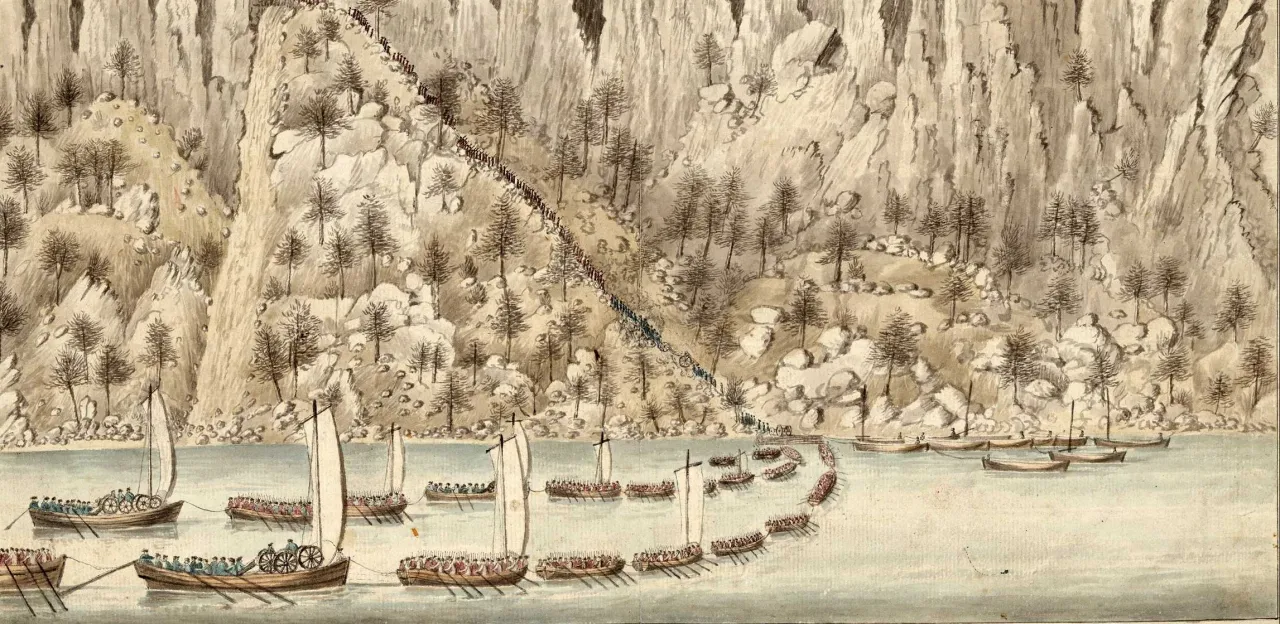
Forts Washington and Lee had been built to work together, preventing British warships from going up the river. But with the Manhattan position in British hands, there was no longer a good reason to hold the fort on the New Jersey side.
The Continental Army had started moving supplies away. But then Gen. Cornwallis led a landing by British troops on the Hudson shore, followed by a climb up the bluffs toward Fort Lee, as shown above.
On 21 November, Washington wrote to Gen. Charles Lee from Hackensack, about eight miles from Fort Lee:
Yesterday Morning the Enemy landed a large Body of Troops below Dobb’s Ferry & advanced very rapidly to the Fort called by your Name. I immediately went over & as the Fort was not tenable on this side & we in a narrow Neck of Land the passes out of wch the Enemy were attempting to sieze directed the Troops consisting of [Rezin] Bealls, [Nathaniel] Heards[,] the Remainder of [James] Ewing’s Brigades & some other Parts of broken Regiments to move over to the West Side of Hackinsack River.Later that day, the commander wrote to William Livingston, governor of New Jersey, from modern-day Passaic, about six miles further:
A Considerable Quantity of Stores & some Artillery have fallen into their Hands—We have no Account of their Movements this Morning. But as this Country is almost a dead Flat, we have not an intrenching Tool, & not above 3000 Men, & they much broken & dispirited not only with our ill Success but the Loss of their Tents & Baggage; I have resolved to avoid any Attack tho by so doing I must leave a very fine Country open to their Ravages…
…we were lucky enough to gain the Bridge before them, by which Means we saved all our Men, but were obliged to leave some hundred Barrels of Flour, most of our Cannon and a considerable parcel of Tents & Baggage. Finding we were in the same danger of being pent up between Hackinsack & Pasaiac Rivers that we had between the North and Hackinsack, and also finding the Country from its Levelness and Openness unfit for making a Stand, it was determined to draw the whole of our Force over to this Side of the River, where we can watch the Operations of the Enemy without danger of their surrounding us or making a Lodgment in our Rear.Two days later, Gen. Washington was ten more miles south at Newark, writing to John Hancock at the Continental Congress:
But as our Numbers are still very inadequate to that of the Enemy I imagine I shall be obliged to fall down towards Brunswic and form a Junction with the Troops already in that Quarter under the Command of Ld Stirling.
The situation of our Affairs is truly critical & such as requires uncommon exertions on our part. From the movements of the Enemy & the information we have received, they certainly will make a push to possess themselves of this part of the Jersey.Three months before, Washington had commanded more than 10,000 troops in and around New York City. Now that whole region was lost, and his force was shrinking fast.

No comments:
Post a Comment