
J. L. BELL is a Massachusetts writer who specializes in (among other things) the start of the American Revolution in and around Boston. He is particularly interested in the experiences of children in 1765-75. He has published scholarly papers and popular articles for both children and adults. He was consultant for an episode of History Detectives, and contributed to a display at Minute Man National Historic Park.

Subscribe thru Follow.it


•••••••••••••••••


Saturday, January 16, 2010

“Silver Bowl, Belonged to Joshua Loring”

Yesterday I quoted a press release from the Sotheby’s auction house about a big silver punch bowl up for bids later this month. Sotheby’s suggests that the bowl was hidden in a well on Commodore Joshua Loring’s estate in Jamaica Plain (shown above, courtesy of the Boston Public Library’s Flickr collection), then retrieved at the end of the war.

What’s the evidence for that account? Sotheby’s catalogue offers more detail:

This bowl is accompanied by two 19th century letters. One letter dated 29 November 1873 states: “The chased silver bowl, valued at nineteen guineas, left to me as an heirloom by my father in 1852, I hereby give to my brother Adml. Loring C.B. instead of leaving it to him in my will. - Henry N. Loring.”

The second letter states: “Silver Bowl, Belonged to Joshua Loring & was buried in a well during the War of American Independence (the Loring family was then living in America) & brought up when it was over.”
So we have no contemporaneous evidence for how the Loring family came into or preserved the bowl—only tradition written down decades and generations later. And the auction house has read some assumptions into the documents it has.

Sotheby’s story of the bowl states two details that the second letter doesn’t corroborate:
  • that Commodore Joshua Loring owned the bowl; the note simply says “Joshua Loring,” and two men of that name—father and son—lived through the Revolution.
  • that the bowl was hidden in Jamaica Plain; the note just mentions a well in America.
And the big question remains: How could the younger Joshua Loring have retrieved the punch bowl from Massachusetts when the war was over, as Sotheby’s suggests? He was in British-occupied New York City, was terribly unpopular with Americans, had no leverage anymore, and had a strict deadline for getting the hell out. The Jamaica Plain property had been legally confiscated and was in possession of another family.

How could Loring have even begun the search? “My dear Mr. Greenough: You don’t know me, and you shouldn’t believe what you’ve heard about me. I used to live in your house before your government took it from my father—but no hard feelings! By the way, have you found anything heavy in your well? Please don’t bother to clean it off. Just ship it to me in New York, and if you could do that so it arrives before the 25th of November, I’d be especially grateful. Your humble servant, &c., &c.”

I think it might be worthwhile to go back and ask how the Lorings came to possess an expensive silver bowl made in the early 1700s by a New York silversmith who catered to that colony’s Dutch elite. Sotheby’s even suggests that it might have been made for
Col. Abraham de Peyster, Mayor of New York (1692-94). De Peyster’s will, probated in 1734, lists “1 large silver Punch Bowl”, whose recorded weight with a serving spoon approximates that of the offered bowl.
So how did a New York punch bowl come to the Lorings?

One possibility is indeed that Joshua Loring, Sr., acquired it before the Revolution. He was in charge of a small fleet on Lake Champlain and Lake Ontario during the Seven Years’ War, which is how he got the title “Commodore.” So he had dealings in upstate New York, where he might have met Dutch aristocrats, and connections to merchants in the city.

Second, Joshua Loring, Jr., spent more than five years in New York during the Revolution as commissary of prisoners. He was a powerful figure in the British military administration. He had a habit, Americans grumbled, of lining his own pockets. (Some say supplying the military prisons in New York was an impossible job for anyone.) Perhaps Commissary Loring took possession of the bowl at that time, and the family preferred to remember it as older patrimony that had been hidden from the rebels.

A third theory: Joshua’s wife Elizabeth was from the Lloyd family of Long Island. Members of that family dealt with Abraham De Peyster and other members of the Dutch business elite. We even have records of the New York Lloyds ordering silver in mid-century, so they were that sort of people.

Perhaps the silver punchbowl was hidden in a well in New York—either the city or Long Island—during the 1775-76 period when Patriots dominated the state. Then the Lloyds retrieved the bowl sometime after the British military’s return in late 1776. It came to Elizabeth (Lloyd) Loring as an inheritance or gift. She and her husband used it to entertain during the war, then brought it with them to England in 1783.

Friday, January 15, 2010

The Mystery of the Loring Bowl

I’m delaying the return of CSI: Colonial Boston to discuss this big silver punch bowl from the early eighteenth century.

A story in the Boston Globe alerted me to Sotheby’s plan to auction the bowl on 22 January. It was made by Cornelius Kierstede of New York, its style dates it to 1700-1710, and the estimated price is $400,000-$800,000. That’s an unusually wide range because, the Globe says, there has never been any piece of American silver this big on the auction market.

Sotheby’s press release (PDF) says:

The bowl has descended in the family of Commodore Joshua Loring, whose stately home in Jamaica Plain, Massachusetts, the Loring-Greenough House, has been preserved as an historic site.

In March of 1776, Loring and his wife evacuated to London, escaping the Revolutionary War. Loring’s son, Joshua Jr., remained in America and continued to fight with the British army. Soon after, however, Loring Jr. fled to London, taking with him few possessions.

Among the pieces taken was the present lot, which had been buried in the family well for safekeeping during the war. Once Loring Jr. was reunited with his family in London, the monumental bowl was stored in a bank vault, where it has remained unused for over 230 years.
That story doesn’t make sense to me.

Both Joshua Lorings and their families indeed moved into Boston for the siege. According to Stark’s Loyalists of Massachusetts, the commodore left Jamaica Plain on the morning of 19 Apr 1775. As for his wife, son, daughter-in-law Elizabeth, and other relatives, they may have gone behind British lines before or afterward.

In the summer of 1775 the younger man jockeyed for appointment as (ironically) auction manager and royal sheriff of Suffolk County. The latter appointment put him in charge of the Boston jail and the wounded prisoners from the Battle of Bunker Hill, many of whom died. By the end of the siege, Joshua, Jr., had a very poor reputation among Massachusetts Patriots.

All the Lorings evacuated to Halifax with the British military. The older generation then went to England while Joshua and Elizabeth Loring accompanied the Crown forces to New York in late 1776: Joshua as commissary of prisoners and Elizabeth as Gen. William Howe’s mistress.

Joshua Loring, Jr., managed supplies for the British military prisons in New York through the end of the war. Americans accused him of starving prisoners of war to enrich himself; his reputation sunk even lower. In 1783 Loring settled in England, and six years later he died. His father had died in 1781.

I’ve heard suggestions that the Lorings hid possessions, including toys, in their Jamaica Plain house, expecting to return after the political turmoil died down. But that didn’t work: Massachusetts confiscated the entire property in 1778 and sold it to a new owner. This is the first statement I’ve found that the family actually got anything out—and it’s a big, extremely valuable object.

TOMORROW: What’s the evidence for the well story?

Thursday, January 14, 2010

Boston 1775 Twitter Feed, 11-13 Jan 2010

Through Twitter and my Google Reader blog subscriptions I see a lot of interesting links which don’t leave me with much to say. I decided I’ll periodically aggregate them in a posting like this in case other folks might find them interesting, too.

  • RT @KevinLevin: Check out Juan Cole's response to Pat Robertson's idiotic outburst about Haiti #Haiti http://bit.ly/5DoDoU #
  • Birthday of Massachusetts Revolutionary with the best political instincts: John Hancock. Active late 1760s to death, never lost a race. #
  • RT @amhistorymuseum: Today in 1773: 1st public museum in America is established. The Charleston Museum: ow.ly/VFM9 #
  • RT @amhistorymuseum: John Hancock purchased this baby rattle: ow.ly/VGdh // Sad story behind rattle: bit.ly/71sCI1 #
  • RT @Thos_Jefferson: "Thomas Jefferson Needs a Quill" courtesy of Sesame Street. ow.ly/VLIb #
  • Thomas Paine's COMMON SENSE was published one day earlier than many books say: bit.ly/7kS3bw #
  • RT @teachinghistory: Nominate for Gilder Lehrman's History Teacher of the Year until 3/15. bit.ly/8LD76p #
  • RT @HistoricNE: It's Historic New England's centennial! Get involved in the launch of our second century at tiny.cc/fsQot #
  • Popular baby names in Boston in 1710—yes, a lot of them were named John and Mary: bit.ly/5QMUzO #
  • Not very good, and not very entertaining, either. // RT @RagLinen: Anyone ever see this Rev War movie ? Any good? tinyurl.com/yjef7ug #
  • RT @RagLinen: An Unlikely Spy Embedded as a Newspaper Printer During the American Revolutionary War: tinyurl.com/yjqps3x #
  • Redcoat soldier stabs another, stabs his wife, stabs himself—what's the story?! From Don Hagist: bit.ly/6chl1F #

Wednesday, January 13, 2010

“Shot with an Iron Gun Rammer”

CSI: Colonial Boston now takes a field trip to New Jersey, soon after the Battle of Trenton, for a case study of a British soldier’s wound. This passage comes from an anonymous manuscript titled A Brief Narrative of the Ravages of the British and Hessians at Princeton in 1776-1777, published by the Princeton University library in 1906.

The writer seems to have used the verb “lap” to mean “to fold around something.”

On the first day of January 1777 some Regular [i.e., British] Soldiers came along the main road from over Stoney brook

One of them was very Strangely Wounded for he was shot with an Iron Gun rammer in Stead of a bullet, Which entered under his chin and came out again at his nose near his eyes one end of it, and the other end lapt round his thigh (as it is said)

Whether he was a Horsman or not I Know not, but it is very likely he was, and rideing up to the Enemy before he done charging, and perce[iv]ing that he was like to be shot with the Rammer, lean’d back on his horse to avoid it, and so received his wound in that manner, as to the Other end laping round his thigh, one end being Stopt, and the other end being heavy would continue its force until it met with something to stop it, and happened to meet with his thigh

He Languished a few days and Dyed.
And now back to your breakfasts.

(Click on the thumbnail above for a video of how one is supposed to stow a rammer, uninterrupted, courtesy of Fort McHenry.)

Tuesday, January 12, 2010

The Difficulties of Medical Training in 1796

I’ve already quoted Dr. Edward Warren (1804-1878) on what his father and professor, Dr. John Warren, thought about digging up bodies to for anatomy study: socially awkward but medically necessary.

Here’s a recollection from Edward’s older brother, Dr. John Collins Warren (1778-1856, shown here courtesy of Countway Medical Library), about studying medicine at Harvard under his father at the end of the eighteenth century:

No occurrences in the course of my life have given me more trouble and anxiety than the procuring of subjects for dissection. My father began to dissect early in the Revolutionary War. He obtained the office of army surgeon when the Revolution broke out, and was able to procure a multitude of subjects from having access to the bodies of soldiers who had died without relations. In consequence of these opportunities he began to lecture on anatomy in 1781.

After the peace there was great difficulty in getting subjects. Bodies of executed criminals were occasionally procured, and sometimes a pauper subject was obtained, averaging not more than two a year. While in college I began the business of getting subjects in 1796.

Having understood that a man without relations was to be buried in the North Burying-Ground, I formed a party, of which Dr. William Ingalls was one. He was a physician of Boston at that time. We reached the spot at ten o’clock at night. The night was rather light. We soon found the grave; but, after proceeding a while, were led to suspect a mistake, and went to another place. Here we found our selves wrong, and returned to the first; and, having set watches, we proceeded rapidly, uncovering the coffin by breaking it open.

We took out the body of a stout young man, put it in a bag, and carried it to the burying-ground wall. As we were going to lift it over and put it in the chaise, we saw a man walking along the edge of the wall outside, smoking. A part of us disappeared.

One of the company met him, stopped him from coming on, and entered into conversation with him. This individual of our party affected to be intoxicated, while he contrived to get into a quarrel with the stranger. After he had succeeded in doing this, another of the party, approaching, pretended to side with the stranger, and ordered the other to go about his business. Taking the stranger by the arm, he led him off in a different direction to some distance; then left him, and returned to the burying-ground.

The body was then quickly taken up, and packed in the chaise between two of the parties, who drove off to Cambridge with their booty. Two of us staid to fill the grave: but my companion, being alarmed, soon left the burying-ground; and I, knowing the importance of covering up the grave and effacing the vestiges of our labor, remained, with no very agreeable sensations, to finish the work.
I love the image of Warren, age eighteen, hurrying to refill this anonymous man’s grave while fuming at his so-called friends who’d left him to do all that work himself. But he’d no doubt heard his father speak of the necessity of filling in the hole so no one can tell you’ve taken the body.
However, I got off without further interruption; drove, with the tools, to Cambridge; and arrived there just before daylight.

When my father came up in the morning to lecture, and found that I had been engaged in this scrape, he was very much alarmed, but when the body was uncovered, and he saw what a fine, healthy subject it was, he seemed to be as much pleased as I ever saw him. This body lasted the course through.
Harvard Medical School’s Anatomical Gift Program is the legal and worthy replacement for the Warrens’ early efforts.

TOMORROW: CSI: Colonial Boston takes an excursion to New Jersey.

Monday, January 11, 2010

The Warren Family and Other People’s Bodies

Dr. John Warren (shown here, courtesy of the Countway Medical Library) was the younger brother of the much-disinterred Dr. Joseph Warren. He became a Continental Army surgeon after his brother’s death.

Dr. John Warren didn’t hold with sentimental ideas about preserving the human body. At Harvard he was part of the club of Spunkers, introduced here, who sought corpses for research and practice. And apparently he had a strong opinion about the incident, described yesterday, when soldiers from Woodbridge’s regiment noticed that one of their recently deceased comrades had been dug up.

This is from Dr. Edward Warren’s biography of his father John (which probably dated the event based on Dr. James Thacher’s published journal):

In November, 1775, the body of a soldier was taken from a grave, as was supposed for the purposes of dissection. Much general indignation was excited, and the practice was forbidden for the future, with stern reprobation by the Commander-in-chief. It was done with so little decency and caution, that the empty coffin was left exposed.

It need scarcely be said that it could not have been the work of any of our friends of the Sp——r Club. It must have been the act of a reckless agent or a novice. In cases of this kind, where the necessities of society are in conflict with the law, and with public opinion, the crime consists, like theft among the Spartan boys, not in the deed, but in permitting its discovery.
In other words, Dr. John Warren felt that the real problem was how the grave-robbers had let people see they’d taken the body!

Dr. John Warren himself wrote of the challenges of anatomical training before the war:
In some of the more populous towns students were sometimes indulged with the privilege of examining the bodies of those who had died from any extraordinary diseases, and in a few instances associations were formed for pursuing the business of dissection, where opportunities offered from casualties, or from public executions, for doing it in decency and safety.

But the Revolution was the era to which the first medical school east of Philadelphia owes its birth. The military hospitals of the United States furnished a large field for observation and experiment in the various branches of the healing art, as well as an opportunity for anatomical investigations.
Like many other wars, the Revolutionary War was a boon to medical training. It inured people to death, provided a larger than usual number of anonymous corpses to work on, and gave regimental surgeons and their assistants lots of practice.

Dr. John Warren went on to be a leader in educating and training American doctors. In 1783, he offered a series of anatomical lectures at the house that had belonged to radical leader William Molineux; the tickets for those lectures were engraved by Paul Revere. Later this Warren helped to found the Harvard Medical School.

TOMORROW: Peacetime brings a shortage of corpses. What could Dr. Warren’s son find to practice on?

Sunday, January 10, 2010

“Taken from His Grave by Persons Unknown”

From Gen. George Washington’s general orders for 1 Sept 1775:

Complaint has been made to the General; that the body of a Soldier of Col [Benjamin Ruggles] Woodbridges Regiment has been taken from his grave by persons unknown;

The General and the Friends of the deceased, are desirous of all the Information that can be given, of the perpetrators of this abominable Crime, that he, or they, may be made an example, to deter others from committing so wicked and shameful an offence—
The corpse was almost certainly removed for anatomical study. Ironically, Col. Woodbridge himself practiced some medicine at his home in South Hadley; in rural towns, the local gentleman of learning might be the best one had for medicine, the law, and science. Here’s the house in South Hadley Woodbridge built in 1788 on Historic Buildings of Massachusetts, and the picture of him above comes courtesy of Wikipedia.

Regimental surgeon James Thacher wrote of this incident:
I am sorry to have occasion to notice in my journal the following occurrence. The body of a soldier has been taken from the grave, for the purpose, probably, of dissection, and the empty coffin left exposed.

This affair occasions considerable excitement among our people; both resentment and grief are manifested; as it seems to impress the idea that a soldier’s body is held in no estimation after death. Such a practice, if countenanced, might be attended with serious consequences, as it respects our soldiers.

Much inquiry has been made, but without success, for the discovery of the persons concerned; and the practice in future is strictly prohibited by the commander in chief.
Curiously, when Thacher prepared his journal for publication decades after the war, he dated this paragraph in November 1775, at least two months after Washington’s order.

TOMORROW: The Warren family on this same incident.

Saturday, January 09, 2010

“Stained…with the hero’s blood”

Yesterday I described how the Rev. William Montague of Dedham came to possess the musket ball that supposedly killed Dr. Joseph Warren—or at least was taken out of the doctor’s body after his death.

Alexander Hill Everett brought that relic to public attention during an oration in Charlestown on 17 June 1836. That was the Battle of Bunker Hill’s 61st anniversary, not usually a noted date, so Everett may have had to try extra hard to make a splash. He stated:

The bullet by which he [Warren] was killed had been previously taken from it [the body] by Mr. [Arthur] Savage, an officer in the Custom House, and was carried by him to London, where he afterwards delivered it to the Rev. Mr. Montague of Dedham.

It was brought to me a day or two ago by a son of Mr. Montague with an affidavit authenticating the facts, and is the one, fellow-citizens! which I now hold in my hand.

The cartridge paper which still partly covers it is stained, as you see, with the hero’s blood.
According to chronicler James Spear Loring, in April 1843 the minister’s son, William H. Montague, sent the musket ball to Edward Warren, junior editor of the Boston Daily American, with a note stating that he was to hold it “till called for.” I suspect Edward was a grandson of Dr. John Warren, younger brother of the doctor killed at Bunker Hill.

That prompted a letter from Richard E. Newcomb, widower of Dr. Joseph Warren’s youngest child, Mary, asking for the bullet on behalf of his son as the dead man’s only direct descendant.

But it appears that the younger Montague, who in 1845 became one of the founders of the New England Historic Genealogical Society, enjoyed owning the relic himself. The ball was in his possession when he died, and the N.E.H.G.S. recorded in its proceedings for 1884:
The librarian would also report the gift, in March last, by William H. Montague, of Boston, the only survivor of the five founders of the Society, of a ball, taken by Arthur Savage, who was a personal acquaintance of Gen. Joseph Warren, who fell at the battle of Bunker Hill, from the body of that hero the morning after the battle.

The ball was presented by Mr. Savage to the father of the donor, the Rev. William Montague, while he was on a visit to England, in the year 1789 or 1790. A deposition to this effect by the Rev. Mr. Montague, taken March 5, 1833, accompanies the bullet.
Reportedly ball and deposition were displayed in a frame at the society. However, Samuel Adams Drake had to report in Old Landmarks and Historic Personages of Boston:
The identity of this ball has been disputed by some of the martyr’s descendants, on the ground that it was said to have been taken from the body, while Warren received his death from a ball in the head. The controversy was maintained with considerable warmth on both sides, the general opinion favoring the authenticity of the fatal bullet.
Mucking about with dead bodies? Controversies over how people died? Single-bullet theories? Why, it can only be the return of CSI: Colonial Boston! (And this time we’ll get to the mystery of Maj. John Pitcairn’s body. Eventually.)

ADDENDUM: Note this observation on the musket ball in question.

Friday, January 08, 2010

“This ball I took from his body”

Longtime Boston 1775 readers will recall our keen scholarly interest in Dr. Joseph Warren’s body, head, skull, and teeth after the Battle of Bunker Hill.

In the same vein, we now report that on 5 Mar 1833, the Rev. William Montague of Dedham went to a magistrate and prepared the following affidavit:

I, William Montague, of Dedham, County of Norfolk, State of Massachusetts, clergyman, do certify, to whom it may concern, that in the year 1789 or 1790, I was in London, and became acquainted with Mr. [Arthur] Savage, formerly an officer of the customs for the port of Boston, and who left there when the Royalists and Royal troops evacuated that town in 1776.

When in London, Mr. Savage gave me a leaden ball, which is now in my possession, with the following account of it, viz.:—

“On the morning of the 18th of June, 1775. after the battle of Bunker or Breed’s Hill—I, with a number of other Royalists and British officers, among whom was Gen. [John] Burgoyne, went over from Boston to Charlestown, to view the battle field. Among the fallen we found the body of Dr. Joseph Warren, with whom I had been personally acquainted. When he fell he fell across a rail. This ball I took from his body, and as I shall never visit Boston again, I will give it to you to take to America, where it will be valuable as a relic of your Revolution. His sword and belt, with some other articles, were taken by some of the officers present; and, I believe, brought to England.[”]
Montague had been rector at Christ Church in Boston from 1786 to 1791, and then went out to Dedham to reopen the Episcopal church there.

Arthur Savage (1731-1801) served as Comptroller of Customs at Falmouth (now Portland), Maine, until 1771, when a mob attacked him for seizing a ship. He then moved to Boston and worked in that Customs office until the evacuation.

Montague died only a few months after preparing his affidavit, in 22 July. His son William then reported finding a 1792 letter to his father from Harrison Gray, the last royal Treasurer of Massachusetts, which said:
I hope you will take good care to preserve that relic which was given you at my house, for in future time it will be a matter of interest to you rebels.
And indeed it did become a matter of interest.

TOMORROW: Where is that musket ball now?

Thursday, January 07, 2010

Clo Pratt at Old Sturbridge Village, 18 Jan.

I thought I’d finished with announcements of events this month, and then I read how Old Sturbridge Village is offering a historical presentation on an intriguing and hard-to-research aspect of life in colonial America:

Storyteller and museum educator Tammy Denease Richardson will present “Life after Slavery: the Clo Pratt Story” as part of the Martin Luther King Jr. Day activities at Old Sturbridge Village Jan. 18. The performance is based on the true story of Clo Pratt, an African-American woman born into slavery in Massachusetts in 1737. . . .

In character as former slave Clo Pratt, storyteller Richardson introduces her audience to a fascinating woman whose story has been obscured through history, but who was influential in the African-American community of her day. In 1774 after her owner’s death, Pratt finds she has been willed her freedom and must earn a living and make a place for herself in colonial New England.
Old Sturbridge normally presents life in the 1830s, but also tries to do well by other aspects of life in central New England, and this is one of them.

Clo Pratt was owned by the Rev. Daniel Russell of the Rocky Hill section of Wethersfield, Connecticut; it was common for New England ministers to own a person or two as household servants. Russell died in 1767. His widow Katherine made out a will in June 1773 that said:
my will is that my Negro woman Named Cloe prut Shall then Be free and Have Her time and also I Give to Her the Bead that She Lyeth on and furniture Belonging to it and a Loom that she weaveth in and tackling & a porige pot one old Chest with one Draw one puter pint pot one knife and fork and a plate and one puter platter and one quart Bason one tramil peil and tongs two old Chairs one pail one Small Square table one Large trunk and Several Books that are Called Her own one Small Brass Kittel and my Every Day wearing apperel and a Red Short Cloak and two spoons
I’m especially struck by “Several Books that are Called Her own.”

Eventually Pratt, by then in her sixties, lived with Hagar and Pompey Dorus, who had been enslaved in the house of Silas Deane.

In January, Old Sturbridge Village is offering free admission for children not in school groups when accompanied by an adult. Other King Day activities include “ice skating (bring your own skates), sledding on 1830s-style sleds, and sleigh rides (snow permitting).”

Wednesday, January 06, 2010

Shifts, Caps, Pockets, and More

The Ladies of Refined Taste & Friends, in partnership with Minute Man National Historic Park, have announced their 2010 schedule of “Hive” workshops for reenactors and park volunteers seeking to improve their interpretation. These Sunday sessions are free for people who want to participate, but some involve a fee for materials and all require advance registration.

Sunday, 17 Jan, 1:00-4:00 P.M., Minute Man Visitor Center, Lincoln: Why We Wear What We Wear — Several speakers will examine primary sources, including New England inventories, wills, advertisements, ships manifests, run-away ads, period art, and extant garments, to explain the background behind the current Battle Road clothing standards.

Sunday, 14 Feb, 10:00 A.M.-4:00 P.M., Noah Brooks Tavern, Concord: SHIFT-O-RAMA — Sharon Ann Burnston, author of Fitting and Proper, will explain the evolution of shifts through the 18th century, and participants will construct their own shifts using period sewing techniques. They will also be entertained during the day with 18th-century prose. Attendees will need to buy, pre-wash, and iron their linen before the workshop; information on yardage and sources will be supplied upon registration. During the same afternoon there will be two-hour sessions on “Sewing” for children aged six and older, “Making a Huswif” ($10 materials fee), and “Learning the Norfolk Drill.”

Sunday, 14 Mar, 1:00 P.M. to 4:00 P.M., Noah Brooks Tavern, Concord: Ladies’ Caps — Try on different styles of caps till you find the one that looks good on you. Then construct your cap. Materials cost of $15. There will also be two-hour sessions on “Making a Sampler” for children who took the previous month’s workshop ($10 materials fee), “Musket Tune Up,” and “Learn the Norfolk Drill.”

The Hive is also offering Saturday workshops for higher fees with more advanced projects: how to make a frock coat or jacket, an English gown, a knapsack, a bonnet, a fashionable pair of stays, and a powder horn.

All these sessions are leading up to the big Battle Road events on 17 Apr 2010, commemorating the first major battle of the Revolutionary War, when the reenactors’ hard work will enhance the experience for us ordinary folks. This being New England in winter, visit the “Hive” website for any changes required by the weather.

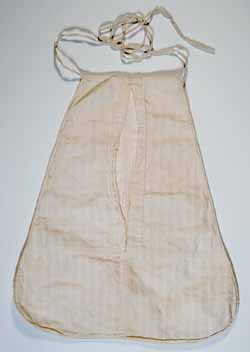
Shown above is another sort of sewing project: a “dimity pocket” owned by Abigail Adams, which the Massachusetts Historical Society featured on its website last month. Sarah Sikes described it this way:

Measuring a full fourteen inches in length, this pocket is composed of eight pieces of dimity sewn together with an opening halfway down the front. Two ties are attached to the top seams of the pocket to be secured around the waist. The simple and sturdy striped fabric of the pocket—the polar opposite of the sheer cotton known today as dimity—suggests that this was a utilitarian garment to be tied under an apron or worn beneath a skirt and accessed through an opening in the outer garments.
Because this one is so well preserved, Adams probably did not wear it for very long. But the provenance looks quite solid.

Tuesday, January 05, 2010

Ahoy! Upcoming Talks on the Naval War

I’m looking forward to two lectures about the naval side of the American Revolution in New England coming up in the next two months.

First, the Friends of Minute Man National Park will present Emily A. Murphy speaking on “The War Has Made Such An Alteration in People & Things: Privateering and the Revolution at Sea.” This talk will come on Wednesday, 20 January, at 8:00 P.M. at the Trinity Episcopal Church at 81 Elm Street, Concord, Massachusetts. It’s free and open to the public.

Emily is the Historian and Public Affairs Officer for Salem Maritime National Historic Site. She holds a Ph.D. in American Studies from Boston University, where her dissertation, “To Keep Our Trading for Our Livelihood”: The Derby Family and Their Rise to Power, examined how that Salem mercantile family reached political and social prominence. For the National Park Service she’s written the walking tour guide Nathaniel Hawthorne’s Salem and Merchants, Clerks, Citizens, and Soldiers: A History of the Second Corps of Cadets.

Privateering produced an outsourced navy, with governments (mostly the colonies/states) licensing private citizens to arm vessels, hire crews, and hunt down enemy shipping. Instead of receiving government pay, privateers’ crews would share the value of the ships and cargos they captured. Although serving on a privateer carried a lot of the risks of soldiering (death, disease, imprisonment), there was also the possible upside of lots of money.

On Saturday, 20 February, at 4:00 P.M., the Friends of the Longfellow House and Longfellow National Historic Site will host a lecture titled “Cambridge: Birthplace of the American Navy?” That cheeky title reflects the fact that in Cambridge, within that very historic mansion, Gen. George Washington gave the first orders for an armed ship to attack enemy shipping under Continental authority. In the fall of 1775 he put army funds into a schooner called the Hannah, and assigned men from Col. John Glover’s regiment to serve aboard her.

Sending troops out on a ship was a bold move. For one thing, attacking British supply ships was offensive rather than defensive warfare, and could be read to mean the American colonies were seeking independence. For another thing, Washington’s orders from the Continental Congress didn’t really authorize him to oversee a fight at sea.

“Cambridge: Birthplace of the American Navy?” will focus on what that early naval war looked like from Washington’s headquarters, which had a view of the Charles but was many miles from the useful American harbors. One reason I’m looking forward to that talk is that I’m giving it, so I’m naturally interested in hearing what I’ve found to say.

Monday, January 04, 2010

Choc-Talk at the Old South Meeting House, 7 Jan.

Boston chocolate lovers will be torn this Thursday at midday. Not only is Anthony Sammarco speaking at the Athenaeum about the history of the Baker Chocolate Company, but the Old South Meeting House is hosting a lunchtime lecture on “Stimulating Beverages: A Brief History of Tea, Coffee and Chocolate”:

Before 1650, a New England breakfast often included a mug of ale, beer or hard wine, but with the introduction of tea, coffee, and chocolate the tastes of the Western world were forever changed. Originally prescribed as cures for ailments ranging from headaches to depression, tea, coffee, and chocolate were soon counted among the necessities of daily live. Hear Amanda Lange, curator at Historic Deerfield, explain how these three beverages emerged as the popular drinks we know today.
That will start at 12:15 P.M., and people are invited to bring their lunches in case they develop an appetite. The admission cost for each event in this series is $5, $4 for students, and nothing for Old South members.

This talk is the first of a month of events on a largely libational theme. On Thursday, 14 January, there will be music from Poor Richard’s Penny, and on Thursday, 28 January, two more musicians perform a program titled “Rum and Revolution!”

In between, at 12:15 P.M. on Thursday, 21 January, comes a more genteel refreshment titled “‘One Bowl More and Then’: Punch Drinking in the 18th Century”:
Punch was introduced to England in the 17th Century, and its exotic ingredients immediately made it a staple in English and American parlors. The mixture of spirits, sugar, fruit and spice caught the eyes and inspired the imaginations of painters, printmakers, and cartoonists. Learn from Donald Friary, president of the Colonial Society of Massachusetts, as he explains how this beverage and its accoutrements brought conviviality to English and American taverns.
Here are Revolutionarily notable punch bowls from Massachusetts and New York.

Sunday, January 03, 2010

Unlikely Events and Unlikely Allies

On Saturday the Boston Globe ran a brief interview with Joel Richard Paul, author of Unlikely Allies: How a Merchant, a Playwright, and a Spy Saved the American Revolution. The paper described that book as “a story too good not to tell—involving the celebrated French dramatist Caron de Beaumarchais, a cross-dressing secret agent named the Chevalier d’Eon, and a boatload of duplicity, hypocrisy, and corruption.”

I hadn’t thought that D’Eon de Beaumont had much to do with the American Revolution, but the book’s jacket copy says the chevalier’s “decision to declare herself a woman helped to lead to the Franco-American alliance.” I’ll have to put this on my list.

The interview contained some interesting observations about researching and interpreting historical documents:

Q. Tell me about doing research for this book. These are three pretty fringe characters you write about.

A. I spent a lot of time at the archives of the French foreign ministry and Bibliotèque nationale de France. I love France, but let’s just say that library science is not their forte. I came away convinced they hadn’t lost their colonies as much as misfiled them.

Q. We like to put the Founding Fathers on a pedestal, and your book paints a quite flawed and human picture of them. What kind of response are you getting?

A. When I speak to groups I always start off saying that the one thing we all know about the diplomacy of the American Revolution is that Ben Franklin went to France in 1776 and forged the Franco-American alliance that provided us with arms. And that’s wrong. Most people are very surprised, and very interested.

Q. Does it make you wonder how many more people are out there who changed the course of history and who we know nothing about?

A. Yeah. I think that most of us start with the assumption that history is shaped by great men or great ideas or great social movements. And one of the things I’ve seen is the extent to which history is shaped by accident, and people acting on the periphery of great events.
Another lively book based, like this one, in Silas Deane’s stumbling attempts at diplomacy and espionage is The Incendiary (also published as John the Painter), by Jessica Warner; I wrote more about it here.

Paul’s third answer above brings up the the question of “agency”—historians’ jargon for the idea that individual decisions can affect the course of major events. Usually that argument gets played out through “great men” and women, leaders making decisions for many other people. But might the real argument for individual effects lie in the plane of peripheral events, quirky accidents, and unintended consequences?

Saturday, January 02, 2010

Finalists for the Cybils Awards

The Cybils are a set of awards for children’s books given by bloggers. Their criteria include both literary excellence, as in the awards given by librarians and book reviewers, and kid appeal. A few of the books on this year’s short lists, announced yesterday, may have special appeal to young students of the eighteenth century.

Among the finalists in middle-grade fiction is Chains, by Laurie Halse Anderson. The nomination committee says:

Chains is told through the eyes of Isabel, a slave girl. Sold after her master dies, Isabel is thrust into the middle of the war where both sides claim they want what is best for her. She passes along messages to the Loyalists only to learn that the only one she can trust to help her gain her freedom is herself. Anderson has presented a story that with the proper foundation can be read, enjoyed and understood by the youngest to the oldest middle-grade student.
On the short list for older nonfiction is Written in Bone: Buried Lives of Jamestown and Colonial Maryland, by Sally M. Walker:
Written In Bone takes readers along the journey as scientists uncover skeletons and other artifacts from colonial-era Virginia and Maryland. We learn not only about the skeletons themselves, but also about the way of life during this often brutal and even deadly time period.
Finally, in the category of Graphic Novels for Young Adults, two of the five nominees are set in the eighteenth century. There’s the first collection of Lora Innes’s The Dreamer:
Seventeen-year-old Beatrice “Bea” Whaley vividly dreams of a handsome Revolutionary War soldier and she welcomes her nightly adventures. Later though, she finds they might be more than just dreams.
And the second nominee is Crogan’s Vengeance, by Chris Schweizer:
…the saga of Catfoot Crogan, a privateer from the early 18th century. Clever dialogue and Schweizer’s caricature-like drawings merge into a cinematic story of pirates and mayhem.

Friday, January 01, 2010

New Year at Valley Forge

Gen. George Washington’s general orders to the army camped at Valley Forge on 1 Jan 1778 began like this:

As this day begins the new year The General orders a gill of spirits to be Served to each non-commission’d Officer and soldier;

And to avoid the irregular and partial distribution of this Article (which has been a good deal complaind of) he expressly orders that no Spirits shall issue to any part of the Troops in future but in Consequence of general or special orders from Head Quarters.

A deviation from this rule will be at the risque and peril of the Issuing Commissary.
Oh, yeah, that’ll stop the complaints.

Thursday, December 31, 2009

“A happy Year may all enjoy”

As in previous New Year’s seasons, Boston 1775 offers a “carriers’ verse,” one of the poems or lyrics that newspaper delivery boys printed at the end of the year as part of their request for tips from customers.

This one with best wishes for 1772 is unique in that it comes from the boys of the Censor. Friends of the royal government paid Ezekiel Russell to launch that magazine in November 1771 as a home for their arguments. This carriers’ verse was thus directed to readers on that side of the political debate, and reflected their views of who was responsible for the turmoil and what was at stake.

The Carrier of the
CENSOR,
Wishes all Happiness to his generous
Customers.


What means this Clamour? why this strife?
To poison all the Joys of Life;
Ah why will Friend ’gainst Friend engage?
And brethren meet with hostile rage?

Say Candidus, rude Mucious say,
“It is such Slavery to obey?”
“Are Rulers Tyrants?—to be free,
“Must we destroy Society?”

Ye Friends to order! ’tis my pride,
To combat on the honest side:
Let Faction rave, or Villains brawle,
The CENSOR nobly scorns them all

May Government her Laws defend,
And foul Misrule to Hell descend;
A happy Year may all enjoy,
And may your FAVOURS bless your Boy.
“Candidus” was one of Samuel Adams’s pseudonyms for newspaper essays. “Mucius Scaevola” was the pen name Joseph Greenleaf had used for his attack on Gov. Thomas Hutchinson in the Massachusetts Spy a few months before; the Censor’s first issue responded to that essay.

Because the Censor stopped publishing a few months into 1772, this is the only New Year’s verse its carriers ever got to distribute. Fellow printers recalled that a woman in Russell’s print shop—possibly his future wife Sarah—composed occasional verses for his newspapers, so this might be one of her compositions.

Wednesday, December 30, 2009

Lessons from “Blogging History”

Our “Blogging History” panel at this March’s O.A.H. convention attracted a patient audience of about fifty—or, as one participant suggested, more than any panel at the convention that didn’t have the word “sex” in its title.

Here are some lessons I picked up from my fellow panelists.

1) Larry Cebula at Northwest History: Historians’ blogs have tended to have a predictable life cycle. They start out discussing history and history-writing, shift (especially in 2008) into arguing politics, and end up focusing on the blogger’s personal life.

Why had Boston 1775 lasted nearly three years without drifting into that cycle? Perhaps because of my escape valve.

Larry shared one post from his blog about nineteenth-century facial hair. The contrast with today might have been starker if the audience hadn’t been looking at three panelists with goatees and one with sideburns.

2) Mary Schaff at the Washington State Library: If people at an institution, particularly a government institution, want to create a blog to communicate to the public, it’s more efficient to ask for forgiveness after launching than to ask for permission beforehand. Going the formal route can lead into the hell of mission-statement committees.

Unfortunately, the Washington State Library blog ended in May because it was taking too much staff time. But other organizations have seen the value of the blogging model—i.e., a website anyone can update without having to go through a sixteen-year-old webmaster.

3) William Turkel at Digital History Hacks: Blogging about ways that historians can create more useful searches for data and documentation? That’s productive and rewarding. Creating search techniques simply in order to have something to put on the blog? Time to call it a day. But his blog posts are still up.

4) Ari Kelman and Eric Rauchway at The Edge of the American West: One key to a successful group blog is a shared ethos of not stepping on—i.e., posting shortly after—someone else’s post. Plus, American men can still find really sharp three-piece suits.

For more of what I learned from visiting Seattle, please see the escape valve. This panel was the idea of Larry Cebula, and I’m grateful to him and moderator Bill Youngs for getting me out to Seattle and showing me a good time while I was there.

Tuesday, December 29, 2009

Exploring a New Medium—as Soon as We Find the Right Plugs

One highlight of my 2009 was participating in a panel discussion at the Organization of American Historians meeting in Seattle on “Blogging History: Explorations in a New Medium.”

I took notes for a posting soon after that event in March, but waited to see if the video that panel moderator J. William T. Youngs had prepared would appear online. And then important matters like Kezia Hincher’s child seized my attention.

But the end of the year offers a fine time to look back and consider the lessons I had a chance to pick up along the way. And right away I can confirm two rules of life:

  • The more time someone has spent creating a multimedia presentation, the less likely it is that the multimedia system in the assigned venue is working.
  • The more that an event depends on technology for its very existence, the less likely that technology is to work.
In our case, Bill Youngs had prepared a video introduction to each panelist’s history blog, with images and music, on his Macintosh. But the LCD projectors at the Washington State Convention and Trade Center had trouble reading any signals from that computer. Problems with Macs that close to Microsoft headquarters—who would have thought?

That left us not only without a snazzy introduction, but also without a computer for a session in which we were to show off and discuss our blogs. Which is hard to do with whiteboards.

Our projected image was still a blank blue rectangle about five minutes after the session’s scheduled start. I leaned into a microphone and asked if anyone in the audience could loan us a Windows PC. One woman graciously offered hers, and soon we were off and rolling.

TOMORROW: Lessons from my fellow panelists.

Monday, December 28, 2009

Choc-Talk at the Boston Athenaeum, 7 Jan.

On Thursday, 7 January, the Boston Athenaeum will host a lecture by Anthony M. Sammarco on “The Baker Chocolate Company: A Sweet History,” which is also the title of his new book. The talk will start at 12:00 noon. It’s free, but one must reserve a spot by calling 617-720-7600.

The event description says:

The Baker Chocolate Company was founded along the Neponset River in 1765 by Dr. James Baker and James Hannon, a skilled chocolate maker. Over the next two centuries, the company became one of the leading manufacturers of chocolate and cocoa in North America.
I’ve seen notices of similar talks by Mr. Sammarco at other venues, too.

The Baker chocolate factory in Dorchester is often said to be the first in North America. However, the descendants of Joseph Palmer of Braintree wrote that a chocolate factory was among the workshops he and Richard Cranch erected in the Germantown section of that town before the Revolution. And other Bostonians were advertising chocolate in the newspapers as early as the 1720s.

I’m not sure how the Baker Chocolate Company documentation stacks up against the rest. The company has not been shy about promoting its history. Then again, neither were the Palmer descendants.

Sunday, December 27, 2009

Revere Communion Vessels on Sale in January

The Boston Globe reports that on 21 January Christie’s will auction off a collection of silver vessels that the First Parish of Beverly decided to sell in order to pay for necessary building repairs.

The items include a ewer, a quart can, and two communion plates made by the workshop of Paul Revere around 1800.

According to the Globe:

Congregants originally used the collection for communion, but the church stopped holding regular communion services after it converted to Unitarianism in 1830. By the early 1900s, church leaders had moved the silver to a vault in a bank across the street for safekeeping. In recent years, according to Charles E. Wainwright, chairman of the church historical committee, only a few of the items were used regularly…
The congregation voted to keep a “baptismal bowl, a tankard, and a goblet”—and, of course, the church roof.

Saturday, December 26, 2009

Saratoga Not the Turning Point?

The Smithsonian website offers Prof. John Ferling’s article “Myths of the American Revolution”. Ferling explores how some common generalizations about the war aren’t completely correct, and may in fact be mostly incorrect. As an example:

Saratoga was not the turning point of the war. Protracted conflicts—the Revolutionary War was America’s longest military engagement until Vietnam nearly 200 years later—are seldom defined by a single decisive event. In addition to Saratoga, four other key moments can be identified.
The first of those four moments is the combination of Lexington and Concord and Bunker Hill, which, one might argue, was a starting point rather than a turning point. But those events did mark a turn from a political conflict with threatening military moves by both sides to a shooting war.

I’ll let you discover the three other “turning points” Ferling mentions. To make it harder, not all of them are battlefield developments. To make it easier, they all involve the tide turning in favor of the Americans.

But surely there had to be moments when the war turned in favor of the British, right? Otherwise, the war wouldn’t have lasted so long. Gen. William Howe’s sweeping reconquest of New York in 1776 wiped out a lot of the American momentum after successful campaigns at Boston and Charleston. Similarly, Howe’s victory at Brandywine sent the Congress scrambling out of its capital and erased the memory of Gen. George Washington’s smaller battlefield triumphs months before.

Finally, as Ferling notes elsewhere in the article, the British military’s southern strategy looked very good after the battle of Camden, with Georgia back in the Empire, Charleston firmly in British hands, and many Americans sick of the war. At that point, the Americans really needed a new turning point.

Friday, December 25, 2009

“So much for Christmas”

Here are entries from the diary of Manasseh Cutler (1742-1823) in 1765. At the time, this Yale graduate was teaching school in Dedham, starting to court Mary Balch, and trying to figure out his career.

Cutler was a Congregationalist, but on this trip to Boston he investigated the holiday rituals of the Anglicans.

Dec. 24, Tuesday. Set out for Boston in the carriage with Miss Polly Balch; very cold. Spent the evening at Captain Hart’s. Lodged at Mr. Williams’. It being Christmas eve the bells in Christ Church were rung, chimed, played tunes, etc. Christ Church is a large brick building, situated at the north end, and is the first church [i.e., Anglican place of worship, not a meeting-house] founded in the town.

Dec. 25, Wed. Christmas. Went to church at King’s Chapel, where was a very gay and brilliant assembly. Several intervals, in reading service, made for singing anthems, which were performed extremely well. Service was read by Parson [Henry] Caner, and a sermon preached, or rather a harangue pronounced by Parson Trouback [John Troutbeck]. After the sermon a collection was made for the poor. Then the sacrament was administered (which I did not tarry to see).

Dined at Mr. Williams’. A very handsome dinner.

In the afternoon service was read, and anthems sung, but no sermon. This church is built of stone, is very beautifully adorned with carved pillars, several images, etc. Here is a very good set of organs, but no bells, as the steeple is not erected. This is the most grand church in town, where His Excellency [i.e., the governor] is obliged to attend.

This evening we came to Roxbury and spent it very agreeably at Mr. Increase Sumner’s, and lodged at Mr. Samuel Sumner’s.

Dec. 26, Thurs. This morning began to snow. At 10 o’clock we set out for the city of Tiot (Indian name of Dedham), and came to an anchor at Dr. [Nathaniel] Ames’, where we dined, drank tea, and spent a very agreeable evening. We came home at 10 o’clock. As it had cleared up, and was a bright moonlight night, and not cold, we had a very pleasant ride. So much for Christmas.
Cutler tried the whaling business, studied law, and finally became a minister in 1771. During the Revolutionary War he was a chaplain, but also studied medicine. In the 1780s Cutler promoted settlement in Ohio, investigating the pre-Columbian mounds in that territory, but he returned to Massachusetts and ended up serving a couple of terms in Congress. So, though he remained the Congregationalist minister in Hamilton, I’m not sure he really settled on a career.

The picture above is King’s Chapel today, courtesy of Light Boston.

Thursday, December 24, 2009

How You Will Spend Your Christmas Vacation

I’m quite pleased to have stumbled into Georgian London, Lucy Inglis’s blog about life in the capital of the British Empire in the 18th and early 19th centuries, and especially life in the capital’s underside.

This week’s posts are dedicated to Hannah Glasse, author of The Art of Cookery, with extracts from her writings. Inglis writes:

Hannah was born in 1708 in London, but raised in the North. She married John Glasse, a man in service and moved with him first to Essex, then to London. As a wife and mother, Hannah spent her time producing the enormous Art of Cookery, but the year it was published, by subscription, her husband died. She struggled to support her family, despite the huge success of her book and it seems likely she was taken advantage of. Hannah would go on to write more books, but nothing equalled the success of her mammoth cooking and household manual, and she died in 1770 with only a short note in the London Gazette to her name.
Of course, that was more notice than most women who had been in service received.

Other topics aren’t so appetizing, such as Inglis’s discussion of the hard lives of child chimney sweeps:
Should any of these boys survive to adolescence, they were prone to the serious malady ‘soot-warts’. For decades it was believed to be a venereal disease resulting from sooty love-making, probably because it arrived at the same time as puberty. It was Percivall Pott, in 1775, who recognised it as the first occupational cancer in his treatise Chirurgical observations Relative to the Cataract, the Polypus of the Nose, the Cancer of the Scrotum. Pott’s treatise is not for the faint-hearted or for anyone in possession of a scrotum…
But there are some happy stories, such as the prosperity of the dwarf couple Robert and Judith Skinner:
With such a large family to support they decided, in 1742, to exhibit themselves in Westminster at intervals over two years in order to raise some money. They were quite the characters about town, being described as ‘very good-looking, perfectly straight and well made, witty, intelligent and jocose’.

Their exhibition proved very successful and they had a small carriage made so that they might tour St James’s Park, ‘No larger than a child's chaise, drawn by two dogs, and driven by a lad of twelve years old, attired in a purple and yellow livery’. After the two years they retired and lived in comfort until Judith died in 1763. Robert isolated himself and died the following year in Ripon, ‘of a broken heart’, leaving a fortune of over twenty thousand pounds.
There are also lots of big pictures. I don’t think one can navigate the blog by date, so one is left to the tags, which are intriguing enough to keep you there for days.

Wednesday, December 23, 2009

Sorting Out the Gossip about Horatio Gates

I’ve been exploring the rumors that Gen. Horatio Gates was secretly the son of a British aristocrat, most likely his mother’s employer, the Duke of Leeds. In The Generals of Saratoga, Max M. Mintz writes:

Enemies and detractors of Gates, skeptical that the son of servants should receive a commission in the British army, have alleged that he was Leeds’s illegitimate son. . . . The unanswered questions haunted Horatio all his life. When he aspired to advancement, he was accused of illegitimate pretensions. If he earned a promotion, it was ascribed to his birth.
Really? This is one of the passages in Mintz’s book that goes beyond the sources cited.

The eighteenth-century British genteel class loved to gossip. Indeed, it often appears that the society was held together by gossip. The third Duke of Bolton’s affair with the actress Lavinia Fenton was talked about almost immediately, and retold often. It appears in a delightfully dishy 1779 publication called The R—l Register, which also says of “the D— of B——“:
no man was ever more indebted to rank and title than this nobleman; for no man stood more in need of the consequence which is derived from them. Weak and whimsical, but persuaded, like many other good mistaken people of the same kind, that he possessed the opposite qualities, he naturally became no infrequent subject of mirth, raillery and cajolement.
Other chapters of that volume discuss the “E— of H——,” “Ld. D—,” “B— of Carlisle,” various monarchs, and so on. (The authors have good things to say about “E— P—,“ or Earl Percy.)

In 1751 Lady Mary Wortley Montagu wrote that the Duke of Bolton’s first wife “failed to give passion”—i.e., wouldn’t have sex with her husband—“and upon this plan threw away her estate, was despised by her husband, and laughed at by the public.” Montagu wrote that with some sympathy, referring to “My poor friend the Duchess of Bolton,” and she wrote it in a letter to her own daughter.

That daughter was the wife of the third Earl of Bute, George III’s favorite minister in the early 1760s. John Horne and others suggested Bute was having an affair with the king’s mother, the Dowager Princess of Wales. Georgian gossip reached very high.

In October 1777, as Londoners were wondering how Gen. John Burgoyne’s attack on the rebel colonies from Canada was going, Horace Walpole wrote of that officer:
He is a natural son of Lord Bingley, who put him into the entail of the estate, but when young Lane [George Fox-Lane, Bingley’s son-in-law] came of age the entail was cut off. He ran away with the old Lord Derby’s daughter, and has been a fortunate gamester.
Walpole and his contemporaries would have been equally interested in sharing the juiciest gossip about Burgoyne’s conqueror, Gen. Horatio Gates.

But the worst they could come up with was that he had no claim to aristocratic status at all.
  • Israel Mauduit, though supporting the American cause, reminded London readers that Gates had been “in the service of Charles Duke of Bolton, was never thought to possess an understanding superior to other men; and…[was] scarce equal to the command.”
  • Horace Walpole recorded in his diary that Gates “was the son of a housekeeper of the second Duke of Leeds, who, marrying a young husband when very old, had this son by him.”
No biographer of Gates has quoted any eighteenth-century British source suggesting that the general was the secret love-child of a peer.

The first recorded hint that Gates had noble blood in his veins surfaced in America after his death, in guesses by the Stevens family of New York. They had weak evidence, and guessed totally wrong. Only decades later, after Walpole’s diary was published, did writers suggest that Gates had a biological connection to the Duke of Leeds.

As I wrote before, the Stevenses were admirers of Gates, and heirs of his second wife. I also suspect they heard hints about Gates’s father being more than an army captain, “respectable victualler,” or clergyman, as authors wrote in the mid-nineteenth century.

Who was the source of those hints? I think the search has to start with the question of who in America would benefit from people believing that Gates wasn’t simply an ambitious child of hard-working servants who convinced their employer to help him become a British army officer. Who in American would like people to think that the retired general, remarried to a wealthy British heiress, was actually the son of a British lord? I can’t help but think that that list starts with Gen. and Mrs. Gates themselves.

Tuesday, December 22, 2009

That Time Again

Boston 1775 congratulates Old South Meeting House on the restoration of the clock in its steeple. The clock, installed by Gawen Brown in 1770, had to be shut two years ago because the hands were damaged. An anonymous donor paid for the full restoration.

This article from the Boston Globe describes one discovery during the process:

The two 9-foot clock faces debuted a new look, black paint coated with ground glass. Restorers discovered evidence of the smalt coating when they analyzed the faces under a microscope; it was the original finish on the nearly quarter-ton clocks when they were created in the mid-19th century to replace older dials.

“They probably had that finish for 20 to 30 years, but haven’t been back to a true smalt until now,” said Wendall Kalsow, a principal architect with McGinley Kalsow & Associates Inc., the Somerville-based restoration firm heading the project. “When the sun hits it, it just sparkles—a shimmer like a little jewel in the air.”
I understand there are also plans to add a bell to the clock for the first time since the aftermath of the great fire of 1872.

How Horatio Gates Became an Officer and a Gentleman

Yesterday I mentioned Max M. Mintz’s The Generals of Saratoga, published in 1990. It traces the careers of both Gen. John Burgoyne and Gen. Horatio Gates, and in doing so offers the latest and most comprehensive work about Gates’s muddled ancestry.

Mintz’s notes mention unpublished parish registers, Treasury and War Office records, and a letter Gates received after the Revolution from a second cousin on his mother’s side, discussing their family. (He apparently never replied.) I haven’t seen any of that stuff, but I have looked at some of the published material Mintz cites.

Sometimes his conclusions strike me as going a little beyond what those sources say. For instance, the book says that Gates’s mother was born Dorothy Hubbock, daughter of John Hubbock. Perhaps those names appear in the letter or another unpublished source. But the cited source that I could check—Six North Country Diaries (Second Series)—contains information about two men named John Hubbock, their work as successive postmasters at Durham, and their children. But it doesn’t list either one having a child named Dorothy or Dorothea. So what’s solid and what’s an informed guess?

Mintz suggests that Dorothy Reeves (her first married name) met Robert Gates when he delivered groceries to an estate in Wimbledon owned by the Duke of Leeds, where she was housekeeper. And that she was still employed there when she gave birth to Horatio, explaining why he was born in the nearby town of Old Malden (which people later misspelled as “Maldon”).

However, The History and Antiquities of the Parish of Wimbledon, Surrey, by William Abraham Bartlett, says that while a future Duke of Leeds bought an estate in that town in the late 1600s, his heirs sold it in 1717, a decade before Horatio was born.

Despite holes like that, I still find Mintz’s recreation of events convincing, with the exception of one point I’ll discuss tomorrow. We can’t be sure that the following account of the Gates family is accurate, but it seems like the most likely scenario of any published so far. The parts in boldface appear well documented, the rest—so far as I’ve seen—informed surmise.

Dorothy Hubbock came from a solid yeoman family. There were clergymen among her ancestors and cousins, and she learned to read and write. Dorothy married a man named Reeves and had a child they named Peregrine after her employer, the second Duke of Leeds. By the late 1720s Dorothy Reeves was that duke’s housekeeper, and a widow.

Robert Gates was a waterman who sold food to the estates along the Thames; that was why he was later identified as a “respectable victualler in Kensington.” At times, Gates did other, less legal work, which is how in 1724 he got arrested and fined by the Customs service.

Around 1727, Dorothy and Robert got married and had a child: Horatio. His mother used her friendship with a fellow servant to have Catherine, Lady Walpole’s young son be the baby’s godfather. In 1729, the Duke of Leeds died, prompting a change in the household management. At the same time, the third Duke of Bolton was setting up house with his new love, the actress Lavinia Fenton, and needed a good housekeeper. So he hired Dorothy Gates.

To ensure her services, the duke provided for her family as well. He pulled some strings at the Treasury, and the Customs office dropped Robert Gates’s smuggling case in 1729, and even hired him and his stepson. In turn, Gates and Peregrine Reeves did services for Bolton. When the duke fell out of favor at court for political reasons in 1733, he valued loyalty from his household staff all the more.

Young Horatio Gates grew up in Greenwich, at least at first in the duke’s house—hence Israel Mauduit’s statement that he “lived with his father in the service of Charles Duke of Bolton.” Greenwich had three comprehensive schools, and Horatio attended the “Green Coat” school for sons of watermen, fishermen, and mariners.

Between that education, his exposure to the Bolton household, and his natural intelligence and ambition, Gates gained the skills of a gentleman. He could write, speak French, make allusions to the classics, and so on. Most important for his career, Horatio also learned the art of putting superior gentlemen at ease.

In 1740, the Duke of Bolton squeezed back into favor, and started getting some lucrative sinecures again. The next year, the Treasury made Robert Gates the Customs Surveyor at Greenwich, explicitly on the duke’s recommendation. This post had an annual salary of £60, plus a portion of seized goods. The Gates family accumulated enough money to buy their own house in Greenwich.

During the Highland uprising of 1745, Bolton offered to raise an infantry regiment. Since this was a new regiment, it fell outside the usual system in the British army of officers selling their commissions to men who wanted those ranks. Here was an opportunity for a young man with no fortune but good connections.

Mintz reports the end of this tale:

Horatio was commissioned an ensign in Colonel Thomas Bligh’s Twentieth Regiment of Foot. This was to give him the entry rank from which he was then promoted to Bolton’s own regiment. On October 14, 1745, the clerk in the War Office wrote down, “Horatio Gates, Gentleman to be Lieutenant,” the fifteenth entry on the roster of Bolton’s officers. Astoundingly, the sixteenth name was “John Burgoyne”…
Thus, in his late teens Horatio Gates, son of a “common victualler” and a housekeeper, became an officer and a gentleman.

TOMORROW: Where did those whispers about Gates’s parentage begin?

Monday, December 21, 2009

Robert Gates and the Customs Service

I’m getting back to Gen. Horatio Gates’s foggy family history, starting with his father’s relationship to the British Customs service.

In The Generals of Saratoga, Max M. Mintz reports that in 1724 Robert Gates was caught rowing “nine hogsheads of French wine” to shore. He blamed the importer, but the court came down hard on him anyway, with a fine of £104.5s.

That was a huge amount for a Thames waterman, and Gates still hadn’t paid the fine five years later. On 20 Feb 1729 the Commissioners of the Customs reported on a petition he had submitted, and on 29 April the Treasury communicated

To the Attorney General for the entry of a non-prosecution to an information against Robert Gates, husbandman, for being concerned in running goods.
In other words, the authorities forgave him.

Not only that, but on 10 July the Customs office appointed Gates as a tidesman, a low-level official responsible for searching and guarding ships.

I found those last two items on British History Online, one of the resources I list on the left here. But, I have to admit that I didn’t think to search that database until I’d stumbled into a reference through Google.

At one point Mintz’s Generals of Saratoga refers to Robert Gates’s wife with the surname of her first husband: “Dorothy Reeves.” I’d already read that she had an older son named Peregrine, so I did a Google search for “Peregrine Reeves.”

And what I found through British History Online was that on 9 Dec 1729 the Customs service appointed Peregrine Reeves a waterman in the London port—an even lower but still steady government position, coming within months of his stepfather’s hiring.

Earlier I wrote, based on a statement in Paul David Nelson’s biography of Gates, that Peregrine Reeves received an army commission in the 1740s. I haven’t found any record of that, and such commissions were widely reported in Britain. So I now wonder if Nelson read a reference to Reeves’s Customs commission in a family letter and misinterpreted it.

Jobs with the Customs service brought steady salaries, insulated from the ups and downs of the market, for as long as one was physically able to do the work. There was a lot of unemployment in Georgian London, so those positions were desirable. That one family secured two jobs within a year suggest that someone with influence had started pulling strings for them.

The Treasury records offer a few more glimpses of Robert Gates through the years. In November 1740 he asked to be “removed from being a boatmen in London port to be a waterman in the searcher's boat at Windsor.” In June 1738, the department granted him a leave of absence as “one of the watermen in London port.”

Finally, on 21 Aug 1741, as I reported before, the Treasury decided:
Robert Gates, a waterman to the coastwaiters, London port, at the recommendation of the Duke of Bolton, is to succeed Mr. Horrex (preferred to be an inspector of the river) as surveyor of Greenwich. William Brooker to succeed Gates.
The Surveyor’s job paid £60 per year, plus a percentage of the value of seized contraband. Robert Gates was thus in a position to help his son Horatio become an officer and a gentleman.

Before moving on to how the Duke of Bolton appears to factor in all this, I’ll note a curious entry in the Treasury records for 2 Feb 1734:
Thos. Gates, waterman, London, to be surveyor of Greenwich, loco [i.e., in place of] Thos. Dorrell, deceased.
Was “Thos. Gates” an error for “Robert Gates,” being pushed for a higher position seven years before he actually got it? Other sources show that William Smith was the Surveyor at Greenwich from 1725 through his death in 1736, so who was the late “Thos. Dorrell”? I can’t find those names anywhere else in the records, so basically I can’t explain that entry at all.

TOMORROW: Dukes and Gateses.

(Photo of the Royal Naval College in Greenwich above by RachelH_, via Flickr. Greenwich is probably my favorite neighborhood—or favourite neighbourhood—of London.)