J. L. BELL is a Massachusetts writer who specializes in (among other things) the start of the American Revolution in and around Boston. He is particularly interested in the experiences of children in 1765-75. He has published scholarly papers and popular articles for both children and adults. He was consultant for an episode of History Detectives, and contributed to a display at Minute Man National Historic Park.

Subscribe thru Follow.it


•••••••••••••••••


Saturday, November 23, 2013

Who Was the Father of the Filibuster?

With the U.S. Senate’s filibuster in the news, this Washington Post article by Ezra Klein from 2010 caught my eye. Senate traditionalists often invoke the name of Thomas Jefferson when they praise their unusual rules; he wrote up an early version of those rules. But the rules allowing some sort of minority to block passage of a bill go back to another Founder: Aaron Burr.

Klein quotes at length from political scientist Sarah Binder, author of Politics or Principle: Filibustering in the United States Senate. Using the historical present tense, Binder starts with the established rule of the “previous question motion.” That was the mechanism in Jefferson’s original rules, based on precedents from Britain’s Parliament and common sense, for ending debate and moving to an actual vote:
In 1805, Aaron Burr has just killed Alexander Hamilton. He comes back to the Senate and gives his farewell address. Burr basically says that you are a great body. You are conscientious and wise, you do not give in to the whims of passion. But your rules are a mess. And he goes through the rulebook pointing out duplicates and things that are unclear.

Among his suggestions was to drop the previous question motion. And they pretty much just take Burr’s advice. And once it’s gone, it takes some time for leaders to realize that they can’t cut off debate anymore. But the striking part to me was that we say the Senate developed the filibuster to protect minorities and the right to debate. That’s hogwash! It’s a mistake. Believe me, I would’ve loved to find the smoking gun where the Senate decides to create a deliberative body. But it takes years before anyone figures out that the filibuster has just been created.
Of course, that wasn’t the only time Aaron Burr fathered something without realizing it.

Binder’s analysis rings true to me. It matches what I’ve noticed about other rules and procedures from the early decades of the republic, such as the Electoral College and recess appointments, that are hard to justify on a democratic basis. Almost always it’s impossible to find a record of the Founders discussing those arrangements in advance. There’s no indication that they considered the possible drawbacks to those decisions, the way people could take advantage of them or they could lead to controversy.

Once some part of the political world has benefited from one of those procedures, however, it becomes hard to remove. And after officials from both parties have used the procedure, change is almost impossible. Because by then it’s acquired the force of precedent and “tradition,” not to mention powerful advocates with an interest in maintaining legitimacy.

Sometimes lawyers and politicians invent arguments to justify a tradition they’ve benefited from. Thus we have the irony of the mid-20th-century Senate filibuster rule, used most famously by Sen. Strom Thurmond to stall a mild civil-rights bill in 1957, held up as a protection for “minority rights.” But such noble ideals don’t seem to have been on the minds of the men who instituted such rules.

Friday, November 22, 2013

Word Problems

The University of Pennsylvania library holds a notebook created in Southampton County, Virginia, between 1786 and 1791, according to the notations inside. It shows someone learning practical arithmetic through word problems like these:

An Overseer and 28 Negroes made 37660 lb. Tobacco, I Demand the Overseers Part, who was to have 1 1/2 Shares?

An Overseer and 50 Negroes made 1575 Barrels of Corn — 42000 Pounds of Tobacco — 3150 Bushels of Peas. I demand the Overseers Part, and what was left for the Employer, allowing the Overseer 2 1/2 Shares?
A little thought reveals that the “Negroes” are irrelevant to the calculations. Which was the real problem, wasn’t it?

A page in the back of the book has “Southampton County” written on it several times. It also has the words “Hamilton County, Northwestern Territory” and, at top, possibly the name “Bennet.” James Bennett was one of the first members of the “Legislative Council” elected in the Northwest Territory in 1799. Had he come from Southampton County, Virginia? Was the student who used this notebook a member of his family? If so, by moving into the Northwest Territory the family gave up direct participation in America’s slavery system. But as the arithmetic problems show, that system pervaded nearly all parts of life.

Thursday, November 21, 2013

Benjamin Franklin and “the bad Effects of Lead taken inwardly”

Earlier in the year I introduced Benjamin Franklin’s fan Benjamin Vaughan, who arranged for the printing of his Works in London during the war and later emigrated to Maine.

Here’s another product of Vaughan’s admiration for Franklin: the older man’s suspicions about lead poisoning, written on 31 July 1786 and quoted here:
I recollect that when I had the great Pleasure of seeing you at Southampton, now a 12 month since, we had some Conversation on the bad Effects of Lead taken inwardly; and that at your Request I promis’d to send you in writing a particular Account of several Facts I then mention’d to you, of which you thought some good Use might be made. I now sit down to fulfil that Promise.

The first Thing I remember of this kind, was a general discourse in Boston when I was a Boy, of a Complaint from North Carolina against New England Rum, that it poison’d their People, giving them the Dry Bellyach, with a Loss of the Use of their Limbs. The Distilleries being examin’d on the Occasion, it was found that several of them used leaden Still-heads and Worms, and the Physicians were of the Opinion that the Mischief was occasion’d by that Use of Lead. The Legislature of the Massachusetts thereupon pass’d an Act prohibiting under severe Penalties the Use of such Still-heads & Worms thereafter. Inclos’d I send you a Copy of the Act, taken from my printed Law book.
Specifically, the law was “An Act for Preventing Abuses in Distilling of Rum and Other Strong Liquors, with Leaden Heads or Pipes,” passed on 3 Sept 1723. Here’s the text from a law book published by Isaiah Thomas. It required every Massachusetts town with distillers to appoint “Assay-Masters” to inspect those stills and ensure they weren’t made with lead.

It’s noteworthy that the Massachusetts General Court didn’t expect distillers to upgrade their equipment just because of market pressure. For the sake of public health, and the good reputation of “New England Rum,” they instituted a government solution. Of course, colonial New England was a highly regulated society.

Back to Franklin:
In 1724, being in London, I went to work in the Printing-House of Mr. [Samuel] Palmer, [in the neighborhood of] Bartholomew Close, as a Compositor. I there found a Practice I had never seen before, of drying a Case of Types, (which are wet in Distribution) by placing it sloping before the Fire. I found this had the additional Advantage, when the Types were not only dry’d but heated, of being comfortable to the Hands working over them in cold weather. I therefore sometimes heated my Case when the Types did not want drying. But an old Workman observing it, advis’d me not to do so, telling me I might lose the Use of my Hands by it, as two of our Companions had nearly done, one of whom that us’d to earn his Guinea a Week could not then make more than ten Shillings and the other, who had the Dangles, but Seven & sixpense. This, with a kind of obscure Pain that I had sometimes felt as it were in the Bones of my Hand when working over the Types made very hot, induc’d me to omit the Practice. But talking afterwards with Mr. James, a Letter-founder in the same Close, and asking him if his People, who work’d over the little Furnaces of melted Metal, were not subject to that Disorder; he made light of any Danger from the Effluvia, but ascrib’d it to Particles of the Metal swallow’d with their Food by slovenly Workmen, who went to their Meals after handling the Metal, without well-washing their Fingers, so that some of the metalline Particles were taken off by their Bread and eaten with it. This appear’d to have some Reason in it. But the Pain I had experienc’d made me still afraid of those Effluvia.

Being in Derbishire at some of the Furnaces for Smelting of Lead Ore, I was told that the Smoke of those Furnaces was pernicious to the neighboring Grass and other Vegetables. But I do not recollect to have heard any thing of the Effect of such Vegetables eaten by Animals. It may be well to make the Enquiry. . . .

I have of a Case in Europe, I forgot the Place, where a whole Family was afflicted with what we call the Dry-Bellyach, or Colica Pictonum, by drinking Rain Water. It was at a Country Seat, which being situated too high to have the Advantage of a Well, was supply’d with Water from a Tank which receiv’d the Water from the leaded Roofs. This had been drank several Years without Mischief; but some young Trees planted near the House, growing up above the Roof, and shedding their Leaves upon it, it was suppos’d that an Acid in those Leaves had corroded the Lead they cover’d, and furnish’d the Water of that Year with its baneful Particles & Qualities.

When I was in Paris with Sir John Pringle in 1767, he visited La Charite, a Hospital particularly famous for the Cure of that Malady, and brought from thence a Pamphlet, containing a List of the Names of Persons, specifying their Professions or Trades, who had been cured there. I had the Curiosity to examine that List, and found that all the Patients were of Trades that some way or other use or work in Lead; such as Plumbers, Glasiers, Painters, &c. excepting only two kinds, Stonecutters and Soldiers. These I could not reconcile to my Notion that Lead was the Cause of that Disorder. But on my mentioning this Difficulty to a Physician of that Hospital, he inform’d me that the Stonecutters are continually using melted Lead to fix the Ends of Iron Balustrades in Stone; and that the Soldiers had been emply’d by Painters as Labourers in Grinding of Colours.
This letter was published in The American Museum, or, Universal Magazine in May 1790, one month after Franklin died at the age of eighty-four. Working with lead had evidently not slowed him down too much.

Wednesday, November 20, 2013

Join This Year’s Boston Tea Party Reenactment

The annual reenactment of the Boston Tea Party is coming up on Monday, 16 December. Tickets are available through this link.

The event description from the co-hosting organizations, the Old South Meeting House and the Boston Tea Party Ships & Museum, says:
Travel back in time and relive one of the most iconic public protests in American history—the Boston Tea Party! Gather at Old South Meeting House, the actual historic landmark where the colonists met in 1773, with Boston’s infamous rabblerousers like Samuel Adams, Paul Revere—and even some crown-loving Loyalists—to debate the tea tax and demand liberty from the British crown! Join the procession to Griffin’s Wharf accompanied by fife and drum and scores of colonists! Then, line the shores of Boston Harbor to witness the daring destruction of the tea firsthand as the Sons of Liberty storm the Brig Beaver, tossing the troublesome tea into the sea!
Just don’t think too hard about what the word “rabblerousers” means to you as a member of the crowd.

The event depends on accurate eighteenth-century reenactors portraying the citizens of Boston, but the organizers ask interested people to register in advance through info@osmh.org. “Preference will be given to those who have previously volunteered, are local, or have experience with similar events.”

The museum has also put out a call for dependable people to help with crowd control as the attendees move from Old South to the ships. If that interests you, contact Dan at doneill@bostonteapartyships.com.

Tuesday, November 19, 2013

Washington Lecture and “Paul Revere” Reading This Week

On Thursday, 21 November, at Longfellow House–Washington’s Headquarters National Historic Site, National Park Ranger Garrett Cloer will speak on the topic “‘Town Devourer’: George Washington, Native Americans, and a Revolutionary War.” The site says:
Join us as we celebrate Native American Heritage Month with an illustrated ranger talk centering on the relationship between George Washington and Native Americans during the American Revolutionary War. To put the war years in context, we will take a quick trip back to Washington’s youthful experiences as surveyor and commander of the Virginia Regiment during the Seven Years War and conclude with a brief examination of Indian policy during the Washington Administration.
Gen. Washington was living in that Cambridge mansion in 1775-76 when he met several times with delegations of Native Americans from different communities. At the time, those meetings were focused mainly on the invasion of Canada. In addition, a company of Native soldiers from Stockbridge was part of the New England army assembled before Washington arrived and remained with the Continental Army during the campaigns that followed.

Cloer is a specialist on Revolutionary history who has previously worked at Minute Man and Independence National Historical Parks. He prepares the essays on Revolutionary history that appear regularly on the Longfellow–Washington Facebook page.

This talk is scheduled to start at 6:00 P.M. in the Longfellow Carriage House. It is free and open to the public. To reserve a seat, please call (617) 876-4491.

On Saturday, 23 November, the staff of Longfellow–Washington will participate in a marathon reading of Henry W. Longfellow’s Tales of a Wayside Inn, an 1863 collection of poetic stories that includes “Paul Revere’s Ride.” Longfellow’s Wayside Inn, a pre-Revolutionary tavern in Sudbury that inspired Longfellow and later took its name from his book, will host this free event.

The reading starts at 11:00 A.M., and folks can sign up to take a turn. But be aware that “Paul Revere’s Ride” comes early in the book. If you arrive later, you’ll end up with something like “Torquemada” or “The Birds of Killingworth.”

(The image above shows a statue of young Washington and Seneca leader Guyasuta near Pittsburgh, courtesy of Mount Vernon’s “Washington Wired” site.)

Monday, November 18, 2013

“Our excellent and venerable Father John Wise”

Yesterday I quoted a 1745 item from the Boston Evening-Post that appears to be a satirical commentary on the enthusiastic reception the Rev. George Whitefield was getting in Boston.

That item suggested Whitefield’s fans might “cordially approve of the well-known Churches Quarrel espoused, wrote by our excellent and venerable Father John Wise, Anno 1715.” Which sounds like an allusion every reader should recognize, and I didn’t.

So I Googled and Wikipedia’ed and otherwise caught up a bit to 250 years ago. I learned that the Rev. John Wise (1652-1725) was a minister in the part of Ipswich, Massachusetts, now called Essex. He gained a reputation for never shying away from controversy.

Wise first became prominent when he went to jail for leading protests against Gov. Edmund Andros in 1688. That act would have been widely respected in eighteenth-century Massachusetts, but the newspaper specifically referred to his activity in 1715.

In 1710 Wise published a pamphlet called The Churches’ Quarrel Espoused. It was a reply to proposals from the Rev. Cotton Mather and other big-congregation clergymen for stronger “associations” among New England’s Congregationalist meetings, presumably to hold off the growing influence of Anglicanism.

Wise answered by declaring that it was important for congregations to maintain their independence not just from the Church of England but from any higher authority. His pamphlet suggested that Mather and his “association” proponents were “gentlemen inclined to presbyterian principles.” Though the Presbyterian Kirk of Scotland was just as Calvinist as the Congregationalists, Wise distrusted its hierarchical structure.

I suspect the style Wise chose for his argument made him appear more radical. The Churches’ Quarrel Espoused was “A Reply in Satire,” and it got biting at times. In addition, Wise came from a working-class background while Mather and most of the other ministers recommending an “association” grew up in the elite. Mather wrote in his diary:
A furious Man, called John Wise, of whom, I could wish he had, Cor bonum [a good heart], while we are all sensible, he wants, Caput bene regulatum [a well-ordered mind], has lately published a foolish Libel, against some of us, for presbyterianizing too much in our Care to repair some Deficiencies in our Churches. And some of our People, who are not only tenacious of their Liberties, but also more suspicious than they have cause to be of a Design in their pastors to make abridgments of them; they are too much led into Temptation, by such Invectives. But the Impression is not so great as our grand Adversary doubtless hoped for.
That was in 1715, when Wise’s pamphlet was reprinted. I bet that whoever wrote the newspaper item was looking at that edition rather than the original from five years before.

In 1717 Wise published a more sober argument for the same position titled Vindication of the Government of New England Churches. One of his intellectual innovations was to base ecclesiastical independence on English liberties as well as scriptural precedents.

William Allen’s American Biographical and Historical Dictionary (1809) said about Wise:
In the beginning of his last sickness he observed to a brother in the gospel, that he had been a man of contention, but, as the state of the church made it necessary, he could say upon the most serious review of his conduct, that he had fought a good fight.
In 1745 the Evening-Post writer appears to have remembered Wise mainly as an anti-authoritarian, thus an inspiration for Whitefield’s “New Light” followers. Decades later, in 1772, Wise’s two anti-association pamphlets were reprinted, which might have reflected more interest in his ideas of liberty. And after the U.S. of A. was established, some authors have looked back at Wise as a forerunner of the country’s fight for independence.

[The image above shows the John Wise House in Ipswich, photographed by Elizabeth Thomsen and available through Flickr under a Creative Commons license. The house is apparently now for sale.]

Sunday, November 17, 2013

The Mystery of the Meeting “at West-Corcus in Boston”

On Friday the Journal of the American Revolution at AllThingsLiberty.com featured my article on the word “caucus,” which surfaced in Boston in 1760, became increasingly accepted over the next decade and a half, and took final form in the history that the Rev. William Gordon published in London in 1788.

People have puzzled over the origin of that word since 1763, when it was still spelled “Corcas” or “corkus.” A lot of the theories about its derivation are based on the “caucus” spelling, and though that might well be how Bostonians pronounced the word, that’s not how they saw it. Instead, we have to look for roots of “Corcas.”

Around 1940, Craigie and Hulbert’s Dictionary of American English on Historical Principles reported that an article in the 19 Aug 1745 Boston Evening-Post referred to a neighborhood in Boston called “West-Corcus.” Other language reference books have repeated that fact as a possible clue, but I don’t see any sign that their authors went to look at that reference in context. I just did. Of course, the Early American Newspapers database makes that task a lot easier today.

The newspaper item does indeed call for a meeting “at West-Corcus in Boston.” However, the whole piece appears to be one of those sarcastic eighteenth-century essays pretending to be someone on the opposite side of a controversy in order to lampoon that side’s views. That makes it very hard to parse out what details, if any, readers were supposed to recognize as relating to real life and what were obviously satirical.

In this case, the controversy was prompted by the visit of the Rev. George Whitefield (shown above, courtesy of NNDB.com) to Boston in early 1745. His “New Light” style of open-air preaching had set off a split and long debate with the “Old Lights” of traditional Congregationalism. (A century later a religious historian would dub this period “the First Great Awakening,” but at the time it seems to have felt more like people who were already religious staying up late arguing fine points of theology when what really mattered was who was in charge.)

This Evening-Post item takes the form of “A Layman” asking the publisher to run a “NOTIFICATION” that says:
WHereas the Association of Lay-Brethren, lately convened at Boston, to take into their serious Consideration the Conduct of those Reverend Clergymen, who have encouraged the Iteration [i.e., departure] of Mr. George Whitefield, whereby the Liberties of the Laity have been invaded, Peace and good Order in many of their Families destroyed, and Reason given for the Report of an unhappy spread of dangerous Doctrines and Divisions, as well as Clerical Encroachments and Usurpations; judge is highly seasonable, that all the Laymen in the Country, who lament the said Disorders, dangerous Doctrines, Divisions and Clerical Usurpations, and cordially approve of the well-known Churches Quarrel espoused, wrote by our excellent and venerable Father John Wise, Anno 1715. should have a general Meeting in order to declare their united Approbation of and Adherence to the great Truths of the Gospel, as exhibited in said Book, and recommend the same, and to consult of proper Methods to maintain them, as an happy Band of Union and special Means to prevent those Disorders, Divisions and Encroachments, and recover and preserve the Gospel Order and vital Piety they lead to; as also to make Enquiry, and bring Accounts of the State of said Ministers in the several Churches, both as to their Doctrine and Behaviour, and to bear proper Testimony against such Errors and evil Practices of theirs as may appear to have any threatening Aspect on Religion and good Order among us.

It is accordingly proposed, that there be such a general Meeting, and that it be held on the last Wednesday of September next, at WEST-CORCUS in Boston aforesaid. Published at the Desire of the abovesaid Association, by
Z. T. Clerk to the Association.
The item closed with a couple of “important Questions” for that gathering to consider:
Whether Christ, after his Resurrection, promised his Presence and Blessing to any other but ITINERANT Preachers? And if not,

Whether the standing Ministry ought not to be dismissed to make way for those Apostolical Preachers? Which will save this Province at least 50,000 per Annum.
Read literally, this item suggested doing away with all the settled ministers and meeting-houses in Massachusetts in favor of traveling preachers like Whitefield. But I don’t think the author expected folks to read the piece literally.

Rather, it’s an attempt at a reductio ad absurdum of Whitefield’s popularity over the long-established ministers of Boston and surrounding towns. The writer was basically sneering, “If all you people want to stand outside and listen to some guy who just arrived in New England last year, then maybe you don’t want to have meeting-houses at all! Maybe you’ll listen to just anyone passing through town!”

What might the phrase “at WEST-CORCUS in Boston” mean in that context? It doesn’t appear to be the real name for a Boston neighborhood, as Craigie and Hulbert assumed; there’s no other reference to such a place in the newspapers of the day. But beyond that I’m not at all sure.
  • Was there already a political “Corcas” operating under that name, fifteen years before the next mention of it in the newspapers, and were its leaders known to be fans of Whitefield?
  • Was “Corcus” a glancing reference to the Scottish kirk, which in 1745 might imply that Whitefield and his followers were somehow less loyal than adherents of established meetings, as well as less respectable?
  • Was “West-Corcus” a reference to a tavern in the western part of town? Again, there’s no other reference to such an establishment in the newspapers.
  • Was “Corcus” just a nonsense word, suggesting that anyone who’d want to attend this meeting should go to the ends of the earth?

TOMORROW: And what’s all that about “our excellent and venerable Father John Wise, Anno 1715”?

Saturday, November 16, 2013

The Servant Left Behind

I’ve been discussing the Chinese businessman Punqua Wingchong, who arrived in Nantucket in 1807 and left New York the following year under controversial conditions. When Punqua came to America, he traveled with a servant. What happened to that man?

According to Frances Ruley Karttunen’s The Other Islanders: People Who Pulled Nantucket’s Oars, Punqua left his servant Quak Te behind on Nantucket. That man kept “a sleeping bag and a very large wardrobe,” and as of November 1809 still had over $40 in cash. But Quak Te evidently despaired of adjusting to life on the island or getting home, and he hung himself in his rented room.

The probate record referred to him as “Quak Te, of Nantucket, a Black man deceased.” Another record labeled him as “colored.” I wondered if that opened the possibility that Punqua’s servant was actually of African descent; Quaco is an Akan name meaning “male born on Wednesday,” and its derivative Quock was not an uncommon name for enslaved men in America.

However, Karttunen quotes an 1809 entry from the Nantucket Atheneum: “Quack Te a Chinese hung himself it is supposed.” I therefore conclude that the island authorities probably had so little experience with Asian men in 1809 that they didn’t know if “Chinaman” was a legal category. They knew Quak Te wasn’t white or Indian, so they classified him with Negroes. Some laws in the early republic required racial classification, but the boundaries of those classes were slippery.

As for Punqua Wingchong, he returned to his business in China despite the imperial laws forbidding him from traveling abroad. Then again, those laws barred him from trading with westerners outside the authorized area of Canton, and he did that in his shop anyway. Perhaps the Chinese authorities were willing to look the other way if he brought back useful information about the young U.S. of A.

Punqua Winchong kept up his good relations with America. He sent a thank-you letter to the new President, James Madison, and a gift for his wife, followed by two more letters over the next couple of years. In 1811, Punqua advertised his Canton shop in New York newspapers. Dael Norwood concludes that he was in America at that time, but I suspect he was still in China and had an agent place that ad targeting American sailors.

Punqua definitely returned to Nantucket in 1818; Karttunen reports his name is on a boarding-house register. That year the Edinburgh Magazine and Literary Miscellany also reported:
A Chinese merchant, Punqua Wingchong, of Canton, was lately in New York. The Tuscarora natives, who saw him, were so struck with his physiognomy, that they insisted he was one of their people. They made earnest inquiry who he was, and were astonished on being told that he was a Chinese. Such is the physiognomonical resemblance of these races of Americans and Asiatics.
Other Americans recognized Punqua from the political controversy of the previous decade.

I don’t know if Punqua once again went home to China, or if there are any Chinese sources to fill out his life. But he and his servant exemplify the expanding international trade of the early nineteenth century.

Friday, November 15, 2013

“He is no more a Mandarin than one of our shopkeepers”

Yesterday I noted Dael Norwood’s article about a Chinese businessman named Punqua Wingchong, who got special permission from Thomas Jefferson’s administration to sail home during the embargo. Jefferson’s critics complained that Punqua was just a front man for John Jacob Astor.

Punqua had come to the U.S. of A. on his own, however. In 1807 he arrived on Nantucket on the Favorite, accompanied by a servant. In The Other Islanders: People Who Pulled Nantucket’s Oars, Frances Ruley Karttunen writes that the local diarist Keziah Fanning described him as: “a Chinaman that came with Mr. Whitney last fall from Canton. He is a merchant there. He is the color of our native whites.”

After Punqua’s return voyage in August 1808 became a political controversy, a New Yorker wrote to Secretary of State James Madison under the pseudonym “Columbus” to warn the administration that they had made a mistake:
Mr. Winchong who is represented as a China Mandarin I know well and knew him before he left Canton. He is no more a Mandarin than one of our shopkeepers is for that is his occupation. That he came away from China and must return by stealth I am sure of, as it is the only way a Chinese can visit a foreign country in a foreign vessel and Mr. Winchong has frequently told me that he came away from Canton without any Mandarin knowing it and he expected to return the same way, and I believe that should the Mandarines become acquainted with his visit to this country when he returns they would strip him of every cent he is worth. . . .

Since I left NewYork (my place of residence) on my Journey to this place I have had continual enquiries respecting the great Chinese Mandarin and I have in several instances related what I knew concerning him and I have just learnt that the Ship Beaver of near 500 Tons is permited to carry him and his property to Canton. This the Feds & Tories with a sneer observe is another proof of the wisdom of Mr. Jeffersons administration. I have sir now only to add that the Ship Beaver belongs to the bitterest opposers of the present administration and should they succeed with their tool Winchong in accomplishing their object they will laugh at those that granted the favor by way of showing their superior wisdom.

That Winchong does not possess 5000 Dollars in this country is my opinion for some time ago I recievd a letter from Mr. S. Whitney the gentleman that bro’t Winchong to this country stating that he wished me to be friendly to Winchong as he had not exceeding $500 Dollars with him and surely he ought to know. That Winchong holds notes of Shaw & Randall’s to a large amount and that he came to this country for the express purpose of collecting the same, is certain, but that House became bankrupts several years ago. Shaw is since dead and Randall with hard labour can scarcly support his indigent family. Therefore not a cent has been collected from them.

It would be cruel to the highest degree for any person to object to Mr. Winchong and the other chinese having permission to return to their native country but why is a ship of five hundred Tons necessary to carry them (and to return with a full Cargo). A small vessel certainly would be more expeditious (and particular at this season when they will have to take a circuitous and difficult route) and perhaps equally as comfortable.
By the time this letter reached the capital, Punqua’s ship had already sailed. But it points out some more connections between Punqua and Massachusetts.

When “Columbus” wrote, “the Ship Beaver belongs to the bitterest opposers of the present administration,” Norwood says he probably meant brothers James Perkins (shown above, courtesy of the Boston Athenaeum) and Thomas Handysyd Perkins, who were partners in that ship with Astor. The Perkinses were indeed Federalists—which is probably why they kept quiet and let Astor handle arrangements with his friends in the Jefferson administration.

Punqua’s “notes of Shaw & Randall’s” also have New England roots. Samuel Shaw had grown up in Boston and become an artillery officer during the Revolutionary War. He helped open the China Trade, first as supercargo on the Empress of China in 1784 and then as a trader and first American consul in Canton from 1786 to his death in 1794.

Thomas Randall’s background is harder to pin down, in part because there’s a prominent New York merchant of the same name. He was a lieutenant in the Continental artillery regiment as early as October 1775, when he was court-martialed for stabbing an enlisted man. (The panel recommended a reprimand.) In 1784 Shaw insisted that “Captain Randall, with whom he had formed an intimate friendship in the course of the American war, and who was as destitute of property and employment as himself, should be united with him and share with him the profits of the agency” in China.

That enterprise failed after Shaw’s death at the age of thirty-nine, and the notes Punqua hoped to collect on were worthless. No wonder he needed help to get back home.

TOMORROW: But what about his servant?

Thursday, November 14, 2013

The Return of Punqua Wingchong

The Readex Report just published a very intriguing article by Dael Norwood about a political controversy in 1808. President Thomas Jefferson had imposed an embargo on American trade as a way to keep the country’s ships from being caught up in the wars between Britain and Napoleon’s France. But he made a special exception for one of John Jacob Astor‘s ships bound for China so that it could return a Chinese businessman who would otherwise be stranded in America.

But who was the man called Punqua Wingchong, who had come to Washington asking to be allowed to sail home? Norwood writes:
The terms used to refer to Punqua lay at the crux of the matter: was he a mere shopkeeper, an important merchant, or a powerful mandarin? In his letter of introduction, Senator Samuel L. Mitchill proclaimed Punqua a “Chinese merchant,” a term that implied both means and gravitas—but no diplomatic status. Secretary of the Treasury [Albert] Gallatin used the same construction in his orders authorizing the Port of New York to allow the Beaver’s voyage to proceed. Jefferson, however, promoted Punqua, naming him a “mandarin”—an official of the Qing Empire. It was the exalted rank bestowed by Jefferson that public supporters and critics alike picked up on when the Beaver’s voyage became more widely known.
Many of those critics and subsequent historians said Astor was behind Punqua’s petition to President Jefferson, grabbing an excuse to send a ship to China when everyone else was stuck on domestic voyages. Astor’s Beaver sailed with large amounts of specie, said to belong to Punqua, and Astor reportedly netted £200,000 after it returned with Chinese goods.

Perhaps Astor (shown above) was sincerely trying to help a fellow immigrant. He himself had been born in Germany, emigrated to Britain, and arrived in New York in 1784 as a flute salesman. But if he could make incredible profits while doing that good deed, Astor would have been all the happier.

TOMORROW: The Massachusetts connections.

Wednesday, November 13, 2013

The Inaugural Issue of Action Presidents!

The first issue of the new Action Presidents! comic debuts today on ComiXology, and it naturally tackles the towering figure of the first President, George Washington.

This comic book comes from Fred Van Lente and Ryan Dunlavey, the team behind Action Philosophers! and (a series I like even more) The Comic Book History of Comics. The Action Philosophers! series dissected the lives and ideas of famous thinkers in comic-book form, the tropes of superhero action often satirizing the subject matter. In contrast, some of the Action Presidents!, including Washington, really were quite active men.

Van Lente structures the story around Washington’s quest for self-control, at first for himself and then for the Continental Army and ultimately for the young U.S. of A. Washington undoubtedly had great ambitions, and he struggled to maintain the calm that his culture demanded of gentlemen.
As you see, Dunlavey’s approach to the art owes a lot to the satiric approach of the 1960s “underground” comics and Larry Gonick’s Cartoon History books. His undisciplined American soldiers, for example, look much like a certain trio of mid-20th-century movie comedians. Because Action Presidents! is being published first in digital form, we see Dunlavey’s art in color, not just black and white as in the previous series.

Naturally, a 20-page comic has to skip a lot of Washington’s life. Among the major aspects left behind was his support for a new Constitution in the late 1780s. Readers would never know from these pages that he chaired the Constitutional Convention, providing its product with far more legitimacy than if he had stayed home. Instead, the comic emphasizes Washington’s wish that someone else could lead the country and let him stay home at Mount Vernon—not that he ever suggested any other man take the job of first President.
The lower panel above shows one repeated lapse of the comic: facial hair on eighteenth-century American men. This is a common mistake among cartoonists trying to produce a variety of male faces in yore; at least Dunlavey’s style means no reader can take those portrayals as realistic.

The comic starts with Washington’s birth in Virginia’s slave-owning aristocracy, noting how upper-class his family was; it could have said more about how precarious his own perch in that upper class was after his father’s death. We see some of Washington’s challenges in the French and Indian War, though not what a grasping young man he was until he married Martha Custis. Overall, however, it does a good job of highlighting the tensions between Washington, the ideal gentleman he wanted to be, and the paragon that American culture has often portrayed him as.

The Action Presidents! narrative of the Revolutionary War is the standard popular American account: New York to Trenton, Valley Forge and the Fabian strategy, the French alliance and Yorktown. That of course leaves out a lot of events, including the Boston campaign, the loss of the nation’s capital in 1777, the long warfare outside New York, and the campaigns Washington oversaw from afar in the north and south. But again, Van Lente and Dunlavey have only twenty pages, and they still have to get to the Presidency.

In that Presidency, the comic focuses rather narrowly on Alexander Hamilton’s fiscal policy, the Whiskey Rebellion, and Washington’s personal response to that unrest. Again, many other aspects of the first administration go unexplored. But that series of episodes raises interesting questions about President Washington and how he interpreted his job. It fits well into the overall theme of this short and, to be sure, active biography.

Tuesday, November 12, 2013

John Adams and “Uncle Fairfield”

I’ve been reviewing the Boston 1775 postings related to the caucus, starting with this one from 2008. That quoted John Adams’s 1763 description of what he’d heard about the “Caucas Clubb” that met in Thomas Dawes’s attic. His list of members was: “Uncle Fairfield, Story, Ruddock, Adams, Cooper, and a rudis indigestaque Moles of others.”

I spotted local office-holders William Story, John Ruddock, Samuel Adams, and William Cooper, but for the first name on that list all I could write was:
I haven’t identified “Uncle Fairfield,” who was presumably one of John Adams’s uncles. [How’s that for historical detective work?]
Back in 1961, the editors of the first volume of the Papers of John Adams could only guess at that relationship and wrote, “JA frequently used ‘Uncle’ or ‘Aunt’ for an older person vaguely related to himself.”

In a 1970 New England Quarterly article titled “The Caucus and Democracy in Colonial Boston,” G. B. Warden identified that man as William Fairfield (1692-1770), elected as one of Boston’s property assessors from 1742 to his death. Fairfield wasn’t John Adams’s uncle, said Warden—he was Samuel Adams’s uncle. He was a brother of Samuel Adams’s mother Mary, whose original surname is often rendered as “Fifield” or “Fyfield.”

But was that John Adams’s only relationship to “Uncle Fairfield”? On 30 May 1771 he wrote in his diary:
I rode this forenoon from little Cambridge [i.e., modern Allston-Brighton] to Brewers [tavern in Waltham], with Mr. Ruggles of Roxbury, the Butcher, and I find him my Relation.—His Mother, who is still living above 70, is Sister to my Grandmother, Aunt Fairfield, Aunt Sharp, and Aunt Ruggles of Rochester, and Parson Ruggles of Rochester, and the Butchers Father were Brothers, so that Tim and he are very near—both by fathers and Mothers side.
Decoded, that passage means that “Aunt Fairfield” and the butcher’s mother were both sisters of John Adams’s grandmother Ann (White) Boylston. And indeed, records show that in 1727 Elizabeth White (1697-1769) married William Fairfield of Boston. Thus, “Uncle Fairfield” was also John Adams’s great-uncle by marriage.

Furthermore, that conversation reveals that the butcher’s mother, “still living,” must have been Joanna (White) Ruggles (1701-1778). She had two sons, the younger one named Nathaniel—and what do you know? The Boston selectmen’s minutes show that an out-of-town butcher named Nathaniel Ruggles leased a stall in or beside Faneuil Hall market in the 1760s, and got into an ongoing dispute over whether he would sell hides to Boston tanners at a set price as his lease required.

Monday, November 11, 2013

Lecture on the Library Patrons of Colonial Newport, 18 Nov.

On Monday, 18 November, the American Antiquarian Society in Worcester will host a lecture by Sean Moore titled “The Redwood Receipt Books and Newport Slavers: A Bio-Bibliographical Inquiry into the Borrowing Records of Early America's Premier Slave-Trading Port.”

That title doesn’t really make clear what this talk is about unless you’re already into the history of the book. “The Redwood” is a circulating library founded in Rhode Island in 1747. Its “Receipt Books” and “Borrowing Records” preserve some of the patrons who were looking at its books. That’s allowed Moore, a professor of English at the University of New Hampshire, to profile some of colonial Newport’s most eager readers.

Or, as his lecture description says:
Rarely do scholars find evidence of the reception of works, but the Redwood Library’s receipt books from eighteenth-century Newport, Rhode Island, present the opportunity to do a bio-bibliographical analysis of some of the Redwood’s readers and perhaps move us towards an understanding of readers’ tastes.

The surviving receipt books are records of what books were borrowed from the library during a five year period from 1756-1761, and were kept by Ezra Stiles, the librarian of the Redwood and future president of Yale University. These printed forms list three blanks per page, and are filled in cursive handwriting with the title of the book, the cash deposit to borrow it, the name of the borrower, and the librarian’s signature. Most of the names have been torn out of them, the custom at the time being to tear out the name of the borrower after the book was returned. Whether this was done to protect the privacy of readers is an open question, but the important thing for my research is that many of the names were not torn out, or at least not completely.

This evidence of who was reading what books is not only of interest to book history, however, but also provides the chance to do what D.F. McKenzie and Jerome McGann described as a “sociology” of the text that considers the possible motives of the readers who were wealthy enough to pay the deposit on a book within what some historians have called early America’s premier slave shipping port. This paper, accordingly, will explore the role of the philanthropy of slave traders and owners in financing the library’s collection and argue that the receipt books give us insight into the financial interests of readers and the possible reasons why they might have been borrowing particular books.
This seminar will take place at 5:00 P.M. in the A.A.S.’s Goddard-Daniels House, 190 Salisbury Street in Worcester. Refreshments will be provided afterwards. If you plan to attend, please reserve a space with Ann-Cathrine Rapp by this Friday.

Sunday, November 10, 2013

“The frothing Tory comeing for his Hog”

From the memoir of Boyrereau Brinch, an African-American dragoon in the Continental Army:
From thence we marched to West Point, and took up winter quarters. While we remained here the soldiers played many boyish pranks. One Samuel Shaw, a brave soldier, but as complete a petty thief as ever graced a camp; not that I would represent him a thievish character; as honesty was never more predominent in any human being, than it was in him, when he pledged himself to any fellow soldier. However he with myself and some others from our camp, the day before we were to be reviewed, by his Excellency, Gen. George Washington, concluded we would have a soldier-like frollick.

Accordingly we secretly stole from the lines, went to a Farm not many miles distant, which was occupied by a Tory. From him we stole a shoat [i.e., young pig]. Shaw was the principle manager in this affair, and we got into camp just before day. We laid the Shoat in the middle of the camp, and sat down, and in the language of gratitude, began conversing upon our success; but short was our confab. As we soon saw the frothing Tory comeing for his Hog.

We immediately covered ourselves with our blankets and effected to be asleep. He recognized his property; he went to the Col. to whose regiment we then belonged, and reported that we had stolen one of his shoats. Col. [Return J.] Meigs, came immediately to our company, and with a countenance, that plainly bespoke a determination of punishing us if guilty.

He asked how we came by that Shoat; I answered immediately that the owner had brought it for sale, but that from his manner of conversation (knowing him to have been a tory) we unanimously suspected him to have come as a spy, and were determined to keep the Shoat until the officers might have an opportunity of being acquainted with his designs.

My fellow soldiers were glad of the opportunity of confirming the truth of my assertion—which so completely satisfied the Col. of our innocence, together with the circumstance of its lying in fair view, in the middle of the Camp—that he severely reprimanded the man for his insult on him and his soldiers. The man a little frightened at so unexpected a charge of guilt that he really had the appearance of a condemned culprit, and was glad to escape with his dead pig upon his back.
Lots of other stories about soldiers’ “pranks” that I’ve seen involve stealing food from a Tory, or a Quaker, or someone else who, the storyteller suggests, deserved to be stolen from because he didn’t support the American cause enough. But I think the real point was the food.

(The picture above shows Col. Meigs later in life, courtesy of Wikipedia. The Samuel Shaw in this anecdote is assuredly not the young artillery officer from Boston.)

Saturday, November 09, 2013

The Legend of the Long Room Club

Yesterday I quoted Samuel A. Drake’s 1873 description of the “Long Room Club” of pre-Revolutionary Boston and asked what was missing.

My answer is that Drake didn’t mention any source(s) for his information. He stated that a hundred years earlier some men met regularly in a large room over the Edes and Gill print shop, and readers had to take his word for that. Many authors did; the “Long Room Club” became a staple of descriptions of pre-Revolutionary Boston, and many books repeated Drake’s list of members. Repetition gave the statement the air of unimpeachable authority. I accepted it until a few years ago when Ben Carp asked me if I’d found any contemporaneous support.

So far as we could tell, no source before Drake had ever mentioned the “Long Room Club.” No contemporaneous document describes the group. A 1772 entry in John Adams’s diary shows that there was a room above the print shop. But a big room? With regular meetings of a club with a name? And those particular members? Drake’s statement was the only support for that idea.

We also have an account from Benjamin Edes’s son Peter describing a secret gathering before the Tea Party in his father’s house, not in the print shop. Under the influence of the “Long Room Club” meme, some authors shifted that gathering to the print shop.

Also missing from Samuel A. Drake’s description are the names of William Molineux and Dr. Thomas Young. All the usual, well-remembered suspects are listed: Samuel Adams, John Hancock, James Otis, Dr. Joseph Warren, Dr. Benjamin Church, the Cooper brothers, Josiah Quincy, Paul Revere, & al. But contemporaneous documents tell us that Molineux and Young were Boston’s most important crowd leaders of the late 1760s and early 1770s. Both men were gone by the end of 1774—Molineux dead and Young to the south. Both were radical and religiously unorthodox. As a result, nineteenth-century Bostonians didn’t remember them so well.

Drake’s “Long Room Club” list includes some names that don’t show up in many other lists of Boston Whig leaders, some from out of town and others a generation younger than the men listed above:

  • Samuel Dexter (1726-1810) was an officeholder from Dedham, not visible in Boston and not among the province’s active Whigs. (His grandson had the same name, and would be a big politician in the early republic, but was only fourteen years old when the war began.)
  • Thomas Fleet (1732-1797) printed the Boston Evening-Post with his brother John; they were known for their “impartiality,” as Isaiah Thomas wrote, rather than their political activism.
  • Samuel Phillips (1752-1802) was a politician from Andover and is best remembered for founding the academy there during the war.
  • John Winslow (1753-1819) was a young businessman who became prominent in federal Boston and was a big source of information about Bunker Hill.
  • Thomas Melvill (1751-1832) was another young merchant, a Tea Party participant and official in post-Revolutionary Boston.
Those men don’t seem to have been part of the innermost circle of Boston Whigs at all. Rather, those were names that Bostonians of the early or mid-1800s probably recalled as connected in some way to Revolutionary times.

As for the “Long Room,” I suspect Samuel A. Drake or his informants might have gotten the Edes and Gill print shop mixed up with the Green Dragon Tavern. Taverns did often have long rooms for banquets and other meetings, and we know that the Green Dragon, which the St. Andrew’s Lodge of Freemasons had bought and turned into their headquarters, was one of the places where Revere convened his “committee of observation” shortly before the war.

Another possible root of the meme is Thomas Dawes’s garret, as described back here. Dawes was another name on Drake’s list, not as prominent in Revolutionary politics as the other men but definitely part of town politics before and after the war. But either way, the “Long Room Club” story seems so poorly sourced and probably garbled that I no longer think it’s reliable at all. (And now I have to go back to all the early Boston 1775 postings that referred to that group and update them.)

Friday, November 08, 2013

“Long Room Club” and RevWar Schmoozer

This post is another spin-off of my talk about “Boston’s Pre-Revolutionary Newspaper Wars” on Wednesday, and perhaps an inducement to attend tonight’s “RevWar Schmoozer” at The Point. That event will in part celebrate the publication of the first Journal of the American Revolution collection, just off the press.

In Old Landmarks and Historic Personages of Boston (1873), Samuel A. Drake wrote this about Benjamin Edes and John Gill, printers of the Boston Gazette newspaper:
Edes and Gill, when they printed the Stamp Act, occupied premises on the south side of Court Street, about on the present site of the Adams Express Co. In their back office, on the old corner, the council for the destruction of the tea was held, of which [Samuel Adams was the master spirit. The Gazette, under the control of Edes and Gill, was the paper in which Adams, [James] Otis, [Dr. Joseph] Warren, [Josiah] Quincy, and other leaders of popular feeling, wrote, and became conspicuous for its able political articles. . . .

Over the printing-office was a long room in which were wont to meet the active patriots. They took the name of the Long Room Club. Samuel Adams was the leader. [John] Hancock, Otis, Samuel Dexter, William Cooper, town clerk, Dr. [Samuel] Cooper, Warren, [Dr. Benjamin] Church, Josiah Quincy, Jr., Thomas Dawes, Samuel Phillips, Royal Tyler, Paul Revere, Thomas Fleet, John Winslow, Thomas Melvill, and some others, were members. In this room were matured most of the plans for resistance to British usurpation, from the Stamp Act to the formation of the Provincial Congress at Watertown.
That statement is echoed in many other descriptions of the “Long Room Club” from the late 1800s to today. The list of men is one that David Hackett Fischer used in Paul Revere’s Ride to identify the best networked Patriots. The upstairs meeting-room inspired Esther Forbes’s description of the “Boston Observers” in her novel Johnny Tremain.

But I’ve come to believe there’s something very important missing from Drake’s description. Come to the Schmoozer tonight and I’ll tell you what it is.

Thursday, November 07, 2013

“Politics and the Pulpit” at Old South This Month

Today the Old South Meetinghouse launches a series of lunchtime talks on the theme of “Politics and the Pulpit.” Each lecture runs 12:15 to 1:00 P.M. and is free to Old South members, $1-6 for others. Here’s the lineup of topics.

Thursday, 7 November
Liberty’s Pulpits: Boston Churches in the Revolution
Churches preaching politics? Hear the inflammatory language of Boston’s Revolutionary preachers in a first-person portrayal by Patrick Jennings of Boston National Historical Park. This program, offering a chance to converse with a late-18th-century minister about politics and religion, premiered at Harborfest in 2011.

Thursday, 14 November
“Liberty is in real value next unto Life”: Samuel Sewall and The Selling of Joseph
In 1697, Judge Samuel Sewall offered a public apology at Old South Meeting House for his role in the Salem witch trials. Three years later, Sewall wrote The Selling of Joseph: A Memorial, the first anti-slavery tract published in New England. Peter Drummey, librarian of the Massachusetts Historical Society, which holds the only surviving copy of this pamphlet, discusses Sewall’s use of Biblical text to decry “Man Stealing” and the place of The Selling of Joseph in ongoing discussions of slavery in 18th-century New England.

Thursday, 21 November
“Speaking of Slavery” at the Meeting House
In this premiere performance, Eric Hanson Plass and Merrill Kohlhofer of Boston National Historical Park portray George Washington Blagden, senior minister of Old South Church from 1836 to 1872, and Jacob Merrill Manning, associate and then senior minister from 1857 to 1882. Despite admonitions from Blagden, in 1857 Manning began to speak out publicly on the issue of slavery from the pulpit. In 1858, after John Brown’s raid on Virginia, he declared, “I would certainly have advised him not to do it, but I am far from regretting that the attempt has been made.” This statement begins a conversation between the ministers about slavery, liberty, patriotism, and ministry.

Wednesday, November 06, 2013

The “Centinel” in the Spy

In 1799 the Massachusetts Historical Society published a history of newspapers in Boston and New England. Unsigned at the time, that article was later credited to the Rev. John Eliot. Among his comments:
At this time [1771], the Massachusetts Spy was growing into high repute; a more violent class of politicians filled this paper with their speculations than the whigs who wrote in the Boston Gazette, who were experienced statesmen, and had a particular object in view; to make people understand the nature of government, the rights of the colonies, the oppressions of Great-Britain, and the virtues necessary to promote social order with the principles of liberty.

A more disorganizing spirit prevailed among those who wrote for the Massachusetts Spy; and who were, most of them, young men of genius, without experience in business, or knowledge of the world; some of whom, perhaps, had no principles to actuate them; or were enthusiasts, if they had principles; and wanted judgment where their virtue did not fail.

Any one who reads a periodical work, styled the Centinel, in forty numbers, which was highly celebrated, and some other pieces of a similar nature, will now see that the same spirit and principles lead to a dissolution of all society, and like more modern publications, on equality and the rights of men [e.g., later works by Thomas Paine], are direct attacks at all authority and law; and being carried into effect, would have made confusion here, as they have since dissolved the governments, and desolated the fair fields of Europe.

The Massachusetts Spy was printed at Worcester during the war; it became a more useful and excellent paper, and did infinite service, in diffusing a knowledge of facts, and some of the best written pieces that have appeared in our American periodical publications.
Who wrote the “Centinel” essays in Spy? Printer Isaiah Thomas never revealed who gave him those essays, and Eliot apparently didn’t know. In fact, Eliot’s characterization of the Spy writers as “young men of genius, without experience in business, or knowledge of the world,” appears to have little foundation.

Most of the “Centinel” essays were about what the writer saw as abuses of the British constitution and law. In 1995, the M.H.S. published an essay by Neil L. York positing that the author was lawyer Josiah Quincy, Jr. York has since co-edited volumes of Quincy’s papers published by the Colonial Society of Massachusetts.

The other leading polemicists publishing in the Spy appear to have been Joseph Greenleaf (1720-1810) as “Mucius Scaevola” and Dr. Thomas Young (1732-1777) as “Leonidas.” “Mucius” especially got under the royal authorities’ skin. Gov. Thomas Hutchinson tried to punish Greenleaf and try his printer Thomas for seditious libel, but the local grand jury refused to indict.

I’ll talk about these and other controversies of colonial Boston’s newspapers tonight at the Boston Public Library.

Tuesday, November 05, 2013

“Mean is the man, M—N is his Name”

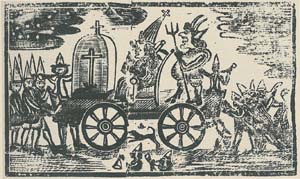
This is the Fifth of November, which Bostonians of the mid-1700s celebrated as “Pope Night.” Young men and boys would parade with what they called pageantry and we’d call floats: wagons decorated with giant puppets representing the Pope, the Devil, and political enemies of the day.

In 1769, the 5th was a Sunday, so Pope Night was piously observed on 6 November. Here’s a description of the pageantry from the 13 November issue of the Boston Evening-Post:
Description of the POPE, 1769.

Toasts on the Front of the large Lanthorn.
  Love and Unity. — The American Whig. —
  Confusion to the Torries, and a total Banishment to Bribery and Corruption.

On the right side of the same. —An Acrostick.
J nsulting Wretch, well him expose,
O ’er the whole World his Deeds disclose,
H ell now gaups wide to take him in,
N ow he is ripe, Oh Lump of Sin.
M ean is the Man, M—N is his Name,
E nough he’s spread his hellish Fame,
I nfernal Furies hurl his Soul,
N ine Million Times from Pole to Pole.
Who was John Mein, whose name was spelled out in that acrostic? He was publisher of the Boston Chronicle, the most vociferous pro-Crown newspaper in Boston.

Mein was also an immigrant, a Scotsman, and an associate of the Rev. Robert Sandeman, who had established a new sect of Protestantism in New England. All those things caused most Bostonians to view him with suspicion. He responded by mocking the local Whigs’ heroes, needling their sore spots, and exposing their hypocrisies.

On 29 Oct 1769 that conflict had come to a head as Mein got into a fight on the street with several Boston merchants. He fled to a British army barracks for protection and then went into hiding. Mein’s partner, John Fleeming, continued to put out their Chronicle newspaper, but Mein would soon leave Boston forever. And, judging by the Pope Night poem, not many locals missed him.

There will be more about Mein—how he had attacked another printer physically, and how John Hancock managed to put him out of business—in my talk at the Boston Public Library tomorrow evening. Come by and hear lots of gossip from “Boston’s Pre-Revolutionary Newspaper Wars.”

Monday, November 04, 2013

Reading the Massachusetts Gazettes

Among the essays posted at the blog for Brandeis’s “Rethinking the Age of Revolution” seminar is Cassandra Berman’s analysis of one newspaper from 5 Mar 1770—the day of the Boston Massacre.

Berman starts by quoting Jeffrey L. Pasley’s similar exercise on a single sheet of the 17 Dec 1794 issue of Greenleaf’s New York Journal and Patriotic Register: “Newspapers were so central an institution in the Founders’ world that it is possible to see almost the whole of their republic in this one example.” As for the Boston paper:
The front page contained news from London, important for connecting colonists to political events in England. On page two was a report from Virginia, of a ship captain named Ferguson who was recently imprisoned “for the murder of three of his crew, and a Negro boy of his own, at sea.” Page three contained a proclamation by Thomas Hutchinson, lieutenant governor of Massachusetts colony. . . .

Like today, eighteenth-century newspapers reserved the most pressing matters for the front page; the back, by contrast, was for advertisements and stories of a less urgent nature. . . . William Dennie offered “Jamaica sugars of the very first Quality, perhaps superior to any ever brought to this Market” – revealing Boston’s commercial interest in Caribbean sugar production, and Bostonians’ vested interest in Atlantic slavery. Timothy Kelley advertised his services as a “hair cutter and peruke maker” and boasted qualifications of “many years experience in the most eminent shops in London.” . . . And an unnamed “young woman” advertised “a good breast of milk,” hoping to “go into a Family in town to Suckle a Child” – indicating that women on the eve of revolution sought employment through breastfeeding, and opening up an interesting line of inquiry regarding women’s labor during a period in which their lives were greatly circumscribed.

In addition, the final page of the March 5, 1770 issue of the Massachusetts Gazette contained two letters, neither of which was concerned with commercial activity, but instead with the recent appearance of a comet in the night sky.
That mix and arrangement of content was typical of Boston newspapers in the decade before the Revolutionary War, as I’ll discuss in my talk at the Boston Public Library on Wednesday.

But what newspaper was Berman looking at? Unfortunately, two newspapers in pre-Revolutionary Boston used the words Massachusetts Gazette to start their titles, indicating that they shared the contract to promulgate the royal government’s proclamations (and therefore leaned toward the royal government in political controversies).

Historians have learned to distinguish those newspapers by the longer-lasting parts of their titles. The newspaper titled The Massachusetts Gazette, and the Boston Post-Boy and Advertiser in the early 1770s, as shown here, is therefore usually called The Boston Post-Boy. And The Massachusetts Gazette: And Boston Weekly News-Letter is simply The Boston News-Letter, the oldest continuously published paper in North America.

The 5th of March was a Monday in 1770, so the Massachusetts Gazette published that day, the one Berman described, was the Post-Boy.

If you think that situation was confusing, pity historians of Virginia. That colony had three newspapers in the 1770s titled The Virginia Gazette. And they had no distinguishing subtitles. Instead, when we cite those newspapers, we have to name their printers (who changed over the years).

Sunday, November 03, 2013

Many Revolutions at Brandeis This Year

To gain perspective on the American Revolution, it helps to consider it in context. And over the past generation historians have been broadening the contexts of their studies in all directions.

We thus have “the long 18th century,” which lets specialists in 18th-century history or literature claim some interesting bits of the late 1600s and early 1800s as well. We have “the Atlantic world,” which looks at all the empires and trading that straddled the Atlantic Ocean, not confined to one nation-state.

Put those together, and we get “the Age of Revolution(s),” usually said to start with the American Revolution and to include other revolutions partly inspired by it: French, Haitian, and South American. Brandeis University has recently launched a year-long seminar called “Rethinking the Age of Revolution” which expands the timeframe even further, back to Britain’s Glorious Revolution of 1688 and up through France’s 1830 Revolution (better known as “the exciting bits of Les Miz”).

This “Comparative Study of Culture” includes a blog in which various participants carry on the discussions from the seminar sessions. Among the postings, John Hannigan discusses how the South Carolina lawyer William Henry Drayton shifted his thinking about the nature of the American colonies’ resistance to the Crown over the course of the year 1776.

And in the process Drayton may have been the person who labeled what was going on “the American Revolution.” In a widely-reprinted charge to a grand jury on 15 Oct 1776, Drayton said, “Carolinians! heretofore you were bound. By the American Revolution you are now free.” (Of course, almost half the population of South Carolina was still bound, but Drayton was speaking to the white men of property who could serve on a jury.)

The next event in Brandeis’s yearlong seminar will take place on Thursday, 14 November. There will be a panel discussion on the topic of “People in Revolution” with presentations by:
  • Kathleen DuVal, University of North Carolina: “Middle (Wo)man History: Biographies of Slightly Important People in the Revolutionary Era”
  • Amy Freund, Texas Christian University: “Aux Armes, Citoyens! Portraiture and Political Agency during the French Revolution”
  • Emma Rothschild, Harvard University/University of Cambridge: “Family Life in Revolution: Angoulême in the 1790s”
That’s scheduled from 4:00 to 5:30 P.M. in the Mandel Humanities Center, room 303.

(The image above shows William Henry Drayton’s family seat, Drayton Hall in Charleston, South Carolina.)

Saturday, November 02, 2013

Mystery and Myth in Millis

A regional section of the Boston Globe recently reported on a talk by Paul LaCroix, president of the Millis Historical Society, about archeological explorations of a site called the Fairbanks Stone House. The property extends over the border to Sherborn.

The newspaper states:
Town records indicated that the Stone House, built in the 1640s as a garrison during a Native American uprising, was torn down in the late 1800s but its exact location was undocumented. . . .

LaCroix found large amounts of slag in addition to the 3-by-3-foot stone foundation of a “bloomery,” the type of furnace used in the 17th century for smelting iron. British policy at that time did not allow the independent manufacturing of products, requiring that all raw resources be exported from the Colonies.

Yet the sheer amount of iron found and the absence of any other iron works in the area indicate that the Stone House bloomery was open from as early as 1643 to as late as 1760, when the property became uninhabited. The first official integrated iron-production operation in North America, the Saugus Iron Works in Saugus, was in operation from 1646 to 1688. The existence of this bloomery in Millis is significant in understanding Colonial industrial activity.
The end of the article quotes LaCroix this way: “I’m not an archaeologist, I’m a history buff,” LaCroix said. “But I learned the hard way, and now I’m a fair hand at it.”

LaCroix did the digging with “family members, community volunteers and the expertise of local archaeologists and surveyors.” However, the article doesn’t include comments from any full-time archeologists or historians. I’d be interested in knowing what they think of those conclusions.

Millis also claims a tavern where George Washington stopped on his way to Cambridge in 1775, shown above. This is apparently based on an unsourced statement by the Rev. E. O. Jameson in The History of Medway, Mass., 1713-1885, published in 1886. (Millis had been East Medway until that year.) Jameson wrote that Moses Richardson (1740-1826) had “kept a public house on the old Mendon Road, where George Washington dined on his way to Cambridge, Mass., in 1775.”

Gen. Washington’s visit seems unlikely since he traveled from Springfield through Worcester to Watertown, and that road didn’t go through Medway/Millis. Washington’s journey away from Cambridge in 1776 took him through Providence, so he probably didn’t see Richardson’s tavern then, either. (See maps here.)

Friday, November 01, 2013

Conference on Revolutionary Women Coming Up in 2014

Next June, the Sons of the American Revolution will hold its annual conference in Colonial Williamsburg, and its theme will be “Women in the Era of the American Revolution.”

The organization is now inviting papers for presentation at the event. The announcement says that conference
will examine and reconsider our understanding of the lives of women during a time of political and economic upheaval, social change, and armed conflict that we call the “era of the American Revolution.”

Papers may examine any dimension of women’s lives and gender roles at this time. During a period of significant disruptions in daily life and changed expectations of what a woman’s place in a marriage, the household, and the community “ought” to be, they assumed multiple roles. They displayed patriotism by supporting boycotts of British goods and encouraging manufacturing at home; they raised funds to feed and clothe the troops; they supported the family by managing the farm or family business while a husband fought; some followed the armies in supporting roles; and some were soldiers. Others remained loyal to the British crown.
And presumably displayed their own patriotism by doing so.
Over these years, they wrote poetry, essays, plays, and fiction, exchanged letters with family members and friends, and kept journals. These records, public and private, yield countless stories that allow us to construct a fuller, more complex, narrative of the period.

The papers should explore in the broadest sense the war’s impact on women’s lives. They may focus on individuals or women as a group, and they need not be strictly confined to the years between the Stamp Act and the Treaty of Paris. The topics may reach back into the colonial era or up into the early nineteenth century as long as they demonstrate a connection to the events of the Revolution. We anticipate that the conference will provide an opportunity and a congenial forum in which to recognize and build upon the pioneering scholarship of generations of historians and at the same time we hope that it will stimulate new research by junior scholars. The resulting conversations and debates will contribute to the critical ongoing effort to understand women’s lives and experiences during the era of the American Revolution.
The conference is scheduled for 20-22 June 2014. The deadline for delivering proposals to Barbara Oberg of Princeton University is 1 December, and those proposals should include “a 250-word abstract and a short C.V.” If your paper is accepted, the S.A.R. will cover travel and lodging costs and offer a $500 honorarium. Plans call for the papers eventually to appear in an edited volume.

This conference is co-sponsored by the Omohundro Institute of Early American History and Culture and will be dedicated to the late Pauline Maier, a leading historian of Revolutionary America (who reportedly did not have much interest in women’s history as a separate field).

For guidance on topics and approach, here are links for the last four conference programs.