J. L. BELL is a Massachusetts writer who specializes in (among other things) the start of the American Revolution in and around Boston. He is particularly interested in the experiences of children in 1765-75. He has published scholarly papers and popular articles for both children and adults. He was consultant for an episode of History Detectives, and contributed to a display at Minute Man National Historic Park.

Subscribe thru Follow.it


•••••••••••••••••


Tuesday, October 20, 2015

Panel on Washington in Roxbury, 24 Oct.

On 3 May 1797, Rufus King, then in London as the U.S. minister to Great Britain, wrote this in his diary:
Mr. [Benjamin] West called on me—we entered into politics after speaking of the Dinner at the Royal Academy and of the annual exhibition; Mr. West said things respecting Amer. had changed very much; that people who cd. not formerly find words of unkindness enough now talked in a different language; that the King had lately spoken in the most explicit manner of the wisdom of the American Gov. and of the abilities and great worth of the characters she produced and employed. He said the King had lately used very handsome expressions respecting Mr. [John] Jay and ——— and that he also spoke in a very pleasing manner of Mr. [Christopher] Gore.

But that in regard to Genl Washington, he told him since his resignation that in his opinion “that act closing and finishing what had gone before and viewed in connection with it, placed him in a light the most distinguished of any man living, and that he thought him the greatest character of the age.”
Two years later, on 28 Dec 1799, the British painter Joseph Farington called on West, and the older man began telling stories about British-American relations. According to Farington’s diary, West described this conversation with George III at some unspecified time toward the end of the war:
The King began to talk abt. America. He asked West what would Washington do were America to be declared independant. West said He believed He would retire to a private situation.—The King said if He did He would be the greatest man in the world.
West might have amalgamated his conversations with the king, but it’s clear that by the late 1790s George III firmly admired Washington for how he stepped away from positions of authority.

On the afternoon of Saturday, 24 October, the Shirley-Eustis House in Roxbury will host a panel discussion about Washington’s recurrent decision to give up power: “George Washington: The Ruler Who Would Not Be King.” The panelists include:
  • Dr. Robert Allison, chair of the History Department at Suffolk University and author of numerous histories of the Revolution.
  • Dory Codington, author of the Edge of Empire series of novels.
  • Stephanie Davis, journalist and founder of Embedded Systems of Boston.
The event begins at 3:00 P.M. Refreshments will be served in the second hour. Admission is $10 in advance, $15 at the door. Register through Eventbrite.

Monday, October 19, 2015

“It is the indispensable duty of these colonies”

By 19 Oct 1765, the Stamp Act Congress had been meeting and debating for over a week and a half. What sort of debate did they have? We have no idea. Clerk John Cotton’s record reads like this:
Wednesday, Oct. 9th. 1765, A.M. — Then the congress met according to adjournment. The congress resumed the consideration of the rights and privileges of the British American colonists, &c, the same was referred after sundry debates, for further consideration.

Then the congress adjourned until to-morrow morning, 11 o’clock.

Thursday, Oct. 10th, 1765, A.M. — Then the congress met according to adjournment, and resumed, &c, as yesterday — and then adjourned to 10 o’clock, to-morrow morning.
Repeat the entry for 10 October verbatim for the 11th, 12th, 13th, and so on through the 18th. (The delegates took Sunday the 15th off.)

Then a breakthrough on the 19th!
The congress met according to adjournment, and resumed, &c. as yesterday; and upon mature deliberation, agreed to the following declaration of the rights and grievances of the colonists in America, which were ordered to be inserted.
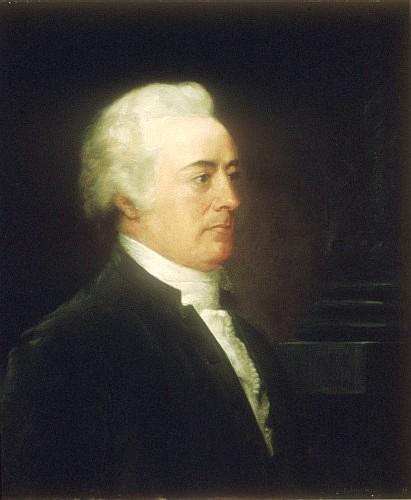
That Declaration of Rights and Grievances was drafted by John Cruger (1710-1791, shown above), mayor of New York and speaker of the New York assembly. The document had thirteen points, but the argument was basically threefold:
  • British colonists had the same rights as people in Britain itself.
  • Those rights included not being taxed without the consent of their own legislature, rendering the Stamp Act unconstitutional.  
  • And besides, the Stamp Act hurt the American economy and thus the whole empire.
The declaration concluded:
Lastly, That it is the indispensable duty of these colonies to the best of sovereigns, to the mother country, and to themselves, to endeavor, by a loyal and dutiful address to his majesty, and humble application to both houses of parliament, to procure the repeal of the act for granting and applying certain stamp duties, of all clauses of any other acts of parliament, whereby the jurisdiction of the admiralty is extended as aforesaid, and of the other late acts for the restriction of the American commerce.
In other words, by opposing the Stamp Act in every way, the men at that congress and elsewhere in America weren’t really defying the king, Parliament, and the British constitution. They were standing up for that system, “protestant succession” and all. It was even their duty to get the Stamp Act repealed! This remained the basis of American Whig thinking right up through the beginning of the war.

Some pre-war Whigs, such as John Cruger himself, never made the jump to believing that the only way to preserve the principles underlying that British constitution was to break with Britain entirely. He voted against the proceedings of the First Continental Congress in 1774 and soon retired from politics, sitting out the war in Kinderhook.

COMING UP: Three messages to Great Britain.

Sunday, October 18, 2015

Revolutionary Talks at the A.A.S. this Fall

The American Antiquarian Society in Worcester has a bunch of interesting public lectures in the next few weeks.

Thursday, 22 October, 7:00 P.M.
Linda K. Kerber, “Looking Back on Women of the Republic
Each year the Annual Robert C. Baron Lecture brings a distinguished A.A.S. member who has written a seminal work of history to Antiquarian Hall to reflect on the book’s impact on scholarship and society in the years since its first appearance. This year, Linda Kerber will discuss her 1980 book, a landmark study of American political thought and women’s roles in the new nation.
Friday, 23 October, 5:30 P.M.
Richard H. Brown, “Dispatches from the Front Lines: Maps and Views of the American Revolutionary Era”
In this illustrated lecture, Brown will examine rare and beautiful full-color maps and images created on the scenes of battles from the French and Indian War through the American Revolution. This lecture is based upon the recently published book Revolution: Mapping the Road to American Independence, 1755-1788 by him and Paul E. Cohen.
After Brown spoke at the Boston Public Library last month, Charles Bahne wrote me to say it was “a really great lecture, one of the best I’ve heard in a long time.”

Thursday, 5 November, 7:00 P.M.
Robert J. Allison, “The Birth of the Liberty Tree
What were the long-term consequences of Boston’s resistance to the Stamp Act? A broad mobilization of Bostonians demolished property and forced Crown officials to resign; the British government rescinded the law; and both sides felt they had averted a bigger crisis. But had they? We will commemorate the 250th anniversary of the Stamp Act with this lecture that examines the importance of the Stamp Act Crisis, both for those who lived through it and for future generations.
Friday, 20 November, 7:00 P.M.
Wendy Bellion, “Representing Iconoclasm: Paint, Print, Performance”
This talk will explore nineteenth-century representations of colonial iconoclasm, such as the 1776 destruction of a statue of King George III in New York, and the re-performance of that action in civic pageants and parades, which often included ephemeral reproductions of the destroyed statue.
Bellion’s lecture is also the keynote address for the CHAViC fall conference.

These talks are open to the public free of charge. All take place in Antiquarian Hall at 185 Salisbury Street. Parking is available on the streets nearby.

Saturday, October 17, 2015

The Birth of an Iroquois Constitutional Legend

Like any good fiction writer, Richard Barry didn’t just describe a dramatic meeting between John Rutledge and Sir William Johnson in 1765 and leave it there.

He also returned to the moment hundreds of pages later, when Rutledge was a delegate to the Constitutional Convention of 1787 and chairing its Committee of Detail (which Barry called by a different name):
At the first meeting of the Drafting Committee, on the morning of July 27, in Independence Hall, Rutledge, as chairman, drew from his pocket a parchment, which had never been referred to in the Convention or by any of the delegates outside, and read it aloud.

It was a replica of the constitution of the Treaty of the Five Nations (the Iroquois) of 1520. Rutledge read what the Indians had written more than two and a half centuries before: “We, the people, to form a union, to establish peace, equity and order. . . .”

The chairman made no speech. He merely read the dry, quaint, and archaic words of the Indian parchment. The inference lay in the act. [Charles] Pinckney, [James] Madison, [William] Paterson, and the others had gone back through England and Greece. The fruit of their research lay to hand in the documents on the table. They would be utilized. But for the first brief moment Rutledge was saying to his committee, in effect: We are American, of this soil and none other.
Barry’s citations offer no source for this anecdote, and we skeptical readers shouldn’t accept such claims without evidence. As I noted yesterday, Barry’s statement that Rutledge had discussed the Iroquois form of government with Sir William Johnson in October 1765 doesn’t hold up to scrutiny.

Furthermore, words on “a parchment” wasn’t how the Iroquois Great Law of Peace worked. The Five Nations hadn’t “written” anything in 1520 (or in whatever year they allied); they didn’t have a written language yet. Wampum belts served as memory aids for the agreement but didn’t preserve exact language. English interpretations of the Great Law of Peace don’t start with “We, the people,…” but with the first-person voice of Dekanawidah, the Great Peacemaker.

Finally, Rutledge’s Committee of Detail didn’t even draft the Preamble to the U.S. Constitution, the part that starts “We the People of the United States, in Order to form a more perfect Union…”—phrasing supposedly adapted from that mythical Iroquois parchment. The first draft of the Preamble came out of the Committee on Style and Arrangement weeks later.

The gaping holes in Barry’s story didn’t stop Charles L. Mee, Jr., from repeating it briefly in The Genius of the People (1987), a popular history of the Constitution. Donald A. GrindĂ© and Bruce E. Johansen then used that “evidence” in their argument in Exemplar of Liberty: Native America and the Evolution of American Democracy (1991) that the example of the Iroquois Confederacy influenced the Founders of the U.S. of A.

The popularity of that thesis in some circles appears in turn to have inspired Joy Hakim to go back to Barry’s book for the tale of Rutledge and Johnson, which she retold in A History of US: From Colonies to Country. That school textbook, published by Oxford University Press, is well regarded. It does a good job of getting beyond traditional power structures to tell the story of the whole American nation. However, in this instance the author was misled by a biographer who had just made stuff up.

Friday, October 16, 2015

Did John Rutledge Meet Sir William Johnson in 1765?

As quoted yesterday, Richard Barry’s 1942 biography of John Rutledge described in dramatic detail how that South Carolina jurist met Sir William Johnson (shown at right, in red), the British Empire’s representative to the Six Nations.

According to Barry, Rutledge was in New York for the Stamp Act Congress in October 1765, and Johnson was making his yearly visit to the city with a retinue of Iroquois warriors.

Barry directly quoted Johnson’s joke about the congress, but he didn’t provide any specific citations for those words. Instead, his notes were general, pointing to the Thomas Addis Emmett Collection on the Stamp Act Congress in the New York Public Library, the Laurens Papers at the Long Island Historical Society [now at the Kendall Whaling Museum], and the Rutledge Family Papers at the Historical Society of Pennsylvania.

But we don’t have to go through all those archives to check Barry’s story. We can look at Sir William Johnson’s papers in the New York state library. In 1909 the state published a Calendar, or chronological list, of that correspondence. Two years later, that institution suffered a disastrous fire. In the 1920s, New York published transcripts of the surviving Johnson documents.

Both the Calendar of the Sir William Johnson Manuscripts and the published correspondence show that in October 1765 Johnson was writing letters from Albany and from his home at Johnson Hall, another hundred miles farther from New York City. He was nowhere near the Stamp Act Congress. (One of Sir William’s sons was in New York on 12 October, heading to Britain, according to a letter by John Watts.)

Furthermore, there’s no mention of a large body of Native American men camping north of New York in the city newspapers for that month. Merchant Thomas Ellison wrote a series of letters about events in the city that year, and the Iroquois didn’t come up.

Barry’s book turns out to be full of other refutable claims, stories without evidence, and outlandish interpretations. When he wrote John and Edward Rutledge of South Carolina (University of Georgia Press, 1997), James Haw wrote: “The only previous biography of John Rutledge, Richard Barry’s Mr. Rutledge of South Carolina, is unreliable. I have followed the advice of Professor George C. Rogers, Jr., to ignore Barry’s book.”

TOMORROW: And yet the Rutledge-Johnson meeting is in a respected textbook today.

Thursday, October 15, 2015

A Legendary Meeting at the Stamp Act Congress

Here’s a lively picture of events during the Stamp Act Congress, which took place in New York two and a half centuries ago this month.

It comes from the pages of Richard Barry’s Mr. Rutledge of South Carolina, a biography of delegate John Rutledge (shown here) published in 1942.
The day after Rutledge put up at the Kings Arms Inn, New York was startled by the arrival of two hundred Indians, heavily armed, but without war paint and in holiday attire. They came down the Albany Post Road as the retinue of Sir William Johnson, High Commissioner of His Majesty to the Six Nations, who was arriving from his castle a hundred miles beyond Albany for his annual visit.

John Rutledge hired a coach and rode out to the Mohawk camp to call on Sir William. As Rutledge entered the tent of the High Commissioner, nude red braves, Seneca warriors, lifted the flap. The visitor had never seen such native males, sleek, alert, silent.

“I see you’ve come to comb the King’s hair!” Sir William shouted as he greeted the young southerner. “Good! Only don’t take his wig off!” He laughed uproariously.

After they had talked a while, Rutledge wanted to know about the operation of the Hodenosenee, the parliament of the Six Nations. Sir William explained: each nation was sovereign internally, but externally, especially in war, the council of sachems was supreme; this gave individuality to six nations, yet they had the united strength of one; the autocratic power granted the chiefs in war was for limited periods and was not hereditary.

“If England is ever to become a great nation,” the High Commissioner summed up, “she must go to school to the Iroquois. The Six Nations control this continent, not by accident, but through the triumph of their science of government. If it had a chance their system could master Europe—or the world.“
Rutledge eventually chaired the congress’s committee to write a petition to the House of Lords, one of three documents it created. His biographer therefore claimed that “JR caused George III to repeal the Stamp Act.” As you might guess, Barry did not have a high threshold of evidence for what he wrote about Rutledge.

In fact, that story about Rutledge, Johnson, and the Iroquois visitors in New York is complete bunkum.

TOMORROW: Negotiating the burden of proof.

Wednesday, October 14, 2015

The Expiring Maryland Gazette

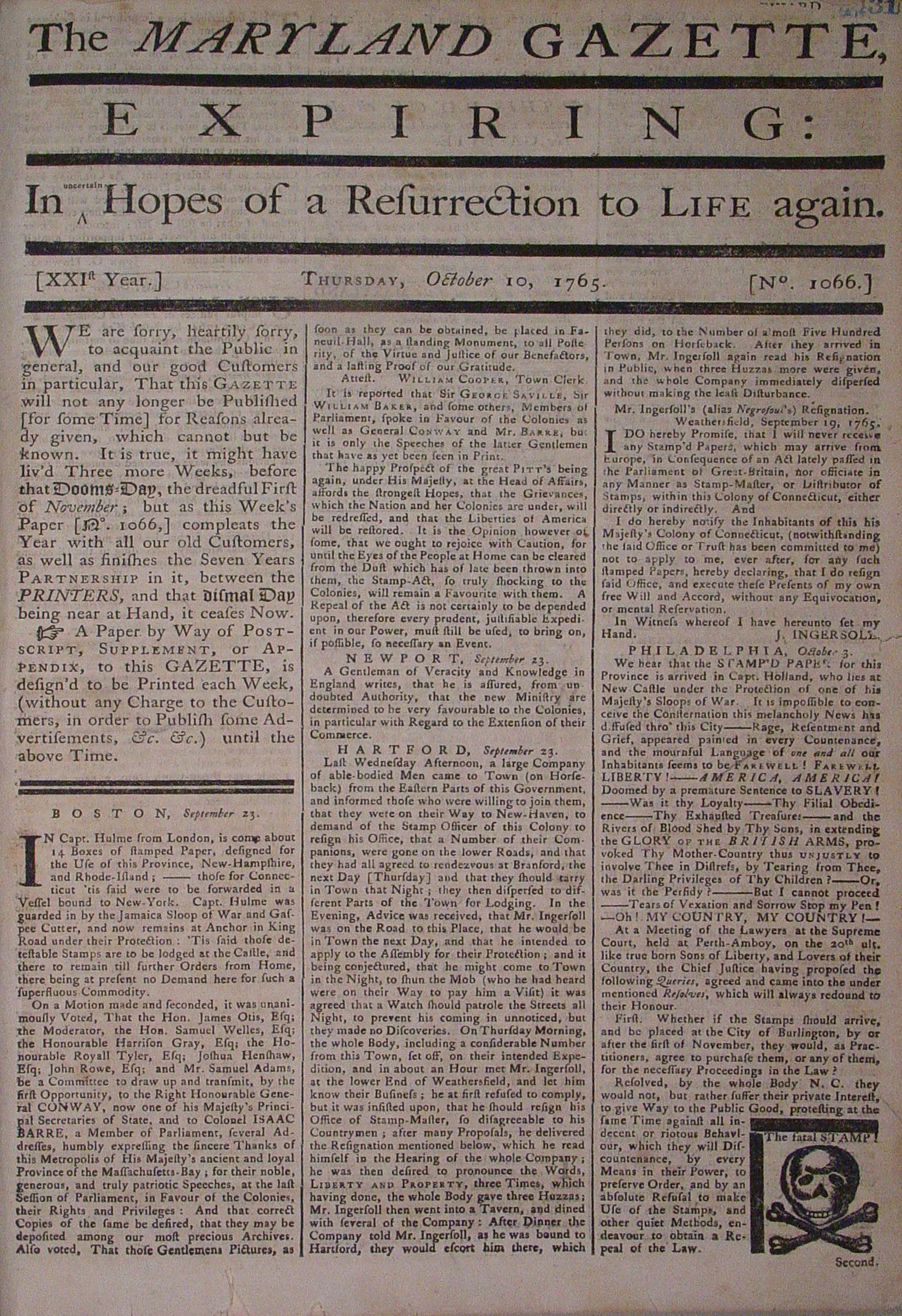
Yesterday I showed an image of the 5 Sept 1765 Maryland Gazette. In the lower right corner, publisher Jonas Green put an image of a skull and crossbones with the label, “Hereabouts will be the place to affix the STAMP.”

Green continued to run that image in the corner of his paper, with different captions, for another few weeks as a warning against the impending Stamp Act. Finally, on 10 October, he issued The Maryland Gazette, Expiring, blaming “The Fatal Stamp” for his decision to close the newspaper.

Green revived the Gazette in early 1766 once it was clear that the Stamp Act was a dead letter. He died the following year, and his Holland-born widow Anne Catherine Green continued the business until the eve of the war.

This University of Maryland website says the Greens had previously used that skull-and-bones woodcut to draw attention to prominent obituaries. The webpage continues, “When Archaeology in Annapolis excavated the remains of their print shop, the piece of type used to create the image on the front page was recovered.”

Tuesday, October 13, 2015

Annapolis Commemorates the Stamp Act Protests, 19-25 Oct.

On 26 Aug 1765, the same day that Bostonians tore apart Lt. Gov. Thomas Hutchinson’s home in the North End, Annapolis saw its first public protest against the Stamp Act.

Following the model of the widely reported demonstration in Boston on 14 August, Marylanders built an effigy of their colony’s stamp agent, Zachariah Hood, and then ritually destroyed it. This is the account from the Maryland Gazette, published by Boston native Jonas Green:
Monday morning last, a considerable number of people, assertors of British American privileges, met here to show their detestation of, and abhorrence to, some late tremendous attacks on liberty, and their dislike to a certain late-arrived officer, a native of this Province. They curiously dressed np the figure of a man, which they placed on a one horse cart, malefactor-like, with some sheets of his paper in his hands before his face.

In this manner they proceeded through the streets of town till noon, the bells at the same time tolling a solemn knell, when they proceeded to the hill; and after giving it the Mosaic law [i.e., thirty-nine lashes] at the whipping-post, placed it in the pillory, from whence they took it and hung it to a gibbet erected for that purpose, and then set fire to a tar-barrel underneath, till it fell into the barrel. By the many significant nods of the head while in the cart, it may be said to have gone off very penitently.
Among the people who led that event was twenty-four-year-old lawyer Samuel Chase. The next year, members of the local political establishment called him “a foul-mouthed and inflaming son of discord and faction.” Chase went on to be a signer of the Declaration of Independence, Chief Justice of Maryland, and an Associate Justice of the U.S. Supreme Court, surviving impeachment in 1805.

Zachariah Hood himself wasn’t in Annapolis to see his effigy. He arrived from London a few days later, met by an angry crowd. In September another mob burned one of his warehouses. Meanwhile, other Maryland towns—Baltimore, Elk Ridge, Fredericktown—burned him in effigy. Hood fled to New York City, then Flushing. Tracked down by local activists in a show of continental solidarity, he finally resigned as Maryland’s stamp agent on 28 November.

Historic Annapolis will commemorate those events with Sons of Liberty Week on 19-25 October. The schedule includes:
  • Lecture and panel discussion on “Freedom of the Press Then and Now,” with historian Glenn Campbell and several present-day journalists.
  • Revolutionary Annapolis Walking Tour.
  • Reenactment march up Main Street on Sons of Liberty Day, 25 October.
  • Revolutionary Festival at the William Paca House and Garden.
  • Exhibit of the Maryland Gazette at the Historic Annapolis Museum.
  • Hand-printed broadsides from the Maryland Hall for the Creative Arts.
In addition, the organizers promise “Public Outbursts” throughout the week: “costumed re-enactors will appear at random throughout the Annapolis historic district in October to exhort townspeople and visitors to join the rebellion.”

Monday, October 12, 2015

Talks by Anderson and Kamensky at the B.P.L.

This month the Boston Public Library will host two lectures on the American Revolution, one by a novelist whose latest book is nonfiction, and one by a history professor who has cowritten a novel.

Wednesday, 14 October
M. T. Anderson, “A Revolution Within the Revolution: The African-American Struggle for Freedom”
Anderson has written stories for adults, picture books for children, adventure novels for young readers, and award-winning books for older readers. His highly praised Octavian Nothing saga is set in Boston during the American Revolution; the first volume, The Pox Party, won the National Book Award for Young People’s Literature in 2006 and both the first and second volumes of that two-part series were Printz Honor Books. Meticulously researched and presented in 18th-century prose, Anderson’s sweeping 900-page epic explores race, science, morality, and the darker facets of America’s quest for liberty.
Wednesday, 28 October
Jane Kamensky, “John Singleton Copley and the Sideways American Revolution”
Professor of History and Pforzheimer Foundation Director of the Schlesinger Library on the History of Women in America at the Radcliffe Institute of Advance Study, Kamensky is a historian of early America, the Atlantic world, and the age of revolutions, with particular interests in the histories of family, culture, and everyday life. Kamensky’s major publications include The Exchange Artist: A Tale of High-Flying Speculation and America’s First Banking Collapse (Viking, 2008), a finalist for the 2009 George Washington Book Prize; and Governing the Tongue: The Politics of Speech in Early New England (Oxford U.P., 1997). With Edward G. Gray, she edited the Oxford Handbook of the American Revolution (Oxford U.P., 2012). Her next book, Copley: A Life in Color, will be a history of painting and politics in the age of revolution centered on the life of John Singleton Copley.
Both talks are scheduled to begin at 6:00 P.M. in the Abbey Room. That’s the one with the impressive murals.

Sunday, October 11, 2015

Chasing Down an Unsuccessful Suitor

After I read the exchange of letters between Gov. Thomas Hutchinson and William Fitzwilliam on 6 Apr 1771, I decided to track down who this young suitor was.

For a long time I was stymied because the most prominent “Lord Fitzwilliam” of the time was the fourth Earl Fitzwilliam (1748-1833), an active member of the House of Lords who voted with the Rockingham Whigs. He was a nephew and, in 1782, heir of the Marquess of Rockingham. He was also some sort of cousin to Gov. John Wentworth of New Hampshire. He appears here in a portrait by Joshua Reynolds.

But in 1771 the fourth Earl Fitzwilliam was only in his twenties and therefore couldn’t have had a son seeking a bride in Boston.

Then in the Irish peerage I came across the sixth Viscount Fitzwilliam of Meryon or Merrion (1711-1776), and the puzzle pieces fell into place. That less prominent and lower-ranking Lord Fitzwilliam had four sons; according to Wikipedia (but not older print sources), all but one of those men eventually succeeded to the title without leaving more sons, so the peerage disappeared.

The only son of the sixth viscount who never got to be a viscount was the second, the Hon. William Fitzwilliam (1749-1810). He was the right age for the Boston wooer, though I can’t confirm that he was in Boston in 1771. Some Hutchinson biographers who have written about Fitzwilliam have assumed he was an officer in the Royal Navy, but I haven’t found evidence for that.

I did confirm a connection between the Hon. William Fitzwilliam and George Onslow, the British politician who thanked Gov. Hutchinson for how he’d handled this affair. Hutchinson wrote that Onslow was Fitzwilliam’s uncle. The relationship wasn’t that close. Onslow’s wife was Henrietta Shelley, a granddaughter of Sir John Shelley, third baronet of that line. Sir John’s only daughter, Frances, had married the fifth Viscount Fitzwilliam, the grandfather of the young wooer. That makes Onslow the husband of the Hon. William Fitzwilliam’s first cousin, once removed.

The Hon. William Fitzwilliam eventually did marry, in August 1782, to the only daughter of John Eames (c. 1716-1795), a master of chancery and tax commissioner. Aside from that marriage and his death, I haven’t been able to nail down any more facts about the man.

Fitzwilliam’s unsuccessful proposal of marriage was first published in James K. Hosmer’s 1896 biography of Hutchinson, then reprinted as a curiosity in several American newspapers. Probably not how he’d have wished to be remembered.

Saturday, October 10, 2015

“A person more suitable to your birth & rank”

Yesterday I quoted a letter that Gov. Thomas Hutchinson received from William Fitzwilliam on 6 Apr 1771, asking for his youngest daughter Peggy’s hand in marriage.

As I said, Hutchinson knew that that young man was the son of a nobleman back in Britain. For many colonial politicians, the prospect of allying his family with the imperial aristocracy would have been very enticing.

Hutchinson wasn’t that sort of person. He loved his daughter dearly, and he also loved his late wife, who had died giving birth to her. He no doubt knew that the marriage of two young people who had never even spoken was unlikely to lead to happiness. A native Bostonian, Hutchinson collected offices at home but showed no ambition to join the noble class in Britain.

The governor was also a firm believer in the social order, and that gave him a way to let Peggy’s suitor down easy. He wrote back the same day:
I am not insensible that such an Alliance as you have proposed would be doing the greatest honour to me & my Family.

I am at the same time very sensible that it cannot be approved of by the Noble Family to which you belong—In my station, from Respect to My Lord FitzWilliam I should think it my duty to do all in my power to discourage one of his Sons from so unequal a match with any person in the Province and I should most certainly be highly criminal if I should countenance & encourage a match with my own daughter

I hope Sir you will think this a sufficient reason for my not acceding to your proposal & sincerely wish you happy in a person more suitable to your birth & rank & who may be approved of by your Honorable Parent

I have the honor to be
Sr. Yr. most obedt.
humble Sert.
Thomas Hutchinson
This action turned out to benefit Gov. Hutchinson in a small way. On 8 Nov 1774, after moving to London, he visited the British politician George Onslow. At the end of that conversation, which seems to have been full of mutual flattery, came this exchange, as Hutchinson recorded it in his diary:
He thanked me for conducting an affair of his nephew, Ld FitzWilliam’s son, in America. I had forgot he was his nephew. He hoped to cultivate an acquaintance, &c.
Peggy Hutchinson joined her father in London. She died three years later, never having married.

TOMORROW: Who was William Fitzwilliam?

Friday, October 09, 2015

“I have had the honor of seeing miss Hutchinson”

Among the creepier items in the Massachusetts Archives is this letter to Gov. Thomas Hutchinson from 1771:
Sir

The various methods there are of writing on the following subject, makes me rather at a loss which to take, as I am a stranger to you,—but as the nature of it requires plain dealing, I shall take the liberty to consider you as a friend, and write to you as such:—

You will prehaps Sir think it rather strange, and be much surprised at the receipt of this letter; particularly as I am going to ask a great favor;—no less Sir than the honor of an alliance to your family;—

I have had the honor of seeing miss Hutchinson, but never in my life spoke to her—I need not tell you I admire her, when I say I wish to call her mine;—on seeing her the first time, I determin’d to endeavour to cultivate her acquaintance, but have not been so happy as to succeed;—therefore I should wish as the most honorable method of proceeding, to get acquainted with her through the means of her Father; and I should be happy in obtaining your permission Sir to visit her:—

I would more on the occasion, but yet not near so much as what I could say to you in person;—therefore Sir if you’ll favor me with a line, directed to me at Mr Perkins near the old Brick meeting House, I will do myself the honor of waiting on you, any time you’ll apoint.

You will find me act, from beginning to end, as a man of honor, and I am very certain that you, on your part, will do the same:

I have the honor to remain with the utmost esteem and respect
Sir
Your very obedient and
most hble Sert.
Wm. Fitzwilliam

April ye. 6th 1771
“Miss Hutchinson” was the governor’s favorite daughter, Peggy, born in 1754 and thus only in her late teens. What were Hutchinson’s thoughts as he read this young man’s expression of interest in marrying her when he’d never even spoken to her?

Complicating matters was Fitzwilliam’s social standing—he was the son of a British peer, and thus an enticing prospect for a colonial politician with social ambitions.

TOMORROW: The governor’s reply.

Thursday, October 08, 2015

The Choice between Ruggles and Otis

One of the first acts of the Stamp Act Congress when it convened in New York in October 1765 was to elect a chairman.

Arguably, that was the first political office to derive its authority from the thirteen colonies that would form the U.S. of A. eleven years later. Even if only nine of them had actually sent delegates to that congress, the others (plus Nova Scotia) at least got an invitation.

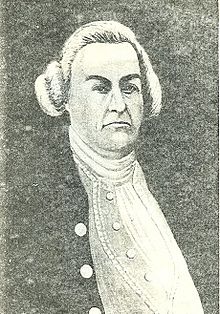
The winner of the vote was Timothy Ruggles (1711-1795, shown here), brigadier in the Massachusetts militia. According to the New York merchant John Watts, writing to a friend:
Brigr. Ruggles is Chairman, [James] Otis aimed at it and would have succeeded but they thought as he had figured much in the popular way, it might give their meeting an ill grace, but it is observed Otis is now a quite different man, and so he seems to be to me, not riotous at all.
Nearly forty years later, delegate Thomas McKean of Delaware recounted his version of events to John Adams, starting:
In the congress of 1765 there were several conspicuous characters: Mr; James Otis appeared to me to be the boldest and best speaker.—I voted for him as our President, but Brigadier Ruggles succeeded by one vote, owing to the number of the committee from New-York, as we voted individually
The record of the Stamp Act Congress states that the delegates chose Ruggles, and suggests the vote wasn’t unanimous, but it doesn’t mention any other candidates or any vote count. No delegates kept diaries or sent gossipy letters that have survived. Thus, there’s no contemporaneous evidence to confirm or refute McKean’s recollection. (More on his claims to come.)

As its clerk, the congress chose John Cotton (1728-1775), who was deputy secretary of the province back in Massachusetts, as well as registrar of wills in Suffolk County. Cotton was also half-brother to Lt. Gov. Thomas Hutchinson’s late wife and to the wife of former stamp agent Andrew Oliver, who was also his boss in the secretary’s office. In 1770 Hutchinson called Cotton “attached to Government and serviceable so far as his Sphere would permit.” He continued to hold offices in the royal bureaucracy until he died of the flux inside besieged Boston.

Cotton’s record of the congress is very spare, recording only the actions the body agreed to and not the preceding proposals, debates, and amendments. As their first procedural decision, later that first day, the delegates decided that each colony should have one vote, a precedent that remained for the Continental Congress of the 1770s. If McKean’s memory was accurate, then that form of voting would have made Otis the chairman instead of Ruggles.

Wednesday, October 07, 2015

When the Stamp Act Congress Convened

On 7 Oct 1765, the Stamp Act Congress convened at City Hall in New York (shown here). It was a week behind schedule.

As proposed by the Massachusetts House of Representatives back in June, this was a convention of delegates from the colonial legislatures of North America to come up with a common response to the Stamp Act.

Royal governors had done their best to stymie legislatures’ plans to participate in the congress, mostly by declining to convene those legislatures in time to choose delegates.

As a result, in Delaware, New York, and New Jersey legislative leaders chose delegates through committees or in meetings held without the governors’ approval. Other colonies, including the oldest and most populous, Virginia, couldn’t finagle a way to send anyone. Out of fourteen colonial legislatures invited (including Nova Scotia), only nine had representatives at the congress.

Massachusetts was one of those nine, but royal governor Francis Bernard was confident that he had things under control, as he reported to the Board of Trade in London on 8 July 1765:
It was impossible to oppose this Measure [for the congress] to any good purpose: and therefore the friends of Government took the lead in it, & have kept it in their hands; in pursuance of which, of the Committee appointed by this house to meet the other Committees at New York on the first of Octr. next, Two of the three are fast friends to Government & prudent & discreet men, such as I am assured will never consent to any undutiful or improper applications to the Government of great Britain. It is the general Opinion that nothing will be done in consequence of this intended Congress: but I hope I may promise myself that this province will act no indecent part therein.
The three Massachusetts delegates were all members of the committee that had recommended proposing the congress:
Probably because Massachusetts had instigated the meeting, there seems to have been consensus among the delegates that their chairman should be from that colony. But which man?

TOMORROW: America’s first national election?

Tuesday, October 06, 2015

Archibald Robertson’s Views of Besieged Boston

I was delighted to discover last week that the New York Public Library’s digital image collection includes the illustrations from Archibald Robertson: His Diaries and Sketches in America, 1762-1780, published in 1930.

The image above is labeled “View of Boston 4th Janry 1776 taken from the epaulment of the citadel on the heights of Charles Town”—i.e., the fort that the British army built on Bunker’s Hill. From the same point, Robertson (c.1745-1813) created a series of images of the Continental-held countryside. As an officer in the Royal Artillery, he had practice in studying and sketching landscapes, and inside besieged Boston he had a lot of time on his hands.

Robertson’s other pictures include views from Copp’s Hill in the North End and a study of the Boston Neck. There’s a “Sketch of the burning of the houses on Dorchester Neck, by our troops who went & returned upon the ice. 14 January, 1776.” and a “Sketch of the burning & destroying of Castle William in Boston Harbour” after the evacuation. Some are more stylized than others, with human figures in the foreground.

And there are some views of New York, Halifax, and other places, but who cares about seeing those?

Monday, October 05, 2015

A Mystery Button from “Parker’s Revenge”

Last week I showed this photo of an artifact found during the archeological study of the “Parker’s Revenge” area in Lexington. On Saturday I attended Dr. Meg Watters’s progress report on that work, which included a better photo of this item, and I was quite intrigued.

I flipped the available photo upside-down to make it a little easier to interpret. It’s a cast-copper button of the size that might be used on the front of a man’s waistcoat or at the knees of his breeches.

On the lower half of the button, apparently in the foreground, is what looks like a fox running from right to left. Above that shape is a horizontal ridge; the right light reveals that to be a bridge. On either side are a series of oval blobs, getting smaller as they rise; those are stylized trees. And in the top rear, the starry shape is a windmill with a vertical tower and four sails.

The mystery is that no one has been able to identify similar iconography on any other artifact, or identify what this scene or collection of symbols might mean. Fox, bridge, windmill, trees. Does that scene represent a family, a military unit, a hunting club?

Sunday, October 04, 2015

Lecture on James DeWolf in Newport, 8 Oct.

On Thursday, 8 October, the Newport Historical Society will host a talk on “James DeWolf and the Rhode Island Slave Trade” by author Cynthia Mestad Johnson.

DeWolf (1764-1837) was a teen-aged sailor on privateers toward the end of the Revolutionary War. After the peace, he became a merchant captain and then a merchant focusing on a particular type of import:
Over thirty thousand slaves were brought to America on ships owned and captained by James DeWolf. When the United States took action to abolish slavery, this Bristol native manipulated the legal system and became actively involved in Rhode Island politics in order to pursue his trading ventures. DeWolf’s political power and central role in sustaining the state’s economy allowed him to evade prosecution from local and federal authorities—even on counts of murder.

Through archival records, author Cynthia Mestad Johnson uncovers the secrets of James DeWolf and tells an unsettling story of corruption and exploitation in the Ocean State from slave ships to politics.
Johnson will sign books after her talk. Admission is $1 for Newport Historical Society members, $5 for others. Seating is limited, so the society strongly encourages people to make reservations (email).

Saturday, October 03, 2015

“Thread, Wool and Silk” at Old South

Old South Meeting House is hosting a series of events this fall on costume and textile-making, and what they say about the economy, social class, politics, and other matters.

Friday, 9 October, 12:15-1:00 P.M.
Lady in the Blue Dress...and You!
Painted in an exquisite blue silk dress by her husband John Singleton Copley, the most famous artist in the American colonies, Susanna Copley was from Boston’s elite, a member of one of the town’s leading merchant families. But in 1773 she found herself surrounded by turmoil when her Loyalist family were named as tea consignees to sell British East India Company tea—the very tea that the Patriots were determined to refuse. Listen as she confides in a friend about her husband’s struggles and her fears for her family’s safety in a world where the established social and political order is coming under siege. Join in the conversation as historic reenactors Elizabeth Sulock and Elizabeth Mees share two well-clad women’s perspectives on a turbulent time.
Admission is free for Old South members, $6 for others. Ticket information here.

Friday, 23 October, 12:15-1:00 P.M.
Sheep to Shawl: Carding and Spinning at the Meeting House with Historic New England
Discover how New Englanders made clothes before the process became mechanized. Learn about the history and technology of spinning and dying wool and weaving cloth from Historic New England educator Carolin Collins. Then try your hand at picking, carding, and spinning wool from Historic New England’s flock of sheep in order to get a hands-on understanding of this vital historical craft!
Admission is free for Old South members, $6 for others. Ticket information here.

Friday, 12 November, 12:30-1:30 P.M.
Thread, Wool, and Silk: Weaving It All Together
Erica Lindamood, Education Director at Old South, will lead an informal discussion weaving together the programs on fashion, social class, and clothing production. Tea and cookies will be served, and participants can bring their own lunch if they wish. Admission is $5 for members, plus one guest.

Friday, October 02, 2015

The Latest Update on Parker’s Revenge, 3 Oct.

On Saturday, 3 October, archeologist Meg Watters will speak at the Concord public library on “Parker’s Revenge Revealed: Notes from the Field.”

This is the latest public update about the re-exploration of part of Battle Road in west Lexington where Capt. John Parker reportedly led his militia company in a counterattack on the British column making its way back from Concord.

The Parker’s Revenge Project is in the last months of its archeological stage, and the Friends of Minute Man Park just issued a press release that says:
Today, the 44-acre site of Parker’s Revenge is on a heavily wooded hillside within the confines of Minute Man National Historical Park. Utilizing a suite of technologies, the Parker’s Revenge project is reconstructing the historic 1775 landscape.

“What we have found to date is very significant. Due to the location and spatial patterning of the musket balls recovered, we now know the exact place where individuals were standing during the battle, allowing us to begin to paint a much clearer picture about what happened that day,” said Dr. Meg Watters, project archaeologist.

A dropped musket ball indicates the geographical position of a combatant. In addition, since the effective range of a 1775 musket was only approximately 100 yards, a fired musket ball also provides clues to combatant positioning. Archaeological investigations have discovered British and colonial musket balls, and a 1775-era copper button from a waistcoat. These findings are significant because they are located within 80 yards of each other. The small cluster is the only occurrence of battle related artifacts over the 44-acre site, clearly identifying the position of individuals fighting that day. Continued archaeological excavations and metallic surveys will complete the historic landscape investigation.
Dr. Watters’s talk, sponsored by the Friends of Minute Man, will start at 7:00 P.M.

Thursday, October 01, 2015

The Imprint of Madison’s Hand

A couple of years ago, I attended a seminar at the Massachusetts Historical Society on a paper by Prof. Mary Sarah Bilder of Boston College Law School. She had been studying James Madison’s record of the U.S. Constitutional Convention of 1787.

That in itself wasn’t unusual; Madison’s notes, first published in 1840, have become the standard source on what happened in those discussions. For folks who take an “originalist” stance to legal interpretations, they’re crucial to what the Founders supposedly meant.

Bilder had focused not on Madison’s record but on how that record had changed since 1787, as revealed by surviving notes and versions copied out by other people in the meantime. The result is the new book Madison’s Hand: Revising the Constitutional Convention.

In this History News Network article, Bilder laid out the basis of her book:
To a remarkable degree, Madison’s revised Notes created the narrative we inherit of the Convention. Hundreds of books and articles have been written about the Convention. They rely on one manuscript: Madison’s Notes. In 1840, after Madison’s death, Dolley Madison published his Notes. They remain the authority for scholars, historians, journalists, lawyers, and judges.

Madison’s Notes are the only source that covers every day of the Convention from May 14 to September 17, 1787. No other source depicts the Convention as Madison’s Notes do: as a political drama, with compelling characters, lengthy discourses on political theories, crushing disappointments, and seemingly miraculous successes. The Notes are, as the Library of Congress catalogs them, properly considered a “Top Treasure” of the American people.

But the Notes do not date in their entirety to the summer of 1787. They are covered in revisions. This fact is known–but the number is a shock. When I saw the manuscript in the conservation lab at the Library of Congress—in the aptly named Madison Building—the additions appear in various ink shades, with handwriting, some youthful, some with the shake of Madison’s later years. Madison even added slips of paper with longer revisions. . . .

Madison’s Notes were revised as he changed his understanding about the Convention, the Constitution, and his own role. Madison’s Notes were originally taken as a legislative diary for himself and likely Thomas Jefferson. They tracked his political ideas, his strategies, and the positions of allies and opponents. The original Notes reflected what Madison cared about.

I love talking about the Notes with students because they know that one cannot take notes of oneself speaking. When they are called on, they either leave their notes blank or they compose that section later, reflecting what they realized afterwards was the right answer. Madison’s own speeches are thus the most troubling in terms of reliability. In fact, in the years immediately after the Convention, he likely replaced several of the sheets containing his speeches in order to distance himself from statements that became controversial. . . .

Beginning in 1789, Madison began to revise the Notes to convert his diary into a record of debates. Along the way, he converted himself into a different Madison. In the original Notes, Madison was annoyed and frustrated. Slowly by altering a word here, a phrase there, he became a moderate, dispassionate observer and intellectual founder of the Constitution.
One particular area of evolution was Madison’s idea of how much control the federal government had over the states. He went into the convention with the idea that the national government should have a veto over state laws, but that idea was unpopular enough that his notes preserve no record of such a suggestion. Of course, Madison continued to change his thinking about the balance of power between state and nation from the late 1780s to the mid-1810s, depending on his circumstances.

Another issue, inextricably related to that one, was how the Constitution treated slavery. Bilder addressed that in a recent essay at We’re History:
Madison’s role in promoting slavery is often overlooked because historians have relied on Madison’s revised version of his record of the Constitutional Convention of 1787, known to historians as Madison’s Notes. They are the most important source for what happened at the Constitutional Convention. In two comments Madison recorded in his Notes, he spoke against slavery at the Convention. They are the only two times in the Notes he claims to have spoken against slavery. Both occasions occur on August 25. No other delegates’ notes from the Convention contain a single word indicating that Madison was opposed to slavery.

New evidence suggests that Madison composed his anti-slavery comments two years after it appeared he had written them. Madison did not finish the Notes until after the Convention, and he wrote the Notes from August 22 to September 17 after the fall of 1789. Curiously, one of the sentences Madison attributes to himself bears a strange resemblance to a statement that he had originally recorded another delegate, Maryland’s Luther Martin, making on August 21.
Madison was the delegate who suggested enumerating enslaved people not as property but as three-fifths of people, the basis of what became known as the “slave power” in ante-bellum America.

Wednesday, September 30, 2015

A Momentous Day for Samuel Adams

A couple of days ago, I listed Boston’s three representatives to the Massachusetts General Court as of 25 Sept 1765.

Under the pre-Revolutionary Massachusetts constitution, Boston could elect four representatives. (That still left its population underrepresented compared to the much smaller rural towns.) But one of the men Bostonians had elected in May, the young attorney Oxenbridge Thacher, had died unexpectedly on 9 July.

On the morning of 27 September, therefore, Boston had a special election in Faneuil Hall to fill Thacher’s seat. The town records say that the meeting began with a prayer by the Rev. Samuel Checkley. The selectmen then asked for all white male Bostonians who met the higher property requirements for a General Court election to vote by noon.
the Inhabitants withdrew & brought in their Votes for a Representative, and upon counting and sorting them it appeared that the number of Votes were 572 of which

Note that Adams did not yet have the wealth to be accorded the honorific “Esq.” Nor did he have a mathematical majority, though he had a clear plurality.

The selectmen then organized a second round of voting. That time Adams received 265 votes out of 448 and “was duly Elected.”

Thus, four days after Adams had drafted Boston’s special instructions to its legislative representatives, he became one of those representatives. He made the short walk over to the Town House where the General Court was meeting and was sworn in that afternoon.

Whereupon Gov. Francis Bernard announced that sadly this legislative session was conflicting with important court dates and keeping some gentlemen away, so he had no choice but to adjourn the Massachusetts General Court until 23 October. That would be after the Stamp Act Congress in New York, and only about a week before the Stamp Act was supposed to take effect.

Thus ended Samuel Adams’s first day as a Massachusetts legislator.

Tuesday, September 29, 2015

Gov. Bernard’s Instructions to the General Court

As soon as the lower house of the Massachusetts General Court reported that it had a quorum on 25 Sept 1765, Gov. Francis Bernard summoned that body up to the Council Chamber in the Town House (now the Old State House) for a serious talk.

Since Bernard was the governor, he got to do all the talking. He delivered a long address about the legislature’s response to the Stamp Act—what it had done wrong and what it should do right. Early on, Bernard said, “I shall not enter into any Disquisition of the Policy of the Act.” Once Parliament passed the law, he said, the province had to obey it.

Bernard made four principal points to the legislators:

  • The House’s call for a Stamp Act Congress was not in the spirit of loyalty to the Crown that its authors professed.
  • Closing the courts and the ports so as not to have to use stamped paper would cause great damage to the economy and society.
  • All branches of the government had to respond with unity and firmness to the “violences which had been committed in this town.”
  • In particular, the legislature should provide “a Compensation to be made to the Sufferers of the late Disturbances.”

The members of the lower house listened to the governor. They had the speech read to them again the next morning. Then they debated it and named a committee to respond to Bernard. They did not repudiate the idea of the congress or start to work on compensating Lt. Gov. Thomas Hutchinson for the destruction of his house.

The next day, Gov. Bernard notified the legislature that a ship had arrived with stamped paper for Massachusetts, New Hampshire, and Rhode Island. With Andrew Oliver no longer acting as the province’s stamp agent, Bernard wanted the legislature to come up with a plan for keeping that paper safe, it “being the King’s Property.”

The assembly’s committee, which included Thomas Cushing, Artemas Ward, and others, soon responded that since the stamped paper had been sent to Massachusetts without the involvement of its legislature, keeping it safe was not the business of the Massachusetts General Court. This was not the cooperation the governor had been hoping for.

TOMORROW: A special election in Boston.
Monday, September 28, 2015

Massachusetts Towns Line Up Against the Stamp Act

Two hundred and fifty years ago, representatives to the Massachusetts General Court were heading home after a very short legislative session.

Gov. Francis Bernard had called the lower house of the Massachusetts legislature to convene on Wednesday, 25 September, in Boston. Most of the representatives summoned to that meeting had been elected back in May, and their towns had given them instructions about how to vote on the big issues of the day. But the Stamp Act, and New England’s forceful response to it, had produced a bigger confrontation than anyone imagined. Many towns therefore held another meeting to come up with additional instructions for their legislators.

On 23 September, Boston’s town meeting approved its special instructions, reiterating its opposition to the Stamp Act and anything that looked like compromise about that new law. That argument came out of a committee, but the man who gets the most credit for drafting it is Samuel Adams. Though the instructions didn’t use the phrase “taxation without representation” (not coined until 1767), that idea was the philosophical basis for Boston’s objection to the stamp tax.

When Boston created its instructions, its representatives in the House were:
  • James Otis, Jr., the fiery attorney who a few years before had resigned his royal appointments and started to represent the interests of the Boston merchants.
  • Thomas Cushing, one of those merchants. His late father had employed Samuel Adams in his mercantile house as a young man, with results that convinced both of them that Adams’s talents didn’t lie in business.
  • Thomas Gray (1721-1774), also the province’s auditor. As a sign of how cozy the political class was then, the province treasurer whose accounts he checked was his older brother, Harrison Gray.
And there was a player to be named later.

Other Massachusetts towns came up with similar instructions for their representatives. In Braintree, Samuel Adams’s second cousin John was the principal drafter. John Adams later claimed that his draft had been adopted nearly without editing (there was a moderate amount of editing), and that it was the model for many other towns’ instructions (other towns were already making the same arguments). Braintree’s protest did use an impressive amount of legal jargon, however.

TOMORROW: The governor’s opening speech.

Sunday, September 27, 2015

Two Talks by Ray and Marie Raphael

Ray Raphael has a new history of the American founding, written with his wife Marie, and they’re coming to Massachusetts to talk about it in the next week.

The book is The Spirit of ’74: How the American Revolution Began. It builds on Ray’s The First American Revolution, published in 2002, filling out the argument that America’s political shift to republican rule was well under way in New England before the actual shooting started in 1775 and well before independence in 1776.

On Wednesday, 30 September, at 7:00 P.M., Ray and Marie Raphael will speak and sign books at the Worcester Historical Museum. This free event is sponsored by the Worcester Revolution of 1774, the consortium commemorating the local events that played a big role in the Spirit of ’74 story. The museum is at 30 Elm Street in Worcester, and there’s free parking off Chestnut Street.

On the next night, Thursday, 1 October, at 7:30 P.M., the Raphaels will speak at the Minute Man National Historical Park visitor center in Lexington. That park is of course where the war began in earnest, but also the site of crucial Massachusetts Provincial Congress sessions earlier. Again, there will be a book-signing after the talk.

Saturday, September 26, 2015

Alderman Wooldridge and an Unfortunate Young Woman

Last month I introduced the figure of Thomas Wooldridge, an alderman of London who started the war as spokesman for the London merchants doing business with America and ended going bankrupt for the second time before dying in distant Boston.

While he was still a respectable magistrate in London, Wooldridge showed up in this story in the May 1777 London Magazine alongside a list of prisoners the American army took at Trenton:
Saturday 3 [May].

Yesterday two inhabitants of the parish of St. Mary Abchurch, made application to Mr. Alderman Wooldridge, at Guildhall for a warrant against the keeper of an infamous house, agreeable to the particular directions of the act of parliament; a warrant was granted, and Mr. Payne the constable immediately went to execute it; he presently came with the prisoner, a woman so big with child that she was on the eve of delivery; with her a pretty young woman, who, it afterwards turned out, was a nymph of the house.

Being closely interrogated by the alderman about her situation, she burst into a flood of tears, and a scene ensued that was extremely affecting: she said that she had lived in many reputable families, which she named, till being debauched by an attorney’s clerk, by whom she was with child, she was compelled to leave service and go to her father; but her mother-in-law [i.e., stepmother] turning her out of doors, she had no other resource to fly to than seeking that dissolute way of life which she now followed: every person present felt for the unfortunate girl, though nobody so much as herself, for her story was accompanied with the most evident emotions of contrition.

The alderman, in very severe terms, reprehended the keeper of the brothel, for to such characters, he justly observed, girls in general owed their ruin; but as the prisoner’s situation made her a very unfit object for a jail, she was permitted to return home, on a promise to discontinue the practice for which she was apprehended.

The young woman was sent by a constable to her father, who is a man of reputation; and we trust he will exercise tenderness, and not severity to a girl who appears to be more unfortunate than abandoned.
No word about how to deal with her stepmother.

See the In the Words of Women for an analysis of the print shown above.

Friday, September 25, 2015

“Pewter Dish (?) with Handle”

Smithsonian Magazine’s website featured this object back in August, saying:
An 18th-century bedpan isn’t all that different from one today. Then, it was round and made of pewter with a handle. In an era before plumbing and bathrooms, the bedpan could be gently heated and slipped under the covers of a sickbed.

The elderly, ill, and women recovering from childbirth could use the bedpan without having to risk further injury by leaving their bed. While healthy adults could use a chamberpot, which might be kept in a cabinet or attached beneath a hole in a chair seat, the bedpan was designed for the immobile.

This particular bedpan was made by a New York pewterer named Frederick Bassett in the late 18th century.
Why did it merit that attention? Because this particular bedpan can be traced to George and Martha Washington.

Or at least to the descendants of Martha’s granddaughter Britannia Wellington Peter Kennon. Around 1900 they inventoried and numbered all the household items that family lore said had come from Mount Vernon after Martha Washington’s death in 1802. This was identified as a “pewter dish (?) with handle.” In the 1930s one heir sold it to the Mount Vernon Ladies’ Association as a “plate warmer.”

Apparently, however, no one used this container in any commemorative banquets before a material-history expert recognized it as a bedpan. And that’s how it’s been catalogued and occasionally displayed at Mount Vernon ever since.

Thursday, September 24, 2015

Early American History Schedules at the M.H.S.

The Massachusetts Historical Society has announced its schedule of seminars for the upcoming academic year. These come in four series: on early America, environmental history, urban history, and the history of women and gender.

I’ve picked out those that relate to colonial and federal America. Except for the one noted otherwise, every session starts at 5:15 P.M. at the society’s building on Boylston Street in Boston.

Tuesday, 6 October
Jane Kamensky, Harvard University, Copley’s Cato or, The Art of Slavery in the Age of British Liberty”
Comment: David L. Waldstreicher, Graduate Center, C.U.N.Y.

Thursday, 8 October
Jen Manion, Connecticut College, “Capitalism, Carceral Culture, and the Domestication of Working Women in the Early American City”
Comment: Cornelia Dayton, University of Connecticut
This session takes place at the Schlesinger Library in Cambridge starting at 5:30 P.M.

Tuesday, 3 November
Owen Stanwood, Boston College, Peter Faneuil’s World: The Huguenot International and New England, 1682-1742”
Comment: Wim Klooster, Clark University

Tuesday, 10 November
Elizabeth Hyde, Kean University, “AndrĂ© Michaux and the Many Politics of Trees in the Eighteenth-Century Atlantic World”
Comment: Joseph F. Cullon, W.P.I./M.I.T.

Tuesday, 1 December
Rachel Walker, University of Maryland, “Faces, Beauty, and Brains: Physiognomy and Female Education in Post-Revolutionary America”
Comment: Robert A. Gross, University of Connecticut

Tuesday, 19 Jan 2016
Sara Georgini, Adams Papers, “The Providence of John and Abigail Adams
Comment: Chris Beneke, Bentley University

Tuesday, 2 February
Wendy Roberts, University at Albany, S.U.N.Y., “Sound Believers: Rhyme and Right Belief”
Comment: Stephen A. Marini, Wellesley College

Tuesday, 1 March
Abigail Chandler, University of Massachusetts–Lowell, “‘Unawed by the Laws of Their Country’: The Role of English Law in North Carolina’s Regulator Rebellion”
Comment: Hon. Hiller Zobel, Massachusetts Superior Court

Tuesday, 5 April
Jared Hardesty, Western Washington University, “Constructing Castle William: An Intimate History of Labor and Empire in Provincial America”
Comment: Eliga H. Gould, University of New Hampshire

Tuesday, 3 May
Joanne Jahnke-Wegner, University of Minnesota, “‘They bid me speak what I thought he would give’: The Commodification of Captive Peoples during King Philip’s War”
Comment: Kate Grandjean, Wellesley College

In these seminars, the author of the paper doesn’t read it aloud. Instead, subscribers are invited to download that paper in advance. Discussions begin with comments by the author and commenter, and then any other attendees who have questions can join in. A subscription to three of the four series can be purchased for $25 through this site. (That doesn’t include the 8 October session, in the women’s history series.)

Wednesday, September 23, 2015

Saturday Events at Minute Man Park and the Wayside Inn

On this Saturday, 26 September, Minute Man National Historical Park is hosting open houses at its Battle Road Homes in Lexington, Lincoln, and Concord.

At the Captain William Smith House, the Lincoln Minute Men will conduct drill and musket-firing programs between 10:00 A.M. and 4:00 P.M. As I noted a year ago, the group helped to refurnish the house in genteel fashion.

At Hartwell Tavern, members of the Hive will demonstrate methods of food preservation: pickling; making relishes and ketchups; stringing beans; and potting, brining, and smoking meats. And of course, they’ll review of what every housewife knew about using her root cellar.

Other open-house sites in the park will include the Whittemore House in Lexington, the Merriam House in Concord, and the Col. James Barrett House in Concord.

Meanwhile, Saturday is also the date of the Sudbury Colonial Faire & Muster at the field across from Longfellow’s Wayside Inn. As sponsored by the Sudbury Companies of Militia & Minute and the Sudbury Ancient Fyfe & Drum Companie, this event will feature dozens of fife & drum bands, demonstrations of musket fire and contra-dance, farm animals, and games for kids. Admission is $2 for adults.

(I’ll be at the Wayside myself, speaking to a private group about the events of 1774.)

Tuesday, September 22, 2015

A Hasty Claim about the Adamses

Recent news about the Hasty Pudding Club at Harvard College included the detail that it claimed Presidents John Adams and John Quincy Adams as alumni. And indeed it does, listing at the head of its list of notable past members:
John Adams, 1775
Attended First Continental Congress; Signed Declaration of Independence; First US Vice President, 1789; Second US President, 1796

John Quincy Adams, 1788
US Senator; Secretary of State under President James Monroe; Sixth US President, 1825-1829; US Representative
The two President Adamses’ portraits appear also prominently on the club’s overview page.

That seemed odd to me. The Harvard and Massachusetts rules against theatricals in the Adamses’ time weren’t the issue since the Hasty Pudding Club’s activities didn’t coalesce around theater until the mid-1800s.

Rather, it’s the question of dates. John Adams was at Harvard College from 1751 to 1755 and later earned an M.A. in 1758 while teaching school and studying the law. His son attended the college from 1784 to 1787 and received his M.A. in 1790. (M.A.’s were pretty informal back then.) So right away there’s a question of how those dates for the Adamses’ inductions match their careers at Harvard College.

And those dates match the society’s history. The Hasty Pudding Club was founded in 1795. So it couldn’t have inducted members, even honorary ones from the college alumni, twenty and seven years before.

As an undergraduate in the class of 1787, John Quincy Adams did join a speaking club that eventually became known as the Institute of 1770, after its founding date. That merged with the Hasty Pudding Club in 1925, so the combined organization can claim that President as an alumnus—if its history acknowledged that he was actually in the speaking club. But his father, John Adams, still doesn’t even appear on the rolls of the Institute.

I found a catalogue of Hasty Pudding members from 1867 which does indeed list John Adams and John Quincy Adams. However, those young men were both less distinguished grandsons of the Presidents with the same names: