J. L. BELL is a Massachusetts writer who specializes in (among other things) the start of the American Revolution in and around Boston. He is particularly interested in the experiences of children in 1765-75. He has published scholarly papers and popular articles for both children and adults. He was consultant for an episode of History Detectives, and contributed to a display at Minute Man National Historic Park.

Subscribe thru Follow.it


•••••••••••••••••


Saturday, March 20, 2021

The Aftermath of the Second Boston Tea Party
Yesterday I discussed the political effect of the second Boston Tea Party in London. Today I’ll wrap up this topic with a look at the ripples from the event in Massachusetts.

Five local men were linked to the shipment of tea on the Fortune. All of them insisted that they hadn’t expected the tea to cause such trouble and wanted to send it back. How did the public accept those assurances?

The captain of the Fortune was Benjamin Gorham. Alas, not only were there other men of that name in Massachusetts, but two had the title “captain” from either maritime or military service. One was born in 1715, died in 1788, and is buried in Barnstable.

According to genealogists, though, this ship’s captain was the Benjamin Gorham born to Shubael and Mary (Thacher) Gorham in Barnstable on 5 June 1726. As of the late 1760s he commanded coasting vessels, bringing in the Hannah in 1769. In 1773, the owners of the Fortune sent him to London with a cargo and instructions to sell the ship there. Instead, Capt. Gorham came back with a range of goods, including those 28 1/2 chests of tea.

Nonetheless, Boston merchants continued to regard Gorham as reliable. On 18 April the Boston Post-Boy announced that he would soon sail the brig Leopard back across the Atlantic, carrying its owner, Jonathan Williams, Jr., and passengers in “genteel Accommodations.”

Gorham was back in Boston that fall; he married Nancy Hinckley in Boston on 28 Nov 1774 at the Rev. Samuel Stillman’s Baptist church. Eventually they had five children.

Early in the war, Gorham carried hatter Nathaniel Balch back to New England from London. In 1776 he became commander of a privateer named the Lizard, but that appears to have been his only military venture. In 1782 the Gorhams bought a house on North or Fore Street; four years later they sold it to John Hinckley, probably a relative of Nancy. In 1785 Capt. Gorham had the license for the Pine Tree Tavern in Dock Square. According to the Columbian Centinel, Gorham was widowed at the start of the year 1793, and genealogists say he died two years later.

The merchant who was supposed to receive most of the tea on the Fortune was Henry Lloyd (1709-1795). In its first report on the cargo, the Boston Gazette accused him of ordering forty chests. A week later, evidently after Lloyd showed them his letterbook, printers Edes and Gill ran a correction:
Better information obliges us to inform the public that Mr. Lloyd on the fifth and seventh of November last wrote to his correspondent to send him no tea on any account whatever, till further orders. . . .

Mr. Lloyd directly contrary to his order and expectation has been drawn into view in a light very disagreeable to himself, and wishes nothing more ardently than to have his conduct truly represented to his Country, with whom his highest ambition is to stand fair and agreeably.
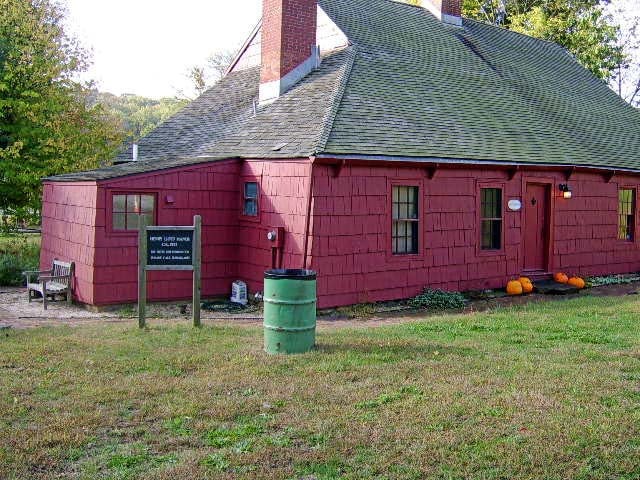
In his politics, religion, and extensive property outside Massachusetts (family manor in Huntington, New York, shown above), Lloyd had many reasons to align with the royal government. As the political split widened in 1774, he signed the address welcoming Gen. Thomas Gage to Boston. Later he supplied the army. A niece he raised, Elizabeth, married royal appointee Joshua Loring, Jr., and also became mistress to Gen. William Howe. In 1776 Henry Lloyd joined the evacuation to Halifax. Though he made one return visit to Boston in 1785, Lloyd didn’t end up standing “fair and agreeably” with most of the people there.

Also among the Loyalist refugees was the brazier William Bowes, who in March 1774 loudly if unreliably stated that the owners of the Fortune had brought in tea for themselves. Although Bowes later claimed to have supported from the Crown from early on, in August 1769 he was among the many Boston men dining with the Sons of Liberty. Bowes’s father was a Congregationalist minister and his mother was a Hancock, so it would have been natural for him to be a Whig. Instead, after 1774 he declared his Loyalism by signing all the addresses to royal governors and then leaving the province.

As for those three owners of the Fortune, I still can’t trace William Thompson. Thomas Walley and Peter Boyer were, as I wrote before, solid Whig merchants up to 1774. Like Lloyd, they insisted that they had told their London contacts they didn’t want any tea and were completely surprised at what Capt. Gorham brought back.

Unlike Lloyd, Walley and Boyer remained trusted Whigs after the second Tea Party. Indeed, they became more politically active.

According to John W. Tyler’s Smugglers and Patriots, Walley was a documented smuggler, and he remained firmly in the center of the Boston business community. He served in the Massachusetts General Court during the war, and from 1786 to 1797 the town chose him as a selectman.

Meanwhile, Boyer served on Boston’s committee to help the poor after the Boston Port Bill and on the committee of correspondence, safety, and inspection in 1776. The following year he signed Massachusetts money along with John Scollay and Ezekiel Price. In 1782 David Jeffries resigned as Boston’s treasurer after many years, and the town meeting elected Boyer to that office, which he held until 1791. The community couldn’t have demonstrated any more trust in him. 

Friday, March 19, 2021

“What natural right, whether that of smuggling, or of throwing tea overboard?”

The second Boston Tea Party on 7 March 1774 made a smaller splash than the first on the preceding 16 December.

There was much less tea involved—fewer than thirty chests as opposed to more than three hundred.

The tea was much less valuable. It was the Bohea variety, an everyday black tea rather than a more expensive blend or a green tea.

The destroyed tea wasn’t owned by the highly connected East India Company but by the private firm of Davison & Newman, consigned to the Boston merchant Henry Lloyd. It had less financial importance for the Crown.

In response to the first Tea Party, Parliament passed the Boston Port Bill, declaring it illegal for Boston to receive goods (with a few exceptions, like firewood) from any other colony. It took only a few days in mid-March for that bill to become law. News of the second action was still making its away across the Atlantic.

Once news of the second Tea Party arrived in London in April, Davison & Newman and their insurers sent a petition to Parliament, reproduced on this website and on tins of “Boston Harbour Tea,” asking that they, too, be compensated for their lost property just as the East India Company would be. (Of course, Boston never paid back the East India Company.)

But the second Boston Tea Party still had an impact in London. On 28 March, prime minister Lord North (shown above) opened formal discussion in Parliament about a plan to change the constitution of the Massachusetts province. He advocated three changes:
  • giving the governor more power so he didn’t depend so much on support from the Council.
  • limiting town meetings to once each year to elect town officials unless the governor allowed otherwise.
  • an unspecified way of regulating the choice of jurymen.
Some Members of Parliament advocated stronger measures. Lord George Germain immediately raised the idea of making the Massachusetts Council an appointed body, as in most other North American colonies, rather than elected.

A smaller number of M.P.’s argued to preserve Massachusetts’s system. Former governor John Pownall described Americans as “a conscientious, good, religious, peaceable set of people.”

Lord North brought in his bill on 15 April, now including the appointed or “mandamus” Council. Soon he added the Administration of Justice Act, empowering the governor to send people charged for actions they had taken to enforce the laws away to another colony or Britain if he felt they couldn’t receive a fair trial in Massachusetts.

Strong Whigs like Isaac Barré and Charles Fox spoke against those bills. They complained about Gov. Thomas Hutchinson, who was being replaced (he didn’t know it yet). They moved to repeal the entire Tea Act. Edmund Burke made a very long speech that went all the way back to the first Navigation Acts and the Stamp Tax. Generally these members argued that while the destruction of the tea in December was wrong, the Crown had to give time for the Boston Port Bill to work before making permanent changes to the Massachusetts government.

On 21 April, Lord North opened another day of debate with a speech that included:
Sir, there is a ship arrived, I think her name is the Fortune, captain Goreham; she arrived in Boston harbour the latter end of February, or beginning of March 1774, I cannot say which; she was loaded with tea; the inhabitants came immediately and unloaded her, and emptied the contents of her cargo into the sea.

Is this, Sir, seeing their error? Is this, Sir, reforming? Is this making restitution to the East India Company?
Sir Thomas Frankland rose to confirm Lord North’s news based on a letter from Boston. Word of the second Boston Tea Party thus arrived just in time to confirm the worst impressions of the first.

Debate continued, but Massachusetts looked harder to defend. On 2 May, Lord North declared:
I am sorry to hear a charge thrown out, that these proceedings are to deprive persons of their natural right. Let me ask, of what natural right, whether that of smuggling, or of throwing tea overboard? Or of another natural right, which is not paying their debts?
He lamented the province “being in a distempered state of disturbance and opposition to the laws of the mother country.”

The Massachusetts Government Act went to a vote that day. The Commons divided 239 in favor of the law, only 64 against. Four days later, there was a vote on the Administration of Justice Act: 127 for, 24 against.

TOMORROW: What happened to the merchants who imported this cargo of tea?

Thursday, March 18, 2021

A Portrait of Thomas Oliver?

Speaking of Lt. Gov. Thomas Oliver, here’s a painting that in 1929 was sold to the Museum of Fine Arts for $2,500 as a portrait of Oliver by Joseph Blackburn.

The picture was signed “I Blackburn Pinxit 1760.” Oliver’s name was penciled on the stretcher.

According to the dealer, Frank W. Bayley, this portrait of Thomas Oliver and another of his wife Elizabeth went into the custody of Penelope Vassall, Elizabeth’s aunt by marriage, after the Revolution.

I imagine that could have happened in the fall of 1774, after the Olivers left Cambridge, or after the war, when Penelope Vassall returned to her home there. Bayley provided a line of inheritance for the portraits from Penelope Vassall ending with “Elizabeth Degan of Brooklyn.”

Bayley was the author of a big early study of John Singleton Copley and another book on five other portrait artists in colonial America. He was also an art dealer heading the Copley Gallery in Boston, which sold a lot of eighteenth-century portraits.

In 1931 Oliver Elton shared a paper about Thomas Oliver with the Colonial Society of Massachusetts. About this painting, Elton said:
It is an excellent half-length pastel by Joseph Blackburn. Thomas appears as a well-favored youth, clean-shaven, with brown hair worn long; with brown eyes, arched eyebrows, wide forehead, and well-cut lips. He wears a blue coat with glimpses of gold lining, and a white stock. He also wears an expression, rather engaging, of modest complacency and inexperience; but not, I think, of weakness.
Around the same time, Bayley authenticated a portrait of George Washington as painted by Gilbert Stuart, helping a New York gallery to sell it to a Boston collector for $25,000.

When the new owner became suspicious, he sent the canvas to the Museum of Fine Arts for another look. According to Robert C. Vose, Jr., writing in the Archives of American Art Journal in 1981, conservators “removed a lining canvas and found, on the back of the original, the signature of a female art student who had made it as a copy at the Museum three years before.”

Bayley killed himself in 1932.

The Colonial Society published the Oliver picture with Elton’s article the next year. However, other scholars began scrutinize all the portraits Bayley had sold in his final years. In April 1936, the American Antiquarian Society published an article by John Hill Morgan and Henry Wilder Foote (P.D.F. download) newly identifying many paintings by Joseph Blackburn and reappraising the identification of others.

In particular, they looked at the portrait said to show Thomas Oliver. They agreed that Blackburn was not known to have worked in pastels and the painting did not fit his style, no matter if his name was painted on it.

Morgan and Wilder also found that though there was a Degen (spelled slightly differently) branch from the Vassall family, neither genealogy nor local directories could locate Elizabeth Degan of Brooklyn or her supposed father, the people who had allegedly owned this canvas.

Likewise, that article cast doubt on the picture of Elizabeth Oliver and portraits said to show Gov. Frances Bernard, his wife, and Gov. Thomas Hutchinson—all signed “I Blackburn Pinxit 1760” and sold by Bayley.

In 1981 Vose wrote about his family’s gallery:
My father bought nine “Colonial” portraits from [Bayley]. Most were accompanied by certificates stating that they were likenesses of Governors or other important American personages. All have proven to be eighteenth-century English paintings whose documentation was expertly forged. Mr. Bayley bought them from a Mr. [Augustus] Deforest in New York and the certificates were contrived in New York by a Mrs. Winter.
And that is why the Museum of Fine Arts doesn’t display this painting, and why it’s no longer used as a portrait of Lt. Gov. Thomas Oliver.

Wednesday, March 17, 2021

Evacuation Day Lecture Now Online

I’ve put “The End of Tory Row,” my Evacuation Day talk for Longfellow House–Washington’s Headquarters, online at YouTube.

Because this was an online talk, I loaded my PowerPoint up with more graphics. I hope those survive my clicking while speaking, the Zoom recording, and finally the compression for YouTube.

One thing I said in the talk is that no one could figure out why the Crown chose Thomas Oliver to be Massachusetts’s new lieutenant governor in 1774. At forty years old, he was hardly a senior figure among supporters of the royal government, and he hadn’t been active in politics. The best explanation seemed to be, I said, that bureaucrats in London got him mixed up somehow with the family of his predecessor, Andrew Oliver.

After the talk, John W. Tyler, currently editing The Correspondence of Thomas Hutchinson for the Colonial Society of Massachusetts, sent me the text of Gov. Hutchinson’s letter to the Earl of Dartmouth on 29 Mar 1774. That document shows that I wronged Thomas Oliver—at least one person in Massachusetts thought he could be a capable lieutenant governor.

This letter shows that after Andrew Oliver’s death Hutchinson sent four names of possible stand-ins to the Secretary of State’s office. The governor wanted someone who could back him up, not knowing that he would soon be superseded by Gen. Thomas Gage.

The four names Hutchinson proposed were:
  • William Browne of Salem. As of 29 March, he asked to be considered for a seat on the Massachusetts Superior Court instead, and was indeed appointed to that bench just in time for the courts to be shut down.
  • William Burch, a Customs Commissioner born in England and based in Massachusetts since 1767—Hutchinson’s top choice.
  • Thomas Flucker, the provincial secretary.
  • Thomas Oliver.
About the last, Hutchinson wrote:
There is a gentleman of the same name with the late Lieut. Governor but of another family Thomas Oliver Esq. of Cambridge, now Judge of the Provincial Court of Admiralty which he must quit in case of his appointment. He has a handsome Estate, is a very sensible man & very generally esteemed. He is Cousin German to Mr. [Richard] Oliver the Alderman and City Member. I know not how the Alderman stands affected to Government but this Gentleman has been steady in his opposition to all the late measures and I think the Administration in case of the absence of the Governor may be safely trusted with him.
Lord Dartmouth’s office thus had a little information about Thomas Oliver and knew that he wasn’t from the same family as Andrew and Peter Oliver. His distant cousin Richard Oliver was about to speak out against the Boston Port Bill in Parliament, but the government didn’t hold that against Thomas.

Hutchinson was anxious to have a lieutenant governor in place because if he died, became ill, or left the province without one, the power of acting governor would fall to the Council, led by its senior member, and the Council was more and more ranged against him. Again, Hutchinson didn’t know that in August that elected Council would be replaced with one appointed from London.

Thus, I was mistaken in saying no one in Massachusetts considered Thomas Oliver to be lieutenant governor material. He was at the bottom of Hutchinson’s short list, but he was on the list.

Tuesday, March 16, 2021

Call for Papers for “The Meaning of Independence,” October 2021

The David Center for the American Revolution at the American Philosophical Society has issued a call for papers for a conference on “The Meanings of Independence” scheduled for 21-22 October in Philadelphia.

The call says:
The conference aims to convene leading and emerging scholars of the era, museum and library professionals, leaders of cultural institutions, teachers at all levels, public intellectuals, and engaged members of the public for two days of discussion about the meaning and import of the American Revolution in the twenty-first century.

We invite proposals from scholars and professionals at all levels of their careers whose work can contribute to this conversation. Conference organizers hope to highlight new scholarship on the causes, course, and consequences of the American Revolution; the lived experience of the Revolution; its place within a global context; innovative plans for commemorations in 2026; and compelling digital and new media scholarship that presents the era in a new light and to a wide audience.
What Revolutionary topics fall within the purview of this conference? Nearly everything, it seems, but that’s not how calls are written. They have to include an explicitly non-exclusive list of possibilities, as in:
  • Origins
  • New interpretations of the cause of the American Revolution
  • Examinations of overlooked events and individuals that cast new light on the Revolution’s cause
  • Experiences
  • The role of warfare on society and its lasting significance
  • The meanings and consequences of independence, for the various peoples affected by war and political upheaval—including loyalists, enslaved men and women, Indigenous peoples, and non-combatants
  • Perspectives from the top-down and bottom-up, and their interplay throughout the course of the Revolution
  • Global Contexts
  • Papers that place the Revolution within the Age of Atlantic Revolutions
  • The effects of the American Revolution around the globe within its own time and after it, including to the present day
  • Other comparative frameworks that help elucidate elements of the Revolution
  • Legacies
  • The changing meaning of the Revolution for those who lived through it
  • Research that interrogates the idea of a founding moment or moments, including papers that provide a comparative perspective from other countries
  • Legacies of independence in shaping lives, institutions, and ideals of citizenship and patriotism
  • Examinations of past commemorations as well as plans for future ones
  • Teaching the Revolution, past, present, and future
  • Innovative digital and archival projects that provide new access to study of the era
  • Approaches
  • Historical
  • Literary
  • Religious
  • Environmental
  • Legal
  • Political
  • Material culture
  • Gender
  • Native American and Indigenous studies
  • Public history
  • Digital scholarship
  • Otherwise
Now the big question for any event in 2021: How close will participants be to one another? The society says, “In order to maximize the opportunity for informal and formal discussion and collaboration, conference organizers plan to hold this gathering in-person. Should travel in October be unadvisable, the conference will be rescheduled for Spring 2022.” All presenters will receive travel subsidies and hotel accommodations.

Papers should be no longer than 15 double-spaced pages. Scholars hoping to present should submit a paper title, 250-word proposal, and curriculum vitae to the organizers by 15 April 2021 via the Interfolio website. Decisions will be announced in June. Papers will be due in September, one month before the conference, to be pre-circulated to registered attendees. Some presenters might be invited to revise their papers for publication in the A.P.S.’s Transactions, one of the longest running scholarly series in America.

For more information, see the A.P.S. website.

Monday, March 15, 2021

“Whereas Tea is an Indian Plant…”

Yesterday I quoted a couple of press reports and a diary entry showing how Bostonians used the trope of “Indians” to discuss the men who dumped tea in the harbor, both in December 1773 and March 1774.

Another document of that sort was printed in facsimile in Francis S. Drake’s Tea Leaves (1884). In 1901 it came to the Bostonian Society as part of the collection of the late Jeremiah Colborn.

According to Drake, the document was in the handwriting of Edward Procter or Proctor (1733-1811). Procter was a middling merchant, a militia officer, and a member of the St. Andrew’s Lodge of Freemasons.

He was also a confrontational Whig, quarreling with Ebenezer Richardson during the protest that led to the death of Christopher Seider and being the first volunteer to patrol the docks when the tea ships arrived.

The document reads:
Abrant Kanakaratöphqua
Chief Sachem of the Mohawks,
King of the Six Nations and
Lord of all their Castles, &c. &c. &c.
To all our liege Subjects—HEALTH.

Whereas Tea is an Indian Plant, and of right belongs to the Indians of every Land and Tribe: and WHEREAS, our good Allies the English, have in lieu of it, given us that pernicious Liquour RUM, which they have pour’d down our Throats, to steal away our Brains, and WHEREAS the English have learn’d the most expeditious Way, or Method, of drawing an Infusion of said TEA without the Expense of Wood, or Trouble of Fire, to the Benefit and Emolument of the East India Trade as vastly greater Quantities may be expended by this Method, than by that heretofore practiced in this Country, and therefore help to Support the East India Company under these present Milancholly Circumstances—

We of our certain Knowledge, Special Grace, and Meer Motion, permit and allow any of our liege Subjects to barter for, buy, or procure of any of our Said English Allies, TEAS of any kind: PROVIDED always each Man purchase not less than Ten, nor more than One hundred and fourteen Boxes, at a Time, and those the property of the East India Company, and PROVIDED also that they pour all the Said Tea into the Lakes, Rivers and ponds, that while our Subjects in their Thirsting instead of Slakeing their Thirst with Cold Water, as usual, may do it with Tea.

Of all which our Subjects will take Notice, and govern themselves accordingly— By command
Toneteroque.
1st. Moon
1774
The phrase “One hundred and fourteen Boxes” refers to the tea chests carried by each of the ships Dartmouth and the Eleanor in December. As Charles Bahne noted here, the official accounting submitted to the House of Lords said the Beaver held only 112 chests, though the Boston press had said there were 342 in all.

A bigger question is when this document was created. If “1st. Moon,” meant January, then it was dated a month after the famous Boston Tea Party. This might thus be the earliest example of putting words about the tea into a supposed Indian chief’s mouth, elaborating impromptu disguises into a parodic royal decree.

This document addresses only tea that was “the property of the East India Company.” The second Boston Tea Party in March 1774 dumped tea sent by an independent mercantile firm. Procter evidently didn’t anticipate that the tea boycott would expand to cover all imported tea. Then again, neither did that mercantile firm.

Another notable detail is that this ersatz proclamation came from the fictional “Chief Sachem of the Mohawks” and “King of the Six Nations” far to the west of Massachusetts, not the Narragansetts from Rhode Island that other people wrote about. But of course it wasn’t really about Indians.

COMING UP: Fallout in London.

Sunday, March 14, 2021

“King of the Narragansett tribe of Indians”?

The second Boston Tea Party cemented the “Indian disguises” aspect of the events.

On the morning after the Fortune arrived in Boston harbor, the report in Edes and Gill’s radical Boston Gazette ended by saying:
The SACHEMS must have a Talk upon this Matter—Upon THEM we depend to extricate us out of this fresh Difficulty; and to THEIR Decisions all the GOOD People will say, AMEN!
Obviously those “SACHEMS” weren’t real Native leaders. That was a code for the men who had organized the destruction of tea the previous December. 

As at the first and bigger Tea Party, some of the men who broke open the tea chests that night indeed came disguised somehow as Indians. London merchants passed on a report that many were “dressed and talking like Indians.” But that means some weren’t. The real value of that disguise was how it gave Whigs a chance to talk about the people who destroyed the tea while denying knowledge of their identity.

Thus, Thomas Newell wrote in his diary for 7 March:
This evening, a number of Indians—as is said, of his Majesty of Oknookortunkogg tribe—emptied every chest into the dock, and destroyed the whole 28 1/2 chests.
Such deniability was even more useful for the press. On 10 March, Isaiah Thomas’s Massachusetts Spy ran the first detailed report on the tea destruction, but only in code:
His Majesty Oknookortunkogog King of the Narragansett tribe of Indians, on receiving information of the arrival of another cargo of that cursed weed Tea, immediately summoned his Council at the Great Swamp by the river Jordan, who did advise and consent to the immediate destruction thereof, after resolving that the IMPORTATION of this Herb, by ANY persons whatever, was attended with perncious and dangerous consequences to the lives and properties of all his subjects throughout America.

Orders were then issued to the seizor and destroyer-general, and their deputies to assemble the executive body under their command, to proceed directly to the place where this noxious herb was. They arrived last Monday evening in town, and finding the vessel, they emptied every chest, into the great Pacific ocean, and effectually destroyed the whole, (twenty-eight chests and a half.)

They are now returned to Narragansett to make report of their doings to his Majesty, who we hear is determined to honour them with commissions for the peace.
The same dispatch appeared in the 14 March Boston Gazette and Boston Post-Boy.

Phrases like “executive body” and “commissions for the peace,” not to mention references to “the Great Swamp,” “river Jordan,” and “Pacific ocean,” show that whoever wrote this article wasn’t trying to convince readers that actual Narragansett Indians had dumped the tea in Boston harbor. It was all a joke, and the smart people were in on it.

Years later, artists began to depict the men of the original Tea Party with feathers in their hair, and eventually full feathered headdresses and bare chests, as shown above. That was taking the joke too far.

TOMORROW: More Native cosplay.

Saturday, March 13, 2021

Tales of the Second Boston Tea Party?

Boston’s first tea crisis lasted two months. The town heard about East India Company tea coming to certain merchants by 18 October, when the Boston Gazette published the news. The men and boys who destroyed that tea headed home late at night on 16 December.

In contrast, the second tea crisis in March 1774 was resolved in less than thirty-three hours. The town learned of the brig Fortune’s arrival with 28 1/2 chests of tea at three o’clock on Sunday afternoon. By eight o’clock Monday evening that tea was going into the harbor.

Dumping tea before the tax could be collected on it had become almost ho-hum. Back in December, John Adams had exulted in his diary:
There is a Dignity, a Majesty, a Sublimity, in this last Effort of the Patriots, that I greatly admire. The People should never rise, without doing something to be remembered—something notable And striking. This Destruction of the Tea is so bold, so daring, so firm, intrepid and inflexible, and it must have so important Consequences, and so lasting, that I cant but consider it as an Epocha in History.
In March, Adams simply wrote: “Last Night 28 Chests and an half of Tea were drowned.”

With far less tea to destroy, the March action would have taken fewer men and/or less time. Still, it’s remarkable how little documentation we have for the second Boston Tea Party.

We don’t have detailed letters from the night, like merchant John Andrews’s much-read account of 16 December. The press reports appeared in a sort of code, as I’ll discuss tomorrow.

We don’t have signs of the nineteenth-century Boston newspaper editors keeping track of old men who had participated in the March tea destruction. The two books that helped to popularize the December event and the joshing term for the men involved, Retrospect of the Boston Tea-Party and Traits of the Tea-Party, don’t mention the March follow-up at all. Families didn’t pass down dramatic stories of the second Boston Tea Party.

Or did they? Is it possible that some of the tales people told about “the Tea Party” were actually about the March tea destruction, not the one in December? If the same men took part in both, did the details meld together in their memories?

Some specifics of the December action can be pinned down through other sources. For example, Ebenezer Stevens’s recollection that his future brother-in-law, Alexander Hodgdon, was a mate on one tea ship. And the way leaves piled in the shallow water beside the ships; astronomers have confirmed that the harbor was at low tide at the crucial hours on 16 December.

But do other memories come from March? Have we inherited tales of the second Boston Tea Party without knowing it?

COMING UP: The code of the Tea Party.

Friday, March 12, 2021

“The same Spirit spreads like a Contagion”

I’m returning to the second Boston Tea Party and the other events of March 1774. And who better to ease us into that mindset than John Adams?

On 12 March he filled his diary with this essay:
There has been and is a Party in the Nation, a very small one indeed, who have pretended to be conscienciously perswaded, that the Pretender has a Right to the Throne. Their Principles of Loyalty, hereditary Right, and passive obedience have led them to this judgment, and Opinion.—And as long as they keep these Opinions to themselves, there is no Remedy against them.

But as soon as they express these opinions publicly, and endeavour to make Proselytes, especially if they take any steps to introduce the Pretender, they become offenders, and must suffer the Punishment due to their Crimes.

Private judgment might be alledged in Excuse for many Crimes—a poor Enthusiast [may?] bring himself to believe it lawfull for him to steal from his rich Neighbour, to supply his Necessities, but the Law will not allow of this Plea. The Man must be punished for his Theft.

Ravaillac and Felton probably thought, they were doing their Duty, and nothing more, when they were committing their vile assassinations But the Liberty of private Conscience, did not exempt them from the most dreadfull Punishment that civil Authority can inflict or human Nature endure.

[Thomas] Hutchinson and [Andrew] Oliver might be brought by their interested Views and Motives, sincerely to think that an Alteration in the Constitution of this Province, and an “Abridgment of what are called English Liberties,[”] would be for the Good of the Province, of America, and of the Nation. In this they deceived themselves, and became the Bubbles of their own Avarice and Ambition.
Adams there quoted the most notorious phrase from the ”Hutchinson letters” published the year before.

Gov. Hutchinson would have protested that he was describing the colonies’ situation, too distant to participate in Parliament, and not prescribing how the British government should treat them. (Oliver, in contrast, had indeed suggested changes to the Massachusetts charter.)

Nevertheless, in supposing that Hutchinson and Oliver might be sincere in their misguided political beliefs, Adams came as close as he ever did to granting them some respect. Even as he compared the two men to Jacobites and assassins.
The rest of the World are not thus deceived. They see clearly, that such Innovations will be the Ruin not only of the Colonies, but of the Empire, and therefore think that Examples ought to be made of these great offenders, in Terrorem.

The Enmity of Govr. [Francis] Bernard, Hutchinson and Oliver, and others to the Constitution of this Province is owing to its being an Obstacle to their Views and Designs of Raising a Revenue by Parliamentary Authority, and making their own Fortunes out of it.

The Constitution of this Province, has enabled the People to resist their Projects, so effectually, that they see they shall never carry them into Execution, while it exists. Their Malice has therefore been directed against it, and their Utmost Efforts been employed to destroy it.

There is so much of a Republican Spirit, among the People, which has been nourished and cherished by their Form of Government, that they never would submit to Tyrants or oppressive Projects.

The same Spirit spreads like a Contagion, into all the other Colonies, into Ireland, and into Great Britain too, from this single Province, of Mass. Bay, that no Pains are too great to be taken, no Hazards too great to be run, for the Destruction of our Charter.
This thinking shows how Adams and other Massachusetts politicians reacted to the Massachusetts Government Act, passed by Parliament later in 1774. It was a “we told you so” moment. No matter that the new law was a response to the Tea Party—both of them—and other unrest the Boston Whigs had promoted over the years.

Adams also hopefully foresaw the popular resistance to that law stemming from “a Republican Spirit,” though he wasn’t yet ready to espouse a republic without a monarchy. And like any good son of Massachusetts, he was sure other provinces, even the mother country, would follow its example.

TOMORROW: Tales of the second Boston Tea Party?

Thursday, March 11, 2021

“Storm of Witchcraft” with Emerson W. Baker, 11 Mar.

Tonight, 11 March, the History Camp online discussion series welcomes Emerson W. Baker speaking about the Salem Witch Trials.

Tad Baker wrote Storm of Witchcraft: The Salem Trials and the American Experience, which investigates the key players in the Salem Village crisis and illuminates why the tragedy unfolded as it did.

This books shows how the Puritan government’s attempts to suppress what had taken place only fueled the popular imagination and established the trials as a turning point from Puritan communalism to Yankee independence.

A professor at Salem State University, Baker has also been involved in local efforts to commemorate the trials and executions properly.

One of the earliest historians to recount those trials was Thomas Hutchinson, as part of his history of Massachusetts, but his manuscript remained unpublished when he died. It finally appeared in the 1870s as an article in the New England Historic and Genealogical Register and printed on its own as The Witchcraft Delusion of 1692.

Early on, Hutchinson wrote:
Whilst the tragedy was acting, there were but few people who doubted the hand of the Devil, and fewer that dared to own their doubts.

When the Commissioners went through the town of Boston on their journey to Salem, they stopped at the house of Col. Hutchinson, one of the council, who advised them, before they began any trial, to see if they could not whip the Devil out of the afflicted; but this advice was rejected.
The prospect of being whipped would certainly have raised the cost of making accusations.

Col. Elisha Hutchinson (shown above) was the author’s grandfather. One of the snide critiques of Hutchinson’s history in his time is that he never missed a chance to write about his own ancestors.

Historians have widened the lens considerably since Hutchinson studied the Salem Witch Trials less than a century after they occurred. Lee Wright and Carrie Lund of History Camp will talk about more recent developments with Tad Baker starting at 8:00 P.M. History Camp discussions stream live to the HistoryCamp.org website and the History Camp Facebook page.

Wednesday, March 10, 2021

Deerfield Textile Forum on “Invisible Makers,” 10 Apr.

On Saturday, 10 April, Historic Deerfield will host a virtual forum on “Invisible Makers: Textiles, Dress, and Marginalized People in 18th- and 19th-Century America.”

The event description says:
Globalized manufacturing in the 21st century has stimulated a greater need to understand where, how, by whom, and under what conditions our clothing is made. In the past, the weaving of textiles and making of everyday clothing has largely been perceived as anonymous, most especially with regard to marginalized people living in white societies. Research into the efforts of Black, Indigenous, and other people of color to design, produce, acquire, and modify textiles and dress within the Anglo-European, North American framework has historically been difficult to quantify because of a paucity of surviving evidence as well as limited attempts both past and present to record and credit those efforts.

Lectures from a dynamic roster of academic and museum professionals promises to enrich and deepen current conversations about fashion both past and present, discussing examples of the important roles and contributions of BIPOC textile and clothing producers and consumers from the past. Presented as case studies, the research includes textiles and clothing produced by forced labor within plantations; people of color working as tailors and dressmakers in Massachusetts; and marginalized people who fashioned their dressed bodies using Anglo-European garments in ways that both subverted normative styles while expressing “other” cultural identities.
Here’s a sample of the scheduled presentations:
  • “Someone Knows My Name: A Framework for Researching the Lives and Experiences of Under-represented Craftspeople in Early America,” Tiffany Momon, Assistant Professor of History, University of the South
  • “Luxury Slaves, Negro Governors, and Jim Crow: Black Dandy Beginnings,” Monica L. Miller, Professor of Africana Studies and English, Barnard College, Columbia University
  • “‘A boy’s shirt for Waghrosra’s wife’s son’: The Global History of an Early American Indigenous Trade Garment,” Laura Johnson, Linda Eaton Associate Curator of Textiles, Winterthur Museum
  • “Behind the Seams: Enslaved Labor in the 1770s Boston Tailoring Trade,” David E. Lazaro, Curator of Textiles, Historic Deerfield
This program will be presented live via Zoom webinar. The link to the webinar will be sent to registrants before the event, and recordings will be available to registrants for two weeks afterward.

The basic cost for the webinar is $60, $50 for Historic Deerfield members, and $45 for students. People newly joining Historic Deerfield can obtain a year’s membership (normally $50) and registration for this webinar for a single price of $85.

For more information and to register, go to this page.

Tuesday, March 09, 2021

Three New Interviews

A couple of weeks ago I wore collared shirts and shaved almost every day of the week.

That’s because I was scheduled to participate a series of online conversations that were recorded for viewing.

First, I spoke with Bob Allison and Jonathan Lane of the Revolution 250 coalition about young Christopher Seider, his killer Ebenezer Richardson, and what date was really George Washington’s birthday. Here’s the link to the video and the audio.

The next day I connected with Christian Di Spigna of the Dr. Joseph Warren Historical Society to interview Mitch Kachun about the place of Crispus Attucks in American history and culture. Kachun’s book is First Martyr of Liberty. Here’s the video.

Finally, on Friday Christian and I linked up again to talk with Nina Sankovitch about her story of three intertwined families from north Braintree (now Quincy), Amerian Rebels: How the Hancock, Adams, and Quincy Families Fanned the Flames of Revolution. Here’s that video link.

Behind me in the videos are the shelves I set up last month in an attempt to get my books more organized. I’ve already assembled three more bookcases, with another two to follow. And I’m not close to caught up yet.

Monday, March 08, 2021

“The End of Tory Row” Online, 11 March

On the evening of Thursday, 11 March, I’ll offer an online presentation for the Longfellow House–Washington’s Headquarters National Historic Site about “The End of Tory Row.”

For the past several years, I’ve spoken about that mansion’s Revolutionary history each March around Evacuation Day.

Usually those talks have focused on Gen. George Washington, who used the house as his headquarters from July 1775 to April 1776, and challenges he faced. Last year, for example, I shared information about Native American visitors to Cambridge during Washington’s time and his efforts at diplomacy on the continent.

That was the last public event I attended for many months. The audience was small and the chairs distanced, according to the protocols of the time. Soon most local institutions shut down completely for visitors. Historical talks moved online, which has brought both technical difficulties and benefits in wider access.

This year’s talk will look at how what’s now Brattle Street in Cambridge became a neighborhood of wealthy households, all related to John Vassall, the man who in 1759 commissioned and moved into that mansion. And how in September 1774 that enclave dissolved under political and militia pressure. I’ll also discuss how that neighborhood’s lifestyle depended both economically and in daily life on the exploitation of slavery.

I’ve discussed the Vassall family and the events of September 1774 before, but this year I’m trying to make more of the online format by incorporating more visuals and perhaps even moving footage. There will be a live question-and-answer session after the presentation.

This online event is free to all through support from the Friends of Longfellow House–Washington’s Headquarters, the Massachusetts Society of the Cincinnati, and the National Park Service. To register in order to receive the viewing link, please start at this page. The event will start at 7:00 P.M. on Thursday.

Sunday, March 07, 2021

“Emptied and threw the Tea into the Water”

On Sunday, 6 Mar 1774, as described yesterday, the brig Fortune carried 28 1/2 chests of tea into Boston harbor, along with “Gun-Powder, Duck and Hemp.”

“The next day,” Gov. Thomas Hutchinson wrote, “the vessel was haled to the wharffe, where the vessels lay which had the East India Company’s tea.” And we know what had happened to that tea the preceding December.

That same Monday, the Boston Gazette ran this calm and measured item:

Messi’rs Edes & Gill, PUBLISH THIS!

It is said that Capt. [Benjamin] Gorham who is just arrived from London, has brought Forty Chests of that baneful, detested, dutied Article TEA, shipped by the East-India Company, their Brokers or Employers, and consigned to HENRY LLOYD, Esq; of this Town, Merchant.

Justice to ourselves and to AMERICA—Justice even to the other Consignees—A Regard to our own Reputation and Honor—Every Obligation binds us most SOLEMNLY, at once to DETERMINE ABSOLUTELY to oppose its Landing—Experience has fully convinced us that the Governor and the Custom-House Officers concern’d will lay INSUPERABLE Bars in the Way of sending it back to London. The Consent of the Consignee to have it return’d would be to no Purpose, if he be waited upon to request it.

The SACHEMS must have a Talk upon this Matter—Upon THEM we depend to extricate us out of this fresh Difficulty; and to THEIR Decisions all the GOOD People will say, AMEN!
That dispatch got some factual details wrong—namely, the number of tea chests, who had sent them, and who was to receive them.

But the Whig newspaper was accurate in predicting the royal authorities would make no compromises to allow the tea to be returned to Britain.

The owners of the Fortune—Thomas Walley, Peter Boyer, and William Thompson—laid out what they were doing that Monday in the next Boston News-Letter. With Lloyd, who had been sent sixteen tea chests; Henry Bromfield, who owned much of the ship’s cargo; and Gorham they “applied to the Collector and Comptroller of the Customs, and unitedly requested a Qualification for the Vessel to return with the Tea.” Because otherwise, they declared, there was “Danger of this Tea’s being destroyed.”

The Customs officers replied:
it was absolutely contrary to their Duty, and therefore could not give any Papers to qualify the Vessel to go back; and that although no Report [legal notice of the arrival] had been then made, yet she could not go away without being liable to be seized, and that even if they should give a Clearance, she would inevitably be stopped by the Officers of the King’s Ships, who were also Custom-House Officers . . . moreover that she could not be reported that Day after two o’Clock, and if not reported within 24 Hours the Capt. as liable to a Penalty of £100 Sterling.
Seeing where his interest lay, Capt. Gorham quickly reported the ship’s arrival and “took out a Permit to unlade the Gun-Powder.” Everyone agreed that was a good idea.

As for further steps, Boston town clerk William Cooper wrote to the Brookline committee of correspondence, seeking to rebuild the united front that had formed the preceding December:
We think it our duty to acquaint you that a Brigantine Benjamin Gorham Master is just arrived from London with a quantity of Tea on board liable to a duty: We ask the favor of your Company at the Selectmens Chamber in Boston toMorrow afternoon 3. OClock in order for a joint consultation, relative to this matter——
As it turned out, that meeting became moot.

Evening fell. Illuminated pictures of the Boston Massacre shone out from the windows of Mary Clapham’s Royal Exchange Tavern on King Street. (That display had been postponed from the 5th because that fell on the eve of the Sabbath.) As I recounted back here, in 1774 there was a new image attacking Gov. Hutchinson and Chief Justice Peter Oliver.

Bostonians had spent weeks talking about what to do with the first three shiploads of tea. They had no patience left for the Fortune. In the words of a petition from shippers in London:
about Eight o’Clock in the Evening…a great Number of Persons all of whom were unknown to the Captain and many of them disguised and dressed and talking like Indians armed with Axes and Hatchets with Force and violence entered on Board the said Vessel and broke open the Hatches and proceeded to rummage the Hold and hoisted out Twenty eight Chests of Tea…upon the Deck of the said Vessel and there with Hatchets axes and Clubs broke open the said Chests and emptied and threw the Tea into the Water whereby the same was wholly lost and destroyed.
That was the lesser-known second Boston Tea Party on the night of 7 Mar 1774.

COMING UP: John Adams surveys the scene.

Saturday, March 06, 2021

“Chests of Bohea tea consigned to several persons”

At three o’clock in the afternoon of Sunday, 6 Mar 1774, Bostonians were jolted by the arrival of the brig Fortune.

More specifically, people were jolted by the news that that ship was carrying chests of tea. This was about ten weeks after the Boston Tea Party and about five weeks after local shopkeepers had agreed not to sell any tea.

Thomas Newell wrote in his diary for that day:
Captain Benjamin Gorham, nine weeks from London, brought 28 1/2 chests of Bohea tea consigned to several persons here.
Who were those “several persons”? Sixteen chests—more than half of the total—were consigned to Henry Lloyd (1709-1795), a wealthy Anglican merchant with relatives locally and on Long Island in New York. Those chests had been shipped to him by the London partnership of Monkhouse Davison and Abraham Newman, with insurance to the amount of £480 backed up five other London businessmen.

A letter to the Boston News-Letter identified “a principal Freighter in said Vessel” as “Mr. Bromfield”—the merchant Henry Bromfield (1727-1820). The Fortune carried a variety of cargo, so it’s possible Bromfield had no tea assigned to him, but it’s also possible he was supposed to receive up to 12 1/2 chests.

Three other businessmen also had a big financial interest in the situation: the owners of the Fortune, who were Thomas Walley, Peter Boyer, and William Thompson.

Thompson is hard to trace, not least because his name was so common. Walley and Boyer, on the other hand, were stalwart members of Boston’s mercantile and civic community. Walley had held town offices since 1763 while Boyer had served on town committees. Both those men dined with Boston’s Sons of Liberty in August 1769. They had signed most of the petitions and non-importation agreements of the past ten years.

What’s more, Boyer was one of the fifteen men whose names Paul Revere had engraved on the so-called “Sons of Liberty Bowl.” In 1770 the Boston town meeting had chosen Boyer for a committee “to draw up an Agreement for the Shopkeepers that have or do deal in Tea, not to dispose of any more of that Article untill the Revenue Acts are repealed.”

So how did those men’s ship end up carrying tea? That’s what they’d like to know, they said. In a 9 March letter to Richard Draper, printer of the Boston News-Letter, Walley, Boyer, and Thompson declared that back in September they had sent the Fortune to London “to have her sold.” They had told Capt. Gorham that if he couldn’t obtain their low asking price, he should bring back “a Quantity of Hemp on the Owners Account.”

As for tea, those three merchants said, they had been explicit in their instructions:
P.S. We are informed the India Company intend to ship a Quantity of Tea to this Place in private Ships,—if our brig should come back on Freight, we absolutely refuse to take on board any Tea for that Company, let the Offer be never so advantageous, or our Loss in the Sale of the Vessel never so great.
Yet the Fortune had returned with tea. Not shipped directly by the East India Company to its North American agents, but tea nonetheless. What‘s more, “a certain William Bowes, Brazier on Dock-Square,” was telling people that the ship’s owners had “imported a Quantity of Tea in that Vessel upon their own Account.” That they firmly denied.

But still, what could be done with the 28 1/2 chests of tea aboard the Fortune? For ten weeks people all over eastern Massachusetts had worked to keep all British tea out of the colony, even chests washed overboard in a shipwreck.

The situation was a powder keg—almost literally, since the Fortune was also carrying gunpowder.

TOMORROW: Attempts at official action.

Friday, March 05, 2021

“My sincere attachment to the interest of my country”

On the morning of 3 Mar 1774, Andrew Oliver, lieutenant governor of Massachusetts, died. He had previously held the offices of provincial secretary and stamp agent, though of course he never got to do any work in that last capacity.

John Adams viewed Oliver as one of ”the original Conspirators against the Public Liberty,” for monopolizing offices with his brother Peter and their relative by marriage Thomas Hutchinson; for reporting on the Council’s sensitive discussion after the Massacre; and for urging changes to the colonial constitution in the “Hutchinson Letters.”

Adams and colleagues quickly started speculating about what Oliver’s death might mean. At a dinner party the consensus was “Peter Oliver will be made Lieutenant Governor, Hutchinson will go home, and probably be continued Governor but reside in England, and Peter Oliver will reside here and rule the Province.” (That didn’t happen.)

The more immediate worry for the Boston Whigs was the 1774 Massacre oration. Past orators had been Dr. Thomas Young, James Lovell, Dr. Joseph Warren, and Dr. Benjamin Church, all known for their newspaper essays and/or poetry. But for this year the oration committee had decided the speaker would be John Hancock.

Though Hancock had been a selectman, General Court representative, and militia officer for several years, he wasn’t known for his public eloquence. Nor his rhetorical skills. Nor his hale and reliable health. But Hancock was prominent and popular, educated and young. If he wanted to deliver the oration, his colleagues couldn’t say no.

Evidence suggests that the Whigs clustered around Hancock to ensure his speech was up to par. In his autobiography John Adams recalled, “Mr. Samuel Adams told me that Dr. Church and Dr. Warren had composed Mr. Hancocks oration…, more than two thirds of it at least.” Other sources credited Samuel Adams himself and the Rev. Dr. Samuel Cooper, Hancock’s eloquent minister.

On Saturday the 5th, Boston men gathered at Faneuil Hall for their first official town meeting since the previous November. They quickly went through the ritual of voting to have an oration, inviting Hancock to deliver it, and adjourning to the Old South Meeting-House, the largest enclosed space in town. The crowd gathered. The orator entered. The Whigs held their breaths.

Hancock’s speech began with remarks about his speaking abilities not being up to the occasion, traditional rhetoric but in this case perhaps right on the nose:
The attentive gravity; the venerable appearance of this crowded audience; the dignity which I behold in the countenances of so many in this great assembly; the solemnity of the occasion upon which we have met together, joined to a consideration of the part I am to take in the important business of this day, fill me with an awe hitherto unknown, and heighten the sense which I have ever had of my unworthiness to fill this sacred desk. But, allured by the call of some of my respected fellow-citizens, with whose request it is always my greatest pleasure to comply, I almost forgot my want of ability to perform what they required.

In this situation I find my only support in assuring myself that a generous people will not severely censure what they know was well intended, though its want of merit should prevent their being able to applaud it. And I pray that my sincere attachment to the interest of my country, and the hearty detestation of every design formed against her liberties, may be admitted as some apology for my appearance in this place.
Soon he started to spout the fiery rhetoric about the killings four years earlier:
Tell me, ye bloody butchers! ye villains high and low! ye wretches who contrived, as well as you who executed the inhuman deed! do you not feel the goads and stings of conscious guilt pierce through your savage bosoms? Though some of you may think yourselves exalted to a height that bids defiance to human justice, and others shroud yourselves beneath the mask of hypocrisy, and build your hopes of safety on the low arts of cunning, chicanery, and falsehood, yet do you not sometimes feel the gnawings of that worm which never dies? Do not the injured shades of Maverick, Gray, Caldwell, Attucks, and Carr attend you in your solitary walks, arrest you even in the midst of your debaucheries, and fill even your dreams with terror?
It’s noteworthy that that is the only passage in all the orations preserved between 1771 and 1783 to name all the people who died in the Massacre. I suspect that reflected Hancock’s instinct for democratic politics—which was actually sharper than most of his colleagues’.

Son and grandson of ministers, Hancock ultimately turned to exhorting his audience to look to their own moral virtue. He got particular points for warning the crowd against following the allure of rich, dishonest men:
Suffer not yourselves to be betrayed, by the soft arts of luxury and effeminacy, into the pit digged for your destruction. Despise the glare of wealth. That people who pay greater respect to a wealthy villain than to an honest, upright man in poverty, almost deserve to be enslaved; they plainly show that wealth, however it may be acquired, is, in their esteem, to be preferred to virtue.

But I thank God that America abounds in men who are superior to all temptation, whom nothing can divert from a steady pursuit of the interest of their country, who are at once its ornament and safeguard.
Again, I suspect that those words, whoever wrote them, reflected Hancock’s own convictions. He inherited a fortune and spent it down on politics, dying a popular but less wealthy man.

As for how people responded to John Hancock’s 1774 oration, I wrote about that last year.

Thursday, March 04, 2021

Ripples from the Boston Tea Party in 1774

Without the Boston Massacre reenactment looming over my schedule this year, I’ll devote the next few days to the events of early March 1774.

That was less than three months after the Boston Tea Party, and the ripples from that big splash in the harbor were still spreading.

Most Bostonians were excited about how the event had turned out. The local Sons of Liberty had kept the tea tax from being collected, but they hadn’t hurt any other property or any people. Other towns and ports along the American coast sent messages of support.

On 20 January an agreement among Boston merchants and shopkeepers to stop selling all tea, regardless of tax status, took effect. The Whigs hauled three barrels of tea to King Street and burned them in front of the customs house.

To be sure, there was still some tea circulating in the colony. A fourth tea ship, the William, had wrecked on Cape Cod, and some chests had been salvaged from the wreck. Local Whig crowds were chasing those down.

Meanwhile, the London government was digesting reports of disorder in Boston the previous fall—even before the tea destruction. Ministers considered the big public meetings and the attack on Richard Clarke’s family warehouse described here. On 5 February, Secretary of State Dartmouth sent Attorney-General Edward Thurlow (1731-1806, shown above) evidence about those events.

Six days later, Thurlow and Solicitor-General Alexander Wedderburn replied that several Bostonians had likely committed high treason. They specifically noted:
The conduct of Mr. [William] Molynieux, and…[William] Denny, [Dr. Joseph] Warren, [Dr. Benjamin] Church, and Jonathan [Williams?] who in the characters of a committee went to the length of attacking Clarke, are chargeable with the crime of High Treason; and if it can be established in evidence, that they were so employed by the select men of Boston, Town Clerk, and members of the House of Representatives, these also are guilty of the same offence.
The law officers also cited Samuel Adams and Dr. Thomas Young for their work on the committee of correspondence and John Hancock for participating in the armed patrols that kept the tea from being landed. Of course, securing prosecutions of any of those men was a bigger challenge.

Also in early February, King George III interviewed Gen. Thomas Gage, commander in chief of the army in North America. Gage stated “his readiness, though so lately come from America, to return at a day’s notice if the conduct of the Colonies should induce the directing coercive measures.” He also opined that those measures wouldn’t need any more troops.

And all the while, a ship called the Fortune was plying the Atlantic toward Boston, carrying more tea.

Wednesday, March 03, 2021

The Boston Massacre’s Political Resonance

The Boston Massacre was a political event, of course.

It arose from conflicts between sources of authority—the imperial government and the town government, the British army and the local community, two groups of people feeling threatened and in the right.

In the immediate aftermath, the Whigs memorialized that event as part of that larger political campaign. Then in 1783, when independence had been won and the U.S. of A. was no longer part of internal British politics, Boston stopped commissioning orations every March.

The Massacre gained new political meaning in the mid-1800s as William Cooper Nell and other abolitionists used the figure of Crispus Attucks to argue that Americans of African descent had long been central to the nation and deserved equal rights.

As Mitch Kachun traces in First Martyr of Liberty, Attucks became an emblem of African-American patriotism in the late nineteenth and early twentieth centuries. When Boston erected a monument to the Massacre victims on the Common in 1889, black civil rights campaigners had been among its strongest proponents, and it was informally called “the Crispus Attucks monument.” (Not to be left out, Irish-Americans pointed to Patrick Carr and German-Americans to Christopher Seider as important martyrs.)

Other African-American heroes and models became prominent in the twentieth century, and Attucks’s name lost some of its resonance. In Boston, Melnea Cass revived the tradition of Crispus Attucks Day, shown in this photograph from 1970. His inspiration and her legacy will be discussed at Revolutionary Spaces’s ”Grief, Remembrance, Justice” online panel discussion on 5 March at 5:00 P.M.

Two months after that 1970 anniversary, National Guardsmen shot and killed four student protesters at Kent State University. Within days, Eric Hinderarker reports in Boston’s Massacre, someone published the poster shown above, paralleling the shooting on King Street and the shooting in Ohio. At almost the same time, Mississippi police officers killed two more students at Jackson State University.

Blacks were not the only Americans seeing their cause reflected in the Massacre of 1770. In Boston, the Bicentennial coincided with a federal court instituting busing to integrate schools. One of the more militant white groups resisting that order, R.O.A.R., attended the 1775 Massacre reenactment in force. When the muskets fired, as J. Anthony Lukas recounted here, scores of those protesters fell down, too—assuming the role of victims of an oppressive government.

The 1999 reenactment was the first I attended in a long time. It came a month after New York detectives had killed an African immigrant named Amadou Diallo, shooting 41 rounds at the unarmed man sitting on his front stoop. The current issue of the New Yorker, dated 8 March, showed a white policeman at a fairground shooting booth with a sign that read “41 Shots 10¢.” At the reenactment, I recall hearing a couple of spectators shout, “Forty-one shots for a dime!”

Last May after a peaceful Black Lives Matter protest on Boston Common, Boston police forcefully went after straggling groups of protesters, resulting in arrests, looting, and vandalism. There was slight damage to some historic sites and statuary. In subsequent days the governor called out the state militia, and Jake Sconyers caught a resonant image of a military vehicle parked in front of the Old State House on a spot where some of the crowd had stood on 5 March 1770.

As long as we have conflicting sources of authority, as long as groups feel threatened, rightly or wrongly—in other words, for the foreseeable future—the Massacre will continue to have contemporary political resonance.

Tuesday, March 02, 2021

The New Massachusetts Spy

Two hundred and fifty years ago, the Massachusetts Spy had gone a full month without a new issue.

Zechariah Fowle and Isaiah Thomas had launched that newspaper in the summer of 1770 with ambitious goals. As described back here, it was smaller than the established Boston papers but promised to make up for that by appearing three times a week.

By October, Fowle had dropped out of the enterprise, and the Spy was appearing only twice a week. Thomas was still trying to appeal to more working-class readers than his competitors.

On 2 Feb 1771, Thomas published his last Saturday issue. And the last issue on any day for more than a month. He had already started to solicit subscriptions for a paper with a different design.

On 7 March, Thomas brought the Massachusetts Spy back, now as a weekly newspaper with four pages and four columns per page. In other words, printed in much the same format and at the same schedule as every other Boston newspaper.

The main distinction was that Thomas’s Spy came out on Thursdays, a day that Richard Draper’s Boston News-Letter had had to itself for many years. The three other surviving newspapers, including Edes and Gill’s fervently Whig Boston Gazette, were published on Mondays.

Thomas later wrote about how the change in publication affected his business:
The majority of the customers for the former Spy preferred the way in which it had been published, and withdrew their subscriptions. On the appearance of this, the subscribers did not amount to two hundred; but after the first week they encreased daily, and in the course of two years the subscription list was larger than that of any other newspaper printed in Newengland.
I frankly don’t believe that last claim, but there’s no way to know for sure.

As for the newspaper’s editorial line, Thomas claimed political neutrality, printing the front page with the motto: “A Weekly, Political and Commercial PAPER; open to ALL Parties, but influenced by None.” He later wrote:
A number of gentlemen supplied this paper with political essays, which for the time were more particularly calculated for that class of citizens, who had composed the great majority of its readers. For a few weeks, some communications were furnished by those who were in favor of the royal prerogative, but they were exceeded by the writers on the other side; and the authors and subscribers, among the tories, denounced and quitted the Spy. The publisher then devoted it to the cause of his country, supported by the whigs, under whose banners he had enlisted.
In fact, Thomas’s own Whig leaning was in display from that first weekly issue. The first item was a column with thick black borders and a skull ornament mourning “Preston’s Massacre” one year before. With the second issue Thomas added a woodcut of “the goddess of Liberty sitting near a pedestal” to the left of the newspaper’s name. The Massachusetts Spy was another paper firmly behind the liberty party.

(One can buy a poster of the front page of the 7 Mar 1771 issue of the Massachusetts Spy here.)

Monday, March 01, 2021

Events on “Colonial North America” at Harvard

The Harvard University Library has a number of events lined up to spread news of its Colonial North America project.

For nearly a decade, the library has been digitizing manuscripts and archival materials from across the system. Thousands of items can now be studied online.

Thursday, 4 March, 3:00 P.M.
Unveiling the Virtual Exhibit: Portals to the Past, Selections from Colonial North America at Harvard Library
Join gallery co-curator Ross Mulcare on an exclusive first look and behind-the-scenes tour of the “new enhanced exhibition within the 360 virtual Widener Library platform.” In registering here, one can ask about particular people, places, or themes in early America, and they may go onto the list of topics to be discussed.

Monday, 15 March, 3:00 P.M.
A Closer Look at Colonial North America Across Harvard Library
Curatorial experts from the Harvard libraries will deliver “lightning talks,” sharing a favorite early American item from their collection, explaining the context and importance for research of these materials. Again, registering for this session offers the chance to ask about particular topics that the curators could address.

In early April, the “Colonial North America Symposium: Culminating a Multi-Year Digital Project at Harvard Library” will have scholarly discussions spread over three days.

Tuesday, 6 April, 11:00 A.M. to 12:30 P.M.
Keynote Address, “Digital Access and Making Early America Vast,” by Karin Wulf, Director of the Omohundro Institute of Early American History & Culture and Professor of History at William & Mary College

Wednesday, 7 April, 11:00 A.M. to 12:30 P.M.
Panel, “Using Digitized Manuscript Collections in New Contexts”

Thursday, 8 April, 11:00 A.M. to 12:30 P.M.
Panel, ”Artificial Intelligence and Access to Manuscript Materials”

One can sign up for any or all three sessions here.