J. L. BELL is a Massachusetts writer who specializes in (among other things) the start of the American Revolution in and around Boston. He is particularly interested in the experiences of children in 1765-75. He has published scholarly papers and popular articles for both children and adults. He was consultant for an episode of History Detectives, and contributed to a display at Minute Man National Historic Park.

Subscribe thru Follow.it


•••••••••••••••••


Tuesday, August 23, 2022

The Changing Image of Catharine Macaulay

In the mid-1760s, as I wrote yesterday, Catharine Macaulay became an icon for British Whigs.

Her History of England from the Accession of James I reinforced the Whiggish story of restoring and preserving ancient British liberties from the tyrannical encroachments of the Stuart monarchs.

Macaulay herself was from a respectable family, the sister of a Member of Parliament, after 1766 the widow of a physician with a young daughter. She wasn’t conventionally beautiful, with her thin face and long nose, but that face made her quickly recognizable.

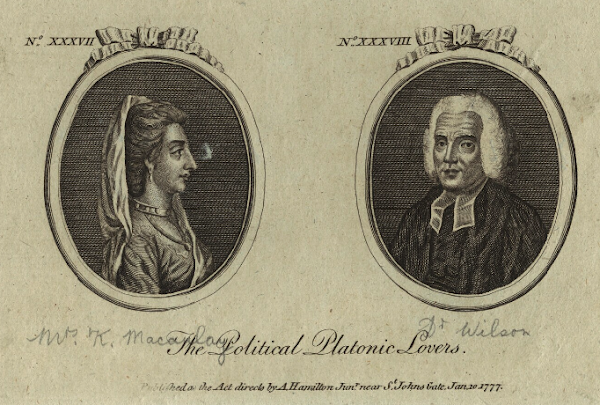
The National Portrait Gallery in London shares some engraved images of Macaulay from this period, such as the one shown above, framing her as a matron from the Roman republic. Another print spelled out that linkage.

In the late 1760s, however, Macaulay’s public image began to change. The more she wrote about the English Civil War and the Commonwealth, the more radical she seemed. Then in 1774 she moved into the Rev. Dr. Thomas Wilson’s house in Bath, as discussed back here. And of course she was a woman in the public eye.

Those developments raised questions in people’s minds, which came out in this engraving issued in 1777, a double portrait of Macaulay and Wilson titled “The Political Platonic Lovers.” That label swirled together the two reasons people might look askance at Catharine Macaulay: her politics and her living arrangement.
Over the next couple of years, Wilson commissioned Robert Edge Pine to paint a portrait of Macaulay holding one of her letters to him. He commissioned Joseph Wright of Derby to paint himself and Macaulay’s daughter. He commissioned John Francis Moore to sculpt a statue of Macaulay as the muse Clio, which he eventually pressed upon the church he was supposed to be serving in London. He published odes to Macaulay on her forty-sixth birthday in 1777 from himself, the teenager Richard Polwhele, and Dr. James Graham. Clearly the minister was besotted with the historian.

Macaulay obviously appreciated the house to live in and the promised bequest to her daughter. But she resisted any offers or hints of marriage from Wilson. She maintained that the septuagenarian minister was merely a friend. Indeed, when she published the first volume of a less formal History of England from the Revolution as “a Series of Letters to a Friend,” that friend was Wilson.

In those same years, Macaulay was struggling to continue her history of 17th-century England; no volume had appeared since 1771. She was feeling sick much of the time. That was how she had become a patient and patron of Dr. Graham, who presented himself as an eye specialist with extra-special training from America.

Given her personal state, Macaulay surely would not have appreciated this crude colored print published later in 1777 and now digitized by the British Museum. Captioned “A Speedy and Effectual Preparation for the Next World,” the picture shows the historian, recognizable by her long nose, putting on her makeup as Death shakes sand out of an hourglass. A portrait of the Rev. Dr. Wilson hangs above her table.
TOMORROW: A journey for her health.

Monday, August 22, 2022

“Opposition to established error must needs be opposition to authority”

In May, prompted by the Boston Museum of Fine Arts’s new acquisition of a double portrait by Joseph Wright of Derby, I started writing about the life and public image of historian Catharine Macaulay.

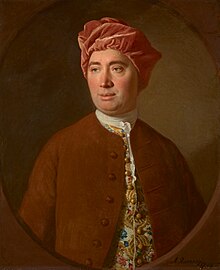
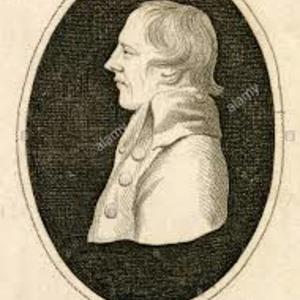
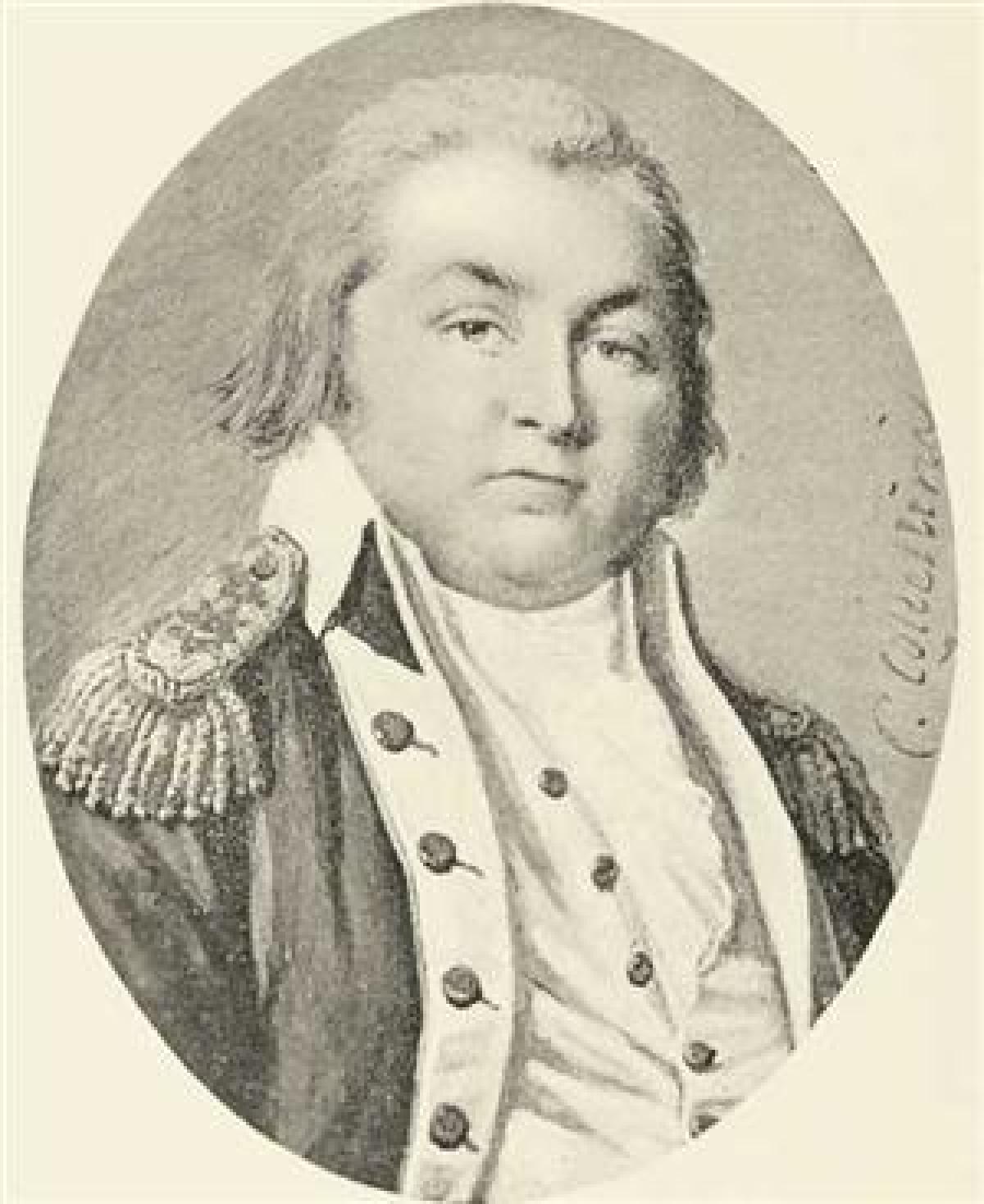
Then I broke off to address other matters, but at last I’m getting back to her. But first a running start with another historian, David Hume (1711–1776, shown here).

Hume began publishing philosophical essays with his Treatise on Human Nature in 1738, earning about as much as philosophers have usually earned. But in 1754 he published the first volume of his History of England. In eight years he wrote six volumes covering time from Julius Caesar to the Glorious Revolution of 1688. That series was popular enough to make Hume moderately rich and famous.

As a national history, Hume’s work was notable for a couple of themes that might seem contradictory:
  • He was skeptical or critical about religion, casting it as an impediment to progress.
  • He was favorable about England’s monarchs, even the Stuarts.
Hume thought of himself as an independent Whig or standing politically between the Whigs and Tories, but the Whigs of the 1750s felt he had created a Tory history of their country.

In 1763 Catharine Macaulay published the first volume of her History of England from the Accession of James I to that of the Brunswick Line. She and her readership saw her as providing a truly Whiggish response to Hume. For her the Stuarts were bad kings, and the uprising against them a Good Thing.

The two authors exchanged letters in 1764. Hume stated, “I look upon all kinds of subdivision of power, from the monarchy of France to the freest democracy of some Swiss cantons, to be equally legal, if established by custom and authority.” Macaulay disagreed:
Your position, that all governments established by custom and authority carry with them obligations to submission and allegiance, does, I am afraid, involve all reformers in unavoidable guilt, since opposition to established error must needs be opposition to authority.
Whigs extolled Macaulay in the mid-1760s. Artists issued portraits of her as a Roman matron “lamenting the lost liberties.”

In 1768 Macaulay, recently widowed, published the fourth volume of her history, covering the trial and execution of Charles I. Even that event she portrayed as a Good Thing, arguing that “Kings, the servants of the State, when they degenerated into tyrants, forfeited their right to government.” Though she criticized Oliver Cromwell, she praised the Commonwealth of the 1650s.

That went too far for the British political establishment. People began to view Macaulay as a “republican,” someone who didn’t think any monarchy was necessary in Britain—and perhaps no social hierarchy, either. The Earl of Rockingham, his Whig faction, and his mouthpiece Edmund Burke distanced themselves from her. Having been celebrated, she was becoming controversial.

Macaulay herself had no formal role in politics, but in 1769 her brother John Sawbridge, a Member of Parliament and London alderman, helped to found the Society of the Gentleman Supporters of the Bill of Rights with the Rev. John Horne. Their original goal was to support John Wilkes in his battles with the government, but within a couple of years Sawbridge and Horne thought the group had become too focused on that one man. They wanted broader reforms, and Macaulay was part of the same circle.

Catharine Macaulay published the fifth volume of her history in 1771. And then she appears to have hit a wall. No sixth volume appeared for a decade.

To be sure, Macaulay did issue shorter works, such as her Address to the People of England, Scotland, and Ireland, on the Present Important Crisis of Affairs in 1775. That crisis was of course the outbreak of war in America, and Macaulay made clear which side she was on:
With an entire supineness, England, Scotland, and Ireland, have seen the Americans, year by year, stripped of the most valuable of their rights; and, to the eternal shame of this country, the stamp act, by which they were to be taxed in an arbitrary manner, met with no opposition, except from those who are particularly concerned, that the commercial intercourse between Great-Britain and her Colonies should meet with no interruption.

With the same guilty acquiescence, my countrymen, you have seen the late Parliament finish their venal course, with passing two acts for shutting up the Port of Boston, for indemnifying the murderers of the inhabitants of Massachusets-Bay, and changing their chartered constitution of government:
Macaulay also jumped ahead of her big history to publish the first volume of a History of England from the Revolution to the Present Time in 1778, but she adopted the less demanding form of “a Series of Letters to a Friend.” In those pages she went so far as to criticize the Glorious Revolution of 1688 for not putting enough curbs on the powers of monarchy.

TOMORROW: Moving to Bath, traveling to France.

Sunday, August 21, 2022

“A country undergoing a severe case of ancestor worship”?

From Louis Menand’s essay “American Democracy Was Never Designed to Be Democratic” in the New Yorker:

You might think that the further we get from 1789 the easier it would be to adjust the constitutional rule book, but the opposite appears to be true. We live in a country undergoing a severe case of ancestor worship (a symptom of insecurity and fear of the future), which is exacerbated by an absurdly unworkable and manipulable doctrine called originalism. Something that Alexander Hamilton wrote in a newspaper column—the Federalist Papers are basically a collection of op-eds—is treated like a passage in the Talmud. If we could unpack it correctly, it would show us the way.

The Bill of Rights, without which the Constitution would probably not have been ratified, is essentially a deck of counter-majoritarian trump cards, a list, directed at the federal government, of thou-shalt-nots. Americans argue about how far those commandments reach. Is nude dancing covered under the First Amendment’s guarantee of the freedom of expression? (It is.) Does the Second Amendment prohibit a ban on assault weapons? (Right now, it’s anyone’s guess.) But no one proposes doing away with the first ten amendments. They underwrite a deeply rooted feature of American life, the “I have a right” syndrome. They may also make many policies that a majority of Americans say they favor, such as a ban on assault weapons, virtually impossible to enact because of an ambiguous sentence written in an era in which pretty much the only assault weapon widely available was a musket.

Some checks on direct democracy in the United States are structural. They are built into the system of government the Framers devised. One, obviously, is the Electoral College, which in two of the past six elections has chosen a President who did not win the popular vote. Even in 2020, when Joe Biden got seven million more votes than his opponent, he carried three states that he needed in order to win the Electoral College—Arizona, Georgia, and Pennsylvania—by a total of about a hundred thousand votes. Flip those states and we would have elected a man who lost the popular vote by 6.9 million. Is that what James Madison had in mind?

Another check on democracy is the Senate, an almost comically malapportioned body that gives Wyoming’s five hundred and eighty thousand residents the same voting power as California’s thirty-nine million. The District of Columbia, which has ninety thousand more residents than Wyoming and twenty-five thousand more than Vermont, has no senators. Until the Seventeenth Amendment was ratified, in 1913, senators were mostly not popularly elected. They were appointed by state legislatures.

Even though the Senate is split fifty-fifty, Democratic senators represent forty-two million more people than Republican senators do. As Eric Holder, the former Attorney General, points out in his book on the state of voting rights, “Our Unfinished March” (One World), the Senate is lopsided. Half the population today is represented by eighteen senators, the other half by eighty-two. The Senate also packs a parliamentary death ray, the filibuster, which would allow forty-one senators representing ten per cent of the public to block legislation supported by senators representing the other ninety per cent.
In addition to Holder’s book, Menand is responding to Nick Seabrook’s One Person, One Vote: A Surprising History of Gerrymandering in America and Jacob Grumbach’s Laboratories Against Democracy.

It makes sense to constitutionally insulate some political matters, such as those individual rights, off from democratic decision-making. It also makes sense to require representatives to win majorities (as opposed to pluralities), and possibly to require supermajorities for important issues.

But there’s no sound philosophical basis for a republic founded on the idea of natural rights and equality to allow numerical minorities to outvote majorities. History, not principle, tells us how those distortions came about, and history offers plenty of reasons to fix them.

Incidentally, Louis Menand’s mother, Catherine Menand, was Director of Archives and Records Preservation at the Massachusetts Supreme Judicial Court and a historical scholar who wrote about Justice John Ruddock, Samuel Adams, and other Revolutionary figures. It was a delight to know her.

Saturday, August 20, 2022

The Details in the Devil

For the Washington Post, University of Delaware history professor Zara Anishanslin wrote about the roots of far-right accusations that the Devil is involved in American politics reach down deep to the Revolutionary protest movement.

Devils were a crucial element of American protests against the Stamp Act, including the August 1765 effigies hanging from what became Liberty Tree, the subsequent processions modeled on that event in other colonies, and even Isaiah Thomas’s little stamps on the Halifax Gazette.

I’d push that form of politics back even further because the Stamp Act protest borrowed imagery from New England Pope Nights, which always included the Devil and multiple imps. Since that holiday was part of the British Empire’s loud stance against Roman Catholicism and the Stuart claimants to the throne, using a religious figure of evil made sense.

And Pope Night was always political as well. The Stuart claimants were contemporary figures, and Charles Edward Stuart almost came within striking distance of the British throne in 1745. A 1750s Pope Night was recalled as lambasting Adm. John Byng, another contemporaneous villain. So the shift to using Pope Night–like effigies against men associated with the Stamp Act wasn’t all that big.

Likewise, after Benedict Arnold defected in 1780, Americans resurrected the Pope Night imagery, largely suppressed while leaders sought alliances with the Québecois and French, to show their enmity to him. The details might change, but the Devil did not.

Anishanslin also writes:
How the devil looked was important. And in Colonial and revolutionary era America, the devil was often portrayed as a Black man. Illustrations of the devil in Cotton Mather’s account of the Salem Witch Trials and Paul Revere’s prints alike both showed the devil with black skin. Such depictions played into the racism and fear of slave revolt that undergirded much of the revolution.
That made me take a closer look at figures of the devil in American printing. The first thing I noticed is a difference between the depictions in woodcuts and in more expensive engravings, such as Revere’s “A Warm Place—Hell.” Engravings could show more detail, but they couldn’t depict solid black. The devils and demons on those pages tend to look like dark, hairy monsters.

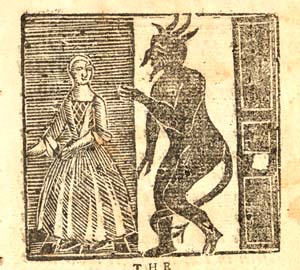
In contrast, woodcuts like the one above usually did show the devil as almost a black silhouette. Often that silhouette had a tail, long pointed nose, and spiky horns or hair—different from how artists of the time showed a generic “Black man.” While the symbolism of blackness itself in British-American culture can’t be denied, I don’t think British-American artists were depicting the Devil in the form of either a man or an African. 

Friday, August 19, 2022

The Mysteries of Fortune Freeman

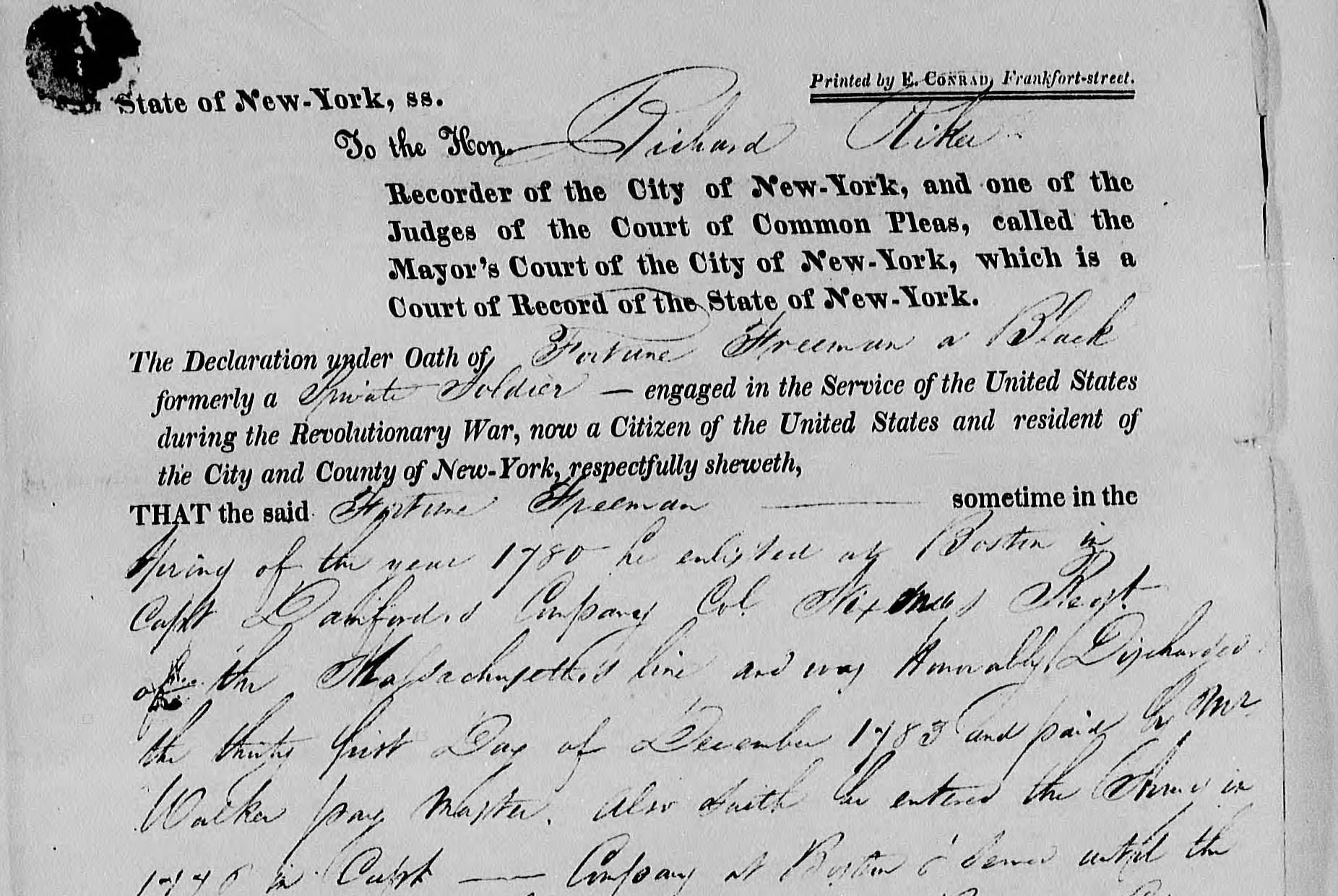
Earlier this year Boston National Historical Park shared a research article by Anjelica Oswald about an African-American Revolutionary War pensioner. It starts with this scene:
In the spring of 1818, an old man named Fortune Freeman…swore to the court that he served as a soldier in the Revolution, and applied for a veteran’s pension for some relief. Arriving to the court with merely the clothes on his back, Freeman provided few details about his personal life in his statement. Aside from his own declarations, few records of his life exist before or after the war. Only one of these precious few records remained in his possession when he approached the court: a discharge paper from the 4th Massachusetts, issued to him at the close of the Revolutionary War in 1783.
Because many veterans similarly lacked paperwork, and because the U.S. War Department had suffered a fire in 1800, the pension process for aging Revolutionary War veterans relied on applicants’ memories. That makes the pension files detailed historical sources but also leaves them riddled with gaps and contradictions.

In Fortune Freeman’s case, his memories didn’t match the remaining paper trail in several ways.
Freeman claimed to have first enlisted in Boston in 1776 in Captain Elijah Danforth’s company, Colonel Thomas Nixon’s regiment, later designated the 6th Massachusetts Regiment in 1779. He stated that he continued to serve in the same regiment until his honorable discharge in 1783. However, when looking through muster rolls, there is no record of a “Fortune Freeman” enlisting in 1776 in Danforth’s company. In fact, there is no record of a “Fortune Freeman” in Danforth’s company at all.
Capt. Danforth was from Billerica, serving from the first day of the war. But he left the army in March 1779. So whom commanded Fortune Freeman after that?

Freeman also testified to having been wounded at the Battle of Brandywine and to witnessing the surrender of Gen. John Burgoyne at Saratoga. Those two major battles took place in the same season hundreds of miles apart, so no army units were at both.

Freeman’s pension application thus shows some of those gaps and contradictions. However, Oswald also found that in May 1777 Col. James Barrett mustered a Billerica man named Fortune (or “Forten”) Conant into Capt. Danforth’s company. This man served in that Massachusetts regiment until 1780. Then there’s no further record of him.

But there is a record of a man named Fortune Freeman enlisting into the 4th Massachusetts regiment in 1781 and serving until the end of the war two years later. Those details matched the discharge paper Freeman presented with his pension application decades later.

Oswald’s essay explores the likelihood had Fortune Conant and Fortune Freeman were the same man, with some details dovetailing, others (like his later commanding officer) left aside, and a few (either Brandywine or Saratoga) embellished.

It also uses the record of the units Conant and Freeman were linked to, and later civilian records, to fill in the big holes of his/their life. Was Fortune Conant born enslaved, perhaps to the Conant family of Billerica? Did Fortune Freeman return to Massachusetts after being discharged? The U.S. government continued to pay his pension until 1824, so is that when this veteran died? The article is a detailed read, careful to distinguish evidence from supposition.

Thursday, August 18, 2022

H.M.S. Endeavour Under Attack?

The story of the shipwreck in Narragansett Bay that’s probably, but not officially, H.M.S. Endeavour continued this month as the Boston Globe reported that the remains are being eaten away.

Brian Amaral has been covering this story, and in this latest installment he described how Reuben Shipway came from the University of Plymouth to investigate the biology of the wreck (in cooperation with local authorities).

Not only did Shipway find naval shipworms, or Teredo navalis, in wood brought up from the seafloor, but “He saw larvae on their gills — that meant they were breeding.” Indeed, shipworm might share responsibility for only about 10–15% of the warship remaining.

What’s more, “Shipway found evidence that a crustacean species called gribbles had eaten at the wood from the outside, a sort of two-pronged attack that will, in time, eat anything that’s exposed to water until it’s gone.” While the material is safer when buried in sediment, currents in the bay and warming water mean that underwater environment will always be changing.

Shipway also examined his samples for evidence of species from distant oceans, which would add to the evidence that this particular wreck is the Endeavour, later renamed H.M.S. Lord Sandwich. None came to light, but Australian archeologists are already convinced.

There remains the big question of who wants to fund further exploration and any attempts at preservation. The ship came from the British navy. It’s in U.S. waters. In world history, it’s most significant as the vessel that brought Capt. James Cook and the British to Australia, and that country is most interested in it.

Meanwhile, the shipworms and gribbles are still living their lives.

Wednesday, August 17, 2022

“More of the spirit of party, than of poetry”

The precocious poet Richard Polwhele’s The Spirit of Frazer (discussed yesterday) tries to use the form and language of heroic national verse to praise Gen. John Burgoyne’s surrender at Saratoga and urge Great Britain to withdraw from its American war.

That would be a hard task for any writer, let alone a teenager. As the literary scholar Dafydd Moore wrote in what might well be the only recent study of Polwhele, “The language and devices of martial heroism are pushed beyond the point they can be credibly flexed.”

But back in 1778, when young Polwhele had his poem printed in Bath and sent to the London bookseller William Goldsmith and literary reviewers, reactions appeared to have hinged on politics.

The Spirit of Frazer was undoubtedly political, and magazine editors didn’t even have to read the poem to get that. By putting the name of “Mrs. [Catharine] Macaulay” on the title page, Polwhele allied himself with the country’s radical Whigs.

The Westminster Magazine’s reviewer wrote:
The inscription to the great Commonwealth heroine, or queen of the Amazons, sufficiently hints the principle on which these pieces are written; and as for the rest, there plainly appears more of the spirit of party, than of poetry, in them.
The Critical Review started out on the same point but actually had something to say about the poetry as poetry:
When the reader observes that these two poems are inscribed to the female historian, we need not add that they are of the patriotic cast. In the Tale we find some strokes of the pathetic, and the Ode contains some flashings of poetical fire.
In contrast, all the Town and Country Magazine had to say was, “Another patriotic reverie in verse.” British Whigs, like Americans, had adopted the term “Patriot” for their platform of political reforms, so it meant both more and less than basic loyalty to Britain.

Some reviewers really didn’t like Polwhele’s message. The Monthly Catalogue stated:
Of all the spirits we ever conversed with, this is the most spiritless. It persuades General Burgoyne (who, it seems, took its advice) to yield the day to [Horatio] Gates. . . . This is the genius—this the language of the gallant [Simon] Frazer!—No, ’tis a base counterfeit—the ghost of a By—g [Adm. John Byng],—or it is some dastard soul, the body of which had been shot in the back.—S’death! if the real spirit of General Frazer, now, perhaps, hovering, melancholy, over the fatal plain of Saratoga, could but hear of this poem, it would certainly waft itself back to Britain, and pull the Author by the nose.
And the London Review of English and Foreign Literature called The Spirit of Frazer:
A piece of Bath metal sent up to a London Goldsmith, to make money of.—What punishment ought not to be inflicted on such counterfeiters of poetical coin.
Still, nothing could daunt young Richard Polwhele from his literary career. He studied for a couple of years at Oxford and then went into the ministry, married, and raised a family while working as a country cleric. And he continued to write—more long poems, antiquarian and topographical studies, biographies.

People care about only one of Polwhele’s books, though: The Unsex’d Females, a 1798 poem (with lengthy footnotes) about the dangers of the French Revolution and Mary Wollstonecraft. And that’s only because it shows the environment that women faced as public authors in the period.

Tuesday, August 16, 2022

“Reason’s voice commands thee, yield”

The first person to use the death of Gen. Simon Fraser at Saratoga in art might have been the young poet Richard Polwhele (1760–1838, shown here).

His first tiny splash in the British literary world was as the youngest of the admirers writing odes to Catherine Macaulay for her birthday in 1777, mentioned back here.

Through the same printer the teenager soon published The Fate of Lewellyn; or, the Druid’s Sacrifice. A Legendary Tale. In Two Parts. To which is added Carnbré, a Poem. Agnes Repplier later wrote of that book:
The title-page stated modestly that the writer was “a young gentleman of Truro School”; whereupon an ill-disposed critic in the “Monthly Review” intimated that the master of Truro School would do well to keep his young gentlemen out of print. Dr. [Cornelius] Cardew, the said master, retorted hotly that the book had been published without his knowledge
Undaunted, in 1778 Polwhele enrolled at Oxford and put out yet another volume: The Spirit of Frazer, to General Burgoyne. An ode. To which is added, The Death of Hilda; an American Tale. Inscribed to Mrs. Macaulay. In fact, according to a 1798 profile, he wrote those poems before leaving school.

I haven’t found any online texts, and for that most people would be grateful. However, Dafydd Moore quoted and analyzed The Spirit of Frazer in his monograph Richard Polwhele and Romantic Culture: The Politics of Reaction and the Poetics of Place. So you’re not getting off that easily.

As Polwhele spins his tale, a few days after his death Fraser appears to Gen. John Burgoyne and poetically urges surrender to the American army. The brigadier’s ghost argues that this is the most honorable course because the war in America is both unjust and unwinnable.
Reason’s voice commands thee, yield:
Ev’n Frenzy’s self would scarce oppose!
Tempt not the horrors of the field,
Nor brave surrounding foes!
Nor Slavery’s dungeon be thy meed!
For Honour would disclaim the deed!
Yet stamps the Roll that bids the battle cease!
Burgoyne, the ghost says, should return to Britain and advocate for peace.
Go! and bid her spread no more
Her thunders o’er the Atlantic wave,
While glooms destruction’s threatning power,
Pointing to the yawning grave!
No more let War his flaming brand
Wide wave o’er Freedom’s ravag’d land,
Where soon a glorious Empire shall arise!
Polwhele thus had Fraser echo how Britain’s most radical anti-war Whigs were responding to news of Saratoga.

TOMORROW: The reviews roll in.

Monday, August 15, 2022

The Memory of Gen. Simon Fraser

Brigadier general Simon Fraser had a long career in the British army before dying in the Battle of Saratoga.

Even so, it appears that Gen. John Burgoyne’s description of his funeral, quoted back here, made Fraser into a British icon of sorts.

Burgoyne’s efforts were helped along by another narrative of that event in Lt. Thomas Anburey’s Travels Through the Interior Parts of America, published in 1789. Anburey wrote:
About sun-set, the corpse was carried up the hill; the procession was in view of both armies; as it passed by Generals Burgoyne, [William] Phillips and Riedesel, they were struck at the plain simplicity of the parade, being only attended by the officers of his suite…and urged by a natural wish to pay the last honors to him, in the eyes of the whole army, they joined the procession.

The enemy, with an inhumanity peculiar to Americans, cannonaded the procession as it passed, and during the service over the grave. The account given me by your friend Lieut. [Quin John] Freeman was, that there appeared an expressive mixture of sensibility and indignation upon every countenance—the scene must have been affecting.
Anburey spent years as a prisoner of war with the Convention Army—that was how he traveled through the interior parts of America. He didn’t come away with any fondness for the host nation.

In the same year Anburey’s account was published, a print appeared on the London market titled “View of the West Bank of the Hudson’s River, 3 Miles above Still Water, Upon which is the Army under the Command of Lt. Gen. Burgoyne (Showing General Frazer’s Funeral).”

Follow this link to a digitized image of this print from the Yale University Art Gallery. On the rightmost of the three hills is a line of tiny figures following two coffins. Some experts interpret the second one as representing Burgoyne’s aide-de-camp Sir Francis Clarke, also killed in the battle though not in any account buried with Fraser.

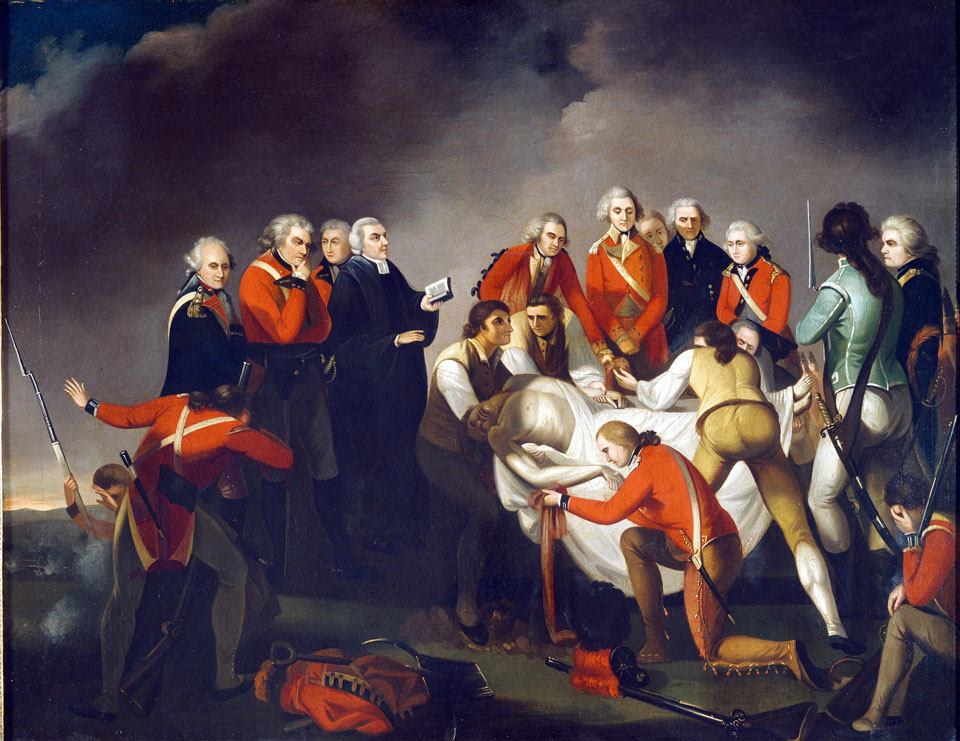
Finally in 1791 the Scottish artist John Graham (1754–1817) exhibited a painting of Fraser’s funeral. Graham was influenced by Benjamin West’s picture of the death of Gen. James Wolfe in 1759. So much so, in fact, that one critic of the time reviewed The Funeral of General Fraser by saying: “We should have been more pleased with the picture if we had not seen The Death of General Wolfe by West.”

As West had done before him (and as other West acolytes like John Singleton Copley and John Trumbull did), Graham sought out the officers who had been at the event he was depicting. He made studies of those men and portrayed them as individuals in his scene. That painting was made into a print in 1794, and the print was issued with a key to the figures.

(I can’t find Graham’s original on the web; the image above shows a copy in the collection of the National Army Museum.)

Burgoyne, Anburey, and Graham thus crafted Fraser’s funeral into an emblem of British fortitude and propriety even in defeat. This stuff-upper-lip behavior could easily, as Don Carleton commented last week, tip into Monty Python–style satire. Still, it was effective.

American chroniclers of the Battle of Saratoga felt a need to quote Riedesel and Burgoyne on Fraser’s death and metal—those sources are just too full of drama to ignore. But the same historians often added a protest that if only the British commanders had told the Americans that the generals were gathering for a funeral there would have been no artillery fire. I’m not entirely convinced.

Sunday, August 14, 2022

Another Dispatch from James Madison’s Montpelier

The Culpepper Star-Exponent is reporting on an odd wrinkle in the already public conflict over historical interpretation at Montpelier, James Madison’s slave-labor plantation.

The U.S. Postal Service closed the small post office near that historic site on short notice in June because, as Allison Brophy Champion reports, “it objected to a historical exhibit there.” The small building that housed the post office is part of the property of the Montpelier Foundation.

A spokesperson told the newspaper, “Service at Montpelier Station was suspended after it was determined the display at the site was unacceptable to the Postal Service.”

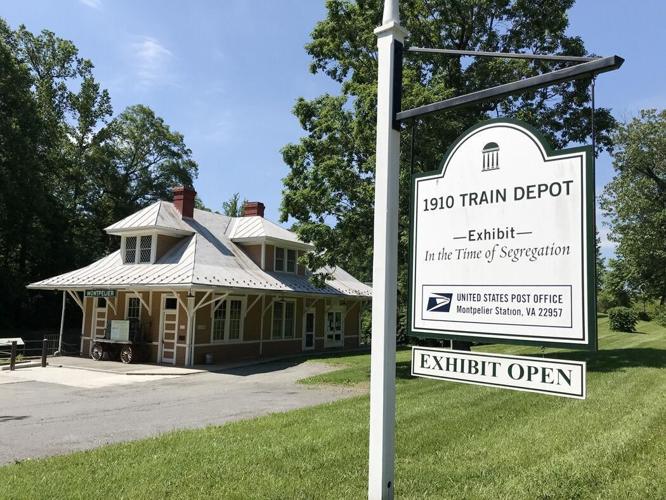
The display at issue consists of one panel on the outside of the building and several more inside—through a door separate from the one that went to the working post office.

The exhibit is titled “In the Time of Segregation,” and it describes segregation at that post office, opened in 1912, and in other services in the Jim Crow states.

Now one might at first guess that this display was a project of the new management at Montpelier. In May, as I described here and here, the Montpelier Foundation resolved months of internal controversy by seating eleven new members representing descendants of people enslaved at that plantation and others nearby, and installing new top management. The organization seemed poised to focus more attention on the site’s history of slavery and segregation.

In fact, the “In the Time of Segregation” exhibit was installed twelve years ago when the post office building reopened after Montpelier restored it. Only in June, within a month of the Montpelier Foundation management change, did some U.S. Postal Service manager deem that presentation of history “unacceptable.”

The post office’s local spokesperson declined to offer any more information and also claimed, “we attempted to address the issue with the property owner.” The head of the Montpelier Foundation told the Star-Exponent, “The U.S. Postal Service did not contact the current CEO or chief of staff, nor did it contact the previous CEO or chief of staff.”

The closure doesn’t affect Montpelier alone. About a hundred people had boxes at that post office because they don’t get mail delivered to their houses nearby. They “were supposed to get temporary postal boxes in Orange,” about four miles away, but that hasn’t happened. The Postal Service also promised a public meeting, but there’s no report of one taking place.

Furthermore, the area’s representative in Congress has told the U.S.P.S. district manager that “To close a post office, the agency is required to make its determination in writing, made available to the customers served by the office, and may not close it until 60 days afterward.” That clearly didn’t happen.

Saturday, August 13, 2022

Online Tools to Investigate the Myths of American History

Today I’m speaking at History Camp Boston, the gathering of history researchers, writers, and buffs organized by the Pursuit of History.

I’ve spoken at each annual History Camp Boston, and it will be good to return after two years in which the pandemic made such a congregation too risky.

Back in late 2019 or early 2020 the founder of the Pursuit of History, Lee Wright, suggested I speak at the next History Camp about debunking myths of Revolutionary history. I decided it would be better to focus on tools for people doing their own research. And then I had other, heavier things on my mind for more than two years.

But at last History Camp Boston is taking place, and my talk is:

Digging and Debunking: Using Online Tools to Investigate the Myths of American History

From Founders’ quotes to inspirational legends to details that historians have repeated for so long that nobody considers where they came from, our history abounds with assertions that we should be skeptical about. This workshop discusses how to assess such historical tales and tidbits. It will share tactics for using Google Books and other free resources to pinpoint when and where stories arose, and lay out the dynamic of “grandmother’s tales,” “memory creep,” and other ways legends spread. And every so often these techniques reveal that a story almost too good to be true is supported by solid evidence.
I expect to touch on the following websites since I use them regularly when I research new topics and details about individuals.

Google, especially Google Books, sometimes augmented with Google Ngram Viewer
HathiTrust Digital Library
Internet Archive

Founders Online
Colonial Society of Massachusetts publications
Massachusetts Historical Society Coming of the Revolution and other resources

Sites on false quotations from famous Founders
Monticello’s spurious quotes page
Mount Vernon’s spurious quotes page
Wikiquote

Language sites
Etymonline
Merriam-Webster
Johnson’s Dictionary Online

JSTOR (I can access through the Newton Free Library; a card from the Boston Public Library, which any Massachusetts resident can apply for, also offers access to electronic resources)

American Archives

Newspapers
GenealogyBank (paid subscription)
Harbottle Dorr collection of Boston newspapers at the Massachsuetts Historical Society
Virginia Gazettes at Colonial Williamsburg

Genealogy sites (for vital records)
Early Vital Records of Massachusetts
FamilySearch
Geni
American Ancestors (N.E.H.G.S.) for local probate files, real estate, &c. (paid membership)

Fold3’s Revolutionary War Pensions (paid membership)

Sources on the naval war
American War of Independence at Sea
Three Decks
Naval Documents of the American Revolution

Town, state, and federal government records
Massachusetts House Journals
Massachusetts census of 1765
Boston town records
Boston tax records for 1780
A Century of Lawmaking on the Continental Congresses

Friday, August 12, 2022

The Funeral of Gen. Simon Fraser

Yesterday I quoted Frederika von Massow Riedesel on the death of Gen. Simon Fraser at Saratoga.

Wounded at Bemis Heights on 7 Oct 1777, Fraser died the following morning. By then the Crown forces had pulled back to their fortified camp, and the Continentals were attacking them.

Riedesel's memoir, in the 1827 translation, continued:
After he had been washed, he was wrapped in a sheet, and laid out. We then returned into the room, and had this melancholy spectacle before us the whole day. . . .

We were informed, that general [John] Burgoyne intended to comply with general Fraser’s last request, and to have him buried at 6 o’clock, in the place which he had designated. This occasioned an useless delay, and contributed to our military misfortunes. At 6 o’clock, the corpse was removed, and we saw all the generals, with their retinues, on the hill, assisting at the funeral ceremony.
Among those generals was Riedesel’s own husband, making what followed particularly unnerving for her. Especially since she obviously felt the army should be moving to a place of greater safety rather than going through this ceremony.

The chaplain who presided was the Rev. Edward Brudenell.

Gen. Burgoyne devoted space in his report to the House of Commons on the failed campaign to Fraser’s funeral:
The incessant cannonade during the solemnity; the steady attitude and unaltered voice with which the chaplain officiated, though frequently covered with dust, which the shot threw up on all sides of him; the mute but expressive mixture of sensibility and indignation upon every countenance: these objects will remain to the last of life upon the minds of every man who was present. The growing duskiness added to the scenery, and the whole marked a character of that juncture that would make one of the finest subjects for the pencil of a master that the field ever exhibited—

To the canvas and to the faithful page of a more important historian, gallant friend! I consign thy memory. There may thy talents, thy manly virtues, their progress and their period, find due distinction; and long may they survive;—long after the frail record of my pen shall be forgotten.
Can you tell that Burgoyne (shown above) was a dramatist?

COMING UP: A scene of British fortitude.

Thursday, August 11, 2022

The Death of Gen. Simon Fraser

During the fight at Bemis Heights, the second act of the Battle of Saratoga, an American rifleman picked off Simon Fraser, brigadier general and commander of His Majesty’s 24th Regiment of Foot.

Frederika von Massow Riedesel left a dramatic account of Fraser’s last hours. Wife of the officer commanding the Crown’s German-speaking hired regiments, she had traveled to North America with their young children.

This is from the 1827 translation of Riedesel’s memoir of the war:
About 3 o’clock in the afternoon, instead of the guests whom I expected, I saw one of them, poor general Fraser, brought upon a hand-barrow, mortally wounded. The table, which was already prepared for dinner, was immediately removed, and a bed placed in its stead for the general. I sat terrified and trembling in a corner. The noise grew more alarming, and I was in a continual agony and tremour, while thinking that my husband might soon also be brought in, wounded like general Fraser.

That poor general said to the surgeon, “tell me the truth: is there no hope?” . . . the ball had passed through his body, but unhappily for the general, he had that morning eaten a full breakfast, by which the stomach was distended, and the ball, as the surgeon remarked, passed directly through it. I heard often amidst his groans, such words as these, “O bad ambition! poor general Burgoyne! poor Mistress Fraser.” Prayers were read, after which he desired that general [John] Burgoyne should be requested to have him buried on the next day at 6 o’clock in the evening, on a hill where a breastwork had been constructed.

I knew not what to do: the entrance and all the rooms were full of sick, in consequence of the dysentery which prevailed in the camp. At length, towards evening, my husband came, and from that moment my affection was much soothed, and I breathed thanks to God. He dined with me and the aids-de-camp in great haste, in an open space in the rear of the house. We poor females had been told, that our troops had been victorious; but I well saw, by the melancholy countenance of my husband, that it was quite the contrary. On going away, he took me aside, to tell me every went badly, and that I should prepare myself to depart, but without saying any thing to any body. Under the pretence of removing the next day to my new lodgings, I ordered the baggage to be packed up. . . .

my children…were asleep, but…, I feared, might disturb the poor dying general. He sent me several messages to beg my pardon for the trouble he thought he gave me. About 3 o’clock, I was informed that he could not hold out much longer, and as I did not wish to be present at his last struggle, I wrapped my children in blankets, and retired into the entrance hall. About 8 o’clock in the morning he expired.
The 1827 translation says that the words in boldface above appeared in English in the original German publication of Riedesel’s memoir. In other words, they were supposedly the general’s exact words. Nonetheless, a later translation presented Fraser’s words as, “Oh, fatal ambition! Poor General Burgoyne! My poor wife!” 

TOMORROW: A memorable burial.

Wednesday, August 10, 2022

All Dressed Up for the Sestercentennial

I got a new T-shirt this week, offered by JCD666 on TeePublic.

The best part is that the official U.S. Bicentennial logo is modified to look weathered, like a silkscreened shirt that’s gone through the laundry for nearly fifty years.

Getting Fort Plain Sorted Out

The year that The Road to Concord was published, I spoke at the American Revolution Conference organized by the Fort Plain Museum, and I had enough fun to go back in other years.

I’ve also enjoyed the Fort Plain Museum’s online bookstore, which stocks a wide range of books about the American Revolution, well beyond the titles on its region. The store often offers generous discounts on recent titles and free shipping for larger orders.

But on my visits I’d never had time to visit the museum itself, not until this week. It provides a thorough account of the fight between the U.S. of A. and the British Empire over New York’s Mohawk Valley.

I must confess I’d need to take better notes to sort out all the “forts” in the area, ranging from a large construction like Fort Stanwix to little more than a big farmhouse with shutters and a bunch of soldiers assigned to it.

I felt reassured, though, that I’m not alone in that confusion. In fact, the struggle to tell the Mohawk Valley fortifications apart apparently reached up to the highest level of the Continental Army. For this I’m relying on a roundup of period quotations from Norm Bollen (P.D.F. download).

As early as 1780, an invoice documents that people living around where Otsquago Creek joined the Mohawk River called their fortification Fort Plain. But when Gen. Robert Van Rensselaer made it his headquarters later that year, he dubbed it Fort Rensselaer.

There was a geographic and class division between the frontier farmers and Gen. Van Rensselaer, aggravated by a court-martial pitting him against the county’s militia officers. This resentment came out in people living near the fort continuing to call it “Fort Plain.”

Even when Col. Marinus Willett took over and proved more popular and more militarily successful, locals still sent him messages about “Fort Plain.” Willett regularly crossed out that name and wrote in “Fort Rensselear” (close enough by 18th-century standards).

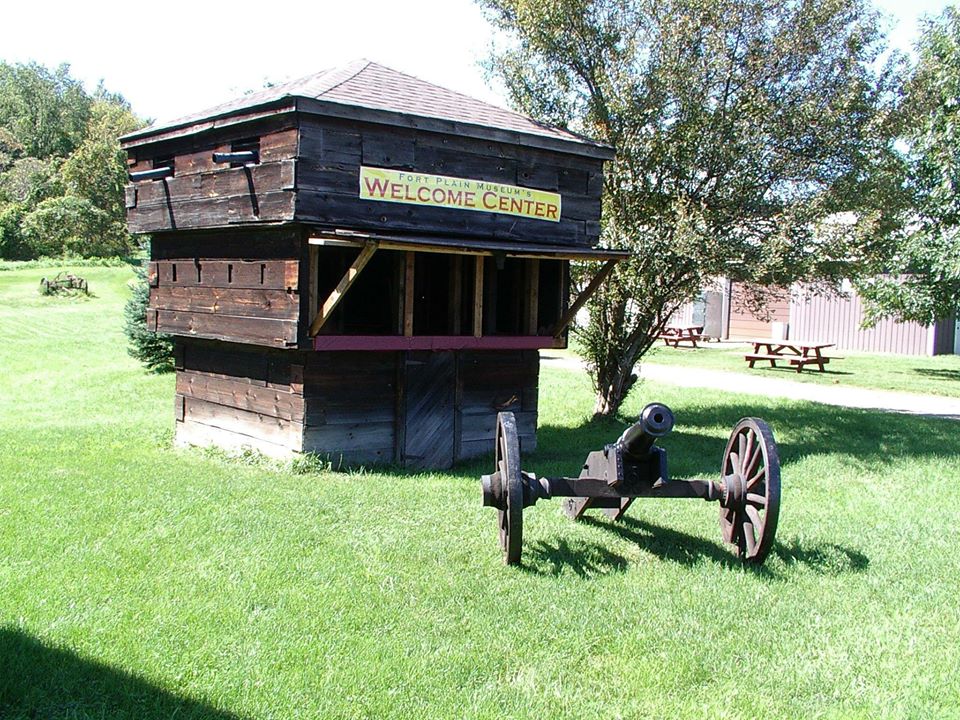
In February 1782 the French military engineer Villefranche de Genton sent Gen. George Washington a “plan of a Redoubt with a Block-house the inside proper to contain two hundred men, and large magazines, as well for ammunition as provisions” for “Fort Ranceler,” as requested by Willett.

Washington thanked the engineer for his work, and in April sent a bunch of paperwork to Gen. Philip Schuyler, including a contract to finish that blockhouse at Fort Rensselaer. Schuyler was Gen. Robert Van Renssalaer’s brother-in-law, so we can be sure of what he called that location.

At the end of May, Col. Benjamin Tupper of Massachusetts took over at that fort. But when he wrote to Washington about the situation, he used the local name:
There is an unfinished Blockhouse at Fort plain which if compleated would be a strong barrior in that Country; I think if some money could be sent on for the Meterials we can procure workmen among the levies to compleat it.
Washington immediately wrote back to say it was “out of my Ability to furnish you with any Money for the Completion of the Block House at Fort plain.” This despite how he’d already asked Schuyler to start work on the blockhouse at Fort Rensselaer.

On 24 June, Gen. Washington traveled up to the Albany region to inspect the Continental posts and supply depots. As part of that trip, he appears to have learned that Fort Rensselaer and Fort Plain were the same place, and it still needed a blockhouse. On 2 July he ordered the quartermaster to send supplies there. Meanwhile, the latest commander of the post, Col. George Reid, was careful to refer to it in his letters to the commander-in-chief as “Fort Plain, or Ransler.”

After the war, the fortification was no longer needed. It disappeared by the end of the century. But the memory of it was strong enough that when the settlers living around Otsquago Creek needed a name for their village, they chose Fort Plain.

Tuesday, August 09, 2022

“Never acquaint any person with that place where I shall be buried”

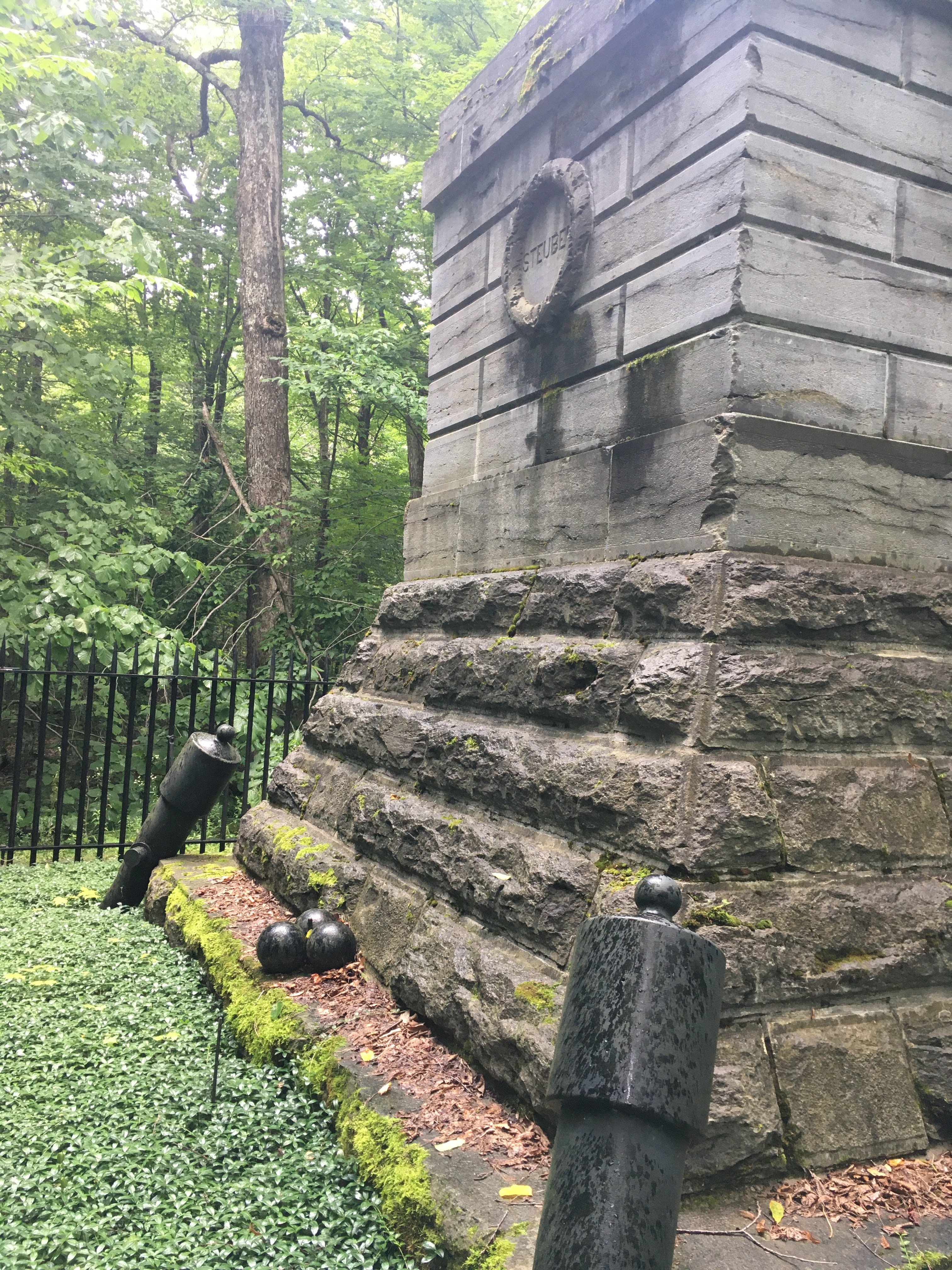
In his last last will and testament, Gen. Frederick William de Steuben wrote:
I do hereby declare that those legacies to my servants are on the following conditions, that on my Decease they do not permit any person to touche my Body, not even to change the Shirt in which I shall die but that they wrap me up in my old Military Cloak and in twenty four hours after my Decease bury me in such spot as I have before my Decease point out to them and that they never acquaint any person with that place where I shall be buried.
It didn’t work out like that.

When the baron died in 1794, his heirs and executors followed his instructions as best they could. (It’s not clear whether he actually did point out a spot or they chose one they thought he’d like.)

But ten years later the growing population of central New York meant that a road was going past or over his grave. Benjamin Walker arranged for his former commander’s remains to be moved to a more secluded spot and donated nearby land to a Baptist church on the condition that its congregation care for that new grave.

Twenty years after that, as the fiftieth anniversary of independence approached, a small monument was erected. In 1871 a much larger pile of stone went up, festooned with half-buried iron cannon and cannon balls.

The gravesite got the high-falutin’ name of the “Sacred Grove”; was named a memorial state park in 1931; has been augmented with a replica of the baron’s cabin, interpretive signage, and public restrooms; and is now managed by the state government in partnership with the National Park Service.

This is, of course, a far cry from Baron de Steuben’s original wish that his executors “never acquaint any person with that place where I shall be buried.”

Yet somehow I think Steuben would be more upset at hearing the cyclist who came through while I was taking photos: “I’ve lived here thirty years, and never knew this was back here.”

A Visit to Fort Stanwix

A combination of travel, illness, and lack of connectivity kept me from posting on my usual daily schedule this weekend, so I’m catching up with some of the places I passed through in central New York.

First up is Fort Stanwix in the city of Rome. I visited this site once before, in the 1990s. It’s impressive to see an eighteenth-century wooden fortification, built to high standards of authenticity, in the middle of a modern city.

Of course, location was the point of Fort Stanwix—it commanded an important portage point in the French and Indian and Revolutionary Wars. It provided a base for protecting the nascent U.S. of A.’s furthest northwest settlements. The city of Rome grew up around it.

And location was also the point of the reconstruction—it was an urban-renewal project. The land was designated as a National Monument back in 1935, when it was still covered with apartment buildings and shops. In the 1960s, Rome city leaders decided a recreated fort would be better for tourism, and Sen. Robert F. Kennedy threw his weight behind the project.

The somewhat dragooned National Park Service offered a master plan in 1967. From 1970 to 1973 it oversaw archeological work, and from 1974 to 1978 the fort went up. Though there’s a reinforced concrete structure, most of what we see is earth and wood.

Fort Stanwix was besieged by Crown forces starting on 3 Aug 1777. To commemorate that period, the park flies a flag based on period sources—thirteen red, white, and blue stripes with no canton or stars.

I was there on a summer Monday. The visitor center was closed. Only one interpretive ranger was on site at a time. A thin but steady stream of visitors suggests that the park could attract more people on summer Mondays with more programming, but of course that costs money.

Some parts of the fort were recently rebuilt, I learned, but the contractor who’d won the bid to haul away the old lumber went out of business during the pandemic. Now there are big piles of logs on the grounds waiting to be removed. That heavy hauling job has to go through the federal hiring process again, following rules designed to protect our public interest but also subject to slowness.

The present park site is thus a memorial to both the wars of the eighteenth century and the expansive, can-do attitude of the Kennedy decade.

Saturday, August 06, 2022

James Leander Cathcart on Three Continents

At Common-place, Julie R. Voss discussed the self-fashioned career of James Leander Cathcart (1767–1843).

Cathcart was born in Ireland and, according to an autobiographical manuscript he left with his family, came to America at age eight with a relative who was a sea captain. That would have been just as the war began.

Within a couple of years, both James and his relative were working on privateers. He reported that he out on the Connecticut-based Continental warship Confederacy under Capt. Seth Harding (1734–1814). That frigate had 32 guns and galley oars as well as sails for better maneuvering, but, when faced with two British warships, Harding surrendered on 18 April 1781.

Cathcart thus became a teen-aged prisoner of war. Voss writes:
In his narrative, Cathcart claims the frigate was seized and the sailors held on a prison ship in New York harbor, from which he and a friend escaped. This striking and adventurous story cannot be corroborated, and it’s at least equally possible that Cathcart claimed his British citizenship when he was seized and then served in the British Navy in order to escape being a prisoner of war.
There are Admiralty Office records of at least some of the New York prison ships, so it might be possible to find young Cathcart’s name and know how long he was a prisoner and how he got out.

After the war, Cathcart continued to work as a sailor, running into another danger:
The Mediterranean practice of seizing ships and holding the crews for ransom or hard labor was common. In fact, the practice dated back centuries, and went in multiple directions. In the heyday of galley ships, European nations captured North Africans to work the oars; and the Catholic Church engineered an entire enterprise of “redemption” for Catholics seized by the ships of Barbary.

By the late eighteenth century, European nations signed treaties with the Barbary States to protect their shipping, and these treaties were renegotiated frequently. After the American Revolution, American ships were no longer protected by British treaties, and Cathcart and his shipmates quickly learned the consequences.
James spent eleven years as a captive, coming of age in northern Africa. At first assigned to be a menial servant, James finessed what Voss calls his “remarkable facility with languages” to become a clerk for the local official and a business owner.

When David Humphreys arrived to neogtiate for the Americans, Cathcart became the man’s aide, helping to obtain his and his fellow prisoners’ release in 1796.

One might think James Leander Cathcart had then had enough of north Africa, but he had lived as long on that continent as any other. He lobbied to be appointed a U.S. consul.

For all his skills, some people thought Cathcart was duplicitous. The American diplomat Joel Barlow stated, “He has neither the talent nor the dignity of character necessary” for his role. Mustafa Baba, the Dey of Algiers after the one Cathcart served, sent a similar message to President Thomas Jefferson. In modern translation:
If he comes to me, I shall in no way receive him since he is not a good man. It is clear that wherever he spends time he creates a great disturbance. For this reason, our not accepting him is for our and your good.
As translated at the time:
his Character does not Suit us, as we know, wherever he has remained That he has created difficulties and brought On a war And as I will not receive him I am shure it will be well for both nations
But the U.S. didn’t have a lot of people experienced in the Arab world and willing to serve the government. Cathcart thus remained consul in Tunis and Tripoli, helping to negotiate again with Algiers. Later he spent more than fifteen years in Madeira and Cadiz before returning to the U.S. of A. and working for the Treasury Department.

Friday, August 05, 2022

Two Revolutionary History Conferences in September

On Saturday, 24 September, folks interested in Revolutionary War history will have a choice of scholarly events to attend or tune into.

Fort Ticonderoga will hold its Eighteenth Annual Seminar on the American Revolution from the evening of Friday, 23 September, to the afternoon of Sunday, 25 September.

Scheduled presentations include:
  • Matthew Keagle, “Highlights from the Robert Nittolo Collection”
  • Blake Grindon, “Jane McCrea, Women, and War: Gender and Violence in the Revolution’s Northern Front”
  • Mark Edward Lender, “Tactical Prowess, Strategic Success, and John Brown’s Ticonderoga Raid Reconsidered”
  • Todd W. Braisted, “‘To do the duty of Soldiers in Every Respect’: New York City’s Loyalist Militia, 1776-1783”
  • Katie Turner Getty, “Displaced: The Donation People and the Siege of Boston, 1775”
  • Ricardo A. Herrera, “FOB Valley Forge: Washington’s Armed Camp on the Schuylkill”
  • Glenn F. Williams, “For Britannia’s Glory and Wealth”
  • J. Patrick Mullins, “‘Wilkes & Liberty’: Material Culture and the Britishness of the American Revolution”
  • Sarah Shepherd, “‘The Infamous Conduct of A few Abandoned Miscreants’: Sexual Violence Committed by Continental Soldiers towards American Women” 
  • Matthew Cerjak, “‘The British Will Know Who We Are’: Women in the Revolutionary War”
  • John William Nelson, “Beyond the Racial Divide: Cross-cultural Alliances and Unexpected Loyalties in the Revolutionary Borderlands”
Registration costs $140 with discounts for early-bird registration by 15 August, Fort Ti membership, and remote access. For more details, go here.

On 24 September, the Emerging Revolutionary War organization will hold its annual symposium in Alexandria, Virginia. This year on the theme “The World Turned Upside: The American Revolution’s Impact on a Global Scale.”

Speakers at that event are:
  • Dr. Lindsay Chervinsky, “‘Peace and Inviolable Faith with All Nations’: John Adams, Independence, and the Quest for Neutrality”
  • Norman Desmarais, “Reevaluating Our French Allies: A New Look at Popular Assumptions of the French Army through the Diary of Count de Lauberdiere”
  • Kate Gruber, “A Retrospective Revolution: England’s Long 17th Century and the Coming of Revolution in Virginia”
  • Scott Stroh, “George Mason’s Declaration of Rights and Their Global Impact”
  • Eric Sterner, “Britain, Russia, and the American War”
Registration for that one-day event starts at $60, again with some discounts, explained here.

Thursday, August 04, 2022

The Stinking Waters and George R. T. Hewes

As I type this, I’m in Richfield Springs, New York. In fact, I’m right across East Main Street (Route 20) from the springs that gave the town its name.

Those are sulphur springs, and the Haudenosaunee (Iroquois) referred to this place as Ganowauges, or “stinking waters.”

Europeans learned about the springs by the early 1750s, and British troops reached the site in 1757 during the French and Indian War. But there was still very little European settlement in the area two decades later when Adam Helmer ran past.

I heard about Richfield Springs first because of its connection to one memorable Revolutionary Bostonian: George Robert Twelves Hewes.

During the siege Hewes lost his shoemaking workshop in Boston and resettled with his family in Wrentham. That change may have helped to cement his memories of the pre-war port.

Later some of Hewes’s children, like many rural New Englanders, moved out to central New York. In the early 1800s the area around Richfield Springs was being developed, with the sulphur water itself promoted as a health remedy.

After the War of 1812, Hewes and his wife Sally followed those children to Richfield Springs. He was then seventy-four years old and ready to retire. Sally Hewes died in 1828. For the next few years, Hewes moved among the houses of relatives and neighbors, telling stories about the Revolution and pulling out his old militia uniform for patriotic holidays.

Some of Hewes’s Independence Day talks came to the attention of a New York writer named James Hawkes, who wrote a biography collecting those tales. The term “Boston Tea Party” had been coined a few years before, and Hawkes titled his 1834 book A Retrospect of the Boston Tea-Party.

That publication spurred Boston grandees to invite Hewes to revisit his home town, which he did in 1835. He sat for a portrait and for celebratory dinners. Since of course we couldn’t be satisfied with a book written by a New Yorker, local writer Benjamin Bussey Thatcher pumped Hewes for more stories, augmented them with other men’s recollections, and published Traits of the Tea Party.

Hewes returned to central New York, having thoroughly enjoyed being a celebrity. In 1840 he was boarding a carriage to ride to yet another Independence Day celebration when he suffered an injury. Hewes died on 5 November at the age of ninety-eight and was buried here in Richfield Springs.

Wednesday, August 03, 2022

Independence Booth in the New Nation

Toward the end of 1778, when Independence Booth was two years old, her parents had a little girl named Hannah. She was their ninth and last child; mother Mary Booth was then forty-five years old.

It looks like Joseph Booth was home for the rest of the Revolutionary War, though his neighbors in Enfield, Connecticut, would continue to call him “Captain Booth” as a courtesy for the rest of his life.

Independence Booth grew up in Enfield and married a man named Danforth Charles in 1802. He appears to have been born in Brimfield, Massachusetts, in 1779. Their first child was a boy named Henry, born in September 1803 but dying thirteen months later. In 1805 they had another boy, whom they also named Henry.

In late 1806, the couple conceived a third child. But in January 1807, Danforth Charles died. Independence gave birth in June to a girl she named Hannah. The widow still had her parents and most of her siblings nearby for support, though Mary and Joseph Booth died in 1809 and 1810, respectively.

In 1817 Independence Charles was listed as an inhabitant of Springfield, Massachusetts, when she married Lewis Barber of Ludlow there. That marriage was newsworthy enough to be reported in the Franklin Herald of Greenfield. Three years later, the Enfield church dismissed “Widow Independence Charles” to the congregation at Ludlow; she and her children had probably already made the move.

In 1828 Independence (Booth Charles) Barber died in Ludlow, survived by her third husband and her two children, then in their twenties. Courtesy of Revolution Happened Here, her gravestone in that town appears above, showing her birthdate as 4 July 1776. She had lived to see the fiftieth anniversary of the independence she was named after. Notably, the gravestone also includes her original surname.

The following year, daughter Hannah Charles married Elisha Taylor Parsons, a man from Enfield who had settled in Ludlow as a schoolteacher. He would become locally prominent as a deacon and town officeholder. Later Hannah’s older brother Henry married a woman named Nancy Parsons; I can’t confirm her family tie to Hannah’s husband. Both of Independence’s children had children of their own, passing on the story of how she was (almost) born on the 4th of July.

Tuesday, August 02, 2022

“Independence Booth was Born”


The New England troops that enlisted in their colonies’ armies in the spring of 1775, and then became the Continental Army in June, agreed to serve until the end of the year.

Some Connecticut troops in fact believed the end of their stint was in mid-December and tried to leave camp then, prompting a confrontation between those men and regiments from other colonies obeying the commands of Gen. George Washington to keep everyone in camp. (I discussed that episode back here.)

Washington also wrote to the New England governors asking them to order some militia regiments to the Boston siege lines to maintain numbers until new Continental recruits and re-enlistees started to arrive in mid-winter. Connecticut governor Jonathan Trumbull activated Col. Erastus Wolcott and his regiment from December to February.

French and Indian War veteran Joseph Booth of Enfield was a junior officer in Wolcott’s regiment. A few weeks before Booth set out for Massachusetts, he and his wife, Mary, conceived their eighth child. Around the time Booth returned home, Mary’s pregnancy began to show. The baby, a little girl, arrived in July.

By then Booth was commissioned in another state regiment, under Col. Comfort Sage, to serve in the expected New York campaign. I like to think that Joseph Booth’s fellow militia officers arranged for him to stay in Enfield until the baby came. But it’s also possible that Mary Booth was home with only her other children (the oldest still only twelve), relatives, and neighbors.

In the little notebook Joseph Booth kept for his occasional diary, accounts, and memoranda, he recorded the arrival of his new daughter this way:
Independence Booth was Born Sunday July 14th: about 4 oclok in the Morning and in the year 1776 which was 10 Days after the united Colonies were Declard. to be Independent Stats by the Continantel Congress
The timeline of events works out this way.
  • 4 July 1776: The Second Continental Congress declared independence.
  • 12 July: Declaration of Independence published in New London’s Connecticut Gazette.
  • 14 July: The Booths’ baby girl was born.
  • 15 July: Declaration of Independence published in Hartford’s Connecticut Courant.
  • 21 July: The baby was baptized Independence.
  • 29 July: That christening was reported in the Connecticut Courant.
The Booth family genealogies I cited yesterday give different dates for Independence Booth’s birth, and neither matches what her father wrote in his notebook. J. H. Booth said she was born on 17 July. Charles Edwin Booth gave the date of 4 July, based on Enfield records, while acknowledging what her father wrote.

Basically, it appears that Independence Booth, her family, and her neighbors eventually decided to believe she was born on Independence Day. Even though news of the Declaration wouldn’t have reached central Connecticut by 4 July, that’s the date that appears on her gravestone.

TOMORROW: Independence Booth grows up.

Monday, August 01, 2022

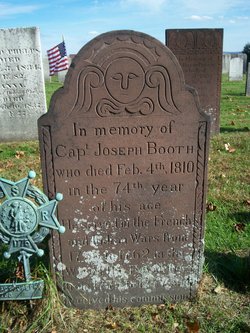
In memory of Capt. Joseph Booth

A tweet from Emily Sneff sent me on the track of an item that appeared in the Connecticut Courant of Hartford on 29 July 1776:
Last Sunday a Child was baptised by the Rev. Mr. [Joseph] Perry of East Windsor, by the Name of INDEPENDENCE.
That news item was reprinted in the New-England Chronicle.

The Courant appeared on Mondays, so “Last Sunday” probably meant not the day before but a week before then: 21 July.

That single sentence still left a lot of questions. Who was the couple who chose to name their child Independence? Was that a boy’s name or a girl’s name? What happened to that child later in life?

So I went looking for Independence. And I found two different babies baptized Independence in central Connecticut in the summer of 1776, with the possibility of still more. Here’s one story.

Joseph Booth (1736–1810) of Enfield, Connecticut, served in the colonial forces during the French and Indian War when he was in his early twenties. Booth’s diary recording that experience and a miscellany of later events, from family milestones to sermon topics to household accounts, has been digitized by the Connecticut Historical Society.

In 1762 Joseph Booth married Mary Hale (1733–1809), born in Glastonbury. They had their first child a year later, “Mary Hale junr.” as Joseph noted in his diary. Booth recorded another child every two or three years after that: David, Annis, Lydia, another Joseph, Peter, Eliphalet… All of the Booth babies survived infancy and lived into the nineteenth century.

That brings us up to the outbreak of war. Heitman’s Historical Register lists a Joseph Booth serving as an ensign in Erastus Wolcott’s Connecticut state regiment from December 1775 to February 1776 and a captain in Comfort Sage’s state regiment from June to December 1776.

One Booth family genealogy, Genealogical Records of Some of the Descendants of Robert Boothe, of Saco, Maine, 1642 by J. H. Booth (1877), quotes a commission signed by Gov. Jonathan Trumbull on 20 June 1776 naming Joseph Booth as a captain. Another, One Branch of the Booth Family Showing the Lines of Connection with One Hundred Massachusetts Bay Colonists by Charles Edwin Booth (1910), states that commission was issued on 21 Mar 1777.

I can’t sort all that out. It’s possible these commissions refer to multiple men. There might have been separate commissions in the Connecticut militia and the state’s short-term forces. And the family chroniclers did make some errors.

All sources agree, however, that Joseph Booth served in the American military early in the Revolutionary War, reaching the rank of captain. Wolcott’s regiment was on the siege lines at Boston in the first months of 1776, and Sage’s was at the Battle of White Plains. But Booth, reaching the age of forty in 1776 and being the father of several young children, was on missions that took him away from Enfield for a few months at most, not years.

TOMORROW: The child Independence was born.