J. L. BELL is a Massachusetts writer who specializes in (among other things) the start of the American Revolution in and around Boston. He is particularly interested in the experiences of children in 1765-75. He has published scholarly papers and popular articles for both children and adults. He was consultant for an episode of History Detectives, and contributed to a display at Minute Man National Historic Park.

Subscribe thru Follow.it


•••••••••••••••••


Friday, July 21, 2023

George Washington Book Prize Nominees for 2023

Mount Vernon has announced the nominees for the 2023 George Washington Book Prize.

There will be an author event at the site on 24 August, and the winner will be announced on 21 September in New York City, home of the cosponsoring Gilder Lehrman Institute of American History. (The third cosponsor in Washington College in Maryland.)

Here are this year’s nominated books.

Female Genius: Eliza Harriot and George Washington at the Dawn of the Constitution by Mary Sarah Bilder, the Founders Professor of Law at Boston College Law School. Eliza Harriot Barons O’Connor was a path-breaking female educator who lectured at the University of Pennsylvania during the Constitutional Convention to an audience that included George Washington and other delegates. Bilder argues that Harriot, as the first such female public lecturer in America, inspired the gender-neutral language of the Constitution.

His Masterly Pen: A Biography of Jefferson the Writer by Fred Kaplan, Distinguished Professor Emeritus at the Graduate Center of the City University of New York. This book is an appreciation of Jefferson’s writing skills as key to his personality and public career. Though he could wield his pen with unrivaled power, he was also a master of using words to both reveal and conceal from others and himself the complications, the inconsistencies, and the contradictions between his principles and his policies.

The Revolutionary: Samuel Adams by Stacy Schiff, winner of a Pulitzer Prize and a past George Washington Prize. Here we see Adams’s transformation from aimless son of a well-off family to tireless, beguiling radical. Shrewd, eloquent, and intensely disciplined, Adams led what could be called the greatest campaign of civil resistance in American history. He packaged and amplified the Boston Massacre. He helped to mastermind the Boston Tea Party. He employed every tool in an innovative arsenal to rally a town, a colony, and eventually a band of colonies behind creating a country.

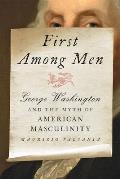
First among Men: George Washington and the Myth of American Masculinity by Maurizio Valsania, professor of American History at the University of Turin. Washington is frequently portrayed as tremendously effective in action, but this aggressive and muscular vision is largely a creation of the nineteenth century. Eighteenth-century ideals of upper-class masculinity preferred a man with refined aesthetic tastes, graceful and elegant movements, and the ability and willingness to clearly articulate his emotions. Valsania considers Washington’s complexity and how his real life diverges from the legend.

Thursday, July 20, 2023

“Arms (deliver’d by the Inhabitants in April 1775)”

On 27 Apr 1775, Boston’s selectmen and designated committee members delivered to the royal governor, Gen. Thomas Gage, “the return made to them by the constables of the town relative to the delivery of arms in their respective wards.”

In other words, the count of how many weapons people had turned over to town officials in exchange for being allowed to leave the besieged town.

The next day, one member of that committee, former selectman Henderson Inches, left Boston and went to where the Massachusetts committee of safety was meeting in Cambridge. He brought the same data:
Mr. Henderson Inches, who left Boston this day, attended, and informed the committee, that the inhabitants of Boston had agreed with the general, to have liberty to leave Boston with their effects, provided that they lodged their arms with the selectmen of that town, to be by them kept during the present dispute, and that, agreeably to said agreement, the inhabitants had, on yesterday, lodged 1778 fire-arms, 634 pistols, 973 bayonets, and 38 blunderbusses, with their selectmen.
In 1900, Boston published an inventory of these weapons with the owners’ names attached (and somewhat different figures from Inches’s). The date on this record is 24 April, the first full day after the town voted to start collecting weapons, but that process took three days at least. It’s notable that this count of weapons “in the Town House” includes guns owned by the town itself. 

Recently Caitlin G. DeAngelis reported finding another inventory of “Arms (deliver’d by the Inhabitants in April 1775) in the Town House Chambers,” dated 1 March 1776, as the British military was slowly preparing to depart. (That process sped up considerably a few days later.) This list comes from Francis Green’s file submitted to the Loyalists Commission, preserved in the British National Archives, series AO 13 (Massachusetts). The photo above from DeAngelis shows the totals, including a note that most of the weapons were in poor repair.

Over the last twenty years I’ve mentioned the published list in a few history forums, hinting that it might provide useful data for a study of gun ownership in occupied Boston. The Green list, which differs slightly in what’s counted and in the totals, could add to that data. No one’s taken up that challenge so far.

The publications that discuss Gage’s demand that Bostonians lodge their firearms with the town are by and large those arguing that a significant factor in the American Revolution was the royal government’s attempts to confiscate individuals’ guns, with implications for modern political conflicts.

Now I’ve written a book about the competition between Gage’s government and the Patriot underground for artillery pieces in 1774 and 1775. I argue that was a precipitating factor in how the war began. But I don’t see evidence for a similar conflict over muskets, pistols, and other individually owned and operated weapons.

Gen. Gage arrived in Boston in May 1774. The “Powder Alarm” in September made both sides shift to military preparations. Samuel Dyer tried to assassinate two British officers with pistols in October. A small British army squad and the New Hampshire militia exchanged fire at Fort William and Mary in December. And at no time before 19 April 1775 did Gage try to confiscate people’s muskets or pistols.

Only after the war had started, the redcoats had suffered hundreds of casualties, and thousands of militiamen were besieging his base did Gen. Gage seek to disarm the civilians all around him. Until then, he’d respected private property and the province’s militia law. And even after he took this step to protect his soldiers from an armed uprising, Gage asked elected town officials to collect and store the weapons, not his army or appointees. This was a wartime measure, not a peacetime policy.

COMING UP: The bargain collapses.

Wednesday, July 19, 2023

“The town relying on the honor and faith of General Gage”

On 27 Apr 1775, in another session of Boston’s ongoing town meeting not preserved in the official records, a committee of selectmen and eminent gentlemen told voters how they had carried out their mandate from four days before.

As printed in the 26 June Boston Gazette:
They reported as follows, viz.

The committee waited on his excellency General [Thomas] Gage, with the papers containing the account of the arms delivered to the select-men, and the return made to them by the constables of the town relative to the delivery of arms in their respective wards.

After long conversation on the subject of the inhabitants removing themselves and effects from the town; his excellency being obliged to attend other business, left the affair to be settled with Brigadier General Robinson, who after further conference, and reporting the substance of it to General Gage, returned to the committee, and declared to them that General Gage, gives liberty to the inhabitants to remove out of town with their effects; and desires that such inhabitants as intend to remove, would give their names to the selectmen, and signify whether they mean to convey out their effects by land or water, in order that passes may be prepared; for which passes, application may be made to General Robinson, any time after eight o’clock to morrow morning; such passes to be had as soon as persons wanting them shall be ready to depart.

VOTED, That the foregoing report be accepted, the town relying on the honor and faith of General Gage, that he will perform his part of the contract, as they have faithfully performed their part of it.

Then the meeting was adjourned to monday next, ten o’clock in the forenoon.

A true copy, examined
Per Henry Alline, jun. Town Clerk, P. T.
I’ve found no record of another town meeting session on the following Monday, 1 May, but such adjournments were a legal way around the restrictions of the Massachusetts Government Act.

This is one of many places I’ve seen the surname of brigadier general James Robertson (1717–1788), the British barrack master general, rendered as “Robinson.” Was this the result of some collision between his Scottish accent and the Boston accent?

Robertson had already served many years as a military administrator in New York, and he would go on to be promoted to lieutenant general and royal governor of New York before the end of the war.

The town clerk pro tem. who took down these minutes was Henry Alline (1736–1804). Different sources say he had been trained as a “housewright and gauger” or “bred a Scrivener,” but he made his living as a notary public and clerk for such organizations as the Plymouth Company and the Kennebeck proprietors. In 1791 the Columbian Centinel reported that “his bodily health is such as renders a stationary business necessary and agreeable.”

In other words, Alline was a natural bureaucrat. After marrying in 1764, he was able to support a growing family; his society didn’t provide a lot of openings for those skills compared to ours, but it rewarded men who could do the job. Evidently in this emergency the town called on Alline to fill in for absent town clerk William Cooper.

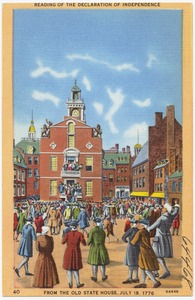
In July 1776 Henry Alline had his family inoculated against smallpox and witnessed the reading of the Declaration of Independence from the Town House balcony, as he described in this letter at the Massachusetts Historical Society.

In 1791 Alline succeeded Nathaniel Green as the Suffolk County registrar of deeds. He held that job for five years until retiring because of failing eyesight. Then his son William, born in 1770, won election and served until 1821. Then William’s son Henry was registrar of deeds until 1860. That’s almost seventy unbroken years of the same family holding the position.

TOMORROW: Counting the guns.

Tuesday, July 18, 2023

“The Affair of delivering up the Arms”

On 23 Apr 1775, as recounted yesterday, the Boston town meeting approved an arrangement with Gen. Thomas Gage for people to store their weapons in exchange for the chance to leave their besieged town.

The committee who served as intermediaries between Gage and the town quickly wrote to Dr. Joseph Warren, chair of the Massachusetts Provincial Congress’s committee of safety:
Sir:

The following proceedings contain the Agreement made between his Excellency General Gage and the Town of Boston.

You are informed it is the earnest desire of the inhabitants, that such persons as incline to remove into the Town with their effects, may be permitted so to do without molestation, and they having appointed us as a Committee to write to you on this subject, we hope this request will be complied with, as the Town, in a very full meeting, was unanimous in this and every other vote, relating to this matter; and we beg the favour of as speedy an answer as may be.

We are, most respectfully, your obedient humble servants,
James Bowdoin, John Pitts,
John Scollay, Ezek. Goldthwait,
Tim. Newell, Alexander Hill,
Thos. Marshall, Henderson Inches,
Samuel Austin, Edward Payne.
That letter was later printed in Peter Force’s American Archives (probably with stylistic editing).

Town officials then got to work collecting people’s guns. The records of the selectmen are entirely blank from 19 Apr 1775 to 20 May 1776, but other sources offer peeks into this work.

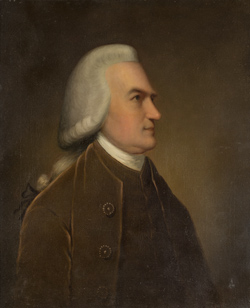
Selectman Scollay (shown above) later wrote, “The Affair of delivering up the Arms & of the Inhabitants removal has given us great trouble.” That was even with the help of the constables the town had elected back in March—up to twelve men.

The family of lawyer Samuel Swift later claimed that his “zeal and resolution…caused many Bostonians to secrete their arms.” There’s not much evidence to support that flattering lore, but then arms-hiding would have been secret. Most townspeople seem to have cooperated grumpily. On 24 April the hat merchant Thomas Handysyd Peck even wrote to Gen. Gage about cannon:
their is two Iron Guns in my store I think about four Pounders if your Exellency thinks best that the guns should be Removed if you Sir will order to what Place I will take Care and have it Done. . . .

PS Those Guns have no Carrages and have laid ever since last war.
It looks like the selectmen thought the collection could be finished in a couple of days. The 26 June Boston Gazette stated:
The meeting was then adjourned to Tuesday morning the 25th of April, ten o’clock in the Forenoon, and was continued by successive adjournments to thursday, P. M. the 20th [sic, 27th] of April, 1775, when the town met to receive the further report of the committee.
TOMORROW: What the committee had to say.

Monday, July 17, 2023

“The vote of the town complying with his excellency’s proposal”

On Sunday, 23 Apr 1775, Boston’s emergency town meeting considered whether to accept Gen. Thomas Gage’s condition for letting people leave the besieged town: all Bostonians had to turn their firearms over to the selectmen to be stored in a central place.

Massachusetts’s militia law required most men to own and train with firelocks. Provincials were proud of that self-defense system. Indeed, they were now relying on it to resolve their dispute with Crown authorities.

Furthermore, Gen. Gage’s demand that men lock up their guns may have come as a surprise; that issue doesn’t appear on the records of the town meeting the day before.

Nonetheless, Bostonians wanted to get out of the town, to be away from the expected battles and food shortages.

As soon as the town’s committee put their understanding of the agreement with the governor in writing, the men at the town meeting acted on it:
Whereupon, Voted,
That the town accept of his excellency’s proposal, and will lodge their arms with the select men accordingly.

Voted, That the same committee be desired to wait upon his excellency the governor with the vote of the town complying with his excellency’s proposal, and the committee are desired to request of his excellency that the removal may be by land and water, as may be most convenient for the inhabitants.
The men at that meeting wanted out. Unlike the previous day’s vote on a promise not to attack the redcoats, this vote wasn’t recorded as unanimous. But it came quickly, and there’s no indication of any counterproposals.

The record published in the 26 June Boston Gazette doesn’t indicate how long the committee’s further consultation with Gage took, instead continuing:
The Committee appointed to wait upon his Excellency, report; that they accordingly waited upon him, and read the vote of the town, which was accepted by his Excellency; and at the same time his Excellency agreed that the inhabitants might remove from the town by land and water with their effects, within the limits prescribed by the Port Act:
Parliament had outlawed most sea voyages from Boston to ports outside of Massachusetts, and Gage felt he had to maintain that law.
…and also informed the committee he would desire the Admiral [Samuel Graves] to lend his boats to facilitate the removal of the effects of the inhabitants, and would allow carriages to pass and repass for that purpose: Likewise would take care, that the poor that may remain in Town should not suffer for want of provision after their own stock is expended, and desire that a letter might be wrote to Doctor [Joseph] Warren, chairman of the committee of the [Massachusetts Provincial] Congress, that those persons in the country who may incline to remove into Boston, with their effects, may have liberty so to do without molestation.

The town unanimously accepted of the foregoing report, and desired the inhabitants would deliver their arms to the Selectmen as soon as may be.
The townsfolk then voted to adjourn their meeting until “Tuesday morning the 25th of April, ten o’clock in the Forenoon.” And most of the men went home to find their guns.

TOMORROW: Implementing the agreement.

Sunday, July 16, 2023

“Being informed that General Gage has proposed a Treaty”

On 22 Apr 1775, Dr. Joseph Warren, chair of the Massachusetts Provincial Congress’s committee of safety, wrote a letter to the Boston selectmen approving an arrangement that would let civilians leave the newly besieged town.

As transcribed by Warren biographer Samuel Forman, the doctor’s letter said:
Joseph Warren to the Select Men and Inhabitants of the Town of Boston

Gentlemen—

The Committee of Congress being informed that General [Thomas] Gage has proposed a Treaty with the Inhabitants of the Town of Boston, wherein he stipulates that the Women and Children with all their Effects shall have safe Conduct without the Garrison and their Men also, upon Condition that the Male Inhabitants within the Town shall on their Part solemnly engage that they will not take up Arms against the King’s Troops, within the Town, sh:d an attack be made from without:

We cannot but esteem those Conditions to be just & reasonable, and as the Inhabitants are in Danger of suffering from the want of Provisions, which in this time of general Confusion cannot be conveyed into the Town: we are willing you should enter into and faithfully keep the Engagement aforementioned said to be required of you, and to remove yourselves, the Women, Children & Effects as soon as may be—

By Order of the Committee of Congress—

Joseph Warren, Chairman

Cambridge 22nd April 1775
It’s significant that Warren and his committee believed Gen. Gage had proposed this arrangement. This letter doesn’t hint at how they came to believe that.

Warren’s letter didn’t hint at any other concessions besides a promise not to attack the redcoats. He wrote that families could leave “with all their Effects.” He noted “the want of Provisions” inside Boston without suggesting the Patriot forces might let food into the town. He didn’t say he still hoped for a peaceful resolution.

Originally Warren told the selectmen, ”we would earnestly pray your acceptance of his proposals,” before toning that down to “we are willing you should enter into and faithfully keep the Engagement aforementioned said to be required of you.” Again, the committee of safety thought that Gage had set forth his conditions.

It’s not clear whether that letter reached the town meeting on 22 April in time to influence the discussion there. However, on that Saturday, Bostonians approved a long statement to Gage that “the selectmen in behalf of the town engaged for the peaceable behaviour of the inhabitants.” Their resolutions then went on at more length reminding Gage of his past promises of good treatment.

When the town’s high-powered committee visited the royal governor, however, he had another condition. Perhaps Gage had had that proviso in mind all along, but to the Bostonians it may have seemed like a new requirement. A “long conference” between the general and the committee resulted, as reported in the 26 June Boston Gazette.

Gen. Gage asked that Bostonians agree to “lodging their arms in Faneuil-hall, or any other convenient place, under the care of the Selectmen.” That way, men couldn’t attack the soldiers with those guns or hand them over to besieging militiamen. Only then would he let families leave the town.

Thus, when the committee returned to the town meeting on Sunday, 23 April, they were recommending the people accept a condition that neither that meeting nor the committee of safety had officially discussed before.

TOMORROW: Decision time.

Saturday, July 15, 2023

“Upon the inhabitants in general lodging their arms in Faneuil-hall”

On 22 Apr 1775, with the Massachusetts militia besieging the king’s soldiers inside Boston, many townspeople wanted to get out of the way.

Gen. Thomas Gage, army commander and royal governor, had his own priorities: forestalling any citizen uprising against those soldiers.

Gage had approached Boston’s selectmen to start discussions on avoiding discontent and unrest. Those officials seized the opening to talk about letting people leave town.

In addition to five of the seven selectmen (John Hancock and Oliver Wendell had left Boston earlier in the month before fighting broke out), the town appointed four men to communicate with the governor. They were all established businessmen with political experience:
  • James Bowdoin, a member of the Council, firm Whig, and, therefore, longtime headache for Govs. Francis Bernard and Thomas Hutchinson. He was, however, wealthy and learned, thus undeniably respectable. Also, though Bowdoin might excuse violence after the fact, he didn’t encourage it beforehand.
  • Ezekiel Goldthwait (shown above), insurance broker, registrar of deeds, and veteran of other political offices, including Boston town clerk. While calling himself a Whig, Goldthwait was more centrist than most in that party and maintained friendly relations with the royal governors. Some people even called him a Tory.
  • Henderson Inches, a Boston selectman voted out earlier in the decade for not pushing as hard on the Massacre orations as the voting public wanted, but still in the Whig party.
  • Edward Payne, wounded in the Boston Massacre while standing peacefully on his front steps—but he chose not to sue about it. 
  • Alexander Hill, a warden and fireward often chosen to audit the town’s accounts. Though he had been put on the town’s committee of correspondence, Hill was rarely involved in protests and debates over imperial issues.
In sum, these were gentlemen whom the governor couldn’t dismiss or treat with suspicion.

It’s a sign of the emergency situation that the town met on Sunday, 23 April. Indeed, Hill’s job as warden had been to ensure that people didn’t conduct business on the Sabbath. But these were desperate times.

The record published in the 26 June Boston Gazette continued:
Sabbath morning ten o’clock, April 23, 1775.

The town met according to adjournment.

The said committee made a verbal report. Whereupon it was desired that the committee would withdraw and reduce their report to writing, which was accordingly done, and is as follows, viz.

The committee appointed by the town to wait upon his excellency General Gage, with a copy of the two votes passed by the town yesterday in the afternoon; report, that they being read to him by the committee, and a long conference had with him upon the subject matter contained in the said votes, his excellency finally gave for answer, that upon the inhabitants in general lodging their arms in Faneuil-hall, or any other convenient place, under the care of the Selectmen, marked with the names of the respective owners, that all such inhabitants as are inclined may depart from the town, with their family’s and effects; and those who remain may depend upon his protection. And that the arms aforesaid at a suitable time would be return’d to the owners.
Most men in Boston, as in other towns, were required by law to drill with the militia and therefore owned firelocks. Gen. Gage didn’t want those guns used against his soldiers. He also didn’t want people to take their weapons out of town, join the besieging force, or arm fighters in that force.

On the other hand, the province had just gone through several months of Patriots complaining that they had the right—indeed, the obligation—to amass weapons, gunpowder, and other military supplies. Bostonians couldn’t participate much in that arming of the countryside, being under army occupation, but they supported it. Would they give up their means of self-defense?

TOMORROW: The townspeople’s expectations?

Friday, July 14, 2023

Boston’s Town Meeting on the Fourth Day of the War

As quoted yesterday, on 3 Apr 1775 the Boston town meeting voted to continue their work by adjournment on 17 April.

By that date, town clerk William Cooper had slipped out of town with the official records. Also unavailable were Samuel Adams, chosen moderator of that meeting, and selectman John Hancock.

I’ve found no record of a notice that Bostonians would not meet that day, nor indication that they tried. The following day, Gen. Thomas Gage set his plan for the Concord expedition in motion, and the day after that the province was at war.

The first indication of another town meeting appeared in Isaiah Thomas’s Massachusetts Spy, newly moved to Worcester, on 3 May. After a detailed account of the first day of fighting, that paper stated:
It is now thirteen days since Boston was entirely shut up. The Sunday after the battle there were but two or three religious assemblies that met in Boston. In the Forenoon there was a town meeting, at which a Committee, consisting of the Select-Man, were chosen to wait upon General Gage, in order to get permission for the inhabitants to remove out of town with their effects.
A more detailed and apparently more accurate account appeared in the Boston Gazette on 26 June. This report used the legal formula of Boston’s other town meetings, and it’s clear the selectmen were involved, so this appears to meet all the criteria to be an official meeting.
Boston, ff. At a Meeting of the Freeholders and other Inhabitants of the Town of Boston legally warned, on Saturday the Twenty second day of April, A. D. 1775.

The Hon. JAMES BOWDOIN, Esq [shown above]; was chosen Moderator.

The Moderator informed the town that the present meeting was in consequence of an interview between his excellency General Gage and the Selectmen, at his desire, and mentioned the substance of the conversation that pass’d; and also that the Selectmen with the advice and assistance of a number of gentlemen had prepared several votes, which they thought it might be proper for the town to pass—And which in conjunction with the assurances that had been given to his excellency by the selectmen, they apprehended from the interview aforesaid, would be satisfactory to his excellency——

Whereupon,
The Hon. James Bowdoin, Esq; Ezekiel Goldthwait, Esq; Mr. Henderson Inches, Mr. Edward Paine, Mr. Alexander Hill, together with the selectmen, viz. John Scollay, Esq; Mr. Timothy Newell, Mr. Samuel Austin, Thomas Marshall, Esq; & Mr. John Pitts, were appointed a committee to consider of this important matter, and were desired to report as soon as may be.

The said Committee made report, and after some debate, the two following votes passed unanimously, viz.

His excellency General Gage in an interview with the selectmen, having represented that there was a large body of men in arms assembled in the neighbourhood of this town, with hostile intentions against his majesty’s troops stationed here, and that in case the troops should be attacked by them, and the attack should be aided by the inhabitants of the town, it might issue in very unhappy consequences to the town.

For prevention whereof, his excellency assured the selectmen, that whatever might be the event of the attack, he would take effectual care, that the troops should do no damage, nor commit any act of violence in the town; but that the lives and properties of the inhabitants should be protected and secured, if the inhabitants behaved peaceably; and the selectmen in behalf of the town engaged for the peaceable behaviour of the inhabitants accordingly:

In confirmation of which engagement—Voted,
That as the town have behaved peaceably towards the troops hitherto, they hereby engage to continue to do so; and the peace officers, and all other town officers, are enjoined, and the magistrates, and all persons of influence in the town, are earnestly requested to exert their utmost endeavors to preserve the peace of the town:

The Town at the same time relying on the assurances of his excellency, that no insult, violence or damage shall be done to the persons or property of the inhabitants, either by the troops or the kings Ships, whatever may be the event of the attack his excellency seems to apprehend; but of which attack we have no knowledge or information whatever, as all communication between the town and country has been interrupted by his excellency’s order, ever since the collection of the body aforesaid.

Whereas the communication between this town and the country both by land and by water is at present stop’d by order of his excellency General Gage, and the inhabitants cannot be supplied with provisions, fuel and other necessaries of life; by which means the sick and all invalids must suffer greatly, and immediately; and the inhabitants in general be distress’d, especially such (which is by much the greatest part) as have not had the means of laying in a stock of provisions, but depend for daily supplies from the country for their daily support, and may be in danger of perishing, unless the communication be opened:

Therefore, Resolved,
That a committee be appointed to wait on his excellency General Gage, to represent to him the state of the town in this regard, and to remind his excellency of his declarations in answer to addresses made to him when the works on the neck were erecting, viz. “That he had no intention of stopping up the avenue to the Town, or of obstructing the inhabitants or any of the country people coming in or going out of the town as usual;” that “he had no intention to prevent the free egress and regress, of any person to and from the town, or of reducing it to the state of a garrison; that he could not possibly intercept the intercourse between the town and country;” that “it is his duty and interest to encourage it; and it is as much inconsistent with his duty and interest to form the strange scheme of reducing the inhabitants to a state of humiliation and vassalage, by stopping their supplies,”—

Also, to represent to him, that in consequence of these repeated assurances of his excellency, the fears and apprehensions of the inhabitants, had generally subsided, and many persons who had determined to remove with their effects, have remain’d in town, whilst others largely concern’d in navigation, had introduced many valuable goods, in full confidence of the promised security:

That the Town think his Excellency incapable of acting on principles inconsistent with honor, justice and humanity, and therefore that they desire his excellency will please to give orders for opening the communication, not only for bringing provisions into the town, but also, that the inhabitants, such of them as incline, may retire from the town with their effects without molestation.

The same Committee were appointed to wait upon the General with the foregoing votes.

Then the meeting was adjourned to Sabbath morning, ten o’clock.
The town was reminding Gen. Gage of all the promises he’d made in the preceding months of keeping life as normal as possible. Of course, now there was a besieging army outside (“a large body of men in arms assembled in the neighbourhood”). How would the general respond?

TOMORROW: Sunday meeting.

Thursday, July 13, 2023

The Gap in the Town Clerk’s Records

The official published records of the town of Boston say that on Monday, 3 Apr 1775, the inhabitants held a meeting in Faneuil Hall.

With Samuel Adams busy at the Massachusetts Provincial Congress at Concord, that meeting chose Samuel Swift to preside in his place.

Voters filled some offices that the men they elected in the preceding month had declined. For instance, this town meeting chose the sons of William Molineux and Royall Tyler to be clerks of the market, an entry-level job for young gentlemen.

The other agenda item was collecting a tax approved in July 1774 “for the Relief of the Poor”—a response to the Boston Port Bill. A committee recommended naming collectors, but the citizens put off a decision until their next gathering.

To get around the Massachusetts Government Act’s limit on town meetings without Gov. Thomas Gage’s approval, the citizens then voted to adjourn to 17 April. As long as they kept the same meeting going by adjournment, they were within the law, right?

If a town meeting took place as scheduled on that day, it wasn’t recorded on the following page. That’s because the town clerk, William Cooper, slipped out of Boston around 10 April. He was apparently acting in response to intelligence that the secretary of state, Lord Dartmouth, had recommended to Gage that he start arresting leaders of the rebellion in Massachusetts.

Cooper took the notebooks that recorded town meetings with him. Some of the selectmen remained in town: Timothy Newell, John Scollay, Thomas Marshall, and Samuel Austin. In the following months, as Newell’s journal shows, they tried to document the damages and injustices of war and to stand up for their fellow citizens.

According to Cooper’s records, the next Boston town meeting took place in Watertown on 5 March. This was the annual oration in memory of the Boston Massacre, delivered that year by the Rev. Peter Thacher. That was, of course, the same day the British army saw the Continental fortifications on the Dorchester heights, so Thacher’s speech probably didn’t command people’s total attention.

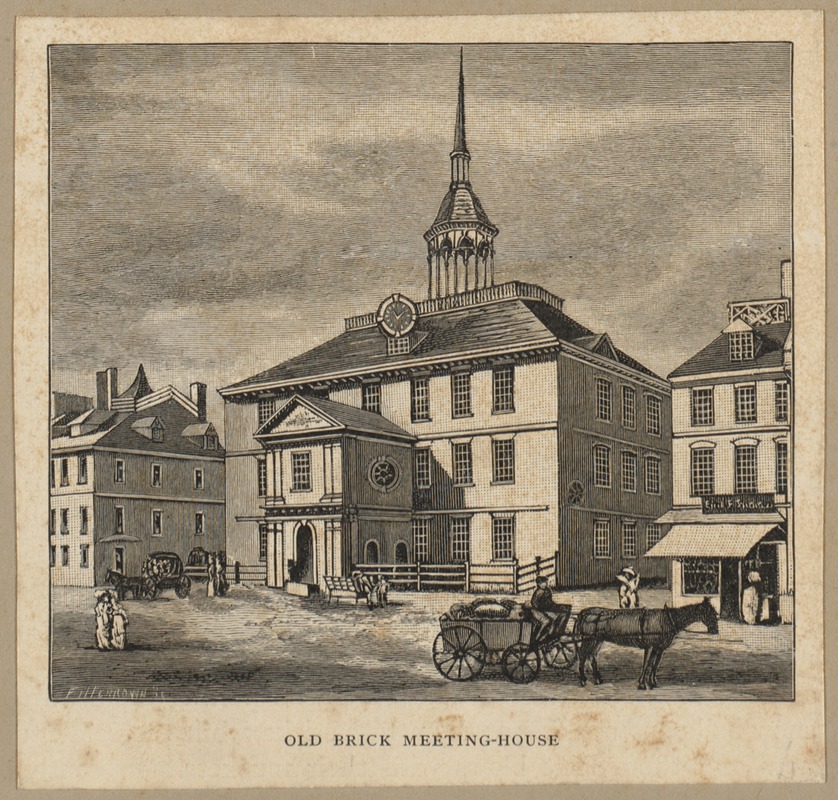
The British military sailed away on 17 March. Bostonians gathered for another town meeting twelve days later, on 29 March. They met in the Rev. Dr. Charles Chauncy’s church, the “old Brick Meeting House” (shown above). The main order of business was to elect officials for the upcoming year, starting with the town clerk. William Cooper continued to fill that role until his death in 1809.

However, there were at least two town meetings held inside besieged Boston that never got recorded in Cooper’s notes.

TOMORROW: The first lost meeting.

Wednesday, July 12, 2023

Events in Marblehead and Quincy, 15 July

Weather permitting, on Saturday, 15 July, folks in Boston’s North Shore and South Shore regions can both enjoy local Revolutionary-era events on the grounds of historic sites.

The recreated Glover’s Marblehead Regiment will hold its annual encampment at Fort Sewall from 10:00 A.M. to 5:00 P.M. Scheduled events include:
  • 10:15 A.M. and 2:00 P.M.: Children’s Drill
  • 10:30 A.M.: March through town with music past Gen. John Glover’s home
  • 11:30 A.M.: Skirmish with Crown forces at Seaside Park
  • 3:30 P.M.: Battle with Crown forces on Gas House Beach
  • 5:00 P.M.: Cannon salute to close camp, followed by sea chanties
Meanwhile, down in Quincy from 11:00 A.M. to 2:00 P.M. the Dorothy Quincy Homestead will host Henry Cooke speaking on and demonstrating “The Tailor’s Art: Making Clothing and Making a Living in 18th-Century New England.”

Cooke is an internationally recognized expert on Revolutionary-era tailoring, having among other commissions created clothing for figures of George Washington on display at Mount Vernon. He’s also a stalwart of local reenactments—his face will be familiar to anyone who’s enjoyed the tea meetings in Old South Meeting House in recent years.

Tuesday, July 11, 2023

“Enough of that, for this confused State!”

Yesterday I rode along the Battle Road with folks from Old North Illuminated, so even though we’re no longer in Patriots Day season this report from April 1775 seems timely.

It was a letter to authorities in Connecticut, printed in the Norwich Packet newspaper on 27 April as well as on at least one broadside:
Cambridge, Saturday Morning, April 22

Gentlemen,

I HAVE waited on the general and the several Committees, and they all agree that the Men must come down to this Place, for we know not when we shall be attacked in this confused State.

The Troops in Boston are in Motion, and preparing to make an Attack some where; but we have no News from Boston unless by some few of the Inhabitants, that run the Risk of their Lives by getting out of the Town by Stealth, for Boston is shut up!---There is no coming in or going out any other Way!---

The People of the Town are all Prisoners, and what their Fate will be, GOD only knows; for the Troops have behaved in a very cruel and barbarous Manner; going into Houses and killing sick People, that were not able to go one Step, putting the Muzzle of the Gun into their Mouths and blowing their Heads in Pieces. Some Children had their Brains beat out!---Several Houses and Barns burned!---and, for Miles together, not a House nor Shop but had their Windows broke, and hundreds of Shot in them!---

There were about 40 of our People killed; but rather more of the Troops, and 70 or 80 of the Latter are taken Prisoners.---Enough of that, for this confused State!---

Pray let the Men be properly inlisted and officered; let there be Teams to bring Provision, and a farther Supply sent immediately after them. Take Care they be sent in good Order.
ISRAEL PUTNAM.
Hezekiah Bissell.
Putnam was, of course, the earthy, excitable militia colonel from Brooklyn, Connecticut, soon to be general. Bissell was a committee-man from nearby Windham. They wanted more of their colony’s troops to join them along the siege lines.

Most of the atrocities this letter described never happened. No sick people had their heads blown to pieces. No children had their brains beat out. The Boston selectmen and Gen. Thomas Gage were working out an agreement that would let people leave town (though that agreement fell apart weeks later).

Still, this report is valuable for showing the emotional tenor of those days, at least for some gentlemen.

Monday, July 10, 2023

“The French in Newport,” 14–15 July

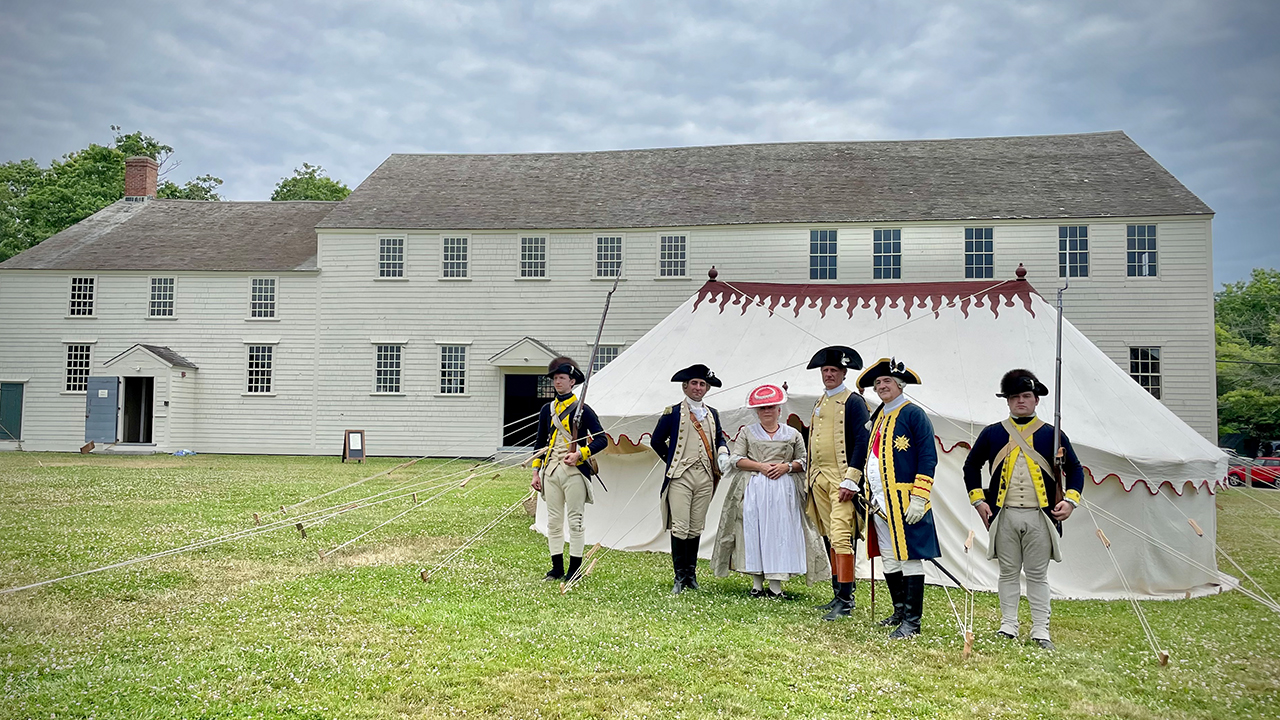
On 14–15 July, the Newport Historical Society will host this year’s edition of “The French in Newport,” a historical reenactment in the heart of the city.

The society’s website explains:
In July 1780, thousands of French troops landed in Newport beginning an occupation that lasted for nearly a year. The presence of this new ally represented a turning point in the American Revolution and the start of the Franco-American Alliance. While French troops played a vital role in American victory at Yorktown in 1781, Newport citizens were far from welcoming upon their arrival. . . .

The French in Newport Event will feature living historians portraying recognizable figures such as George and Martha Washington, the Marquis de Lafayette and the Marquis de Chastellux along with the head of the French army, comte de Rochambeau. Dozens of costumed living historians representing both civilians and French soldiers will discuss the challenges of establishing this new alliance. 
One highlight will be the Museum of the American Revolution’s First Oval Office Project, a hand-sewn replica of Gen. Washington’s sleeping tent, exhibited at Washington Square.

Justin Cherry of Half Crown Bakehouse, resident baker at Mount Vernon, will offer 18th-century baking demonstrations and discuss the food rations available in 1780 Newport.

The Middlesex County Volunteers Fifes & Drums will close the event with a concert.

Here’s the schedule as it stands now.

Friday, 14 July, 11:00 A.M.
Washington Square
Dr. Iris de Rode on the French Efforts to Charm Rhode Island

Friday, Noon
Washington Square
Rochambeau’s Proclamation

Friday, 1:00 P.M.
Washington Square
Dr. de Rode on Tea Traditions

Friday, 2:00 P.M.
Colony House
Dr. de Rode interviews the Marquis de Chastellux

Friday, 3:00 P.M.
Washington Square
Meet the Marquis de Lafayette

Saturday, 15 July, 11:00 A.M.
Colony House
Dr. de Rode interviews the Marquis de Chastellux

Saturday, Noon
Washington Square
The First Cruise of General Washington, a Rhode Island Privateer

Saturday, 1:00 P.M.
Washington Square
Dr. de Rode on Tea Traditions

Saturday, 2:00 P.M.
Colony House
Dr. Matthew Keagle on French Military Uniforms

Saturday, 3:30 P.M.
in front of the Colony House
Fife & Drum Concert by the Middlesex County Volunteers

One appealing feature of this event is that, because most of the events take place outdoors in public parks, they’re free. Now we just have to hope for good weather.

Sunday, July 09, 2023

“The area is steeped in Revolutionary significance”

New York Magazine’s Curbed website just shared an extraordinary article by Reeves Wiedeman titled “The Battle of Fishkill.”

It details the long and ongoing conflict between a New York restaurateur and property developer named Domenic Broccoli and a group of local preservationists named the Friends of the Fishkill Supply Depot.

The land in question was part of a Continental Army logistics site. Archeologists have found bodies buried there, with ground-penetrating radar turning up signs of more. This has raised the question whether the land should be mostly set aside for study and commemoration, partially preserved, or developed as planned into a retail site called Continental Commons.

Wiedeman writes:
For more than a decade, the Friends [of the Fishkill Supply Depot] have argued — based on some evidence, but not as much as they would like — that there are more Revolutionary War soldiers buried on [Domenic] Broccoli’s land than anywhere else in the United States.

Broccoli argues that this is rubbish and accuses his foes — with some evidence, but not as much as he would like — of going so far as to plant human remains on his lot in their effort to make it seem more grave-stuffed than it actually is. . . .

The Friends of the Fishkill Supply Depot are a group of history buffs and retiree volunteers, and yet Broccoli claimed he had found it necessary to spend more than a million dollars battling them with archaeologists, lawyers, and the private investigators he hired as “spies” to infiltrate the Friends. As it happened, one of his spies was at the Memorial Day protest holding up a STOP CONTINENTAL COMMONS sign while surreptitiously recording the group in case anything might help the RICO case Broccoli was building.

Broccoli insists that he’s not anti-history. He doesn’t dispute the fact that people are buried on his land or that the area is steeped in Revolutionary significance; his vision for the IHOP [in Continental Commons] involves a wait staff in tricorne hats and bonnets. But it was still a bit of a mystery exactly whose bones were buried on his property and who put them there.

And, besides, if there really were hundreds of soldiers beneath the ground, Broccoli believed it to be self-evident that he was the one pursuing the vision of life, liberty, and happiness that George Washington’s troops had fought and died for: the right to sell pancakes where they were buried.
In that last point, Broccoli’s not wrong. The Founding generation didn’t value landscape preservation. They put up small monuments in a few spots, like the hard-to-farm crest of Breed’s Hill in Charlestown, but plowed and built over most battlefields and other military sites. That’s why the only fortifications remaining from the lines around Boston are the small, late-built earthworks in Washington Park in Cambridge, preserved solely by the Dana family for generations.

Historical preservation became an American value in the late 1800s. By then, of course, the Revolutionary generation had died out. Fewer sites survived. What remained seemed all the more precious. With industrialization, it became easier to preserve (or restore) battlefields in rural areas, but urban sites got swallowed even faster.

The Fishkill Supply Depot didn’t make the cut for preservation then. The local culture barely remembered it, in fact. It was a logistical site, well away from the fighting. There was no ‘Battle of Fishkill’ to commemorate. Compared to other places (most, but not all, already preserved or commemorated in some way), its significance might fade.

Nonetheless, many Continental soldiers died at the site. Diseases spread naturally when eighteenth-century people gathered in large numbers. Andrew Wehrman, author of The Contagion of Liberty, has tweeted that Fishkill was also a site of mass inoculation against smallpox, which (given the use of the actual live virus at that time) meant a site of many smallpox deaths.

Our contemporary culture is more squeamish about dead bodies and graveyards than our ancestors were. Many of greater Boston’s hallowed burying-grounds have actually been excavated and relandscaped over time before arriving at what we now perceive to be their historic shape. We’d have a harder time stomaching that process now, even though there are probably fewer Revolutionary remains than ever.

As for the Fishkill Supply Depot, there doesn’t seem to be any resolution in sight. Though Sen. Charles Schumer supports the idea of making some of the land into a new national park, there are lots of details to be worked out and support to line up. This deadlock might end only when more people die out.

(The photograph above shows the Van Wyck Homestead, once the administrative center for the supply depot and now the only surviving structure from that large complex. It’s a New York state museum.)

Saturday, July 08, 2023

Peeking in on “Revolution’s Edge”

A month ago I noted the upcoming premiere of “Revolution’s Edge,” a play dramatizing the stresses affecting three men associated with Christ Church in the North End on 18 Apr 1775.

The three characters are the Rev. Dr. Mather Byles, Jr., planning to leave that church; his enslaved servant, Cato, worried about being removed from his family; and John Pulling, a merchant captain and vestryman who’s also interested in the movement of British soldiers. Byles is a Loyalist, Pulling a Patriot, and for Cato the lack of liberty cuts most deeply.

I attended that first performance at Old North and can recommend the show as a thoughtful exploration of how the Revolution’s big issues intersected with individual desires and needs. Performances run through 19 September.

WBUR’s report on the play included this passage:
Nathan Johnson, the actor who plays Cato, says it is one of the most important projects in which he’s been involved.

Johnson, who is Black, promised himself early in his acting career that he would never play an enslaved person. But the depiction of Cato, and the importance of the play’s message, made the role too compelling to pass up.

“I want everyone to see that we have all something to contribute to our history,” Johnson said. “I want everyone to see that it is not a matter of white and Black. It is a matter of America. It is a matter of progress. It is a matter of stakes, it is a matter of tension. And not just for Pulling and Byles, but for Cato as well.”
Cato is the least documented of the three characters. Playwright Patrick Gabridge had to gather vital records from Boston, Roxbury, and Nova Scotia, and then make an educated assumption that all those mentions of a man named Cato related to the same person.

To compound the challenge of building Cato’s character when none of his words survive, an enslaved man in a room with his owner wouldn’t have been able to speak his mind.

Gabridge turned that vacuum into an advantage by making Cato the character who addresses the audience, introducing the historic situation, the other characters, and his own unvoiced thoughts.

For folks who want to hear more, WBUR also ran an audio report.

The photo above of Johnson performing as Cato was taken by Evan Turissini, who plays Pulling, as he waited to enter.

Friday, July 07, 2023

How Samuel Swift Sought Scipio

While researching the Boston lawyer Samuel Swift last month, I came across a series of advertisements he placed in Boston newspapers in 1770.

The Boston Evening-Post, 28 May:

SCIPIO, a smooth fac’d Negro Fellow, pretty black, 22 Years old, on the 23d Inst. [i.e., of this month] ran away from his Master; he has since chang’d his Cloaths: His Hair or Wool grows something onward upon his Cheeks, is good natured and artful, inclines to a Seafaring Life; bent his Course towards Providence or Rhode-Island. Whoever will convey him to his said Master in Boston, shall be handsomly rewarded by
SAMUEL SWIFT.

P.S. It may be needless for any Captain of a Ship or other Vessel to harbour him, as it may not eventually be either for their Profit or Honor, he is such an Urchin.

Boston, May 26, 1770.
Usually people seeking other people they claimed as property put the same ad in as many newspapers as they could afford, and then kept those ads running week after week until the runaway was found or they gave up. But Swift wrote multiple versions of his notice.

The Boston Gazette, 4 June:
Run-away from his Master the 23d Instant, a Negro Fellow about 22 Years old, has since chang’d his Cloaths. His Hair or Wool grows pretty much on his Cheeks, smooth-fac’d, his Fore-teeth jet out a little, is artful and good natured, went towards Providence. Whoever conveys him to his Master, shall be well rewarded, by
SAMUEL SWIFT.

N.B. It is taken for granted all Captains of Vessels will discountenance him.

Boston, May 26, 1770.
Those ads didn’t have any effect, so on 28 June the Boston News-Letter published this:
TO all worthy Brothers and other Generous Commanders of Ships or other Vessels sailing between the Poles,—as also to all the valourous Sons of Zebulon and others, however dispers’d upon the wide surface of old-Ocean, or upon any Island or Main-laid upon this habitable Globe, into whose Hands these may chance to fall:—

Note well,—THAT on the 23d of May 1770, SCIPIO, a Negro Man near 23 Years old, Ran from the Subscriber,——He is five Feet and 3 or 4 Inches high, little more or less, and well set, his Hair or Wool (unless shav’d) comes low upon his Cheeks, his Fore-teeth rather splaying, has an Incision mark on one of his Arms where he was Inoculated, and 2 or 3 Scars in his Legs where he was lanc’d, is pretty black, with a flattish-Nose, tho’ not that flat so peculiar to Negroes, is very Artful—Speaks plain but something inward and hollow, inclines much to the Sea, will make an able Seaman, and is a Cooper,—

If he returns voluntarily he shall not be whipt as he deserves, but I will either sell him to a Good Ship-Master, or lett him as he shall chuse, till he has Earnt his prime Cost, &c, when I will give him his Freedom,—but if any shall bring or convey him to his Master, shall be paid EIGHT DOLLARS, by
SAMUEL SWIFT.

P. S. I at present forbear mentioning the Ship I am satisfy’d he went off in.
The word “Brothers” in the top line might have been an address to Swift’s fellow Freemasons. “Sons of Zebulon” referred to mariners, but rarely enough that it’s an example of Swift’s uncommon phrasing.

The term “prime cost” usually appears in Boston newspapers of this time to mean a good price for the consumer, so Swift appears to have been promising Scipio he wouldn’t have to pay the maximum amount for his freedom. But he’d still have to pay.

Swift’s last ad continued to run through late July. I see no evidence Scipio ever came back to the attorney, voluntarily or not.

Thursday, July 06, 2023

“We have every opportunity and every encouragement”

Over the Independence Day holiday, the political reporting website called The Bulwark published a provocative article by history professors Timothy C. Hemmis and David Head titled “This July Fourth, Remember the ‘Founding Scoundrels’.”

The subhead explains the thesis: “They helped build America, too.”
As Americans celebrating Independence Day, we tend to want to remember the ideal promised by the new nation: that the United States would be a place where high-minded people led virtuous citizens in a spirit of well-ordered liberty.

That’s what Thomas Paine meant in 1776 when he wrote that “we have every opportunity and every encouragement before us, to form the noblest, purest constitution on the face of the earth.” And it’s certainly how the Founding Fathers themselves wanted to be remembered.

But some of their contemporaries interpreted “every opportunity” differently.

These particular individuals would fight for independence from Britain, sure, and even establish new political and social institutions—so long as they could also serve themselves.
Follow the link to see which three scoundrels these authors picked to spotlight.

All three of those men went after opportunities in the old American Southwest, or the new nation’s frontier border with Spain/France. Arguably, such adventurism had as much to do with creating the modern, continent-wide U.S. of A. as the mercantile ventures more typical gentlemen were trying back along the coast.

There’s a book coming, of course. Hemmis and Head are the editors of the collection A Republic of Scoundrels: The Schemers, Intriguers, and Adventurers Who Created a New American Nation, which will arrive in December.

Wednesday, July 05, 2023

2026 Is Coming, and the New York Times Is On It!

Yesterday the New York Times ran an article by Jennifer Schuessler headlined “Will America Be Ready for Its 250th Birthday?”

As Schuessler noted, this isn’t the first time the newspaper asked such a question:
In 1973, Congress disbanded the original federal Bicentennial commission, after leaked documents suggested that Richard Nixon was seeking to manipulate it for political gain. In 1975, The New York Times reported that the impending celebration featured a crowded calendar but “an uncertain focus.”

And the history on view was not just a whitewashed celebration. There was a growing attention to complexity, contradiction and dissent, thanks to groups like the Afro-American Bicentennial Corporation and the left-wing People’s Bicentennial Commission (which disrupted the official commemoration of the Boston Tea Party and even hung Ronald McDonald from a Liberty Tree).

One of the biggest legacies of the Bicentennial, scholars say, was a boom in popular interest in history, and what the scholar M. J. Rymsza-Pawlowska in her book “History Comes Alive” calls a more emotional, personal engagement with the past.

The anniversary also generated major investments in history-related infrastructure, and not just in the places where Paul Revere rode or Betsy Ross sewed. According to an 1982 survey, as many as 40 percent of the nation’s roughly 23,000 historical organizations were created in the Bicentennial era.
Indeed, as a child of the Bicentennial myself, I have much more interest and faith in local organizations than in America250, the official United States Semiquincentennial Commission, headquartered in and focused on Philadelphia.

The article notes a March gathering of “300 people from three dozen states” to set up an independent network of historical organizations, including some from this region:
“It’s messy, because democracy’s messy,” said Nathaniel Sheidley, the president and chief executive of Revolutionary Spaces, which operates the Old South Meeting House and the Old State House in Boston. “There’s something fitting about it playing out in this way. If it were boxed and top down, would feel inauthentic to the history.”

At the gathering, there were presentations of research showing that Americans’ views of history are far less polarized than news coverage might suggest. And there was plenty of good-natured ribbing among attendees from Virginia, Massachusetts and Pennsylvania over whose revolutionary legacy was bigger and better.

But overall, the emphasis was less on soaring oratory than the nuts-and-bolts of legislation, funding and, for states beyond the original 13 colonies, ways to link the Semiquincentennial to their own histories.
That financial concern points to what I think is the biggest shift since 1976—not that American society is more or less politically divided and uncertain than before, but that the nation no longer shares a consensus on the basic value of government serving the public. The Bicentennial was closer to the New Deal, much closer to the Great Society, than it was to us today.

Tuesday, July 04, 2023

“By words and actions, endeavoured to discourage the people”

On 4 Feb 1777, seven months after the Continental Congress issued the Declaration of Independence, the Massachusetts General Court enacted “An Act for Preventing or Punishing Crimes that May Be Committeed against the Public Safety, Below the Degree of Treason and Misprision of Treason.”

In other words, the legislators outlawed some behavior that they knew couldn’t be prosecuted as treason but still saw as threatening the newly independent state.

The law read:
WHEREAS the Congress of the United Colonies of America, in order to preserve the inhabitants thereof from that ruin and misery to which they were destined by the avarice and cruelty of Great Britain, did, upon the fourth day of July, one thousand seven hundred and seventy-six, declare the said colonies to be free states, independent of all people and nations; and whereas, some evil-minded persons within this state, have, at divers times, by words and actions, endeavoured to discourage the people thereof from supporting said declaration, as also in their opposition to those acts and measures of the king and parliament of Great Britain, which induced the Congress to make such declaration,

Be it therefore enacted by the Council and House of Representatives in General Court assembled, and by the authority of the same,

That if any person shall make use of any expressions, in preaching or praying, or in public or private discourse or conversation, with an apparent design to discourage the people of this state, measures taken or any of them, from supporting said declaration, or that shall by by the king or words or actions, directly or indirectly, endeavour to support or justify the measures taken by the king and parliament of Great Britain against the American States, or shall dissuade the people of this state, or any of them, from supporting their opposition to s’d measures, or shall endeavour, by any ways or means, to prevent the Continental Army from being raised, or the Continental Navy from being manned, or, with an evident design to prevent the raising said army or manning said navy, shall dissuade or endeavour to prevent any person or persons from inlisting in the army or navy of the United States, or either of them, or shall use any means to hurt or distroy the credit of the public bills of the United States of America, or of this state; each person so offending, and being thereof convicted, shall pay a fine, to the use of the town or plantation where such offence is committed, not exceed’g fifty pounds, nor less than twenty shillings, at the discretion of the court before whome the conviction shall be, and shall recognize for his good behaviour, as such court shall order, and stand committed untill sentence be performed.

And be it further enacted by the authority aforesaid,

That any justice of the peace, upon complaint made to him of such offence, and finding presumptive evidence that the same is true, shall order such offender to find surities for his appearance at the next court of general sessions of the peace to be held in the county where such offence is committed, and, in default thereof, to commit such offender to the common goal; and all sheriffs, constables, grand jurors and tythingmen are directed and enjoined to make presentment and complaint of all such offences as shall come to their knowledge, respectively.
Obviously, this law limited people’s freedom to speak and even pray as they chose. But there was a war on, and wartime governments almost always restrict their own citizens’ liberties.

Four years later, on 5 Mar 1781 (a Massacre anniversary), the General Court deemed that “the Penalty in said Act is insufficient to deter from the Commission of said Crimes.” Even a £50 fine didn’t mean as much anymore, given the inflation of Continental and state currency.

The legislature therefore revised the earlier act this way:
That if any Person or Persons shall be convicted of any of the Crimes described in said Act, such Person or Persons so convicted, shall, at the Discretion of the Court before whom the Person or Persons may be convicted, pay a Fine not exceeding the Sum of Five Hundred Pounds, in Gold or Silver, at the Rates established by Law, or in Bills of Credit current within this Commonwealth equivalent thereto, nor less than Thirty Pounds, in Gold and Silver as aforesaid, or Bills of Credit equivalent thereto, to be applied as is provided in said Act, or be whipped at a public Whipping-Post, not exceeding Thirty-nine Stripes, nor less than Ten, or stand in the Pillory one Hour at least, or be confined on board some Ship of War belonging to this Commonwealth or the United States, not exceeding the Term of Three Years, nor less than One Year; there to do Duty as directed by the Commander of the Ship of War, or be confined within some Fort or Garrison, not exceeding the Term of Three Years, nor less than One Year; to be subject to the Commander of such Fort or Garrison:

And if any Person or Persons so convicted and confined, shall desert said Ship of War, Fort or Garrison, he or they so deserting, shall be tried before a Court-Martial; and upon Conviction, shall suffer the Pains and Penalties which Deserters from the Continental Army are, by the Rules and Regulations of said Army, liable to suffer.
The state had grown more harsh, now threatening these less-than-treasonous offenders not just with fines but corporal punishment, confinement, forced military labor, and, if people sought to escape the last fate, possible execution.

Monday, July 03, 2023

“America shall suffer Calamities still more wasting”

On 3 July 1776, John Adams wrote to his wife Abigail from Philadelphia.

That letter is most often quoted for John’s prediction that the country would celebrate the anniversary of the preceding day, when the Continental Congress voted for independence.

While predicting the type of celebration, John Adams was wrong about the date, not foreseeing that the date placed on top of the public Declaration the Congress was still working on would determine what anniversary Americans thought was significant.

In fact, as I’ve already noted, by 4 July 1777 the Congress and Adams were publicly celebrating the Fourth.

The conclusion of John Adams’s letter doesn’t get quoted so often. It looked both backward and forward, and its predictions were pretty dire:
When I look back to the Year 1761, and recollect the Argument concerning Writs of Assistance, in the Superiour Court, which I have hitherto considered as the Commencement of the Controversy, between Great Britain and America, and run through the whole Period from that Time to this, and recollect the series of political Events, the Chain of Causes and Effects, I am surprized at the Suddenness, as well as Greatness of this Revolution.

Britain has been fill’d with Folly, and America with Wisdom, at least this is my judgment.—Time must determine. It is the Will of Heaven, that the two Countries should be sundered forever.

It may be the Will of Heaven that America shall suffer Calamities still more wasting and Distresses yet more dreadfull. If this is to be the Case, it will have this good Effect, at least: it will inspire Us with many Virtues, which We have not, and correct many Errors, Follies, and Vices, which threaten to disturb, dishonour, and destroy Us.—The Furnace of Affliction produces Refinement, in States as well as Individuals. And the new Governments we are assuming, in every Part, will require a Purification from our Vices, and an Augmentation of our Virtues or they will be no Blessings.

The People will have unbounded Power. And the People are extreamly addicted to Corruption and Venality, as well as the Great. But I must submit all my Hopes and Fears, to an overruling Providence, in which, unfashionable [as] the Faith may be, I firmly believe.
In the copy of this letter he kept for himself, Adams also included the sentence “I am not without Apprehensions from this Quarter” in the last paragraph after the word “Great.”

Even as Adams was achieving his goal of a united independence, Adams’s deep-seated pessimism and mistrust was surfacing. And since royal officials like Thomas Hutchinson no longer held authority, he directed those feelings at the new American people as a whole.

Sunday, July 02, 2023

Walks and Talks from Historic Deerfield in July

For the next two Sundays, 9 and 16 July (weather permitting), Historic Deerfield will offer an evening walking tour on the topic “Deerfield in the American Revolution.”

The event description says:
Enjoy a special guided evening walking tour along Old Main Street that explores life in a small town during the American Revolution. Incorporating music and stories from the period, this special tour looks at the experience of Revolution in lives of ordinary people, both Patriot and Loyalist. It highlights the experience of women, enslaved people, and others often left out of the story of the Revolution.

As one Deerfielder lamented, “all nature seems to be in confusion; every person in fear of what his neighbor will do to him. Such times were never seen in New England.”
(That Deerfielder was Elihu Ashley, a young doctor in training from a Loyalist family. No wonder he didn’t like how things were heading. Still, Deerfield was notable in having a stronger Loyalist contingent than many Massachusetts towns, producing more political conflict.)

It looks like each walking tour takes about half an hour, starting from the Visitor Center at Hall Tavern. The first will depart at 5:00 P.M., and the next fifteen or thirty minutes after that.

Walking tour tickets cost $10 and must be purchased in advance through the Historic Deerfield website or, on each Sunday until 4:30 P.M., at the Flynt Center.

Ticket purchasers can also dine in Champney’s Restaurant and Tavern at the Deerfield Inn with a 20% discount on the entrees. The restaurant recommends scheduling those reservations for an hour after the start of one’s tour.

In July Historic Deerfield will also host its 2023 Summer Lecture Series, this year focusing on Native communities in the region. Those talks are:

Thursday, 6 July, 7:00 P.M.
“Life and Times of the Pocumtuck”
Peter Thomas, local historian

Thursday, 13 July, 7:00 P.M.
“The 1735 Deerfield Conference: Indigenous Diplomacy in Action”
Colin Calloway, Dartmouth College

Thursday, 20 July, 7:00 P.M.
“Hiding in Plain Sight? Reconsidering Native Histories Along the Kwinitekw”
Margaret Bruchac, University of Pennsylvania

Saturday, July 01, 2023

History Camp Boston Scholarships Available

History Camp Boston will take place on Saturday, 12 August, in the Suffolk University Law School building, close to the Park Street T stop.

I’ll be speaking at that event about William Dawes, Jr., and his contributions to the American Revolution beyond that truncated ride on 18-19 Apr 1775.

Many other folks have also signed up to give talks at History Camp Boston on other aspects of the American Revolution, or on other aspects of history as a whole. There are authors, professors, living historians, fiction writers, and more, united by a common interest in historical research. You can see the list of scheduled presentations here.

History Camp Boston attendees can also sign up for one of two expert tours of Salem the next day, at an extra cost.

This year, thanks to the generosity of a couple of donors, there are also a few student scholarships available. People aged 15 to 25 can apply for free registration for the Saturday event, including lunch.

That means college students interested in history can attend that Saturday without dipping into the money they’re saving over the summer. Or a high-school student and parent might attend together for the price of one registration.

The scholarship application process isn’t burdensome—just an expression of interest in History Camp Boston and history, and a commitment to attend so the opportunity isn’t kept away from another student who wants it. There are a limited number of slots, and they’ll be assigned on a first-come, first-served basis. The goal is to ensure that any student of history who hopes to enjoy this unique event can.