J. L. BELL is a Massachusetts writer who specializes in (among other things) the start of the American Revolution in and around Boston. He is particularly interested in the experiences of children in 1765-75. He has published scholarly papers and popular articles for both children and adults. He was consultant for an episode of History Detectives, and contributed to a display at Minute Man National Historic Park.

Subscribe thru Follow.it


•••••••••••••••••


Friday, August 19, 2016

An Impressive Reenactment in Newport, 27 August

Next Saturday, 27 August, the Newport Historical Society is sponsoring another of its fine large-scale reenactments in the center of town: “Naval Impressment: A 1765 Reenactment in Colonial Newport.”

The society explains:
On the afternoon of August 27, 2016, visitors to downtown Newport’s Washington Square, Perotti Park and the Wanton-Lyman-Hazard House can “step back in time” to the summer of 1765. From 1pm-4pm, the Newport Historical Society will host a large scale living history event with dozens of costumed interpreters who will recreate a naval press gang incident.

In June 1765, members of the Royal Navy from HMS Maidstone impressed sailors into service from the area that is today Washington Square. In reaction to this incident, citizens stole Maidstone’s longboat which they set on fire. This negative treatment is one incident that prompted many men to participate in the Stamp Act riots in August 1765.
Rhode Islanders would go on to destroy the Customs ship Liberty in 1769 and H.M.S. Gaspee in 1772. (In contrast, Bostonians destroyed Customs Commissioner Joseph Harrison’s personal boat in 1768 and of course those shiploads of tea in 1773 and 1774. So why did the Crown focus so much of its attention on Boston? I get the feeling the ministers in London already knew Rhode Island was ungovernable.)

There will be three distinct areas of reenactment which the public can watch:
  • At Perotti Park (39 America’s Cup Avenue), interpreters will represent life in the Royal Navy as “impressed sailors” train and discuss life at sea. Visitors can also view a reproduction eighteenth-century boat moored in the harbor.
  • At the Wanton-Lyman-Hazard House (17 Broadway), interpreters portraying middle- and upper-class residents will discuss the views on the naval incident and how the loss of sailors impacts their personal economic stance.
  • And Washington Square will be occupied with reenactors portraying many aspects of eighteenth-century daily life including a fish market, a merchant captain, tavern life, a sailmaker, printer, and much more.
There will also be children’s activities and a “family scavenger hunt.”

These activities take place out in Newport’s streets and parks. They are therefore free to all, with the reenactors being hard-working volunteers. Some costs of the event will be defrayed by selling handmade clay tankards which visitors can fill with apple cider at each site. Those tankards cost $25; they can be ordered in advance by calling the Brick Market: Museum & Shop at 401-841-8770 or bought there on the day of the program.

In addition, on 27 August the Newport Restoration Foundation will offer free tours of the William Vernon House, which served as General Rochambeau’s headquarters during the French occupation of the town in 1780-1781. It’s now a private residence, making this thirty-minute tour a rare opportunity to see the interior architectural craftsmanship and and eighteenth-century Chinoiserie parlor panels.

Those tours will run from 11:00 A.M. to 12:30 P.M., starting every half-hour. Tickets are free but must be ordered in advance online or by email to Liz@newportrestoration.org.

To read up on the history behind the Maidstone conflict, visit Timothy Abbott’s “Another Pair Not Fellows” blog. He has a four-part discussion of naval impressment in the eighteenth century starting here, as well as a look at the work behind creating a Royal Navy uniform for the young midshipman in charge of recruiting sailors by any means necessary.

Thursday, August 18, 2016

“Five thousand acres of land from Government”

As I described yesterday, the war separated Thomas and Eunice Hazard of Newport, Rhode Island for more than three years, starting when he left the town with the British military in late 1779.

Thomas had to leave since he was an active Loyalist—raiding New England shores for livestock before the British evacuation, spying on Newport’s defenses and commanding an outpost on Long Island afterward.

But with the end of the war in 1783, Thomas Hazard decided to come back to his home state. The Rhode Island Assembly had assigned Eunice his estate (at least, the part not taken to pay debts). What’s more, his older brother Jonathan J. Hazard, who had supported the Continental cause, was an influential member of that legislature.

I’ve found a couple of accounts of how Rhode Islanders received Thomas Hazard. Based on family tradition, his grandson Wilkins Updike wrote in his History of the Episcopal Church, in Naragansett, Rhode-Island (1847):
After the war, Mr. Hazard returned to this State, and the General Assembly, through the influence of his brother, Jonathan J. Hazard, a leading Whig, were inclined to restore his estates if a satisfactory submission should be made. This he indignantly refused, and the confiscation was consummated.
A couple of years ago the Loyalist Trails newsletter drew on Hazard’s own contemporaneous correspondence to provide this account:
Having successfully settled his financial matters in Martha’s Vineyard, Thomas Hazard returned to his Rhode Island home. He anchored his schooner in a convenient harbour and went ashore to see his family. Rebels arrested him, and imprisoned him for five days. They confiscated his vessel and seized all of its contents. The rebels then threatened to execute Hazard unless he paid “the most extravagant charges” to let him go. Ransoming himself, the loyalist was told never to return to Rhode Island “upon pain of death”. Hazard was furious. He concluded his letter to [Gen. Sir Guy] Carleton by saying “if the friends to Government are to be treated in this manner and no notice taken of it, I should be glad to know how to conduct myself for the future.”
Hazard’s attempt to get Carleton to restart the war on his behalf didn’t work.

His Loyalism reinvigorated, Thomas Hazard sailed to England in 1785 and petitioned the Crown for a reward. He received a large land grant in the new colony on St. John’s, now Prince Edward Island. In 1786 he summoned Eunice and his children to come settle with him there.

The three surviving children of Thomas’s first marriage had married in Rhode Island, however. He wrote to his daughter Abigail Watson, inviting her to emigrate:
I have got five thousand acres of land from Government, and am to settle it in one year, or give up that which will not be settled on. I have for you, if your husband will come and settle on it, five hundred acres of good land that lies on a harbor, where you can catch plenty of all kinds of fish, and there is good timber and hay on it; if you do not come or send and settle on it this summer, you cannot have it in the same place.
Neither Abigail nor her full siblings took up that offer to resettle in Canada.

Eunice made the move with her children, their ages then ranging from early twentysomething to preteen. That branch of the family changed the spelling of their surname to Haszard (which Thomas might have used previously). Reunited as a couple, Thomas Haszard died in April 1804 and Eunice five years later.

Wednesday, August 17, 2016

“Left her three years ago in a condition almost helpless”

Yesterday we left Eunice Hazard and her children in Newport, Rhode Island, in 1779 after her husband Thomas evacuated the town with the British military.

In February 1782 she described her situation in a petition to the Rhode Island Assembly:
that she is the wife of Thomas Hazard, late of Narragansett, now a refugee in New York; that the said Thomas Hazard left her three years ago in a condition almost helpless, with seven young children, one of them at the breast, and the rest unable to subsist themselves; and that from that time to this, she has encountered many difficulties in bringing up and supporting the said children, and hath at length exhausted all the resources in her power, and expended not only what remained in her hands of her said husband’s effects, but also nearly the whole of what came to her particular use from the estate of her late honored father; and thereupon she prayed this Assembly to take her unhappy case under consideration, and extend unto her and her children such grace and favor as may seem meet, and in particular to grant her that house and lot of land lying in Newport, which was her said husband’s late estate…
Eunice was a genteel descendant of Rhode Island founder Roger Williams, so she commanded sympathy. Pending their final decision, the legislature ordered the official managing the Hazard estate to give her the current year’s rent.

That vote was striking since the state had decreed in July 1780 that Thomas Hazard had “joined the enemy.” Which he had. He had supported the British army during the occupation of Newport by raiding the New England coast for livestock.

Furthermore, in that same month of July 1780, as Christian M. McBurney reveals in Spies in Revolutionary Rhode Island, Hazard had landed back in Rhode Island to gather information on the newly arrived French fleet. After four days stranded behind enemy lines, Hazard escaped back to New York. He then drew a map of the French warships and land defenses that survives in Gen. Sir Henry Clinton’s papers.

In September 1780, Hazard was setting up a military unit at Manor St. George on Long Island. Maj. Benjamin Tallmadge, Continental dragoons officer and spy manager, raided that site in November. The Americans carried off at least one of Hazard’s soldiers—a black man named Misick Parlay.

Despite her husband’s work, in November 1782 the Rhode Island Assembly decided that Eunice Hazard could have his property. But only that part remaining after some was “surrendered to the creditors of the said Thomas Hazard.” And only after she paid the state for “a debt due from the said estate to Martin Howard, Jr.,” apparently the same man who had been colony’s stamp agent in 1765.

Several months later, the war ended. And Thomas Hazard decided to return to his family.

TOMORROW: So how did that go?

Tuesday, August 16, 2016

The Hazards of Thomas Hazard

Thomas Hazard was born 22 Feb 1727 on the west side of Rhode Island’s Narragansett Bay. He was the descendant of a man of the same name who had come to Boston in the 1630s Puritan migration, then helped to found Newport in 1639.

Hazard inherited a large farm in an area of Kingstown called “Boston Neck.” (Why Rhode Islanders called the western side of Narragansett Bay “Boston Neck” I don’t know, but it’s very confusing.) But Hazard was more interested in the mercantile trade.

About the time he turned twenty, Hazard married Mary Bowdoin. Her grandfather was a Huguenot emigré to Maine; her father moved to Virginia while her uncle James settled in Boston. Mary Hazard was thus a cousin to the James Bowdoin who helped to lead the Boston Whigs and later became governor of Massachusetts.

By marrying a Virginia woman, Thomas Hazard became known as “Virginia Tom,” which distinguished him from his cousin “College Tom” and several other Thomas Hazards living in Rhode Island at the time. The Puritans and their descendants tended to keep reusing the same names.

Thomas and Mary Hazard had nine children, but only three survived to adulthood. The youngest was born Susannah in 1758. When she was a little over a year old, her four-year-old sister Mary died. Susannah was then renamed Mary after her sister and mother, who died in early 1760. Like I said, reusing the same names.

In 1761 Thomas Hazard married nineteen-year-old Eunice Rhodes, a descendant of Rhode Island’s founder, Roger Williams. The next year, she bore her first child. Thomas and Eunice had eight children in all, and seven grew to adulthood. By the last two the family had apparently run out of family first names and had to reuse the surnames of Thomas Hazard’s two wives, Bowdoin and Rhodes.

In 1760, Thomas Hazard and Henry Wall had financed a privateer (possibly the Success, captained by Abel Mincheson) to fight in the Seven Years’ War. It captured a French ship, burdening the investors with “eleven Frenchmen” as prisoners of war. Hazard and Wall secured permission from the Rhode Island Assembly to exchange those men in the Caribbean for “so many English prisoners to be brought back into Newport as the vessel will carry.”

When the Revolutionary War began, Rhode Island was split in two. The British seized Aquidneck Island in December 1776. The rest of the state remained independent. Thomas and Eunice Hazard were in occupied Newport along with their children, ranging from two twentysomethings from Thomas’s first marriage to little Rhodes, born in September 1777.

Soon, as Christian M. McBurney describes in Spies in Revolutionary Rhode Island, Thomas Hazard was participating in raids on the New England coast to collect meat for the Newport garrison. With “sixteen Refugees” he first “brought off a flock of sheep,” outracing ”two privateers” to get back into harbor.

Hazard then signed up under George Leonard, a Plymouth Loyalist who had been one of Lt. Col. Francis Smith’s guides out to Concord on 18-19 Apr 1775. Leonard was organizing Newport Loyalists into military units for both naval and land operations.

Working under Leonard’s command in May 1779, Hazard reported, “We went by my advice to Point Judith and brought off eleven hundred sheep (one hundred of which was my own property). Also brought off sixty head of cattle.” On another they “took a Rebel guard of sixteen men and some inhabitants,” though at the cost of “a Negro man (his property).” Then Hazard “bought a share in an armed vessel” for more raids and scouting missions.

Then the British military pulled out of Newport in October 1779. Hazard sailed with them to New York, leaving Eunice and the children behind.

TOMORROW: Can this marriage be saved?

(Map of Narragansett Bay from 1777 courtesy of Graham Arader.)

Monday, August 15, 2016

Rhode Island Furniture in Connecticut, Opening 19 Aug.

On Friday, 19 August, The Yale University Art Gallery will open a new exhibit titled “Art and Industry in Early America: Rhode Island Furniture, 1650-1830.”

The exhibit’s website says: “Drawing together more than 130 exceptional objects from museums, historical societies, and private collections, the show highlights major aesthetic innovations developed in the region.”

The New York Times reported:
Patricia E. Kane, the lead curator of American decorative arts at the University Art Gallery here, has overseen a team that is attributing thousands of antiques and fragments of architectural ornament to Rhode Island carvers. The workers’ biographies are traceable partly because of the sheer volume of legal paperwork, which tells of unpaid bills, stints in prison and abandoned wives. . . .

Her team has connected chalk and pencil lettering on the undersides of furniture to particular artisans and patrons mentioned in deeds, wills, invoices, family correspondence and memoirs. The information has been organized into a database, the Rhode Island Furniture Archive.

Ms. Kane has helped debunk family legends about provenances, corrected typos in the historical records and resolved disagreements among dealers and scholars. She has deciphered looping handwriting and decoded cryptic numbering systems that were used by families of carvers who intermarried and worked in similar styles, including the Goddards and Townsends in Newport and the Spencers in Providence. . . .

The artisans — who had job titles like joiner, turner and upholsterer — and their clients also profited from owning and trading slaves. The Africans and African-Americans helped in the woodworking shops. Still, Ms. Kane said, no names of any Rhode Island slaves who made furniture have surfaced.

The catalog describes reversals of fortune and tragic fates. Apprentices at workshops that went bankrupt ended up in rags and in court with their former employers. Eunice Hazard, one of the Goddards’ regular customers, was left impoverished after the Revolutionary War with seven children; her husband [Thomas] had sympathized with the British and eventually fled to Canada.
For more information on the region’s furniture production, see the Boston Furniture Archive, managed by Winterthur. That Delaware museum owns the clock shown above, made about 1750, which will be in this exhibit.

TOMORROW: Eunice Hazard and her husband.

Sunday, August 14, 2016

But Enough about Me—Let’s Talk about My Book

Laura Beach of Antiques and the Arts recently interviewed me about how I got into researching and writing history and then creating this blog. Here’s a taste of that exchange:
How broad is public interest in American history?

American history at this level is a niche interest, but, like any niche, it has fervent followers. The way media is going, it’s all niches and fervent followers. Americans are interested in parts of history they see as significant to the nation: the settlement period, the founding, the Civil War, for instance. People who write about these periods in a dramatic fashion, which doesn’t necessarily mean poorly researched, really grab a nerve.
Go here for the rest.

If that’s not enough of me, Lee Wright of The History List archived my session at the Pioneer Valley History Camp earlier this summer. My talk, drawn from The Road to Concord, was titled “How the British Empire Lost New England Seven Months Before the Revolutionary War.” That video is here.

Lee shared two more talks as well:
Speaking of The Road to Concord, it’s received some nice reviews on Amazon, for which I’m very grateful. One reader called for a movie adaptation. Another felt the book has too much information for his taste, and I’m just going to have to live with that. I do load it on.

Saturday, August 13, 2016

A Split in the Merchants’ Club in 1771

On Tuesday, 13 Aug 1771, John Adams went into Boston for a weekly meeting of one of his gentlemen’s clubs and discovered that most of the club wasn’t there.

He wrote in his diary:
Spent the Evening at [Hannah] Cordis’s, the British Coffee house.—In the front Room, towards the long Wharfe, where the Merchants Clubb has met this twenty Years. It seems there is a Schism in that Church—a Rent in that Garment—a Mutiny in that Regiment, and a large De­tachment has decamped, and marched over the Way, to [Joseph] Ingersols.

This Evening The Commissary and Speaker, and Speaker and Commissary, Mr. [Thomas] Cushing was present. The Clerk of the House Mr. [Samuel] Adams, Mr. [James] Otis, Mr. John Pitts, Dr. [Joseph] Warren, Mr. [William] Molineux, Mr. Josa. Quincy, and myself were present.
The men left at the British Coffee House were the most politically aggressive members of the Merchants’ Club. In fact, most of those men weren’t even merchants—they were lawyers (Otis, Quincy, John Adams himself), a doctor (Warren), and a full-time politician (Samuel Adams).

Of the remainder, Cushing was pretty busy with the two high provincial offices Adams tagged him with. (Did Adams’s repetition of “Commissary and Speaker, and Speaker and Commissary” hint at some disapproval of dual office-holding?) Molineux appears to have supported himself by managing Charles Ward Apthorp’s local property while setting up a cloth factory. That left only John Pitts concerned full-time with imperial trade. (He would become a selectman in 1773-1777.)

John Adams’s other diary entries for August 1771 show that Otis’s behavior was becoming erratic. He had acted “quite wild at the Bar Meeting” the previous week. Otis had been reelected to his old seat in the Massachusetts General Court in May, but by November the authorities were stepping in. So some members of the Merchants Club might have decamped to get away from Otis.

In general, there was not much support for radical, confrontational politics in late 1771 simply because there was less to confront. The tariff on tea was the only remaining Townshend duty. There were no troops stationed in the center of town. The issues of judicial salaries hadn’t surfaced.

My big question is whether John Hancock was at Ingersoll’s Bunch of Grapes tavern with the “large Detachment” of merchants or had skipped both meetings. In this period Gov. Thomas Hutchinson perceived enough daylight between Hancock and Adams to believe he could win the young merchant over to his side. That didn’t happen, but maybe evenings like this suggested it might.

Friday, August 12, 2016

The Fights After the Fight off Fairhaven

Yesterday I started describing the 14 May 1775 fight outside Buzzard’s Bay between the newly-armed whaler Success from the village of Fairhaven and two trading sloops that the Royal Navy had recently captured.

When I broke off, provincial militia captains Nathaniel Pope and Daniel Egery had recaptured one of the prize sloops and were heading after the other, owned by the Wing family of Sandwich.

The Royal Navy junior officer left in charge of that vessel, Midn. Richard Lucas, spotted the provincials and ordered his crew to sail away.

But the prize sloop couldn’t move off fast enough. The provincials caught up. Both sides fired their swivel guns and muskets. According to one American:
the Success had but one carriage gun, a swivel, which, having lost its trunnions, was then loaded, lashed to a timber head, and when chance brought it in range, fired, but proving yet loyal to the king, it kicked out of the traces and went overboard at first fire.
A Fairhaven mariner recalled the British commander “was a North Briton or Scotchman…[who] kept most of the time during the action in the cabin, occasionally showing his head from the companion-way to give orders to his men.” A provincial marksman, probably Joseph Shockley, “was ordered to stand by the mast and ‘drop the dodging officer.’”

The next time Lucas stepped outside, Shockley shot him in the head. Fortunately for the midshipman, Shockley had loaded the gun with buckshot:
He had received a buckshot directly in front, on the retreating line of his forehead, which, piercing to the bone, slid on its surface, cutting the scalp in its course, and was found flat, thin and sharp on the back of his head.
Lucas reportedly “took his mishap philosophically, saying his kin had been characterized as a thick-skulled family.”

With the British commander down, the fight ended quickly. Pope and Egery brought their ships up alongside the Wings’ sloop. The militiamen swarmed over the rails, recapturing the prize. In addition to Lucas, two of the British crew were wounded, but no one killed. The provincial crews triumphantly sailed all three vessels back to Fairhaven.

Then they worked fast, expecting that the leaders of the larger town of Dartmouth would not be pleased by the fight. Those men were mostly Quaker, tied into British trade networks, and fearful of retaliation from the Royal Navy. According to Capt. Pope’s son:
Joseph Rotch, Edward Pope, and many others, came from [New] Bedford on Monday morning, and held counsel with some of the timid at the house of Esquire [Lemuel] Williams, and concluded to send the prisoners and captured sloops, with an apology, back to the Falcon; but the captors were on the qui vive, and marched off the prisoners for Taunton before the council rose. Thus defeated, the council sent a committee to Captain [John] Linzee, at Taunton Court, with an apology, “making the best story they could.” Colonel Edward Pope and ’Squire Williams were of this committee.
Four prisoners were left in Dartmouth: Midn. Lucas, wounded sailors Jonathan Lee and Robert Caddy, and surgeon’s mate John Dunkinson, probably caring for the others. Most of the sailors found on the captured ships were set free; Pope’s son recalled that some “were very clever fellows, and I think some of them remained” in Massachusetts.

On the morning of 16 May, the Massachusetts Provincial Congress in Watertown received “a verbal information of the capture of three vessels, by a king’s cutter, at Dartmouth, and the retaking two of them, and fifteen marines prisoners.” Capt. Egery appears to have brought that news after leaving Taunton. Other men from Dartmouth may have brought the same news with a different spin. The legislature, as usual, formed a committee to sort things out.

The next day that committee recommended “that the inhabitants of Dartmouth be advised to conduct themselves, with respect to the prisoners they have taken, agreeably to the direction of the committee of inspection for that town.” The legislature would thus grant authority to the local Patriot activists. A “long debate” followed before the congress confirmed that recommendation and sent “the gentlemen from Dartmouth” back home.

That wasn’t the end of the matter. On 7 June the congress had to consider “what is best to be done with the four prisoners brought from Dartmouth, via Cambridge”—Lucas and his men. The legislators decided they should “be sent to Concord, to the care of the selectmen of said town, to be by them secured and provided for, agreeably to their rank, at the expense of this colony, until they receive some further order.”

Meanwhile, there was a dispute between the owners of the sloops, Jesse Barlow and Simeon Wing, and the Fairhaven men who had rescued them. On 1 July a congress committee found:
Messrs. Wing and Barlow applied to the Dartmouth people, who took the vessels, for them again: the people offered them their vessels, upon Wing’s paying them eight dollars, and Barlow ten dollars, with which they complied, and Wing paid the money; after which, the Dartmouth people detained the vessels until the orders of Congress could be known, and refuse to give them up, without Barlow and Wing paying forty-five dollars, and giving bonds to indemnify the Dartmouth people.
That afternoon the congress decided to “leave the matters in dispute to arbitration.”

At some point, Richard Lucas was exchanged. He was commissioned a captain in the Royal Navy in 1782, commanded the 74-gun warship Arrogant in 1796, and died the following year.

Thursday, August 11, 2016

The Fight off Fairhaven

Fort Phoenix in Fairhaven overlooks the site of what’s often called, especially in Fairhaven, the first naval fight of the Revolutionary War. (People in Machias, Maine, disagree.)

As Derek W. Beck described in this article for the Journal of the American Revolution, the action started on 11 May 1775 when “a barge from Capt. Linsey’s brig”—H.M.S. Falcon under Capt. John Linzee—stopped a sloop in Buzzard’s Bay. (Linzee shown here courtesy of the Linzee Family Association.)

That sloop was owned by Simeon Wing of Sandwich and commanded by his son Thomas. According to a June report from the Sandwich committee of correspondence, the Wings’ ship
hath been plying, as a wood boat, between Sandwich and Nantucket for some years, and it hath been the usual practice to settle with the custom house once a year, the officer always giving them their choice of paying twelve pence per trip, or the whole at the year’s end: and this hath been, we find, on examining, the common practise with other vessels which have followed the same business at the same place.
That arrangement meant, however, that the sloop had no clearance papers for that particular voyage. Linzee seized it. The historian Richard Frothingham later understood that the captain planned to use vessels he captured to “freight sheep to Boston” from Martha’s Vineyard, feeding Gen. Thomas Gage’s besieged garrison.

Following normal protocol, Linzee transferred some of his crew onto the Wings’ sloop to sail it into a friendly harbor. Midshipman Richard Lucas was put in charge of “eight seamen, three marines, a gunner, and a surgeon’s mate,” as Beck (using British naval sources) recounts.

Then the British officers learned about another vessel ripe for seizure. The Sandwich report stated: “An Indian fellow, on board of Wing’s vessel, informed Capt. Linsey of said [Jesse] Barlow’s vessel, which had brought a cargo lately from the West Indies, and was laden with provisions, in Buzzard’s Bay.” That Native American sailor evidently saw a better future allying with the Royal Navy.

Linzee sent the Wings’ sloop after “Barlow’s vessel” and the provisions it carried, quite possibly intended for the provincial army. But by the time Midn. Lucas had caught up with that ship in Dartmouth harbor, it had been unloaded. He seized it anyway. Then “both vessels, with all the crews and passengers, were taken, and proceeded to the cove to Captain Linsey.”

Barlow, a young man from Sandwich, was determined to get his sloop back. He “made application to some people at Dartmouth” for help. At the time, that town still encompassed modern New Bedford, Acushnet, and Fairhaven. Dartmouth was dominated by Quaker merchants who were not enthusiastic about the war and how it disrupted their trade. Barlow therefore went to men in the Fairhaven village, who were reportedly having a militia drill on the afternoon of Saturday, 13 May.

Barlow offered to put up half the money to arm the 40-ton whaling ship Success with two swivel guns and an extra large crew for fighting. Two militia officers—Daniel Egery and Nathaniel Pope—gathered twenty-five to thirty volunteers, including drummer Benjamin Spooner. In the shorter of two accounts later published by local historians, Pope’s son related that the bulk of the men hid below deck as the Success sailed out of Fairhaven on Sunday morning:
Father had the deck, managing affairs there, and Captain Egery, with the drummer, was in the cabin. Captain Egery came on deck to counsel, at father’s foot-rap. There was one other man and a boy, I think, on deck.
The Success spotted Barlow’s sloop in the waters between Buzzard’s Bay and Martha’s Vineyard. Only one sailor and one armed Marine were on deck. Pope steered his ship close before stomping for Egery. Spooner’s drum sent the militiamen charging up onto the Success’s deck.

The Marine set down his gun and ran to cut the anchor cable of the prize sloop so it could move off, but the Success was too close. Pope shouted for the British men to stay still or be shot. His crew grappled the two ships together and boarded the prize. Pope’s son wrote, “the thirteen prisoners were disarmed and placed below, their position secured by the weight of cable and anchor put over the gangway.”

Egery and Pope then consulted on what to do next. Pope’s son later wrote that they sent the recaptured prize back to port, but British sources suggest that the provincial officers took the Success and Barlow’s sloop together out to look for the other captured ship—the Wings’ firewood boat. Midn. Lucas was on board that sloop along with most of his loyal sailors and Marines.

TOMORROW: Shots fired, and the aftermath.

Wednesday, August 10, 2016

Catching All the Crowds at Fort Phoenix

Another news story with historic roots that’s been bouncing around the web this week has been the reported vandalism at Fort Phoenix, site of a Revolutionary War battery in Fairhaven, Massachusetts.

On 13 July, the Fairhaven Historical Commission met to discuss an unexpected strain on the site: Pokémon Go players. Fort Phoenix has been designated a Pokémon Gym, one of many sites around the world where teams of players can meet to compete.

As public history professor David Hunter explained at Process, Pokémon Go “relies upon discrete public and semi-public landmarks. Sites that host gyms or stops seem to have migrated from Ingress, a place-based game that served as a Pokémon Go precursor, or are drawn from the Historical Marker Database.”

On 14 July, The New Bedford Guide’s Facebook page featured “a look at Fort Phoenix last night” with a message from a player saying, “Fort Phoenix is the best place for Pokemon Go, nice people and everyone’s friendly. Yesterday there was easily over 150 people.” However, the Historical Commission had asked the police to step up patrols of the area. Commenters on that post soon complained about officers telling people to leave and ticketing cars.

A week later, the website South Coast Today reported on the story:
The popular game Pokeman [sic] is having the side effect of drawing crowds and causing vandalism at Fort Phoenix. Wayne Oliveira of the Historical Commission said the game is drawing people often at night, where they are throwing trash and even jumping on cannons. He said they have photos of people doing back flips on the historic cannons.

Oliveira said the damage is mostly occurring “when it’s dark. That’s what we’re running into. We’re worried about all the plaques and the wood.” . . .

Historical Commission member Gary Lavalette said 400 to 600 people typically come every night and that 75-200 people “stay right through the night.” He said someone took a crowbar and chipped away at about 30-40 feet of a cement wall. “Pokeman lists it as one of the hot spots,” Lavalette said. “It’s overwhelming. A wheel to a 260-year-old cannon was destroyed and those are about $3,000 apiece.” Lavalette said someone, probably a child, drew figures in chalk on all over the wall and cannons.
The wall and the wheel are big costs, but I’m pretty sure that chalk will wash off. As for that “260-year-old cannon,” that might refer to the fort’s “John Paul Jones Cannon,” said (on what authority isn’t clear) to be over three centuries old, having spent the years 1882 to 1950 embedded mouth down in a town sidewalk. Or it might be one of the cannon considerably younger than 260 years.

On 5 August, a local television station covered the controversy, interviewing Lavalette and some Pokémon players. The next day, a report went out over the Associated Press wire. As a result, there’s been national attention to the story of “Pokémon Go players harming Revolutionary site.” That framing set up the situation as the suspiciously modern versus the venerated historic, self-absorbed gaming versus appreciation of the past.

But here’s the thing. Fort Phoenix isn’t just a historic site—it’s a public beach co-managed with the state. There are historic plaques and cannon mounted on a hilltop, but most of the area is a beach. It’s been a local recreation site for well over a century. In his 1892 history of the New Bedford area Leonard Bolles Ellis wrote of “The throngs of people who yearly picnic at the fort in the lovely summer days.”

Fairhaven promotes visits to Fort Phoenix, trying to bring in more people during the summer with public programs, including a Revolutionary War reenactment in May and pirate games for kids. The new challenge is that the site is attracting far more people than its budget was designed for.

There’s no direct link between Pokémon Go and the damage that caretakers have complained about. The competition between Pokémon teams takes place in the digital realm—people flicking at their smart phones. Nothing in the game encourages players to dig holes, pry at walls, draw with chalk, or drop cigarette butts, as the park’s caretakers have complained about. Those are just things some people do at public beaches, perhaps especially at night.

It’s telling that one form of reported harm is trashcans filling up more quickly than expected. Which means most of this summer’s visitors are using the trashcans. But there are more of those visitors than expected, thus more trash, and thus a need for more staff to empty the trash cans. Likewise, the problem of public urination at night is based less on the rules for Pokémon Go than on the fact that the beach’s restrooms close at 5:00 P.M.

Of course, ramping up services for this summer’s larger, later crowds will be an unexpected hit on the budgets of Fairhaven and Massachusetts. No one, including the makers of Pokémon Go, expected that game to become so popular and bring so many people to the public sites in its database. But for historic Fort Phoenix and the neighboring beach, this problem is too much of a good thing.

(Photo at top by A Midnight Rider via Uncle Sam’s Misguided Children.)

Tuesday, August 09, 2016

Investigating the Meaning of the Gadsden Flag

A government agency’s report from a couple of months ago is just now being spread around the web, thanks to law professor Eugene Volokh’s column about it in the Washington Post.

The Volokh article is headlined “Wearing ‘Don’t Tread on Me’ insignia could be punishable racial harassment.” Some right-wing websites echoing that story skipped the “could be” and leapt right to misinforming readers that a government agency had ruled “Don’t Tread on Me” racist.

In addition, some people commenting on those stories assume that a federal authority has ruled that the Gadsden Flag and associated “Don’t Tread on Me” slogan are racist because of their roots in the slave society of Revolutionary America. That shows they didn’t read the ruling or Volokh’s column.

The anonymous employee who filed a complaint with the Equal Employment Opportunity Commission did make that claim:
Complainant stated that he found the cap to be racially offensive to African Americans because the flag was designed by Christopher Gadsden, a “slave trader & owner of slaves.”
The historic claims are correct. In 1774 more than ninety men, women, and children were enslaved on Gadsden’s two rice plantations. He paid Customs duties on the cargo of at least two slave ships, in 1755 and 1762.

Furthermore, Gadsden’s South Carolina was a society built on slavery. At the time of the Revolution, historians estimate that more than half of its human population was enslaved. Because the British military freed and evacuated so many people, that fraction went down by the 1790 census, but South Carolina still had a larger percentage of its population in bondage than any other state. By the early 1800s through the Civil War, the state’s population was once again mostly enslaved.

However, the E.E.O.C. rejected the claim that the Gadsden Flag is offensive because of its historical origin:
After a thorough review of the record, it is clear that the Gadsden Flag originated in the Revolutionary War in a non-racial context. Moreover, it is clear that the flag and its slogan have been used to express various non-racial sentiments, such as when it is used in the modern Tea Party political movement, guns rights activism, patriotic displays, and by the military.
In doing so, the E.E.O.C. also confirmed that “the modern Tea Party political movement” expresses “various non-racial sentiments” through the flag, which looks like a tacit rejection of the complaint’s suggestion that the Tea Party is an expression of “white resentment against blacks.”

The potential problem with the Gadsden flag, the E.E.O.C. ruling said, lies not in its past but in the way it’s being used today:
However, whatever the historic origins and meaning of the symbol, it also has since been sometimes interpreted to convey racially-tinged messages in some contexts. For example, in June 2014, assailants with connections to white supremacist groups draped the bodies of two murdered police officers with the Gadsden flag during their Las Vegas, Nevada shooting spree.
One hopes that fans of the Gadsden Flag loudly decried how those terrorists used it.

We know that a respectable symbol can become a threat, an insult, and socially anathema after a destructive movement seizes on it. We don’t see swastikas as design elements anymore. (The Las Vegas killers also left swastikas on the bodies of their victims.) Was it reasonable to think that had happened with the Gadsden Flag when this complain was filed?

Chronology works against that argument. The complaint was made to the E.E.O.C. in January 2014. The dispute over a Gadsden Flag in the New Haven Fire Department, which the complaint and ruling seem to refer to (inaccurately mentioning a flagpole), became public in February of that year. The Las Vegas killings occurred in June. In other words, the specified evidence of the Gadsden flag’s racist meaning didn’t exist during the period covered by the complaint.

Of course, there’s another way to look at that sequence of events. The employee might feel that the Las Vegas murders were tragic confirmation of what he’d already sensed based on previous evidence—the racists had adopted the Gadsden Flag and tainted it with their ideology. But the complaint would need to present that evidence.

Finally, it’s important to recognize that the E.E.O.C. has not ruled on whether that perception of the Gadsden Flag has merit. Instead, it concluded:
In light of the ambiguity in the current meaning of this symbol, we find that Complainant’s claim must be investigated to determine the specific context in which C1 [another employee] displayed the symbol in the workplace. In so finding, we are not prejudging the merits of Complainant’s complaint. Instead, we are precluding a procedural dismissal that would deprive us of evidence that would illuminate the meaning conveyed by C1’s display of the symbol.
Volokh, who has long argued that workplace harassment laws impinge on free speech, presented this conclusion as ominous. Many political websites picked up on that argument without acknowledging what the E.E.O.C. actually decided—to investigate further.

Monday, August 08, 2016

His Royal Highness, the Teen-Aged Midshipman

The English Historical Fiction Authors blog just reran the late M. M. Bennetts’s article about Prince William Henry, third son of George III and Queen Charlotte, and his adventures in the American War:
In 1778, when he was twelve, Prince William’s concerned parents conceived the idea that he should be educated at sea in the service of the Royal Navy, as a sort of royal “leading from the front” kind of exercise. As a dutiful parent, King George visited Portsmouth and boarded the 90-gun flagship, Prince George, to see for himself the accommodation; he “visited the three Decks to see the Men exercise as in action…” and decided firmly that the Navy was an ideal environment for the education of this starting-to-be-dangerously-wild third son.

Coincidentally, Prince William’s embarkation on a naval career would also have the effect of stirring up patriotic support for the Navy during this awkward period of war with the American colonies. A win-win situation in the king’s mind.

Thus on 15 June 1779, Prince William Henry boarded the Prince George to begin his new life at sea. He’d been kitted out with the finest naval uniform by his father—including some 3 dozen shirts and stocks, a mattress, bolster and pillows, pens, ink powder and paper, log books and journal books and a number of weighty tomes on navigation and mathematics—and a special tutor, a Cantabrigian, by the name of Mr. Majendie. Both the Prince and his tutor were given the rank of Midshipman.
Prince William Henry was at the 1780 Battle of the Cape of St. Vincent, a significant British victory over the Spanish, though he saw only a little bit of the action.

By September 1781, the prince was a teenager who had spent years with other naval officers—not the sort of experience likely to make him less wild. In that month the Prince George and its fleet arrived in New York harbor. “Prince William Henry was the first member of the royal family ever to visit North America and the loyalists received him with rapturous delight, and indeed—just as the king had hoped—rallied to the royal banner.”

Outside New York, Lt. Col. Matthias Ogden of the Continental Army had a different response to news of the royal midshipman. He proposed to Gen. George Washington to kidnap the prince in order to force the Crown to speed up peace negotiations. Christian M. McBurney finished that story at the Journal of the American Revolution.

Though you might well guess the outcome when I report that the prince survived to become King William IV of Great Britain.

Sunday, August 07, 2016

The Schoolboy Footraces of Philadelphia

In his 1811 memoir, Alexander Graydon (1752-1818) offered a glimpse of schoolboy life in 1760s Philadelphia.

After the death of Alexander’s father in 1761, to support the family and to pay his tuition at the academy his mother took in other boys as boarders. He recalled:
The first lads that were placed with her, were two brothers, the sons of a colonel Lewis of Virginia. The younger, named Samuel, about a year older than myself, had the attractions of a pleasing countenance and great gentleness of manners. Though he belonged to a younger class than mine, the living and sleeping together were sufficient to cement a warm attachment between us, and there was not a boy in the school in whose welfare and competitions I took so decided an interest; the ardor of which was in almost perpetual requisition, from the circumstance of his being a champion in the gymnastic exercise of running, which was then the rage.

The enthusiasm of the turf had pervaded the academy, and the most extravagant transports of that theatre on the triumph of a favorite horse, were not more zealous and impassioned, than were the acclamations which followed the victor in a foot-race round a square. Stripped to the shirt, and accoutred for the heat by a handkerchief bound round the head, another round the middle, with loosened knee-bands, without shoes, or with moccasons instead of them, the racers were started; and turning to the left round the corner of Arch street, they encompassed the square in which the academy stands, while the most eager spectators, in imitation of those who scour across the course at a horse race, scampered over the church burying-ground to Fifth street, in order to see the state of the runners as they passed, and to ascertain which was likely to be foremost, on turning Market street corner. The four sides of this square cannot be much less than three quarters of a mile; wherefore, bottom in the coursers, was no less essential than swiftness, and in both, Lewis bore away the palm from every one that dared enter against him.

After having in a great number of matches completely triumphed over the academy, other schools were resorted to for racers; but all in vain: Lewis was the Eclipse that distanced every competitor, the swift-footed Achilles, against the vigorous agility of whose straight and well proportioned form, the long legged stride of the overgrown, and the nimble step of the dapper, were equally unavailing.

I was scarcely less elated with his triumphs, than if I myself had been the victor. I was even supremely happy in the circumstance, which gave me a claim to a more than common degree of interest in him, and from my experience of the force of these associations, in which, by a kind of metonymy, we take the place of the real agent, I can fully enter into the feelings of the butcher, who, ecstacied at the good behavior of his dog at a bull beating, exclaimed to Charles the second, “Damme, sir, if that is’nt my dog!” Since the time of those exploits, in which I was too young to enter the lists, I have valued myself upon my own agility in running and jumping; but I have never had the vanity to suppose, that at my best, I could have contended with any chance of success, in so long a race against Lewis.

At what time I was separated from this friend of my youth I cannot remember; but have to regret, that I lost the opportunity of seeing him, when several years afterwards, having I know not what business in Philadelphia which required dispatch, he called upon me one evening when I chanced to be out, and as he was obliged to leave the city very early in the morning, staid in the hope of meeting me till a very late hour. But my engagements unfortunately detained me too long, and he had been obliged to depart before I returned. This could not have been long before the war, probably between the year 1770 and 1772, when we had both attained to years of manhood; but whatever may have been his destiny, I have never since heard of him.
In a footnote, Graydon guessed that his childhood chum Samuel Lewis might have been part of the Battle of Point Pleasant in Dunmore’s War in 1774. Col. Andrew Lewis commanded the Virginia militia in that fight, and he had a son named Samuel, but that boy had died young in 1763.

The stretch of Fifth Street between Arch and Market is now designated as the northern part of Independence Mall. The “church burying-ground” that race spectators hurried through contains the grave of Benjamin Franklin. A late-nineteenth-century editor of Graydon’s memoir wrote that the distance around the square was not really close to “three quarters of a mile” but only 700 yards.

Saturday, August 06, 2016

Ebenezer Stevens Exhibit in New York

The New-York Historical Society is featuring what I expect is a small but thorough exhibit on Ebenezer Stevens, a lieutenant colonel in the Continental artillery.

Stevens was a Boston mechanic who participated in the Tea Party, carefully avoiding the view of his brother-in-law Alexander Hodgdon, a mate aboard one of the ships. Sometime in the next few months Stevens and John Crane, a fellow carpenter and Tea Party veteran, moved to Rhode Island—perhaps because Boston’s economy was squeezed by the Boston Port Bill, perhaps because they feared arrest.

In December the Rhode Island assembly voted to form an artillery unit. As I’ll discuss in a talk for the Newport Historical Society late this year, the commanders of that unit were men from Boston, including Crane and Stevens. They returned to Massachusetts at the start of the siege.

At first Stevens served as one of Col. Crane’s subordinate officers, but he had further ambitions. He led a separate Provisional Artillery Battalion in the Saratoga campaign. Finally, he switched to Col. John Lamb’s artillery regiment to become a lieutenant colonel.

After the war, Stevens settled in New York and raised his family there while building a mercantile business. His descendants included the novelist Edith Wharton. And his papers and souvenirs of military service went to the New-York Historical Society. This exhibit includes “Stevens’ Society of Cincinnati badge and officer’s tailcoat.”

The Ebenezer Stevens display will be up through 2 October. That means it coincides with some other exhibits of interest at the N.Y.H.S.:

Friday, August 05, 2016

Living History in Boston, 13 and 14 August

On the weekend of 13-14 August, a group of dedicated historical reenactors who call themselves the Middling Sort will be in Boston participating in a couple of living history events.

On Saturday, 13 August, the Old State House will host “Echoes of the Past,” “a one-day transmedia game in the streets of Boston that will immerse players in the story of Boston’s famous Stamp Act protest” through a “fusion of interactive theatre and puzzle solving.”

Boston’s first anti-Stamp demonstration took place on Thursday, 14 Aug 1765—a market day, when farmers from the countryside brought in fresh wares to sell to townspeople and bought supplies to carry home. The Middling Sort will help to recreate Market Day based on actual vendors and what they sold. Their goods will also be part of the game.

There will be three sessions of the “Echoes of the Past” game, starting at 1:00, 2:00, and 3:00 P.M., followed at 4:00 by a recreation of the anti-Stamp procession through the streets of Boston, led by shoemaker Ebenezer Mackintosh.

On Sunday, 14 August, the action moves to the Loring-Greenough House in Jamaica Plain (shown above), which is commemorating the 300th birthday of Commodore Joshua Loring this month.

From noon to 4:00 P.M., “Fight or Flight” will explore the choices that the Loring family faced as Loyalists in 1774 and beyond. Should they move into Boston? Prepare to leave New England? What would happen to their estate?

Thursday, August 04, 2016

“You will be very apt to hang separately”

Before leaving the topic of the signing of the Declaration of Independence, I want to address one more popular anecdote about that event. That’s the story of Benjamin Franklin saying, “We must, indeed, all hang together, or most assuredly we shall all hang separately.”

The Course of Human Events blog recently listed that story among “a number of quotations from the signing for which we have no evidence.” Richard Samuelson’s Weekly Standard article seems more certain of the tale, though without citing a reliable source.

I agree that we have no strong evidence linking this witty remark to the day of the signing, 2 Aug 1776. Nor to Franklin, much as we like to ascribe witty sayings to him.

But in 1811, retired Continental Army officer Alexander Graydon (1752-1818) wrote in his Memoirs of His Own Time about a former lieutenant governor of colonial Pennsylvania:
Mr. Richard Penn, having no official motives for reserve, was even upon terms of familiarity with some of the most thorough-going whigs, such as General [Charles] Lee and others:

An evidence of this was the pleasantry ascribed to him, on occasion of a member of Congress, one day observing to his compatriots, that at all events “they must hang together:”

“If you do not, gentlemen,” said Mr. Penn, “I can tell you that you will be very apt to hang separately.”
Graydon didn’t claim to have heard this story directly, but he was in Philadelphia in 1774 and 1775 during the early Continental Congress meetings. Penn left the city in the middle of 1775, carrying the Olive Branch Petition to Britain. He settled there and later became a Member of Parliament. In 1808 Penn returned to Philadelphia for a visit, an occasion when this story might have been repeated.

Thus, we have no contemporaneous or first-hand evidence of Penn voicing this witticism. But seeing it in print as early as 1811, when several members of the Continental Congress were still alive and able to respond, constitutes some pretty good evidence in its favor. The exchange would have had to happen before mid-1775, however, and Franklin didn’t get to deliver the punch line.

Wednesday, August 03, 2016

The Tale of Benjamin Harrison and Elbridge Gerry’s Signatures

In its description of the Continental Congress’s main signing of the Declaration of Independence on 2 Aug 1776, the Course of Human Events blog listed “a number of quotations from the signing for which we have no evidence.” Among them is a story about Benjamin Harrison joking with Elbridge Gerry about long it would take each of them to hang.

Likewise, in a recent Weekly Standard essay Richard Samuelson repeated that same story (it’s too good to ignore) but called it “probably apocryphal.”

In fact, we have strong evidence that anecdote is true. As I noted a few years back, Dr. Benjamin Rush recounted that story in a letter to John Adams dated 20 July 1811:
Do you recollect the pensive and awful silence which pervaded the house when we were called up, one after another, to the table of the President of Congress, to subscribe what was believed by many at that time to be our own death warrants? The Silence & the gloom of the morning were interrupted I well recollect only for a moment by Col: Harrison of Virginia who said to Mr Gerry at the table, “I shall have a great advantage over you Mr: Gerry when we are all hung for what we are now doing. From the size and weight of my body I shall die in a few minutes, but from the lightness of your body you will dance in the air an hour or two before you are dead.” This Speech procured a transient smile, but it was soon succeeded by the Solemnity with which the whole business was conducted.
Rush and Adams were both at the signing. Adams’s reply took no issue with the tale (though he disliked Harrison and came to see Gerry as a political foe).

In addition, Dr. James Thacher published a version of the story in 1823 in his Military Journal, which appears to combine his actual notes from the war years with later recollections and material from other sources. In a 1776 entry Thacher wrote:
I am credibly informed that the following anecdote occurred on the day of signing the declaration. Mr. Harrison, a delegate from Virginia, is a large portly man—Mr. Gerry of Massachusetts is slender and spare. A little time after the solemn transaction of signing the instrument, Mr. Harrison said smilingly to Mr. Gerry, “When the hanging scene comes to be exhibited I shall have the advantage over you on account of my size. All will be over with me in a moment, but you will be kicking in the air half an hour after I am gone.“
Thacher might well have heard the story from Rush, with whom he corresponded. In 1824 Adams told Thacher: “I have had read to me, your valuable Journal of your Campaigns in the American revolutionary war, and I have no hesitation in saying, that it is the most natural, simple, and faithful narration of facts, that I have seen in any history of that period.” Once again, Adams didn’t quibble with this anecdote.

Tuesday, August 02, 2016

The Story of Stephen Hopkins’s Signature

Today is the anniversary of the day when delegates to the Continental Congress started signing the handwritten copy of the Declaration of Independence that we know so well, as the Course of Human Events blog recently described in detail.

Pauline Maier, Danielle Allen, and other scholars have pointed out how almost none of the first two or three generations of Americans saw that document or a reproduction of it. For them the Declaration existed as a printed text or as words read aloud.

After the first facsimile of the handwritten Declaration was published in 1823, that elegant image became the standard idea of the document. The signatures, especially John Hancock’s, became iconic. The signing of the document became an important moment to remember—though a lot of authors forgot that happened on 2 August and moved it to 4 July, the date on the text.

Yesterday I quoted the anecdote about Hancock signing his name published by the Adams Sentinel of Gettysburg on 2 Aug 1841. That was one of two “Revolutionary Anecdotes,” and here’s the other:
When I visited Mr. [John] Adams in November, 1818, his hand trembled similar to that of Stephen Hopkins, the Quaker patriot from Rhode Island, who had been afflicted with a paralytic stroke. Mr. Adams acted as his amanuensis, and asked him if he should sign his name to the Declaration of Independence for him. “No! I will sign it myself—if we are hung for signing it, you shall not be hung for it for me.”

Mr. Adams, then, in imitation of Hopkins, took his pen, clasped his wrist with his left hand, went through the tremulous motion of signing his name, and in the language of Hopkins, emphatically said, “If my hand trembles, John Bull will find my heart won’t!” which Mr. Adams said electrified all Congress, and made the most timid firm in their purpose.
There’s no signature or source attached to this article in the Adams Sentinel. But within the story itself are signs of a provenance: from “Mr. Adams,” who was at the signing, to a writer who visited him in late 1818. Its original publication presumably contained more hints about that writer.

This story appeared under the unsourced anecdote about Hancock signing the Declaration that I discussed yesterday. Did a newspaper editor put these two anecdotes together because they came from the same source—i.e., John Adams? Or simply because they both involved Continental Congress delegates signing the Declaration with a comment about “John Bull”? I suspect the latter.

We know that Adams remembered Hopkins with respect and fondness, which offers support for this story. At the same time, Adams’s anecdotes don’t always check out. On balance, I think that evidence supports this anecdote of the signing. Now if only we could identify the original writer.

TOMORROW: Another reliable anecdote of the signing.

Monday, August 01, 2016

The Legend of John Hancock’s Signature

In the 1840s an item headed “Revolutionary Anecdotes” circulated in American newspapers, recounting two stories about the signing of the Declaration of Independence.

This was a common type of newspaper article, material that was of public interest but didn’t become dated. Editors copied texts from other papers whenever they needed to fill space, occasionally with credit but usually without. Items circulated so thoroughly that a newspaper could run the same item a year or two later with no suggestion that readers might have seen it before.

The earliest newspaper I’ve seen offering “Revolutionary Anecdotes” was the 2 Aug 1841 Adams Sentinel of Gettysburg, Pennsylvania. I don’t want to derogate the town of Gettysburg, but it’s hard to believe that was the very first newspaper to run that item. The anecdotes seem to have Massachusetts roots. Bigger databases and further research might reveal a prior publication, perhaps the original.

The first of those anecdotes was:
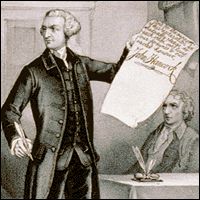
It will be remembered that a reward of £500 was offered for the head of John Hancock. When he signed the Declaration of Independence, he did it with a bold hand, in a conspicuous manner, and rose from his seat, pointing to it, and exclaimed, “there, John Bull can read my name without spectacles, he may double his reward, and I put him at defiance.”
This is the earliest statement I’ve found that the British government had offered a £500 reward to capture Hancock by the summer of 1776, as I discussed yesterday. Since the item suggested that fact should already be common knowledge, there were probably earlier reports, but there’s still no contemporaneous evidence to confirm that belief.

“Revolutionary Anecdotes” is also the earliest version I’ve found of the story Hancock signing his name on the Declaration so large that someone “can read my name without spectacles.” Here that figure is John Bull, the personification of England. Later authors changed that to George III or his ministers. Likewise, the wording of Hancock’s exclamation changes from one recounting to another.

This Revolutionary anecdote appears more than sixty years after the event with no stated source and attached to the dubious information about the reward. As the Course of Human Events blog recently pointed out, the Continental Congress didn’t send the parchment with all the signatures to Britain but kept it in its archives. So this anecdote isn’t convincing. But it’s lasting—some authors are still repeating the story today.

TOMORROW: I said there were two anecdotes, didn’t I?

Sunday, July 31, 2016

“Excepting only from the benefit of such pardon”

Yesterday I quoted from Gen. Thomas Gage’s proclamation on 12 June 1775 declaring martial law in Massachusetts.

Since at the time Gage controlled only the peninsula of Boston and Castle William, that proclamation didn’t have a big effect in the province. A couple days later, he and his generals started planning to take the Dorchester and Charlestown peninsulas as well, but few people were living in those areas, either.

The part of the proclamation that people most noticed at the time and remember today is its offer of pardon to any surrendering rebels, with a couple of notable exceptions:
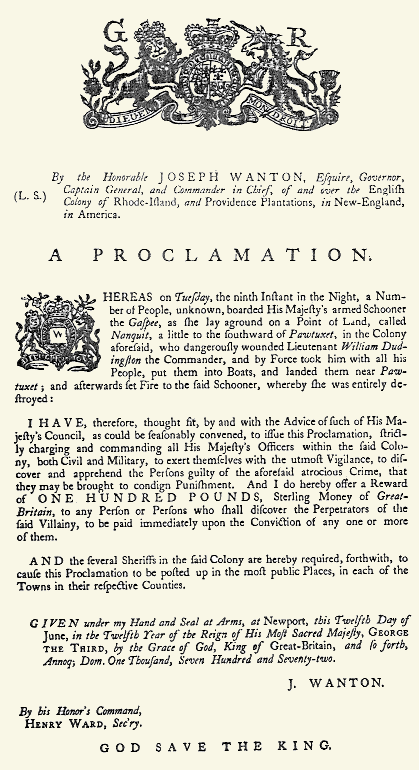
In this exigency of complicated calamities, I avail myself of the last effort within the bounds of my duty, to spare the effusion of blood; to offer, and I do hereby in his Majesty’s name, offer and promise, his most gracious pardon in all who shall forthwith lay down their arms, and return to the duties of peaceable subjects, excepting only from the benefit of such pardon, Samuel Adams and John Hancock, whose offences are of too flagitious a nature to admit of any other consideration than that of condign punishment.

And to the end that no person within the limits of this proffered mercy, may plead ignorance of the conseqences of refusing it, I by these presents proclaim not only the persons above-named and excepted, but also all their adherents, associates and abettors, meaning to comprehend in those terms, all and every person, and persons of what class, denomination or description soever, who have appeared in arms against the King’s government, and shall not lay down the same as afore-mentioned, and likewise all such as shall so take arms after the date hereof, or who shall in any-wise protects or conceal such offenders, or assist them with money, provision, cattle, arms, ammunition, carriages, or any other necessary for subsistence or offence; or shall hold secret correspondence with them by letter, message, signal, or otherwise, to be rebels and traitors, and as such as to be treated.
Those passages appeared in italics in the printed proclamation, presumably to signal that Gage really, really meant it.

This proclamation is also significant in what it doesn’t say. It offers no financial reward for Hancock and Adams, or any other Patriot leader.

In the 1800s it was common for American authors to say that the British Crown had promised £500 for the capture of Hancock, Adams, and sometimes other men. Some authors say that offer came in early 1775, others in early 1776. But as far as I’ve seen, there’s no evidence the Crown ever offered such a reward at all. None of those authors cites a document to back up the claim.

Gage and his colleagues wouldn’t have kept such a bounty secret; when you make an offer like that, you spread the news as wide as possible. Here, for example, and the proclamations from:
Even without a reward, Adams and Hancock clearly benefited from being singled out as “flagitious” by Gov. Gage, just as they had benefited from the mistaken belief that the king’s troops had tried to catch them in Lexington on 19 April. [I present the evidence against that belief in The Road to Concord.]

TOMORROW: John Hancock’s famous signature.