J. L. BELL is a Massachusetts writer who specializes in (among other things) the start of the American Revolution in and around Boston. He is particularly interested in the experiences of children in 1765-75. He has published scholarly papers and popular articles for both children and adults. He was consultant for an episode of History Detectives, and contributed to a display at Minute Man National Historic Park.

Subscribe thru Follow.it


•••••••••••••••••


Sunday, May 06, 2007

The Fife as a Cause of Travels and Disasters

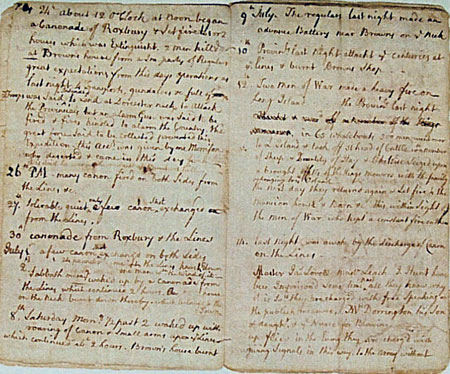
I spent yesterday afternoon at the Lexington Fife & Drum Muster (shown above during the “F Troop” congregation of members from all the units present, led somewhat casually by members of the host group). So it seemed appropriate to share John Greenwood’s memoir of becoming a fifer, and what that led him into.

About this period [1770] I commenced learning to play upon the fife, and, trifling as it may seem to mention the circumstance, it was, I believe, the sole cause of my travels and disasters.

I was so fond of hearing the fife and drum played by the British that somehow or other I got possession of an old split fife, and having made it sound by puttying up the crack, learned to play several tunes on its sufficiently well to be fifer in the militia company of Captain Gay. This was before the war some years, for I think I must have been about nine or ten years old. The flag of the company was English; so were they all then.
The captain must have been coppersmith Martin Gay (1726-1809). Gay’s politics are interesting because he was obviously torn. In December 1770, he hosted a spinning-bee, generally a Whig activity. But in 1774 he affirmed his loyalty to the Crown, and left Boston with the British troops in 1776. Then he returned to Massachusetts in the late 1780s, rejoined his old meeting-house, and eventually died at home.

But back to young John Greenwood:
At the age of thirteen I was sent eastward to a place called Falmouth (Portland), 150 miles from Boston, to live with my father’s only brother, whom I was named after. . . .

My uncle was lieutenant of an independent [militia] company (the Cadets), and of course I was engaged to play the fife while they were learning to march, a pistareen an evening for my services keeping me in pocket-money. Being thus early thrown into the society of men and having, as it were, imbibed the ardor of a military spirit; being moreover the only boy who knew how to play the fife in the place, I was much caressed by them.
Moving on! In April 1775, word of the Battle of Lexington and Concord reached Maine. John, who turned fifteen on 17 May, decided to return to Boston to see his parents, whom he was already missing. He left secretly early one Sunday morning when his uncle and everyone else was in meeting.
As I traveled through the different towns the people were preparing to march toward Boston to fight, and as I had my fife with me—yes, and I was armed likewise with a sword—I was greatly caressed by them. Stopping at the taverns where there was a muster, out came my fife and I played them a tune or two; they used to ask me where I came from and where I was going to, and when I told them I was going to fight for my country, they were astonished such a little boy, and alone, should have such courage. Thus by the help of my fife I lived, as it were, on what it usually called free-quarters nearly upon the entire route.
John managed to reach the Charles River, only to find that there was no way into besieged Boston. Charlestown was still intact; it wouldn’t be burned down until the Battle of Bunker Hill. But there were no families around.
Charlestown was at the time generally deserted by the inhabitants, and the houses were, with few exceptions, empty; so, not knowing what to do nor where to go and without a penny in my pockets, if I remember rightly, I entered a very large tavern that was filled with all descriptions of people.

Here I saw three or four persons whom I knew, and, my fife sticking in the front of my coat, they asked me, after many questions, to play them a tune. I complied forthwith, but although the fife is somewhat of a noisy instrument to pay upon, it could hardly be heard for the din and confusion around.

After I had rattled off several tunes, there was one Hardy Pierce who, with Enoch Howard and three or four others, invited me to go up to Cambridge to their quarters, as they called it. When there they tried to persuade me to enlist as a fifer, telling me it was only for eight months, and that I would receive eight dollars a month and be found in provisions; moreover, they calculated to quickly drive the British from Boston, when I would have an opportunity of seeing my parents.
Thus John Greenwood became fifer for Capt. T. T. Bliss’s company.

Saturday, May 05, 2007

Phillis Wheatley Gathers Testimonials

In 1772 the Wheatley family announced that a volume of their enslaved servant Phillis’s poetry would soon be published. I’ve seen it written that the Wheatleys were “unable to get her poems published in Boston,” with the possible implication that the town was hostile to them.

But I suspect the real problem was how volumes of poetry got published in the eighteenth-century British Empire. Poets had to pay their own printing bills. They could either be wealthy to begin with, attract wealthy patrons to subsidize them, or sign up lots of subscribers before publication. And Americans weren’t as interested in books of poetry as the wealthy top of British society.

Phillis’s ode to the late Rev. George Whitefield had attracted the admiration of Selina Hastings, Countess of Huntingdon, and other evangelicals in England. They encouraged her to send her poems to be printed in London instead of Boston. But while New Englanders had been seeing Phillis’s poems in newspapers for six years, and Bostonians probably knew her by sight, Londoners didn’t know her—and many didn’t believe that a young black woman could write poetry.

Merchant John Andrews described the problem and Phillis’s solution in a letter to a relative in Philadelphia:

In regard to Phillis’s poems they will originate from a London press, as she was blamd by her friends for printg them here & made to expt [expect] a large emolument if she sent ye copy home, which induced her to remand yt of ye printer & dld [delivered] it Capt Calef, who could not sell it by reason of their not crediting ye performance to be by a Negro, since which, she has had a paper drawn up & signd by the Govr. Council, Ministers & most of ye people of note in this place, certifying the authenticity of it; which paper Capt Calef carried last fall, thefore we may expect it in print by the spring ships
(My reading of this letter differs from the standard transcription from the Massachusetts Historical Society. But hey, I don’t hold it against them.)

That “paper drawn up & signd” is evidence that Boston’s establishment didn’t stand in Phillis’s way. The eighteen men who signed it were the establishment, from both sides of the political divide, and they testified about her genuine talent: In the language of modern book marketing, Phillis Wheatley had the best “blurb” Boston could provide, on top of the countess’s financial support. Those men’s names appeared at the front of her Poems on Various Subjects, Religious and Moral, when it was printed in London in 1773.

Friday, May 04, 2007

Phillis Wheatley Writes about Christopher Seider

Both in the 1770s and now, one of the most famous inhabitants of Revolutionary Boston was Phillis Wheatley. Sold into slavery in West Africa, she arrived in Massachusetts in 1761 at the age of about seven (to judge by the baby teeth she was missing). The tailor John Wheatley purchased the little girl as a servant for his wife Susannah, who renamed her Phillis. She learned to read so quickly that the family started to provide more lessons and books. In 1767 Phillis published her first poem in a Newport newspaper. In 1773 the Wheatleys legally emancipated her, after the publication of a collection of thirty-seven of her poems in London.

Wheatley wrote a lot of her verse in response to events of the day: the death of the Rev. George Whitefield, the death of someone’s child, the Boston Massacre, &c. She wrote odes to famous men, from the Earl of Dartmouth, Britain’s Secretary of State, to George Washington, commander of the army that opposed Dartmouth. She wrote lots of pious pronouncements. This wasn’t a period for introspective, personal poetry, and Wheatley wasn’t a particularly introspective, personal poet. (Her letters are more revealing.)

Among the subjects Wheatley chose was the boy Christopher Seider, killed by a Customs officer on 22 Feb 1770. That poem didn’t appear in the 1773 collection, probably because it was too tied to Boston events for a wider audience and perhaps because it was too controversial. But a manuscript remained, and it was published in The New England Quarterly in 1970. It now appears in Wheatley’s Collected Works.

On the death of Mr Snider
Murder’d by Richardson


In heavens eternal court it was decreed
How the first martyr for the cause should bleed
To clear the country of the hated brood
He whet his courage for the common good
Long hid before, a vile infernal here
Prevents Achilles in his mid career
Where’er this fury darts his Poisonous breath
All are endanger’d to the Shafts of death.
The generous Sires beheld the fatal wound
Saw their Young champion gasping on the ground
They rais’d him up. but to each present ear
What martial glories did his tongue declare
The wretch appal’d no longer can dispise
But from the Striking victim turns his eyes
When this young martial genius did appear
The Tory chiefs no longer could forbear.
Ripe for destruction, see the wretches doom
He waits the curses of the age to come
In vain he flies, by Justice Swiftly chaced
With unexpected infamy disgraced
Be Richardson for ever banish’d here
The grand Usurpers bravely vaunted Heir.
We bring the body from the wat’ry bower
To lodge it where it shall remove no more
Snider behold with what Majestic Love
The Illustrious retinue begins to move
With Secret rage fair freedoms foes beneath
See in thy corse ev’n Majesty in Death
Wheatley spelled the boy’s name “Snider,” as it appeared in some newspapers (but not in the family baptismal records). The praise for Seider as a martyr also came right out of the newspapers, and even the phrase “martial genius” reflects their comment on what was found in the boy’s pockets. All in all, it’s a remarkably overblown bit of verse.

Thursday, May 03, 2007

Wish I Could Be There in Princeton, New Jersey

For those not already committed to events on Sunday morning, 6 May, there will be a free walking tour of Princeton, New Jersey, battlefield led by Brandeis professor David Hackett Fischer. His book Washington’s Crossing, about the 1776-77 campaign in New Jersey, won the Pulitzer Prize for history a couple of years back.

This tour is sponsored by the Princeton Battlefield Society, which asks people to register at the site at 9:30 A.M. for the tour that begins at 10:00. The Clarke House museum and its collection of firearms will be open as well. Donations are welcome.

Princeton Battlefield State Park is a mile and a half south of downtown Princeton. I have relatives in that area, so I walked around the site a couple of summers ago without a guide, trying to piece together events through plaques and signs, some created by an enterprising Eagle Scout. The image above represents the “Mercer Oak,” said to be the tree under which Gen. Hugh Mercer lay after being bayoneted during this battle. That tree died seven years ago, so you get to see a stump and a sapling planted to replace it.

Wednesday, May 02, 2007

Black Drummers of the 29th Regiment

Roger Fuller at Minute Man National Historical Park alerted me to this online image of a small exhibit at England’s Worcester City Museum on the black drummers of the British army’s 29th Regiment of Foot. And here’s an article about that regiment’s tradition of recruiting drummers of African descent; its pictures come from the nineteenth and twentieth centuries, but it names the drummers going back to Revolutionary times, as compiled by John Ellis.

Now “tradition” and “recruited” might not be the right words for the practice in 1768-70, when the 29th was in Boston. According to other sources, Admiral Edward Boscawen bought the first “eight or ten boys” to serve as drummers in 1759 and gave them to his brother George, who was colonel of the 29th. So those boys most likely arrived as slaves, not of their free will, and the tradition was only about a decade old.

Or are those other sources accurate? Ellis’s study notes three drummers who retired from the regiment with years of service dating from before 1759, at least two of them middle-aged by that year:

  • John Charloe—born on St. Kitts, 1710; served 1751-80
  • John Bacchus—born on Jamaica, 1726; served 1752-80
  • Joseph Provence—born on Santo Domingo; served 1755-90
Perhaps the 29th had some black drummers before 1759, but the Boscawens decided to employ only black men. Perhaps the term “boys” was inaccurate, and a bit pejorative. A later commander of the 29th, John Enys, stated that when he joined in 1775, at least three of the original ten black drummers were still serving, which matches with the data above.

Bacchus was the drummer for Capt. Ponsonby Molesworth’s company in 1769, according to muster rolls. Cpl. William Wemms (or Wemys), one of the Boston Massacre defendants, came from that company.

Ellis’s research lets us identify the other drummers of the 29th’s time in Boston as Robert Baird (born 1738, discharged 1792), Lushington Barrett (died 1787), Thomas Othello (Capt. Archibald Campbell’s company in 1770, died 1777), John Rufael (deserted 1770), John Archer, Thomas Walker, and possibly John Blenheim.

The best documented of that group is Thomas Walker, who got caught up in the fight at the ropewalk on the Friday before the Boston Massacre. He left a deposition about his experience, and Justice John Hill mentioned the “tall negro drummer” in his own testimony. Walker served in Capt. Thomas Preston’s company. Ellis found that he was with the regiment in 1765 and 1774, and might be the drummer “Samuel Walker” listed as dying in 1781 but otherwise unknown.

In the British army (as later in the Continental Army), drummers were responsible for whipping men convicted of crimes. The Worcester City Museum website says, “recruits were sometimes deterred by the thought of being flogged by a black man, and the citizens of Boston even wrote to the commanding officer about it.” That refers to protests like this, from an October 1768 dispatch that the Whigs sent to newspapers in other colonies:
In the forenoon one Rogers, a New-England man, sentenced to receive 1000 stripes, and a number of other soldiers, were scourged in the Common by the black drummers, in a manner, which however necessary, was shocking to humanity; some gentlemen who had held commissions in the army, observing, that only 40 of the 170 lashes received by Rogers, at this time, was equal in punishment to 500, they had seen given in other regiments.
The locals’ main point was how British military punishments far exceeded what the local courts doled out, even when corporal punishment was standard. But the Whigs made sure to slip in the detail about the drummers being black, which could rile up people. As the Boston Evening-Post expressed it on 6 Oct 1768: “To behold Britons scourged by Negro drummers was a new and very disagreeable spectacle.”

Another dispatch from the same series shows a drummer himself being punished the same way in Feb 1769:
There has been within these few days a great many severe whippings; among the number chastised, was one of the negro drummers, who received 100 lashes, in part of 150, he was sentenced to receive at a Court Martial;—It is said this fellow had adventur’d to beat time at a concert of music, given at the Manufactory-House.
It appears that even if these drummers arrived as slaves, they enjoyed a respectable standing within the regiment and retired as free men—but they had to get through the discipline of British military service first.

Tuesday, May 01, 2007

Mayday at Valley Forge, 1778

When the U.S. of A. became independent, its citizens recognized that they needed new national holidays, not simply those derived from British culture (and especially not those celebrating the king or other aspects of that culture they were fighting against).

Here’s a description of one such attempt, from the Continental Army encampment at Valley Forge in 1778. In late April, the men had received word of the country’s formal alliance with France, which augured more success in the war. In addition, Gen. Washington’s soldiers seem to have achieved a higher level of military discipline and cohesion over the preceding winter. And the winter was over. So they had lots to celebrate.

This description of the day comes from the Military Journal of George Ewing (1754-1824). I think the young officer’s closely written text achieves a sort of poetry:

May
1st Last Evening May poles
were Erected in everry Regt in
the Camp and at the Revelie
I was awoke by three cheers
in honor of King Tamany

The day was spent in mirth
and Jollity the soldiers parading
marching with fife & Drum
and Huzzaing as they passd the
poles their hats adornd with
white blossoms

The following was the procession
of the 3d J[ersey] Regt on the aforesaid day

first one serjeant drest in an
Indian habit representing
King Tamany

Second Thirteen Sergeants
drest in white each with a bow
in his left hand and thirteen
arrows in his right

Thirdly thirteen Drums & fifes

Fourthly the privates in
thirteen Plattons thirteen
men each—

The Non Commissiond
Officcers and Soldiers being
drawn up in the afforsaid
manner on the Regimental
Parade gave 3 Cheers at their
own Pole and then Marchd
of to Head Quarters to do Honor
to his Excellency but just
as they were descending the
hill to the house an Aid
met them and informd
them that the Genl was
Indisposd and desird them
to retire which they did
with the greatest decency
and regularity—

they then returnd and
marchd from right to
left of Lord Stirlings Division
Huzzaing at every Pole

they pasd and then retird
to their Regimental parade
taking a drink of whiskey
which a Generous contribution
of their officers had procurd
for them they dismisd
and each man retird to
his own hut without any
accident hapning throughout
the whole day the whole
being carried on with the
greatest regularity—

in the evening the Officers
of the aforesaid Regt assembld
and had a song and dance
in honour of King Tamany
about 12 O Clock we dismissd and
retird to rest.
We just don’t celebrate like this anymore. The number thirteen symbolized the states, of course. Tammany was a Native chief, thus a symbol of the New World instead of the Old. Whiskey was whiskey.

William Alexander, Lord Stirling, was an American general who claimed a Scottish earldom. The House of Lords disagreed, that that didn’t stop Americans from addressing him with the aristocratic title. The same army was also pleased to welcome a Prussian-born baron of some dubious claims, Gen. Frederick William von Steuben, and the very legitimate Marquis de Lafayette. Republican sentiment melted in the presence of actual European aristocrats.

Maypoles seem to have been unpopular in eighteenth-century America, or at least I couldn’t find mentions of them a couple of years ago. I suspect they became tainted by their association with the Stuart kings after the Restoration. So there’s another irony in seeing them sprout again in the new republic. Then again, when you’re celebrating on the first of May, how else are you going to do it?

Monday, April 30, 2007

What People Read About the “Liberty Tree Flag”

Last Friday, I posted a baker’s dozen contemporaneous reports on flags at Boston’s Liberty Tree in the 1760s. Two of those quotes turn out to be particularly significant, I think, and I’ll return to them later. But now I’m going to jump ahead to when the Bostonian Society’s “Liberty Tree Flag” is definitely documented.

The red and white banner came to the society in 1893 from John C. Fernald. Earlier in that year he had loaned it to the Columbian Exposition in Chicago, where the official catalogue of items in the U.S. Government Building listed it as:

10. Liberty Tree Flag—
Part of the original flag which waved over the Liberty Tree on Boston Common in 1775. Loaned and collected by John C. Fernald, Boston, Mass.
In the same display were several weapons said to have been carried in the Battle of Bunker Hill and the sword of Col. James Barrett, senior provincial officer during the fight at Concord.

Fernald told the Bostonian Society that he’d purchased the flag from a granddaughter of a wireworker named Samuel Adams, who had died in 1855 at the age of ninety-six. Apparently the statement that it had flown on Liberty Tree had come down through the generations of that family.

How reliable was Fernald’s information? In some ways, it clearly wasn’t. Liberty Tree was never “on Boston Common”—it was at the corner of modern Washington and Boylston Streets. There were thousands of army troops in Boston throughout 1775, making a mass meeting of Sons of Liberty very unlikely in that year. But those details might have been mistaken assumptions about Revolutionary Boston, off by just a few blocks and a few years.

The Chicago catalogue’s statement that the cloth was only “Part of the original flag” implies that Fernald thought the original was larger, probably much larger. Does that support the theory that the banner originally had thirteen stripes? Or is this more likely another mistaken assumption, distorted by hindsight?

Who was Samuel Adams, wireworker? I haven’t unearthed any information about him, but I’ve just started digging. If the information about his death is correct, then he was born in 1759 and still a teenager in 1775, when Liberty Tree was chopped down. That would make him an unlikely guardian of the Patriots’ flag, but perhaps he inherited the cloth from his father or master.

I did find one curious passage in Charles Francis Adams’s 1871 biography of his grandfather, John Adams:
in the town meeting or the body meeting,...all assembled on an equal footing. And Samuel Adams, the journeyman wireworker, living on perhaps fifty cents earned every week-day, was entitled to his say as freely, though he might not be heard so readily, as his namesake whilst engaged in combining the far more important wires of the corresponding committees.
The Samuel Adams who died in 1855 would have been too young to speak in town meetings when the more famous Samuel Adams was managing the town’s Committee of Correspondence. So was this mention of a wireworker with that name just a literary coincidence?

I think that information published in the late 1800s might be very significant to understanding the “Liberty Tree Flag.” Those publications were the lens through which people viewed the past. They determined what people expected in Revolutionary artifacts.

Which brings me to those two particular quotations from Friday. Most came from newspapers. While those newspapers survived in Massachusetts libraries, I don’t think they’d yet been collected in complete runs (much less turned into a digital database). Few, if any, historians had read through all the issues of the late 1760s to find all mentions of Liberty Tree. As for the two quotes from John Rowe’s diary, that document wasn’t published until 1895.

So that leaves two items from my Friday list: the reports to London from Gov. Francis Bernard and the Customs Commissioners, describing “a Flag-Staff, which went through the Tree, and a good deal above the Top of the Tree,” and “a red flag.” Those documents were printed in 1769, having been leaked in London. The resulting pamphlet remained in Boston’s archives, much easier to find and read than the newspapers.

The historian Richard Frothingham drew on that source for his 1865 Life and Times of Joseph Warren. On page 61, he wrote, “A red flag was now hoisted above Liberty Tree,” and, “there was a larger assemblage at Liberty Tree, over which still waved the red flag, than had ever been seen in the town.” Though Frothingham noted Union flags at other Whig demonstrations, that page contains his only description of a flag at Liberty Tree. George H. Preble’s History of the Flag of the United States (1872) offered the same information, probably based on Frothingham.

Thus, the best-informed Americans during the Centennial of 1876 and through 1893 probably all thought that the flag at Liberty Tree was red—not, as in most of the newspaper reports from the 1760s, a British Union flag. Which certainly made it easier to believe that a certain red-and-white, seven-feet-by-thirteen banner was that flag.

Sunday, April 29, 2007

Liberty Tree at the Theater in 1857

Boston 1775 interrupts its meditation on the Liberty Tree Flag for a commercial announcement—well, a commercial for a play that was touring Massachusetts venues like the “Boston Museum” in 1857. Or, in the words of its broadsides, the troupe offered a:

Great Local Patriotic Play of the Revolution, in three acts, called the
LIBERTY
TREE

or the
BOSTON TEA PARTY!
This might have been an update of the 1832 play The Liberty Tree, or Boston Boys of ’76; both contain a Yankee character named “Bill Ball,” originally played by Boston playwright Joseph Stevens Jones (1811-1877). However, that character plays only a small role in the action, according to the broadsides’ summary, so this might be a new play written to capitalize on memories of its predecessor.

The major characters are:
  • among the Americans, “Gordon, a Patriot”; “Nat Hinge, an old Northender”; “Peter Gummery, Gordon’s Negro”; and “McJig, an Irish Serjeant.”
  • among the “English” (as the broadside labels them), “Elton, a Government Officer”; “Colonel Worston”; and “Pilky, a Tory.”
Like a lot of American entertainment before World War 2 (and perhaps afterward), The Liberty Tree seems to depend on ethnic stereotypes. The characterization gets particularly bigoted around the Peter Gummery character, including the racist terms of the time. Yet that same character pops up so often in the summary that many in the audience must have come to see him. That interest in ethnicity dovetails with the post-Revolutionary obsession with explaining how Americans are different from British, directly opposite the message Boston’s Liberty Tree was originally supposed to convey.

But without further ado, here is the “Programme of Scenery and Incidents” for The Liberty Tree:
Part First—Scene 1—Shipyard at North End Discontent of the People. Peter’s opinion of things in general. Nat Hinge and his chest of Tools. A spy well treated. Scene 2--Old Triangular Warehouse in Dock Square. The British Soldiers and the Yankee Printer. The uses and abuses of a Leg Mutton. Loss of Uniforms. The First Retreat. Scene 3—House of Mr. Gordon. Opinion of an American Patriot. “This town, Boston, where the Tree of Liberty flourishes, emblem of its name, shall give the word, at which all shall rise who own the name of Freeman, and pluck the bright jewel America, from the Crown of England.” Scene 4—Interior of Hinge’s House. Cutting the crown off. “Darn these Buttons.”—Scene 5—Elton’s House. The American Patriot and the British Subject. Scene 6—THE LIBERTY TREE! Assembling of the people. The plan and the RESOLVE. Scene 7--GRIFFIN’S WHARF! Resolution of the people. ”The work’s begun, Americans, complete it!!” THE BOSTON TEA PARTY.

Part Second—Scene 1—Apartment at Colonel Worston’s.
British tuition and Yankee politeness. “Where did you come from?” “Concord and Lexington.” The disguise and the ESCAPE. Scene 2—Gordon’s House. The father and his child. Scene 3—Apartment. The American women at work for their patriot husbands and fathers. Gummery’s opinion of matrimony subjects. “The Boston Boys have heard drums and guns too, and are not much scared at either.” PATRIOTIC SONG—Hinge—“Our Country is our Ship.” Scene 5--OLD SOUTH CHURCH, seen from Milk Street. Boston Boys going to work. The ROGUE’S MARCH. The Tory’s Ride. Scene 6--SHIP YARD.—In the distance, Charlestown in Flames. The attack and retreat. The Tory treated to a coat of TAR and FEATHERS.

Part Third—Scene 1—Street in Boston. Peter Gummery and his Irish Friend, McJig. “The greatest Nigger in the World—I’se General Washington’s Nigger.” SONG—Gummery—“Old George and de Boston Tea Party” Scene 2—Colonel Worston’s House. The consultation. Respect your enemies. Scene 3—Room in Hinge’s House. “Bad news! no dinner to-day, the guns have frightened all the fish—true American fish won’t bite while there’s a red coat in town.” “There’s a Yankee wife for somebody.” Scene 4—PILKEY’S HOUSE. Preparations for breakfast. How about that Cow? Pilkey’s illness. The doctor and his prescription. Knowledge of anatomy. Scene 6—DOCK SQUARE. The assault. The rescue. The forced retreat.—Scene 5—Room in GORDON’S HOUSE. GRAND PANORAMA! Entrance of WASHINGTON! HIS STAFF AND AMERICAN ARMY TO THE GOOD OLD TOWN OF BOSTON. Tableau.
And curtain.

Friday, April 27, 2007

Newspapers on the Flag at Liberty Tree

In my last posting, I promised a look at what Boston’s colonial newspapers said about flags at Liberty Tree. This was my contribution to Monday’s discussion of the “Liberty Tree Flag” at the Old State House Museum (though museum director Rainey Tisdale uncovered one of the crucial quotes below).

Boston Evening-Post, 16 Sept 1765:

At the South Part of the Town the Great Trees for which many have so great Veneration, were decorated with the Ensigns of Loyalty, and the Colours embroidered with several Mottos.
Boston Post-Boy, 19 May 1766:
On the Tree of Liberty waves the British Standard
Boston Evening-Post, 26 May 1766:
The Tree decorated with flags and Streamers, and all round the Town, on the Tops of Houses, were displayed Colours and Pendants
Boston Gazette, 23 Mar 1767:
the venerable Elm of Liberty was variegated with a Multitude of Streamers most beautifully disposed among it’s Branches
Merchant John Rowe’s diary, 14 Aug 1767:
This day the Colours were displayed on the Tree of Liberty & ab[out] Sixty People Sons of Liberty met at One of Clock & Drank the Kings Health.
Customs Commissioners’ report to the Treasury in London, 15 June 1768:
a red flag was hoisted yesterday in the afternoon at Liberty Tree, and continued flying this morning, and that about 10 o’clock this morning a great number of people, supposed to be near 2000, met, and after choosing a moderator adjourned to Faneuil Hall ’till 3 o’clock in the afternoon.
Gov. Francis Bernard’s report to the Earl of Hillsborough, Secretary of State, 16 June 1768:
In August last, just before the Commencement of the present Troubles, they erected a Flag-Staff, which went through the Tree, and a good deal above the Top of the Tree. Upon this they hoist a Flag as a Signal for the Sons of Liberty, as they are called. . . .

Upon this Staff the Flag was flying early in the Morning on Tuesday; at the Time appointed there were assembled they say at least 4,000 Men, many having come out of the Country for that Purpose; some of the principal Gentlemen of the town attended in order to engage the lower People to concur in Measures for Peace and Quiet.
These two confidential reports and some others were later leaked back to Boston by people in London sympathetic to the Massachusetts Whigs. (A leak of similar letters from Gov. Thomas Hutchinson and others came through Benjamin Franklin in 1774, derailing both men’s careers.) Boston printers published those documents in a pamphlet and newspapers, convincing many people that the governor and Customs officials were indeed hostile to local liberties and dishonest about their intentions. But I digress.

Boston Post-Boy, 20 June 1768:
Early on Tuesday Morning the Colours were flying on Liberty Tree; and at the Hour appointed, vast Numbers of Inhabitants appeared at and near the Hall; but the Weather being wet and uncomfortable in the Streets, they adjourned to Faneuil-Hall
Boston Evening-Post, 22 Aug 1768:
At the Dawn, the British Flag was displayed on the Tree of Liberty
The Boston Whigs’ ”Journal of the Times” dispatches for newspapers in other towns, 20 Mar 1769:
The British flag was displayed on Liberty Tree, and at noon a number of gentlemen met in the hall under the same, and the greatest order and decorum observed by the company.
John Rowe’s diary again, 1 Aug 1769:
The Flag hoisted on Liberty Tree—the Bells Ringing—Great Joy to the People.
New York Gazette, 7 Aug 1769, probably quoting a newspaper from Boston:
The Union Flagg was displayed from LIBERTY-TREE, where it was kept flying ’till Friday—Colours were also flung out from most of the Vessels in the Harbour—And from the Tops of the Houses in Town.
New York Gazette, 28 Aug 1769, again probably a quoted report:
Monday last being the 14th of August, the Anniversary was celebrated by the Sons of Liberty: In the morning the British flag was displayed on Liberty Tree, under the shade of which at noon the true-born Sons met, and fourteen toasts were drunk
So contemporaneous sources confirm that Whig organizers would fly a flag from the pole near Liberty Tree on celebratory occasions and to summon public meetings. But none of those sources describe a red and white striped flag like the Bostonian Society’s “Liberty Tree Flag.”

Instead, almost every source that describes the flag at or around Liberty Tree says it was a British or Union flag—a symbol of the Empire. The Customs Commissioners wrote of “a red flag” in June 1768, but I wonder if they didn’t mean a “Union Flag with a red field” or red ensign, which other sources confirm was displayed in the colonies before the Revolution. I doubt it was an all-red flag; Boston required such a banner to be flown outside of houses where people had smallpox, so that would hardly be an effective way to summon people.

Flying a symbol of Great Britain from Liberty Tree fits the American Whigs’ political platform through 1775. They weren’t saying, “We’re Americans, and the British are oppressing us”—that message wouldn’t come until the war had started. No, the Whigs were shouting as loud as they could, “We’re British, and a few corrupt politicians in London are oppressing us!” By hoisting the British or Union flag, they proclaimed their loyalty to the king and claimed their rights as British subjects.

COMING UP: What people read about the flag at Liberty Tree in the late 1800s.

Thursday, April 26, 2007

What Could Nine Stripes Mean?

Yesterday I started to write about the Bostonian Society’s “Liberty Tree Flag” and its ongoing efforts to authenticate that banner as one which indeed flew from Boston’s Liberty Tree to signal popular meetings.

That flag has nine vertical stripes, alternating red and white, as shown here. It’s natural to ask, therefore, what those stripes might symbolize. That was the topic of Dr. Whitney Smith’s talk at the Old State House Museum on Monday evening.

But first, some of the earlier explanations proffered for the nine stripes. David Martucci’s essay on American Revolutionary flags quotes one (without, I should say, endorsing it):

According to Standards and Colors of the American Revolution by Edward W. Richardson (University of Pennsylvania Press & the Pennsylvania Society of Sons of the Revolution and its Color Guard, 1982) the nine stripes could correspond to nine segments of the cut up rattlesnake in the cartoon (representing New England, New York, New Jersey, Pennsylvania, Maryland, Virginia, North Carolina, South Carolina and Georgia).
Unfortunately, Benjamin Franklin’s 1754 cartoon calling for colonial unity shows a snake in eight pieces. (He didn’t include Georgia, and treated Delaware as part of Pennsylvania.)

Delegates from nine colonies attended the Stamp Act Congress of October 1765, around the same time that Boston’s Whigs gave Liberty Tree its political name. So could the flag have nine stripes to symbolize those nine colonies? I doubt the Whigs would have done that because some colonies not at the congress had nonetheless opposed the Stamp Act, including close neighbor New Hampshire; Virginia, oldest and largest of Britain’s American colonies; and Nova Scotia. When you see yourself in a titanic struggle for your political liberties, you don’t want to alienate your friends.

Another possible explanation is that the “Liberty Tree Flag” is only part of the original banner. It might have contained more vertical stripes. It might even be just a scrap of a much larger flag with thirteen horizontal stripes, the common arrangement of early national flags. But that would have been a huge, heavy banner, probably impractical for this use. And there doesn’t seem to be any physical or documentary evidence suggesting that this banner was only a minor part of the original.

In his public lecture, Dr. Smith offered an ingenious new theory: the four white stripes and five red stripes represented the number 45. Any American Whig of the 1760s would have immediately recognized that number as a reference to issue No. 45 of John Wilkes’s magazine The North-Briton, which landed him and some of his associates in jail in London for sedition.

American Whigs indeed adopted the number 45 as one of their symbols for resistance to unjust government from London. In 1768, a group of Whig businessmen commissioned Paul Revere to create a punch bowl for them, and among the many political mottoes engraved on it was:
No 45.
Wilkes & Liberty
In fact, the men even seem to have called the whole bowl “Number 45.” Merchant John Rowe wrote in his diary for 1 Aug 1768: “Spent the evening at Mr. Barber’s Insurance Office & the Silver Bowl was this evening for the first time introduced, No. 45. Weighs 45 ounces & holds 45 gills”. (Nathaniel Barber’s name is one of those inscribed on the bowl.) Now dubbed the “Sons of Liberty Bowl,” this artifact is at Boston’s Museum of Fine Arts.

Probably the most memorable American use of the number 45 came two years later in New York, after Alexander McDougall was put in jail for criticizing the royal government in a broadside—a freedom of press issue much like Wilkes’s. Then someone noticed that the proceedings against McDougall fell on page 45 of the legislative record. Coincidence? They thought not. Mary Louise Booth’s 1867 History of the City of New York states:
...on the forty-fifth day of the year,...forty-five of the Liberty Boys went in procession to the New Jail, where they dined with him on forty-five beef-steaks cut from a bullock forty-five months old, and, after drinking forty-five toasts with a number of friends who joined them after dinner, separated, vowing eternal fidelity to the common cause.
On another occasion, McDougall was reportedly visited by forty-five virgins singing him either (according to different sources) forty-five songs or the 45th Psalm. Historians seem to enjoy this episode particularly because it offers the chance to quote an anonymous Tory’s suggestion that all those virgins were forty-five years old.

We can even connect the number 45 to Liberty Tree. On the evening of 19 May 1766, the next issue of the Boston News-Letter reported, there were forty-five lanterns hung on Liberty Tree. However, that same item also indicates that the town’s Whigs were moving on to higher numbers. They thought their tree “would have made a more loyal and striking Appearance if [the number of lanterns] increased to the glorious Majority of 108.” So they loaded up the tree with more than twice as many lanterns the next night. Even Revere’s punch bowl features the number 92 more prominently than Wilkes’s 45.

(What, for goodness’ sake, was the significance of 108 or 92? I’m guessing that the “glorious Majority of 108” referred to the margin of victory when the House of Commons voted 275-167 to repeal the Stamp Act in early 1766. As for 92, after Gov. Francis Bernard insisted the Massachusetts House rescind its vote against the Townshend Act in 1768, ninety-two legislators refused to comply.)

So what do all those numbers mean to the “Liberty Tree Flag”? While American Whigs did adopt the number 45, I’m unaware of any other time they used four and five stripes to symbolize it—that would have required more explanation than, say, embroidering “45” on the cloth. Also, when Whigs celebrated 45, they weren’t shy about proclaiming that symbolism and what it meant in their newspapers.

TOMORROW: What Boston newspapers said about the flag on Liberty Tree.

Wednesday, April 25, 2007

Studying the Old State House's Liberty Tree Flag

Monday evening I attended an event I’d mentioned last week: a lecture at the Bostonian Society’s Old State House Museum about a banner in its collection called the “Liberty Tree Flag.”

Among flag historians and collectors there, I had the pleasure of meeting not only lecturer Whitney Smith, but also Peter Ansoff (after years of exchanging emails) and Ben Zaricor. Historians of Boston in the audience included Alfred F. Young, Marty Blatt of Boston National Historical Park, and Charles Bahne. And representing our host, the Bostonian Society, were executive director Brian LeMay, museum director Rainey Tisdale, public events manager Samantha Nelson, and many other staffers and members.

The Old State House’s “Liberty Tree Flag” isn’t a banner that depicts a Liberty Tree or pine tree, like several examples from the first years of the Revolutionary War. Rather, according to the statements of the woman who donated the flag to the Bostonian Society in the 1890s, this was the flag that Boston’s Sons of Liberty had flown from the pole beside Liberty Tree when they wanted to assemble a crowd for a public meeting.

The flag is made of wool, seven feet by thirteen feet, and assembled from nine vertical stripes of alternating red and white. Its design, shown above, appears in many discussions of the evolution of American flag. In dating from 1766-1775, when the British army chopped down Liberty Tree, this banner would represent the first prominent use of stripes in American Revolutionary symbolism.

However, the flag’s donor offered no documentation for its age or usage, nor an explanation of how the flag had come into her family. The banner she donated was probably the same displayed at the Columbian Exposition in Chicago in 1893, and perhaps one of the two exhibited at Old South Meeting-House during the Centennial as having flown from the Liberty Tree flagpole. But was it really hoisted in 1766-75?

The Bostonian Society, to its great credit, is now trying to authenticate that flag, and for a few days I’ll cogitate on the various issues the investigation is raising. One very important step was an examination of the flag by textile expert Fonda Thomsen. She wasn’t at the event on Monday, by Tisdale shared one of her preliminary findings: the “Liberty Tree Flag” is made of fabric from a machine loom, not a hand loom.

At one point, that finding would have made scholars conclude that the flag couldn’t have been around before 1775. But more recent research has apparently found that there were water-powered machine-looms in Britain as early as the first half of the 18th century. So it’s possible that the wool was woven in Britain well before the 1760s. Thompson wishes to explore whether the manufacturing details she spotted in the “Liberty Tree Flag” match pre-Industrial Revolution examples of machine-woven cloth.

There would be political implications if the Sons of Liberty flew a flag made from imported fabric. After the Townshend duties of 1767, Boston’s Whigs discouraged almost all imports from Britain and promoted domestic manufacturing instead. For example, when tanner William Dawes, Jr., married for the first time in May 1768, the Boston Gazette devoted an unusual amount of ink to the event:

Last Tuesday was married, Mr. WILLIAM DAWES, to Mrs. MEHITABLE MAY, both of this Town, and Yesterday made a handsome Appearance, dress’d wholly in the Manufactures of this Country, wherein he did honor to himself, and merits the Respect of the Province...
To be completely consistent with their political position, the Whigs shouldn’t have flown a flag made of British cloth, hand-woven or machine-woven.

However, there wasn’t a lot of North American cloth to go around. The Dawes-May wedding item was a “man bites dog” story, making news precisely because the bridegroom’s clothing was unusual. Out of thousands of men in Boston in 1768, Dawes was one of the very few to appear dressed wholly in domestic cloth. So if the Sons of Liberty’s only flag was made from ordinary cloth—which meant cloth shipped from Britain—then they might simply have lived with that contradiction. After all, it would have been imported before they called their boycott, right?

On the other hand, though some machine-woven cloth could have been in Boston before 1775, the great majority of cloth in that century was hand-woven. I think Thomsen’s finding about the flag’s weaving makes it less likely that the “Liberty Tree Flag” is as old as Liberty Tree.

TOMORROW: What those nine stripes could mean.

Tuesday, April 24, 2007

Hanged by the Neck on the Neck

Spring, or possibly even summer, has finally arrived in Boston, and yesterday was lovely for walking around the city, visiting the Old State House for discussions and lectures on the city’s Revolutionary past. More about the museum’s “Liberty Tree Flag” later in the week.

In the morning Jane Kamensky of Brandeis asked me “a Boston 1775 question”: Where were Boston’s gallows in that period? Specifically, were people hanged inside or outside the town proper?

The 1769 map of Boston shows the gallows on the Neck leading from the town to the rest of the province, just outside the fortified gates on the east side of the road. But that map was based on a copperplate engraved decades before, and it was impossible for the reprinter to correct it, so he just left the gallows where they were.

According to Annie Haven Thwing’s Crooked and Narrow Streets of Boston, Sheriff Stephen Greenleaf had erected a new set of gallows on the Neck in 1765. These were on the west side of the road, “on a little rising spot of ground, and beyond the clay pond.” Either way, the gallows were “beyond the pale” that defined the inhabited part of Boston. You had to leave town to be executed.

In the pre-Revolutionary period, the gallows seem to have been used for more symbolic executions than actual ones. In 1764 merchant John Rowe reported in his diary that at the end of a fatal Pope Night the “South End people got the Battle (many were hurt & and bruised on both sides) & burnt Both of them [i.e., both sides’ effigies] at the Gallows on the Neck. Several thousand people following them, hallowing & c.”

According to shoemaker George R. T. Hewes in A Retrospect of the Boston Tea-Party, an angry 1774 seized a Customs official who had attacked Hewes, tarred and feathered him, whipped him through town to the gallows on the Neck, whipped him another 39 times, “and then, after putting one end of a rope about his neck, and throwing the other end over the gallows, told him to remember he had come within one of being hanged.”

Richard Frothingham’s Life and Times of Joseph Warren offers this anecdote about the doctor and Patriot organizer, presumably from 1774-75:

One day he was passing the place at the Neck where the gallows stood, and met three [British army] officers, one of whom insultingly said, “Go on, Warren: you will soon come to the gallows.” Warren turned, walked up to the officers, and calmly asked who it was that uttered these words, but received no reply.
That story came from James Spear Loring’s The Hundred Boston Orators, who credited Warren’s nephew Dr. John Collins Warren.

Perhaps more reliable because it doesn’t even pretend to be true is this joke from “the Gleaner,” a pseudonym Nathaniel Ingersoll Bowditch used for his newspaper writings in the mid-1800s:
Two friends riding into town, one of whom, looking at the gallows said jocosely, “Where would you be now if everybody had their deserts?”

And the reply was, “I should be riding into town alone.”

Sunday, April 22, 2007

The Many Faces of George Washington

The new issue of the online early American history magazine Common-Place features Catherine E. Kelly’s article about the numerous engraved portraits of George Washington published in the late 1700s and early 1800s. She writes:

Questions about the authenticity of Washington’s likenesses initially emerged when he attained international renown as commander in chief of the Continental Army and “fictitious portraits” found their way into the marketplace. Capitalizing on Washington’s celebrity status, confidence-men-cum-artists unloaded bogus prints on unsuspecting consumers by sticking the head of some other person (real or imagined) atop a suitably dressed and posed body.

The most famous of the fictitious portraits, the so-called Campbell engravings, used various military props along with the tagline “Done from an Original Drawn from the Life by Alexander Campbell of Williamsburg in Virginia” to authenticate themselves. Variations of Campbell’s fake likeness were published in London between 1775 and 1778 and seem to have circulated mostly in Europe, although at least a few made their way back to the United States. One was presented to Washington himself, who wryly observed that the commander in chief appeared to be a “very formidable figure [with] . . . a sufficient portion of terror in the countenance.”
Those early pictures were a news medium, promising to show Europeans the leader of this distant rebellion. After winning the war, Washington became famous and beloved in America, producing a market for his portraits based on admiration and even idolization. Washington the military man gave way to Washington the statesman and eventually Washington the icon.
Well into the nineteenth century, some Americans continued to believe that an authentic portrait of Washington, be it an oil painting, a print, or a bust, had the power to reawaken and even create powerful sentiments about the founding father and by extension, the republic itself.
Not mentioned in this article on prints is another form of nineteenth-century portraiture, made possible by the Jacquard loom: a picture of a person woven on a loom in contrasting threads rather than printed. Earlier this month there was an unsuccessful eBay auction for one such portrait of Washington. I remember seeing one of these in a house museum somewhere around here—I think it was the Golden Ball Tavern in Weston, Massachusetts.

Saturday, April 21, 2007

Timothy Newell on the Outbreak of War

In 1775, Timothy Newell was one of Boston’s seven selectmen and a deacon of the wealthy Brattle Street Meeting-House (where the Rev. Dr. Samuel Cooper presided). He wasn’t heavily involved in the political resistance, like his fellow selectman and congregant John Hancock. Rather, Newell seems to have seen his wartime responsibility as looking after Boston and his place of worship. He remained in town through the siege, keeping notes about public events. The resulting diary is somewhat impersonal, but a valuable record of how Boston officials experienced the first months of the Revolutionary War.

Sometime in the following decades, the Rev. Dr. Jeremy Belknap, founder of the Massachusetts Historical Society, made a transcript of Newell’s document, and the society published it in 1852. I’ll quote Newell’s comments over the next several months, trying to time each entry for exactly 232 years after he wrote, to provide a sense of the siege.

Here, a couple of days late, is Newell’s account of how the war began:

1775. April 19th. At 10 of the clock last night, the Kings Troops marched out from the bottom of the Common, crossed over to Phip’s farm, marched on till they came to Lexington and proceeded to Concord where they were sent to distroy Magazines of Provisions, &c. After doing some damage by spiking up and destroying cannon &c. they halted and were soon attacked by our People, upon which they retreated, being about 800. Men commanded by Major Pitcairn of the Marines.
Maj. John Pitcairn was near the head of the column, and thus the senior officer during the skirmish on Lexington green. However. Lt.-Col. Francis Smith actually commanded the mission until the arrival of Earl Percy, who was a full colonel, with the reinforcement column.
Upon their retreat they were joined by a Brigade commanded by Lord Percy who continued the retreat and were beat by our People from thence, down to Charlestown, which fight was continued till sunset. Our People behaved with the utmost bravery—about thirty of our People were killed and wounded, and fifty of the Kings Troops. The next day they came over to Boston. (Double the number of Kings Troops to our People, were in action that day) and blessed be God who most remarkably appeared in our favor.
Newell’s numbers are estimates based on incomplete reports, obviously, and in one respect quite wrong. It’s now thought that on 19 April 1775 the provincial militia had 50 men killed, 39 wounded, and another 5 missing. The regular troops had 73 killed, 174 wounded, and 26 missing, some of those deserters.

More important, by the end of the day the provincials had twice as many men in the field as the army, contrary to Newell’s comment about “Double the number of Kings Troops” (which I suspect was an addition to his original sentence, hence the parentheses in the transcript). Newell, like many other Americans, preferred to think of their men as fighting against the odds, meaning any success showed that God was on their side. But the great strength of the Patriots throughout the war was their superior number. They didn’t have the training and weaponry of the British army, but they had more potential fighting men and more sympathetic supporters on the continent.

Newell’s original manuscript is now on sale for $75,000 through Kaller Historical Documents. Click on that link and search for “Newell.”

Friday, April 20, 2007

Special Lecture at Old State House, 23 April 2007

The Bostonian Society has announced a Special Lowell Lecture on “Boston’s Liberty Tree Flag,” free to the public on Monday, 23 April 2007, at 6:30 P.M. in the Old State House Museum (shown here).

This flag isn’t one of those banners with a picture of Liberty Tree or a pine tree on it, but rather one that was said to have flown from a pole beside Liberty Tree when the Whigs wanted to assemble a public meeting there. Documents from the 1760s, particularly a letter from Gov. Francis Bernard, indicate that there was such a flag. The question is whether the artifact in the Bostonian Society’s collection is likely to be that flag.

Here’s the museum’s announcement:

This spring, thanks to a grant from the Massachusetts Chapter of the Society of the Cincinnati, the Bostonian Society has been conducting research to further authenticate its Liberty Tree flag. This flag, which measures seven by thirteen feet and has nine stripes (five red, four white), is thought to have hung at Boston’s Liberty Tree in the years leading up to the American Revolution. If its authenticity can be verified, it may very well be the oldest red-and-white-striped flag in the American context.

In February 2007 the flag was sent to Fonda Thomsen, a textile conservator known for her work in dating American flags. Thomsen is analyzing the flag’s fabric and construction in an attempt to definitively determine when it was made. Meanwhile, noted flag historian Whitney Smith has been researching the flag’s history and context in relation to Boston’s Liberty Tree.

At this special lecture, Smith will present the results of the research project, and explain how they impact our understanding of the flag, the tree, and Boston during the American Revolution.
Part of this research involved reading several emails from me, which means the Old State House Museum curators got much more than they’d bargained for. See you there!

Thursday, April 19, 2007

What Were Gen. Gage's Troops Looking For?

As I discussed yesterday, in early 1775 the government in London instructed Gen. Thomas Gage to arrest the leaders of the Massachusetts Provincial Congress in order to stamp out the rebellion against royal authority in New England. And it looks like someone sent those Patriots leaders a warning about those orders.

But why did Gen. Gage actually send troops to Lexington and Concord? What were those soldiers looking for, 232 years ago today?

Two versions of Gage’s orders for the march on 18-19 April 1775 have survived. In General Gage’s Informers, novelist and historian Allen French suggested these were first and final drafts. The final draft, which appears here, starts:

Having received intelligence, that a quantity of Ammunition, Provisions, Artillery, Tents and small Arms, have been collected at Concord, for the Avowed Purpose of raising and supporting a Rebellion against His Majesty, you will March with a Corps of Grenadiers and Light Infantry, put under your Command, with the utmost expedition and Secrecy to Concord, where you will seize and distroy all Artillery, Ammunition, Provisions, Tents, Small Arms, and all Military Stores whatever. But you will take care that the Soldiers do not plunder the Inhabitants, or hurt private property.

You have a Draught of Concord, on which is marked the Houses, Barns, &c, which contain the above military Stores. You will order a Trunion to be knocked off each Gun, but if its found impracticable on any, they must be spiked, and the Carriages destroyed. The Powder and flower must be shook out of the Barrels into the River, the Tents burnt, Pork or Beef destroyed in the best way you can devise. And the Men may put Balls of lead in their pockets, throwing them by degrees into Ponds, Ditches &c., but no Quantity together, so that they may be recovered afterwards. If you meet any Brass Artillery, you will order their muzzles to be beat in so as to render them useless.
The other draft offers even more detail about where the troops should search for weapons in Concord, information which might have been rendered out of date before Gage wrote his final orders, so he left it out.

Neither draft makes any mention of arresting leaders of the Provincial Congress; these documents were entirely focused on military ordnance in Concord. Furthermore, Gage’s intelligence files, now at the University of Michigan’s Clements Library, show the information he gathered was also focused on weapons around the province, particularly artillery, but not about the locations of Patriot politicians. In September 1774, December 1774, and February 1775, the general had sent troops to Cambridge, Portsmouth, and Salem to secure weapons. He never, as I noted yesterday, arrested any Whig leaders, even those he could get to in Boston.

Despite that documentary record, however, some American authors continue to write that Gage had two objectives for the April march: destroying military stores in Concord, and capturing John Hancock and Samuel Adams in Lexington. (Here are some examples.) It might have made sense in the 1800s to assume the British commander wanted to arrest Hancock and Adams. After all, the column did come close to the parsonage in Lexington where those men had been staying.

But now we have evidence in Gage’s own handwriting about just what he wanted. And all along American historians knew that British officers and soldiers never moved from Lexington green toward that parsonage on the morning of 19 April 1775, even after they had routed the local militia. The column marched through Lexington simply because it was on their way to Concord, not because they were looking for anyone.

Wednesday, April 18, 2007

How Much Did Boston's Patriots Know About Gen. Gage's Orders?

Two hundred thirty-two years ago tonight, British troops in Boston were preparing to cross the Charles River, the first leg of their mission to Concord. William Dawes, Jr., was already riding toward Lexington with a warning for Patriot leaders about that march.

But even before that night, Boston’s Whigs knew that Gen. Thomas Gage (shown here, in a portrait by Copley) was about to take serious action. They just didn’t know what action he was about to take. In fact, they may have had a better idea of what the general’s superiors in London had ordered him to do than of what he was actually planning for himself.

On 12 Apr 1775, the Falcon arrived with orders for Gen. Gage from his government superiors in London. Two days later, the Nautilus brought another copy of those orders. In those papers the Earl of Dartmouth, as Secretary of State, told Gage:

The first & essential step to be taken toward re-establishing government, would be to arrest the principal actors and abettors in the Provincial Congress (whose proceedings appear in every light to be acts of treason and rebellion).
Gage had earlier warned that such arrests could bring on armed rebellion. Dartmouth, believing the opposition was “a rude rabble, without plan, without concert, and without conduct,” insisted that removing their leaders would quash the uprising.

But Gage didn’t arrest any political leader before the war broke out (and had no good opportunity to do so afterward, either). Years later, he explained his situation to the historian George Chalmers this way:
On the arrival of two vessels at Marblehead, on the 8th of April, 1775, an unusual hurry and commotion was perceived among the disaffected. It being on a Sunday morning, Dr. Cooper, a notorious rebel, was officiating in his meeting-house, and, on notice given him, pretended sudden sickness, went home, and sent to another clergyman to do his duty in the evening. He, with every other chief of the faction, left Boston before night, and never returned to it.

The cause, at the time unknown, was discovered on the 14th of said month, when a vessel arrived with Government dispatches, which contained directions to seize the persons of certain notorious rebels. It was too late. They had received timely notice of their danger, and were fled.
I think Gage was wrong on the details, and perhaps too eager to portray himself as powerless to carry out his orders, but I think he was accurate on the basic fact: the Boston Patriots had some warning about what the London government had decided.

The Rev. Dr. Samuel Cooper did suddenly leave Boston, on 10 April. In his diary he described “having received Several Menaces and Insults, particularly at Mrs. Davis[’s tavern?] having a scurrilous Song offered me by an Officer,” and seems to have planned to return for “my dear Child, all my [silver] Plate, Books and Furniture.” But he didn’t. Furthermore, his brother William, the longtime town clerk and another firm Whig, joined him in Weston before the 18th.

Other leaders seem to have made up their minds even before those putative ships at Marblehead. Writing from the Provincial Congress meeting in Concord on the 7th, James Warren said:
The Inhabitants of Boston are on the move. H. and A. go no more into that Garrison, the female Connections of the first come out early this morning and measures are taken relative to those of the last.
Samuel Adams, John Hancock, and Hancock’s aunt and fiancĂ©e stayed in the parsonage at Lexington rather than revisit occupied Boston. However, Adams didn’t get his wife and family out of town before the war began.

On the night of 16 April, Massachusetts Spy printer Isaiah Thomas slipped out of town with the help of blacksmith Timothy Bigelow, a leader of the resistance at Worcester. (Printer Benjamin Edes also escaped from town with some printing equipment, but he seems to have departed after the war began.)

That’s not to say that Boston had no Patriot leaders left on 18 April 1775, but their ranks were certainly thin. James Bowdoin was home sick, and probably too well born and too old to either get involved in the dirty work of rebellion or to be arrested if he had been. Dr. Benjamin Church, Jr., was also in town—but since he was spying for Gage, the general had no reason to arrest him. Paul Revere and other politically active mechanics were everywhere, but they still seem to have been deferring to genteel leaders.

So at this moment the Patriot cause really rested on the shoulders of Dr. Joseph Warren. He gathered the decisive intelligence about the army’s march. He sent Dawes off to Lexington and told Revere to send his signal from Old North Church. And he stayed in Boston until after the troops had marched. Jacob Rogers of Charlestown would write of 19 April:
About ten in the morning I met Doctor Warren riding hastily out of town, and asked him if the news was true of the men’s being killed at Lexington; he assured me it was. I replied I was very glad our people had not fired first, as it would have given the king’s troops a handle to execute their project of desolation. He rode on.
So two mysteries about the start of the Revolutionary War that intrigue me are:
  • Who was sending the Boston Patriots accurate intelligence about the British government’s plans? Sympathizers in London had leaked documents to the Americans for years, but this seems to have been a particular warning.
  • If Gen. Gage had arrested Dr. Warren as Lord Dartmouth had told him to, and used Dr. Church to bottle up the remaining Patriots in Boston, could the march to Concord have succeeded?

Tuesday, April 17, 2007

Drying Off After Patriots' Day

With the arrival of a storm that caused a few deaths elsewhere in New England, organizers wisely canceled or postponed most of the Patriots’ Day activities scheduled for Sunday and Monday morning.

One group that started their traditional march to Concord early Monday was the Acton Minutemen. As the Boston Globe reported:

Four yellow Acton school buses had been following the group as a precaution, and almost two hours into the walk the Acton police had some strong advice.

“He made it very clear,” [commander Alan] St. Lawrence recalled. “‘Get on the bus. You can’t march to Concord.’”
Always better to have everyone still around to make the 51st annual march next year. The thumbnail above, taken by Joanne Rath and run on the front page of the Globe, is also from Acton; it shows Randy Wilson marching out the storm in the town’s parade.

There are still events planned for 19 April, the actual anniversary of the Battle of Lexington and Concord, and the following weekend. In addition, I’ve heard that the Bunker Hill Monument’s new illumination system is scheduled to be unveiled this Friday, 20 April, at dusk, but I haven’t found any official announcement about that. Mark Garfinkel of the Boston Herald captured the spire’s new nighttime look during a test this winter.

[ADDENDUM: The Woburn Historical Society has rescheduled its “Pathways of the Patriots” event to Sunday, 22 April, 1:00 to 3:00 P.M.]

Monday, April 16, 2007

Israel Bissell and the Press

Today’s Patriots’ Day posting comes via the Associated Press, which is distributing David Weber’s dispatch on Israel Bissell spreading the news of the Battle of Lexington on 19 April 1775. The first modern expert cited in the story is, well, myself. (Here’s the Hartford Courant link in case the Boston Globe version is unavailable.)

The edited article states:

Dozens of other messengers also raced on horseback to spread the word, making it likely that Revere was a composite of these brave men, said J.L. Bell, a Massachusetts writer who specializes in Revolutionary War-era Boston.
Of course, the historical Paul Revere was real, and an individual, and quite significant in how things turned out. My comment here on Boston 1775 was that Henry W. Longfellow’s Revere, waking “every Middlesex village and farm” including Concord, was a composite. But that’s the difference between narrative poetry and history.

The A.P. story doesn’t quite make clear how Revere (and William Dawes, and Dr. Samuel Prescott, and many other men) rode on the night of 18-19 April 1775, before and during the British march. They spread the word of what the army might do to Massachusetts provincial leaders and supplies, and summoned militia units in response.

Israel Bissell set out for the south on the morning of 19 April after the skirmish at Lexington had occurred and while the army was in Concord. His job was to spread the news of what the army had done, as the Massachusetts Provincial Congress wanted that news spread. Bissell was a professional post rider, or long-distance mail carrier, and he had an official commission from the congress to carry out that job. His news went into many newspapers and printed broadsides along the way.

Bissell rode much further than Revere and Dawes, eventually reaching Philadelphia. But unlike those Bostonians, he didn’t have British officers trying to stop him. Those three riders and the many anonymous men who also carried the messages were all important nodes in the Patriot communication system, but they had different jobs to do at different times.

[ADDENDUM: Please see Boston 1775’s 2010 postings about Isaac Bissell.]

Sunday, April 15, 2007

Dr. Thomas Bolton Answers Dr. Warren's Oration

It took nine days for Boston’s printers to issue a pamphlet of Dr. Joseph Warren’s oration on the Boston Massacre in March 1775. When it appeared, the British military officers in town made a parodic reply. Merchant John Andrews described the scene in a letter:

Last Wensday, the day the oration was publish’d, a vast number of Officers assembled in King street, when they proceeded to the choice of a moderator and seven out of their number to represent the select men, the latter of whom with the moderator went into the Coffee house balcony, where was provided a fellow apparrell’d in a black gown with a rusty grey wigg and fox tail hanging to it, together with bands on—who deliver’d an oration from the balcony to a crowd of few else beside gaping officers.
That “fellow” was Thomas Bolton (or Boulton), a Loyalist physician. He had reportedly left Salem after being attacked and perhaps even tarred and feathered—at least he said so later. Bolton served as a surgeon for the Royal Navy during the war, and may already have been doing so in March 1775.

Dr. Bolton’s oration was eventually printed in the same format as Warren’s—perhaps in New York or after the war had begun, because it would have taken a brave Boston printer to issue it without the protection of martial law. It’s a delightful source for fans of invective and gossip. Take this one sentence alone. It’s an apologia, as Warren had delivered at the start of his own speech (“You will not now expect the elegance, the learning, the fire, the enrapturing strains of eloquence which charmed you when a LOVELL, a CHURCH, or a HANCOCK spake”). But Bolton gets so much more personal about the Patriots:
I cannot boast the ignorance of Hancock, the insolence of Adams, the absurdity of Rowe, the arrogance of Lee, the vicious life and untimely death of Mollineaux, the turged bombast of Warren, the treason of Quincy, the Hypocrisy of Cooper, nor the Principals of Young...
And then Dr. Bolton got nasty.

He said John Hancock “courted popularity and fame almost as Long as he did ——— Miss ——— Miss ——— or Mr. Bernards Cook maid, Betty Price.” (At least two other Loyalists also accused Hancock of having affairs with serving-women, though one said he hadn’t actually been able to complete the job.)

About Dr. Thomas Young, the outspoken deist who had moved to Newport the previous September:
I can only refer you to——his own countenance, wherein you may read his true and genuine disposition. Suffice it to say, this man stands accused of rebellion, not only against his Sovereign, but against his God;—and he makes a mock at the merits of his Redeemer, and uses his God only to swear by.
Bolton accused merchant John Rowe of having “invented the new method of making Tea,” a reference to Rowe’s offhand remark during the tea crisis about mixing tea and saltwater. Rowe was desperately trying to stay on friendly terms with both political sides, at least until he was sure which way to jump. He went home and wrote in his diary: “This day an oration was delivered by a Dirty Scoundrell from Mrs. Cordis Balcony wherein many Characters were unfairly Represented & much abus’d & mine among the Rest.”

The published speech spent extra space attacking the Rev. Dr. Samuel Cooper of the Brattle Street Meeting, adding several lines in verse about the man (shown above). Bolton insinuated that Cooper was not only a hypocrite but a ladies’ man—something rumored around town for years. The physician also made a cryptic comment about the Seventh Commandment; according to Cooper’s modern biographer, Charles W. Akers, a penciled note on a copy at Brown University says that arose because “Dr. Cooper’s Wife is a Noted Thief.”

Finally, there are Bolton’s remarks on William Molineux, the radical merchant who had died suddenly the previous October:
The fifth of these chiefs is now no more—his name was Mollineaux, he had an aversion to all order, civil or Ecclesiastic, he swore the King was a Tyrant, the Queen a Whore, the prince a Bastard, the Bishops Papists—and the houses of Lords & Commons a Den of theives—through the Strength of his own Villainy, and the Laudanum of Doctor Warren, he quitted this Planet and went to a secondary one, in search of Liberty.
So, according to Bolton, one Patriot leader had supplied the poison that another had taken to commit suicide. Nice.