J. L. BELL is a Massachusetts writer who specializes in (among other things) the start of the American Revolution in and around Boston. He is particularly interested in the experiences of children in 1765-75. He has published scholarly papers and popular articles for both children and adults. He was consultant for an episode of History Detectives, and contributed to a display at Minute Man National Historic Park.

Subscribe thru Follow.it


•••••••••••••••••


Monday, April 06, 2015

Rebels Writer in Bellingham, 11 Apr.

On Saturday, 11 April, Friendly Neighborhood Comics in Bellingham will host a signing by Brian Wood, writer and co-creator of the new comic book series Rebels, set during the Revolutionary War.

Wood has written many types of comics, including the franchises X-Men, Conan the Barbarian, and Star Wars and such originals as DMZ. The antecedent for this magazine is Northlanders, in which he told stories of Vikings from different periods in European history. Rebels will likewise be a series of adventures, not necessarily connected, about the Revolutionary War.

The store sent me an “ashcan” preview of twelve pages from the first issue. The draftsmanship by Andrea Mutti and coloring by Jordie Bellaire are top-notch. Unfortunately, Mutti didn’t draw late-eighteenth-century faces and clothing. There are great gobs of facial hair on the men, and no stays or caps on the women.

Likewise, the historical grounding for the story is shaky. Wood is a Vermont native, so it’s natural for him to launch the series with a story from that part of America. But that story doesn’t come close to reflecting what actually happened. In a Previews interview, Wood said:
One phrase I came across early in my research is “America’s first militia,” which refers to the Green Mountain Boys, a pivotal group early in the war for independence. I think that’s a great hook, a way to tie history to current events, a way to look at both the present and the past. So much of current political maneuvering is justified by this history.
If we narrow the meaning of “militia” to how it appears in today’s American politics, for a self-selected group of men running around the woods with guns and questionable legal papers because they feel disempowered by the society around them, then yes, the Green Mountain Boys could be the “first militia.” But if we use that term historically, then we should say that America had militias from the start of British settlement. They were an institution in colonial society, established by law, officially answering to governors and functioning as arms of the community.

The story in Rebels, #1, starts with the hero’s heavily bearded father making him shoot at British regulars in the Vermont woods in 1768. That didn’t happen. It couldn’t have happened because the Crown didn’t use its army to deal with the long, vexing dispute between its New York and New Hampshire colonies over the land west of the Connecticut River.

The scene then shifts to the confrontation at the courthouse in Westminter, Vermont, on 13 Mar 1775. That was a real scene of conflict between New York-appointed authorities and settlers who held grants from New Hampshire. The parish was politically split east and west. Men who opposed the New York government took over the courthouse. The sheriff and a judge read the Riot Act and then formed a posse from the population on their side to clear the building. The resulting violence killed two men inside the courthouse.

For centuries Vermonters have tried to tie that fracas in Westminster to the war that burst out in Massachusetts the next month. That’s tenuous but arguable. Contrary to how the Rebels comic depicts the scene, however, there were no redcoat troops involved. Nor was the Continental Congress discussing “separation from the Crown” in March 1775. Nor was Albany yet the capital of New York.

I’m hoping that future issues of Rebels are better grounded in Revolutionary history and material culture. There really is great narrative potential in the events of the War for Independence, stories that can be both accurate and fresh for comics readers.

Sunday, April 05, 2015

Colonial Comics Classes and Events in April

During Massachusetts’s upcoming school vacation week, I’ll speak about the Colonial Comics series alongside top editor Jason Rodriguez, my fellow assistant editor A. David Lewis, and other contributors and comics creators in various combinations.

We’ll talk about the art and mystery of making history comics in two types of events: workshops designed for creative kids and evening talks for anybody interested in translating history into graphic form.

Tuesday, 21 April, 2:00 to 4:00 P.M.
Family Day Program for Young Historians, Parents & Grandparents
Massachusetts Historical Society, Boston
Come to M.H.S. during the school vacation week for a hands-on history program. Historian J. L. Bell will tell participants the story of the riots that followed the passage of the Stamp Act in 1765 from an eighteenth-century child’s point of view: young people participated in marches to Liberty Tree and witnessed the ransacking of Thomas Hutchinson’s mansion.

After that talk, local comic book artists associated with the Boston Comics Roundtable, Fulcrum Publishing, and the Massachusetts Historical Society will help the young historians make their own historical comic depicting the conflict over the Stamp Act. Finished comics will be part of a temporary display. This workshop is free, but registration is required.

Tuesday, 21 April, 5:30 to 7:00 P.M.
Author Talk: Colonial Comics with Jason Rodriguez
Massachusetts Historical Society, Boston
Colonial Comics editor Jason Rodriguez will speak about the process of putting the collection together, ensuring historical accuracy, and selecting the topics to be covered. He will discuss how this illustrated book brings to light tales about free thinkers, Pequots, Jewish settlers, female business owners, dedicated schoolteachers, whales and livestock, slavery and frontiers, and other aspects of colonial life.

This talk will be followed by a Colonial Comics Happy Hour open to M.H.S. Associate Members (age forty and under). Those members are invited to a nearby restaurant with Rodriguez to continue the discussion about historical events as subject matter for comic books and graphic novels. Registration required at no cost. Please call 617-646-0543 for more information.

Wednesday, 22 April, 7:00 P.M.
Colonial Comics Book Talk and Signing
Harvard Book Store, Cambridge
The store welcomes Eisner Award nominee Jason Rodriguez and local writer J. L. Bell for a discussion of Colonial Comics: New England, 1620-1750. Co-sponsored by Mass Humanities. Free.

“In the first of three proposed anthologies, beautifully produced comics reveal the rich, often overlooked lives of Native Americans, women, and servants in colonial New England. Each of the two dozen selections is based on primary sources, and most pieces feature individuals whose names can be found fairly readily elsewhere. Unlike those other resources, however, the selections in this anthology take the vantage point of more marginalized groups, bringing attention to the people history has tended to view as mere props to stories featuring white male upper-class settlers.” —Booklist

Thursday, 23 April, 10:00 A.M. to 12:30 P.M.
History, in Panels: A Comic Book Making Workshop
Concord Museum, Concord, Massachusetts
Make your own comic book! Professional comic-book artists and writers will introduce kids to the world of comic-book creation and mentor them as they create their own history-themed comics. Working with editor and writer Jason Rodriguez, along with artists behind Colonial Comics: New England, 1620-1750 and the upcoming Colonial Comics: New England, 1750-1775, participants will get a hands-on look at how a historical comic book story is created, from working with primary and secondary sources, piecing a narrative together, and finding references, to illustrating the piece.

Then participants will create a comic of their own using first-hand accounts from colonial Concord, as well as objects and images from the Concord Museum’s collection. The workshop is designed for ages 8-16. The cost is $10 per person for museum members, $15 for others. Register online or by calling (978) 369-9763, ext. 216.

Saturday, April 04, 2015

Another Newly Discovered Poem by Jupiter Hammon

For the second time in four years, a researcher has identified a previously unstudied poem by the enslaved preacher Jupiter Hammon in an archive.

In this case, the poem had not already been properly catalogued, like the last time. It was filed under the name of Phebe Townsend in the Townsend Family Papers at the New-York Historical Society. But above her signature in big letters, Townsend had labeled the three-page manuscript:
Composed by Jupiter hammon
A Negro belonging to mr Joseph Lloyd
of Queens Village on Long island
August the 10th 1770
Claire Bellerjeau, who has researched the Townsend family’s own slaves in depth, came across the document and confirmed that the poem had not been published elsewhere. She has been speaking about the find this spring. The New Haven Register reports that Bellerjeau “hopes to publish her findings by the end of this year in the New York History Journal,” which is the periodical of the New York State Historical Association.

The Oyster Bay Enterprise-Pilot reported on Bellerjeau’s surprising conclusion about the untitled poem’s subject:
She said one of the things that struck her about this poem is that it is an homage to [Anne] Hutchinson, a woman who lived 127 years before Hammond’s time.

“It’s truly incredible,” she said. “He was educated enough, thoughtful enough and scholarly enough to pay tribute to her, a woman who also had a belief that she was equal in God’s eyes.” . . .

She explained that the poem by Hammond is in three parts, titled “Sickness,” “Death” and “Funeral” and alludes to aspects of Hutchinson’s life; and since Hutchinson never had a proper funeral, Bellerjeau interprets the poem as a way of “laying her soul to rest.”
I’d love to see the full text of the poem because Bellerjeau’s reading raises several questions for me:
  • What “aspects of Hutchinson’s life” does it address, and how rare were those for early American women? 
  • In the “Death” section, does it describe how Hutchinson was so notably killed by Native Americans? 
  • Aside from the “Funeral,” what other aspects of life does the poem discuss which were not part of Anne Hutchinson’s life? 
  • Can we rule out the possibility that Hammon wrote a memorial to a local woman who had recently died, of the sort the young Phillis Wheatley was cranking out in Boston?

I ask those questions because I’m surprised that Hammon, who advocated meek and conventional piety, would praise Anne Hutchinson, a disruptive dissenter who had lived a century earlier. Hutchinson wasn’t as widely admired in 1700s America as she later became.

That said, the eighteenth-century author who had the most to say about Anne Hutchinson was her descendant Thomas Hutchinson. He wrote about her at length in his History of the Province of Massachuset’s-Bay. That book was published a few years before the date on this poem, so perhaps it was Hammon’s source of information and inspiration.

Friday, April 03, 2015

For Your Listening Pleasure

Here are some podcast episodes I’ve enjoyed recently, beyond those every audiophiliac fan of eighteenth-century American history should visit regularly, such as the Junto Cast, Ben Franklin’s World, and Colonial Williamsburg’s Past and Present.

In Our Time with Melvyn Bragg: “The Wealth of Nations,” the seminal economic book by Adam Smith (shown here).

Oxford Dictionary of National Biography: “The Lunar Society of Birmingham” (mp3 download).

Footnoting History: “Jean Hardouin and the Phantom Time Conspiracies”.

BackStory with the American History Guys: in “The Middling Sort”, the segment “On the Edge” about Elizabeth Pratt of Newport.

C-Span’s Lectures on History: Timothy Wolters on “Colonial America and King George’s War.” It’s possible that this conflict in the 1740s had a bigger effect on how the New Englanders of 1775 viewed military conflict than the more recent French & Indian War.

Thursday, April 02, 2015

David Hartley: “singular in his dress”

Last month I wrote about David Hartley (1732-1813), the Member of Parliament who went from being a far-out-of-power rookie lawmaker in 1774 to signing the Treaty of Paris for Britain in 1783.

He was by no means a typical British gentleman of the time, and not just because of his scientific talent or progressive views on slavery. In The Literature and Literati of Bath (1854), George Monkland wrote of Hartley (at least in later life):
He was a man of an ingenious and inventive mind; in his person and appearance, I can recollect, he was somewhat eccentric; he wore a hat of peculiar shape, and no cravat, but his shirt collar was turned down, and simply confined by a black ribbon tied in a bow, which, at the time I speak of, was by no means an usual style of costume; now-a-days, when men wear anything and everything, he might perhaps have passed unobserved.
In a supplemental volume published the next year, Monkland quoted from a letter by the Rev. Richard Warner (1763-1857):
David Hartley was singular in his dress and simple in his manners, and (perhaps) rather affected the quaint apparel of the puritans; he never wore stockings. . . .

One day after dinner [in the fellows’ room of Merton College, Oxford, of which he was the second oldest fellow], allusion was made to Hartley’s stockingless legs, and denounced as a dirty practice. “I beg your pardon,” said Hartley, and throwing off his shoe, and spreading his naked limb upon the table, “There, gentlemen, you see that there is not a speck of dust upon my foot.”
I think about this in contrast to how Hollywood would want to cast and dress a British diplomat signing the peace treaty with the Americans: as a highly aristocratic, formally dressed snob brought low, not an eccentric intellectual who probably outdid Benjamin Franklin in informality.

For more on eighteenth-century stockings, particularly ladies’, see this post on All Things Georgian.

Wednesday, April 01, 2015

David Coy Remembers His Service in April 1777

On 11 Mar 1853 a man named David Coy appeared before a magistrate in Kendall, New York, and swore that in 1777 at the age of eighteen he was drafted from “a Regiment of Militia to go and serve as a soldier in Rhode Island…, to serve as he believes for three months.” His commanding officer was Capt. Ezra Parsons.

But Coy admitted “That he has no dockumentary evidence; that he knows of no person whose testimony he can procure who can testify to his service.” All he had to convince the officials overseeing the pension system that he had genuinely served was the vivid authenticity of his memories.

Coy therefore offered up details of his weeks in military service more than three-quarters of a century before. For example, David Coy recalled that the date when his unit arrived in Providence was 1 Apr 1777 because of this recollection:

A boy came up to the Capt. and said, gentlemen, you have lost your kneebuckle,

the Captain looking said, no, I have not.

“on the other knee said the boy”

no that is not lost said the capt.

the boy running off said “April fool”.
Even Judge Samuel Sewall would have to acknowledge that April Fools’ joke ended up having some value.

Coy also recalled “That the General commanding at the time of his serving on that station he thinks was Spencer, who was at Providence and he thinks was not a brave man as they used to call him granny Spencer.” More on Joseph Spencer’s nickname here.

(I first met up with David Coy’s pension record as transcribed by Paula Naujalis. This week I checked the file and transcribed it myself.)

Tuesday, March 31, 2015

More “Black Regiments” in Eighteenth-Century Massachusetts Culture

In the 1760s, friends of the British royal government in Massachusetts such as Peter Oliver (shown here) claimed that James Otis, Jr., had spoken of the value of having a “black Regiment” of clergymen on his side in political disputes.

In searching for uses of the phrase “black Regiment” in eighteenth-century Boston, I came across allusions to various things besides a group of politicized clergymen, which might help to put the phrase in context.

Many British religious authors wrote about the “black Regiment” of devils or sins:
  • “And the Black Regiment of Hell are ready Armed”: Rev. Peter Thacher in The Saints Victory and Triumph over Sin and Death (1696).
  • “Observe that he puts his evil Thoughts in the Front, as the Leader of all this Black Regiment”: Rt. Rev. Ezekiel Hopkins in An Exposition on the Ten Commandments (1697).
  • “Besure the Grand Adversary Seems often to give it in his Instructions to his black Regiments to fight neither with small nor great, but with the Ministers of the Gospel”: quoted by Rev. Thomas Skinner in The Faithful Minister’s Trials, Qualifications, Work, and Reward Described (1751).
Seventeenth-century British authors also used that imagery to make an easy link between hellish demons and the wrong sort of priests, either Roman Catholic or Anglican, depending on their own theologies. The phrase “black Regiment” thus appeared in publications like The Morning-Exercice against Popery (1675) while Sir Roger L’Estrange in his Narrative of the Plot (1680) complained about Anglican ministers being unfairly vilified as “The Black Guard [and] The Black Regiment of Hell.”

In 1750 the Boston printer Daniel Fowle reissued a British book titled Memoirs of the Remarkable Life and Surprizing Adventures of Miss Jenny Cameron, by Archibald Arbuthnot. Or rather, that was the pseudonym the writer chose for this attack on the Jacobite claimants and one of their female supporters, in a book that’s big on insinuation and low on facts. Describing various sexual sinners, the author wrote: “The Black Regiment, I fill up with our Students in Universities, who employ more of their Time in Intrigues with pretty Girls, than they do at their Books”.

Not surprisingly, there were also racial uses of the term. Historians occasionally referred to military forces made up of men of African descent as “black Regiments,” as in Edward Lang’s History of Jamaica (1774) or the widely printed The Modern Part of an Universal History (1763). At the end of 1775 Americans quickly started to refer to Gov. Dunmore’s adherents escaping from slavery in Virginia as his “black regiment.”

I was struck by seeing the same phrase used without explanation for Native American fighters. A Narrative of the Troubles with the Indians in New-England, by the Rev. William Hubbard of Ipswich, referred in 1677 to “Philip with his black Regiment of Wompanoags.” That usage resurfaced in the 29 Apr 1771 Boston Post-Boy:
An Indian Girl belonging to Robert Dennis, of Tiverton, went away on the Night of the 10th of January last; and after a few Days, some evil minded People pretended she was dead, and gave hints that her Master and Mistress were the Cause thereof, which so inflamed all the Indians in the Neighbourhood, that they mustered together, to search for the supposed dead Girl, but to no Purpose:—

Whereupon some English Volunteers joined the Black Regiment, ranging the Woods, searching Brooks, &c, but all in vain: then to the Authority they went for a Warrant to search his House, but the Authority mistrusting their evil Intentions, took Two of his Neighbours with him and went to see Mr. Dennis, who gave them free Liberty to search his House as much as they pleased, which they did, but could not discover the least Appearance of Evil.—

The above affair having made such Noise, and caused great Clamours and uneasiness in said Dennis’s Neighbourhood; this is to give public Notice, that, after an Absence of 3 Months and Ten Days, the said Girl, or her own Accord, is safe returned home to her Mother, to the great Joy of many well-minded People.
I suspect there are other such references out there.

Finally, in The Wisdom of God Manifested in the Works of the Creation, first published in England in 1691 and expanded and reprinted often after that, John Ray used the phrase “black regiment” to refer to a “Prodigious Multitude” of frogs he encountered one day in rural England. But I’m going to consider that an outlier.

Thus, well before Otis became the leading opponent of Massachusetts’s court party, there was a tradition of referring to religious ministers one didn’t like as a “black Regiment.” The same phrase also carried connotations of devils or sins, and of frightening non-white fighters. For British authors the term was always pejorative, whatever its context or meaning. Which makes it unlikely that Otis used the phrase for his supporters—unless, of course, he was speaking sardonically in private.

The words’ current resurrection by politically-minded ministers in the form of the “Black Robe(d) Regiment” therefore seems to reflect either ignorance of its historical connotations or a bold reappropriation of the term.

Monday, March 30, 2015

The “Black Regiment” in the Newspapers

As I quoted yesterday, the Loyalist refugee Peter Oliver wrote that on entering electoral politics James Otis, Jr., had said, “that it was necessary to secure the black Regiment, these were his Words, & his Meaning was to engage ye. dissenting Clergy on his Side.”

Oliver was not the first to make that accusation, as shown by an item in the 25 July 1768 Boston Gazette headlined “Dialogue, between a PENSIONER and a DIVINE.” In this context, the “pensioner” was someone being paid by the imperial government and the “divine” a minister. The colloquy begins:

PENSIONER. It seems to me that the Clergy interest themselves too much in the political Dispute of the Day. The Gentlemen in Crape have no Right to intermediate in such Things. But Otis says he could not carry his Points without the Aid of the black Regiment.

DIVINE. If Mr. Otis expressed himself in that Manner, (which I question) he might have expressed himself rather more decently; but surely you will allow this to be a Day of Darkness and Difficulty, and you will also allow us to pray for Light and Direction.
Thus, there was debate at the time over whether Otis had actually spoken of the “black Regiment.” And the side questioning that attribution was also defending clerical involvement in politics.

Two years later, on 8 June 1770, acting governor Thomas Hutchinson wrote to John Pownall, undersecretary of state, with his own complaints about politicized clergy:
It is certain that the present leaders of the people of Boston wish for a general convulsion, not only by harangues, but by the prayers and preaching of many of the clergy under their influence, inflame the minds of the people, and instil principles repugnant to the fundamental principles of government. At the Artillery Election Sermon, one minister in his prayers deplored the tragedy, etc., then prayed “that the people might have a martial spirit, that they might be instructed and expert in military discipline, and able to defend themselves against their proud oppressors, and the men whose feet are swift to shed innocent blood.“ Our pulpits are filled with such dark covered expressions and the people are led to think they may as lawfully resist the King’s troops as any foreign enemy.
A copy of that letter was found in Hutchinson’s Milton mansion after the war began and printed in the 8 August 1775 Massachusetts Spy. The Rev. Samuel Stillman had delivered the sermon to the Ancient and Honorable Artillery Company four days before Hutchinson’s letter and three months after the Boston Massacre. He was the minister of Boston’s Second Baptist Meeting, not an orthodox Congregationalist, but he was on the Whig side.

Hutchinson made the same arguments as the fictional “Pensioner” and the real Judge Oliver about ministers speaking against the government, but I haven’t found him using the “black Regiment” phrase. (Maybe the editors of his papers know better.)

Nonetheless, another political essay accused Hutchinson of using that phrase. On 7 Dec 1772, the Boston Gazette ran an item it said came from the 8 September Public Ledger of London. Writing six days before in the metropolis’s “Pennsylvania Coffee house,” a man signing himself “An ISRAELITE” told readers:
Mr. Thomas Hutchinson…was, from his earliest entering into life, a most rigid Dissenter; and being a man of uncommon art, subtilty, and disguise,…had once the greatest part of the dissenting Clergy of New-England, and some here very much devoted to him. The BLACK REGIMENT, as he of late terms them was his main support; there was no doing without the Black Regiment, which he for many years headed, in bitter opposition to the ease and prosperity of the Church of England in that part of the world. The Black Regiment have, however, since found him out; have had the most convincing proofs of his hypocrisy, falshood, and total want of principle; and therefore, almost to a man despise him with an hatred and detestation that can hardly be expressed:

however, as it has always been a maxim with Mr. Hutchinson, that in political affairs, nothing can be done to any effect without spiritual assistance of some sort or other, he has put on another mask, and is now paying his greatest court and attention to the Episcopal Clergy; goes mostly to Church, stays to the Communion, and stands God father to the children of all such as think proper to ask him to the Altar, thinking that such conduct, together with secretly insinuating here, that a Suffragan Bishop would be of great service to Civil Government in New England, will engage our Clergy to become Advocates for his Administration, and thereby be the means of his continuing (however obnoxious) at the head of Government in that Colony.
The essay ended by insinuating that if Hutchinson thought he could gain “a more lucrative Place” by it, he would endure “the pains of Circumcision at the age of seventy.” Nice.

This “Israelite” thus managed to remind his London audience that Hutchinson wasn’t Anglican while also accusing him of trying to install a bishop in America. Overall that essay suggested that any politician might seek clerical support; the real sin was being unfaithful to one’s own denomination.

I’ve found one more example of this use of the phrase “black Regiment” in Massachusetts newspapers. On 11 Jan 1776, inside besieged Boston, the Boston News-Letter published an essay signed “Z.Z.” which described an unnamed man this way:
This man’s adroitness in law was thought necessary to be engaged in the cause of defeating acts of parliament: He was engaged, and he had shrewdness enough to start a thought which, artfully pursued, hath generally its expected effect in all popular commotions; he said, that it was necessary to enlist a black regiment in their service: the bait was snapped at; and many ministers of the gospel, too, too many for the honor of the christian religion joined in the cry.
Phrases in the “Z.Z.” essays show that the author was Peter Oliver, and the man described here was obviously James Otis, Jr. Which brings us back to where we started.

TOMORROW: Other meanings of the “black Regiment.”

Sunday, March 29, 2015

More of Peter Oliver on the “Black Regiment”

A month ago I quoted the longest passage in Peter Oliver’s Origin and Progress of the American Rebellion on “Mr. Otis’s black Regiment,” the politicized Congregationalist clergy of Boston. Oliver used the phrase “black Regiment” at other times in his chronicle as well.

The first passage is from an early chapter on “Beginnings of the Revolution.” It starts in 1760 with Gov. Francis Bernard choosing not to nominate James Otis, Sr., to the province’s highest court, and James Otis, Jr., quitting his royal office and making his talents available to the opposition instead. Oliver, who eventually sat on that court himself, wrote that Otis himself used the phrase “black Regiment“:
Mr. Otis, ye. Son, understanding the Foibles of human Nature, although he did not always practise upon that Theory, advanced one shrewd Position, which seldom fails to promote popular Commotions, vizt. that it was necessary to secure the black Regiment, these were his Words, & his Meaning was to engage ye. dissenting Clergy on his Side. He had laid it down as a Maxim, in nomine Domini incipit omne malum [in the name of God begins all evil]; & where better could he fly for aid than to the Horns of the Altar? & this Order of Men might, in a literal Sense, be stilled such, for like their Predecessors of 1641 they have been unceasingly sounding the Yell of Rebellion in the Ears of an ignorant & deluded People.
The “Predecessors of 1641“ was a reference to the English Puritans who fought the Civil War against Charles I. Oliver was himself a descendant of Puritans, his family arriving in the Massachusetts Bay Colony in the 1630s, but being on the other side of a rebellion changed his attitude.

The “black Regiment” resurfaces in Oliver’s text as it describes the Stamp Act:
Such was the Reign of Anarchy in Boston, & such the very awkward Situation in which every Friend to Government stood. Mr. Otis & his myrmidons, the Smugglers & the black Regiment, had instilled into the Canaille, that Mr. [Thomas] Hutchinson had promoted the Stamp Act; whereas, on the Contrary, he not only had drawn up the decent Memorial of the Massachusetts Assembly, but, previous to it, he had repeatedly wrote to his Friends in England to ward it off, by shewing the inexpedience of it; & the Disadvantages that would accrue from it to the english Nation, but it was in vain to struggle against the Law of Otis, & the Gospel of his black Regiment. That worthy Man must be a Victim; Mr. Otis said so, & it was done.
Oliver thus accused Boston’s Congregationalist ministers of inspiring the attack on Hutchinson’s house in 1765.

A later section titled “Nonimportation of English Goods” offers this passage:
Mr. Otis’s black Regiment, the dissenting Clergy, were also set to Work, to preach up Manufactures instead of Gospel. They preached about it & about it; untill Women & Children, both within Doors & without, set their Spinning Wheels a whirling in Defiance of Great Britain. The female Spinners kept on spinning for 6 Days of the Week; & on the seventh, the Parsons took their Turns, & spun out their Prayers & Sermons to a long Thread of Politicks, & to much better Profit than the other Spinners; for they generally cloathed the Parson and his Family with the Produce of their Labor: This was a new Species of Enthusiasm, & might be justly termed, the Enthusiasm of the Spinning Wheel.
The spinning meetings or bees organized by “Daughters of Liberty” usually took place at a minister’s homes, and the participants would leave the yarn they spun with him.

Those spinning meetings took place in both Boston and rural communities, and Oliver presented the ministers as a link from one town to another:
About this Time some of the Clergy, at 2 or 300 Miles Distance, undertook their Pilgrimages to the new Jerusalem, Boston, to consult Measures for the Conduct of the sacerdotal Order; & some of the Boston Clergy took their Airings into the Country Towns, to creep into the House & lead silly Men & Women captive; & they cannot be denyed the everlasting Honor of being as industrious in the Cause of Sedition as the first Martyrs were in the Cause of Christianity; but, perhaps, they would not have been equally faithfull to Death, in any cause.

Mr. Otis was prophetically right, at his first Outset, with Respect to his black Regiment; neither their Cloaths, their Shoes, or their Throats are as yet worn out. The Faction deceived them; they have helped to deceive the People; & when the Time may come that the People like Ld. Wharton’s Puppies, may open their eyes before drowning, the Curses of the deluded Sufferers will alight upon their Heads, to their irrevocable Contempt, without Benefit of the Clergy.
The image of Lord Wharton’s puppies opening their eyes as (or just before) they were drowned shows up a lot in eighteenth-century British political writing. The Rev. William Gordon also used it on the other side of the debate. It functions a bit like our frog in a pot being boiled and not jumping out.

And finally during the siege:
At some Times, a Shell would play in the Air like a Sky Rocket, rather in Diversion, and there burst without Damage;…the whole Scene was an idle Business. But as little as the red Regiments performed, the black Regiment played its Artillery to some purpose, and
The Pulpit, Drum eccliastick
Was beat with Fist, instead of a Stick
to such Purpose, that their Cushions contained scarce Feathers, sufficient for the Operation of tarring & feathering one poor Tory.
The couplet comes from Samuel Butler’s Hudibras. The “red Regiments” were the army. But overall I’m not sure what Oliver was getting at in that passage—maybe alluding to how Massachusetts’s rural ministers, and refugees from Boston like the Rev. Samuel Cooper, continued to preach in support of the rebellion.

Proponents of the “Black Robed Regiment” idea today took the concept from Oliver’s memoir but rarely quote it at length. Perhaps because these passages and the longer discussion I quoted before state these historical realities and critical judgments:
  • British Protestants’ intolerance toward Roman Catholics, and rivalry between the Church of England and independent or Congregationalist meetings.
  • the government trying to strengthen its established religion, and how that backfired.
  • ministers as “a Set of very weak Men” driven by “a supreme Self Importance” and not above exploiting women and children who admired them.
  • ministers taking the political lead from their congregants, and being engaged on the side of a vindictive politician.
  • ministers doing “Evil,” spreading lies about a political opponent, and encouraging violence.
Of course, those modern proponents might say, these are the judgments of a Loyalist opposed to the U.S. of A.; the modern “Black Robed Regiment” would never really act like that.

TOMORROW: Where did the phrase “black regiment” come from?

Saturday, March 28, 2015

Filling in the Hole in West’s Painting

Yesterday I showed an image of Benjamin West’s painting of the American diplomats who went to Paris to negotiate the end of the War for Independence.

As shown above, John Adams, Benjamin Franklin, and John Jay signed the treaty of peace with Great Britain. West also pictured Henry Laurens and William Temple Franklin, two other Americans involved in the negotiation. But he couldn’t get David Hartley to represent the British side he had signed for, so West abandoned the painting.

In the last few decades, at least two New England artists stepped in to fill that hole.
In 1983 the U.S. Postal Service commissioned a painting for a stamp commemorating then bicentennial of the treaty signing. David Blossom of Weston, Connecticut, created the image above, showing the treaty signers only—and Hartley from the rear. Esther Porter adapted the image for the stamp. Blossom’s original painting now belongs to Winterthur.
In the last decade, David R. Wagner of Scotland, Connecticut, undertook a series of paintings about events along the Rochambeau Revolutionary Route. To that he added an image of the Treaty of Paris, based on West’s original, but with Hartley inserted, reportedly based on other portraits.

Wagner’s painting was shown at the Carroll Museum in Baltimore and at Yorktown in 2008. Judging by the artist’s website, it is now available for purchase.

Friday, March 27, 2015

Hartley and Franklin, Reunited in Paris

I’ve been writing about the on-again, off-again correspondence of Benjamin Franklin and David Hartley, British scientist and Member of Parliament. Their relationship actually turned out to be a factor in the end of the war.

After London received news of the Battle of Yorktown, Lord North’s government fell. In March 1782 power shifted to the Marquess of Rockingham, longtime leader of the opposition, with a mandate to bring the American War to a close before it cost even more money. Rockingham filled the post of prime minister for all of four months before he died of the flu.

The Earl of Shelburne, one of Rockingham’s secretaries of state, took over. He was already steering negotiations with the U.S. of A.’s European diplomats through his envoy, the merchant Robert Oswald. By November 1782 Oswald worked out preliminary articles of peace with Franklin in France.

Meanwhile, Rockingham’s other secretary of state, Charles James Fox, refused to serve under Shelburne. He led other Rockingham Whigs, such as Edmund Burke, out of government. (That created openings for such rising politicians as William Pitt, who became Chancellor of the Exchequer at the age of twenty-three; they didn’t call him “the Younger” for nothing.)

David Hartley had opposed the American War all along, but he also disliked Shelburne and voted against the preliminary articles for peace. Hartley was a Fox ally, and he also maintained a personal friendship with Lord North, despite their political differences.

In April 1783 Fox and North, longtime opponents, made a surprising alliance to force Shelburne out of power. Shortly afterwards, George III appointed Hartley the new negotiator with the Americans. Fox and North both trusted Hartley, and they thought his friendly correspondence with Franklin would help to finish the negotiations on favorable terms.

Hartley walked into a very complex situation since France, Spain, and the U.S., though formally allied and bound to negotiate together, were all secretly angling for their own advantages and undercutting each other. Though there weren’t any more major campaigns on the North American continent, naval battles in the Caribbean and the siege of Gibraltar were still going on, tipping the balance of power and affecting different nations’ hunger for peace.

The Americans in Paris insisted on making very few changes to the terms they had reached with Oswald. If Hartley wasn’t going to sign over Canada, they weren’t about to concede anything else. France and Spain, meanwhile, thought the Shelburne ministry’s agreement to give the new American republic land all the way west to the Mississippi River was quite generous already.

In the end, the Treaty of Paris was basically what Oswald had negotiated eight months earlier. Hartley had voted against those terms, but his main contribution to the final treaty was the “Paris” part—he refused to leave the city for Versailles. On 3 Sept 1783, Hartley signed the final Treaty of Paris on behalf of Great Britain. Franklin, John Adams, and John Jay signed on behalf of the U.S.

(The picture above is Benjamin West’s famous unfinished canvas of the American diplomats involved in the negotiations in Paris. Hartley declined to pose.)

Thursday, March 26, 2015

“I have therefore been backward in Writing”

As I described yesterday, in late 1775 David Hartley, an opposition Member of Parliament, sent two letters to Benjamin Franklin proposing an unlikely way to reconcile Britain’s central government and the rebellious North American colonies. The Crown would pull back its tough laws on Massachusetts and the colonies would guarantee all slaves the right to trial by jury.

In The House of Commons: 1754-1790, Lewis Bernstein Namier and John Brooke called Hartley’s proposal “a tribute both to his benevolence and naĂŻvety”:
It never occurred to Hartley that even if the British Parliament could be induced to pass such an Act, it would merely be regarded in America as one more example of British tyranny.
Franklin must have been savvy enough to know that. So how did he respond?

He didn’t. The next surviving letter from Franklin to Hartley was sent from Passy, France, in 1777, over a year later. It began:
I received duly your Letter of May 2nd. 77. including a Copy of one you had sent me the Year before, which never came to hand, and which it seems has been the Case with some I wrote to you from America.
This is the equivalent of “Your email never arrived, something must have gone wrong with my emails, let’s start over.” Which, given the wartime conditions, was quite plausible.

But then Franklin protested a little more:
Filled tho’ our Letters have always been, with Sentiments of Good Will to both Countries, and earnest Desires of preventing their Ruin, and promoting their mutual Felicity, I have been apprehensive that if it were known a Correspondence subsisted between us, it might be attended with Inconvenience to you. I have therefore been backward in Writing, not caring to trust the Post, and not well knowing, who else to trust with my Letters. But being now assured of a safe Conveyance, I venture to write to you, especially as I think the Subject such a one as you may receive a Letter upon without Censure.
Which at least opens the door to another explanation: Franklin found Hartley’s letters so impolitic and impractical that he just didn’t make a priority of responding.

Either way, Franklin started right up where his last extant letter had left off, complaining about how badly the Crown was treating the colonies:
She has given us by her numberless Barbarities, in the Prosecution of the War, and in the Treatment of Prisoners, (by her Malice in bribing Slaves, to murder their Masters, and Savages to Massacre the Families of Farmers, with her Baseness in rewarding the unfaithfulness of Servants, and debauching the Virtue of honest Seamen, entrusted with our Property,) so deep an Impression of her Depravity, that we never again can trust her in the Management of our Affairs, and Interests.
Once again, even though Hartley had advocated more rights for enslaved people and eventual abolition, all Franklin had to say about slaves was that the British army was encouraging them to revolt. His personal opposition to slavery was growing, but at this point he was writing as a diplomatic representative of the U.S. of A.

In fact, by the time the two men resumed their correspondence, Hartley was advocating that Parliament ban the trans-Atlantic slave trade. He was the first British abolitionist to propose such a law. It took another generation for that idea to take hold.

TOMORROW: Hartley and Franklin meet again.

Wednesday, March 25, 2015

David Hartley’s Bright Idea

After my talk at Longfellow House–Washington’s Headquarters National Historic Site earlier this month, there was a long and lively question-and-answer session. And one question I didn’t have a great answer for. So I went home and looked up more stuff.

The question was about a suggestion made to Benjamin Franklin that American governments should guarantee slaves the right to trial by jury. How did that idea arise, and how did Franklin respond?

I looked in the Franklin Papers at Founders Online, and sure enough, a British Member of Parliament proposed that step to Franklin in late 1775. That M.P. was David Hartley (1730-1813, shown here), already introduced on Boston 1775 as the most boring speaker in the House of Commons.

Hartley became acquainted with Franklin in London through their mutual interest in science. He was elected to Parliament for the first time in late 1774. When Franklin headed home to Philadelphia, Hartley suggested they correspond regularly to share ideas about how to reconcile the Crown and the colonies. Because nobody was in a better position to solve the imperial crisis than a rookie lawmaker on the far side of the political opposition.

On joining the Continental Congress, Franklin sent Hartley letters laying out the standard American position, which would later inform the Declaration of Independence. For instance, on 12 September he wrote:
Your Nation must stop short, and change its Measures, or she will lose the Colonies for ever. The Burning of Towns, and firing from Men of War on defenceless Cities and Villages fill’d with Women and Children: The exciting the Indians to fall on our innocent Back Settlers, and our Slaves to murder their Masters; are by no means Acts of a legitimate Government: they are of barbarous Tyranny and dissolve all Allegiance.
Hartley replied on 14 November with a detailed plan for compromise by the two sides. To be more exact, Hartley sent Franklin a letter signed “G.B.” which said it was merely passing on ideas from “Your friend Mr. Hartley.” The first step, he agreed, was for Parliament to suspend three of the Coercive Acts: the Massachusetts Government Act, the Boston Port Bill, and the Administration of Justice Act. The next step:
To pass an act to establish the right of trial by jury to all Slaves in America and to annull all Laws in any Province repugnant thereto, and to require the enrollment of the said act by the respective assemblies of each Province in North America. . . .

I have consulted several American Gentlemen, who have all expressed themselves as confident that America would not hesitate to comply to the act of Jury to slaves, if they could be assured by their compliance with such an act of parliament, that they could secure to themselves restoration to their condition in 1763. It would be a satisfaction to receive some respectable or authentic opinion from America upon that subject.
Why trial by jury? I suspect that was the most basic right in British Whig thought, rooted in Anglo-Saxon legal traditions, not dependent on a person’s property or gender, and available even to criminal defendants. Establishing that right for enslaved blacks would start them on the stairs to more rights.

One wonders who the “several American Gentlemen” Hartley consulted were, because the only initiative in 1775 less likely than convincing Parliament to relax its strictures on Massachusetts (where an actual war had broken out) was to convince American slaveholders to give their human property more rights.

Nevertheless, Hartley thought well enough of his plan to repeat it in another letter to Franklin on 23 November. And on 7 December, well before he could have heard back from America, he brought his ideas to the House of Commons, explaining at length:
The object of the act of Parliament to be proposed to America may be perhaps in the event the abolition, but at present can only be considered as the first step to correct a vice, which has spread through the continent of North-America, contrary to tbe laws of God and man, and to the fundamental principles of the British Constitution. That vice is slavery.

It would be infinitely absurd to send over to America an act to abolish slavery at one word, because, however repugnant the practice may be to the laws of morality or policy, yet to expel an evil which has spread so far, and which has been suffered far such a length of time, requires information of facts and circumstances, and the greatest discretion to root it out; and, moreover, the necessary length of settling such a point would defeat the end of its being proposed as an act of compromise to settle the present troubles; therefore, the act to be proposed to America as an auspicious beginning to lay the first stone of universal liberty to mankind, should be what no American could hesitate an instant to comply with, viz: That every slave in North-America should be entitled to his trial by jury in all criminal cases.

America cannot refuse to accept and to enroll such an act as this, and thereby to re-establish peace and harmony with the parent State. Let us all be reunited in this, as a foundation to extirpate slavery from the face of the earth. Let those who seek justice and liberty for themselves, give that justice and liberty to their fellow-creatures.

With respect to the idea of putting a final period to slavery in North-America, it should seem best, that when this country had led the way by the act for jury, that each Colony, knowing their own peculiar circumstances, should undertake the work in the most practicable way, and that they should endeavour to establish some system, by which slavery should be in a certain term of years abolished. Let the only contention henceforward between Great Britain and America be, which shall exceed the other in zeal for establishing the fundamental rights of liberty to all mankind.
Hartley then moved for a vote on his idea. The vote was overwhelmingly negative.

TOMORROW: And what did Franklin say about Hartley’s proposal?

Tuesday, March 24, 2015

The Limits on Fatal Violence in Boston, 1765-1774

Though Boston earned a reputation as a riotous town in the ten years after the first public Stamp Act protests of 1765, those Boston rioters never killed anyone.

A mob did ruin Lt. Gov. Thomas Hutchinson’s North End mansion in 1765, and damaged several other royal officials’ houses in the same months. In 1768, the Customs service’s seizure of John Hancock’s ship Liberty prompted another crowd to manhandle three Customs officials.

The next year, Bostonians learned the ritual of tarring and feathering, which they inflicted on several lower-level Customs employees over the next few years. But those actions all stopped short of killing people.

There are examples from elsewhere in New England of fatal, or nearly fatal, resistance to the Crown. In April 1769, as detailed here, sailors out of Marblehead resisting impressment into the Royal Navy killed Lt. Henry Panton at sea.

During the GaspĂ©e seizure of 1772, the Rhode Islanders storming that Royal Navy vessel shot its commander, Lt. William Dudingston, in the chest—which sure sounds like he could have been killed. But he survived with medical care. Guns were also fired, though not hitting anyone, during some rural demonstrations against mandamus Council members in the fall of 1774.

One might argue that the lack of fatalities in Boston riots was only a matter of luck. There were some close calls:
  • After Ebenezer Richardson shot Christopher Seider on 22 Feb 1770, he was nearly lynched by an angry crowd. The Whig leader William Molineux insisted on taking the unpopular Customs employee to a magistrate for indictment.
  • Later that year, a crowd frightened importer Patrick McMaster with tar and feathers so badly he collapsed.
  • In 1774, a mob attacked John Malcolm, yet another Customs employee, after he clubbed George Robert Twelves Hewes. That attack lasted for hours, and involved choking Malcolm with a noose as well as beating, whipping, and tarring and feathering him. But he survived.
In addition, Hutchinson felt that his nephew Nathaniel Rogers was hounded to an untimely death in 1770.

Nonetheless, the fact remains that during those tumultuous years no Crown official, soldier, or supporter was killed in political violence in Boston. In contrast, during a month-long stretch of early 1770 employees of the royal government shot dead four men and two boys, and wounded several more. A big reason for that difference was that Bostonians didn’t use guns in their conflicts, preferring to intimidate their opponents through numbers.

On 18 Oct 1774, an angry sailor named Samuel Dyer broke that pattern. He attacked two Royal Artillery officers at noon on Boston’s main street, firing pistols at their heads. Both his guns misfired, but the army naturally saw Dyer’s actions as an escalation.

I’ll talk about Dyer, his claims of mistreatment, what the record actually shows, and how his assault with deadly weapons might have started the American War off quite differently at this Saturday’s History Camp.

Monday, March 23, 2015

Anderson on Marblehead Furniture Makers and Buyers, 26 Mar.

On Thursday, 26 March, at 7:00 P.M. the Salem Maritime National Historic Site in Salem will host a free talk by Judy Anderson on “Eighteenth-Century Furniture Craftsmanship and Patronage in Marblehead.”

This talk was inspired by the Peabody Essex Museum’s exhibit of work by the Salem cabinetmaker Nathaniel Gould, which closes on 29 March. As noted back here, when genealogist Joyce King and furniture expert Kemble Widmer spotted Gould’s account books in the papers of his attorney at the Massachusetts Historical Society, they were able to match existing examples of Gould’s work with specific sales, shedding new light on both his business and his art.

One of Gould’s most important clients in the years just before the Revolutionary War was the wealthy merchant Jeremiah Lee, who was furnishing his home across the harbor in Marblehead. Anderson has been curator of the Jeremiah Lee Mansion, and in 2003 she collaborated with Widmer on a study of his town’s cabinetmakers. Her fully illustrated talk will explore furniture craftsmanship and patronage in Gould’s time. It includes “some remarkable surprises uncovered by the Gould research and several stories of compelling social history.”

Anderson will deliver the same talk on Friday, 27 March, at 11:00 A.M. at the Salem Athenaeum. For that event, she suggests $5 or $10 donations to benefit the Athenaeum.

Sunday, March 22, 2015

Stamp Act Approved by King, Leading to a Change of Government

On 22 Mar 1765, the Stamp Act for North America received the royal sign-off necessary before becoming law. However, George III never approved the bill. He approved of it, it’s clear, but in March 1765 when the bill reached that stage he was ill and confined to his room. Therefore, a special royal commission approved the Stamp Act for the king.

That process led to the fall of George Grenville’s ministry—but not because the Stamp Act kicked up so much opposition in America, much as we might like to believe that. Grenville was replaced before those protests became widespread.

Instead, this is how Edward Baines described the situation in his History of the Reign of George III (1820):
This event impressed upon his majesty’s mind the propriety of appointing some individual, who might, in case of the royal demise, exercise the functions of royalty during the minority of the Prince of Wales. The troubles in which the country had been involved by regencies obnoxious to the parliament and the nation, induced the king to desire parliamentary sanction to his appointment; and for the attainment of this object he went to the house of peers on his recovery, and recommended the two houses to pass a bill, enabling him to vest the regency in the hands of some one personage, from any number which parliament might nominate, with a council composed of individuals, whose relationship, offices, or rank might render them fit advisers to the regent.

The house of peers accordingly passed a bill, empowering his majesty to appoint as regent, the queen, or any member of the royal family, by which was meant only the descendants of George II. usually residing in Great Britain, till the Prince of Wales attained the age of eighteen years. The council whom they appointed was composed of the Dukes of York and Gloucester, his majesty’s brothers; the Duke of Cumberland, his uncle; Princes Henry Frederick and Frederick William, his youngest brothers; and the chief officers of state tor the time being.

By these provisions, the Princess of Wales, his majesty’s mother, was excluded from the number of those who might be appointed regent, as well as from the council.
In some quarters, whispers held that the king’s mother [shown above] was already guiding him, on her own and through his former tutor and first choice for chief minister, the Earl of Bute. Some folks even suggested that the Princess of Wales and Bute had been having an affair.

After the 1763 Treaty of Paris, Bute’s opponents had complained that he was too lenient on France and Spain. Bute had resigned, to the king’s dismay, and his deputy Grenville took over. Bute and Grenville had basically the same policies, but the king never liked his new prime minister personally.

Back to Baines on the regency bill and the Princess of Wales:
In the house of commons,…Lord Bute’s influence was sufficient to procure her nomination as one of the personages eligible for the regency; but this compliment was paid with so indifferent a grace, that it was not proposed to add her name to the list of the council, and the bill, with its amendment, being returned to the lords, was agreed to and passed.

The conduct of ministers on this occasion was considered by the Princess of Wales as a studied insult towards herself; and the downfall of the administration, which had been long anticipated, became now no longer doubtful.
Here’s the text of the final bill. One lesson from this episode seems to be that if you’re worried about the king’s mother having too much power, you’d better make sure you can cut her off, or else she’ll take you down.

In July, George III offered the prime minister’s job to the Marquess of Rockingham, heretofore the leader of the opposition in the House of Lords. I guess the king figured if he wasn’t going to get along with the chief minister, it might as well be about politics instead of personalities.

That led to five years of Whig reformers sharing power in London. North Americans expected the London government to be a lot more friendly to them, and Rockingham did repeal the Stamp Act. But he and his successors saw the same needs as Grenville to maintain Parliament’s sovereignty and raise money from the colonies.

Saturday, March 21, 2015

A Mohegan Woman’s Deathbed Remarks

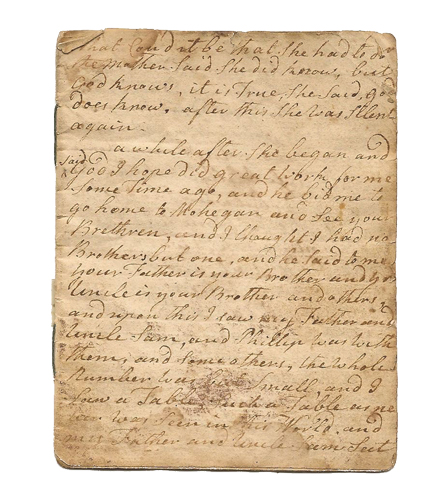
A recent issue of the Yale magazine offered a look at a newly recognized document in the handwriting of the Rev. Samson Occom. Apparently in 1776 he took down the deathbed statement of a young woman:
That December, a daughter of Mohegan leader Robert Ashbow, motivated by a religious vision, returned home after what appears to have been a long absence. By the end of the month, the young woman was dying. On Christmas Eve, Occom wrote an account of the last moments of her life, which included a conversation with her mother. (The daughter’s name, unfortunately, is never given.)

The beginning is typical for Christian deathbed narratives—a confirmation of belief in God and an acceptance of death. But then the woman declares, “No one that fights Shall ever enter the Kingdom of Heaven, nor them that Cary Sharp Weapons and Heavy things for the first Christians did not fight but were Loving.” She adds that her aunt Hannah thought herself “better and above” Hannah’s daughter-in-law, Jerusha, but Jerusha had “better inheritance.” These are unusual, unexplained statements.

At first, we thought “inheritance” referred to spiritual redemption. But as we reconstructed the lives of the people in the narrative, another explanation seemed plausible. Hannah’s husband, we found, was Rev. Samuel Ashbow, Robert Ashbow’s brother. The couple had lost one of their sons, Samuel Jr., at Bunker Hill—the first Native American killed in the Revolution. For Hannah and Samuel, that death would begin their family tragedy: they would lose three more sons before the war was over. On the other hand, Jerusha, the widow of Samuel Jr., had a young son whose life was just beginning. Were the dying woman’s remarks a comment on the futility of war? A portent of the immense physical and cultural losses the Mohegans would endure as a result of that war?
Did they reflect that particular moment during the war in late 1776, when the royal forces were handily dispatching the Continental Army and armed resistance seemed like a poor idea? With so few written sources preserved, we‘re unlikely to have the answers to those questions.

The same magazine also notes a rare harpsichord from about 1770 that somebody decided to make look like an even rarer harpsichord from several decades before.

Friday, March 20, 2015

Freedom’s Way Conference in Concord, 26-28 March

This is the last day to register for the Freedom’s Way National Heritage Area’s three-day conference on interpreting “Community Character and Common Themes” in local history.

This event will take place in Concord, 26-28 March, and use that historic town as a laboratory to investigate engaging ways to interpret the meaning and memory of place.

The conference description says:
In a rapidly globalized increasingly homogeneous world, it is the character of the places in which we live that define us. Local stories and places provide a lens through which to develop community identity and sense of place. The conference will explore the intimate link between discovery and interpretation as a means of bringing local stories to life within individual communities, connecting them to themes within the National Heritage Area.
John R. Stilgoe, Harvard University’s Robert & Lois Orchard Professor in the History of Landscape, will deliver the keynote address, “Verandas and Dooryards: Observing Landscape Close to Home.” Historian Bill Fowler of Northeastern University will speak on how regional history shapes the way we think. Case studies, presentations, and round tables will explore best practices in interpretation and educational programming using local resources.

The organizers are offering behind-the-scenes tours of The Wayside at Minute Man National Historical Park, The Thoreau Institute at Walden Woods, The Old Manse (shown above), and other historic locations in Concord.

This conference is aimed to counteract a common challenge for local historical societies and small sites: focusing on local places, artifacts, and stories so closely as to omit the connections with other sites in neighboring towns that, when woven together, can tell a larger story that’s still grounded in the local communities. For example, every Massachusetts town has its own story of citizens responding to the Massachusetts Government Act of 1774 and deciding whether to switch allegiance (and tax funds) to the extralegal Massachusetts Provincial Congress. Together those stories add up to a mass movement and a governmental revolution in the province.

As a sign of how many different organizations are involved in this event, the Freedom’s Way National Heritage Area is working in partnership with the U.S. National Park Service, Minute Man National Historical Park, Boston National Historical Park, John H. Chafee Blackstone River Valley National Heritage Corridor, American Antiquarian Society, The Drinking Gourd Project, Fitchburg Art Museum, The Guild of Historic Interpreters, Mass Audubon Society, Nashua River Watershed Association, New England Scenic Trails, The Thoreau Institute at Walden Woods, The Thoreau Society, The Trustees of Reservations, Walden Pond State Reservation (DCR), and Wachusett Mountain State Reservation (DCR).

As I said above, registration closes 20 March, and space is limited. The full conference costs $30, and cheaper registration is available for certain days only. Click the link above for more information.

Thursday, March 19, 2015

Women to Meet at the Shirley-Eustis House this Spring

This spring the Shirley-Eustis House in Roxbury is hosting a series of first-person interpretive presentations on women of Revolutionary Boston and later periods.

Sunday, 22 March, 2:00 P.M.
Meet Phillis Wheatley
Valerie Link Foxx kicks off the series with a poignant first-person performance of the life of Phillis Wheatley. Brought to Boston from Africa at about the age of seven, little Phillis learned English so quickly that she was composing impressive verse while she was still in her teens. As a young woman she pursued literary success with a trip to London even while she was still enslaved, then personal independence as an author, wife, and mother in Boston.

Foxx is an actor, author, wife, and mother. She is also a native of Roxbury and has performed since the age of seven. In 1977, Valerie and her mother, Bernice Link, co-founded Link & Foxx Productions to produce one-woman and family skits and stage plays.

Sunday, 29 March, 2:00 P.M.
Meet Rachel Revere—Petticoats at the Revolution
Hear a remarkable story of tea and Revolution from the woman who rode through life with Paul Revere. Rachel Revere tells of the Boston Tea Party, the midnight ride, and the siege of Boston through the eyes of a woman who had to keep the home fires burning while her husband fanned the flames of Revolution.

This presentation will be performed by Joan Gatturna, creator of Petticoat Adventures. Gatturna is an actor and storyteller. She has been named as a Creative Teaching Partner of the Massachusetts Cultural Council and is on the Touring Roster of the New England Foundation for the Arts.

Sunday, 12 April, 2:00 P.M.
Meet Elizabeth Murray—Shopkeeper to Farmstead
Elizabeth Murray, a Scottish immigrant, developed a successful retail business in colonial Boston. By offering the latest fashions and teaching advanced crafts, and by insisting on prenuptial agreements in two of her three marriages, she achieved economic independence and became a mentor for younger women. Through the upheavals of the American Revolution, Elizabeth (Murray Campbell Smith) Inman faced the challenge of separating from Tory family members while maintaining her home in Massachusetts.

Una McMahon, Founder-Owner of Acorn Tours, provides customized sightseeing tours of Boston and New England and specializes in their rich colonial histories. She is a Governor/Board Member and the Chair of the Events Committee for the Shirley-Eustis House Association. McMahon has taught French Language, led student tours to France and Canada, and established organizations such the Irish Business Network Small Business Forum.

In addition, on 26 April Marcia Stein-Adams will present “Meet Isabella Stewart Gardner,” and on 3 May Jan Turnquist will offer “Meet Louisa May Alcott.”

Admission for each lecture is $10 per person.

(The copy of Gilbert Stuart’s portrait of Rachel Revere above comes courtesy of Oceansbridge.)

Wednesday, March 18, 2015

History Camp in Boston, 28 March

Boston’s second annual History Camp will take place on Saturday, 28 March, at the Harriet Tubman House of the United South End Settlements at 566 Columbus Avenue in Boston.

History Camp is a self-organizing conference for people interested in all sorts of history in all sorts of ways. That means the schedule of presentations and panels will be decided on the day of the event, with folks then choosing which sessions to attend.

Who’s going to be there? Paula Bagger, who put together the pieces of evidence about Prince Demah. Jason Rodriguez, editor of Colonial Comics. Elizabeth Sulock from the Newport Historical Society. Liz Covart from the Ben Franklin’s World podcast. Salem Witchcraft Trial experts Marilynne Roach and Emerson “Tad” Baker. Erik Bauer from the Peabody Library. Dr. Sam Forman, Judy Cataldo, and many more.

Including me. Here’s the presentation I’m preparing:

“How Would-Be Assassin Samuel Dyer Nearly Triggered the Revolutionary War”

In October 1774 an angry seaman named Samuel Dyer arrived in Newport, describing how the Royal Navy had kidnapped him from Boston to London, how high government ministers had interrogated him about the Boston Tea Party, and how the Lord Mayor of London had helped him to return to America. Rhode Island Patriots fĂȘted Dyer and sent him back to Boston. Soon after arriving, Dyer confronted two Royal Artillery officers on the street and shot at them before escaping to the rebellious Provincial Congress in Cambridge—only for those Patriots to send him back to the royal authorities and the Boston jail. This talk digs into Dyer’s story: how he came close to setting off war in Massachusetts, what happened to him next, and how much of the outlandish story he told was true.
This is a story I haven’t told in full on this blog or anywhere else.

The Harriet Tubman House is five minutes by foot from the Mass. Ave. T stop and ten minutes by foot from a large covered parking garage that serves Jordan Hall. Here are directions.

Last year’s History Camp filled up in advance. There’s still time to register for this one.