J. L. BELL is a Massachusetts writer who specializes in (among other things) the start of the American Revolution in and around Boston. He is particularly interested in the experiences of children in 1765-75. He has published scholarly papers and popular articles for both children and adults. He was consultant for an episode of History Detectives, and contributed to a display at Minute Man National Historic Park.

Subscribe thru Follow.it


•••••••••••••••••


Thursday, April 11, 2024

“The unrivaled honor of having shed the first British blood”?

I’ve written several postings about Solomon Brown, even suggesting he might have been responsible for the first shot in Lexington on the morning of 19 Apr 1775.

There’s one source about him I haven’t been able to nail down.

In an 1880 issue of The Magazine of American History, the Rev. Horace Edwin Hayden of Pennsylvania quoted a local obituary of Solomon Brown like this:
Deacon Solomon Brown

The individual whose name heads this article, and a notice of whose death appeared in this paper, a short time since, was one of the oldest inhabitants of New Haven in this county [in Vermont], and died claiming the respect of all who knew him, for his virtues both as a man and a citizen. . . . 

Deacon Brown was a soldier of the Revolution, and bore a part in that memorable struggle, which should immortalize him in the annals of his country. He was a participator in the first battle for freedom on the plains of Lexington, and has the unrivaled honor of having shed the first British blood in defence of American liberty, at the battle of Lexington on the morning of the 19th of April, 1775.

This battle was the opening scene of the bloody drama which closed with the surrender of Cornwallis at Yorktown, and in this scene the subject of this notice stands forth the most prominent actor. He wrote in blood the first word in the charter of American freedom. Let his name be registered among the noblest of his country's benefactors and heroes, and honored by posterity as the most dauntless of their heroic sires. Deacon Brown served five years in the revolution as a sergeant of artillery, and encountered all the perils and hardships of that memorable and glorious struggle. He died mourned by his friends, lamented by the church, and respected by all. 
But as to the source of that encomium, Hayden could only say: “Middlebury, Vt., Free Press, about 1830.”

Two years later, Hayden published A Biographical Sketch of Captain Oliver Brown, an Officer of the Revolutionary Army who Commanded the Party which Destroyed the Statue of George the Third. Solomon was Oliver’s younger brother, so he tagged along in that booklet. Unfortunately, Hayden’s citation only got worse with Middlebury turned into “Middleburg.”

I went looking for the newspaper article Hayden quoted. It doesn’t appear in the newspaper database I access. Furthermore, I discovered that there was no Middlebury Free Press in 1830. The printer E. D. Barber was still calling his young newspaper the Anti-Masonic Republican.

In the Genealogical and Family History of the State of Vermont compiled by Hiram Carleton in 1903, I found a statement that Solomon Brown died on 6 June 1837. That date does fall in the period when Barber called his newspaper the Middlebury Free Press, just before he sold out to Hamilton Drury and it became the Vermont Argus and Free Press. So we should be able to narrow the search down to the summer of 1837—if copies of the newspaper survive from then.

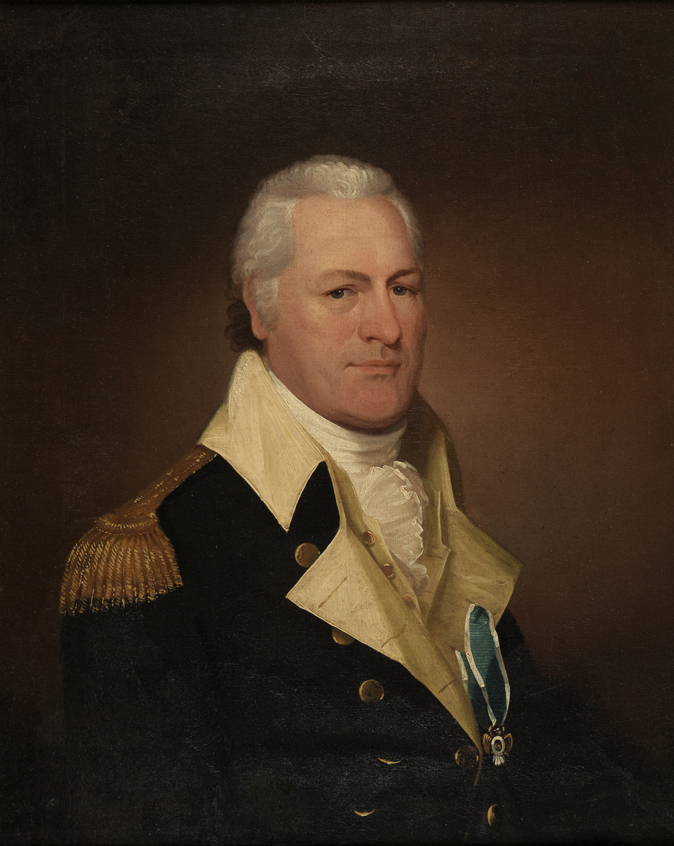
Another voice speaking to Solomon Brown’s primacy was Josiah Bushnell Grinnell (1821–1891, shown above). He was a U.S. Representative from Iowa and namesake of Grinnell College. In 1887 he returned to his home town of New Haven, Vermont, to deliver a historical address, later published. Grinnell stated:
Dea. Solomon Brown also lived and died here fifty years ago. To him belongs the honor of having fired the first effective shot at the red coats in the revolutionary war. I attended his funeral, at which his memorable shot was mentioned, and I just remember the story from his own lips. . . . He did not wait for orders and sighted an honest gun at a red coat spy, where was found blood, and to him belongs the honor of that first shot which “echoed round the world.”
Both Hayden and Grinnell cited the depositions collected by Elias Phinney in his 1825 History of the Battle of Lexington as supporting Brown’s claim. The evidence in that book is more equivocal.

It’s worth noting that in 1775 no British officers reported that the regulars on Lexington common suffered any wounds, and they had every reason to do so in the effort to cast blame on the provincials.

Solomon Brown might well have shot at the redcoats—he could even have been the first to do so. But that doesn’t mean his shots hit anyone.

Wednesday, April 10, 2024

Elijah Sanderson of Lexington and Salem

Elijah Sanderson has appeared on Boston 1775 several times, but usually as a source on other people’s experiences of the April 19 battle.

Several years back, Donna Seger highlighted Sanderson’s memories of that day and his subsequent career on her Streets of Salem site.

In 1775 Sanderson signed off on a brief account of his experience for the Massachusetts Provincial Congress. But he had much more to say in Elias Phinney’s History of the Battle of Lexington, on the Morning of the 19th of April, 1775, published in 1825.

Seger wrote:
Phinney took oral histories from participants who were still alive, published in the form of sworn affidavits in the book’s appendix, and the very first account was that of Elijah Sanderson, who was at the end of a long career as one of Salem’s most successful cabinetmakers. Sanderson’s testimony was given just weeks before his death in early 1825, and published not only in Phinney’s account but also in the regional newspapers that year, when historical consciousness of the importance of the Battles of Lexington and Concord seems quite well-developed.

Elijah Sanderson and his younger brother Jacob were among the most prolific and consequential cabinetmakers of Salem, who spread the city’s craftsmanship and style far beyond New England through an expansive export trade in alliance with their partner Josiah Austin and several prominent merchants and shipowners.
That’s the same Josiah Austin quoted in this document describing how he moved ammunition out of Concord. Since that account seems incredible, perhaps Austin was spurred to invent his tale after hearing his partners talk about their presence at Lexington. Or perhaps someone else thought that if one Salem cabinetmaker was in the thick of the fight, another could be inserted into that action as well.
…in 1775 the Sanderson brothers were living in Lexington, in the home of their elder brother Samuel…on the main road from Boston. . . . relatively late on the evening of the 18th Elijah noted the passing of a party of British officers “all dressed in blue wrappers”. He decided to discern what was up, so made his way to John Buckman’s tavern where an older gentleman encouraged him to “ascertain the object” of these officers, so he did so, on a borrowed horse in the company of two other comrades. . . .

Elijah’s party was stopped by nine British officers a few miles down the road in Lincoln, and they were detained and examined, along with two other “prisoners”, a one-handed pedlar named Allen and Col. Paul Revere. After “as many question as a Yankee could” ask, the entire party mounted and made their way to Lexington, where [fellow detainee John] Loring observed “The bell’s a ringing, and the town’s alarmed, and you’re all dead men” but [the officers] let them go, after cutting the bridle and girth of Elijah’s horse.

We hear no more of Revere, but Elijah made his way to the tavern in Lexington and there promptly fell asleep! Yes, he fell asleep in the middle of the opening act of the American Revolution.
But then came the drums signalling that the British column was in sight. To follow Sanderson through what happened next, visit Streets of Salem.

(The picture above is a secretary bookcase from the Sanderson brothers’ shop, now the property of the U.S. Department of State.)

Tuesday, April 09, 2024

“The Regular Troops have this morning kill’d six men”

Here’s what appears to be an authentic document from 19 Apr 1775. It was sold by Heritage Auctions in June 2017, but the company has preserved an image for us.

This short note reads:
To all whom it may concern, be it known, that the Regular Troops have this morning kill’d six men near Lexington Meeting House; this news is brot: to Watertown by Mr. Sanger, who told me that he saw the men lie dead.

J. Palmer
of the Congress Com:tee

Watertown, Wednesday Morning abt 8 o’Clock
Joseph Palmer (1716–1788) was a Massachusetts Provincial Congress delegate from Braintree and a member of the committee of safety and supplies. He was staying in Watertown with in-laws.

Two hours later, “near 10 o’Clock,” Palmer wrote a longer, more detailed letter that he sent to Hartford, Connecticut, with courier Isaac Bissell. That dispatch reported that a British relief column was out. By then, Palmer wrote, he had “spoken with Several Persons who have seen the Dead & Wounded.”

Along the way that letter was copied and sent south, its text mutating as it was hurriedly transcribed. I don’t think the original of that letter exists, but many handwritten and printed copies do, making it rather famous.

This first, shorter letter shows that Palmer had heard about the deaths on Lexington common by eight o’clock and started to spread the news on behalf of the congress’s committee. It’s unclear whom he addressed this particular note to, however.

I also can’t identify “Mr. Sanger.” There were multiple men with that surname in Watertown at this time, including David Sanger, on an October 1774 committee to equip two cannon, and Samuel Sanger, first sergeant of the militia company.

That’s a reminder that, even though some documentation survives to show such men as Joseph Palmer spreading the alarm in April 1775, many more people did so without leaving a firm trace in the historical record.

Monday, April 08, 2024

Peering into the Josiah Austin Story

Back in 2020 the Spared & Shared website, which usually presents documents from the U.S. Civil War, published the transcript and scans of an account of events on 19 Apr 1775.

Attributed to Josiah Austin, “formerly of Charlestown now of Salem,” this narrative describes the effort of driving a wagon load of “powder & balls” from Concord as the British army closed in.

Indeed, according to this document, regulars actually found the wagon disabled on the road, only to ignore the men with it as “affrightened ‘Yankees,’ returning from market.”

Earlier this year, Alexander Cain at Historical Nerdery did a fine job of pointing out the holes in this account.

The transcription quotes Austin stating “he was at Concord with Col. Barrett and others on the 18th of April 1775 having in charge ammunition &c.” We know that James Barrett was storing a large amount of the Massachusetts Provincial Congress’s military supplies on his farm—until a couple of days before, when the family and friends started to move that stuff to better hiding-places.

Alex Cain points out that those hiding-places were naturally to the west, further away from Boston and any expedition coming from there. Yet Austin said his wagon went east “toward Lexington.” Why the hell would anyone drive a wagon of secret ammunition toward the military search party?

We also have the names of men employed by the Massachusetts Patriots to help Barrett gather and prepare military supplies. One man was John Austin. None was named Josiah Austin.

The British expedition stopped several young men riding out on the roads on the night of 18–19 April, sometimes detaining them for hours. (One, Asahel Porter, was killed in the shooting on Lexington common.) Cain notes it would therefore be quite odd for some soldiers to come across a wagon in the vicinity of the place they had been ordered to search and pass by without examining the cargo.

Finally, Austin claimed that the British soldiers he met were “pioneers,” but none of those specialized soldiers were assigned to the march to Concord.

I have nothing to add to Alex Cain’s cutting analysis of the document’s content. But I’ll make an observation about its form. The first six lines refer to “Col. Barrett” twice—but only after editing.


Spared & Shared’s scans of the handwritten document show that originally the transcriber wrote another name, possibly “Butler.” Sometime after the original writing, that name was crossed out and replaced with “Barrett.” We don’t know how much later that change was made. We don’t know if someone looking up Barrett’s name in historical sources prompted that change as a correction.

But we do know that whoever first told this story didn’t initially remember the name “Barrett,” even though Josiah Austin was supposed to have worked with Col. Barrett and traveled on the ammunition wagon with Barrett’s son.

That’s just one more reason to deem this account dubious. Josiah Austin might have been telling an exaggerated story to a credulous transcriber, or the entire document might have been concocted.

Sunday, April 07, 2024

Heading into Patriot’s Day 2024

With yesterday’s posting, Boston 1775 has entered the Patriot’s Day season for 2024.

It’s hard to find a complete posting of Patriot’s Day events because so many towns and organizations have their own celebrations. But a good place to start is the calendar on the front page of Revolution 250.

Among the new commemorations this year is Tavern Week in Arlington, known as West Cambridge or Menotomy in 1775. The Massachusetts Provincial Congress’s committee on safety and supplies met in the Black Horse Tavern on what’s now Massachusetts Avenue on 18 April. Three members planned to spend the night but bolted out the back door when the redcoat column approached.

The Arlington Historical Society is also offering tours of the Jason Russell House, site of the bloodiest fighting of the day, on Saturday, 13 April, and Monday, 15 April, noon to 4 P.M.

Also on 13 April, Michael Lepage will portray Paul Revere at the Paul Revere House in Boston while the Minute Man National Historical Park hosts its annual big tactical demonstration and reenactment of events along the Battle Road.

Some of the towns planning local Patriot’s Day remembrance events include Billerica, Danvers, Somerville, Hanover, and Lynnfield. Others will send traditional contingents to the event in Minute Man Park.

All outdoor events of course depend on welcoming weather. We had snow last week, and flooding forced the cancellation of an event at James Barrett’s farm in Concord today. So let’s hope for sunshine and cool breezes for the next two weeks!

Saturday, April 06, 2024

The British March to the 1/88th of a Mile

So far this month I’ve been looking at the publishing history of Lt. Col. Robert Donkin’s Historical Collections and Remarks, particularly the removal of an incendiary footnote and how that might have affected the publishing schedule.

There are other significant blanks in the book, not made by a knife but left by the author.

On page 170, Donkin discussed the British troops’ march to Concord on 18–19 Apr 1775.

Donkin’s praise for the redcoats’ endurance would have been more impressive if he’d actually stated how long they marched. Instead, he left blanks: “the space of     hours,” “about     miles,” “less than     hours!”

Did Donkin just forget, and Hugh Gaine’s print shop never told him? Did he expect to write those figures in after printing, only to be caught up in the footnote brouhaha and capturing Philadelphia?

However it came about, Donkin didn’t tell readers how long the march to Concord was, in space or time. Just that it was impressive, believe him.

Frank Warren Coburn undertook the measurement in his 1912 study, The Battle of April 19, 1775. He had the advantage of bicycle with a cyclometer that measured distance to the 88th of a mile, or 60 feet. Coburn calculated that the companies who went all the way to James Barrett’s house and back to Bunker’s Hill traveled 39 and 71/88 miles. That’s over five miles more than the troops who stopped in central Concord.

As to time, which was measured less exactly in the eighteenth century, David Hackett Fischer rounded up all the reports and estimates of when things happened in Appendix L of Paul Revere’s Ride (1995), and Derek W. Beck further analyzed those in Appendix 7 of Igniting the American Revolution (2015).

Based on those analyses, the figures Donkin was looking for were:
  • the troops were under fire for eight hours, from leaving Concord at noon to reaching Charlestown around 8 P.M.
  • on average, the soldiers who went to Concord marched about 36 miles.
  • if we time that march as starting in Cambridge at 2 A.M. and ending in Charlestown, then the whole mission took 18 hours.
However, if we start the clock when the troops got into boats to cross the Charles River and end it with those troops coming back across the river from Charlestown, that was about 24 hours.

Friday, April 05, 2024

After Historical Collections and Remarks

As discussed yesterday, Lt. Col. Robert Donkin distributed Historical Collections and Remarks to most of his subscribers in the spring of 1778, even though Hugh Gaine printed it in 1777.

The book carried a dedication to Earl Percy (shown here), best known for leading the British relief column during the Battle of Lexington and Concord in April 1775. The next year, he was promoted to general.

Percy participated in the Crown’s recapture of New York City and Newport, Rhode Island, in 1776. Gen. Henry Clinton left him in charge in the latter port.

Gen. Percy didn’t get along with Gen. Sir William Howe, his commander-in-chief. He sailed home to Britain in May 1777, ostensibly for noble family reasons but really because he didn’t want to take orders from Howe anymore. (Percy was heir to an English dukedom while Howe was merely younger brother of a viscount in the Irish peerage.)

Thus, by dedicating Historical Collections and Remarks to Percy, and then commissioning a frontispiece featuring him, Donkin took sides in a feud within the British command. However, in late 1777 Howe sent his own resignation to London, and he left America in May 1778, so Donkin’s career didn’t suffer.

The artist who engraved Percy’s portrait, James Smither, evidently accompanied the British army from Philadelphia to New York in the summer of 1778. The following 22 May, he advertised in James Rivington’s Royal Gazette:
JAMES SMITHER,
Engraver and Seal Cutter,
LATE of Philadelphia, at the Golden-Head No. 923, in Water-Street, near the Coffee-House, and next door but one to Mr. Nutter’s, where he engraves in the most elegant manner Coats of Arms, Seals, Maps, Copper Plates, and all other kind of engraving.
Meanwhile, the government of Pennsylvania declared that Smither was a Loyalist collaborating with the enemy and confiscated his property.

After the war was over a few years, however, Smither was able to quietly return to Philadelphia. In 1790 he started advertising an “Evening Drawing School,” much as he had back in 1769. He died around 1797, and his son, also named James Smither, carried on engraving until the 1820s.

As for Lt. Col. Robert Donkin himself, he continued to serve in the British army. He didn’t have the money that let Percy, Howe, and some other officers resign on principle.

In 1779 Clinton made Donkin the lieutenant colonel of the Royal Garrison Battalion. This unit was made up of “the worn out & wounded Soldiers of the British Regular Regiments in America,” Donkin later wrote. The officers were chosen for “Zeal & Experience and Constitutions broken by a long & arduous Service.” The unit was thought unfit for duty on the march or in battles but capable of serving in New York City, the Caribbean, or other secure garrisons. By 1780, Lt. Col. Donkin was commanding the bulk of those troops on Bermuda.

In 1783 the Royal Garrison Battalion was reduced. Donkin returned to Britain as a retired officer with a pension. Out of courtesy he was gradually promoted every few years, and since he lived until 1821, when he was ninety-three years old, Donkin made it all the way up to full general.

TOMORROW: More holes in Historical Collections.

Thursday, April 04, 2024

“An elegant frontispiece is now engraving”

We left Maj. Robert Donkin in 1777 with probably hundreds of copies of his Military Collections and Remarks needing to be shorn of a footnote that intemperately suggested his fellow British soldiers could fire smallpox-tipped arrows at the Americans.

That fall Donkin was busy with other things. In September the War Office announced his promotion to lieutenant colonel, news that made the American newspapers in December. By that time, Donkin was part of the British military force occupying Philadelphia.

We left the Philadelphia engraver James Smither as he switched to work for the Crown forces instead of Pennsylvania’s rebel government. Smither had been in North America for less than ten years, and, with the redcoats taking the American capital, he probably thought the king’s forces were winning.

On 14 April 1778, James Robertson’s Royal Pennsylvania Gazette ran this notice:

To the corps at New-York and Rhode-Island, that subscribed to the military remarks, &c.

LIEUT. Col. Donkin, gives notice that he has distributed to the orphans and widows of of [sic] the army here - - British £204.15.0

And that Mr. Thompson, Town-Adjutant of New-York, will proceed to distribute forthwith - - - £85.13.7

Being the balance arising from the publication, after defraying the expences of printing, &c. £290.8.7

N.B. An elegant frontispiece is now engraving at Mr. Smither’s, one of which will be sent to every subscriber.

Philadelphia, 13 April, 1778.
Thompson ran a similar announcement and accounting in Hugh Gaine’s New-York Gazette on 27 April. Donkin had deputized him to collect subscriptions the year before. (I haven’t found this man’s given name. The Scots Magazine and North-British Intelligencer reported that he was sergeant-major of the 37th Regiment.)

Thus, in 1778 Donkin commissioned Smither to create an illustration for his Military Collections, perhaps to make up for the delay and deletion of the footnote. So far as I can tell, none of the three copies with the footnote intact have the frontispiece shown here, and all of the copies with the frontispiece have a hole in page 190–1.


Donkin had dedicated his book to “the Right Honourable Hugh, Earl Percy, Colonel to his Majesty’s Vth regiment of foot,…commander in chief of the forces in Rhode Island.” He wrote:
HAVING had frequent occasions in the subsequent treatise to quote the grand actions of the most renowned captains of antiquity, it was natural for me to look at home for a Modern equally brilliant. Britannia holds forth PERCY! Fame sounds,
Great in the war, and great in the arts of state!” ILIAD.
That was the scene Smither illustrated: Donkin at work on his book, interrupted by Fame trumpeting and Britannia (notably without a Liberty Cap) holding out a picture of the earl with the label “Ille noster heros (He is our hero).”

I quoted the £290.8.7 in charitable donations from inside this copy of the book. It’s possible that those pages were added to what Gaine had printed in 1777 at the same time that the frontispiece was inserted. To know for sure, we’d need to examine the copy owned by Gen. Valentine Jones (now at the Clements Library).

TOMORROW: Separate ways.

Wednesday, April 03, 2024

James Smither, Engraver of Philadelphia

The 18 Apr 1768 Pennsylvania Chronicle included this advertisement:
James Smither, Engraver,
At the first house in Third Street, from the Cross Keys, Corner of Chestnut-Street, Philadelphia,
PERFORMS all manner of ENGRAVING in Gold, Silver, Copper, Steel, and all other Metals—Coats of Arms, and Seals, done in the neatest Manner. Likewise cuts Stamps, Brands, and metal Cuts for Printers, and ornamental Tools for Bookbinders. He also ornaments Guns and Pistols, both engraving and inlaying Silver, at the most REASONABLE RATES.
Smither had come from Britain, where he reportedly worked for a while in the Tower of London engraving guns for the government.

In January 1769, Smither proposed to start a drawing school for “young gentlemen and ladies.”

Meanwhile, he was also doing a wide range of engraving jobs, including:
In October 1775, the colony was at war, and it needed to print more money. Pennsylvania hired Smither to engrave another series of notes, issued through April 1776.

In the fall of 1777, the British army took Philadelphia.

By May 1778, Smither was engraving the tickets for the Meschianza, Maj. John André’s elaborate ball and theatrical tournament for army officers and wealthy Loyalists.

But that may not have been the only job James Smither did for the royal authorities in Philadelphia. On 11 April, Thomas Paine wrote to Henry Laurens, then president of the Second Continental Congress, about counterfeiters. He made this proposal:
As Forgery is a Sin against all men alike and reprobated by all Civil Nations. Query, would it not be right to require of General [William] Howe, the Persons of Smithers and others in Philadelphia suspected of this Crime; and if he or any other Commander, continues to conceal or protect them in such practices, that in such case the Congress will Consider the Crime as the Act of the Commander in Chief.
The idea that the Congress could ask Gen. Howe to hand over anyone suspected of forging Continental or state notes was ludicrous, but no one ever said Thomas Paine wasn’t visionary.

On 18 June, the British army pulled out of Philadelphia, heading across New Jersey back to New York. James Smither probably went with them. In 1778 the Pennsylvania council put him on a long list of people who had “willingly aided and assisted the enemies of this state,” and at the end of the war it seized his property.

TOMORROW: Meeting Maj. Donkin.

Tuesday, April 02, 2024

“Twang them at the American rebels”

Maj. Robert Donkin ran advertisements in the New-York Gazette promoting his upcoming book Military Collections and Remarks and thanking the latest subscribers from January through June 1777.

In the latter part of that year, the Gazette’s printer, Hugh Gaine, actually produced the book.

According to the accounting published inside, the print run was 1,000 copies, folded, bound, and covered.

But the book turned out to need more work.

Maj. Donkin had no good words for “this unnatural rebellion,” as his ads said. But on one page inside the book, he let his anger run away on him.

In a short section titled “Bows,” the major added this footnote:

Dip arrows in matter of smallpox, and twang them at the American rebels, in order to inoculate them; This would sooner disband these stubborn, ignorant, enthusiastic savages, than any other compulsive measures. Such is their dread and fear of that disorder!
In Pox Americana, Elizabeth Fenn analyzed this passage as showing how British officers could picture spreading smallpox among the enemy as long as they saw those people as “savages.” There had been similar talk of infecting Native Americans during the last war.

Fenn also reported that only three copies of Donkin’s book with that footnote are known to exist. One, now at the Clements Library in Michigan, belonged to Gen. Valentine Jones of the 62nd Regiment, a subscriber.

All other copies have that footnote on page 199 sliced out, as shown below in the University of California’s volume, digitized by Google and also available through the Hathi Trust.


This excision became well known among book dealers and collectors. Around 1900, catalogues describing copies of the book noted the deletion and added “as usual.”

All the copies I’ve found online are missing the footnote. Most of the excisions are neater and more complete than the one I’m showing here. For instance, through this page one can find the American Revolution Institute’s volume. Another copy on Google Books shows how the British Library staff patched the hole with blank paper.

The thoroughness and neatness of the footnote’s removal suggests that some authority demanded that Donkin and Gaine delete it. Soon after the major started to distribute the book, it appears, someone had to go through every remaining copy with a sharp blade. That certainly took more time, and probably more money.

Fortunately, the other side of that page was blank in that spot, so those copies didn’t lose any other text.

In fact, it appears that subscribers and purchasers of the censored version got something extra.

TOMORROW: He is their hero.

Monday, April 01, 2024

“His majesty’s troops peaceably marching to and from Concord”

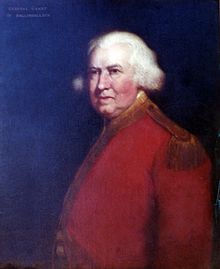
I profiled Maj. Robert Donkin (1727–1821) back in 2021, which was 212 years after someone drew this profile of him as a retired general.

In 1777, Donkin was an officer in the 44th Regiment of Foot, stationed in New York City. He decided that was the right time to publish a collection of short essays and anecdotes on military topics.

Donkin described Military Collections and Remarks as the wisdom of “a late general officer of distinguished abilities, in the science of war”—probably his mentor, Gen. William Rufane. But the major wrote at least some of that material himself since it referred to events after Rufane’s death in 1773.

Donkin cast the project as a charity project. In his preface he wrote of “the bloody massacre committed on his majesty’s troops peaceably marching to and from Concord the 19th April, 1775,” and promised that proceeds from his book would
relieve and support the innocent children and widows of the valiant soldiers inhumanly and wantonly butchered that day, as well as for those that gloriously fell in their country’s cause at Bunker-hill the 17th June following.
The book contains a subscribers’ list eighteen pages long, all military officers or administrators, about 500 of them. At the end of that list is an accounting. Donkin and his agents had collected £422.7.3.

Here are the costs for the 296-page book, printed in New York by Hugh Gaine:
To Paper for 1000 Copies, £37.19.4 1/2
To Printing Expences, 57.13.1 1/2
To folding, sewing, and covering 1000 Copies, 21.1.10 1/2
To Advertisements, 4.19.3 1/2
Expences in England, Scotland and Ireland. 5.5.0
Incidental Charges 5.0.0
[total] Sterling, £131.18.8
The major therefore declared he had “Distributed in Charity, Sterling, £290.8.7.”

But if Donkin and Gaines thought that they were done when they printed those pages, they were fooling themselves.

TOMORROW: Cut it out.

Sunday, March 31, 2024

“Our firm belief in telling a story here that is accurate and honest”

Daniel P. Jordan, director and then president of Thomas Jefferson’s Monticello for over twenty years, died earlier this month.

Ann Lucas, Senior Historian Emerita at the site, provided a remembrance for its website that says, in part:
Jordan adhered to Jefferson’s principle to “follow the truth wherever it may lead.” As director-elect, he visited Monticello several times as a “regular tourist,” and was struck by the fact that he never once heard a reference to Jefferson owning a plantation or the enslaved labor that it required. Once in leadership, he conveyed to staff that “from January the first on, we're going to try to tell the most honest story we can about Jefferson and slavery and race and the plantation, and it's all going to be based on serious scholarship."

Toward that end, Jordan defined new academic departments (research, archaeology, restoration, education, publications, and historic plants), accelerated the publication of Jefferson’s writings with The Papers of Thomas Jefferson: Retirement Series, and established the Robert H. Smith International Center for Jefferson Studies. He supported a new generation of Jefferson-era research, passing the torch of the Thomas Jefferson Foundation professorship from Merrill Peterson to Peter Onuf.

No event more clearly illustrates Jordan’s dedication to transparency and scholarship - and his confidence in the Monticello staff - than his response to the Sally Hemings DNA study. Steadfast in the face of opposition, Jordan, in his words, “set the tone” to support Monticello’s scholars.

Within 24 hours of the 1998 release of the study linking Jefferson to the paternity of Hemings’ son, Monticello held a press conference, posted public statements on the web site, and instructed interpreters in how to initiate conversations on the subject with visitors. The Foundation pledged to continuously evaluate all relevant evidence, advancing “our firm belief in telling a story here that is accurate and honest - and thus inclusive - about Jefferson’s remarkable life and legacy in the context of the complex and extraordinary plantation community that was Monticello.”
Those findings, bolstered by historical analysis, were convincing for the great majority of historians. There was a great outcry from a few authors, descendants, and self-appointed Jefferson “protectors,” quite like the objections we hear today to “woke” history and any effort at diversity, equity, and inclusion in institutions. In fact, some of the same people are objecting.

Saturday, March 30, 2024

Leafing through the “Davenport Letters”

The Museum of the American Revolution in Philadelphia has just unveiled a webpage displaying seventeen letters written by Continental soldiers Isaac How Davenport (1754–1778) and James Davenport (1759–1824) of Dorchester.

The original letters don’t survive, but a nephew copied them into a ledger book, which remains in the family.

The museum is sharing scans of those transcripts as well as P.D.F. files of their text in the raw and with modernized punctuation for easier reading.

I presume the older brother was the “Isaac Davenport” listed among the Dorchester men who responded to the militia alarm on 19 Apr 1775.

Middle names were rarely used in New England at this time. It looks like Isaac How Davenport received his father’s mother’s maiden name, sometimes spelled Howe, as his middle name. In nineteenth-century histories of Dorchester, that man’s name was misprinted as “Isaac Shaw Davenport.”

Isaac became a member of the commander in chief’s guard and then the dragoons under Col. George Baylor. He spent several months of 1777–78 at Valley Forge, where he wrote two of the letters in this collection. Isaac Davenport was among the Continental dragoons killed in a nighttime raid on their billets on 27 Sept 1778.

The younger brother, James, enlisted in the Continental Army in February 1777, when he was seventeen years old, leaving behind an apprenticeship to a shoemaker. He served for the rest of the war, rising to the rank of sergeant in 1780. In 1777–78 he was also at Valley Forge, but his surviving letters start in 1780, getting more numerous late in the war when there was less to do besides write home.

After the war James Davenport returned from New York to Dorchester and used his earnings to build a house, marry, and start a family. He lived long enough to apply for a pension in 1818, sending in copies of his promotion to sergeant and his discharge signed by Gen. George Washington. Many veterans didn’t have such documentation.

The U.S. government initially awarded Davenport a pension, but then rescinded it. I suspect the problem was that Davenport wasn’t poor enough; the pensions of that decade required applicants to show need, and he owned a farm, a house, and cash.

Davenport tried to present himself as in need: “my health is much impaired by my services in the Army,” “My House was built more than 30 years ago,” his wife Esther was prone to illness.

In the end, though, James Davenport’s best claim to public support was his service. He described himself as “engaged at the Capture of Burgoyne, Cornwallis, at Monmouth & always with my Regiment.” (His regiment wasn’t actually at Yorktown.) A later law would have let him keep his pension because it wasn’t need-based, but by then there were fewer veterans to pay for.

After James Davenport died in 1824, Dorchester’s minister, the Rev. Thaddeus Mason Harris, preached at his interment. The published sermon reportedly “included excerpts from a journal of his wartime experiences.”

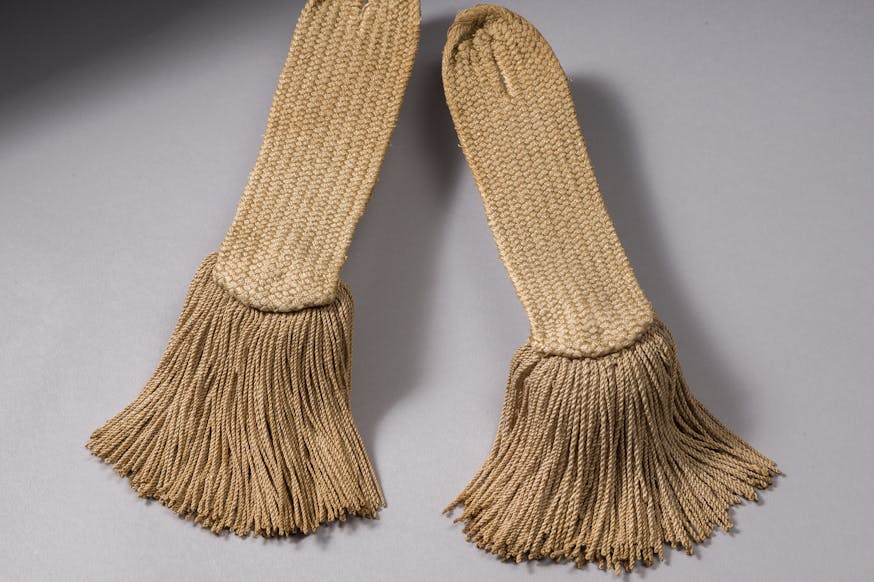
The Davenport family had not only preserved that journal until then and the texts of the letters, but also some mementos of James’s military service: a sword, epaulettes (shown above), and a pair of red wool baby booties reportedly made from a British coat. Those are now part of the Museum of the American Revolution’s collection, and can be viewed through the “Davenport Letters” webpage.

Friday, March 29, 2024

New Collection from the Journal of the American Revolution

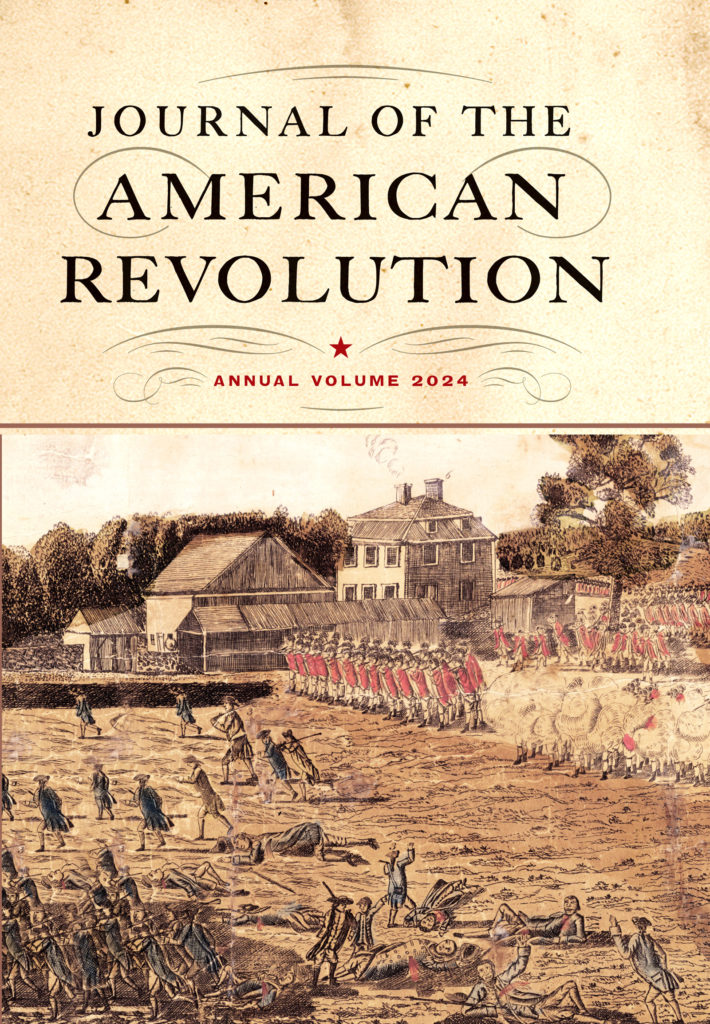
Next month Westholme Publishing will issue The Journal of the American Revolution Annual Volume 2024, edited ably once again by Don N. Hagist.

This webpage about the book says it will contain two articles by me.

In fact, the book will have only one article from me. That’s because I combined my two web articles about the confounding Samuel Dyer into one complete study.

This volume offers many other articles about Revolutionary New England, including:
  • Remember Baker: A Green Mountain Boy’s Controversial Death and Its Consequences by Mark R. Anderson
  • John Hancock’s Politics and Personality in Ten Quotes by Brooke Barbier
  • Mercy Otis Warren: Revolutionary Propagandist by Jonathan House
  • Captain James Morris of the Connecticut Light Infantry by Chip Langston
  • Smallpox Threatens an American Privateer at Sea by Christian McBurney
  • John Adams and Nathanael Greene Debate the Role of the Military by Curtis F. Morgan, Jr.
  • The Perfidious Benjamin Church and Paul Revere by Louis Arthur Norton
  • The Highs and Lows of Ethan Allen’s Reputation as Reported by Revolutionary-Era Newspapers by Gene Procknow
  • Captain Luke Day: A Forgotten Leader of “Shays’s Rebellion” by Scott M. Smith
  • Engaging the Glasgow by Eric Sterner
(My apologies to the authors of any other relevant articles I missed.)

And there are of course lots of articles about the American Revolution in, you know, other places.

Thursday, March 28, 2024

“The Gathering Storm” in Acton, 2 Apr.

On the evening of Tuesday, 2 April, I’ll speak in Acton at the invitation of the Acton 250 Committee.

We’re calling this talk “The Gathering Storm,” and here’s the description:
As 1774 began, Massachusetts politicians worried about the royal government response to the Boston Tea Party. The force of that reaction became clear in the return of troops to Boston, the Coercive Acts, and the Massachusetts Government Act. In late summer the province’s people rebelled by shutting down government functions in rural counties, seizing weapons in ports, and electing their own legislature.

The engine of that resistance was a little-understood institution: the colonial militia. By fall, it was clear that the new royal governor had no leverage outside Boston. This talk traces the end of British power in most of Massachusetts even before the war began.
I’ll draw on the stories in The Road to Concord and elsewhere, discussing how rural Massachusetts shifted in 1774 from lukewarm support for Boston’s fight against tariffs to militant opposition to the Crown.

This will be part of a series of talks by different authors tracing the events that led to war in 1775. Eventually the people of Acton were so committed to the Patriot cause that their militia company marched at the front of the Middlesex County column confronting the British regulars at the North Bridge in Concord.

This talk will take place in Room 204 of the Acton Town Hall on Main Street starting at 7:00 P.M. It is free, but the Acton 250 Committee asks people to register so that they can be contacted about future events. The talk will also be shown live on Acton TV and Zoom.

Wednesday, March 27, 2024

The Last Glimpses of Lt. Ragg

Yesterday’s posting took Lt. John Ragg of the British marines to Middletown, Connecticut, as a prisoner of war along with his servant, Pvt. Benjamin Jones, in September 1776.

I’ve looked for records of what happened next, without success. I assume there must be some paperwork at the Continental or local level, but not published.

It appears that the lieutenant was exchanged for an American officer taken prisoner that fall, and there were a lot of those.

The next sign of Lt. Ragg is in the 12 May 1777 issue of the New-York Gazette and Weekly Mercury, printed by Hugh Gaine inside the Crown-held city. An advertisement for Maj. Robert Donkin’s Military Collections and Remarks, to be printed by Gaine later that year, listed “Marines, Lieut. Ragg” among the subscribers.

Then the man drops out of my sight again until toward the end of the war.

Lt. Ragg had a brother named Andrew, who became the Customs service controller of Customs on the Pocomoke River in southern Maryland in May 1766. When the war broke out the local authorities detained him, then let him out as long as he didn’t cause trouble and paid heavy taxes.

On 5 Feb 1779, Andrew Ragg asked the Maryland government to allow him and his young daughter Anne to return to Britain. On 31 March, Ragg filed a deposition promising not to give intelligence to the enemy, and that same day the state Council granted permission to travel to New York.

Evidently the Raggs didn’t go to New York until 1780. Anne was then nine years old. To the British authorities they characterized their journey as an “escape.”

The little family got on board a ship to Britain, but during the voyage Andrew Ragg fell overboard and was drowned. John Ragg, by then a captain in the marines, petitioned the government to support his niece on 24 Apr 1781.

The last sign I’ve found of John Ragg is that “Captain Ragg, of the marines,” was listed as wounded while serving on H.M.S. Magnificent in the Battle of the Saintes in April 1782.

After the war, Ragg might have gone home to Aberdeen, Scotland. He was living in that city in February 1767 when he was listed as a witness in a court case recorded in the city’s Enactment Book (notes in P.D.F. form here).

That book also lists “Andrew Ragg, late apprentice to William Brebner, merchant,” among the genteel young men accused of a breach of the peace in April 1763. Was this the future Customs officer? Those men “bound and enacted themselves that they shall behave themselves regularly, soberly and discreetly” and got off.

In any event, that’s all I’ve been able to uncover about Lt. John Ragg, remembered in the Shaw family lore as the lieutenant named Wragg who so angered young Samuel Shaw.

(The painting above shows H.M.S. Magnificent among the Royal Navy warships capturing two French vessels at the Battle of the Saintes.)

Tuesday, March 26, 2024

Lt. Ragg in Captivity

The Battle of Brooklyn on 27 Aug 1776 didn’t end well for the Continental Army. Gen. Sir William Howe’s forces inflicted heavy casualties and drove the Americans off Long Island.

At eight o’clock that evening, Gen. George Washington’s military secretary, Robert Hanson Harrison (shown here), wrote to John Hancock as chair of the Continental Congress:
a Smart engagement ensued between the Enemy and our Detachments, which being unequal to the force they had to contend with, have sustained a pretty considerable loss—At least many of our Men are missing, among those that have not returnd are Genls [John] Sullivan & Lord Stirling

The Enemy’s loss is not known certainly, but we are told by such of our Troops that were in the Engagement and that have come in, that they had many killed and wounded—Our party brought off a Lieutt, Sergt, and Corporal with 20 privates prisoners.
Sullivan and Stirling were prisoners, but at least they survived. Hundreds of other Americans were dead.

Continental commanders hoped this would prove to be a Pyrrhic victory for the Crown, like Bunker Hill. Gen. Henry Knox wrote to his wife Lucy, “The enemy lost nearly 1000 kill’d among whom was General [James] Grant and Capt. [Andrew] Neilson of the 52d.”

In fact, Gen. Howe reported only 63 dead from the Crown forces, and fewer than 400 casualties in all. Gen. Grant was fine; a lieutenant colonel of the same name died.

Later American writers seeking actions to praise in that battle had to content themselves with gallant ways to lose. The noble sacrifice of the Marylanders holding off the enemy! The sly evacuation across the river to Manhattan!

Among the few solid successes Knox could firmly claim was, “We took a Lt. Ragg whom I knew at Boston and 25 Grenadiers of the marines.” And even that overstated the details slightly. Harrison’s numbers were closer.

Lt. John Ragg had led Sgt. David Wallace, Cpls. Thomas Pike and Edward Gibbon, and twenty marine privates into captivity because he and his superiors had mistaken the Delaware Continentals for Hessians.

Behind the American lines, on 29 August Gen. William Heath ordered Lt. Nathan Umstead to conduct those prisoners of war to Fairfield, Connecticut.

A month later, Thaddeus Burr of the Fairfield committee of inspection wrote back to Gen. Washington, reporting that they had sent Ragg and his servant, Pvt. Benjamin Jones, on to Middletown. The other twenty-one men were taken to Wallingford and “placed in the Parishes in the interior part of the County agreable to Rules of Congress.”

There was just one more thing, Burr told the commander-in-chief: Who would pay for “the charges of marching them”? The committee had fed those prisoners for eleven days and paid “a Sergeant and Six from our Battery…a penny a Mile” to lead them on to Wallingford. How was the town to be reimbursed £14.6.½?

The Washington Papers editors wrote, “No reply to that letter has been found.”

TOMORROW: The last of Lt. Ragg.

Monday, March 25, 2024

Two Lieutenants and the Battle of Brooklyn

On the afternoon of 27 Aug 1776, British and Hessian soldiers under Gen. James Grant advanced on a Continental force, including men from Delaware and Maryland, under Gen. William Alexander, Lord Stirling (shown here).

Lt. John Ragg of the British marine grenadiers led twenty men forward from the right flank of the Crown forces. His orders were “to speak to” the commander of a unit in blue coats, thought to be Hessians, and tell them to stop firing at their own side.

Meanwhile, Lt. William Popham was one of the American officers trying to hold the left side of their line with a company of “awkward Irishmen and others.” Coming from the Delaware regiment, those soldiers were dressed in blue coats.

You can guess what happened. As Popham told it, “Capt. Wragg [sic] and 18 men, supposing us to be Hessians by the similarity of our dress, approached too near before he discovered his mistake.”

The Delaware Continentals took the marines as prisoners. The Americans stripped the British of their guns, Popham taking charge of Ragg’s weapons.

Decades later Popham reported:
I was immediately ordered with a guard to convey them across the creek in our rear to our lines. On descending the high ground we reached a salt meadow, over which we passed, though not miry, yet very unfavorable to silk stockings and my over-clothes.
Popham was a Princeton College graduate eager to look like a gentleman.

As the party crossed the meadow, the British started to fire cannon in their direction. Lt. Ragg stopped moving, “in the hope of a rescue.”

Popham ordered Ragg to “march forward instantly, or I should fire on him.”

Ragg started moving again. But then a new obstacle appeared:
When we got to the creek, the bank of which was exceedingly muddy, we waded up to our waists. I got in after my people and prisoners, and an old canoe that had been split and incapable of floating except by the buoyancy of the wood, served to help those who wanted help to cross a deep hole in the creek, by pushing it across from the bank which it had reached.

I had advanced so far into the mud, and was so fatigued with anxiety and exercise, that I sat down on the mud with the water up to my breast, Wragg’s fusee, cartouch-box, and bayonet on my shoulder; in which situation I sat till my charge were all safely landed on the rear.
Gen. Grant continued to press forward with his 7,000 men, more than twice the British force in the Battle of Bunker Hill. However, that was just a diversion.

Gen. William Howe had sent many more of his troops on long flanking march to the right. They moved through an unguarded pass and hit the Americans from an unexpected direction. In fierce fighting, almost the whole Continental force was driven back to Brooklyn Heights.

Stirling ordered most of his men back as well, keeping a contingent of Maryland soldiers as the rear guard. He led them in two counterattacks on the Crown forces while other Americans withdrew as best they could.

At the end of the day, the Continentals had lost more than 2,000 men. Nearly all the Maryland rear guard was dead. Stirling was a prisoner.

Gen. Howe reported 64 killed, 293 wounded, and 31 missing—including Lt. Ragg and his marines.

TOMORROW: The end of Lt. Ragg’s war?

Sunday, March 24, 2024

The Continentals from the Lower Counties

From the start of nationhood Americans have spoken of the “thirteen colonies,” but really it was more like twelve and a half.

The Penn family were proprietors of both Pennsylvania and Delaware and always appointed the same man to govern both.

Though Delaware had an older history of European settlement, Pennsylvania became much bigger and wealthier. The “Lower Counties on the Delaware” had their own legislature, but many people treated that area as a mere adjunct.

Delaware didn’t rate its own part of the “Join, Or Die.” snake that Benjamin Franklin printed in 1754, for example. (Though I should also note that all of New England was one piece.)

Under the Stamp Act, the British government appointed John Hughes to collect the tax in both Pennsylvania and Delaware.

The First Continental Congress’s Articles of Association in 1774 still referred to “the three lower counties of Newcastle, Kent and Sussex on Delaware,” as did the Second’s commission for a commander-in-chief in 1775.

We might say that Delaware made itself a full-fledged state by participating in the American resistance. The three counties sent representatives to the Stamp Act Congress and then the Continental Congresses. Deriving their authority from the people through a legislature meant those men were separate from the Pennsylvania delegation. By late 1775, John Adams was writing of “Thirteen Colonies.”

Delaware also raised its own troops to support the Continental Army in January 1776. Not many, since it was a small colony: about 800 men in one big regiment under Lt. Col. John Haslet. In the summer of 1776 those Delaware Continentals marched north to New York.

One young officer in that regiment was Lt. William Popham (1752–1847, shown above). He arrived in New York City on 21 August, and a few days later the Delaware Continentals crossed to Long Island. They were grouped with Marylanders under Gen. Stirling.

A few days later, Popham wrote:
I marched toward the ground occupied by our army, in the summit of the high ground in front of Gowanus, near the edge of the river, where the enemy were landing from their ships, one or two lying near the shore to cover the landing. Many shots were exchanged between us and the enemy.

About 12 o’clock Gen. Stirling came to the east brow of the hill and ordered the Delaware regiment up. Here we received the first order to load with ball, and take care that our men (who were awkward Irishmen and others) put in the powder first.

We then marched up and joined the army which was drawn up in line, my regiment and my company on the left. The whole bay was covered with the enemy’s shipping. The firing continued all the time of the enemy’s landing, and we lost several men.
The British and Hessians began to spread out and march toward the American positions. Haslet saw how “the enemy began to send detachments as scouts on our left.” Though the Continentals held the high spots, the Crown forces outnumbered them and might try to outflank them.

One more thing about the Delaware regiment: They wore blue coats with red facings, not unlike the Hessians.

TOMORROW: Two lieutenants meet.

Saturday, March 23, 2024

Lt. Ragg in the Assault on Brooklyn

In June 1776, Lt. John Ragg of the marines was in Halifax, Nova Scotia, with the rest of the British military force evacuated from Boston.

In July, Ragg was in the fleet of forty-five ships that started unloading British soldiers onto Staten Island, New York.

More troop transports and Royal Navy warships arrived from other parts of the empire. By the end of July, Adm. Lord Richard Howe was overseeing more than one hundred ships while Gen. Sir William Howe commanded 32,000 soldiers.

Those numbers continued to grow in early August. Among the new arrivals were 8,000 Hessian soldiers.

On the morning 22 August, 4,000 redcoats moved onto Long Island. This was significantly more than the British force in the Battle of Bunker Hill, but it was only an advance guard, about a tenth of Howe’s entire land army.

The Americans drew back. By the end of that day, the British had landed 15,000 men at Gravesend Bay, with 5,000 more to follow a couple of days later.

The two armies dug in warily for the next two days. The Americans held the Brooklyn and Guan Heights, guarding the main passes.

Late in the evening of 26 August, Gen. James Grant (1720–1806, shown above) sent a force of about 4,000 British and Hessian men forward against the Continentals. The first major skirmish was around the Red Lion Inn. The British captured the American commander, Maj. Edward Burd, and sent his forces fleeing.

Gen. Samuel Holden Parsons of Connecticut managed to gather Continental troops along the Gowanus Road and to send for reinforcements. Gen. Stirling arrived with about 1,500 men from Maryland and Delaware. Under his command, the Continentals moved back toward the Red Lion Inn.

Meanwhile, Gen. Grant’s Crown troops were also growing, up to 7,000. That force included the 2nd battalion of marines.

According to a letter written on 4 September by a British officer to a friend in Aberdeen, and published in the Scots Magazine, the marine battalion “was sent from our right to support Gen. Grant.”

In the fighting on 27 August, those marines came under “several fires” from a unit dressed in blue uniforms with red facings. Those were the colors of some Hessian regiments while most of the Continental Army had no uniforms at all, so the British officers assumed that was friendly fire.

Lt. Ragg and twenty men from his grenadier company were “sent out to speak to” those Hessians.

TOMORROW: They weren’t Hessians.