J. L. BELL is a Massachusetts writer who specializes in (among other things) the start of the American Revolution in and around Boston. He is particularly interested in the experiences of children in 1765-75. He has published scholarly papers and popular articles for both children and adults. He was consultant for an episode of History Detectives, and contributed to a display at Minute Man National Historic Park.

Subscribe thru Follow.it


•••••••••••••••••


Showing posts sorted by relevance for query smallpox. Sort by date Show all posts

Saturday, October 01, 2011

“Several of the founding fathers were champions of inoculation”

In The Nation, Lindsay Beyerstein took on Rep. Michele Bachmann’s recent incendiary comments about vaccinations from a historical perspective:
As a Tea Party conservative, Bachmann styles herself as defender of original vision of the founding fathers for America. Ironically, several of the founding fathers were champions of inoculation against infectious disease. Some even played key roles in ushering in the vaccine age.

If it hadn’t been for mandatory smallpox inoculation, the Republic might never have survived. General George Washington ordered the Continental Army inoculated against smallpox in 1777, the first large scale inoculation of an army in history. Washington was supported in this effort by Dr. Benjamin Rush, a signatory to the Declaration of Independence and the chair of the Continental Congress’ Medical Department.

Inoculation was a precursor to vaccination which induced a milder case of smallpox by scratching the skin and rubbing in pus from a smallpox lesion. Cleric and amateur scientist Cotton Mather provided a dramatic proof of concept for inoculation when he inoculated 287 people during a smallpox epidemic in Boston in 1721. Only six of the inoculated individuals died, a much lower death rate than for natural smallpox. Mather gets credit for introducing smallpox inoculation to North America, but he learned about it from Onesimus, a slave who had undergone inoculation in Africa.

Despite the success of his experiment, Mather was widely vilified for mocking the will of God. At the time, many believed that smallpox was a divine punishment for sins and that trying to evade the consequences of sinning by getting inoculated was a sin in itself. That argument sounds ridiculous to modern ears, but that same logic still prevails in some quarters when discussing sexually transmitted diseases.

Someone threw a small bomb through Mather’s window with a note that said, roughly, “Inoculate this, Mather.”
The article goes on to name-check Alexander Hamilton, Thomas Jefferson, and Harvard professor Dr. Benjamin Waterhouse.

Not mentioned in the article is how in 1721 James Franklin published essays criticizing Mather (shown above) and Dr. Zabdiel Boylston for their inoculation campaign in his New England Courant newspaper and in pamphlets. Among the apprentices who helped to create those publications was the printer’s little brother Benjamin.

Eventually, however, Benjamin Franklin accepted the scientific evidence for the value of smallpox inoculation, particularly after his young son died of the disease in 1736. Two decades later, Franklin and Dr. William Heberden of London published a pamphlet on inoculation in England and America. Franklin had a very important quality for a political leader, or anyone else: the willingness to change one’s mind after seeing solid evidence that undermines one’s initial beliefs.


Tuesday, December 06, 2022

Nature on The Contagion of Liberty

The journal Nature just published Heidi Ledford’s review of The Contagion of Liberty: The Politics of Smallpox in the American Revolution by Andrew M. Wehrman.

Ledford, a senior reporter at the magazine, writes:
As revolutionary sentiment simmered, the colonies cycled through a series of smallpox outbreaks; each city mounted its own response. Wehrman recounts in exhaustive detail the debates and votes in a handful of towns as citizens grappled with when to allow inoculation, who should receive it and how it should be administered. At times, it’s hard to see where this is all heading.

Eventually, Wehrman’s point becomes clear. Riots over access to inoculation and public bickering about how it should be done give way to consensus as the fledgling nation emerges from war: smallpox inoculation saves lives, and the country’s new government should ensure that it is available. Communities discuss pre-emptive inoculations, systematically administered to all children rather than waiting for an outbreak. There is talk of trying to eliminate smallpox altogether.

And then that commitment disintegrated. By 1800, a vaccine had emerged. It contained the cowpox virus — related to smallpox and thus capable of generating immunity against it, but incapable of passing between humans, and so with no risk of seeding outbreaks. Suddenly, administration of the vaccine did not pose communal risk; therefore, its distribution did not inspire communal action.

Efforts to launch vaccination campaigns foundered in the face of rampant misinformation, competing business interests and a smallpox-weary public. (Sound familiar?) Outbreaks continued, albeit at a much slower pace than before, and the United States — once a proud leader in smallpox immunizations — slipped behind its counterparts in Europe and beyond. Wehrman flies through this part of his story, but after the three years we’ve just had, it feels so familiar that more detail seems unnecessary.
Wehrman will discuss his new book in a couple of online events next week:

Sunday, March 23, 2008

No Pox Party in John Adams

I thought I was done writing about H.B.O.’s John Adams miniseries for a while, but interesting comments on Dr. Samuel Gelston’s smallpox hospitals got me thinking about that part of the show. Many critics have singled out the sequence in which Abigail Adams and the children are inoculated against smallpox as a particularly gritty portrayal of history.

There were actually two significant epidemics during the siege of Boston:

  • “The bloody flux,” a form of dysentery that Judy Cataldo wrote about back here. This disease reached Braintree in October 1775, making Abigail and her three-year-old Tommy sick. Her mother, Elizabeth Smith, and John’s younger brother Elihu Adams both died.
  • Smallpox, an untreatable, contagious disease with a death rate of close to 30% and a really scary rash.
The screenplay apparently combined these two diseases into something called “the bloody pox.”

After the winter of 1775-76, smallpox was the bigger worry for both armies and the civilian populations. Indeed, the epidemic eventually affected the whole continent, as Elizabeth Anne Fenn described in Pox Americana.

John Adams’s great-uncle, Dr. Zabdiel Boylston (1676 or ’79-1766), was the first American physician to try inoculating people against smallpox, provoking a huge controversy in 1720s Boston. The Rev. Dr. Cotton Mather supported him, citing advice from his enslaved man Onesimus. James and Benjamin Franklin attacked the practice in their newspaper. Because inoculation involved deliberately giving people (what everyone hoped was) a mild case of the disease, and those people remained contagious for a while, at first it seemed like a step backward in public health.

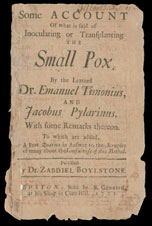
In 1730 Dr. Boylston published his results in London (as shown above, courtesy of the New York Academy of Medicine). He reported that although some patients had died after inoculation, their death rate was significantly smaller than that of people who caught the disease naturally. And the more smallpox survivors there were in a population, the less easily the disease could spread. By the middle of the 1700s, it was clear that inoculation saved lives. But it was still risky.

John had himself inoculated shortly before marrying. As a lawyer, he expected to travel and meet a lot of people, so he needed to protect himself. Abigail and the children were still vulnerable to smallpox in the summer of 1776, however. She decided to make arrangements for inoculation as she described to John in a letter dated 13 July:
I now date from Boston where I yesterday arrived and was with all 4 of our Little ones innoculated for the small pox. My unkle and Aunt [probably James and Elizabeth Cunningham] were so kind as to send me an invitation with my family.

Mr. [Richard] Cranch and wife [Abigail’s older sister, Mary] and family, My Sister Betsy and her Little Neice, Cotton Tufts [a cousin and physician] and Mr. [John] Thaxter [another cousin and tutor to the boys], a maid who has had the Distemper and my old Nurse compose our family. A Boy too I should have added. 17 in all. My unkles maid with his Little daughter and a Negro Man are here.

We had our Bedding &c. to bring. A Cow we have driven down from B[raintre]e and some Hay I have had put into the Stable, wood &c. and we have really commenced housekeepers here. The House was furnished with almost every article (except Beds) which we have free use of, and think ourselves much obliged by the fine accommodations and kind offer of our Friends. All our necessary Stores we purchase jointly.

Our Little ones stood the opperation Manfully. Dr. [Thomas] Bulfinch is our Physician. Such a Spirit of innoculation never before took place; the Town and every House in it, as are as full as they can hold. I believe there are not less than 30 persons from Braintree. Mrs. Quincy, Mrs. Lincoln, Miss Betsy and Nancy [okay, I’m giving up on the identifications] are our near Neighbours. God Grant that we may all go comfortably thro the Distemper, the phisick part is bad enough I know.

I knew your mind so perfectly upon the subject that I thought nothing, but our recovery would give you eaquel pleasure, and as to safety there was none. The Soldiers innoculated privately, so did many of the inhabitants and the paper curency spread it everywhere. I immediately determined to set myself about it, and get ready with my children. I wish it was so you could have been with us, but I submit.
The last paragraph reveals that Abigail had decided to go through with the treatment without waiting for a decision from John. As the war went on and their separations increased, she grew more comfortable making such decisions on her own. The whole family survived, as did most of their friends.

In the miniseries, Abigail and the Adams children undergo the inoculation and recovery at their home in Braintree without any servants, relatives, or neighbors in sight. A physician comes to their home with a poxy teenager in a wagon; that was the least realistic aspect for me. As the story of Dr. Gelston shows, towns were extremely edgy about confining and isolating people who might be infectious.

The actual inoculation process shown on screen—scraping pus from an infected person’s sores and inserting it into a cut on the inoculatee—was one of the cruder medical protocols of the time. Physicians also used ground-up scabs and threads dipped in pus to transmit the disease. They looked for infected people who seemed to have mild cases. According to an anonymous commenter on this posting, the series showed pus too thick to be from the early stage of the disease, and thus not contagious. I must confess that I don’t know my pus that well. But I commend the miniseries for including this unattractive but common aspect of eighteenth-century life, even within the confines of its budget.

Friday, May 21, 2021

“No Person whatever, belonging to the Army, is to be innoculated for the Small-Pox”

This being the two-week anniversary of my second vaccination against Covid-19, I’m going to celebrate by looking at a controversy around inoculation in 1776.

By then it was no longer controversial that inoculation programs helped protect individuals and communities against smallpox. But people still had reasons for fear.

Inoculated people developed the disease—a mild, non-fatal case, they hoped—and were infectious for several days, including some days before visible symptoms. Furthermore, doctors worried that clothing and other goods might be contaminated and spread the pox. Therefore, people wanted any inoculation program to keep its patients strictly isolated until they had fully recovered, and to take other measure to prevent uncontrolled infection.

On top of that, for an army commander, the benefits of having troops inoculated against smallpox had to be weighed against the risk of taking large numbers of men out of action for about four weeks, leaving the force vulnerable to a non-viral attack.

Gen. George Washington didn’t have to worry about smallpox personally. He’d contracted the disease in the “natural way” as a teenager and was therefore immune. But he worried about his troops and the general population, even accusing the British commanders inside Boston of sending out infectious people during the siege.

Smallpox was already damaging another part of the Continental Army. After Gen. Richard Montgomery failed to take Québec at the end of December 1775, the Continental Congress responded by sending even more soldiers into Canada, with Gen. John Thomas to command them. But that American army was steadily disintegrating, and the worst foe wasn’t the small royal force in Québec but the smallpox epidemic.

Meanwhile, Gen. Washington had moved his larger portion of the Continental Army from Massachusetts to New York. He worried that the British would attack that city before his defenses were ready. As usual, he feared he didn’t have enough troops, and he didn’t want to lose any to either epidemic or inoculation.

On 20 May, Washington’s general orders therefore declared:
No Person whatever, belonging to the Army, is to be innoculated for the Small-Pox—those who have already undergone that operation, or who may be seized with Symptoms of that disorder, are immediately to be removed to the Hospital provided for that purpose on Montresors’-Island. Any disobedience to this order, will be most severely punished—As it is at present of the utmost importance, that the spreading of that distemper, in the Army and City, should be prevented.
Montresor’s Island sat at the mouth of the Harlem River to the east of Manhattan, far enough from the city to serve as a smallpox hospital. Since 1772 it had been the property of Capt. John Montresor, the chief engineer of the British army in North America. (After the war Montresor’s Island was renamed Randall’s Island, and in the twentieth century it was connected to two other islands nearby.)

It took only four days for the authorities to hear about men in the Continental Army disobeying Washington’s order.

TOMORROW: A suspicious doctor.

Thursday, October 15, 2009

The “Suttonian Method” of Fighting the Smallpox

So what was the Suttonian method of smallpox treatment that Dr. James Latham offered in Salem in 1773-74?

Donald R. Hopkins’s The Greatest Killer: Smallpox in History says this was a medical regimen developed by the English physician Dr. Robert Sutton, and then used and modified by “his six sons.” One of them, Dr. Daniel Sutton, claimed to have changed the treatment and broken with his father in 1763, but other medical men and the public wrote as if there was a single “Suttonian method.”

In Public Health in the Town of Boston, 1630-1822 John B. Blake described the first part of the treatment this way:

the practice involved a diet of puddings, gruel, sago, milk, fruits, and vegetables for nine or ten days proceeding the operation and abstention from meat, butter, cheese, liquor, spices, and other heating foods. The typical patient also received relatively mild dosing with a preparation of mercury and antimony and with Glauber’s salt.
This was actually a shorter period of dieting than what earlier British doctors had insisted on.

Furthermore, in October 1768 Benjamin Rush, then studying medicine in London, wrote that “Dr. Sutton’s method is now universally advocated by most of the physicians in England,” but few patients were taking mercury.

The Suttons’ biggest improvement over previous British forms of inoculation was inserting the virus (though they didn’t know that’s what they were doing) through a shallow cut rather than a deep one. Solomon Drown, a Brown College student, underwent the procedure in New York in 1772. He wrote:
We are inoculated after the Suttonian Method, which is this, the doctor with his lancet just scratches up the skin so as to fetch blood, then fixes a piece of thread, infected with the matter [from a previous patient], into the scratch, upon which, a very tenacious plaister is applied, and a bandage around the arm.
Ironically, as Hopkins points out, the Suttons’ innovations—the shallow cut, less fasting and purging, less of that yummy mercury—brought the procedure closer to what doctors in Turkey had done for centuries. Lady Mary Wortley Montagu had published a description of that treatment in London in 1721.

I think British doctors had chosen to make the inoculation regimen more elaborate and more trying for two reasons. The first might well have been fee-for-service: the more patients saw them doing, the more they got to charge. Second, the eighteenth-century British seem to have believed that if a treatment didn’t cause major, uncomfortable side effects, you couldn’t be sure it was working.

A Dr. Thomas Dimsdale described some of the Suttonian method in print in 1767, and one of his pamphlets was reprinted in New York four years later. The Suttons themselves kept their secrets as long as they could, publishing nothing until 1796. Instead, they trained other doctors, who had to keep the secrets and probably kick back some earnings. William Sutton—presumably another son—licensed Dr. Latham to practice the Suttonian method in the northern American colonies, as described yesterday.

Another Suttonian inoculator I’ve found was an Oxford-educated doctor named Robert Houlton. In 1768 he moved to Dublin and published Indisputable Facts Relative to the Suttonian Art of Inoculation, advertising himself as authorized by the Sutton family to bring their methods to Ireland. Houlton also wrote poems, musical plays, and newspaper essays. His last recorded writing, alas, consisted of pleas for assistance from Fleet Prison in 1796.

At that time, the “Suttonian method” was still the most advanced protection against smallpox in the English-speaking world. But two years later Dr. Edward Jenner published his findings that cowpox protected against smallpox, and inoculation with live smallpox was on its way out. (Of course, some people feared the new method; the caricature above shows small cows bursting from the mouths of people Jenner has just vaccinated.)

Saturday, May 16, 2026

“To Vax or Not to Vax” walking tour in Boston, 17 May

On Sunday, 17 May, the Partnership of Historic Bostons is offering a walking tour titled “To Vax or Not to Vax: Smallpox in Early Boston.”
The organization says:
The subject of our newly revised walking tour is smallpox, one of the great killers of the 17th century. This European disease found fertile ground in the growing colonies in New England, with the most devastating effects suffered by Native Americans who had no immunity. Up to 90% of the Massachusett Tribe, whose land included Boston and Charlestown, perished, their villages lying empty and providing English colonists with unoccupied land for reasons that Puritans saw as providential.

English colonists had some immunity but, even so, successive generations suffered wave after wave of deadly smallpox outbreaks. . . .

During the tour, we will investigate how the colonists saw smallpox and tried to contain it, and how smallpox roiled their society in a number of ways. Had God handed the Shawmut peninsula over to them by clearing out the Native population, or was he punishing them with the same pestilence for not sufficiently following His word? Could smallpox be successfully treated by medical methods practiced since the time of the Romans, or would new, more radical methods (some employed by Africans, including Cotton Mather’s enslaved African Onesimus, and Turks) prove more effective?
This tour is led by Michael Prochilo. It will start outside of Park Street Station at 2:30 P.M. and is scheduled to last 90 ninety minutes. Because of construction projects, the route is not wheelchair-friendly. Participants are reminded to bring water [Sunday might bring our first 80°F. days this year] and wear comfortable shoes.

Wednesday, October 14, 2009

Dr. James Latham’s Inoculation Franchise

Yesterday’s posting mentioned Dr. James Latham, a smallpox inoculator working in Salem in 1773-74. He came to town claiming to have a superior method for treating the disease. That probably sounded good to the town leaders at first, but when the people of Essex County turned against those newfangled and exclusive inoculation hospitals, Latham’s secrecy became a liability.

The best source on this doctor is an article by Barbara Tunis called “Dr. James Latham (c. 1734-1799): Pioneer Inoculator in Canada,” published in the Canadian Bulletin of Medical History in 1984. It draws on a 1903 profile in the Boston Medical and Surgical Journal of another physician who worked with Latham and left papers documenting their business relationship.

Tunis writes that Latham enters the historical record as a surgeon’s mate in His Majesty’s 8th Regiment of Foot in 1756, succeeding to the rank of surgeon in 1767. That regiment arrived in Québec in July 1768, and on 15 September Latham advertised his services in inoculating people against the smallpox. This is apparently the first documented example of inoculation in Canada. (That’s a bigger deal in the Canadian Bulletin of Medical History than elsewhere.)

Latham seems to have found enough business to retire from the army, perhaps on half-pay. The next year he moved to Montreal to inoculate people there, and in 1770 to New York. By 1773 Dr. Latham was married with children, living on a large farm in Livingston Manor.

The doctor advertised himself as following the “Suttonian” method of treatment—indeed, he declared, he had the exclusive license to offer that treatment in North America north of Philadelphia. He in turn authorized associates in seven towns and sold them the “Suttonian” medicines, which they had to promise not to try to replicate. They paid him half of all they earned up to £300 and a third above that. The contract started like this:

Whereas, William Sutton of Kensington Lane, in the County of Surrey, in England, hath found out and discovered a method or art of inoculation for the smallpox, and hath also discovered and prepared certain medicines, preparatory and effectual in the cure of that distemper, and, whereas the said William Sutton, in order to extend the benefit of this method to America, did, upon certain conditions, take James Latham into partnership for the carrying on and practising of this said method, art or mystery, and inoculation with the medicines aforesaid in certain districts in America, with power to depute under him other persons within said districts under certain terms and conditions,…
In sum, Dr. Latham set up a smallpox-inoculation franchise.

When the Revolutionary War broke out, Latham apparently tried to remain neutral, at least until he saw which way the fight was going. He resigned his army ties by August 1775, but in the following years Patriots suspected him of trying to smuggle flour to the British army and then of trying to cross enemy lines. In May 1783, with the war winding down, Latham wrote to Gen. Sir Guy Carleton in New York City, professing his continued loyalty to the Crown. Nonetheless, he remained at Livingston Manor with his family.

For a few months in 1786 Dr. Latham went back to Québec to inoculate people, and then in March 1790 he moved and officially became surgeon for the army garrison in Kingston, Ontario (well, it’s now Ontario). Smallpox treatment continued to be a big part of his practice. He died in Kingston on 28 Jan 1799, aged about sixty-five.

(The painting of a doctor inoculating a family above appears on a Scienceblogs posting by PalMD about eighteenth-century scientific wariness of the procedure.)

Friday, October 09, 2009

“Permitted to Die of the Small-Pox”

Last weekend the Boston Globe’s Ideas section ran an article by historian Andrew M. Wehrman headlined “A Pox on You.” It starts like this:

On a blustery January night in 1774, scarcely a month after the famous Tea Party in Boston, an even more shocking protest unfolded on Massachusetts’ North Shore. In the dead of night, a crew of 20 men blackened their faces and armed themselves with torches and buckets of tar. The object of their anger was not a chest of tea, a tax collector, or British soldiers. What these men, mostly sailors from Marblehead, burned down was the town’s brand new hospital.

On the surface, such an attack might seem inhuman, or at best ignorant. But the act was the calculated result of long-simmering anger over the cost and politics of smallpox inoculations in one of the largest and most prosperous towns in the Colonies. Their anger would be familiar to anyone today who has faced ballooning insurance premiums, or who was moved to stand up and shout at this summer’s town hall debates on health care.
Wehrman’s study of the destruction of the Marblehead smallpox hospital appeared this year in the New England Quarterly. In this opinion essay, and in a follow-up discussion on N.P.R.’s Talk of the Nation, he touches on larger questions of public health and public resources, which have concerned governments in America from the start.

Later in the week I stumbled across a pertinent item from the Columbian Centinel for 14 Nov 1804. It was a column that combined simple death notices, longer obituaries, and some bills of mortality—early public health information. Among those last items was:
In New-York, from the 26th Oct. to the 3d Nov. 42 deaths;—of whom 14 were men, 10 women, 13 boys, and 6 girls;—by taking laudanum, (suicide) 1 person; TEN of SMALL-POX!—Shame!

Among those who were permitted to die of the small-pox, was Mr. Charles B. Rich, printer, of Brookfield, (Massa.); a young man of strict integrity and emulative worth, and bid fair to be a public, as he had been a private, ornament to society.
The Centinel employees might have felt special regret for Rich’s death because he was a fellow printer, perhaps even one they knew. But they also regretted it because people had started to see smallpox as a preventable disease.

For decades people had realized that an infection with a mild form of smallpox could grant lifelong immunity, lowering the rate of the disease’s transmission and mortality. And in 1798 Dr. Edward Jenner of Gloucestershire (shown above, courtesy of the New York City Department of Health) started to publicize his success at vaccination: injecting people with the rarely fatal cowpox or “kinepox” virus made them immune to smallpox as well.

The Centinel printers felt that having citizens die when people knew of better medical and public-health methods was a stain on American society. And a drain—a healthier public would benefit the nation. That thinking seems to be neglected in the U.S. of A.’s current debate over medical insurance, in which people have paid a great deal of attention to how much different plans might cost without noting how much money each is projected to save based on a healthier population and more efficient use of medical services. (And of course the policy-makers’ debate basically ignores how much more the nation could save by reducing private bureaucracies.)

Sunday, September 28, 2025

A Last Word on Boston’s Sedan Chairs

Originally I flagged Alun Withey’s blog post about sedan chairs in Britain just because I thought it had interesting details about daily life in the eighteenth century.

But then I got interested in the question of whether those details also applied in Boston.

Looking for sedan chairs locally led me into the smallpox epidemic of 1764, and thus to the name “Williston” appearing over and over in the selectmen’s records. So I had to figure out who Thomas Williston was.

So, having spent nearly a week on what I’d thought was a one-day topic, I’m coming back around to complete this sedan chair trip with some familiar names.

In 1769 the smallpox virus flared up again in Boston, though not nearly as badly as five years before. On 21 June the selectmen’s minutes reported:
Mr. Thomas Cunningham living near Dr. [Jonathan] Mountforts gives information to the Selectmen, that one Joseph Hading who came to his House on Satturday last, from a Vessel which then arrived here from Philadelphia is suspected of having the Small Pox broke out upon him.

Dr. [Joseph] Warren was in consequence of the above information sent to the said Cunninghams house to examine into the same, who having done it, makes Report that the Person has got the Small Pox.

Whereupon the Sedan was sent to carry him to the Hospital at New Boston.
“Mountforts Corner” was the site of a well-known apothecary shop in the North End. The Jonathan Mountfort running it in 1769 was a son of the man with the same name who’d set it up. When he died in 1781, the business passed to his own son, also named Jonathan (born in 1746 and painted as a kid by the young John Singleton Copley, as shown above courtesy of the Detroit Institute of Arts). That third Jonathan Mountfort died only four years later, but the name survived for at least another decade.

In late July 1769 the selectmen sent the town sedan chair to carry more smallpox victims to the province hospital: “Mr. Jabez Searl,” “a Child a Daughter of Abijah Lewis,” and “Capt. Timothy Parker…between the Hours of Two & Three OClock in the morning.” (Others, such as “a Negro Woman Servant to Mr. William Wingfield,” were simply ordered to be removed to the hospital, and it’s not clear how that happened.)

These people were surprised to be catching smallpox. They must not have volunteered to be inoculated with what doctors believed was a mild strain. Health statistics stretching back decades showed that contracting the disease “in the natural way” was more deadly than being inoculated. And indeed, by 9 August, Searl and Parker had both died.

A few months later, the army drummer Thomas Walker was carried to the hospital in what he called “the Machine for the Conveniency of Removing the Sick.” He didn’t have the smallpox; instead, he’d been injured in the fight between soldiers and ropemakers on 2 Mar 1770. I wonder if that “Machine” was the town sedan chair or if the army had its own equipment.

My next milestone in the story of sedan chairs in Boston comes in 1799. In that year the town established its first board of health. Paul Revere was board president, the silversmith’s highest civic office. On 8 Apr 1800, the selectmen’s records say: “On application from the Board of Health, order’d that the Sedan Chairs belonging to the Town be delivered to them for their use”.

Thus, in eighteenth-century Boston, sedan chairs were ambulances. We can find a few individual sedan owners in the records, but they appear to have been in poor health. The appearance of a sedan chair on your street signified not luxury but illness.

Monday, July 05, 2021

“I could almost wish that an inoculating Hospital was opened, in every Town”

In the Washington Post, Prof. Andrew Wehrman wrote about Massachusetts and Boston’s official response to the threat of smallpox in the summer of 1776:
Abigail Adams…learned of the Continental Army’s failed invasion of Canada. Smallpox had broken out among the soldiers, dooming the campaign. Returning soldiers threatened to bring the disease back with them. Exasperated, John wrote to Abigail: “The Small Pox! The Small Pox! What shall we do with it?” He answered his own question by remarking, “I could almost wish that an inoculating Hospital was opened, in every Town in New England.”

While John Adams and 55 other men in Philadelphia debated the final wording of the Declaration of Independence, on July 3, 1776, the people of Boston declared their independence from smallpox. Fearing further outbreaks, the Massachusetts legislature voted to once again shut down the entire city for a general inoculation.

The people of Boston cheered the news. Ezekiel Price, a local businessman and court official, declared on July 4: “Liberty given for to inoculate for the small-pox; many begin upon it this afternoon.”

Abigail Adams took her four children to her uncle’s house to inoculate with the families of her two sisters. Guardhouses were built to warn anyone entering the city of the presence of smallpox and to prevent anyone from leaving the city during the general inoculation without a certificate from a doctor.

On July 18, 1776, Col. Thomas Crafts read the Declaration of Independence for the first time to the people of Boston from the balcony of the State House. Abigail Adams joined the “multitude into King Street to hear the proclamation.” The assembled crowd was composed of recently inoculated Bostonians and those with previous immunity who had stayed behind to take care of the rest. . . .

Boston’s “freedom summer” ended on Sept. 18, 1776, when the city ordered the guardhouses closed and the city to reopen for business. Although statistics were not immediately published, 20 years later, Thomas Pemberton, a businessman and member of the newly founded Massachusetts Historical Society, compiled the numbers. In the summer of 1776, Boston saw 29 deaths from 304 cases of natural smallpox. By contrast, only 28 deaths were reported with 4,988 Bostonians inoculated. Ninety percent of Boston’s nonimmune population was inoculated, saving hundreds of lives.
The implications for how our population should respond today are obvious. Some choose to reject them.

Saturday, April 25, 2020

“First instructed in it, by a Guramantee-Servant”

As described yesterday, the Rev. Dr. Cotton Mather tried to convert Onesimus, an enslaved young man he received in 1706, to his form of Christianity. But the man was more interested in marrying, having children, and earning his own money.

On 31 July 1716, the minister was reaching the end of his patience. He wrote in his diary:
My Servant Onesimus, proves wicked, and grows useless, Froward, Immorigerous. My Disposing of him, and my Supplying of my Family with a better Servant in his Room, requires much Caution, much Prayer, much Humiliation before the Lord. Repenting of what may have offended Him, in, the Case of my Servants, I would wait on Him, for his Mercy.
“Froward” meant “contrary.” “Immorigerous” meant “rude.” As for “Disposing of him,” the minister hadn’t yet made up his mind about what to do.

Remarkably, that same month Mather wrote to a correspondent in the Royal Society of London, describing Onesimus’s intelligence and knowledge of the seemingly radical practice of smallpox inoculation. That 12 July 1716 letter said:
Enquiring of my Negro-man Onesimus, who is a pretty Intelligent Fellow, Whether he ever had ye Small-Pox; he answered, both, Yes, and No; and then told me, that he had undergone an Operation, which had given him something of ye Small-Pox, and would forever praeserve him from it; adding, That it was often used among ye Guramantese, & whoever had ye Courage to use it, was forever free from ye Fear of ye Contagion. He described ye Operation to me, and shew’d me in his Arm ye Scar, which it had left upon him…
In 1713 and 1716 the Royal Society published two accounts of smallpox inoculation from European physicians who had traveled and worked in Turkey. Soon afterward, Lady Mary Wortley Montagu and her diplomat husband returned from Constantinople, and in London she also talked up this way of obtaining immunity from the virus.

In 1721, a smallpox epidemic broke out in Boston. Mather allied with a local physician named Zabdiel Boylston to try using inoculation locally. Since that treatment meant giving people the disease, though hopefully a mild case, it prompted a lot of opposition from people who thought the point of medicine was to produce fewer sick people, not more. Opponents included the European-educated Dr. William Douglass and the printer of the newspaper Douglass helped to fund, James Franklin.

Boylston published a pamphlet drawing on the Royal Society publications and adding more arguments, some from Mather. The minister cited what he had learned from Africans. Of course, opponents of inoculation used that source to ridicule the idea.

The argument became so heated that someone threw an incendiary bomb at Mather’s house. But eventually Boylston was able to inoculate enough people to make a scientific case that the new treatment saved lives. It became a standard regimen for the rest of the century, though communities still worried about careless doctors not keeping their infectious patients isolated from the public.

Mather wrote about the controversy in his 1724 manuscript “The Angel of Bethesda,” which echoed that earlier pamphlet in how he described learning about inoculation:
There has been a Wonderful Practice lately used in Several Parts of the World, which indeed is not yett become common in o’r Nation.

I was first instructed in it, by a Guramantee-Servant of my own, long before I knew, that any Europaeans or Asiaticks had the least Acquaintance with it; and some years before I was enriched with the Communications of the learned Foreigners, whose Accounts I found agreeing with what I received of my Servant, when he shewed me the Scar of the Wound made for the Operation; and said, That no Person ever died of the Small-pox in their Countrey that had the Courage to use it.

I have since mett with a considerable Number of these Africans, who all agree in One Story; That in their Countrey grandy-many dy of the Small-Pox: But now they learn This Way: People take Juice of Small-Pox, and Cutty-skin, and Putt in a Drop; then by’nd by a little Sicky, Sicky: then very few little things like Small-Pox, and no body dy of it; and no body have Small-Pox any more. Thus in Africa, where the Poor Creatures dy of the Small-Pox like Rotten Sheep, a Merciful GOD has taught them an Infallible Praeservative. Tis a common Practice, and is attended with a Constant Success.
This passage has been analyzed for Mather’s presentation of an African dialect and for the way he portrayed Africans as backward while also drawing on their medical knowledge.

Indeed, the whole 1720s argument over smallpox inoculation in Boston has attracted a lot of scholarship, and I haven’t tried to recount it all here. Among the most recent studies are Stephen Coss’s The Fever of 1721, Amalie M. Kass’s “Boston's Historic Smallpox Epidemic” in the Massachusetts Historical Review, and Margot Minardi’s “The Boston Inoculation Controversy of 1721-1722” in the William and Mary Quarterly.

By the time that controversy raged, the Rev. Cotton Mather had already disposed of his frustrating servant, and source of medical knowledge, Onesimus.

TOMORROW: What happened to Onesimus?

Monday, March 03, 2008

Dr. Samuel Gelston Fights the Smallpox

A few days ago I wrote about a “Dr. Gilson,” who escaped from the Plymouth jail in late February 1776 and informed people in Boston of an upcoming Continental Army offensive. I identified him as Dr. Samuel Gilston of Nantucket, and tentatively shared what information I could find.

Then Boston 1775 reader Tom Macy alerted me to a broadside that spelled the man’s name as “Gelston,” and that opened a big ol’ door. Dr. Samuel Gelston turns out to be much better documented than Dr. Samuel Gilston or Gilson.

Let’s start with his genealogical information: Samuel Gelston was born in 1727, died in 1782. He married a woman named Anne Cotton, and they had eight children, including the boy Roland (who I’d correctly guessed was the doctor’s son and successor as a physician on Nantucket). According to this article from Gelston.org, Samuel Gelston was the son of Hugh and Mary Gelston of Southampton, New York.

Fred B. Rogers’s 1972 article about the two doctors in the Journal of the History of Medicine and Allied Sciences (shared on this page of Cape Cod medical history) states that in 1763 Dr. Samuel Gelston offered to inoculate people against the smallpox in Edgartown on Martha’s Vineyard. Inoculation then meant deliberate infection with (what one hoped was) a weak strain of the smallpox virus. Patients developed the disease, became contagious for a while, sometimes died, but more often survived with lifelong immunity.

Dr. Gelston’s inoculations were successful enough that he went to the Massachusetts capital when it suffered an outbreak the following year. The Boston Post-Boy for 5
Mar 1764 carried this advertisement:

Dr. SAMUEL GELSTON
Gives this Publick Notice to his Patients in Boston and the adjacent Towns that he has prepared (by Permission of his Excellency the Governor) all comfortable Accommodations for them at the Barracks at Castle-William, in order to their being inoculated for the Small-Pox under his immediate Care.

N. B. His Rooms are in that Part of the Barrack where the Patients of Dr. Nathaniel Perkins, Dr. [Miles] Whitworth and Dr. [James] Lloyd are received.

Dr. Gelston and Dr. [Joseph] Warren reside at Castle-William Day and Night.

All Persons inclined to go to the Barracks at Castle-William to be inoculated where Dr. Gelston resides, may apply to Dr. Lloyd at his House near the King’s Chapel, who will provide them a Passage to the Castle.
In 1771, Dr. Gelston set up another smallpox inoculation hospital on Gravelly Island off Nantucket. Obed Macy’s 1835 History of Nantucket says:
Houses were accordingly built, and the business commenced. But it was not long before the people began to murmur, and express their dissatisfaction with the measure; for some who had been there to be inoculated, were so careless as to put the inhabitants in
danger of taking the disease on their return.
The locals asked the Massachusetts General Court to order Gelston to stop the inoculations, bought his property the next year, and tore down the buildings.

Dr. Gelston applied to open hospitals in Edgartown in 1771 and in Buzzards Bay in 1772, and was turned down both times. Then came the war.

COMING UP: Dr. Gelston as a “dangerous person.”

Wednesday, November 15, 2023

Gomes Prize for The Contagion of Liberty

On 15 Nov 1773, 250 years ago today, the Essex Hospital on an island off Marblehead took in its second round of patients for smallpox inoculation.

The dispute over that hospital, which culminated in its destruction in late January, is a reminder that not all conflicts in Revolutionary New England broke down along the lines of Patriot v. Loyalist.

Some of the local merchants who had invested in the hospital were stalwarts of the local resistance—as were some of the local laborers and seamen who destroyed it.

That sestercentennial anniversary seems like a good occasion to note that the Massachusetts Historical Society just gave the 2023 Peter J. Gomes Memorial Book Prize for best nonfiction work on the history of Massachusetts to Andrew M. Wehrman for The Contagion of Liberty: The Politics of Smallpox in the American Revolution.

Wehrman is a professor of history at Central Michigan University. Back in 2008, he received the Walter Muir Whitehill Award for his article, “The Siege of ‘Castle Pox’: A Medical Revolution in Marblehead, Massachusetts, 1764–1777.” Wehrman’s book expands on that incident to trace the debate over how to fight smallpox through the Revolutionary War.

By that time, most people understood how inoculation worked—the scientific dispute had been settled decades earlier. But there were practical problems of isolating people who had been inoculated until they stopped being infectious. Those problems were why folks in Essex County destroyed the smallpox hospital off their coast, and why Gen. George Washington waited so long before having his troops inoculated.

Wednesday, May 26, 2021

“Thereby prevent Inoculation amongst them”

On 25 May 1776, the New York provincial congress sent Gen. George Washington its report about Continental Army officers undergoing inoculation against smallpox.

The congress’s inquiry was instigated by information from Dr. Isaac Foster of the army, acting on orders from Gen. Israel Putnam, so Washington was probably already aware of the basics. But he deferred to the civil government on how to deal with the inoculator, Dr. Azor Betts.

Both the Patriot government and the commander-in-chief had issued orders against such inoculation. They didn’t fear the treatment absolutely. Rather, they worried that unregulated inoculations could end up spreading the disease or weakening the army just as the British military might reappear.

Washington responded to the New York government’s concerns by inserting that report into his general orders for the next day, followed by his own public messages:
The General presents his Compliments to the Honorable The Provincial Congress, and General Committee, is much obliged to them, for their care, in endeavouring to prevent the spreading of the Small-pox (by Inoculation or any other way) in this City, or in the Continental Army, which might prove fatal to the army, if allowed of, at this critical time, when there is reason to expect they may soon be called to action; and orders that the Officers take the strictest care, to examine into the state of their respective Corps, and thereby prevent Inoculation amongst them; which, if any Soldier should presume upon, he must expect the severest punishment.

Any Officer in the Continental Army, who shall suffer himself to be inoculated, will be cashiered and turned out of the army, and have his name published in the News papers throughout the Continent, as an Enemy and Traitor to his country.

Upon the first appearance of any eruption, the Officer discovering of it in any Soldiers, is to give information to the regimental Surgeon, and the Surgeon make report of the same, to the Director General of the hospital.
That certainly sounds tough. But so far as I can tell, it was mostly for show.

As I described back here, none of the officers found to have gotten inoculated appear to have been punished. Nor are there more penalties noted in the general orders. No names were “published in the News papers throughout the Continent.”

What’s more, in the very same period that Gen. Washington was issuing these orders, his wife Martha was being inoculated for smallpox in Philadelphia. Early the next month he wrote to his brother:
Mrs Washington is now under Innoculation in this City; & will, I expect, have the Small pox favourably—this is the 13th day, and she has very few Pustules—she would have wrote to my Sister but thought it prudent not to do so, notwithstanding there could be but little danger in conveying the Infection in this Manner.
Again, it wasn’t the inoculation process that Washington feared. It was the possible side effects, medical and social. The general didn’t want to risk adverse public opinion—hence the very loud and stern reply to the provincial congress.

But Washington couldn’t smother the epidemic. On 2 June, Gen. John Thomas died of smallpox near Chambly in Canada. Despite being a doctor, he had never contracted the disease or been inoculated against it. Many other men in the northern Continental Army were also ill or dying, destroying the Americans’ only chance to take Canada before Britain sent reinforcements.

This small controversy over inoculation in New York in May 1776 showed how men in the Continental Army were pushing back against the official non-inoculation policy. They understood that isolation and hoping for the best wasn’t going to work. In early 1777 Gen. Washington finally came around to a new strategy for protecting his army from smallpox; that story will be part of Andrew Wehrman’s upcoming book The Contagion of Liberty.

Monday, June 29, 2020

Perspectives on Boston’s 1764 Smallpox Epidemic

On 13 Apr 1764, John Adams sent his fiancée Abigail a story about being inoculated against smallpox in Boston.

Through a cousin of Abigail’s, Dr. Cotton Tufts, Adams and his brother had received a referral to Dr. Nathaniel Perkins. At first Perkins responded that he wasn’t taking any new patients, however, and that the brothers should have prepared with medications before coming into town. When Adams wrote again, dropping Tufts’s name, that changed things:
The Dr. came, immediately with Dr. [Joseph] Warren, in a Chaise—And after an Apology,…for not recollecting what Dr. Tufts had told him, Dr. Perkins demanded my left Arm and Dr. Warren my Brothers.

They took their Launcetts and with their Points divided the skin for about a Quarter of an Inch and just suffering the Blood to appear, buried a Thread about a Quarter of an Inch long in the Channell. A little Lint was then laid over the scratch and a Piece of a Ragg pressed on, and then a Bandage bound over all—my Coat and waistcoat put on, and I was bid to go where and do what I pleased. (Dont you think the Dr. has a good Deal of Confidence in my Discretion, thus to leave me to it?)

The Doctors have left us Pills red and black to take Night and Morning. But they looked very sagaciously and importantly at us, and ordered my Brother, larger Doses than me, on Account of the Difference in our Constitutions.
This was the first time Adams met Warren, whom he described as “a pretty, tall, Genteel, fair faced young Gentleman.” Warren was still only twenty-two years old. Eventually he would become an Adams family physician, political colleague, and friend. As a doctor barely out of training, Warren didn’t lead Boston’s fight against smallpox in 1764, but that was the first public health crisis he faced and thus a milestone in his medical career.

The Dr. Joseph Warren Historical Society was founded recently by Randy Flood, an interpreter at the American Revolution Museum at Yorktown. Randy’s using the current pandemic to explore the 1764 smallpox outbreak through a series of online interviews, which you can watch here. So far he and Christian Di Spigna, author the Warren biography Founding Martyr, have talked to:

Monday, December 03, 2007

Smallpox at Point Shirley?

On 3 Dec 1775, Boston selectman Timothy Newell recorded the British authorities’ second removal of poor inhabitants from the besieged town to Winthrop:

A Transport Ship sailed for Point Shirley, with about three hundred Inhabitants.
The provincials weren’t entirely happy to see these refugees, however. Indeed, in fine eighteenth-century fashion, they immediately suspected that their enemy was up to something. Some of those people were sick, and the American authorities soon concluded that the British had deliberately sent out people infected with the smallpox virus to spread the disease among the besieging army.

On 5 December, Gen. George Washington wrote:
By recent information from Boston, General [William] Howe is going to send out a number of the inhabitants, in order as it is thought to make room for his expected reinforcements; there is one part of the information that I can hardly give Credit to, A Sailor says that a Number of these coming out have been inoculated with design of Spreading the Small pox through this Country and Camp.
On 6 December the Massachusetts Council made this vote:
Whereas, a Committee has been appointed by this Court to provide for, and remove such of the Inhabitants of Boston, as may be sent from thence to Point-Shirley, or other places, as also to make use of every precaution necessary to prevent a communication of the Small-Pox to other parts of this Colony, which appears to be the intention of our enemies.

Resolved, That the said Committee be, and hereby are directed and empowered to impress (if it should be found necessary) a sufficient number of Carriages for the removal of such of said inhabitants, and their effects, as shall have been sufficiently smoked and cleansed [processes meant to stop whatever spread the smallpox], to such towns as the Committee shall judge proper, giving them certificates that they are of the poor of Boston, and quite free from infection;

and it is recommended to the Committee that they retain at Point-Shirley such of said inhabitants as they shall apprehend may have been in the way of receiving the Small-Pox, for such a space of lime as may be necessary to determine whether they had the infection, taking care that they are supplied with such quantities of Provisions, Wood, &c., as they judge will be sufficient to keep them from suffering.

It is further recommended to said Committee to provide, if they see occasion, suitable houses as Hospitals for the reception of those persons who may be taken with the Small-Pox, or shall appear to have the symptoms of the distemper, as, also, to engage a Physician or Physicians to attend the sick, if required, and to place sufficient guards at the infected houses to prevent a promiscuous passing or repassing to and from said houses.
Fortunately, there was already a smallpox hospital at Point Shirley, from a big regional outbreak of 1764. In this period, “hospital” didn’t mean a specialized building with all the medical equipment we expect today. It was basically any large building which could contain beds for a lot of sick people away from everyone else—which was basically the best that medicine had to offer.

Writing from Malden on 10 December, Thomas Crafts, Jr., told William Cooper:
The small-pox has broke out in two families that came out of Boston in the first vessels. Two persons have it at Point Shirley, and one at Malden. I thought it my duty to acquaint you of it, as soon as possible. Beg you would lay it before the General Court, that they may take the best measures to prevent the spreading of that distemper at this alarming crisis of our publick affairs. As it is impossible to get wood carried to Point Shirley, the meeting house there being of no service and rotten, if we might not have orders to pull that down for their immediate supply of fires.
On 12 December the legislative committee designated to consider Crafts’s letter resolved:
That the Committee at said Point Shirley be, and they hereby are, directed to make use of any old decayed stores, barns, or fish-houses, as fuel for the relief of the sick and distressed, and if necessary, to take down any publick building there for the purpose aforesaid; said Committee to render an account of their proceedings to this Court.

And they are further directed to use their utmost endeavours to prevent the spreading of the small-pox, and make proper representation of the state of such persons as are put under their care, to this Court, whenever they find there is occasion therefor;

and that Captain [Jedidiah] Foster [shown above, courtesy of Quaboag Regional High School] and Captain Searl be a Committee to repair immediately to Point Shirley, and cause such buildings, as may be thought necessary to be taken down for fuel, to be appraised, and take any measures, and give any directions that shall appear to them necessary to aid the Committee now there in procuring wood and in preventing the spreading of the small-pox.
As winter approached, people were tearing down buildings both inside Boston and out for firewood.

Sunday, April 25, 2010

Twitter Feed, 17-24 Apr 2010

  • RT @OldManseConcord: The Revolutionary War as a Civil War?? bit.ly/d40qff #
  • RT @history_geek: Reading: BETSY ROSS AND THE MAKING OF AMERICA by Marla R. Miller. #
  • RT @amhistorymuseum: Today in 1790, Benjamin Franklin dies. See what he left George Washington in his will: ow.ly/1yzQ5 #
  • RT @Gothamist George Washington Stole Library Books! bit.ly/bLH1Ug // Or NY Society Library keeps imperfect records. #
  • Spent all day in a (mostly) warm academic conference center. These volunteers at Minute Man Park braved the weather: bit.ly/bud9 0v #
  • N. C. Wyeth's four murals for the First National Bank of Boston: bit.ly/bBaFcV #
  • RT @universalhub: Weren't the Sox supposed to be a defensive team this year? // Well, they have a lot to be defensive about. #
  • RT @jmadelman: Franklin also gave his printing materials to grandson B.F. Bache, and created a fund for young artisans. bit.ly/b8VUKY #
  • @Willambeau: Gordon Wood won Pulitzer for "Radicalism of the American Revolution", right? // Yes, in 1993. Also Ralph W. Emerson Prize. #
  • RT @PaulRevere1734: April 18, 1775: Spent the day w/Paul, Jr. in our Shop, not thinking 'twould be nigh on 11 mo's ere I saw either again. #
  • Gravestone of Samuel Tarbell of Groton, Mar 1776: bit.ly/biBzjs Why did his son become a Loyalist officer, then return to Groton? #
  • Historian Richard Archer suggests British soldiers picked their targets at the Boston Massacre. Was that murder? bit.ly/cGY5QS #
  • Connecticut town tax collector arrested in 1786 for…not paying taxes: bit.ly/92jN4a #
  • RT @RagLinen: 235 years later we can watch the animated Battle of Lexington and Concord online: tinyurl.com/y3wsh95 // Interesting! #
  • HistoryAnimated.com puts Revere, Dawes, and Prescott together too early. (They met at Lexington.) And Dawes didn't return to Boston. #
  • I saw a few other timing issues with HistoryAnimated.com's Concord march, but overall it's very impressive. tinyurl.com/y3wsh95 #
  • RT @universalhub: Battle re-enactment photos from Lexington and Concord: bit.ly/cJtMxM #
  • RT @HistoryNet: Daily History Q: Which country would you most like to visit to explore its history? bit.ly/99bUZh #
  • The Massachusetts troops' battle of the 19th of April—in 1861: bit.ly/bx5qj2 #
  • Thorough review by @JBD1 of thorough study of Bermuda trade in 18th century: bit.ly/c1UPZD #
  • Poems on the Battle at Concord from Emerson and Lowell: bit.ly/bvoT4c #
  • RT @BatGirlBabs: "Alexander Hamilton is my homeboy" #
  • Marker for British soldiers who died in Menotomy (Arlington), Mass., on 19 Apr 1775: bit.ly/9omFW9 #
  • RT @franceshunter: Jefferson, Hamilton, and the sex scandal that rocked early America: ow.ly/1AJvT #
  • RT @Harvard_Press: Watch Alison LaCroix discuss the origins of federalism: bit.ly/arlW3a #
  • RT @gordonbelt: An economic historian's take on Citizens United v. FEC: What Founding Fathers Thought of Corporations bit.ly/9LCJPh #
  • RT @MilestoneDocs: One of our most popular DocNotes analyses: F. Douglass "What to the Slave Is Fourth of July?" bit.ly/9hiLLf #
  • New book on an old story, Boston debate over smallpox inoculation in early 1700s: bit.ly/8ZLRbq #
  • Smallpox debate notable for Cotton Mather being on side of experimental science, Ben Franklin on side of religious traditionalists. #
  • Heard fresh take on smallpox history from @AndyWehrman at NEHA: by late 1700s Americans believed inoculation method was their discovery. #
  • Member of Bedford Minuteman Company dies doing ritual he loved, marching to Patriots' Day commemoration: bit.ly/aRh0lq #
  • Heard Bill Poole talk of ancestor: bit.ly/b5UyFM But no, Ebenezer Locke didn't fire first shot at Lexington. He REACTED to shots. #
  • NEW YORKER questions Stephen Ambrose's claims about interviewing Eisenhower, basis of his initial rep as historian: bit.ly/criZmU #
  • H-Net review of book about Atlantic Slave Trade Census, now expanded and refined: bit.ly/boN1wr #
  • RT @history_book: Growing Up in England: The Experience of Childhood 1600-1914 - Anthony Fletcher - Yale UP. j.mp/d6tQlf #
  • RT @dancohen: Slate's @jcbeam writes about "How Future Historians Will Use the Twitter Archive": bit.ly/d8Beua #
  • @Willambeau HBO made JOHN ADAMS because Tom Hanks liked the book and pushed. Adams letters personalize him unlike most other founders. #
  • RT @gordonbelt: I suspect that our most colorful Founding Father would approve of this colorful C-note makeover: bit.ly/brqnYU #
  • Remarks and video from OAH panel about paper on "Liberty and Discipline in the Continental Navy": bit.ly/dmssU2 #
  • City of Quincy finds letter by John Quincy Adams: bit.ly/aLXDE1 As if we didn't have enough JQA to read. #
  • Archivists stump for US bill to provide more funds for…archiving: bit.ly /ct2bFu #
  • SCIENTIFIC AMERICAN podcast with John Nagy about spy technology in the Revolutionary War: bit.ly/boeQMJ #
  • From C-SPAN, full video of John Nagy's talk on spycraft in America's Revolutionary War: bit.ly/dCZ6Zh #
  • Helped NEW YORKER fact-check an article this week—scratch one more thing off the lifetime to-do list. #
  • RT @universalhub: Problems at Waltham dam mean large parts of the Charles in Newton could become a fetid mud flat bit.ly/da4HPS #
  • CHAINS, Revolutionary War novel by @halseanderson, on short list for Carnegie Medal in UK: bit.ly/9Zoykq #
  • RT @gordonbelt: A late Founding Father in the Cherokee campaigns? John Sevier and the Battle of Etowah: bit.ly/cM17Ui #
  • From @lucyinglis, something rarely seen in Puritan Boston: cockfighting spurs – bit.ly/aUFYmI #
  • Blog listed as resource for college course on Boston history. Some students search it. Some just email me for answers. So I make stuff up. #
  • RT @dancohen: @nytimes needs big survey to figure out demographics of Tea Party. @dbamman uses text-mining: bit.ly/94RmzF #
  • RT @Boy_Monday: New blog post >> Transatlantic History: Top Ten Books on Eighteenth-Century America bit.ly/d8oEVn #
  • RT @gordonbelt: "The Crazy Imaginings of the Texas Board of Education" by Geoffrey R. Stone huff.to/duWA9n #
  • RT @Historyday: On this day in 1800 the U.S. Library of Congress was established as John Adams signed legislation to spend $5,000 on books. #

Sunday, October 18, 2020

Conversations to Watch and Texts to Read

At the start of the month I participated in a couple of online conversations recorded for history.

First was the “Onesimus and Rev. Cotton Mather: Race, Religion, and the Press in Colonial America” organized by the Freedom Forum. This was part of a series titled “Religious Resolve,” and it focused on the response to smallpox in Boston in 1721. Here’s the recording.

Here are some of the texts and studies we mentioned in this discussion: 
  • John Adams’s account of being inoculated against smallpox in 1764.
  • Abigail Adams’s account of having her household inoculated in 1776.
  • Benjamin Franklin’s remarks on his son not being inoculated, in 1736 and decades later.
  • Kathryn Koo’s article “Strangers in the House of God: Cotton Mather, Onesimus, and an Experiment in Christian Slaveholding” (P.D.F. download).
  • Lorenzo J. Greene, The Negro in Colonial New England, 1620-1776 (1942).
  • William D. Pierson, Black Yankees: The Development of an Afro-American Subculture in Eighteenth-Century New England (1988).
  • Daniel R. Mandell, Behind the Frontier: Indians in Eighteenth-Century Eastern Massachusetts (1996).
  • Elizabeth A. Fenn, Pox Americana: The Great Smallpox Epidemic of 1775-82 (2002).
  • Alex Goldfeld, The North End, A Brief History of Boston's Oldest Neighborhood (2009).
  • C. S. Manegold, Ten Hills Farm: The Forgotten History of Slavery in the North (2009).
  • Stephen Coss, The Fever of 1721: The Epidemic That Revolutionized Medicine and American Politics (2009).
  • Jared Hardesty, Unfreedom: Slavery and Dependence in Eighteenth-Century Boston (2016).

The second recording comes from the Dr. Joseph Warren Historical Society, founded by Christian DiSpigna and Randy Flood. They’ve been posting a series of video interviews with authors and invited me to be a guest host for a conversation with Serena Zabin about her new book The Boston Massacre: A Family History. That recording is here.

In addition to Zabin’s new book, we talked about some older texts, and here’s what I remember:
  • Hiller B. Zobel, The Boston Massacre (1970).
  • The Legal Papers of John Adams, edited by L. Kinvin Wroth and Zobel (1965), readable here.
  • A Short Narrative of the Horrid Massacre, Boston’s official report on the event, readable here.
  • My articles on Pvt. John Moies of the 14th Regiment, starting here.

Sunday, October 19, 2025

John Vinal “continues to keep a private School”

Back in September I quoted John Adams’s account from 17 Apr 1764 of meeting a man who had taken the smallpox inoculation before him:
My Unkle [Dr. Zabdiel Boylston?] brought up one Vinal who has just recoverd of it in the natural Way to see Us, and show Us. His face is torn all to Pieces, and is as rugged as Braintree Commons.
That couldn’t have been very encouraging.

That man was John Vinal (1736–1823), the usher, or assistant teacher, at Boston’s South Writing School under Abiah Holbrook.

The Boston Athenaeum has a painting of Vinal, apparently copied from an earlier canvas around 1900. I’ll have to look for smallpox scars the next time I see it.

On 15 May Vinal petitioned the Boston town meeting “that an allowance may be made him, in consideration of the Straits and Difficultys he has been reduced to by means of the Small Pox.” After some debate the town voted to pay Vinal £15 on top of his usual salary of £50.

That was just one way Vinal augmented his town salary. Like other town teachers, he offered private lessons. As early as 1756 he advertised an evening school for adults. This 15 Sept 1760 Boston Evening-Post notice lays out his subjects:
John Vinal
Hereby gives Notice, that he intends an Evening-School will be opened as usual, at the South Writing School, the 29th of this Instant, where Persons may be taught Writing, Arithmetic, Algebra, &c. also Book-keeping, in so plain a Method, that any Person of a common Capacity, may in a short Time, at a small Expence, be able to keep his own Accompts with Exactness.
In the 3 Oct 1763 Boston Post-Boy Vinal promised to cover “Reading, Writing, Arithmetic vulgar and decimal, Navigation and several Branches of the Mathematics; also the Italian Manner of Bookkeeping.”

That still left some free hours of the day. The boys at the town schools went home for their midday dinners, and then again at the end of the day. Master Holbrook probably had his own private pupils come into the South Writing School at that time, so where did that leave Vinal?

He hustled over to a space that yet another teacher, Richard Pateshall, used for private lessons in “the Rudiments of the Latin Tongue” along with English reading, spelling, and arithmetic. While Pateshall was out, Vinal went to work teaching children, as shown in this 30 Apr 1764 Boston Post-Boy ad:
John Vinal,
Hereby gives Notice, that he continues to keep a private School, opposite William Vassall’s Esq; where Youth may be instructed in Reading, Writing and Arithmetic in the best Manner, from XI to XII o’Clock, A.M. and from V to VI o’Clock, P.M. Misses may also be taught Spelling. Those who send their Children, may depend upon their being faithfully instructed.
That ad appeared less than two weeks after Adams saw Vinal’s smallpox-ravaged face. A lesson the youth would never forget.

TOMORROW: Moving up.

Tuesday, October 13, 2009

“Great excitement here against inoculation for small pox.”

When Justice Nathaniel Ropes of Salem came down with smallpox in early 1774, as reported yesterday, Essex County was already in an uproar over the disease and its treatment.

As Andrew Wehrman described here, in late January a crowd from neighboring Marblehead burned down the smallpox hospital on Cat Island (now Children’s Island, shown here via the Marblehead Reporter).

Salem’s selectmen had given their approval to that hospital in the summer of 1773. Then they approved creating a smaller hospital in Salem, according to these quotes from Joseph B. Felt’s Annals of Salem (1827):

Nov. 1 [1773]. Small pox of so mortal a kind had prevailed here, that 16 out of 28, who were seized with it and sent to the Pest house, died. The town grant leave to some of the inhabitants to build a hospital in the S. E. part of great pasture for the purpose of inoculating. . . .

[Dec.] 9th. First class of 132 enter the Hospital for inoculation. James Latham, called the Suttonian Doctor, inoculated them. . . .

Jan. 7th [1774]. Second class of 137 enter the Hospital for inoculation.
The Marblehead hospital went up in flames on 26 Jan 1774. Almost a month later, on 25 February, authorities jailed two men, John Watts and John Gulliard, on suspicion of setting that fire. Felt’s Annals report what happened that night:
In the evening 4 or 500 persons from Marblehead rescued the two men and carry them back. Military companies are ordered out to prevent this, but to no effect.

March 1st. By order of the High Sheriff, his deputy in Salem assembles several hundreds of the people here with arms, for recovering the two prisoners and seizing the principals concerned in their rescue. In the mean while, 6 or 800 were prepared at Marblehead to resist this force. The proprietors of the consumed hospital, fearful that if these two bodies came in collision, lives would be lost, agree to give up the prosecution of their claims for satisfaction. Such an agreement being made known here, the sheriff releases the men, whom he had summoned to enforce the law.
Salem’s town meeting then voted to stop inoculation at their own hospital, promising to reimburse the proprietors.

Two days later, those investors sat down with Dr. Latham to ask some pointed questions about his methods. Rumors said that “his patients had not done so well as those of American physicians.” Did that mean they might still be infectious?

Given all that, it’s no wonder that Felt’s Annals concludes its entry for 9 March with: “Great excitement here against inoculation for small pox.”

And just around that time, the people of Salem must have heard that Justice Ropes had the disease—perhaps even as a result of being inoculated at one hospital or the other. He was already known as a supporter and appointee of the unpopular royal government, and of course he was a rich man.

The common people of Salem might have perceived Ropes as having gotten a form of inoculation they couldn’t afford, then having brought the disease into their town. Such feelings could have been enough to spur a crowd to surround the judge’s house, breaking his windows and decorations—a time-honored way for a New England community to express disapproval of a wealthy citizen.

In any event, the very next item in Felt’s annals after the “Great excitement” over inoculation was Nathaniel Ropes’s death. As I noted yesterday, his family believed that the mobbing had hastened his death. I’m not sure how susceptible a man with late-stage terminal smallpox would be to psychological stress, but that couldn’t have been an easy night for his family.