J. L. BELL is a Massachusetts writer who specializes in (among other things) the start of the American Revolution in and around Boston. He is particularly interested in the experiences of children in 1765-75. He has published scholarly papers and popular articles for both children and adults. He was consultant for an episode of History Detectives, and contributed to a display at Minute Man National Historic Park.

Subscribe thru Follow.it


•••••••••••••••••


Saturday, August 21, 2021

John Akley, Continental Drum Major

The next Akley brother, after Francis, Joseph, and Thomas, was John, baptized in September 1757.

In October 1764 John had just turned seven, and the Boston Overseers of the Poor sent him all the way out to Springfield.

Samuel and Lucy Williams promised to teach the boy to “Read Write & Cypher” and give him £13.6s.8d. when he came of age in 1779.

Before that date, war broke out. In April 1775, at the age of seventeen, John Akley marched with the town militia company. That unit got as far as Brookfield before the officers realized the emergency had passed and marched everyone home again. John served only three days that year.

In early 1776, however, John Akley enlisted in the Continental Army. In his pension application filed in May 1818 from Norwich, New York, he recalled that he had then lived in Longmeadow, a part of Springfield that didn’t formally become a town until 1783. Akley reported that he was a drummer and his first company commander was Capt. Silvanus Walker of Brookfield.

With that unit “he was in the battle at Trenton at the taking of the Hesians.” When his year was up, Akley recalled, he was discharged in Newtown, Pennsylvania. He then reenlisted for three years in the company of Capt. Asa Coburn of Sturbridge, regiment of Col. Icahbod Alden of Duxbury. Based on his experience, he was immediately made the drum major. He was nineteen.

During his second stretch, Akley stated, “he was in the Battle at the taking of Burgoin [Saratoga], and at Cherry Vally in the State of New York where the Col. was killed.” On 11 Nov 1778 Crown forces under Joseph Brant and Maj. Walter Butler attacked that settlement, catching Col. Alden and many other officers outside the fort. That defeat with civilian casualties became known to Americans as “the Cherry Valley Massacre.”

On 1 Feb 1780, John Akley was discharged from the regiment, now led by Col. John Brooks, at West Point. He went home and became close to Miriam Ward of West Springfield, then about sixteen years old.

In 1839 Miriam Akeley applied for a pension as John Akley’s widow. The law providing such pensions offered more money to women who had married soldiers while they were still in service. That might have influenced how Miriam Akeley described their nuptials on 29 Oct 1781:
John Akeley (or Ackley as the name is some times spelt) was at home on furlo and could not remain at home a sufficient time to be published according to the laws of Massachusetts, and that they went from West Springfield to Suffield in Connecticut and was there married (without being published) on the day where written by Rev. Mr. [Ebenezer] Gay Minister of said Suffield.
Suffield’s town clerk verified that marriage date. According to his widow, John Akley returned to the army in late 1781, then came home for good a year later.

Nonetheless, John Akley mentioned no such additional year in the army in his 1818 pension application. Massachusetts Soldiers and Sailors of the Revolutionary War records his last army service in February 1780.

Massachusetts also listed a man named John Ackley serving on board the Continental frigate Hague under Capt. John Manley in 1783. However, that’s probably another man of the same name. John Akley’s 1818 application didn’t mention fighting at sea, either.

Another wrinkle appears in Charles Martyn’s The William Ward Genealogy (1925). It states:
Miriam Ward married John Ackley of Brattleboro, Vt. They resided for a time in Brattleboro, then he disappeared and was never heard of again. She afterwards lived in Wethersfield, Conn.
That book lists two children for the couple, including Polly Ackley, who married a man named Flint in Wethersfield, Connecticut. Polly and John Flint appear in the Akleys’ pension file, so clearly it’s the same family.

According to the 1790 U.S. Census, “John Akeley” was then living in Guilford, Vermont, with one white boy and two white females—no doubt his son, wife, and daughter. That was close to Brattleboro. By 1800 that family may have moved to Hartford County, Connecticut, where a John Ackley and relatives appear on the census.

According to John Flint’s 1838 affidavit, he had known John Akley personally, Miriam Akley had lived at the Flint house in Wethersfield since about 1808, and John Akley was absent from that house “about eighteen or twenty years since.” Around that time, Polly Flint destroyed her father’s drum major warrant, “not supposing it to be of any value.”

Putting the dots together, that suggests John Akley left his extended family in Connecticut and went to central New York before 1818. He applied for a federal pension in Norwich that year. The government paid Akley that pension until he died on 1 Apr 1819.

Eventually word of John Akley’s death got back to his family in Connecticut, though Flint never knew the exact date, thinking it was in June 1820. Almost two decades later, the U.S. government approved a widow’s pension for Miriam Akeley. She was still signing for those payments (albeit with a mark) in 1848 at the age of eighty-five. Miriam Akeley finally died on 8 May 1850, and her gravestone, mentioning her long departed husband by name, appears above.

TOMORROW: An Akley artillerist.

Friday, August 20, 2021

Thomas Akley and “a military Road over the Green Mountains”

The third Akley boy was Thomas, baptized at King’s Chapel on 25 May 1755. When he was nine years old, the Boston Overseers of the Poor sent him to live with the Rev. Jason Haven in Dedham.

In 1832 Thomas Akley applied for a Revolutionary War pension. He was then living in Brattleboro, Vermont. He said he was 77 years old and had been “born in Boston, Mass. in the year 1755,” confirming the match.

Thomas Akley testified that he marched in Dedham’s minuteman company on 19 Apr 1775, and:
A few days after Lexington Battle I inlisted for eight months under Capt. [Joseph] Gild and Col. [John] Greaton. . . . Served that term of eight months, at Roxbury, Dorchester and Cambridge, and was dismissed at Cambridge at the end of the term, without any written discharge.

also served one month more in the same company after the said eight months had expired, to supply the place of some recruits who did not arrive in camp as expected.
When asked about officers he recalled serving under, Akley said that from that year he “remembers Col. [John] Patterson’s regment, remembers General [Artemas] Ward.”

Akley moved to Vermont in 1776, and in the middle of that year he joined another unit alongside Phinehas Mather:
we enlisted into a company to go & open a military Road over the Green Mountains from Charlestown (N.H.) or No. 4. to the Lake, so that the New Hampshire & other eastern militia could march over to Fort Independence & the Lake

I enlisted at Guilford, Vt. on or about the first day of June AD 1776 and marched thro’ Brattleboro’, Dummerston, Putney, Westmoreland & Walpole, to said Charlestown, under Capt. [Samuel] Warriner & Maj. John Shepardson.

From Charlestown, I went to Springfield (Vt.) to Col [John] Barrets, who provided for us. Thence to Cavendish, where we were encamped awhile & employed on said Road, the bridges &c.

We repaired or opened the Road over the Green Mountains & when we got to Rutland, were billetted out some time, working upon the said Road & bridges. We made a Bridge at Rutland, over Otter Creek River.

While there there was an Alarm or Two by the movements of the Enemy on the Lake, and we marched thro’ Castleton & Hubbardston to Mount Independence. Genl [Benedict] Arnold was on the Lake about this time, and being compelled to retreat & leave the lake, is said to have burnt his ship before he gave up.

As near as I can recollect, our time expired the first of December 1776 & we returned thro’ Cavendish, Springfield, & so down the River as we went, to our homes. We were then under New York State, & probably called New York troops. . . . We were armed with Guns & tomahawks.
Several documents in Akley’s pension file are arguments that this road-building was an army project, not a civilian effort, and thus should count toward his military service.

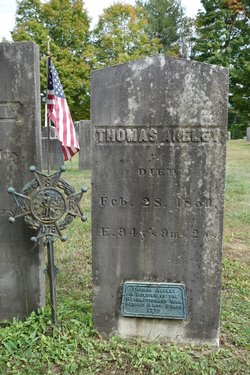
Thomas Akley settled in Brattleboro and married Abigail Wilder in 1783. They had fourteen children between 1783 and 1808. Abigail died in 1840. Thomas survived until 28 Feb 1850, dying at ninety-four. Shown above, courtesy of Find a Grave, is Thomas Akley’s gravestone in the West Brattleboro Cemetery.

TOMORROW: More Akleys.

Thursday, August 19, 2021

Francis Akley, Continental Ranger

When I started to focus on Joseph Akley, I also introduced his brothers: Francis, one year older, and Thomas, John, Samuel, and William, from three to seventeen years younger.

Samuel and William were so much younger, in fact, that Joseph never lived in the same household with them, being indentured out before he was born. (Joseph and William both grew up in Boston, so they might have known each other at least.)

The Boston Overseers of the Poor sent the other five brothers to new masters all over the province, as far west as Springfield and as far north as Topsham, Maine.

Those Akleys were young men and teenagers during the Revolutionary War. In 1775 only Joseph had married and started a family. Francis, Thomas, and John came of age before or during the war, meaning their apprenticeships ran out. They had no doubt built some personal ties in the communities where they grew up, but they didn’t have any relatives or property.

In sum, those Akley brothers were just the sort of young men the Continental Army was looking for. Just the sort of young men that towns were happy to grant a little bonus money and send off to fill draft quotas.

Indeed, all four of those Akley brothers joined the army, and, remarkably, all four survived long enough to apply for pensions in the early 1800s. By that time they had scattered across the northeastern U.S. of A. None of their applications described their family background or life in Boston before enlisting, but they stated their ages and the towns from which they enlisted, confirming that these are the right guys.

Francis Akley, Jr., baptized on 19 May 1751, was indentured to a cooper in Lancaster. After turning twenty-one in 1772 he moved to Guilford in what would be Vermont. In January 1777 he enlisted under Lt. David Goodnough in “an independant corpse of rangers mostly from New Hamps. at Tyconderoga commanded by Major [Benjamin] Whitcomb—and Capt. [George] Aldrich Company.”

Aldrich’s company fought in the Battle of Bennington on 16 Aug 1777. The only event Akley specifically recalled, however, was being “at the taking of Burgoyne” after Saratoga. He said he was discharged at Haverhill, New Hampshire, “I think in 1783.” Whitcomb’s Rangers actually disbanded at the start of 1781.

Francis Akley applied for a pension while living in Halifax, Vermont, in 1819. The following year he testified that he was seventy years old and his property consisted of “two Pigs—1 Jacknife & 1 old Pocketbook.” At that time, the law required veterans to show need before receiving any support.

The federal government granted Akley a pension. In 1829 he moved to Connecticut, and then in 1838 back to Vermont. Akley appeared on the U.S. government’s pension list in 1840, the year he turned eighty-nine.

The Vermont Mercury for 26 Mar 1841, published in Woodstock, carried a notice from the men commissioned to settle “Francis Akley’s Estate,” he being “represented insolvent.” They invited creditors to meet “at the dwelling-house of Lyman Akley in Plymouth,” most likely a descendant the veteran had been living with at the end of his long life.

TOMORROW: More Akley brothers’ service.

(The drawing above comes from the website of the reenacted Whitcomb’s Rangers and shows a soldier like Francis Akley.)

Wednesday, August 18, 2021

Joseph Akley as an Adult

Being sued for tarring and feathering a Customs officer wasn’t the only big event in Joseph Akley’s life in the spring of 1771.

On 16 May, still aged only nineteen, Joseph wed Margaret Durant, according to Boston’s list of intentions to marry.

I can’t find a record of what church the couple married in or anything more about Margaret Durant. But there’s no record of a child coming quickly.

Instead, the couple’s first recorded children were baptized at King’s Chapel:

  • Joseph on 5 May 1773.
  • Margaret, 12 Mar 1775. [Transcribed “Skeley” in some publications.]
Later there was Sarah, baptized 25 Oct 1778 at Trinity Church, when that was the only functioning Anglican church in town.

Massachusetts Soldiers and Sailors of the Revolutionary War lists only one “Joseph Akeley.” He did twenty-one days active service in Capt. Hopestill Hall’s company of Col. Lemuel Robinson’s Massachusetts militia regiment. That was in February 1776, when Gen. George Washington was desperate for any men to shore up the siege lines.

That “Akeley” was recorded as enlisting in Roxbury. But that would be consistent with the Akely family having left Boston after the war started. It’s also understandable that Joseph Akley, father of young children, didn’t go into the Continental Army full-time.
By the 1790s we see Joseph Akley listed as a hairdresser in the Boston directories. He owned real estate, having overcome the poverty of his early years.

Indeed, the Akley family seems to have gained a little stature. When Joseph’s mother, Tabitha Akley, died in 1790 at the age of seventy, her death was noted in newspapers across the state. Only twenty years earlier she had been in the Boston almshouse.

On 13 Nov 1794 the American Apollo reported this death:
At Point-a-Petre, Guadaloupet Mr. Joseph Akely, jun. of this town—a worthy young man, whose death is much lamented by his most cursory acquaintance, Æt. 22.
Presumably the Akleys’ oldest child was on some sort of mercantile voyage when he died.

On 1 Nov 1808, the New-England Palladium reported that the barber Joseph Akley had died the previous day at the age of fifty-six. His widow Margaret was appointed executrix.

The 1810 U.S. Census lists Margaret Akely living alone on Hanover Street in Boston. That could be the widow or her eldest daughter, unmarried.

TOMORROW: The Akely brothers at war.

Tuesday, August 17, 2021

“Informed against for his participation in the destruction of the tea”

In the late nineteenth century, the Boston historian Francis S. Drake collected lore about the Boston Tea Party from lots of families.

Drake published those stories, along with many documents, in the book Tea Leaves (1884). One entry read:
——— ECKLEY,

A barber, was informed against for his participation in the destruction of the tea, and committed to prison. The Sons of Liberty supported him while in confinement, and also provided for his family. He was finally liberated, and the person who informed against him was tarred and feathered, and paraded through the town with labels on his breast and back bearing his name, and the word “informer” in large letters.
Some books on the Tea Party repeated this information without adding to it. No one has brought forward more evidence to corroborate this oral tradition, even from places we should expect to find it.

People don’t get “committed to prison” for long enough to need outside support without getting put on records. We know royal authorities in both Boston and London were very eager to find out who organized the destruction of the tea. Gen. Thomas Gage and Adm. John Montagu even secretly transported Samuel Dyer across the Atlantic because they thought he had useful information. But no source at the time mentioned this barber or the dismissal of his case.

To tar and feather someone and parade him through town was also a highly public act. When a Boston mob abused John Malcolm that way in January 1774, it was widely discussed in both New England and Britain. That same period offers no record of a tarring and feathering connected to the Tea Party like this.

Here’s my theory: This is a distorted memory of Joseph Akley’s dispute with Owen Richards in 1770-71, attached to the Tea Party because by the mid-1800s that was Boston’s most famous and respectable Revolutionary protest, the one families wanted to have an ancestor participating in.

This lore reversed the order of events, and probably exaggerated Joseph Akley’s tribulations, but we can recognize those events from the story of the mobbing of Owen Richards.

First, we know Richards was tarred, feathered, and paraded around town. People called him an ”informer.“ He recalled, “they also fix’d a paper on my breast, with Capital Letters thereon, but [I] cannot Recollect what it contained.”

The tradition referred to “ECKLEY…A barber.” Joseph Akley, whose name was spelled many different ways, was a barber later in life, after the peruke wigs he was first trained to make went out of style.

There’s no evidence Akley was accused of helping to destroy the tea or locked up, but Owen Richards did accuse him of a crime and haul him into court in 1771. Boston’s Whig leaders, including John Adams, John Hancock, and newspaper writers, did get involved in fighting against Richards’s accusations.

I suspect that some stories about that documented dispute, overshadowed by bigger Revolutionary events, got passed down in the Akley family or circle. Over time they faded until people in the late 1800s didn’t even remember the barber’s name precisely. But they remembered something about tarring and feathering, and legal jeopardy, and help from the Sons of Liberty. They hung those baubles of memory off the larger story of the Tea Party, and Francis S. Drake conglomerated the “Eckley” story with the rest.

TOMORROW: Joseph Akley in the war.

Monday, August 16, 2021

When Owen Richards Sued Joseph Akley for Assault

My last posting about Joseph Akley argued that despite being indentured away from his impoverished family at the age of ten and seeing his master die five years later, Akley turned out okay.

But, Boston 1775 readers might ask, we started looking into young Joseph only because Owen Richards sued him for being part of a tar-and-feathers attack in May 1770. Might that suggest the teenager ran wild and got into trouble?

That’s still a possibility, but today I’ll argue that Akley’s relationship to his master’s family played into both how he got sued and how he got out of that jam.

To start with, let’s go back to the attack on Owen Richards. He was a tide waiter for the Customs service, involved in that department’s disputes with John Hancock in 1768. On 18 May 1770, Richards confiscated a Connecticut ship for smuggling, and that evening a mob came to his house.

It makes sense to assume that most of the people in that mob were sailors, waterfront workers, and others with a grudge against the Customs service. The most prominent person Richards sued for assaulting him was Joseph Doble, a sea captain and son of a sea captain.

A teen-aged wigmaker like Joseph Akley could have joined that crowd, but he wouldn’t have led it. Why, then, did Owen Richards single out Joseph as another of only three people he sued for assault?

My answer starts in 1758 when peruke-maker Timothy Winship’s daughter Margaret, aged twenty-three, married John Gregory at King’s Chapel. Nine months later the couple returned to that church for the baptism of their first child, John.

There were three sponsors at that baptism. One was the mother’s older sister, Sarah. Back here I guessed that she was helping to manage the Winship household and her younger siblings after her mother’s death.

Another sponsor was Owen Richards.

Thus, Richards was close to members of the Winship family. He may well have met the indentured boy who arrived in the peruke-maker’s house in 1762, seen him grow up at church, and even attended the master’s funeral.

I theorize that Richards sued Joseph Akley not because that teenager was a leader of the tar-and-feathers mob but because he recognized the kid’s face.

We don’t have many records of that lawsuit, but we know who represented Akley and his fellow defendants in court: John Adams. He collected fees of 12s. and 48s. for defending the teen, more than twice what he charged Joseph Doble.

Beside the second payment Adams wrote: “at Elizabeth Winship’s Instance.” That was Timothy Winship’s widow, who had raised Joseph Akley since 1762 and was evidently still looking after him.

TOMORROW: A barber at the Tea Party?

Sunday, August 15, 2021

Sir George Collier and the Digital N.D.A.R.

Last month I wrote about a Royal Navy commander named George Collier and his capture of the U.S.S. Hancock.

In the late nineteenth century the Dictionary of National Biography published an entry on Collier that said:
In 1775 he seems to have been sent to North America on some special service, the circumstances of which have not been chronicled, but which obtained for him the honour of knighthood.
That’s intriguing! Of course I want to know what Collier’s special mission was.

More Than Nelson states that King George III knighted Collier on 27 January, indicating he’d sailed to North America in 1774. But still no clue about why.

I held out hope that the Naval Documents of the American Revolution project, launched in 1964, dredged up the answer. The first volume even starts in 1774. But alas, Collier doesn’t come on board until December 1775 when the Admiralty gave him command of H.M.S. Rainbow.

But some good news: Looking for that source led me to the Naval Documents of the American Revolution Digital Edition, which offers fully searchable files of the existing thirteen volumes. (In addition, the Naval History and Heritage Command Center offers P.D.F. files of those same volumes.) This is an excellent resource for researchers.

And now for the bad news: Volume 13 of the N.D.A.R., published in 2019, leaves off on 15 Aug 1778. The French fleet has barely entered the fray, and the Spanish are yet to appear.

The process of assembling, transcribing, annotating, and editing sources related to the war at sea continues. The first five volumes of the N.D.A.R. were published over a span of seven years (1964-1970) while the last five took forty-two years (1977-2019). Since information technology improved tremendously in those same decades, the volumes could be coming out more quickly if the project had the same level of staffing as in its earliest years. And that’s a matter of the federal budget.

There are still five years of the Revolutionary War to get through. Indeed, the last phases of the war after Yorktown were primarily fought at sea between the navies of the European great powers. Would it be possible for the N.D.A.R. volume covering the Battle of the Saintes to appear by the Sestercentennial of that event in 2032?

Saturday, August 14, 2021

Call for Papers on the Long End of H.M.S. Gaspee

The Rhode Island Historical Society and Newport Historical Society have issued a call for submissions for a combined issue of their journals on the theme of “The Bridge: The Gaspee Affair in Context.”

The call says:
Prior to the end of the Seven Year’s War in 1763, the British colonies had enjoyed what historians often called “salutary neglect,” which had enabled economic and political development with little interference from the crown for nearly a century. After 1763, the British government took advantage of a period of European peace to overhaul the empire, seeking tighter control and more revenue, especially from North America. The late 1760s saw a series of acts which sent shock waves through the colonies and sparked various forms of colonial opposition. One such instance in Rhode Island was the Gaspee Affair.

On June 9, 1772, the British customs schooner HMS Gaspee ran aground on a sandbar at what is today known as Gaspee Point, Warwick, Rhode Island. The Gaspee had been chasing the Hannah, a packet vessel that had evaded the empire’s customs duties at Newport. At Providence, the Hannah’s captain Thomas Lindsey notified merchant John Brown of the Gaspee’s compromised position.

Mobilizing other merchants including Simeon Potter, Joseph Tillinghast, Ephraim Bowen, and Abraham Whipple in protest of the empire’s customs duties, Brown instigated a mob, including artisans, merchants, and several enslaved people, to attack the beached Gaspee. At dawn on June 10, the rioters boarded the Gaspee, shot the vessel’s captain, forced its crew to abandon ship, seized the vessel’s documents, and set the vessel ablaze.

Since the Revolution, Rhode Islanders have commemorated the Gaspee Affair as one of the earliest watersheds of the movement toward American independence.

We seek article submissions which re-contextualize the Gaspee Affair within the broader imperial crisis of its era, with a focus on such topics as other acts of colonial resistance to the crown prior to the Boston Tea Party; a better understanding the Gaspee Affair within the development of global capitalism; situating the role of enslaved and indigenous people in forms of colonial resistance in Revolutionary War period; examining the ways in which the Gaspee has been remembered, reconstructed and recast in various moments of American history; and a better understanding of how communication about pre-war acts of resistance helped to form regional identities that carried into the New Republic period.
Articles should be 5,000 to 7,000 words long with citations in the Chicago style. Deadline for submission is 15 Jan 2022. Articles will go through peer review and revision before being published in the spring. For other details on how to submit, see the call webpage.

Friday, August 13, 2021

“Play up the Yankee Doodle tune”

This series started with a letter from three of Boston’s wardens reporting an incident of martial music played on Sunday, 11 June 1769.

As I’ve been quoting, the Boston Whigs complained about that noise disrupting church services almost since army regiments arrived in town the previous October. That incident wasn’t the only conflict.

The Whigs’ “Journal of the Times” addressed the event the wardens wrote about, but not until the dispatch dated 24 July 1769, or six weeks afterward. That dispatch said:
Some Sabbaths past, as the guards, placed near the Tavern-House, were relieving, there was a considerable concourse of people, chiefly boys and Negroes to partake of the entertainment given by their band of music;

the wardens having by their laudable exertions dispersed the rabble, soon perceived that Mr. John Bernard, our Governor’s second son, had made one among them, and still kept his standing; upon which they very civilly accosted him desiring that he should walk off, lest his being suffered to remain, should give occasion for their being taxed with partiality in the execution of their trust;

Mr. Bernard then seemed to be walking away, when Capt. M—s—h, who commanded the guard, called to him, desiring that he would come into the square, where he should be protected from the wardens; the young man accepted of so pressing and polite an invitation; but the wardens called to him as he was going into the square, praying him to desist, as they would otherwise be put to the disagreeable necessity of returning his name to a magistrate, the Monday following;

upon that the officer of the guard, in a sneering manner, called upon the musicians to play up the Yankee Doodle tune, which compleated the conquest of the military, and afforded them a temporary triumph.

The wardens made good their promise, and discharged their duty, by entering a complaint with a magistrate, against Mr. Bernard, for breach of Sabbath, when he was convicted, and punished agreeable to law.
The wardens’ letter referred to “a Young Gentleman an Inhabitant of the Town,” but this newspaper item makes clear that man was John Bernard (1745-1809), son of Gov. Francis Bernard. He had served as his father’s personal secretary and then set himself up in business. In early 1770 he was one of the handful of merchants who defied the nonimportation agreement.

The wardens spelled out the name of “Capt. M—s—h,” letting us identify him as Ponsonby Molesworth of the 29th Regiment. In April he had eloped with fifteen-year-old Susannah Sheaffe, beautiful daughter of a Customs official, but then they came back to town to start life as a married couple.

The wardens’ letter said Molesworth ordered the regimental musicians to play “the Yankee tune.” The Whigs’ article confirms Lance Boos’s guess that meant “Yankee Doodle.” However, in his essay on the letter for the Massachusetts Historical Society’s blog, Boos interpreted the tune as intended to insult the “Young Gentleman.”

The “Journal of the Times” item shows that in fact the officers saw themselves as protecting Bernard’s right to enjoy the army music, and they called for “Yankee Doodle” as a way to defy and insult the wardens. In Boston’s political conflict, the governor, Customs officials, the army, and their family members were allies.

On the other side, wardens Thomas Walley, John Joy, and Henry Hill had the responsibility to ensure people observed the Sabbath, a reflection of Boston’s Puritan traditions. They couldn’t order the army to keep quiet; they and the selectmen could only make requests of the army commanders. But they could charge “an Inhabitant of the Town” like young Bernard with violating the Sabbath by not going home when they asked him to.

It’s interesting to note that in 1774 warden John Joy (1727-1804) became a Loyalist, probably inspired by his past military service to the Crown. His namesake son returned to Boston after the war and gave his name to Joy Street on Beacon Hill.

Thursday, August 12, 2021

“Opportunity of hearing NANCY DAWSON”

As I described yesterday, in late 1768 Boston officials became concerned about the army regiments in town playing music on Sundays.

That music was a normal aspect of changing the guard. The garrison’s main guard was at the center of town, near the Old Brick Meeting-House.

By early December, that dispute nearly led to violence as soldiers chased away local youths who “behaved so as to displease the officer” in charge.

At the end of the year, the town’s highest elected officials complained directly to the officer commanding the four regiments:
Yesterday the Selectmen, waited upon General [John] Pomeroy, to acquaint him that the music of the fife, &c. on the Sabbath, was very disagreeable to the inhabitants, and might have an ill effect upon the younger and more thoughtless part of the community, with respect to the observance of that day; and as they apprehended it contrary to law, they expressed their hopes and desires that it might be omitted for the future, as they had taken notice it had sometimes been in stormy weather…
The selectmen also used the occasion to complain about sentries challenging civilians who passed their guardhouses and stations, as soldiers were ordered to do. Why did a British town at peace need sentries? Mostly to stop men from deserting from the army.  

The selectmen’s request had no effect according to the Whigs’ “Journal of the Times” dispatch for 1 Jan 1769.
The soldiery are obliged, the Lord’s day not excepted, to attend twice or thrice a day at the calling of the rolls. . . . The noise of the fife was this day more general and offensive than it has been upon any Sabbath, since the troops came among us.
But then the “Journal of the Times” didn’t mention military music again for over four months. (Or rather, the writers confined their complaints to a reportedly violent officers’ ball and the 29th Regiment’s black drummers.)

The issue of music on Sundays returned on 15 May:
Yesterday, but before divine service began, part of the town had opportunity of hearing NANCY DAWSON from a most elegant band of music, the French horns certainly were inimitable.—

It is some time since we have had such a Sunday morning’s regale, the drums and fife, being the common entertainment, and ‘tis uncertain to whose taste we owe this: Some think it the fancy of Madam G——m, while others think that the Justice himself conceived it might be an agreeable relief to the wardens under the burthen of their duty.
While fifes and drums were standard instruments for military musicians, many regimental bands had indeed expanded into French horns and oboes.

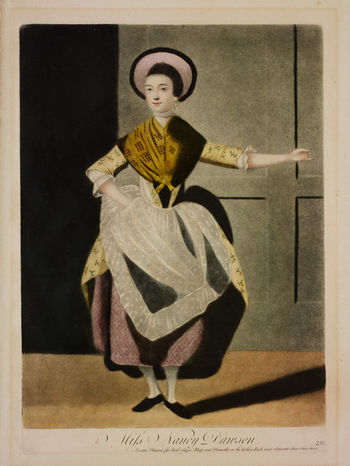
As for the allusions in that passage, Nancy Dawson (shown above) was a British actress and dancer who died in 1767. The hornpipe titled “The Ballad of Nancy Dawson” became very popular in the British Empire. That melody was also known as “Piss on the Grass,” and is now most easily identified as “Here We Go Round the Mulberry Bush.” (Boston’s youth also referred to the boys who dressed in women’s gowns and danced around the effigies during Pope Night processions as “Nancy Dawsons.”)

Finally we come to “Madam G——m” and “the Justice himself.” Dr. Samuel Gillam was a justice of the peace in Surrey, England. In May 1768 he authorized soldiers to disperse a crowd gathered to support John Wilkes, killing six or seven people. Whigs across the Empire viewed that “Massacre at St. George’s Fields” as an example of tyranny. Gillam was even tried for murder, but acquitted.

Earlier in their “Journal of the Times” the Boston Whigs had reported that ”the G——r had nominated and appointed the J—s M——y already noticed in this Journal, as one of his Majesty’s justices of the peace.” That is, Gov. Francis Bernard had made the Scottish-born merchant James Murray a magistrate. The Whigs warned, “the G——r will not now want a Justice Gillam.” In other words, Bernard now had an appointee willing to read the Riot Act and unleash troops on civilians.

The Whigs’ reference to “Madam G——m” and “the Justice himself” thus meant James Murray and his second wife, the former Margaret (Mackay) Thompson. According to Patricia Cleary’s biography of James’s sister, Margaret Murray was known in the family for enjoying the social whirl. That might be why the Whigs dragged her into this little controversy.

TOMORROW: Confrontation in June.

Wednesday, August 11, 2021

“Martial music on the Sabbath”

Back in December 2019 Lance Boos, working on a fellowship at the Massachusetts Historical Society, shared and analyzed a 17 June 1769 letter from Boston’s wardens to Col. Alexander MacKay, senior army officer in town.

The letter concerned an incident the preceding Sunday, six days before. A military band was playing that morning around the time of church services (which of course extended over most of the day).

More specifically:
a Young Gentleman an Inhabitant of the Town, appeared at ye relieving of ye Main Guard who being desired by one of ye Wardens to retire showed a willingness to Comply, but Capt. [Ponsonby] Molesworth of ye 29th Regiment, who was Capt. of ye Guard that was to be relieved, & an other officer Came to him & Insisted upon his tarrying to hear the Musick, Saying he would protect him, & Immediately ordered the fifes to play (in derision, as we Suppose,) what by them is Commonly Called ye Yankee Tune.
The three town officials who signed this letter—Thomas Walley, John Joy, and Henry Hill—then asked Mackay to order the troops not to play music during guard changes on Sunday any longer. As wardens, they had civic responsibility to keep the peace on the Sabbath.

We can find more context for this incident in the “Journal of the Times” reports that Boston’s Whigs dispatched to newspapers in other colonies to complain about the army presence in their town. The historian Oliver Dickerson collected and published those articles with the title Boston Under Military Rule.

The Whigs complained about martial music on Sundays starting soon after the regiments landed, with the first complaint dated 6 Nov 1768:
This being Lord’s day, the minds of serious people at public worship were greatly disturbed with drums beating and fifes playing, unheard of before in this land—What an unhappy influence must this have upon the minds of children and others, in eradicating the sentiments of morality and religion, which a due regard to that day has a natural tendency to cultivate and keep alive.
Yes, think of the children! About a month later, as of 4 December, the army seemed to accommodate the local authorities’ wish for peace and quiet:
It is observed with pleasure that the guards are now relieved on Lord’s day morning one hour earlier than on other days, which allows the soldiery to attend public worship in season; that there is now much less martial music on the Sabbath then has been heard since the first arrival of the troops.
But within a couple of weeks, the problem came to be martial music when the meetinghouses let out, and once again children were at risk:
Last evening after church service, there was a considerable gathering of children and servants, near the Town House, drawn by the music of the fife, &c. which is again heard on the Sabbath, to the great concern of the sober and thoughtful inhabitants; some of the youth’s having behaved so as to displease the officer, orders were given the guard to clear the parade; they marched up with bayonets presented,—one of the lads was pursued by a soldier to some distance, who made a thrust with his bayonet, which passed thro’ his coat, and had he not thrown himself on the ground that instant, its thought he would be run thro’ the body: He has entered a complaint against said soldier, with one of the magistrates of the town.
This passage repeats a common Whig trope, blaming disorder on “children,” “servants” (i.e., enslaved people), and “youth’s,” as opposed to “the sober and thoughtful inhabitants” who truly represented the town.

On the one hand, the dispatch said, young people lacked the judgment to resist gathering for the music. Even when they expressed their opposition to the soldiers, they did so through misbehavior instead of, say, formal complaints to the army and newspaper essays.

The result proved the Whigs’ main message: the presence of soldiers in the crowded town led to violence, and the London government should have foreseen that. And of course, when describing military abuse, a child was always a useful victim.

TOMORROW: This conflict continues.

Tuesday, August 10, 2021

Remembering Another John Paul Jones

It recently came to my attention that a lot of quotation websites list the following under the name of John Paul Jones of the Continental Navy:

If fear is cultivated it will become stronger. If faith is cultivated it will achieve the mastery. We have a right to believe that faith is the stronger emotion because it is positive whereas fear is negative.
Jones might indeed have spoken about fear, I thought, but where would he have recorded his ideas about faith? Why would he express himself in such short, twentieth-century sentences? And what eighteenth-century thinker would refer to faith as an emotion?

Some tactical Googling revealed the answer. These words appeared in Forbes Magazine in 1952, attributed to “John Paul Jones, D.D.”—no doubt the longtime minister at the Union Church at Bay Ridge, Brooklyn.

The Rev. Dr. Jones previously made Time magazine with a dramatic anti-Nazi sermon in 1939. In the year after the quotation’s appearance in Forbes, Jones had prompted a controversy over “the social gospel” by preaching on “Religion, Patriotism, and Communism.”

That prompted some grumbling in the congregation, and in June 1954 Jones suddenly announced his resignation. At first he told the New York Times in June that the kerfuffle over his sermon had nothing to do with his decision, but the next month the newspaper reported the minister had rescinded his resignation after the congregation “cleared up” just that situation by a vote and letter in his favor.

As Jones then described it, the controversy was whether Union Church “should be a ‘liberal’ church, whose minister and program represent a social as well as a personal gospel, seeking to interpret spiritual principles and obligations in relationship to the economic, political and human relations problems in a controversial age and society; or should ‘stick to the Bible’ and avoid controversial matters such as, to quote one letter, ‘your racial equality.’”

The Union Church at Bay Ridge now remembers Jones this way:
Dr. John Paul Jones (1931) was a man ahead of his time, who often spoke on labor and other seminal issues that defined the first part of the century. He sometimes exchanged pulpits with a minister from Bedford-Stuyvesant and with a rabbi. He was a dramatic, gripping preacher and one of the first civil rights activists.
Jones finally left the pulpit in 1956 after a quarter-century.

Just to confuse matters, Bay Ridge has a John Paul Jones Park, but that’s named after the Continental Navy commander. It includes a 1916 monument to “the first resistance made to British arms in New York state” in August 1776 and a 1980 flagpole honoring Capt. Jones. 

Monday, August 09, 2021

Making History at the Local Level

Last month the American Association for State and Local History published Making History at 250: The Field Guide for the Semiquincentennial.

Boston 1775 readers know we prefer the synonym Sestercentennial, but we certainly support the widespread commemoration of the 250th anniversary of the American Revolution.

The A.A.S.L.H. describes its new resource as offering “guiding themes and inspiring ideas to help you prepare for 2026”—you being a state or local history organization. “Whether you’re already planning or are still unsure if you’ll take part, this publication will help all of us fulfill the potential of this anniversary.”

The organization also appears to be building its contact list of organizations interested in the Sestercentennial, asking people to fill out the brief form on this page to download the guide.
It further says:
We are monitoring national, regional, and state commemoration plans as they develop, serving as a clearinghouse of information for history organizations and practitioners at the local, state, and national levels. We are publishing resources to help guide commemoration planning, like webinars, blog posts, and other publications. We are in communication with other national initiatives, including the U.S. Semiquincentennial Commission, to help ensure that the values and goals of the history community are represented well in national commemoration efforts.
Ahead of 1976, a lot of Bicentennial event planning was pushed onto local and state organizations because the Nixon administration was consumed with other matters. I think that actually worked out well, with lots of local history publications and bottom-up initiatives. With increased communication, small organizations now have the potential to connect directly and to reach broader audiences.

Sunday, August 08, 2021

“Dr. Franklin, Citizen Scientist” Exhibit in Philadelphia

The American Philosophical Society Library & Museum in Philadelphia has just opened an exhibit titled “Dr. Franklin, Citizen Scientist.” The facility is open at a limited capacity for public safety.

The exhibit description says:
Taking inspiration from Benjamin Franklin’s commitment to the pursuit of knowledge for the “Benefit of Mankind in General,” Dr. Franklin, Citizen Scientist considers the relationship between science and public life in the 18th-century Atlantic World.

The exhibition examines the production, circulation, application, and accessibility of scientific knowledge through the life and work of Benjamin Franklin. Throughout, it highlights lesser-known contributors to the scientific enterprise and the various spaces where science was performed. The exhibition connects Franklin's scientific pursuits to contemporary issues in science and society.
Among the items on display are a first edition of Franklin’s Experiments and Observations on Electricity, a set of Leyden jars said to be part of his electrical experiments, his chart of the Gulf Stream, and the only-known portrait of his wife, Deborah Franklin.

Franklin probably started to experiment while he was still a kid in Boston, as he described in a letter preserved only in its French translation. Google says Franklin wrote something like:
In my youth, I made myself two small oval paddles, each about 10 inches long, by 6 wide, with a thumb hole through them to hold it applied to the palm of my hand. They looked rather like painter’s palettes. While swimming, I pushed them forward edgewise, and I struck the water with their flat surfaces as I pulled them back. I remember very well that I swam faster by means of these paddles, but they tired my wrists.

I had also made some kinds of soles to apply to the bottoms of my feet, but I was not happy, because I observed that the blow is partly given with the inner side of the feet and ankles, and not just with the bottoms of the feet.
The A.P.S. has also recently published an illustrated book about Franklin’s lifelong interest in swimming by Hunter College professor Sarah B. Pomeroy.

Saturday, August 07, 2021

“How Americans Fought the Stamp Act with Memes,” 9 Aug.

On Monday, 9 August, I’ll deliver an online talk to the Paoli Battlefield Preservation Fund on “How Americans Fought the Stamp Act with Memes.”

Here’s our event description:
The word “meme” is a modern coinage expressing how ideas replicate, spread, and mutate like genes, and the conflict over the Stamp Act shows memes at work in the Revolutionary era.

When news of the new tax arrived in North America in the spring of 1765, it produced an unprecedented wave of protests. Colonial politicians and printers promoted that opposition with slogans like “Sons of Liberty,” repurposed images like the “Join, Or Die” snake, and a radical new form of outdoor political protest that edged into riots. As those activities spread from colony to colony, they created the first continental resistance to imperial policy.

How effective was the anti-Stamp campaign, what problems did it cause colonial leaders, and what new ideas did it establish for the next imperial dispute?
I’m still honing my talk, but it could take in fake news about Patrick Henry, Benjamin Franklin’s bad timing, and Richard Henry Lee leading a procession of his slaves while dressed as a clergyman.

Sign up for this event here, and learn more about the Paoli Battlefield while you’re at it.

Friday, August 06, 2021

What Would Become of Young Joseph Akley?

wigmaking tools from Diderot's Encyclopedie
When Timothy Winship died at the end of 1767, the apprentice he’d taken in for Boston’s Overseers of the Poor, Joseph Akley, was fifteen years old.

Though Joseph had been living with and working for the peruke maker for five years, he was still five years short of his majority.

He didn’t have the legal standing, and he probably didn’t have all the skills, to set up his own shop.

Joseph did have parents nearby in Boston. However, that family had its own troubles. In the spring of 1768, three younger Akley children were admitted into the alsmhouse, to be bound out to masters outside Boston by the fall.

So what happened to Joseph? I haven’t found many clues from the next few years, and that’s a good thing. Because Joseph did not reappear on the Overseers of the Poor records, unlike his parents and his brother Thomas.

It seems likely that Joseph was a bright lad. Winship chose him as an apprentice ahead of his older brother, and for a profession that required social graces.

Furthermore, the Winship shop was still a going concern when the peruke-maker died in 1767. Timothy Winship still had his shop and his tools. His estate owed wages to George Bellamy, presumably a journeyman.

As executrix, the widow Elizabeth Winship collected on debts; paid off creditors like Bellamy, landlord Hugh Hall, Dr. Nathaniel Perkins, and Dr. Joseph Warren; and came out ahead. She still had her husband’s goods and a pew at King’s Chapel. She continued to sponsor friends’ baptisms there.

I suspect that Elizabeth Winship or other wigmakers in her husband’s circle saw potential in Joseph, already partly trained, as well as an obligation. Someone kept him on as an apprentice, but because that was a private arrangement we don’t know who.

The biggest clues about how Joseph Akley weathered the death of his master is how he appeared in Boston records after the Revolutionary War. As of 1796, he was established as a hairdresser on “Hanover street, corner Wing’s Lane.” He owned a little real estate.

Furthermore, in adult life Akley was an Anglican/Episcopalian. His parents were Congregationalists, like most Bostonians, but he joined the denomination of the Winship family. That suggests how much influence his apprenticeship had on him.

No doubt Joseph Akley faced some challenges after Winship’s death. Being sued for tarring and feathering a royal official was one. Joseph may have had to grow up quickly. He married in May 1771, a few weeks short of his nineteenth birthday, and was a father before he turned twenty-one. But he was able to support that family with the skills he learned.

COMING UP: What about that lawsuit?

Thursday, August 05, 2021

What Timothy Winship Died With

When peruke-maker Timothy Winship died, he made his third wife, Elizabeth, his executrix.

Late in 1767 she filed an inventory of her husband’s property with the probate judge, Thomas Hutchinson (who was also Massachusetts lieutenant governor and chief justice of the superior court).

Winship wasn’t a rich man. He owned no real estate, and a lot of his goods were assessed as common or old. On the other hand, his household had touches of gentility: four feather beds and four pillows, a “Square Mahogany Table,” two pictures under glass, two wineglasses and a decanter, six teacups and saucers, a silver watch.

Required by law to serve in the militia, Winship owned two guns with bayonets and two swords.

The inventory listed Winship’s books:
  • “1 Bible” (3s.)
  • “Hervey’s Life and Letters, 2 books, 1 lost” (4s.), probably Collection of the Letters of James Hervey, to which is prefixed an account of his Life and Death, by Thomas Birch (1760, reprinted in Boston two years later by Zechariah Fowle and Samuel Draper). The Rev. James Hervey (1714-1758) was an Anglican theologian. 
  • “Life and Reign of Queen Ann” (2s.8d.), probably Abel Boyer’s History of the Life and Reign of Queen Anne (1722).
  • “1 Companions the Feasts & Fasts of the Church of England” (2s.8d.), or Robert Nelson’s A Companion for the Festivals and Fasts of the Church of England (1704), which Brent S. Sirota describes as “arguably the most popular and important Anglican devotional work of the eighteenth century.”
In her study of colonial New England probate inventories from 1774, Alice Hanson Jones found that only the top fifth of inventoried estates contained non-religious books. Winship’s book about Queen Anne was therefore unusual.

Another page of Winship’s inventory detailed what the assessors found in his shop. So this is what you might find walking into a middling peruke-maker’s workspace in 1767 Boston:
  • “6 ounces of white Horse hair @ 1/6”
  • “3 lb. Brown ditto 16/ p lb.”
  • “1 lb. Grey & Brown”
  • “18 oz. Goat ditto 2/ p oz.”
  • “7 oz. Mo. Grown hair”
  • “4 Blocks @ 6/”
  • “1 Card & brush 8/”
  • “1 pr. brushes 3/”
  • “1 doz. Razors @ 7/”
  • “1 Hone”
  • “7 Wiggs @ 12/”
  • “7 1/2 Pewter More [?] @ 10”
  • “1 Looking Glass”
  • “1 Lamp Lanthorn”
  • “1 Table”
  • “2 old Chairs”
  • “1 Round Do.”
All told, Winship’s tools and inventory were worth a little less than £14.

TOMORROW: Where did Winship’s death leave young Joseph Akley?

Wednesday, August 04, 2021

Timothy Winship, Peruke Maker of Boston

Yesterday I described how in October 1762 the Boston Overseers of the Poor indentured ten-year-old Joseph Akley to a man named Timothy Winship.

The Akley family was falling on hard times. In the following years Joseph’s parents would end up (separately) in the Boston almshouse, and most of his siblings would be bound out to other households across the province, from Springfield to Maine.

Joseph’s placement was unusual in several ways. He was the first Akley child to be apprenticed even though he wasn’t the oldest. He remained in Boston instead of being sent to a smaller town. And he was to learn a trade that catered to the genteel class rather than housework or making wheels and barrels.

Timothy Winship was a “peruke maker,” meaning he made wigs and shaved gentlemen so they looked good wearing them. In an eighteenth-century British seaport, that meant steady work.

There are two genealogical sources of information about Timothy Winship. One consists of the records of Boston and its Anglican churches. The other is the Barbour Collection’s index of vital records from Middletown, Connecticut, even though there’s no sign Timothy Winship ever lived in that town. I’m guessing that descendants settled there and inserted their family’s backstory into the local record.

According to the Barbour Collection, Timothy Winship was born on 3 May 1712 in Westminster, England. That’s close but not an exact match to the Boston report that he was fifty-seven years old in 1767. Not being from an old, Puritan New England family explains why he was an Anglican.

Boston records state that Winship married Margaret Mirick of Charlestown on 5 Aug 1731, with the Rev. Hull Abbott of that town presiding. The bride appears in the Connecticut data as Margaret Merrick. Their children listed in the Middletown records were:
  • Samuel, born 3 May 1732
  • Sarah, 20 Jan 1734
  • Margaret, Nov 1735
  • Timothy, 3 Dec 1737
  • Joseph, 2 Oct 1739
  • John, 30 Mar 1742
  • Jacob, 6 Jan 1744
  • Anna, 26 Apr 1746
Of those, King’s Chapel recorded baptisms of Timothy, Jr., on 30 Dec 1737; Joseph on 12 Oct 1739; and Jacob on 9 Feb 1744.

Timothy Winship never advertised in Boston’s newspapers, but there are signs that he became an established tradesman. He owned an enslaved man named Caesar, who on 23 Sept 1742 married a free black woman named Margaret Codner at Old South. That same year, Winship took in a couple as tenants from Cambridge, which we know because Boston cited him for not informing the selectmen. In 1748, the Boston town meeting elected Winship as one of the Scavengers responsible for keeping the streets clean.

The peruke maker also suffered losses. Margaret Winship died “about one hour after birth of Anna,” the couple’s youngest, according to the Barbour Collection. King’s Chapel records state that Timothy Winship’s wife was buried on 29 Apr 1746.

A little less than a year later, on 9 Apr 1747, Timothy Winship married Sarah Rogers at King’s Chapel. That was none too soon because the couple had a son, William, baptized less than eight months later on 28 November. A second son, Benjamin, was baptized on 1 Jan 1750.

Sadly, that new Winship family did not thrive. William died before age seven and was buried from the new King’s Chapel building on 1 June 1754. Timothy’s wife Sarah died on 23 Jan 1755 at age thirty-eight. Their surviving son Benjamin died on 10 Jan 1758 at age eight. (The Connecticut records say nothing about this family.)

This time, Timothy Winship found a new wife even more quickly. On 25 Aug 1755, seven months after becoming a widower again, he married Elizabeth Vila of Watertown at Christ Church in the North End. I see no sign of Timothy and Elizabeth having more children of their own.

Thus, when Timothy Winship took in Joseph Akley in 1762, the peruke maker was about fifty years old and thrice married. His youngest surviving child, Anna, was in her mid-teens. His oldest, Samuel, had married Sarah Miller of Glastonbury, Connecticut, in October 1758 and had twin girls with several more kids on the way.

We can see in the King’s Chapel records that Timothy Winship and his wives were in a network of other Boston Anglicans, sponsoring the baptism of each other’s babies. Notably, on 6 Sept 1765 Timothy, Elizabeth, and Timothy’s daughter Sarah all sponsored the baptism of a baby born to James and Mary Vila, probably from Elizabeth’s family.

That eventful year of 1765 brought big changes to the family. The brothers Timothy, John, and Jacob Winship all died in their twenties. On 28 October, Sarah Winship married Nicholas Butler, a twenty-seven-year-old barber, at King’s Chapel. As the eldest daughter, she had most likely shouldered the household and childrearing responsibilities after her mother had died. Now, at age thirty-one, she was leaving to start a family of her own.

On 3 Mar 1767, Timothy Winship wrote out his will. He declared that he was in good health but wanted to tend to his business and his soul. Owning no real estate, he left all his personal property “unto my Beloved Wife Elizabeth Winship,” to be shared after her death among his children Samuel, Joseph, and Anna Winship. For Sarah Butler, about to give birth to her first child, Winship left only five shillings, to be paid out after her stepmother’s death.

On 12 Nov 1767, Timothy Winship, “Peruke Maker,” was buried out of King’s Chapel.

TOMORROW: A wigmaker’s estate.

Tuesday, August 03, 2021

The Poor Akley Family

Back in April, I started to look into the men Owen Richards sued for tarring and feathering him on 18 May 1770.

The first and easiest to track was Joseph Doble, both because he came from a fairly prominent maritime family and because he spelled his name only two ways.

The next name on my list, Joseph Akley, has been more difficult. I’ve found his family name spelled Akly, Akeley, Aikley, Aykley, and even Heakley. In later life he used Ackley, but his mother and his widow chose other forms. One influential source appears to have remembered him as Eckley. I’m going to stick with Akley just because I’ve already created a label for him under that spelling.

Joseph Akley’s story starts on 8 June 1750 when the Rev. Dr. Joseph Sewall married Francis Aikley (or Akley) and Tabitha Bull (or Buell) at Old South. I can’t find any period mention of Francis Akley’s profession. [ADDENDUM: It looks like he was a wheelwright.]

Francis and Tabitha started to have children on a regular basis. According to the New South Meeting-House records, its minister baptized:
  • Francis, Jr., on 19 May 1751
  • Joseph, 5 July 1752
  • Tabitha, 9 Dec 1753
  • Thomas, 25 May 1755
  • John, 4 Sept 1757
  • Sarah, 25 Mar 1759
  • Mary, 18 Jan 1761
  • Samuel, 13 May 1764
In addition, there was a William born in 1769.

The Akleys had trouble caring for all those children, which provides a second set of records about them—from Boston’s Overseers of the Poor.

The first sign of the family intersecting with those town officials was on 14 Oct 1762 when Joseph, aged ten, was bound out to Timothy Winship of Boston until 10 June 1773, which would be when he turned twenty-one.

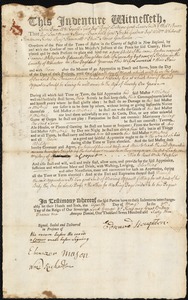
The following May, older brother Francis was indentured to Edward Houghton of Lancaster until 16 Mar 1772. He was to be trained as a cooper. That indenture appears above, courtesy of Digital Commonwealth.

The next year, the family needed more support. On 5 Jan 1764, Overseer Benjamin Dolbeare authorized the almshouse to take in “Tabitha Akley And 4 Children.”

In October the Overseers indentured the other two Akley boys. Thomas was sent to the Rev. Jason Haven of Dedham, probably as a household servant, to serve until 3 Oct 1777. This relationship was legally renewed on 6 Feb 1771 and then again in duplicate on 6 Nov 1771. Perhaps the Akleys or Haven grew dissatisfied and ended the arrangement but then went back to it. 

On 11 Oct 1764 the Boston Overseers bound seven-year-old John Akely out to Samuel and Lucy Williams of Springfield to work until 1 Apr 1779. Williams was identified as a gentleman, and he didn’t promise to teach John any trade, just “to Read Write & Cypher,” which suggests the boy was to be a household servant. Williams also promised to give John £13.6s.8d. when he came of age. The Akley children were being dispersed far across the province.

For the next four years the diminished family appears to have eked by, but on 1 Apr 1768 Overseer John Bradford sent “3. Children of Francis Akley” to the almshouse. Those three children were sent out of town in the following months:
  • In May, nine-year-old Sarah Akley was bound out to Joshua Clap of Scituate to learn housewifery until 1 Mar 1777.
  • In June, four-year-old Samuel was sent to John Merrill of Topsham, Maine, to be trained as a wheelwright until 17 June 1785.
  • In September, seven-year-old Mary was indentured to Edward Russel of North Yarmouth, Maine, to learn housewifery until 20 Dec 1780.
On 11 Aug 1769, “Tabitha Akley & Child” came into the house “from Workhouse.” On 20 August, Overseer Samuel Partridge sent “Willm. Akley a Child” there.

About a year later, on 17 Sept 1770, Overseer Royall Tyler authorized “Tabitha Akley & Child” to be admitted into the almshouse, and on 26 October Joseph Waldo did so again. On 7 Feb 1771, Edward Richardson “Discharg’d Tabitha Akley to Workhouse.” (This might have been the daughter Tabitha, who turned eighteen that year.)

On 16 Sept 1772, Overseer John Leverett admitted the father Francis Akley into the workhouse, designating him as “Lame.” On 23 Oct 1773 Tabitha Akley was moved from the workhouse to the almshouse by order of Overseer Samuel Whitwell.

The last mention of the family in the surviving Overseers of the Poor records came when those officials bound out William Akley from 6 Oct 1774 to 15 Feb 1790 to learn navigation from Capt. Shubael Downes. Back-calculating from his date of majority, William was then five years old; he had first entered the almshouse as an infant.

TOMORROW: Joseph Akley’s new master.

Monday, August 02, 2021

Podcast Episodes to Search Out

I subscribe to several podcasts dedicated to Revolutionary history (broadly defined).

I also listen to several podcasts that range more widely in topics but every so often land in the eighteenth century.

Here are a few recordings from the latter group that I’ve found interesting in recent weeks.

At HUB History, Jake Sconyers recounted “The Liberty Riot” of 1768, “Three Battles for Boston Light” during the siege, and “The Prison Ship Uprising” in 1780.

At Mainely History, Ian Saxine welcomed Tiffany Link for a discussion of “The Bombardment of Falmouth,” Maine, on 18 Oct 1775. The podcast also hosted a “Pageant of Corruption,” with Saxine, Kristalyn Shefveland, and Alexandra Montgomery presenting their case for the most string-pulling, greedy, and petty gentleman of colonial America. The contenders were Virginia lieutenant governor Alexander Spotswood, New Jersey and Massachusetts governor Francis Bernard, and Maine developer Samuel Waldo.

On the B.B.C. interview show In Our Time, Melvyn Bragg led discussions by academic experts on “Edward Gibbon,” author of The History of the Decline and Fall of the Roman Empire (1776–), and “Kant’s Copernican Revolution,” about the significance of Critique of Pure Reason and its sequels (1781–).

The In Our Time discussion of “Longitude” makes a good companion for the Travels Through Time podcast interview of author Nicholas Crane on “Latitude.”

And cementing the Anglophiliac theme of this posting, the History Extra podcast offers interviews with Jacqueline Riding about “Hogarth: The Chronicler of the 18th Century,” with Sir Tom Devine on “The Highland Clearances,” and with Norman Davies on “George II.”

Sunday, August 01, 2021

Cooking Up a Language in Central Europe

Earlier this summer Atlas Obscura published an interesting article by Kaja Seruga titled “The 18th-Century Cookbook That Helped Save the Slovene Language.”

The cookbook in question came from an unlikely author, though he wasn’t alone in his path from the Enlightenment movement into early nationalism:
Valentin Vodnik was born in 1758 near Ljubljana, today the capital of Slovenia and then part of the Habsburg empire. He was a man of boundless energy, curiosity, and drive: Besides his work as a priest and later a high-school teacher and headmaster, he was fluent in half a dozen languages, wrote some of the first Slovene poetry, published the first Slovene newspaper, and began corresponding with intellectuals in Slovene.

Vodnik’s mission was popularizing and elevating the reputation of the language at a time when educated Slovenes mostly spoke German, considering their native tongue to be the vernacular of poor illiterate farmers, unfit for polite society and incapable of expressing complex ideas.
Vodnik set out to publish a cookbook in the Slovene language using as few words with German roots as possible. Creating what he titled The Cookbook (Kuharske bukve) was a challenge, for three reasons:
  • “Vodnik had probably never cooked a meal in his life.”
  • His sources were all German cookbooks and chefs, not Slovene kitchens.
  • The recipes reflected the upper-class cuisine of Vienna rather than the plain fare of most Slovene speakers.
Nonetheless, Seruga writes, The Cookbook caught on and eventually sparked a more practical literature in Slovene.
Even though the largely illiterate, poor Slovenes living in rural areas had little use for Vodnik’s decadent recipes, the book was popular with presbytery cooks working for village priests. These cooks were an important source of new cooking techniques and ideas for small village communities and, with their help, some of Vodnik’s simpler recipes and cooking methods found a wider audience.

In 1868, Vodnik’s recipes served as an important touchstone for Magdalena Pleiweis, who wrote The Slovene Cookbook. This new cooking guide, finally written by a woman who knew her way around the kitchen, included updated versions of Vodnik’s recipes and complemented them with the types of traditional Slovene dishes that he had pointedly ignored, such as buckwheat žganci—once traditional “poor man’s food”—and potica pastry, which comes in more than 100 regional variations.
By then there was enough published in Slovene to codify a language out of several dialects and make it distinct from the related tongues of neighboring regions. It wasn’t until 1991, however, that Slovenia became an independent country to go with Slovene.