J. L. BELL is a Massachusetts writer who specializes in (among other things) the start of the American Revolution in and around Boston. He is particularly interested in the experiences of children in 1765-75. He has published scholarly papers and popular articles for both children and adults. He was consultant for an episode of History Detectives, and contributed to a display at Minute Man National Historic Park.

Subscribe thru Follow.it


•••••••••••••••••


Thursday, April 18, 2024

The Launch of Concord’s Arrowhead Ridge

As Patriots’ Day season continues, Boston 1775 is pleased to welcome back our old friend Christopher Lenney, author of Sightseeking: Clues to the Landscape History of New England, as a guest blogger.

In this posting, Chris discusses the origin of a name that has come to appear in maps and descriptions of the Battle of Lexington and Concord, but which the locals of 1775 didn’t use.


The mile-long ridge running parallel to Lexington Road from Meriam’s Corner to the center of Concord has long been a looming presence in the landscape and the history of the town. However, until the mid-twentieth century, it had no single, well-established name. At various times, various parts have been known as ye Hill above ye Meeting house, Meriam’s Hill, Heywood’s Hill, or simply the hill (or hills).

Its present name, Revolutionary Ridge, likely first appeared about 1915 and was popularized as the original name of Ridge Road. It was officially adopted by the U.S. Geological Survey on the 1943 Concord quadrangle map and has become widely accepted.

So anachronistic a name as Revolutionary Ridge has obvious drawbacks when recounting the events of April 19, 1775. It presupposes what hasn’t yet occurred. Something less glaringly modern, please!

Since the 1960s, Arrowhead Ridge, a name of even more recent coinage and one borrowed from another war, has come to fill the void. While a few arrowheads have coincidentally been found there, this is not how the name came about.

Arrowhead Ridge originated almost accidentally with military historian John R. Galvin, who brought a shrewd eye for terrain to the study of the battle. In the text of his book The Minute Men (1967), he employs the term purely descriptively—lowercase—four times:
  • “A long ridge, shaped like an arrowhead, runs eastward from the center…The arrowhead points directly at Lexington”
  • “At Meriam’s Corner, just below the east tip of the arrowhead ridge”
  • “the British were preparing to march out along the arrowhead ridge”
  • “climbing up the slope of the arrowhead ridge”
Gen. Galvin was a Massachusetts native (Melrose and Wakefield) who had a lifelong interest in the battle. The term could only have occurred to someone studying a U.S.G.S. topographical map, and then perhaps only to a military topographer. It is inconceivable that Galvin, who was a cadet at West Point from 1950 to 1954, could have been unaware that Arrowhead Ridge (uppercase) was also the name of a fierce October 1952 battle of the Korean War.

To illustrate Galvin’s account, Arrowhead Ridge was understandably, but misleadingly, given equal weight with other place names on the endpaper map of the first edition of his book. From there it slowly spread. A decade later Arrowhead Ridge resurfaced on a map in The Minute Men 1775–1975, a booklet published locally by the Council of Minute Men in 1977.

Relatively few have ever seen the original Galvin map, as most copies of the 1967 edition are now locked away in local history rooms and the map was omitted altogether from the much-revised and more widely available 1989 edition (although use of “arrowhead ridge” persisted in the text). Still fewer have seen the Council of Minute Men publication, which is something of a rarity.

However, virtually everyone interested in the events of April 19, 1775, has seen Arrowhead Ridge where it truly came into its own: on the map of the British retreat on page 223 of David Hackett Fischer’s now classic Paul Revere’s Ride (1994). Although not original to Paul Revere’s Ride, the influence of that book has assured that use of the term would survive and thrive: notably in Time-Life’s The Revolutionaries (1996). Nathaniel Philbrick’s Bunker Hill (2013), and Rick Atkinson’s The British Are Coming (2019). It has even made its way into a 2005 National Park Service report.

While Fischer refers to Galvin at least twenty-four times, the term Arrowhead Ridge never actually appears in the text of Paul Revere’s Ride. It was perhaps introduced by the cartographer, who compiled the map from Galvin and other sources. Its use is somewhat surprising in that Fischer twice takes exception to anachronistic terminology in his footnotes: Hardy’s Hill for Brooks Hill and, more famously, Bloody Angle for Bloody Curve. The latter is especially singled out for criticism as a Civil War name being reused for a battle in the Revolutionary War.

Ironically, in the use of Arrowhead Ridge we can see an example of much the same thing. Only in this case it was not a Civil War name that was borrowed, but one with ultimate origins in the Korean War.

We might ask whether Concordians of 1775 ever thought of that high ground as arrowhead-shaped since they weren’t used to picturing the world from above, the way we are in this era of widespread maps, plane travel, and satellite views.

Thanks, Chris!

Wednesday, April 17, 2024

Mercy Warren in History

Since I’ve been writing about the Warrens of Plymouth in 1775, it seems appropriate to mention that there’s a push to increase Mercy Warren’s visibility as the Sestercentennial proceeds.

Last month Nancy Rubin Stuart published this profile of Mercy Warren as “America’s First Female Historian” in the Saturday Evening Post.

Michele Gabrielson portrayed Warren in two episodes of the Calling History podcasts, which records first-person interpretations of historical figures.

And those folks and others launched a nonprofit organization called Celebrate Mercy Otis Warren, which can be found on Facebook.

One of that group’s goals is to have a bust of Warren installed in the Massachusetts State House, perhaps in the one empty spot in the senate chamber.

A bill promoting that plan has been moving through the legislature. As of today, the proposed language is:
The superintendent of state office buildings shall, subject to the approval of the State House Art Commission as to size and content, install and maintain in a conspicuous place of the Art Commission’s choosing in the State House, a memorial honoring Mercy Otis Warren, of Barnstable, Massachusetts, a leading author, playwright, satirist, and patriot in colonial Massachusetts, whose essays contributed to the creation of the Constitution’s Bill of Rights, and whose book, History of the Rise, Progress, and Termination of the American Revolution became this country's first published history of the American Revolution. Said memorial shall be the gift of Cape Cod artist David Lewis who will bear all costs associated with the creation, transportation, and installation of the artwork.
Lewis has already created a full-size statue of Warren shown above. It towers in Barnstable, the town where she was born.

Now I realize part of the Massachusetts legislature’s job is to boost the state’s products, but there were histories of the American Revolution published before Warren’s in 1805. At the time people pointed to David Ramsay’s History of the American Revolution from 1789. Michael Hattem’s superb chronology of the historiography likewise pairs Ramsay and Warren.

(A year even before Ramsay came the Rev. William Gordon’s History of the Rise, Progress, and Establishment, of the Independence of the United States of America. I suppose it doesn’t get counted as “this country’s first” because it was printed in Britain, and in some part written there. However, Gordon clearly composed a lot of material while living in Roxbury. Like Mercy Warren, he knew most of the local players.)

Of course, by coming later Warren’s book could cover the establishment of the federal government. Her final chapter describes the Shays’ Rebellion, the Constitutional Convention, and George Washington’s terms as President, with particular attention to the Jay Treaty. And then some remarks on John Adams that caused a deep rift between him and the Warrens.

I think that although Warren wrote history (just as she had earlier written poetry and closet dramas), her calling and strength were as an opinion writer. She didn’t disguise her feelings about Adams or the Federalist program overall. Writing in a Jeffersonian era, however, Warren was optimistic:
The wisdom and justice of the American governments, and the virtue of the inhabitants, may, if they are not deficient in the improvement of their own advantages, render the United States of America an enviable example to all the world of peace, liberty, righteousness, and truth.

Tuesday, April 16, 2024

“The Inhabitants of Boston are on the move”

Among the items in the London newspapers that arrived in Marblehead in the first week of April 1775 was this:
Yesterday a messenger was sent to Falmouth, with dispatches for General [Thomas] Gage at Boston, to be forwarded by a packet boat detained there for that purpose.
It didn’t take long for the Massachusetts Patriots to figure out that if this report had gone into the newspapers, and those newspapers had traveled to New England, then those dispatches could have made it to New England, too. And in that case, the royal governor might already be preparing to act on them.

Decades later, Mercy Warren wrote of the royal authorities in Massachusetts: “from their deportment, there was the highest reason to expect they would extend their researches, and endeavour to seize and secure, as they termed them, the factious leaders of rebellion.”

I can’t actually find those italicized words in the writings of royal officials, and “deportment” is a lousy basis for such a conclusion. But the Patriots may have had a more solid basis for expecting arrests, possibly from sympathetic people in Britain.

On behalf of the imperial government, the Earl of Dartmouth had written to Gage: “the first & essential step to be taken towards re-establishing Government, would be to arrest and imprison the principal actors & abettors in the Provincial Congress.” That letter didn’t arrive in Massachusetts until 14 April, but it looks like Patriots anticipated it after those Marblehead arrivals.

Most of the rest of the letter from James Warren to his wife Mercy that I’ve been discussing is about that worry—that Gage’s government would start arresting resistance leaders. On 6 April, James wrote from Concord:
The Inhabitants of Boston begin to move. The Selectmen and Committee of Correspondence are to be with us, I mean our Committee, this day. The Snow Storm yesterday and Business prevented them then. From this Conference some vigorous resolutions may grow. . . .

I am with regards to all Friends and the greatest Expressions of Love and regard to you, your very affect. Husband, JAS. WARREN

Love to my Boys. I feel disposed to add to this long letter but neither time nor place will permit it.
Then on 7 April James went back to his letter with more information and a warning:
I am up this morning to add. Mr. [Isaac] Lothrop [another Plymouth delegate] is the bearer of this and can give you an Acct. of us.

The Inhabitants of Boston are on the move. [John] H[ancock] and [Samuel] A[dams] go no more into that Garrison, the female Connections of the first [Lydia Hancock and Dorothy Quincy] come out early this morning and measures are taken relative to those of the last [Elizabeth Adams, who didn’t make it out before the siege]. The moving of the Inhabitants of Boston if effected will be one grand Move. I hope one thing will follow another till America shall appear Grand to all the world.

I begin to think of the Trunks which may be ready against I come home, we perhaps may be forced to move: if we are let us strive to submit to the dispensations of Providence with Christian resignation and phylosophick Dignity.

God has given you great abilities; you have improved them in great Acquirements. You are possessd of eminent Virtues and distinguished Piety. For all these I esteem I love you in a degree that I can't express. They are all now to be called into action for the good of Mankind, for the good of your friends, for the promotion of Virtue and Patriotism. Don’t let the fluttering of your Heart interrupt your Health or disturb your repose. Believe me I am continually Anxious about you. Ride when the weather is good and don’t work or read too much at other times. I must bid you adieu. God Almighty bless you. No letter yet. What can it mean? Is she not well? She can't forget me or have any Objections to writing.
James Warren appears to have gone home to Plymouth a few days later and then immediately gone on to Rhode Island to try to convince that elected government to help prepare a New England army. He was in that colony when word came of shooting at Lexington.

Monday, April 15, 2024

“Concord, where a provincial magazine was kept”

Now we come to the part of James Warren’s 6 Apr 1775 letter to his wife Mercy that I like to quote in talks.

James was in Concord for the Massachusetts Provincial Congress, and he wrote frankly about military preparations:
All things wear a warlike appearance here. This Town is full of Cannon, ammunition, stores, etc., and the Army long for them and they want nothing but strength to Induce an attempt on them. The people are ready and determine to defend this Country Inch by Inch.
Earlier in the letter James alluded to news from London that the imperial government would insist on making Massachusetts obey Parliament’s laws. He told Mercy: “you well know my Sentiments of the Force of both Countrys.” That appears to refer to the strength of Britain and Massachusetts—or perhaps New England or even America. Whatever his “country” was, James expressed confidence that his side would be strong enough to prevail.

All that adds up to a very different picture from how later American historians liked to portray the Patriot cause: as poorly equipped and unprepared for war. For example, in publishing the records of the provincial congress, which are full of references to artillery and other weapons, William Lincoln wrote: “It is not improbable, that in the confusion occasioned by the sudden march of the British troops to Concord, the documents exhibiting the weakness of the province in martial stores, as well as the strength of its patriotism, were destroyed.” The provincials had to be the underdogs in the fight.

I’m not saying James Warren’s confidence was more realistic than those later assessments. He and his colleagues did overestimate their military preparations—how ready for use those cannon were, how much gunpowder was on hand, and so on. But knowing that Warren saw lots of weaponry around him and felt his faction’s force was the stronger helps us to understand his political decisions.

James’s remark about Concord being full of cannon also connects to a passage that Mercy Warren wrote decades later in his history of the Revolution:
When the gentlemen left congress for the purpose of combining and organizing an army in the eastern states, a short adjournment was made. Before they separated they selected a standing committee to reside at Concord, where a provincial magazine was kept, and vested them with power to summon congress to meet again at a moment’s warning, if any extraordinary emergence should arise.
The records of the provincial congress and its committee of safety (the same ones published by William Lincoln) do mention “the gentlemen [who] left congress for the purpose of combining and organizing an army in the eastern states.” The Massachusetts Patriots designated envoys to Connecticut, New Hampshire, and Rhode Island—the last group including James Warren.

But those records don’t mention this “standing committee to reside at Concord.” I’d like to know who they were, what they did when the British column arrived. I’m keeping my eyes open for signs.

TOMORROW: Run away!

Sunday, April 14, 2024

“We shall have many chearful rides together yet”

As I quoted yesterday, in his 6 Apr 1775 letter to his wife Mercy, James Warren started by telling her that the latest news from London made a political solution to Massachusetts’s conflict with the Crown less likely.

And that had kept the Massachusetts Provincial Congress in Concord from adjourning as he’d hoped.

Warren went on:
However my Spirits are by no means depressd, you well know my Sentiments of the Force of both Countrys, you know my opinion of the Justness of our Cause, you know my Confidence in a Righteous Providence. I seem to want nothing to keep up my Spirits and to Inspire me with a proper resolution to Act my part well in this difficult time but seeing you in Spirits, and knowing that they flow from the heart.

How shall I support myself if you suffer these Misfortunes to prey on your tender frame and Add to my difficulties an affliction too great to bear of itself. The Vertuous should be happy under all Circumstances. This state of things will last but a little while. I believe we shall have many chearful rides together yet.

We proposed last week a short adjournment and I had in a manner Engaged a Chamber here for my Beloved and pleased myself with the health and pleasure the Journey was to give her; but I believe it must be postponed till some Event takes place and changes the face of things.
There was deep affection between the Warrens, just as there was between their friends, John and Abigail Adams. At this time James was forty-eight years old, Mercy forty-six. They had five children, all boys; the youngest was George, who turned nine that year. Looks like James thought that was old enough for Mercy to come to Concord for some private time with him while the congress wasn’t in session.

At the end of his 6 April letter, James returned to that personal message for Mercy:
But to dismiss publick matters, let me ask how you do and how do my little Boys, especially my little Henry [second youngest, born in 1764], who was Complaining. I long to see you. I long to sit with you under our Vines etc and have none to make us afraid. Do you know that I have not heard from you since I left you, and that is a long while. It seems a month at least. I can't believe it less. I intend to fly Home I mean as soon as Prudence Duty and Honour will permitt.
The line about “Vines” was another Biblical allusion (Micah 4:4; also 1 Kings 4:25; Zechariah 3:10). The Warrens knew that phrase well enough that James could cut it off with an “etc.”

That verse was also a favorite of George Washington, another gentleman planter. And through him it got into the lyrics of Hamilton.

TOMORROW: Concord’s cannon.

Saturday, April 13, 2024

James Warren: “News we have”

On 6 Apr 1775, James Warren was in Concord, representing Plymouth in the Massachusetts Provincial Congress.

He started writing home to his wife, Mercy, that day. That letter contains a passage I’ve quoted many times in my Road to Concord talks, but there’s a lot more going on, too.

So over the next few days I’ll analyze of Warren’s whole letter.
My Dear Mercy,—

Four days ago I had full Confidence that I should have had the pleasure of being with you this day, we were then near closeing the Session. Last Saturday we came near to an Adjournment, were almost equally divided on that question, the principle argument that seemd to preponderate, and turn in favour of sitting into this week was the prospect of News and News we have.

Last week things wore rather a favourable aspect, but alas how uncertain are our prospects. Sunday Evening brought us accounts of a Vessel at Marblehead from Falmouth, and the English Papers etc by her. I have no need to recite perticulars. you will have the whole in the Papers, and wont wonder at my forgoeing the pleasure of being with you. I dare say you would not desire to see me till I could tell you that I had done all in my power to secure and defend us and our Country.

We are no longer at a loss what is Intended us by our dear Mother. We have Ask’d for Bread and she gives us a Stone, and a serpent for a Fish.
That last line is an allusion to Matthew 7:9–11.

The British news that Warren alluded was printed in the Essex Journal of Newburyport before spreading to other papers. “Capts. Barker and Andrews” had sailed from England on 17 February, bringing the latest.

The Essex Journal reprinted a long report on debate in Parliament on 5 April and an even longer one on 12 April. Those two articles don’t agree in all the details, but they’re clear on the basic developments.

For years the Massachusetts Whigs had hoped that their pleas, protests, and persistence would prompt a change in British government policy. Instead, the Lords refused to hear the latest petitions from America.

The Earl of Chatham, formerly William Pitt and still America’s favorite, moved that Parliament repeal the Coercive Acts and remove troops from Boston. Other peers argued for “compelling the Americans to the immediate obedience of the legislature of the mother country.” Ultimately the House of Lords rejected all of Chatham’s proposals by margins like 77 to 18.

Furthermore, on 9 February both houses of Parliament had signed off on an address to the king that declared in part:
…we find that a part of your majesty’s subjects in the province of Massachusetts Bay have proceeded so far to resist the authority of the supreme legislature; that a rebellion at this time actually exists within the said province. . . .

we consider it as our indispensible duty, humbly to beseech your majesty that you will take the most effectual measures to enforce due obedience to the laws and authority of the supreme legislature; and we assure your majesty that it is our fixed resolution, at the hazard of our lives and properties, to stand by your majesty against all rebellious attempts…
The king’s official response was to promise “the most speedy and effectual measure for enforcing due obedience to the laws, and the authority of the supreme legislature.”

And that was just the official record. The London newspapers also threw in comments like “Lord N—h is determined that the Americans shall wear chains.”

TOMORROW: Keeping up spirits, keeping up defenses.

Friday, April 12, 2024

Thomas Machin on the Firing at Lexington

On 9 August 1775, Jedediah Preble (1707–1784, shown here) was visiting Cambridge.

A veteran of the wars against the French, he had been the Massachusetts Provincial Congress’s first choice to command its forces back in October 1774, but turned down the job on account of his age and health.

During that visit Preble wrote in his diary: “This morning met with a man that deserted from the regulars this day fortnight, as sensible and intelligent a fellow as I ever met with.”

A fortnight, or fourteen days, before was 27 July. There was one man who deserted from Boston around that date, remained with the Continentals, and was praised for his intelligence by men on both sides: Thomas Machin, captain in the American artillery from 1776. So I believe Preble recorded the former private Machin’s observations on the start of the war.

Preble wrote:
He was at Lexington fight. He says he came out with Lord Percy, and that he asked a young fellow of his acquaintance who fired first.

The soldiers when they first came where the Provincials were, one of them flasht his piece, on which a regular officer fired and swung his gun over his head, and then there was a general fire. They had 75 killed and missing, 233 wounded.
Alas, the antecedent for “one of them” is ambiguous: “soldiers” or “Provincials”?

Machin’s informant certainly blamed some “regular officer” for aggravating the situation. On the other hand, this version of events doesn’t have Maj. John Pitcairn or other officers ordering the redcoats to fire, which became the official provincial line soon after the battle.

There are further considerations. Machin’s information was secondhand, and he may have felt pressure to tell Americans what he thought they wanted to hear. Nonetheless, these comments ring true as a British enlisted man’s perspective: What did officers expect their soldiers to do when one of them was firing his gun and waving it around?

Preble went on:
He was also at Bunker’s Hill, where there was killed and died of their wounds 700, and 357 wounded that recovered. He took the account from Gen’l Robinson [actually James Robertson]. He says before he came out there died eight men of a-day, one day with another, and that they could not muster more than 6000 men.
Again, we know from Gen. George Washington’s files that Machin had brought out those casualty figures, as well as drawings of the British fortifications. He must have planned his desertion carefully.

Thursday, April 11, 2024

“The unrivaled honor of having shed the first British blood”?

I’ve written several postings about Solomon Brown, even suggesting he might have been responsible for the first shot in Lexington on the morning of 19 Apr 1775.

There’s one source about him I haven’t been able to nail down.

In an 1880 issue of The Magazine of American History, the Rev. Horace Edwin Hayden of Pennsylvania quoted a local obituary of Solomon Brown like this:
Deacon Solomon Brown

The individual whose name heads this article, and a notice of whose death appeared in this paper, a short time since, was one of the oldest inhabitants of New Haven in this county [in Vermont], and died claiming the respect of all who knew him, for his virtues both as a man and a citizen. . . . 

Deacon Brown was a soldier of the Revolution, and bore a part in that memorable struggle, which should immortalize him in the annals of his country. He was a participator in the first battle for freedom on the plains of Lexington, and has the unrivaled honor of having shed the first British blood in defence of American liberty, at the battle of Lexington on the morning of the 19th of April, 1775.

This battle was the opening scene of the bloody drama which closed with the surrender of Cornwallis at Yorktown, and in this scene the subject of this notice stands forth the most prominent actor. He wrote in blood the first word in the charter of American freedom. Let his name be registered among the noblest of his country's benefactors and heroes, and honored by posterity as the most dauntless of their heroic sires. Deacon Brown served five years in the revolution as a sergeant of artillery, and encountered all the perils and hardships of that memorable and glorious struggle. He died mourned by his friends, lamented by the church, and respected by all. 
But as to the source of that encomium, Hayden could only say: “Middlebury, Vt., Free Press, about 1830.”

Two years later, Hayden published A Biographical Sketch of Captain Oliver Brown, an Officer of the Revolutionary Army who Commanded the Party which Destroyed the Statue of George the Third. Solomon was Oliver’s younger brother, so he tagged along in that booklet. Unfortunately, Hayden’s citation only got worse with Middlebury turned into “Middleburg.”

I went looking for the newspaper article Hayden quoted. It doesn’t appear in the newspaper database I access. Furthermore, I discovered that there was no Middlebury Free Press in 1830. The printer E. D. Barber was still calling his young newspaper the Anti-Masonic Republican.

In the Genealogical and Family History of the State of Vermont compiled by Hiram Carleton in 1903, I found a statement that Solomon Brown died on 6 June 1837. That date does fall in the period when Barber called his newspaper the Middlebury Free Press, just before he sold out to Hamilton Drury and it became the Vermont Argus and Free Press. So we should be able to narrow the search down to the summer of 1837—if copies of the newspaper survive from then.

Another voice speaking to Solomon Brown’s primacy was Josiah Bushnell Grinnell (1821–1891, shown above). He was a U.S. Representative from Iowa and namesake of Grinnell College. In 1887 he returned to his home town of New Haven, Vermont, to deliver a historical address, later published. Grinnell stated:
Dea. Solomon Brown also lived and died here fifty years ago. To him belongs the honor of having fired the first effective shot at the red coats in the revolutionary war. I attended his funeral, at which his memorable shot was mentioned, and I just remember the story from his own lips. . . . He did not wait for orders and sighted an honest gun at a red coat spy, where was found blood, and to him belongs the honor of that first shot which “echoed round the world.”
Both Hayden and Grinnell cited the depositions collected by Elias Phinney in his 1825 History of the Battle of Lexington as supporting Brown’s claim. The evidence in that book is more equivocal.

It’s worth noting that in 1775 no British officers reported that the regulars on Lexington common suffered any wounds, and they had every reason to do so in the effort to cast blame on the provincials.

Solomon Brown might well have shot at the redcoats—he could even have been the first to do so. But that doesn’t mean his shots hit anyone.

Wednesday, April 10, 2024

Elijah Sanderson of Lexington and Salem

Elijah Sanderson has appeared on Boston 1775 several times, but usually as a source on other people’s experiences of the April 19 battle.

Several years back, Donna Seger highlighted Sanderson’s memories of that day and his subsequent career on her Streets of Salem site.

In 1775 Sanderson signed off on a brief account of his experience for the Massachusetts Provincial Congress. But he had much more to say in Elias Phinney’s History of the Battle of Lexington, on the Morning of the 19th of April, 1775, published in 1825.

Seger wrote:
Phinney took oral histories from participants who were still alive, published in the form of sworn affidavits in the book’s appendix, and the very first account was that of Elijah Sanderson, who was at the end of a long career as one of Salem’s most successful cabinetmakers. Sanderson’s testimony was given just weeks before his death in early 1825, and published not only in Phinney’s account but also in the regional newspapers that year, when historical consciousness of the importance of the Battles of Lexington and Concord seems quite well-developed.

Elijah Sanderson and his younger brother Jacob were among the most prolific and consequential cabinetmakers of Salem, who spread the city’s craftsmanship and style far beyond New England through an expansive export trade in alliance with their partner Josiah Austin and several prominent merchants and shipowners.
That’s the same Josiah Austin quoted in this document describing how he moved ammunition out of Concord. Since that account seems incredible, perhaps Austin was spurred to invent his tale after hearing his partners talk about their presence at Lexington. Or perhaps someone else thought that if one Salem cabinetmaker was in the thick of the fight, another could be inserted into that action as well.
…in 1775 the Sanderson brothers were living in Lexington, in the home of their elder brother Samuel…on the main road from Boston. . . . relatively late on the evening of the 18th Elijah noted the passing of a party of British officers “all dressed in blue wrappers”. He decided to discern what was up, so made his way to John Buckman’s tavern where an older gentleman encouraged him to “ascertain the object” of these officers, so he did so, on a borrowed horse in the company of two other comrades. . . .

Elijah’s party was stopped by nine British officers a few miles down the road in Lincoln, and they were detained and examined, along with two other “prisoners”, a one-handed pedlar named Allen and Col. Paul Revere. After “as many question as a Yankee could” ask, the entire party mounted and made their way to Lexington, where [fellow detainee John] Loring observed “The bell’s a ringing, and the town’s alarmed, and you’re all dead men” but [the officers] let them go, after cutting the bridle and girth of Elijah’s horse.

We hear no more of Revere, but Elijah made his way to the tavern in Lexington and there promptly fell asleep! Yes, he fell asleep in the middle of the opening act of the American Revolution.
But then came the drums signalling that the British column was in sight. To follow Sanderson through what happened next, visit Streets of Salem.

(The picture above is a secretary bookcase from the Sanderson brothers’ shop, now the property of the U.S. Department of State.)

Tuesday, April 09, 2024

“The Regular Troops have this morning kill’d six men”

Here’s what appears to be an authentic document from 19 Apr 1775. It was sold by Heritage Auctions in June 2017, but the company has preserved an image for us.

This short note reads:
To all whom it may concern, be it known, that the Regular Troops have this morning kill’d six men near Lexington Meeting House; this news is brot: to Watertown by Mr. Sanger, who told me that he saw the men lie dead.

J. Palmer
of the Congress Com:tee

Watertown, Wednesday Morning abt 8 o’Clock
Joseph Palmer (1716–1788) was a Massachusetts Provincial Congress delegate from Braintree and a member of the committee of safety and supplies. He was staying in Watertown with in-laws.

Two hours later, “near 10 o’Clock,” Palmer wrote a longer, more detailed letter that he sent to Hartford, Connecticut, with courier Isaac Bissell. That dispatch reported that a British relief column was out. By then, Palmer wrote, he had “spoken with Several Persons who have seen the Dead & Wounded.”

Along the way that letter was copied and sent south, its text mutating as it was hurriedly transcribed. I don’t think the original of that letter exists, but many handwritten and printed copies do, making it rather famous.

This first, shorter letter shows that Palmer had heard about the deaths on Lexington common by eight o’clock and started to spread the news on behalf of the congress’s committee. It’s unclear whom he addressed this particular note to, however.

I also can’t identify “Mr. Sanger.” There were multiple men with that surname in Watertown at this time, including David Sanger, on an October 1774 committee to equip two cannon, and Samuel Sanger, first sergeant of the militia company.

That’s a reminder that, even though some documentation survives to show such men as Joseph Palmer spreading the alarm in April 1775, many more people did so without leaving a firm trace in the historical record.

Monday, April 08, 2024

Peering into the Josiah Austin Story

Back in 2020 the Spared & Shared website, which usually presents documents from the U.S. Civil War, published the transcript and scans of an account of events on 19 Apr 1775.

Attributed to Josiah Austin, “formerly of Charlestown now of Salem,” this narrative describes the effort of driving a wagon load of “powder & balls” from Concord as the British army closed in.

Indeed, according to this document, regulars actually found the wagon disabled on the road, only to ignore the men with it as “affrightened ‘Yankees,’ returning from market.”

Earlier this year, Alexander Cain at Historical Nerdery did a fine job of pointing out the holes in this account.

The transcription quotes Austin stating “he was at Concord with Col. Barrett and others on the 18th of April 1775 having in charge ammunition &c.” We know that James Barrett was storing a large amount of the Massachusetts Provincial Congress’s military supplies on his farm—until a couple of days before, when the family and friends started to move that stuff to better hiding-places.

Alex Cain points out that those hiding-places were naturally to the west, further away from Boston and any expedition coming from there. Yet Austin said his wagon went east “toward Lexington.” Why the hell would anyone drive a wagon of secret ammunition toward the military search party?

We also have the names of men employed by the Massachusetts Patriots to help Barrett gather and prepare military supplies. One man was John Austin. None was named Josiah Austin.

The British expedition stopped several young men riding out on the roads on the night of 18–19 April, sometimes detaining them for hours. (One, Asahel Porter, was killed in the shooting on Lexington common.) Cain notes it would therefore be quite odd for some soldiers to come across a wagon in the vicinity of the place they had been ordered to search and pass by without examining the cargo.

Finally, Austin claimed that the British soldiers he met were “pioneers,” but none of those specialized soldiers were assigned to the march to Concord.

I have nothing to add to Alex Cain’s cutting analysis of the document’s content. But I’ll make an observation about its form. The first six lines refer to “Col. Barrett” twice—but only after editing.


Spared & Shared’s scans of the handwritten document show that originally the transcriber wrote another name, possibly “Butler.” Sometime after the original writing, that name was crossed out and replaced with “Barrett.” We don’t know how much later that change was made. We don’t know if someone looking up Barrett’s name in historical sources prompted that change as a correction.

But we do know that whoever first told this story didn’t initially remember the name “Barrett,” even though Josiah Austin was supposed to have worked with Col. Barrett and traveled on the ammunition wagon with Barrett’s son.

That’s just one more reason to deem this account dubious. Josiah Austin might have been telling an exaggerated story to a credulous transcriber, or the entire document might have been concocted.

Sunday, April 07, 2024

Heading into Patriot’s Day 2024

With yesterday’s posting, Boston 1775 has entered the Patriot’s Day season for 2024.

It’s hard to find a complete posting of Patriot’s Day events because so many towns and organizations have their own celebrations. But a good place to start is the calendar on the front page of Revolution 250.

Among the new commemorations this year is Tavern Week in Arlington, known as West Cambridge or Menotomy in 1775. The Massachusetts Provincial Congress’s committee on safety and supplies met in the Black Horse Tavern on what’s now Massachusetts Avenue on 18 April. Three members planned to spend the night but bolted out the back door when the redcoat column approached.

The Arlington Historical Society is also offering tours of the Jason Russell House, site of the bloodiest fighting of the day, on Saturday, 13 April, and Monday, 15 April, noon to 4 P.M.

Also on 13 April, Michael Lepage will portray Paul Revere at the Paul Revere House in Boston while the Minute Man National Historical Park hosts its annual big tactical demonstration and reenactment of events along the Battle Road.

Some of the towns planning local Patriot’s Day remembrance events include Billerica, Danvers, Somerville, Hanover, and Lynnfield. Others will send traditional contingents to the event in Minute Man Park.

All outdoor events of course depend on welcoming weather. We had snow last week, and flooding forced the cancellation of an event at James Barrett’s farm in Concord today. So let’s hope for sunshine and cool breezes for the next two weeks!

Saturday, April 06, 2024

The British March to the 1/88th of a Mile

So far this month I’ve been looking at the publishing history of Lt. Col. Robert Donkin’s Historical Collections and Remarks, particularly the removal of an incendiary footnote and how that might have affected the publishing schedule.

There are other significant blanks in the book, not made by a knife but left by the author.

On page 170, Donkin discussed the British troops’ march to Concord on 18–19 Apr 1775.

Donkin’s praise for the redcoats’ endurance would have been more impressive if he’d actually stated how long they marched. Instead, he left blanks: “the space of     hours,” “about     miles,” “less than     hours!”

Did Donkin just forget, and Hugh Gaine’s print shop never told him? Did he expect to write those figures in after printing, only to be caught up in the footnote brouhaha and capturing Philadelphia?

However it came about, Donkin didn’t tell readers how long the march to Concord was, in space or time. Just that it was impressive, believe him.

Frank Warren Coburn undertook the measurement in his 1912 study, The Battle of April 19, 1775. He had the advantage of bicycle with a cyclometer that measured distance to the 88th of a mile, or 60 feet. Coburn calculated that the companies who went all the way to James Barrett’s house and back to Bunker’s Hill traveled 39 and 71/88 miles. That’s over five miles more than the troops who stopped in central Concord.

As to time, which was measured less exactly in the eighteenth century, David Hackett Fischer rounded up all the reports and estimates of when things happened in Appendix L of Paul Revere’s Ride (1995), and Derek W. Beck further analyzed those in Appendix 7 of Igniting the American Revolution (2015).

Based on those analyses, the figures Donkin was looking for were:
  • the troops were under fire for eight hours, from leaving Concord at noon to reaching Charlestown around 8 P.M.
  • on average, the soldiers who went to Concord marched about 36 miles.
  • if we time that march as starting in Cambridge at 2 A.M. and ending in Charlestown, then the whole mission took 18 hours.
However, if we start the clock when the troops got into boats to cross the Charles River and end it with those troops coming back across the river from Charlestown, that was about 24 hours.

Friday, April 05, 2024

After Historical Collections and Remarks

As discussed yesterday, Lt. Col. Robert Donkin distributed Historical Collections and Remarks to most of his subscribers in the spring of 1778, even though Hugh Gaine printed it in 1777.

The book carried a dedication to Earl Percy (shown here), best known for leading the British relief column during the Battle of Lexington and Concord in April 1775. The next year, he was promoted to general.

Percy participated in the Crown’s recapture of New York City and Newport, Rhode Island, in 1776. Gen. Henry Clinton left him in charge in the latter port.

Gen. Percy didn’t get along with Gen. Sir William Howe, his commander-in-chief. He sailed home to Britain in May 1777, ostensibly for noble family reasons but really because he didn’t want to take orders from Howe anymore. (Percy was heir to an English dukedom while Howe was merely younger brother of a viscount in the Irish peerage.)

Thus, by dedicating Historical Collections and Remarks to Percy, and then commissioning a frontispiece featuring him, Donkin took sides in a feud within the British command. However, in late 1777 Howe sent his own resignation to London, and he left America in May 1778, so Donkin’s career didn’t suffer.

The artist who engraved Percy’s portrait, James Smither, evidently accompanied the British army from Philadelphia to New York in the summer of 1778. The following 22 May, he advertised in James Rivington’s Royal Gazette:
JAMES SMITHER,
Engraver and Seal Cutter,
LATE of Philadelphia, at the Golden-Head No. 923, in Water-Street, near the Coffee-House, and next door but one to Mr. Nutter’s, where he engraves in the most elegant manner Coats of Arms, Seals, Maps, Copper Plates, and all other kind of engraving.
Meanwhile, the government of Pennsylvania declared that Smither was a Loyalist collaborating with the enemy and confiscated his property.

After the war was over a few years, however, Smither was able to quietly return to Philadelphia. In 1790 he started advertising an “Evening Drawing School,” much as he had back in 1769. He died around 1797, and his son, also named James Smither, carried on engraving until the 1820s.

As for Lt. Col. Robert Donkin himself, he continued to serve in the British army. He didn’t have the money that let Percy, Howe, and some other officers resign on principle.

In 1779 Clinton made Donkin the lieutenant colonel of the Royal Garrison Battalion. This unit was made up of “the worn out & wounded Soldiers of the British Regular Regiments in America,” Donkin later wrote. The officers were chosen for “Zeal & Experience and Constitutions broken by a long & arduous Service.” The unit was thought unfit for duty on the march or in battles but capable of serving in New York City, the Caribbean, or other secure garrisons. By 1780, Lt. Col. Donkin was commanding the bulk of those troops on Bermuda.

In 1783 the Royal Garrison Battalion was reduced. Donkin returned to Britain as a retired officer with a pension. Out of courtesy he was gradually promoted every few years, and since he lived until 1821, when he was ninety-three years old, Donkin made it all the way up to full general.

TOMORROW: More holes in Historical Collections.

Thursday, April 04, 2024

“An elegant frontispiece is now engraving”

We left Maj. Robert Donkin in 1777 with probably hundreds of copies of his Military Collections and Remarks needing to be shorn of a footnote that intemperately suggested his fellow British soldiers could fire smallpox-tipped arrows at the Americans.

That fall Donkin was busy with other things. In September the War Office announced his promotion to lieutenant colonel, news that made the American newspapers in December. By that time, Donkin was part of the British military force occupying Philadelphia.

We left the Philadelphia engraver James Smither as he switched to work for the Crown forces instead of Pennsylvania’s rebel government. Smither had been in North America for less than ten years, and, with the redcoats taking the American capital, he probably thought the king’s forces were winning.

On 14 April 1778, James Robertson’s Royal Pennsylvania Gazette ran this notice:

To the corps at New-York and Rhode-Island, that subscribed to the military remarks, &c.

LIEUT. Col. Donkin, gives notice that he has distributed to the orphans and widows of of [sic] the army here - - British £204.15.0

And that Mr. Thompson, Town-Adjutant of New-York, will proceed to distribute forthwith - - - £85.13.7

Being the balance arising from the publication, after defraying the expences of printing, &c. £290.8.7

N.B. An elegant frontispiece is now engraving at Mr. Smither’s, one of which will be sent to every subscriber.

Philadelphia, 13 April, 1778.
Thompson ran a similar announcement and accounting in Hugh Gaine’s New-York Gazette on 27 April. Donkin had deputized him to collect subscriptions the year before. (I haven’t found this man’s given name. The Scots Magazine and North-British Intelligencer reported that he was sergeant-major of the 37th Regiment.)

Thus, in 1778 Donkin commissioned Smither to create an illustration for his Military Collections, perhaps to make up for the delay and deletion of the footnote. So far as I can tell, none of the three copies with the footnote intact have the frontispiece shown here, and all of the copies with the frontispiece have a hole in page 190–1.


Donkin had dedicated his book to “the Right Honourable Hugh, Earl Percy, Colonel to his Majesty’s Vth regiment of foot,…commander in chief of the forces in Rhode Island.” He wrote:
HAVING had frequent occasions in the subsequent treatise to quote the grand actions of the most renowned captains of antiquity, it was natural for me to look at home for a Modern equally brilliant. Britannia holds forth PERCY! Fame sounds,
“Great in the war, and great in the arts of state!” ILIAD.
That was the scene Smither illustrated: Donkin at work on his book, interrupted by Fame trumpeting and Britannia (notably without a Liberty Cap) holding out a picture of the earl with the label “Ille noster heros (He is our hero).”

I quoted the £290.8.7 in charitable donations from inside this copy of the book. It’s possible that those pages were added to what Gaine had printed in 1777 at the same time that the frontispiece was inserted. To know for sure, we’d need to examine the copy owned by Gen. Valentine Jones (now at the Clements Library).

TOMORROW: Separate ways.

Wednesday, April 03, 2024

James Smither, Engraver of Philadelphia

The 18 Apr 1768 Pennsylvania Chronicle included this advertisement:
James Smither, Engraver,
At the first house in Third Street, from the Cross Keys, Corner of Chestnut-Street, Philadelphia,
PERFORMS all manner of ENGRAVING in Gold, Silver, Copper, Steel, and all other Metals—Coats of Arms, and Seals, done in the neatest Manner. Likewise cuts Stamps, Brands, and metal Cuts for Printers, and ornamental Tools for Bookbinders. He also ornaments Guns and Pistols, both engraving and inlaying Silver, at the most REASONABLE RATES.
Smither had come from Britain, where he reportedly worked for a while in the Tower of London engraving guns for the government.

In January 1769, Smither proposed to start a drawing school for “young gentlemen and ladies.”

Meanwhile, he was also doing a wide range of engraving jobs, including:
In October 1775, the colony was at war, and it needed to print more money. Pennsylvania hired Smither to engrave another series of notes, issued through April 1776.

In the fall of 1777, the British army took Philadelphia.

By May 1778, Smither was engraving the tickets for the Meschianza, Maj. John André’s elaborate ball and theatrical tournament for army officers and wealthy Loyalists.

But that may not have been the only job James Smither did for the royal authorities in Philadelphia. On 11 April, Thomas Paine wrote to Henry Laurens, then president of the Second Continental Congress, about counterfeiters. He made this proposal:
As Forgery is a Sin against all men alike and reprobated by all Civil Nations. Query, would it not be right to require of General [William] Howe, the Persons of Smithers and others in Philadelphia suspected of this Crime; and if he or any other Commander, continues to conceal or protect them in such practices, that in such case the Congress will Consider the Crime as the Act of the Commander in Chief.
The idea that the Congress could ask Gen. Howe to hand over anyone suspected of forging Continental or state notes was ludicrous, but no one ever said Thomas Paine wasn’t visionary.

On 18 June, the British army pulled out of Philadelphia, heading across New Jersey back to New York. James Smither probably went with them. In 1778 the Pennsylvania council put him on a long list of people who had “willingly aided and assisted the enemies of this state,” and at the end of the war it seized his property.

TOMORROW: Meeting Maj. Donkin.

Tuesday, April 02, 2024

“Twang them at the American rebels”

Maj. Robert Donkin ran advertisements in the New-York Gazette promoting his upcoming book Military Collections and Remarks and thanking the latest subscribers from January through June 1777.

In the latter part of that year, the Gazette’s printer, Hugh Gaine, actually produced the book.

According to the accounting published inside, the print run was 1,000 copies, folded, bound, and covered.

But the book turned out to need more work.

Maj. Donkin had no good words for “this unnatural rebellion,” as his ads said. But on one page inside the book, he let his anger run away on him.

In a short section titled “Bows,” the major added this footnote:

Dip arrows in matter of smallpox, and twang them at the American rebels, in order to inoculate them; This would sooner disband these stubborn, ignorant, enthusiastic savages, than any other compulsive measures. Such is their dread and fear of that disorder!
In Pox Americana, Elizabeth Fenn analyzed this passage as showing how British officers could picture spreading smallpox among the enemy as long as they saw those people as “savages.” There had been similar talk of infecting Native Americans during the last war.

Fenn also reported that only three copies of Donkin’s book with that footnote are known to exist. One, now at the Clements Library in Michigan, belonged to Gen. Valentine Jones of the 62nd Regiment, a subscriber.

All other copies have that footnote on page 199 sliced out, as shown below in the University of California’s volume, digitized by Google and also available through the Hathi Trust.


This excision became well known among book dealers and collectors. Around 1900, catalogues describing copies of the book noted the deletion and added “as usual.”

All the copies I’ve found online are missing the footnote. Most of the excisions are neater and more complete than the one I’m showing here. For instance, through this page one can find the American Revolution Institute’s volume. Another copy on Google Books shows how the British Library staff patched the hole with blank paper.

The thoroughness and neatness of the footnote’s removal suggests that some authority demanded that Donkin and Gaine delete it. Soon after the major started to distribute the book, it appears, someone had to go through every remaining copy with a sharp blade. That certainly took more time, and probably more money.

Fortunately, the other side of that page was blank in that spot, so those copies didn’t lose any other text.

In fact, it appears that subscribers and purchasers of the censored version got something extra.

TOMORROW: He is their hero.

Monday, April 01, 2024

“His majesty’s troops peaceably marching to and from Concord”

I profiled Maj. Robert Donkin (1727–1821) back in 2021, which was 212 years after someone drew this profile of him as a retired general.

In 1777, Donkin was an officer in the 44th Regiment of Foot, stationed in New York City. He decided that was the right time to publish a collection of short essays and anecdotes on military topics.

Donkin described Military Collections and Remarks as the wisdom of “a late general officer of distinguished abilities, in the science of war”—probably his mentor, Gen. William Rufane. But the major wrote at least some of that material himself since it referred to events after Rufane’s death in 1773.

Donkin cast the project as a charity project. In his preface he wrote of “the bloody massacre committed on his majesty’s troops peaceably marching to and from Concord the 19th April, 1775,” and promised that proceeds from his book would
relieve and support the innocent children and widows of the valiant soldiers inhumanly and wantonly butchered that day, as well as for those that gloriously fell in their country’s cause at Bunker-hill the 17th June following.
The book contains a subscribers’ list eighteen pages long, all military officers or administrators, about 500 of them. At the end of that list is an accounting. Donkin and his agents had collected £422.7.3.

Here are the costs for the 296-page book, printed in New York by Hugh Gaine:
To Paper for 1000 Copies, £37.19.4 1/2
To Printing Expences, 57.13.1 1/2
To folding, sewing, and covering 1000 Copies, 21.1.10 1/2
To Advertisements, 4.19.3 1/2
Expences in England, Scotland and Ireland. 5.5.0
Incidental Charges 5.0.0
[total] Sterling, £131.18.8
The major therefore declared he had “Distributed in Charity, Sterling, £290.8.7.”

But if Donkin and Gaines thought that they were done when they printed those pages, they were fooling themselves.

TOMORROW: Cut it out.

Sunday, March 31, 2024

“Our firm belief in telling a story here that is accurate and honest”

Daniel P. Jordan, director and then president of Thomas Jefferson’s Monticello for over twenty years, died earlier this month.

Ann Lucas, Senior Historian Emerita at the site, provided a remembrance for its website that says, in part:
Jordan adhered to Jefferson’s principle to “follow the truth wherever it may lead.” As director-elect, he visited Monticello several times as a “regular tourist,” and was struck by the fact that he never once heard a reference to Jefferson owning a plantation or the enslaved labor that it required. Once in leadership, he conveyed to staff that “from January the first on, we're going to try to tell the most honest story we can about Jefferson and slavery and race and the plantation, and it's all going to be based on serious scholarship."

Toward that end, Jordan defined new academic departments (research, archaeology, restoration, education, publications, and historic plants), accelerated the publication of Jefferson’s writings with The Papers of Thomas Jefferson: Retirement Series, and established the Robert H. Smith International Center for Jefferson Studies. He supported a new generation of Jefferson-era research, passing the torch of the Thomas Jefferson Foundation professorship from Merrill Peterson to Peter Onuf.

No event more clearly illustrates Jordan’s dedication to transparency and scholarship - and his confidence in the Monticello staff - than his response to the Sally Hemings DNA study. Steadfast in the face of opposition, Jordan, in his words, “set the tone” to support Monticello’s scholars.

Within 24 hours of the 1998 release of the study linking Jefferson to the paternity of Hemings’ son, Monticello held a press conference, posted public statements on the web site, and instructed interpreters in how to initiate conversations on the subject with visitors. The Foundation pledged to continuously evaluate all relevant evidence, advancing “our firm belief in telling a story here that is accurate and honest - and thus inclusive - about Jefferson’s remarkable life and legacy in the context of the complex and extraordinary plantation community that was Monticello.”
Those findings, bolstered by historical analysis, were convincing for the great majority of historians. There was a great outcry from a few authors, descendants, and self-appointed Jefferson “protectors,” quite like the objections we hear today to “woke” history and any effort at diversity, equity, and inclusion in institutions. In fact, some of the same people are objecting.

Saturday, March 30, 2024

Leafing through the “Davenport Letters”

The Museum of the American Revolution in Philadelphia has just unveiled a webpage displaying seventeen letters written by Continental soldiers Isaac How Davenport (1754–1778) and James Davenport (1759–1824) of Dorchester.

The original letters don’t survive, but a nephew copied them into a ledger book, which remains in the family.

The museum is sharing scans of those transcripts as well as P.D.F. files of their text in the raw and with modernized punctuation for easier reading.

I presume the older brother was the “Isaac Davenport” listed among the Dorchester men who responded to the militia alarm on 19 Apr 1775.

Middle names were rarely used in New England at this time. It looks like Isaac How Davenport received his father’s mother’s maiden name, sometimes spelled Howe, as his middle name. In nineteenth-century histories of Dorchester, that man’s name was misprinted as “Isaac Shaw Davenport.”

Isaac became a member of the commander in chief’s guard and then the dragoons under Col. George Baylor. He spent several months of 1777–78 at Valley Forge, where he wrote two of the letters in this collection. Isaac Davenport was among the Continental dragoons killed in a nighttime raid on their billets on 27 Sept 1778.

The younger brother, James, enlisted in the Continental Army in February 1777, when he was seventeen years old, leaving behind an apprenticeship to a shoemaker. He served for the rest of the war, rising to the rank of sergeant in 1780. In 1777–78 he was also at Valley Forge, but his surviving letters start in 1780, getting more numerous late in the war when there was less to do besides write home.

After the war James Davenport returned from New York to Dorchester and used his earnings to build a house, marry, and start a family. He lived long enough to apply for a pension in 1818, sending in copies of his promotion to sergeant and his discharge signed by Gen. George Washington. Many veterans didn’t have such documentation.

The U.S. government initially awarded Davenport a pension, but then rescinded it. I suspect the problem was that Davenport wasn’t poor enough; the pensions of that decade required applicants to show need, and he owned a farm, a house, and cash.

Davenport tried to present himself as in need: “my health is much impaired by my services in the Army,” “My House was built more than 30 years ago,” his wife Esther was prone to illness.

In the end, though, James Davenport’s best claim to public support was his service. He described himself as “engaged at the Capture of Burgoyne, Cornwallis, at Monmouth & always with my Regiment.” (His regiment wasn’t actually at Yorktown.) A later law would have let him keep his pension because it wasn’t need-based, but by then there were fewer veterans to pay for.

After James Davenport died in 1824, Dorchester’s minister, the Rev. Thaddeus Mason Harris, preached at his interment. The published sermon reportedly “included excerpts from a journal of his wartime experiences.”

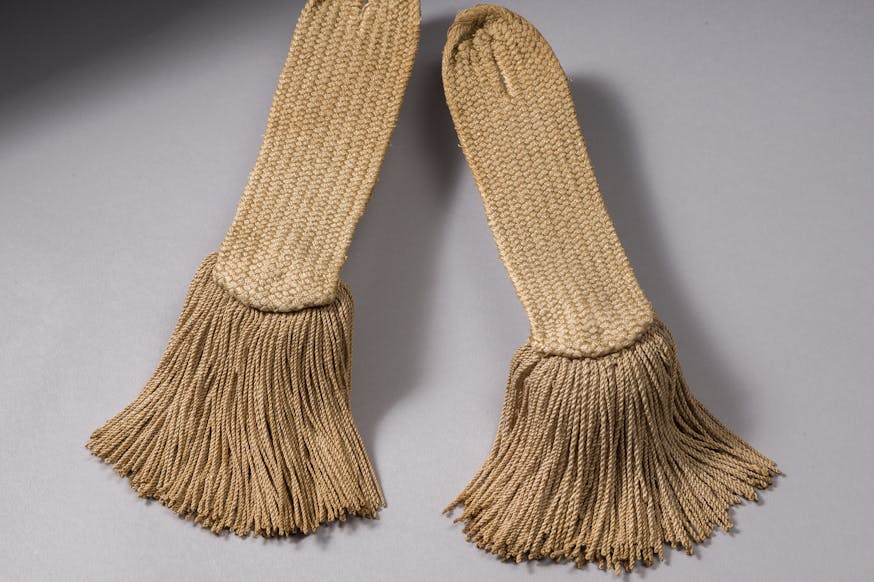
The Davenport family had not only preserved that journal until then and the texts of the letters, but also some mementos of James’s military service: a sword, epaulettes (shown above), and a pair of red wool baby booties reportedly made from a British coat. Those are now part of the Museum of the American Revolution’s collection, and can be viewed through the “Davenport Letters” webpage.

Friday, March 29, 2024

New Collection from the Journal of the American Revolution

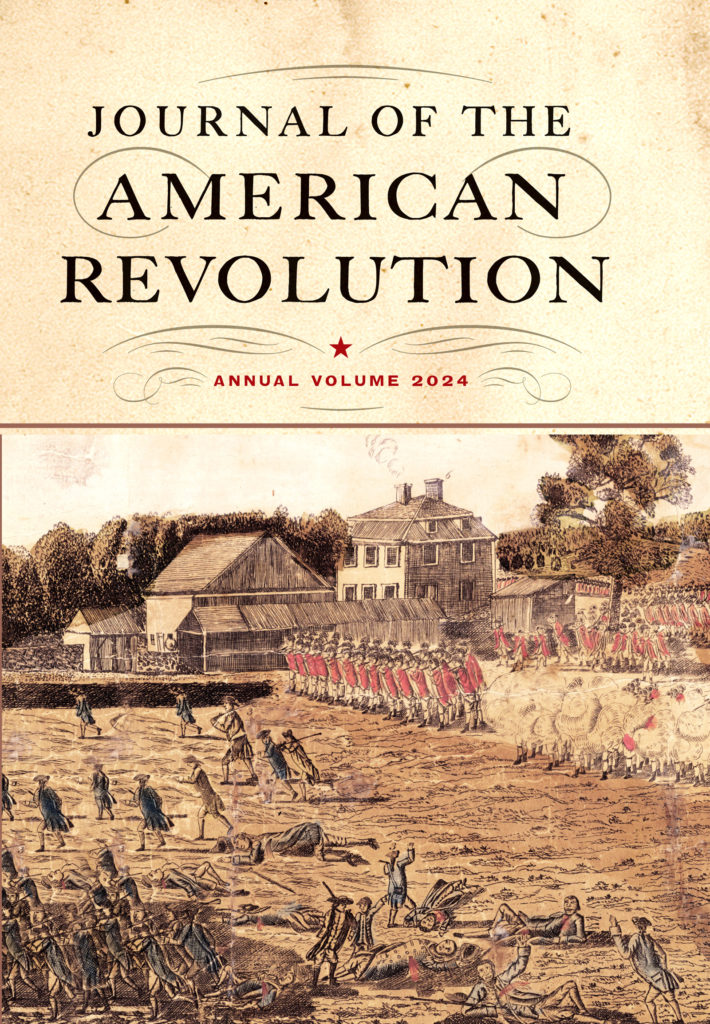
Next month Westholme Publishing will issue The Journal of the American Revolution Annual Volume 2024, edited ably once again by Don N. Hagist.

This webpage about the book says it will contain two articles by me.

In fact, the book will have only one article from me. That’s because I combined my two web articles about the confounding Samuel Dyer into one complete study.

This volume offers many other articles about Revolutionary New England, including:
  • Remember Baker: A Green Mountain Boy’s Controversial Death and Its Consequences by Mark R. Anderson
  • John Hancock’s Politics and Personality in Ten Quotes by Brooke Barbier
  • Mercy Otis Warren: Revolutionary Propagandist by Jonathan House
  • Captain James Morris of the Connecticut Light Infantry by Chip Langston
  • Smallpox Threatens an American Privateer at Sea by Christian McBurney
  • John Adams and Nathanael Greene Debate the Role of the Military by Curtis F. Morgan, Jr.
  • The Perfidious Benjamin Church and Paul Revere by Louis Arthur Norton
  • The Highs and Lows of Ethan Allen’s Reputation as Reported by Revolutionary-Era Newspapers by Gene Procknow
  • Captain Luke Day: A Forgotten Leader of “Shays’s Rebellion” by Scott M. Smith
  • Engaging the Glasgow by Eric Sterner
(My apologies to the authors of any other relevant articles I missed.)

And there are of course lots of articles about the American Revolution in, you know, other places.

Thursday, March 28, 2024

“The Gathering Storm” in Acton, 2 Apr.

On the evening of Tuesday, 2 April, I’ll speak in Acton at the invitation of the Acton 250 Committee.

We’re calling this talk “The Gathering Storm,” and here’s the description:
As 1774 began, Massachusetts politicians worried about the royal government response to the Boston Tea Party. The force of that reaction became clear in the return of troops to Boston, the Coercive Acts, and the Massachusetts Government Act. In late summer the province’s people rebelled by shutting down government functions in rural counties, seizing weapons in ports, and electing their own legislature.

The engine of that resistance was a little-understood institution: the colonial militia. By fall, it was clear that the new royal governor had no leverage outside Boston. This talk traces the end of British power in most of Massachusetts even before the war began.
I’ll draw on the stories in The Road to Concord and elsewhere, discussing how rural Massachusetts shifted in 1774 from lukewarm support for Boston’s fight against tariffs to militant opposition to the Crown.

This will be part of a series of talks by different authors tracing the events that led to war in 1775. Eventually the people of Acton were so committed to the Patriot cause that their militia company marched at the front of the Middlesex County column confronting the British regulars at the North Bridge in Concord.

This talk will take place in Room 204 of the Acton Town Hall on Main Street starting at 7:00 P.M. It is free, but the Acton 250 Committee asks people to register so that they can be contacted about future events. The talk will also be shown live on Acton TV and Zoom.

Wednesday, March 27, 2024

The Last Glimpses of Lt. Ragg

Yesterday’s posting took Lt. John Ragg of the British marines to Middletown, Connecticut, as a prisoner of war along with his servant, Pvt. Benjamin Jones, in September 1776.

I’ve looked for records of what happened next, without success. I assume there must be some paperwork at the Continental or local level, but not published.

It appears that the lieutenant was exchanged for an American officer taken prisoner that fall, and there were a lot of those.

The next sign of Lt. Ragg is in the 12 May 1777 issue of the New-York Gazette and Weekly Mercury, printed by Hugh Gaine inside the Crown-held city. An advertisement for Maj. Robert Donkin’s Military Collections and Remarks, to be printed by Gaine later that year, listed “Marines, Lieut. Ragg” among the subscribers.

Then the man drops out of my sight again until toward the end of the war.

Lt. Ragg had a brother named Andrew, who became the Customs service controller of Customs on the Pocomoke River in southern Maryland in May 1766. When the war broke out the local authorities detained him, then let him out as long as he didn’t cause trouble and paid heavy taxes.

On 5 Feb 1779, Andrew Ragg asked the Maryland government to allow him and his young daughter Anne to return to Britain. On 31 March, Ragg filed a deposition promising not to give intelligence to the enemy, and that same day the state Council granted permission to travel to New York.

Evidently the Raggs didn’t go to New York until 1780. Anne was then nine years old. To the British authorities they characterized their journey as an “escape.”

The little family got on board a ship to Britain, but during the voyage Andrew Ragg fell overboard and was drowned. John Ragg, by then a captain in the marines, petitioned the government to support his niece on 24 Apr 1781.

The last sign I’ve found of John Ragg is that “Captain Ragg, of the marines,” was listed as wounded while serving on H.M.S. Magnificent in the Battle of the Saintes in April 1782.

After the war, Ragg might have gone home to Aberdeen, Scotland. He was living in that city in February 1767 when he was listed as a witness in a court case recorded in the city’s Enactment Book (notes in P.D.F. form here).

That book also lists “Andrew Ragg, late apprentice to William Brebner, merchant,” among the genteel young men accused of a breach of the peace in April 1763. Was this the future Customs officer? Those men “bound and enacted themselves that they shall behave themselves regularly, soberly and discreetly” and got off.

In any event, that’s all I’ve been able to uncover about Lt. John Ragg, remembered in the Shaw family lore as the lieutenant named Wragg who so angered young Samuel Shaw.

(The painting above shows H.M.S. Magnificent among the Royal Navy warships capturing two French vessels at the Battle of the Saintes.)