J. L. BELL is a Massachusetts writer who specializes in (among other things) the start of the American Revolution in and around Boston. He is particularly interested in the experiences of children in 1765-75. He has published scholarly papers and popular articles for both children and adults. He was consultant for an episode of History Detectives, and contributed to a display at Minute Man National Historic Park.

Subscribe thru Follow.it


•••••••••••••••••


Monday, November 16, 2015

Two Gentlemen Who Couldn’t Possibly Take Charge of Connecticut’s Stamped Paper

When the British government instituted the Stamp Act for North America, one of the first steps was to buy a lot of paper. With the tax added, that paper was budgeted to bring in over £100,000 from the thirteen colonies that became the U.S. of A. alone. The untaxed cost of that paper was less, but it was still a substantial investment for the government.

The paper was also a substantial chunk of government property to take care of. Naturally, most colonial officials didn’t want to take any more responsibility for that than they had to.

On 9 Sept 1765, as the anti-Stamp protests heated up in Connecticut, designated stamp master Jared Ingersoll asked a favor of Cadwallader Colden (1688-1776, shown here), the acting governor of New York:
the Stampt papers intended for this Colony are Expected to arrive Soon at N. York & were to have been forwarded to me who am appointed the Distributer here, but the unaccountable rage & fury of the Mob is at present So high against Stamp Officers & papers that I do not think it Safe to have the later Sent here as yet

I have therefore to desire of you to protect the Same when they Shall arrive by placing them in the Fort, or otherwise as you shall be Able, until Some further Steps may be taken . . .

my Duty to the King obliges me to give You this trouble

I am Sr
Yr Most Obedt & Most Humbl. Servt.…
On 14 September, Colden responded:
I have yours of the 9th desiring me to take care of the stamp Paper for your Colony when they arrive. In my opinion they may be put more safely & with greater ease on board one of the Men of War at this Place, & more easily conveyed from thence to your Colony, than by placeing them in this Fort, where it is too probable there will be a necessity of placeing those designed for this Colony. This Fort at present is crowded with Men & military Stores. It may be proper for you or some Person for you to be in this place to take care of your Stamp’d Papers, as my hands are too full with the affairs peculiar to this Province. . . .

I am with great Regard, Sir,…
Ingersoll publicly resigned his post as stamp master on 19 September, as described starting here. He therefore told Colden that the papers were really no longer his charge:
by the time that your favour of the 14th reached my house, I had been Compelled in a most Extraordinary manner to declare I would not directly or indirectly intermeddle with the Stampt papers intended for this Colony—at present therefore when all the Springs of Government are broken I can do no more than recommend to you to take the best Care you Can of those Stampt papers for the Crown until you shall have further directions concerning them from the Commissioners of Stamps, or from me

I am
Yr. Most Obedt. Humb Servt.…
When the stamps for Connecticut actually arrived, Gov. Colden silently disregarded that request and had his son David (1733-1784) take up the correspondence on 28 October:
The Gover. Orders me to inform you that Captn. Davis has brought over three Packages of Stamp’d Papers Marked for Connecticut, which are now lodged in the Governor’s House in the Fort. The Gaspey Cutter is now here & is a very fitt vessell for carrying the Papers to you if you can prevail upon Captn. [Archibald] Kennedy to order her to do it. We hear more Stamped Paper is on board three Ships daily expected here.

I am with great Regard, Sir,…
Ingersoll replied directly to the acting governor on 31 October:
Yesterday I received your favour of the 28th advising me of the Safe arrival of part of the Stamp papers intended for this Colony. I immediately advised with the Governour [Thomas Fitch] on the Subject & for Answer have to Say, that as the people of this Colony have with impunity offered the most high handed violence to my person on account of my having undertaken to be Distributor of Stamps And still Continue their threats to me in case I shall intermeddle with the Stamp papers, as also the destruction of the papers themselves, and as the house of Representatives of this Colony have lately voted the Act of Parliament itself unprecedented & unconstitutional whereby the peoples Spirits are kept up, and as we have no Strong hold wherein to place the papers, I Cannot think it Safe for me or the papers or prudent to bring them into the Colony & have therefore only to thank you for your past goodness & to repeat to you my request that you will be So good as to keep & protect the papers that have or shall arrive at N.York until you Shall receive further directions about the Same.

I am Sr
Yr. Most Obedt. Humble Servt.…
I like how the complimentary closes to those letters give an “Alphonse and Gaston” tone to this exchange.

By the time Colden received Ingersoll’s last letter, the situation in New York had become dire. Connecticut’s paper was the least of his troubles.

Sunday, November 15, 2015

Josiah Quincy for the Defense

Yesterday we left tobacconist John Willson on trial for the murder of a shoemaker named David Murray in 1771. That was on 6 September, slightly less than a month after Murray had turned up dead on the shore of Boston Neck.

The facts weren’t in Willson’s favor. People had seen the two men leave Castle William in a boat together, and Willson didn’t tell a coherent story of what happened. Though there were no witnesses, it seemed pretty clear that the two men had gotten into a fistfight.

The law was also not on Willson’s side. If the jury decided he killed Murray in a fight, British rules of the time didn’t offer much leeway in evaluating whether he deserved to die. He would have had to prove the circumstances of manslaughter or self-defense. There were no prisons as an alternative to the gallows.

Courtroom records from the 1770s are quite sparse, with the exception of the trials that followed the Boston Massacre. But we have Josiah Quincy, Jr.’s speech defending Willson. That appears in Joseph Hawley’s commonplace book, recently digitized by the New York Public Library.

After quoting from a couple of legal authorities, Quincy challenged the jury to live up to those standards since “our crown law is with justice supposed to be more nearly advanced to perfection.”

Finally he addressed the specifics of this case:
One doubt in this case is whether the dec[ease]d. was killed by any man.—another doubt there certainly will be, whether he was killed by the prisoner. But if he was so killed, will any one say that the prisoner was guilty of murder? a Crime at which human nature starts, and which is almost universally punished with death. . . .

It will be said, perhaps, if you are fully convinced, that the prisoner killed the decd[,] every circumstance to justify or excuse such killing must be proved by the prisoner. This no doubt is good law. But here it is impossible; none being present but the prisoner and the decd.

Can it be supposed to be law, reason, or christianity to oblige a prisoner to prove impossibilities, or lose his life? how astonishing to suppose reason so little to prevail at the formation of our laws, and under the formalities of justice, that weak equivocal evidence, nay surmise and suspicion, should ever be thought sufficient proof—for crimes, the most atrocious in their nature, the most deliberate in their commission, and therefore the most improbable, as if it were the interest of the laws and the judges, and for the good of society, not to enquire with charity and candor, but to prove the crimes: as if there was not greater risk of condemning any person when the probability of his guilt is less. . . .

If a man be found suddenly dead in a room, and another be found running out in hast with a bloody sword; the blood, the weapon, the hasty flight, are all the necessary concomitants of such horrid facts.—here are deficient the weapon—the blood on such weapon, and above all the hasty flight. Did the prisoner fly, did he ever attempt to secrete himself?

or In some cases presumptive evidences go far to prove a person guilty, tho there be no express proof of the fact to be committed by him, but then it must be warily pressed (and surely as cautiously believed) so as to convict em. For it is better that 10 guilty persons escape unpunished than one Innocent person should die. &c
The 12 Sept 1771 Boston News-Letter reported the outcome of Quincy’s argument:
At the Superior Court held here, on Friday last, John Willson was tried for the Murder of David Murray, who was found dead on the Neck, mentioned in this Paper of the 15th of August last: The Jury brought in their Verdict, Not Guilty.
Not simply not guilty of murder, but not guilty of all charges.

The fact that Hawley copied Quincy’s argument into his commonplace book suggests that the attorneys of Massachusetts thought it was a remarkable case.

Saturday, November 14, 2015

The Life and Death of David Murray

On 10 Apr 1755, shoemaker David Murray and Mary Fitzgerald married at the New South Meetinghouse, having announced their intention the previous October.

Soon afterward, Boston employee Robert Love visited them at their home on Blowers’s Wharf in the South End, according to Cornelia Hughes Dayton and Sharon H. Salinger in their study Robert Love’s Warnings: Searching for Strangers in Colonial Boston.

Over the next fifteen years the Murrays had children, but David remained a journeyman, never doing well enough at making shoes to open his own shop.

Then, on 12 Aug 1771, the Boston Evening-Post carried this item:
Last Thursday Afternoon [i.e., 8 April] David Murray, a Shoemaker belonging to this Town, was found dead on the Beach near the Neck, an some Marks of Violence appearing on several Parts of his Body, and the Jury of Inquest being of Opinion that his Death was occasioned by some violent Blows, one Willson, a Tobacconist, who had been with him in  a Boat to the Castle, and came off with him from thence the Evening before, was taken up and examined, and telling many contradictory Stories relative to the Affair he was the next Day committed to Goal on a strong Suspicion of being the Means of his untimely End.
The indictment accused Willson of beating Murray to death with his fists. Within a month, Willson was on trial for murder. His attorney: Josiah Quincy, Jr.

TOMORROW: Quincy’s plea to the jury.

Friday, November 13, 2015

“Glass Branches” for the Old North

This week Bryan McQuarrie of the Boston Globe reported on the return of an eighteenth-century chandelier to the Old North Church in Boston’s North End.

The five-armed glass chandelier first came to the church as half of a matched pair. According to Hannah Mather Crocker’s Reminiscences and Traditions of Boston, written in the 1820s:
The chandeliers were given by Capt Gruchy. They were taken near the close of the Spanish War. They were made for one of their cathedrals, but were way laid by a privateer belonging to him and thus brought to Boston to be hung up in the North Church since remembrance.
In Rambles in Old Boston, New England (1887), the Rev. Edward G. Porter quoted this item from the Christ Church (North Church) records:
June 16, 1746. Whereas Messrs. Mr. Robert Jenkins, Capt. Grushia, Mr. Hugh McDaniel, Mr. Jno. Gould, Mr. Jno. Baker, oners of the Priveter Queen of Hungary, hath made a present to Christ Church in Boston of 4 cherubims and 2 glass branches taken by ye said Vessell, Voted, That the branches be hung in ye body of the church and ye cherubims placed on ye top of the Organ.
Thomas James Gruchy was a privateer captain during King George’s War, now known as the War of the Austrian Succession or more fondly as the War of Jenkins’s Ear. He commanded the Queen of Hungary, sharing ownership with those other men.

Gruchy reportedly captured a French ship on its way to Québec. Its cargo included those two chandeliers (the “glass branches”) and four carved wooden angels. Gruchy apparently led the choice to donate those to Christ Church, where he was a junior warden.

By 1830, that North Church—soon to be the “Old North”—had refurbished its interior. The carved wooden angels were moved to a new spot, but the chandeliers were put outside in the courtyard. A former church official was founding an Episcopal mission in the western Massachusetts town of Otis, and he took one chandelier out for its new building. The other disappeared.

That church in Otis is now defunct, the building up for sale. Episcopal officials packed up some of its furnishings, including the chandelier, and sent them back east. The National Park Service is now analyzing the pulpit and prayer desk for clues to their age, and Old North is looking for a place to hang its new, old glass chandelier.

Thursday, November 12, 2015

Hawley, Adams, Gridley, and Otis, Attorneys at Law

Going back to the newly digitized Joseph Hawley Papers at the New York Public Library, one noteworthy item is Hawley’s commonplace book.

A commonplace book was a notebook in which a (usually) gentleman copied out passages from books or documents that he found interesting, thoughts he wanted to explore, and other material. For example, Hawley’s starts with “Thoughts on various Subjects” and extracts from Cicero “of the Principles of the Stoics.”

Then comes something very meaty for historians of the Revolution: a summary of Jeremiah Gridley’s argument for the Crown in the February 1761 writs of assistance case, followed by the much longer rebuttal from James Otis, Jr. (shown here).

Late in life, and resentful of all the attention Patrick Henry and Virginia were getting, John Adams argued that that court case was the real beginning of the American Revolution. “Then and there the Child Independence was born,” he told William Tudor in 1817. Not coincidentally, almost all the information we have about that event was supplied by John Adams, sometimes with an extra helping of courtroom drama.

Hawley’s commonplace book contains, I understand from Mark Boonshoft’s essay at the Junto blog, the most complete rendering of those arguments to survive. Adams probably wrote out those texts from his notes between the argument in February and 3 Apr 1761, when he showed a copy to Col. Josiah Quincy. Compared to his later description, they are less dramatic but more reliable, though still a long way from a true transcript.

Interestingly, Adams’s own manuscript of these arguments doesn’t exist. Instead, he gets credit for having written the textual ancestor of several overlapping versions that do survive, including Hawley’s. On 29 Apr 1773 the Massachusetts Spy printed Otis’s speech, sparking more interest in it. That August, the Massachusetts Committee of Correspondence sent the Gridley and Otis arguments to the Connecticut legislature. Joseph Hawley was on that committee, so that’s probably how he got to make a copy of his own.

Wednesday, November 11, 2015

Meeting the Quincy Women, 12 Nov.

In January 1759, John Adams paid a call to Col. Josiah Quincy’s house in Braintree (shown here).

There the young lawyer found his host’s daughter Hannah (1736–1826) and her first cousin Esther Quincy (1738–1810).

Referring to Hannah Quincy as “O.” in his diary, Adams compared the two young ladies:
O. thinks more than most of her Sex. She is always thinking or Reading. She sitts and looks steadily, one way, very often, several minutes together in thought. E. looks pert, sprightly, gay, but thinks and reads much less than O. . . .

O. makes Observations on Actions, Characters, Events, in Popes Homer, Milton, Popes Poems, any Plays, Romances &c. that she reads and asks Questions about them in Company. What do you think of Helen? What do you think of Hector &c. What Character do you like best? Did you wish the Plot had not been discovered in Venice preserved? These are Questions that prove a thinking Mind. E. asks none such.
But really they were both flummoxing him: “I talk to Hannah and Easther about the folly of Love, about despizing it, about being above it, pretend to be insensible of tender Passions, which makes them laugh.”

Hannah Quincy married Dr. Bela Lincoln of Hingham the next year. Esther Quincy married Adams’s friend and fellow lawyer Jonathan Sewall in 1764. That same year, Adams married Abigail Smith, whose mother was a Quincy.

On Thursday, 12 November, Nancy Carlisle will speak at Old North Church in Boston on the topic “From the Revolution to the Close of the Nineteenth Century, the Remarkable Women of the Quincy Family.”
In a family where six successive generations of Quincy men held prominent public roles in the civic life of Boston and New England, the women in the family have long been overshadowed. But in reality it is because of them that we know as much as we do about their husbands, fathers, and brothers. When we shine a light on the lives of the Quincy wives and daughters we learn about the role that intelligent, articulate, and engaged women played in the political and cultural life of the region.
Carlisle is the Senior Curator of Collections for Historic New England. For the past three years she has focused on the Quincy House and its inhabitants as part of a major reinstallation.

This talk is scheduled to start at 6:30 P.M. It is free, but Old North asks people to reserve seats through this site. There will be a reception afterwards.

Tuesday, November 10, 2015

Poking through the Joseph Hawley Papers

Harvard University isn’t the only institution digitizing Revolutionary-era documents, of course.

The New York Public Library ended up with a bunch of significant papers from Massachusetts, including Samuel Adams’s papers and the correspondence of the Boston Committee of Correspondence. It too has been scanning lots of documents and making them available to the world for free as part of its Early American Manuscripts Project.

I’ll start with the Joseph Hawley Papers. Hawley was an attorney in Northampton, respected by all Massachusetts Whigs for his legal knowledge and judgment. He was quite active in the Massachusetts legislature leading up to the Revolutionary War.

This is Hawley’s copy of the text of a letter that William Brattle sent to Gen. Thomas Gage in late August 1774 warning about rumblings of military preparation in the countryside. Gage responded by removing gunpowder from the provincial powderhouse in what is now Somerville. The rural militia mobilized in what became known as the “Powder Alarm.” That event signaled how Massachusetts farmers had become more confrontational than Bostonians.

Here’s a letter from a man in Boston on 27 Feb 1775 worrying that the Massachusetts Provincial Congress has given too much power to its Committee of Safety to call out the militia again:
when once the Soldiers are mustered by order of the Committee they will suppose it their duty to fight, and for fear of being Impeached for Cowardice, it is more than probable they will Commence Hostilities…
Who wrote that letter? The page with the signature doesn’t appear to have survived. But the handwriting looks a lot like that in this July 1775 letter from Thomas Cushing—Boston merchant, speaker of the Massachusetts house, and delegate to the Continental Congress.

Later in July Cushing wrote again with news that the Congress had chosen Hawley to help negotiate with Native American nations in the northern theater. Hawley’s papers also include a commission signed by John Hancock. There follow a few letters from the other commissioners, asking why they hadn’t heard from Hawley. Finally he wrote to the Congress saying he couldn’t take on the job because of this health—quite possibly the beginning of a long depression that curtailed his political activity.

Hawley appears to have remained active in local affairs, at least at times. His papers include an August 1775 document in which a bunch of British prisoners signed onto the terms of their parole within the town of Northampton. Here are notes on how Hawley’s town voted to pay “nine-month men” enlisting in the Continental Army, and here’s the list of some men who signed up on those terms.

Monday, November 09, 2015

Digging through Harvard’s Digital Papers

I rather like my segue yesterday from the Stamp Act confrontation unfolding 250 years ago to Harvard’s new Colonial North American Project.

As the university announced, its archivists are digitizing all the seventeenth- and eighteenth-century documents in several different collections. With 2,400 objects documents available for viewing, the project is still in an early stage.

For example, here’s a notebook of Prof. John Winthrop’s meteorological observations for the mid-1740s. The professor kept those up to his death in 1779, meaning we have detailed weather records from just outside Boston for all the important days of the pre-Revolutionary turmoil and the siege of Boston. But the later notebooks don’t appear to be digitized yet.

Winthrop’s astronomical studies probably explain why the papers of him and his wife Hannah, who were firm establishment Whigs, include almanacs from the Loyalist printers John Mein and John Fleeming. But maybe they were just intrigued by the scientific reports on the covers of those publications, about giants in South America and a furious wild beast in France.

There’s a lot of other visual material in the online collection, more easily reproduced that way than in print. Harvard students learned how to take surveys and sketch buildings as part of their mathematics courses, so more than one left a plan of Cambridge common,

William Tudor, Jr.’s mathematics notebook shows him using “Genl. Warren’s monument on Bunker Hill” to calculate heights in 1795, illustrated above. A couple of decades later, Tudor helped to organize the initial drive to create today’s Bunker Hill Monument on the same hilltop.

Sunday, November 08, 2015

“Make Application before the said first Day of November”

Here’s a glimpse of Ames’s Almanack for 1766. Usually almanacs were published at the end of the preceding year, sometimes reprinted in the first couple of weeks of the year they covered.

The 1766 almanacs, however, would then fall under the provisions of the Stamp Act, taking effect on 1 Nov 1765. Some printers therefore moved up their publishing schedules so they could sell copies without needing stamped paper.

Richard and Samuel Draper advertised this almanac in early September issues of their Boston News-Letter. Its second page summarized the part of the Stamp Act that applied to almanacs and then warned:
Those Persons who are desirous of being furnished with this Almanack, are requested to make Application before the said first Day of November, as the Price after that Time will be more than double what it is now.
(Incidentally, the author of this almanac wasn’t Dr. Nathaniel Ames of Dedham, despite its title. Instead, it was probably Joseph Willard [1738-1804] credited as “a late Student of Harvard-College.” Ames had published with the Draper family in the past, but this year he either didn’t like being rushed or chose to go with other printers, so the Drapers just pirated his name. But hey—they were taking a moral stand against the Stamp Act!)

Harvard professor John Winthrop (or his wife Hannah, but I think it was John) bought a copy of this almanac, presumably before November. It became part of the couple’s papers in the collections of Harvard University.

And now that university is digitizing this almanac and all its seventeenth- and eighteenth-century documents to create the Colonial North American Project at Harvard University, as reported here. The Winthrops’ artifacts are also part of a new exhibit at the Pusey Library called “Opening New Worlds.” And both the online resource and the exhibit are free to all.

Saturday, November 07, 2015

“As regular as a military Corps”

As I read the accounts of anti-Stamp Act demonstrations from late 1765, I’ve been struck by their emphasis on the crowd’s military discipline.

After the 1 November procession, Gov. Francis Bernard reported to London: “[Ebenezer] MackIntosh is a noted Captain of a Mob & has under him 100 or 150 men trained as regular as a military Corps.”

And in more detail:
To show how fully this Town is in the hands of the mob, I will add that Capt. Mackintosh (now called Genl. Mackintosh) who took the care of the Town, after the Militia had refused to muster under my order, & the Council advised me to discharge the Order, & who professes to have 150 or 200 men trained under him; on the 1 of November marshalled at least 2,000 men, & marched in regular order.

What is more surpising is, that one of the Council, Col. [William] Brattle, walked with him, arm in arm, along the Streets, complimented him on the Order kept & told him his Post was one of the highest in the Government. This Councellor conducted him round the Town House whilst both the Houses were sitting; before which regular Huzza’s were made.
Brattle (shown above) was a high-ranking militia officer, on his way to becoming a general, so his praise for Mackintosh meant a lot. As did skipping out on a Council meeting to march around with the working-men outside.

Mackintosh wasn’t really a captain or general, of course. He gained his informal title from leading the South End gang during Pope Night processions and brawls in the early 1760s. But Mackintosh was a veteran of the previous war, and he and nearly every other young man in Boston trained with their militia companies each season, so they knew how to march in step and obey military command.

In fact, they were extremely disciplined. And that worried the royal authorities as much as riots and disorder. Judge Peter Oliver later wrote of Mackintosh:
He dressed genteelly; & in Order to convince the publick of that Power with which he was invested, he paraded the Town with a Mob of 2000 Men in two Files, & passed by the Stadthouse, when the general Assembly were sitting, to display his Power. If a Whisper was heard among his Followers, the holding up his Finger hushed it in a Moment: & when he had fully displayed his Authority, he marched his Men to the first Rendevouz, & order'd them to retire peacably to their several Homes; & was punctually obeyed.
The implication of such discipline, of course, is that with a flick of the same finger Mackintosh could order those same hundreds of men to attack.

Friday, November 06, 2015

“The union was established in a very ceremonial manner”

So what did the “Union” of North End and South End gangs on the fifth of November 1765 look like?

As the Massachusetts Historical Society quoted in 2009, chronicler James Freeman described the day this way:
the disorders which had been committed from time to time induced several gentlemen to try a reconciliation between the 2 parties; accordingly the chiefs met on the 1st of this inst. [i.e., of November], & conducted the affair in a very orderly manner. In ye even’g the commander of ye N. & [S.] after making general overtures they reciprocally engaged in an Union, & the former distinctions to subside, at the same time the chiefs with their assistants engaged their honour no mischief should arise by their means, & that they would prevent any disorders on ye 5th.

When the day arrived about noon the pageantry representing the Pope, the Devil, & several other effigies signifying tyranny, oppression, slavery, &c. were brought on stages from the N. & S. & met in Kings Str. where the union was established in a very ceremonial manner, & having given three huzzas, they interchanged ground, the S. marched to ye N. & the N. to the S. parading thro’ ye streets until they again met near ye Court House.

The whole then proceeded to Liberty tree, under the shadow of which they refreshed themselves for a while, & then returned to ye Northward agreeably to their plan. They reached Cop’s hill before 6 o’clock, where they halted, & having enkindled a fire, the whole pageantry was committed to the flames & consumed.
That was actually a lot like the way smaller New England ports celebrated Pope Night every year: with a single procession, a big bonfire, and public refreshments. So in 1765 the Boston gangs got to enjoy those things without the violence, while getting extra praise and other goodies.

In 2011 the M.H.S. added some remarks from the merchant Isaac Winslow (1743-1793): “There were no disguises of visages, but the two leaders, [Ebenezer] M’cIntosh of the South, and [Henry] Swift of the North, (the same who was so badly wounded last year[)], were dress’d out in a very gay manner”.

Those men’s outfits were military-style coats that town gentlemen had given to the “chiefs with their assistants” of the two gangs—reflecting their self-conferred titles of “captains and lieutenants.” A couple of years later, the artist Pierre Eugéne du Simitière sketched those coats on gang leaders, as shown above. (Du Simitière’s notes preserve the detail that the coats were blue with red trim.) I suspect that by that year Mackintosh and Swift had passed their roles, and those coats, on to younger men.

TOMORROW: The military discipline of the “mob.”

Thursday, November 05, 2015

The Danger of Pope Night in 1765

As I described earlier in the week, Boston’s civic leaders were very nervous that the fifth of November in 1765 would bring on a riot. As it usually did.

On that date young British males traditionally observed Guy Fawkes Day or Pope Night by carting around effigies of the nation’s political and religious villains and burning them. Boston’s youth took that patriotic display two steps further than anyone else by dividing into South End and North End gangs and having a big brawl after sunset.

In 1764, one of the Pope Night carts ran over and killed a little boy named Brown, described by different sources as five to nine years old. That happened early in the day, and the holiday proceeded anyway, including the brawl. Tradition, you know.

In the following August, Pope Night rituals spread into the town’s anti-Stamp Act protests: twin effigies hanged and burned, processions through the center of town, bonfires. But instead of just threatening to break windows if householders didn’t treat them well, the crowds broke into three or four mansions and smashed all the furniture.

Sheriff Stephen Greenleaf detained the captain of the South End gang, a shoemaker named Ebenezer Mackintosh, after the riot against Lt. Gov. Thomas Hutchinson on 26 August. But then the town authorities worried that arrest would only rile up the rioters, so they set Mackintosh free. He was prominent in the anti-Stamp demonstrations at Liberty Tree in the following months. But what would he, his comrades, and their cross-town rivals do on Pope Night?

Mackintosh seems to have enjoyed his new role as a political leader and the respect that went with it. He probably appreciated the town leaders’ concerns about keeping Boston’s reputation safe. He definitely appreciated what they offered the gangs if they behaved well.

So Mackintosh made a deal with Henry Swift, captain of the North End gang. The young printer John Boyle described the result: “A Union established between the South and North End Popes. Capt. McIntosh on the Part of the South, and Capt. Swift, on the Part of the North. . . . This Union and one other more extensive [the Stamp Act Congress?], may be looked upon as the only happy Effecte arising from the Stamp Act.”

TOMORROW: A new way to celebrate the fifth of November.

Wednesday, November 04, 2015

Conversations at Washington’s Headquarters

It’s not every day we get a chance to discuss George Washington’s policy decisions at one of his military headquarters.

This month, the Supervisory Park Ranger at Longfellow House–Washington’s Headquarters National Historic Site in Cambridge, Garrett Cloer, will host two discussions of the commander-in-chief’s correspondence on important issues.

Open to anyone, these informal sessions are designed to be “a fun way to learn more about the general, the process of historical investigation, and perhaps a little about ourselves.” The topics are:

Thursday, 5 November, 6:30 P.M.
“Creating an Army: George Washington Reacts to New England”

Thursday, 19 November, 6:30 P.M.
“A Look at Washington’s Evolving Views on Slavery”

The discussions will take place in the carriage house at the rear of the site. Each participant will receive copies of the Washington letters to be analyzed. For the staff to know how many handouts to make, they ask for all participants to reserve a space in advance by email or calling 617-876-4491.

Tuesday, November 03, 2015

John Huske on “an inland tax” for North America

As shown yesterday, on 1 Nov 1765 Bostonians hung an effigy of John Huske from Liberty Tree. Most histories say this was based on the mistaken notion that Huske had proposed the Stamp Act in Parliament when in fact he had opposed it.

I’ve found two profiles of Huske online, one built around his political career in Britain and the other in the Franklin Papers and thus more focused on his links back to America.

A lot of Bostonians knew Huske. He was a son of Ellis Huske, postmaster of Boston and chief justice of New Hampshire. He was named for an uncle who became a prominent general. After being born in Portsmouth, the young Huske moved to Boston for schooling and to begin his career in business.

In 1748 Huske headed to London to make his fortune. He seems to have done that in several ways over the next two decades, losing his money an equal number of times. He also went into politics, attaching himself to Charles Townshend. His campaigning in the district of Hull in 1757 prompted a letter to a duke that said:
Mr. Huske finding that he could make no impression even upon the mob which I had secured, and which he expected great matters from, thought it yesterday most prudent to retire which saved us the trouble of throwing him into the Humber
In 1763, Huske finally got elected to the House of Commons from Maldon.

As a native of America and a merchant doing business with the colonies, Huske often spoke in Parliament about American policy. Some people were more impressed than others. Horace Walpole called him “a wild, absurd man.” He had a lot of ideas, but he wasn’t close enough to the Grenville administration for most people to pay attention to them.

In March 1764, George Grenville and his ministers first proposed a Stamp Tax for North America. Charles Garth, an agent for South Carolina, reported on Huske’s response:
The chancellor of the Exchequer at first proposed it as a measure to take place this sessions, but Mr. Alderman [William] Beckford and Mr. Huske signifying their wish to have the colonies apprized of the intention of Parliament, Mr. Grenville readily acquiesced, declaring it was far from his inclination to press any measure upon any part of the dominions without giving them time to be heard, should they have objections thereto.
Thus, rather than proposing the Stamp Act, Huske actually helped to delay it for a year.

In August 1764, Huske sent a letter to his brother-in-law Edmund Quincy, Jr. (1726-1782), who published it in the 29 Oct 1764 Boston Gazette. It was a reply to “the Committee of Merchants in Boston” who had addressed him about the state of trade the previous February, and was long enough to take up a full page of the paper.

In that letter Huske lamented the Sugar Act and warned that a Stamp Act was likely to pass in Parliament’s upcoming session. He asked the Massachusetts merchants to send any him information he could use to argue against it: “why the provincial stamp did not succeed with you and at New-York;…with every reason you can assign against the establishment of a general stamp duty throughout America.”

Huske blamed “the indiscreet conversation of some Americans, who deny the rights of Kings, Lords and Commons, to impose such a tax on America.” Raising that argument had forced the ministry’s hand, he suggested; the only way for them to confirm Parliament’s sovereignty across the whole Empire now was to enact just such “an inland tax.”

Huske then went to grumble about “the principal author and abettor of this mushroom policy” becoming known “as the person to whom the colonists are indebted for the postponing of the Stamp duty.” He wrote opaquely about “the other undiscerning American he has drawn into the adoption of his sentiments,” and of yet “another Gentleman” whom Americans saw “as their honestest, ablest, firmest, and most successful friend.” All that suggests there was a lot of jockeying, and some backstabbing, among the men in London who claimed to represent American interests. Huske obviously wanted his Massachusetts correspondents to give him more credit for the Stamp Act’s delay.

However, Huske had apparently made his own proposal for raising revenue in North America. According to James Harris’s notes on parliamentary speeches, on 31 Jan 1764 Huske had “proposed an entire new bill of his own—a capitation tax, I think—to be extended through Scotland, Ireland and America.” That’s another term for a poll tax, and it would have hit every free adult male on top of the colonies’ own poll taxes. A few days after that speech, someone wrote to Boston warning that Huske was not “standing an advocate for his injured Country” but had “officiously proposed…a tax on the Colonies.”

Thus, although John Huske was an opponent of the Stamp Act, he was a proponent of imperial taxes on American colonists. Indeed, his proposal would have directly affected more householders than the Stamp Act. Bostonians were receiving contradictory messages from Huske and other correspondents in London, which might have reinforced an existing idea that he was an ambitious, devious man who could play to both sides.

So was it fair or unfair for Bostonians to hang Huske in effigy from Liberty Tree?

Monday, November 02, 2015

“There’s that Villain H—k”

On 1 Nov 1765, Bostonians hung two men in effigy from Liberty Tree. One was George Grenville, the prime minister who had sponsored the Stamp Act.

The other was identified in the newspapers as “J–hn H–sk–” or “J—n H—k” and in a word balloon in Paul Revere’s engraving (shown here) as “that Villain H—k.”

On that effigy hung this label:
Quest. What, Brother H—sk this is bad?
Ans. Ah indeed! I am a wicked Lad;
My Mother always thought me wild,
The Gallows is thy Portion Child
She often said, behold ’tis true,
And now the Dog must have his due;
For idle Gewgaws, wretched Pelf,
I sold my County—d–m’d my self;
And for my great unequal’d Crime,
The D——l take H—sk before his Time.
But if some Brethren I could Name,
Who shar’d the Crime, should share the Shame,
This glorious Tree tho’ big and tall,
Indeed would never hold ’em all.
Which doesn’t often a whole lot of clues.

But back on 9 Apr 1764, the Boston Evening-Post had published a letter sent from London that February which warned the ministry was planning “Stamp Duties” for North America. It went on to say:
What is most unlucky for us, is, there is one Mr. HUSKE, who understands America very well, and has lately got a seat in the House of Commons; but instead of standing an advocate for his injured Country (for he is an American born, and educated at Boston) he has officiously proposed in the House of Commons, to lay a tax on the Colonies, which will amount to £500,000 per ann. sterl. which he says they are well able to pay; and was heard by the House with great joy and attention.
We can thus identify “J–hn H–sk–” as John Huske (1724-1773), a Member of Parliament born in New Hampshire who had begun his career as a merchant in Boston. And some folks in Boston thought he was responsible for the Stamp Act.

TOMORROW: But what was Huske’s connection to the Stamp Act?

Sunday, November 01, 2015

“The day the stamp-Act was to take Place”

The Stamp Act was scheduled to take effect on the first day of November in 1765. After that date, all courts in British North America were supposed to reject filings that weren’t on stamped paper. All ships leaving American ports on or after that date were supposed to have Customs forms on stamped paper, and the Royal Navy was empowered to stop ships to check. Newspapers published after that date were required to appear on stamped paper.

And yet in the most populous British colonies on the continent, from New Hampshire to South Carolina, stamp masters had been intimidated into resigning. In many of those places the royal authorities were keeping the stamped paper under wraps lest it be stolen or destroyed. So the big question was whether judges, Customs officers, and other royal appointees would insist on following the law or let business go on without stamps.

In Boston, the Whigs kept up their anti-Stamp campaign by reprising the opening act: hanging effigies on the elm they had named Liberty Tree. Here’s a report that appeared in the newspapers of 4 November:
Last Friday being the day the stamp-Act was to take Place, the Public were not much alarmed or displeased at the Morning’s being ushered in by the Tolling of Bells in several Parts of the Town, and the Vessels in the Harbour displaying their Colours half mast high, in token of Mourning: and tho’ some previous Steps had been taken by Authority to prevent any Pageantry, fearing lest Tumult and Disorder might be the Consequence yet the People were soon informed that the Great Tree at the South part of the Town (known by the Name of the Tree of Liberty ever since the memorable 14th of August) was adorned with the Effigies of the two famous or rather infamous enemies of American Liberty; G—ge G—nv—e and J–hn H–sk–.

The Figures continued suspended without any Molestation till about 3 o’clock in the Afternoon, when they were cut down in the View and amid the Acclamations of several Thousand People of all Ranks, and being placed in a Cart, were with great Solemnity and Order followed by the Multitude, formed into regular Ranks, to the Court House, where the Assembly was then sitting; from thence proceeding to the North End of the Town and then returning up Middle Street, they pass’d back thro’ the Town to the Gallows on the Neck, where the Effigies were again hung up, and after continuing some Time were cut down, when the Populace, as a token of their utmost Detestation of the Men they were designed to represent, tore them in Pieces and flung their Limbs with Indignation into the Air.—

This being done, three Cheers were given, and every Man was desired to repair to his Home, which was so punctually performed, that the Evening was more remarkable for Peace and Quietness than common; a Circumstance that would at any Time redound to the Honour of the Town, but was still more agreeable, as the Fears of many were great least it should prove another 26th of August; for the horrid Violences of which Night we hope the good Order of this will in some measure atone, as it is a Proof such Conduct was not agreeable to the Sentiments of the Town, but was only the lawless Ravages of some foreign villains, who took Advantage of the over heated Temper, of a very few people of this place, and drew them in to commit such violences and disorders as they shuddered at with horror in their cooler hours.
No, Boston’s leaders didn’t want “another 26th of August,” when mobs had attacked royal officials’ houses, culminating in the near-destruction of Lt. Gov. Thomas Hutchinson’s mansion in the North End. That event sullied the reputation of Boston, its political leaders, and the whole anti-Stamp Act movement.

And getting through the first of November wasn’t enough. As the 4 November issue of the Boston Gazette makes clear, the town was looking forward with great anxiety to the following day:
Notwithstanding the Insinuations of those who would represent the Inhabitants of this Town as Mobbish, it has no doubt given Pleasure to the General Assembly now sitting, to find it quite otherwise; and that the spirited Endeavours of those who would picture the Betrayers of their invaluable Liberties in a just and ridiculous View, are attended with the greatest Order and Decorum. . . .

We are well assured, and we have Reason to think, that the Inhabitants are satisfied in it, that if any Exhibitions are made, as usual, on the 5th of the Month, the same unexceptionable Behaviour will be observed; those true Sons of Liberty having agreed to unite as Brethren, in preventing Disorders of every Kind, and in promoting the COMMON CAUSE.
In other words, the North-End and South-End gangs should not take advantage of a historic anniversary to have a series of brawls testing who was tougher and more patriotic, no matter how fun that tradition was.

TOMORROW: “G—ge G—nv—e” was George Grenville, but who was “J–hn H–sk–”?

Saturday, October 31, 2015

Meanwhile, in London…

As their anti-Stamp Act campaign got started in the late summer of 1765, American Whigs were heartened by the news from London that Prime Minister George Grenville’s ministry had fallen.

This change had nothing to do with the unhappiness in America. It was all about the internal politics of the royal court, and in fact of the royal family. But as a result, the man who had championed the Stamp Act was removed from power. George III invited the Marquess of Rockingham to form a coalition with a broader base.

The American press speculated happily that this change meant the popular William Pitt would return to a position of authority. In fact, Pitt refused any role in the new government.

Instead, the strongest man in the new coalition was Prince William, the Duke of Cumberland, the king’s uncle and a military commander (shown above). Cumberland hosted the cabinet meetings at his city and country estates.

The first news those ministers received about the violent American protests was a letter from Massachusetts governor Francis Bernard, sent on 31 August and received on 5 October. Two days later, Andrew Oliver’s resignation as Massachusetts’s stamp master arrived. The government’s quick response was to send back a letter urging Bernard to appoint a temporary stamp-tax collector and proceed as planned.

The cabinet met on 13 October and had a brief discussion of the situation in North America, among many other things, according to John L. Bullion’s study in the 1992 William & Mary Quarterly. The ministers were confident that the leaders of colonial society would realize that they had to use stamped paper for lawsuits, transatlantic trade, and their other business, so they would soon accede to the new law, however grudgingly.

The Privy Council issued instructions to the colonial governors on 23 October, urging them to repeat that message about the wisdom of accepting the tax and getting on with business. Those governors could call on the military forces available in North America to put down riots, if necessary. But there was no plan to send more troops across the ocean; that would be expensive (the Stamp Act was supposed to bring in revenue, not cost a lot) and hard to do with winter coming on.

Five days after that message went out, a letter came in from Gen. Thomas Gage in New York. He reported that riots were spreading across the colonies, driving stamp masters into hiding and threatening the stamped paper itself. Gage suspected that rebellious Americans planned to make it impossible for royal officials to distribute the stamps and then to insist that courts and Customs offices stay open anyway. Now the situation seemed more dire. On 31 October, the cabinet gathered again at the Duke of Cumberland’s London house.

Just before the ministers went into their meeting, the duke collapsed with a heart attack and died. Though Cumberland had significant health problems, including an old war wound, he was only forty-four years old, and no one expected him to leave the scene so suddenly.

All the politicians in London began speculating and maneuvering anew. The Marquess of Rockingham was now the actual head of the government, as well as the titular one, but could he hold power without the duke’s authority behind him? In that political turmoil, the cabinet didn’t meet again until 11 December. And by then, they knew the situation in America had gotten worse.

Friday, October 30, 2015

Stamp Masters in the Deep South

In South Carolina, two men received appointments under the Stamp Act: George Saxby as inspector of the stamps and Caleb Lloyd as distributor.

This appears to have been a way to spread the patronage around. But official news of those appointments didn’t arrive in Charleston until late October 1765, causing some confusion.

On 19 October, Charlestonians—“2000 souls” in all, according to the newspaper—went through the ritual of hanging the stamp master in effigy, even though they weren’t sure who that man was.

Before burning that effigy on the green, the crowd visited a house owned by Saxby and broke some windows. Later the crowd went to Lloyd’s home, demanding to know if he was going to execute the law. The next day, a Sunday, Lloyd posted a notice at St. Michael’s church in the center of town insisting he hadn’t received a commission—which might have been true, but he probably knew one was on its way.

Over the next couple of days, crowds went to other sites, seeking the stamped paper. On the night of 23 October, about seventy men pushed their way into the mansion of Henry Laurens. He hadn’t supported the Stamp Act or sought an appointment under it, but he’d advocated following the law instead of defying it. The crowd demanded the freedom to search Laurens’s house for the stamps. While those men did no more than 15 shillings’ worth of damage, they frightened Laurens’s pregnant wife badly.

The next morning, Lt. Gov. William Bull finally announced that the stamps had arrived back on 20 October and were “lodged in Fort Johnson, till it should be necessary for his Majesty’s service to remove them from thence.” Lloyd was probably in that island fort as well, and Saxby joined him after arriving on another ship from Britain on 26 October.

Two days later Saxby and Lloyd wrote from Fort Johnson with a promise to do nothing to enforce the Stamp Act. That was enough for Charleston’s mercantile and political leaders to promise them safety. The two men came into town, went through the ritual of publicly repeating their promise to the crowd, and were escorted to a tavern with music and flags for “some refreshment.”

A similar situation in North Carolina played out as farce. On 19 and 31 October, Dr. William Houston was hanged in effigy as the colony’s stamp agent in Wilmington, New Bern, and one of the towns that became Fayetteville. Meanwhile, Houston reportedly had no idea he’d been appointed to the job.

Dr. Houston traveled from his plantation to Wilmington to meet with Gov. William Tryon on 16 November, only to be greeted by a crowd of three to four hundred men. They demanded that the physician resign his appointment, which he did, and then repeat that resignation in writing at the courthouse. As for the stamps, they didn’t arrive in the colony until 28 November, nearly a month after the law was supposed to take effect.

Likewise, as of 1 November, the small colony of Georgia had seen no stamped paper, no stamp master, and no anti-Stamp Act demonstrations.

Thursday, October 29, 2015

Two Virginia Gentlemen and the Stamp Act

As I noted back in May, the Virginia House of Burgesses was the first American institution to protest the Stamp Act—albeit not as forcefully as first thought, or later reported.

Virginians were also ahead of their southern neighbors in protesting the new law on the street, starting even before their stamp master had made his way back from Britain.

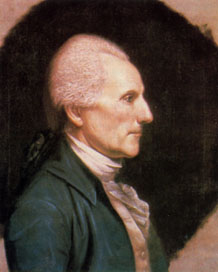
George Mercer (1733-1784), a former military companion of George Washington, was first hanged and burnt in effigy in Westmoreland County on 24 Sept 1765. Richard Henry Lee (shown here) led that protest, ordering his slaves to cart the effigy around and reportedly himself playing the part of a clergyman taking its confession before execution.

Mercer arrived in Virginia in the last week of October 1765. On the evening of 30 October, newspapers reported, he reached the colonial capital of Williamsburg.
…upon his walking up streets as far as the Capitol, in his way to the Governor’s, [Mercer] was accosted by a concourse of gentlemen assembled from all parts of the colony, the General court [House of Burgesses] sitting at this time. They insisted he should immediately satisfy the company (which constantly increased) whether he intended to act as a commissioner under the Stamp Act;

Mr. Mercer told them that any answer to so important a question that he should make, under such circumstances, would be attributed to fear; though he believed none of his countrymen, as he had never injured them, could have any design against his person; insisted that he ought to be allowed to wait on the Governor and Council, and to receive a true information of the sentiments of the colony (whose benefit and prosperity he had as much at heart as any man in it) and that he would, for the satisfaction of the company then assembled, give them his answer on Friday [1 November] at ten o’clock.

This seemed to satisfy them, and they attended him up as far as the Coffee-House, where the Governor, most of the Council, and a great number of gentlemen were assembled; but soon after many more people got together, and insisted on a more speedy and satisfactory answer, declaring they would not depart without one. In some time, upon Mr. Mercer’s promising them an answer by five o’clock this evening [31 October], they departed well pleased; and he met with no further molestation.

And accordingly he was met this evening at the capitol, and addressed himself to the company as follows:
I now have met you agreeable to yesterday’s promise, to give my country some assurances which I would have been glad I could with any tolerable propriety have done sooner.

I flatter myself no judicious man can blame me for accepting an office under an authority that was never disputed by any from whom I could be advised of the propriety or weight of the objections. I do acknowledge that some little time before I left England I heard of, and saw, some resolves which were said to be made by the House of Burgesses of Virginia; but as the authenticity of them was disputed, they never appearing but in private hands, and so often and differently represented and explained to me, I determined to know the real sentiments of my countrymen from themselves: And I am concerned to say that those sentiments were so suddenly and unexpectedly communicated to me, that I was altogether unprepared to give an immediate answer upon so important a point; for in however unpopular a light I may lately have been viewed, and notwithstanding the many insults I have from this day’s conversation been informed were offered me in effigy in many parts of the colony; yet I still flatter myself that time will justify me; and that my conduct may not be condemned after being cooly inquired into.

The commission so very disagreeable to my countrymen was solely obtained by the genteel recommendation of their representatives in General Assembly, unasked for; and though this is contradictory to public report, which I am told charges me with assisting the passage of the Stamp Act, upon the promise of the commission in this colony, yet I hope it will meet with credit, when I assure you I was so far from assisting it, or having any previous promise from the Ministry, that I did not know of my appointment until some time after my return from Ireland, where I was at the commencement of the session of Parliament, and for a long time after the act had passed.

Thus, gentlemen, I am circumstanced. I should be glad to act now in such a manner as would justify me to my friends and countrymen here, and the authority which appointed me; but the time you have allotted me for my answer is so very short that I have not yet been able to discover that happy medium, therefore must intreat you to be referred to my future conduct, with this assurance in the mean time that I will not, directly or indirectly, by myself or deputies, proceed in the execution of the act until I receive further orders from England, and not then without the assent of the General Assembly of this colony; and that no man can more ardently and sincerely wish the prosperity thereof, or is more desirous of securing all its just rights and privileges, than

Gentlemen, Yours &c.,
George Mercer.
Rather than stick around, Mercer headed back to Britain, warning the imperial government that the Stamp Act was unenforceable. Sympathetic bureaucrats there appear to have leaked letters to him showing that another Virginian had applied for the job of stamp master months before: none other than Richard Henry Lee.

TOMORROW: Stamp masters in deep trouble in the deep south.

Wednesday, October 28, 2015

When “Clamours run very high” in Philadelphia

As of 8 Sept 1765, the stamp agent for Pennsylvania, John Hughes, had heard demands for his resignation, but he brushed them off. Then on 12 September, he reported to the man who had secured that appointment for him:
Our Clamours run very high, and I am told my House shall be pull’d down and the Stamps burnt. To which I give no other Answer than that I will defend my House at the Risque of my Life. I must say, that all the sensible Quakers behave prudently.
The irony is that Hughes and the man he was writing to, Benjamin Franklin, were leaders of the political alliance that had broken down the Quaker dominance of the Pennsylvania legislature.

On 15 September, Philadelphia received news of the change in government in London: George Grenville, who had sponsored the Stamp Act, was no longer prime minister. That news caused celebrations in the city, which soon turned into actions against the men seen as supporting or carrying out the unpopular law.

Hughes wrote out periodic reports to Franklin about what followed:
Sept. 16. in the Evening. Common Report threat[ens] my House this Night, as there are Bonfires and Rejoicings for the Change of Ministry. The sober and sensible Part of the People are doing every thing towards being in Readiness to suppress a Mob if there should be any Intention of Rising. I for my Part am well-arm’d with Fire-Arms, and am determin’d to stand a Siege. If I live till tomorrow morning I shall give you a farther Account; but as it is now about 8 aClock, I am on my Guard, and only write this between whiles, as every Noise or Bustle of the People calls me off.

9 aClock. Several Friends that patroll between my House and the Coffee House, come in just now, and say, the Collection of Rabble begins to decrease visibly in the Streets, and the Appearance of Danger seems a good deal less than it did.

12 aClock. There are now several Hundreds of our Friends about Street, ready to suppress any Mob, if it should attempt to rise, and the Rabble are dispersing.

Sept. 17. 5 in the morning. We are all yet in the Land of the Living, and our Property safe. Thank God.
In those same days, crowds visited Franklin’s house—though they knew he was three thousand miles away in London. It was up to his wife Deborah (shown above) and their friends to dissuade the crowd from causing any damage.

The stamped paper for the Middle Colonies arrived in the Delaware River on 5 October. With it came Hughes’s official commission as stamp agent. A large crowd gathered outside the State House and chose a committee that included James Allen (1742-1778), Robert Morris, and Charles Thomson to call on Hughes and find out what he planned to do with the paper now.

Hughes was sick in bed, but he received the committee. He told them that he wouldn’t enforce the Stamp Act unless the law was generally accepted in the colonies—which was not looking likely. Hughes refused to formally resign, however. The crowd visited again two days later, but he stuck to his position, and his bed. The people went away, figuring that was the best they could do until November, when the law was to take effect.

TOMORROW: To the south.