J. L. BELL is a Massachusetts writer who specializes in (among other things) the start of the American Revolution in and around Boston. He is particularly interested in the experiences of children in 1765-75. He has published scholarly papers and popular articles for both children and adults. He was consultant for an episode of History Detectives, and contributed to a display at Minute Man National Historic Park.

Subscribe thru Follow.it


•••••••••••••••••


Saturday, April 07, 2018

Patriots’ Day Season at Minute Man Park, 7-21 Apr.
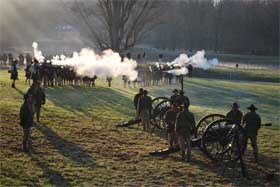
The Patriots’ Day season is upon us, so I’ll focus for several days on details and commemorations of the Battle of Lexington and Concord and the start of the Revolutionary War.

Minute Man National Historical Park has a bunch of free events lined up, starting today. For additional information, check its website. In addition, there are commemorations and events not on park land but in nearby towns such as Lexington, Bedford, and Arlington; visit the Battle Road website for those.

Saturday, 7 April, 1:00 P.M. 
Meriam’s Corner Exercise
737 Lexington Road, Meriam’s Corner, Concord
The Town of Concord, joined by area minute companies, fife and drum units, and the Concord Independent Battery, pay remembrance to the fight at Meriam’s Corner that marked the beginning of the six-hour running battle back to Boston.

Saturday, 7 April, 3:00 P.M. 
Paul Revere Capture Ceremony
Paul Revere Capture Site, 200 North Great Road, Lincoln
The Lincoln Minute Men and the Town of Lincoln, joined by other reenactment units, observe the historic capture of Paul Revere with fife and drum music and a musket fire salute.

Saturday, 14 April, 7:00 A.M.
Tough Ruck and Captain Brown’s Company of Minute Men
Step off at The Old Manse field, adjacent to North Bridge, Concord
Minute Man National Historical Park is honored to once again host the “Tough Ruck,” military personnel marching in memory of our fallen soldiers. Support our soldiers and veterans in this 26.2-mile hike along the historic Battle Road Trail. The ruck will kick off with a musket volley from the North Bridge.

Saturday, 14 April, 9:30 A.M. to 5:30 P.M.
Life at Hartwell Tavern
136 North Great Road, Lincoln
Park staff, Lincoln Minute Men, and living history volunteers will be demonstrating various aspects of life in Massachusetts at the beginning of the American Revolution.

Saturday, 14 April, 10:00 A.M. to 12:00 noon and 2:00 to 5:00 P.M.
Visit Whittemore House 
Behind Minute Man Visitor Center, Rte. 2A, Lexington
Whittemore House will be staffed by costumed park volunteers demonstrating what life was like in 1775. Try on colonial children’s clothing, gather ingredients for a meal, and listen to stories of the Whittemore family and their experience of April 19, 1775.

Saturday, 14 April, 10:30 A.M.
Explore Bloody Angle with Edmund Foster
Hartwell Tavern, 136 North Great Road, Lincoln
Edmund Foster, a volunteer from Reading, Massachusetts (portrayed by Park Volunteer Ed Hurley), will lead a tour to this key battle site where he fought in 1775.

Saturday, 14 April, 11:30 A.M.
1st Michigan Colonial Fife and Drum Corps
Amphitheater, Minute Man Visitor Center, Rte. 2A, Lexington
Listen to military music of the American Revolution and get into the spirit of Patriots’ Day!

Saturday, 14 April, 9:30 A.M. to 12:15 P.M.
Caught in the Storm of War: Civilians of April 19th
Captain William Smith House, 136 North Great Road, Lincoln
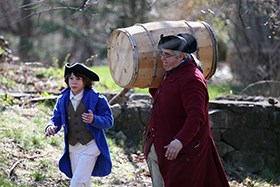
What would you take with you if you had to leave your home in a hurry, uncertain of your return? Learn about the local civilians on April 19, 1775. Once the refugees leave the Smith house, you may encounter them along the Battle Road Trail heading towards Lexington and the Minute Man Visitor Center just prior the the Parker’s Revenge Battle Demonstration. The Smith house will remain open until 4:00 P.M.

Saturday, 14 April, 1:00 P.M.
Parker’s Revenge Battle Demonstration
Battle Road Trail behind Minute Man Visitor Center, Rte. 2A, Lexington
Hundreds of British and colonial reenactors will engage in a tactical weapons demonstration with musket firing and fast-paced battle action along a stretch of the actual Battle Road of 1775. This is one of this year’s major events, newly informed by archeological findings.
Sunday, 15 April, 1:00 to 4:00 P.M.
Warlike Preparations: British Soldiers Search the Barrett House
Colonel James Barrett House, 448 Barrett’s Mill Road, Concord
In 1775, Colonel James Barrett of Concord was responsible for safeguarding all the military supplies in town, and his house was searched by British soldiers during their mission to Concord. Visit the Barrett House and learn about the intense military preparations that helped launch America into the Revolutionary War. Around 3:00, redcoats will arrive and search the property for arms and supplies.

Sunday, 15 April, 2:00 P.M.
Revolutionary Dogs: “Paws for the Cause!”
Minute Man Visitor Center, Rte. 2A, Lexington
Join Park Ranger Roger Fuller for a walk on the Battle Road to explore the lives of dogs in colonial America and in the Revolution. The 45-minute walk starts at Minute Man Visitor Center and is open to all, including well-behaved, friendly dogs on leashes.

Monday, 16 April, 8:45 A.M. 
Commemoration of the North Bridge Fight and Concord Parade
North Bridge, Concord
British reenactors will be joined by the Acton Minutemen and other local companies for a special commemoration of the North Bridge Fight featuring musket volleys. The Concord Parade will arrive at North Bridge around 9:30 A.M. All of the roads in the center of town are closed to vehicles beginning at 8:30 A.M.

Wednesday, 18 April, 7:50 to 8:45 P.M.
The Patriot Vigil
North Bridge, Concord
As darkness descends upon the North Bridge battlefield, we invite you to come and reflect on the events of April 19, 1775, and the meaning of liberty. The evening ceremony will feature a lantern-light procession stepping off from North Bridge Visitor Center at 7:50, poetry, music, and a recitation of the names of Patriots who gave their lives on that “ever-memorable” 19th of April. (To participate in the procession, bring an enclosed real candle lantern; no flashlights or L.E.D. bulbs.)

Thursday, 19 April, 6:00 A.M. to 12:00 noon
Salutes from the Bridge
North Bridge, Concord
A series of musket and cannon salutes from the bridge at various times of the day. 6:00 A.M.: The Concord Minute Men and the Concord Independent Battery. 10:00 A.M. (approximately): The Molly Cutthroats, a living-history group dedicated to the role of women in the Revolution. 11:30 A.M.: The Sudbury Companies of Militia and Minutemen. 12:00 noon (approximately): Sons of the American Revolution, Henry Knox Color Guard.

Saturday, 21 April, 4:30 - 8:30 p.m.
After the Battle: The War Has Begun
Hartwell Tavern, 136 North Great Road, Lincoln
War between the people of Massachusetts and Gov. Thomas Gage and the British regulars has just broken out. Thousands of men are preparing to leave home for the front lines around Boston. Whole communities are faced with numerous challenges demanded by this frightening new reality. Step back into the year of 1775 and get involved. Recommended donation: $5 per person, $10 per family. Children wearing a Junior Ranger badge (which can be earned on 14 or 21 April) admitted free.

Friday, April 06, 2018

“A meticulously researched study unspoiled by pedantry”

The Journal of the American Revolution has just shared a very nice review of The Road to Concord from the spring 2018 issue of Army History.
J. L. Bell’s The Road to Concord: How Four Stolen Cannon Ignited the Revolutionary War tackles a familiar subject—how Thomas Gage’s attempts to prevent a revolution ended up provoking one—but makes the story feel fresh by revealing how drastically the theft of four brass guns from Boston affected the British general’s judgment. . . .

The Road to Concord is a rare treat—a meticulously researched study unspoiled by pedantry. . . . The admirable standard that he has achieved in his first book augurs well for the other Journal of the American Revolution-sponsored books set to follow in its wake.
Check out those titles here.

The reviewer is Prof. Gregory J. W. Urwin of Temple University, who has written about several American wars and is currently researching a social history of Gen. Cornwallis’s campaign in the south.

Through some economic magic, Amazon is currently selling the hardcover edition of The Road to Concord at a discount of 60%. Heck, at that price I bought four copies for myself (the maximum available to any one customer.)

Thursday, April 05, 2018

“Very silly questions very foolishly answered”

At All Things Georgian, Sarah Murden has shared some amusing extracts (part 1 and part 2) from a 1759 book titled The Gentleman and Lady of Pleasure’s Amusement: In eighty-eight questions, with their answers, on love and gallantry.

Murden likens the book’s format to “agony aunt” letters or, as we in the U.S. of A. call them, advice columns. The extracts cover such topics as unexpected pregnancy, being in love with two sisters, whether to read a spouse’s mail, and what gender the Devil is.

The snarkiness of the queries and replies got me curious enough to look for an online copy of this book to verify its existence. The postings did appear around 1 April, after all.

I failed to find one, reflecting how few copies of The Gentleman and Lady of Pleasure’s Amusement made their way to and stayed in university libraries. (Harvard has a copy that was never digitized by Google Books. Another is at the University of Pennsylvania, donated by Prof. John C. Mendenhall.)

I did find an assessment of the book in The Critical Review, Or, Annals of Literature, edited by Tobias Smollett. The questions and answers were printed along with a couple of equally risqué novellas called The Adventures of Sophia and The History of Frederick and Caroline. The reviewer sniffed:
The first and larger part of this curious performance is, it seems, a hachis [i.e., hash] from the Athenian oracle, consisting of very silly questions very foolishly answered. Of these we shall say nothing further than that our author does by no means seem qualified to reanimate the dead. We might observe, that the Athenian oracle is not only silent and dead, but damned likewise: for that reason, perhaps, it is deprived of rest, and walks—But, a word to the wise, de mortuis nil nisi bonum [don’t speak ill of the dead].
Another magazine, the Monthly Review, said straight out that those questions and answers were “Purloin’d, as the purloiner indeed honestly confesses from two old dull books called the Athenian Oracle and the British Apollo.” The first of those books was in print by 1703, the second by 1726. Together they came in several volumes and promised more than “two thousand answers to curious questions.”

The Monthly Review evidently thought the content of The Gentleman and Lady of Pleasure’s Amusement came out of those earlier books, but my test samples didn’t find any overlap. So it’s possible that the later book was a parody, or hash, of the established genre with a more modern attitude.

The Critical Review’s critical review of the novellas was:
The latter part, which, if we may believe the editor, contains two genuine stories, is a heap of dull absurdities, without invention, humour, or probability. In the first dialogue, a woman of the town relates to her companion, as how she was debauched by the master of a ship, married to a Spaniard who lived at La Vera Cruz not far from Acapulco, shipwrecked upon a desolate island in the South Sea, which proved to be the seat of a powerful empire, ravished by an Indian, promoted to the rank of favourite sultana to the emperor, afterwards wedded to a nobleman of that country, and finally found by accident and brought back to England in a ship commanded by the same man who had deprived her of her virginity.

The second story relates to a young gentleman who met with his own sister as a lady of pleasure, and did not recognize her until they had passed the night together. The sister drowned herself in despair: the brother lost his wits, and the author has none to lose——Judge then if this production is worth three shillings.
This item appeared in the December 1758 issue of the Critical Review. Likewise, the Monthly Review notice was in the November issue. Since The Gentleman and Lady of Pleasure’s Amusement is evidently dated 1759, the printers must either have slipped an advance copy to the magazines or had such success that they quickly issued a second edition.

Wednesday, April 04, 2018

Andrew Jackson O’Shaughnessy’s Massachusetts Tour

Prof. Andrew Jackson O’Shaughnessy of the University of Virginia will give two public talks in Massachusetts next week, both on his book The Men Who Lost America: British Leadership, the Revolutionary War and the Fate of Empire.

Here’s a précis of the book:
The loss of America was a stunning and unexpected defeat for the powerful British Empire. Common wisdom has held that incompetent military commanders and political leaders must have been to blame, but were they? O’Shaughnessy dispels the incompetence myth and uncovers the real reasons that rebellious colonials were able to achieve their surprising victory.
On Tuesday, 10 April, O’Shaughnessy will kick off the American Antiquarian Society’s Spring Public Lecture Series. That free event starts at 7:00 P.M. in Antiquarian Hall, 185 Salisbury Street in Worcester.

On Wednesday, 11 April, he’ll deliver the Lexington Historical Society’s Cronin Lecture. This free talk is co-sponsored by the Friends of Minute Man National Park and His Majesty’s 10th Regiment of Foot. The evening starts at 6:00 P.M. with a reception in the Lexington Depot, and the lecture is scheduled for 7:00 P.M.

At both events copies of The Men Who Lost America will be available for sale and signing. The book has won many awards, including the George Washington Book Prize, the New-York Historical Society Annual American History Book Prize, The National Society Daughters of the American Revolution Excellence in American History Book Award, and the Fraunces Tavern Museum Book Award.

It’s also a handsome, nicely packaged book. I’ve started to read it multiple times, and I keep running into the problem that Prof. O’Shaughnessy and I have fundamentally different ideas about how to use commas. But obviously other readers haven’t been stopped that way, and sooner or later I’ll try again.

Tuesday, April 03, 2018

John Rowe and “the Funeral of the Remains of Dr. Warren”

Yesterday I noted that on Thursday King’s Chapel will host a talk by Sam Forman on the funeral of Dr. Joseph Warren, which took place in that same church on 8 Apr 1776.

The organizers of that funeral were the Freemasons of the St. Andrew’s Lodge, which Warren had led. Deputy Grand Master Joseph Webb asked young member Perez Morton to quickly write and deliver an oration. Paul Revere, Edward Procter, and Stephen Bruce expressed the lodge’s thanks afterward, and printer John Gill’s edition of that speech highlighted the Freemasons’ support.

In addition to Warren’s family and the members of the St. Andrew’s Lodge, the funeral procession also included a contingent of Continental Army troops and members of the Massachusetts General Court. The Rev. Dr. Samuel Cooper offered prayers, so the Patriot establishment was well represented.

However, one gentleman found he wasn’t welcome: the merchant John Rowe, also a grand master in the Freemasons. In his diary for 8 April Rowe wrote:
Afternoon I went by invitation of Brother Webb to attend the Funeral of the Remains of Dr. Warren & went accordingly to the Council Chamber [of the Old State House] with a Design to Attend & Walk in Procession with the Lodges under my Jurisdiction with our Proper Jewells & Cloathing but to my great mortification was very much Insulted by some furious & hot Persons witho. the Least Provocation

one of Brethren thought it most Prudent for me to Retire. I accordingly did so—this has caused some Uneasy Reflections in my mind as I am not Conscious to myself of doing anything Prejudicial to the Cause of America either by will or deed.

The Corps of Dr. Warren was Carried into Chapell Dr. Cooper prayed & Mr Perez Morton delivered an Oration on the Occasion. There was a handsome Procession of the Craft with Two Companies of Soldiers.
Those last sentences evoke a picture of Rowe standing outside the chapel, watching people go in—standing on the side of the street as the “handsome Procession” passed by without him.

Rowe was the leader of Boston’s other group of Freemasons: the St. John’s Lodge. That lodge had been wealthier and closer to the Crown than the upstart St. Andrew’s, which was at last in the ascendancy.

Furthermore, Rowe himself had “trimmed” his political sails enough during the preceding decade to make people on both sides of the political divide suspicious of him. And that April, there was no way to deny that he had spent the whole siege inside Boston with the royal government and royal military.

Rowe assured himself that he hadn’t done “anything Prejudicial to the Cause of America either by will or deed.” But some of his fellow Bostonians, “furious & hot” after twelve months of war, didn’t share his confidence.

Monday, April 02, 2018

Warren Funeral Commemoration at King’s Chapel, 5 Apr.

On Thursday, 5 April, King’s Chapel will host a talk by Samuel A. Forman on “Dr. Joseph Warren and King’s Chapel—242nd Anniversary of Warren’s Funeral.”

As Boston 1775 readers know, Dr. Joseph Warren was killed at the Battle of Bunker Hill and then buried several times. Not in pieces, though some rumors claimed that, but in different graves over the decades.

The first burying-place was on the battlefield itself. But after the British left Boston, Warren’s family and friends sought out his body and brought it across the Charles for a large funeral.

That event took place at King’s Chapel on 8 Apr 1776. Warren wasn’t a member of that Anglican congregation; he had been a congregant at the Brattle Street Meetinghouse instead. But Boston’s places of worship were in turmoil after the siege.

On Sunday, 10 March, the minister at King’s Chapel, the Rev. Henry Caner, had written in the church records:
An unnatural Rebellion of the Colonies against his Majesties Government obliged the Loyal Part of his subjects to evacuate their dwellings and substance, and to take refuge in Halifax, London, and elsewhere; By which means the public Worship at King’s Chapel became suspended, and is likely to remain so, till it shall please God in the Course of his Providence to change the hearts of the Rebels, or give success to his Majesties arms for suppressing the Rebellion.
Much of the upper-class Anglican congregation sailed away with the royal troops.

That left the big stone building available for Dr. Warren’s funeral less than a month later. A few weeks after that, the Old South Meeting-House congregation moved in for a few years until their own building was restored from being used as a riding stable by British dragoons.

Sam Forman’s talk will examine what Warren meant to Boston, the retrieval of his remains from Charlestown, and how young lawyer Perez Morton’s oration helped to define Warren’s legacy in the nascent republic. Forman is the author of Dr. Joseph Warren: The Boston Tea Party, Bunker Hill, and the Birth of American Liberty.

King’s Chapel is at 58 Tremont Street in Boston. This event will start at 6:30 P.M. It is free and open to the public, but King’s Chapel asks people who plan to attend to register here. There’s a suggested donation of $5 to support the church’s preservation efforts and history program.

Sunday, April 01, 2018

The Myth of Dolley Madison and the Easter Egg Roll

Many authors have written about Dolley Madison instituting the tradition of rolling eggs on the White House grounds on or around Easter.

The story goes way back. A magazine called The Industrial Enterprise quoted the 11 Apr 1909 Detroit Free Press as stating:
The custom of having the children of Washington come to the White House on the Monday following Easter and roll eggs originated so far in the distant past that its beginning is uncertain. It is the current belief, however, that Dolly [sic] Madison first gathered them in and herself prepared the eggs which they rolled, coloring them a scarlet by boiling them wrapped about with red flannel which faded upon them.
And it’s still current. In 2017 the Politico website stated: “The roots of the Easter Egg Roll are often traced to President James Madison and first lady, Dolly Madison, but these early public celebrations were held on Capitol Hill.”

Even the White House Historical Association passes on that factoid, though fobbing it off on others: “Some historians note that First Lady Dolley Madison originally suggested the idea of a public egg roll…”

In fact, that’s all a myth. As the Dolley Madison Papers explain, there’s absolutely no evidence behind it.
During the Founding Era,…religious observances such as Easter and Christmas were simply not part of the national calendar. Indeed, when James Madison was President of the United States, Easter was not yet a publicly celebrated holiday; it was observed neither at the president’s mansion—not yet officially known as the White House—nor by Congress. And a search of Dolley’s letters fails to produce a single mention of Easter or Easter eggs. That leaves two questions: when and where did the tradition begin, and what does Dolley Madison have to do with it?
The tradition in Washington, D.C., can be definitely dated to the years after the Civil War. Late in the Ulysses Grant administration, Congress barred children from playing on the Capitol grounds, but President Rutherford B. Hayes welcomed them at the White House. The press coverage of the event really took off in the 1880s and 1890s, turning it into a national institution.

That same period coincided with America’s Centennial and Colonial Revival, when Dolley Madison became the nation’s paragon of a political hostess. Her papers site says:
She was the symbol of American hospitality, warmth, and graciousness. By the late 19th century manufacturers were using her image to promote their products. Between 1876, which marked the end of Reconstruction, and World War II, all kinds of manufacturers used her image as part of their advertising campaigns to send a message of grace and charm and cordiality. If not unique, Dolley Madison was one of the very few American icons with an equal appeal to both the North and the South.
Thus, if there was any sort of venerable public event in Washington, it made sense to say Dolley Madison was the earliest hostess.

Saturday, March 31, 2018

“Terror Twice Told” Seminar in Boston, 3 Apr.

On Tuesday, 3 April, the Massachusetts Historical Society will host a session of Boston Area Early American History Seminar that promises a lively discussion among some of the region’s most incisive historians of the Revolutionary period.

The reading for the seminar is Boston University professor Brendan McConville’s paper “Terror Twice Told: Popular Conventions, Political Violence, and the Coming of the Constitutional Crisis, 1780-1787.” The event description says:
As the revolutionary war ended, members of committees, conventions and other extraordinary revolutionary institutions continued to operate as independent political actors. Between 1781 and at least 1786, committeemen and conventioneers launched forceful, violent efforts to reengineer American society. Committee-directed mobs expelled “tories” from many communities, and committeemen and conventioneers used both local laws and contract theory to legitimate these expulsions.

This paper argues that the wave of political violence after the American victory at Yorktown in 1781 ultimately reflected conflicts within the American political community over who could be an American, what institutions constituted “the people” in a republic, and the character and limits of the “the people’s” power to form self-governing institutions. These disputes played an important role in creating the 1787 constitutional crisis.
The main commentary will be offered by University of Connecticut professor Richard D. Brown. Then discussion can become general.

McConville is the author of The King’s Three Faces: The Rise and Fall of Royal America, 1688-1776 and These Daring Disturbers of the Public Peace: The Struggle for Property and Power in Early New Jersey.

Brown is the author of numerous books including Self-Evident Truths: Contesting Equal Rights from the Revolution to the Civil War, Taming Lust: Crimes Against Nature in the Early Republic (coauthored by Doron S. Ben-Atar), The Hanging of Ephraim Wheeler: A Story of Rape, Incest, and Justice in Early America (coauthored by Irene Quenzler Brown), The Strength of a People: The Idea of an Informed Citizenry in America, 1650-1870, Knowledge Is Power: The Diffusion of Information in Early America, 1700-1865, and Revolutionary Politics in Massachusetts: The Boston Committee of Correspondence and the Towns, 1772-1774.

This seminar is scheduled to start at 5:15 P.M. It is free and open to the public, but the society asks people to R.S.V.P. to ensure seating and adequate munchies for afterward. In addition, the conversation will be much easier to follow if one comes early to peruse the paper.

Friday, March 30, 2018

The Final Fate of Jefferson’s Four-Horned Ram

On 23 Feb 1808, a week after young Alexander Kerr, Jr., died from being gored by a four-horned ram on the grounds of the Presidential mansion, Thomas Jefferson made plans to move that animal to Monticello.

Jefferson wrote to his plantation manager, Edmund Bacon, about his flocks:
I am glad to hear you have lost no lambs. you must attend to the males being cut at a proper season in the spring; and at shearing time remember that the lambs are not to be shorn. I have here 18 ewes and shall have about the same number of lambs from them, by a many horned ram, all of which I shall propose to have driven to Monticello in the summer. this breed being very different from the big-tail we shall have to provide two separate ranges for them.
Jefferson wrote nothing in that letter or others to Bacon about the “many horned ram” attacking people and therefore perhaps needing special attention. The manager and an enslaved wagoner named David Hern came to Washington, D.C., and got Jefferson’s Presidential flock to Monticello.

According to one anti-Federalist newspaper, “a female child of one of the President’s domestics”—i.e., his slaves—had been among the ram’s victims; “her person has become disfigured.” That report may have been exaggerated for political reasons. But Jefferson does appear to have had a blindspot when it came to that killer animal.

The President’s established interest in improving American sheep grew after he instituted an embargo on British and French goods in December 1807. The U.S. of A.’s ability to manufacture its own woolens became even more appealing. He therefore loaned out his rams to other Virginia sheep farmers and promoted the fleece of his own flock.

On 13 October, Jefferson wrote to James Ronaldson, a Philadelphia manufacturer:
I happen by accident to have obtained the Iceland or Shetland race of sheep of many horns. it is from their wool I understand that the famous Shetland stockings are made which I believe sell for a guinea a pair being as soft as fur. as this peculiar wool may possibly be useful for some manufacture here, I send a fleece of it as a sample, by my grandson [Thomas Jefferson Randolph], who is going to Philadelphia, and who will put it into your hands. and I am encouraged to take this liberty by the zeal which your letter manifested for the promotion of manufactures. the request I have to make is that you will be so good as to have ascertained whether there will be any particular utility in raising this kind of wool, & what would be it’s probable price in Philadelphia, if encouraging I can probably extend it’s produce to any requisite degree in my neighborhood.
Within two weeks, that man replied that all the weavers and craftsmen who’d seen the fleece said it was suitable for blankets only. Still, Jefferson remained determined to find value in that many-horned ram.

In October 1809 Jefferson told Sen. John Milledge of Georgia: “I have for you a very fine Iceland ram with 4. horns, who will be sent down the river, as soon as the season restores it’s navigation…” Milledge wrote back, “I thank you for the Ice land ram, the wool from the breed of that animal, will answer for clothing our negroes.”

In 1811 Jefferson promised to send a younger four-horned ram to Milledge, but on 5 June he had to report bad news:
The many-horned ram which I was to have sent to Norfolk for you was killed by his sire. this abominable animal killed moreover two fine Barbary rams for me, & was so dangerous generally that I was obliged to have him destroyed. I found the species very worthless.
Jefferson maintained hopes for that animal even after it had killed a boy and injured one or two others in Washington, but once it started kill other rams in his flock, especially those of his favorite breed, he decided it had to die.

Thursday, March 29, 2018

“Severely wounded and bruised by your excellency’s ram”

After Thomas Jefferson’s four-horned Shetland sheep gored a boy near the Presidential mansion on 6 Feb 1808, the President “ordered a blinder or board to be put on the face of the ram,” according to the U.S. Gazette of Philadelphia.

But that wasn’t enough for some of his critics. On 12 Mar 1808 the New York Commercial Advertiser ran this commentary, which originally appeared in the North American of Baltimore:
The President’s Ram.—This sturdy animal is a native of Africa.—Besides his uncommon size, he is, if we well remember, a unicorn, and characterised by other peculiarities. He was some time ago presented to his present owner by a gentleman of Washington.

This is the concise history of a monster, who has added to the proofs, that unbridled liberty is productive of nought but evil. We are extremely sorry to hear, that for want of confining him, he was recently killed a very promising and beautiful boy, a son of Mr. [Alexander] Kerr of the Branch Bank; knocked down and severely injured a poor old man, and a female child of one of the President’s domestics insomuch that her person has become disfigured
The editor of the North American was Jacob Wagner. When the Jefferson administration began, he was a clerk in the State Department appointed by Timothy Pickering. He convinced the new Secretary of State, James Madison, that he could stay on and perform his job without political leanings, which he did successfully until resigning in early 1807.

Then Wagner came out as a strident Federalist, editing one anti-administration newspaper after another. He was happy to find anything to criticize Jefferson for. In actuality, the President’s ram wasn’t from Africa but from a northern European breed. It had four horns, not one. But if it could serve as a symbol of “unbridled liberty” under Jefferson, all the better.

The man whom the President’s ram injured in February 1808 was named William Keough. On 3 March, Jefferson wrote in his memorandum book: “Gave Keough in charity 5.D. [five dollars]” as compensation.

The next month, Rep. Nicholas R. Moore of Maryland presented Keough’s petition to the U.S. Congress from “praying relief in consideration of wounds received and injuries sustained while serving as a soldier in the Maryland line, during the Revolutionary War.” That request doesn’t appear to have been granted.

In December 1808, the Maryland house of delegates considered Keough’s service and poverty and voted to grant him “a sum of money annually, in half yearly payments, equal to the half pay of a sergeant.” But the state senate “dissented from” that vote.

On 15 Feb 1809, with Jefferson less than a month from leaving office, William Keough wrote to him in desperation:
To his excellency the President of the United States

Your petitioner William Keough begs leave to state to your excellency that in February 1808 in Passing through the President’s Square he was attacked and severely wounded and bruised by your excellency’s ram—of which he lay ill for five or six weeks under the hands of Doctor [Arnold] Elzey.

Your petitioner troubles your excellency with regret, he would not presume to do it now but for extreme distress. He is without money and without freinds. His business in this place was for the purpose of obtaining a pension to which he considered himself entitled for his revolutionary services—He has been able to obtain lodgings in the poor’s house, but without the usual allowance of fare.—

It is probably the last time your excellency will be troubled as President of the U.S. by an individual, most assuredly the last, by your petitioner; and if the prayers of a poor, old soldier will be any consolation to your excellency in your retirement, you have them from his heart.—Hoping your excellency will take his distressed situation in consideration, and grant some relief, your petitioner as in duty bound will ever pray.
I’ve found nothing more about the unfortunate William Keough.

TOMORROW: The final fate of Jefferson’s ram.

Wednesday, March 28, 2018

Alexander Kerr and “the late distressing affair”

None of the printed sources about the son of Alexander Kerr who was killed by President Thomas Jefferson’s four-horned ram in February 1808 state the boy’s name.

I played a hunch and searched for “Alexander Kerr, Jr.” At Find-a-Grave I found this gravestone in the Oak Hill Cemetery of Washington, D.C., for a person of that name who died on 16 Feb 1808. So this is the marker for the boy who was killed by the President’s sheep. (The stone also lists two siblings who died decades later, one of them having been a U.S. Army officer.)

Less than two months later the boy’s father again wrote to the President, this time seeking a federal government job:
Washington 4 April 1808.

Sir

The office of Collector of the Port of Baltimore being vacant by the death of Mr. Christie, I beg leave to offer myself to you as a Candidate for that situation. I have been engaged in the Bank in this place since its establishment, however the greater part of my life, prior to that, I have been engaged in Mercantile pursuits & particularly in the Shipping line, which gives me confidence that I could do justice to the discharge of the duties & in a little time give satisfaction to the Public—

The compensation I receive from my present situation is too small for the support of my family, in the manner they have always been accustomed to, which is a strong reason for my taking this liberty in applying to you for an Office: Independent of that, the great desire I have to remove myself & family from the place, where every day, indeed I may say every hour, presents something to keep our feelings alive to the late distressing affair that has taken place in it.
In other words, your sheep killed my son, so you owe me.
Pardon me for this weakness. Mr. [James] Madison has known me for many years, to whom I beg leave to refer you for farther information. I would have waited on you in Person, but did not think myself Sufficiently Known to you to authorize my doing so. Time would not admit, else I would have procured Letters from Men of the first respectability to strengthen my application. On enquiry, should you think me worthy of this appointment, I pledge myself to use every exertion to give general satisfaction.

With the utmost respect, I have the honor to be, Sir, Your Most Ob: Servt.
Alexr. Kerr
Kerr had indeed sought positions from Secretary of State Madison in 1801, and would again from President Madison in 1812. Because President Jefferson didn’t offer him a job.

There’s a line in Jefferson’s private accounts for 10 July 1808, slightly more than five months after the ram attacked young Alexander:
Drew ord. on the bk. US. in favr. of the bearer for 25.D. in charity sent by Mr. Kerr.
That might have been a discreet way of compensating the Kerr family for its loss.

Alexander Kerr remained in the private sector. He moved from the Branch Bank to the National Metropolitan Bank in Washington when it opened in 1814 and remained there until his death in 1832. In that capacity he served another Secretary of State and future President, John Quincy Adams.

TOMORROW: More victims of the killer sheep.

Tuesday, March 27, 2018

“The ram ran his horns into the bowels of the boy”

On 18 Feb 1808, the United States Gazette for the Country, a Federalist-leaning newspaper published out of Philadelphia, shared this news from Washington, D.C.:
The only incident within the last ten days, to excite conversation, is an unhappy affair, of which the hero is the president’s ram.

About a week since, as a lad, nine years old, was returning from school, he was attacked by this ram in the plain beyond the [Presidential] palace on the Georgetown road. The boy, knowing that the ram was wont to push, avoided the first attack, but the second time he was not so fortunate. The ram ran his horns into the bowels of the boy. It was some time before they were disengaged.
The ram must have gored the boy on 6 February because the next day President Thomas Jefferson wrote to the lad’s father, Alexander Kerr, sending thoughts and prayers:
Sir

The unfortunate accident of yesterday has given me inexpressible concern. had the orders I had given some days before for securing the instrument of it against doing injury, been timely executed, this great calamity would have been prevented. that they were not will be to me a source of unceasing regret.

I am but too sensible that the participation of others in this scene of distress cannot alleviate the sufferings of tender parents: yet I cannot refuse to myself the expressing to them the deep affliction I feel as well for them as the unfortunate victim. not knowing his situation I can but offer my devout prayers for his safety, and to yourselves my sincere sympathies and respect.

Th: Jefferson
Kerr wrote back the same day:
Sir.

Mrs. Kerr & myself are much gratified & our affliction somewhat alleviated by your sympathetick & friendly Letter of this Morning, which you have done me the honor to write respecting my Child.

The Wound is of a very dangerous nature, however the fever has not yet risen to an alarming height & the Doctors, ([John] Weems, [Arnold] Elzey & [Charles] Worthington, who have been here this morning) think appearances not unfavorable. I trust Sir, that in a few Days, I shall have it in my Power to inform you that he is out of danger.

I am perfectly satisfied that you feel as a Parent on the present melancholy occasion & I sincerely hope that your prayers, with those of his Parents, & the rest of his friends, may be heard by him who has the Power to save my darling Boy.—

With the utmost respect, I am Sir Your Obt. Servant
Alexr. Kerr
Five days later came another report:
Sir

I feel great satisfaction in being able to inform you, that my Son, in whose recovery you have taken so much interest, has the appearance of mending. He is now nearly at the expiration of the sixth day & the inflammation & tenseness of the Body have abated, without any appearance of mortification. The Intestine still discharges a little of its contents through its wound, although we are in hopes it has commenced to unite.

The Child has generally been very much composed, his only nourishment until yesterday has been Sleep. The Physicians have not pronounced him to be out of danger, but they give some reason for us to hope for a favorable issue; & that, principally from the Child having held up so long.

With the utmost respect.
Alexr. Kerr
Unfortunately, that prognosis was too optimistic. An infection set in. The U.S. Gazette reported, “The boy languished and died. He was buried yesterday,” or 17 February.

TOMORROW: The results of this “unhappy affair.”

Monday, March 26, 2018

President Jefferson’s Flock

Thomas Jefferson was always interested in improving American agriculture, and his own farming enterprises, though he wasn’t always successful.

In 1794, after stepping down as Secretary of State, Jefferson had his managers at Monticello buy a flock of forty ewes. Robert Morris gave him a ram smuggled from Spain. On becoming President, Jefferson gained access to other exotic sheep—a Bengal ewe in 1805, a Barbary Broadtail ram and ewe in 1806.

In June 1807 a man named James D. Barry offered the President a ram of the Shetland breed (also found in other parts of northern Europe). Jefferson replied:
Th: Jefferson presents his compliments and thanks to mr Barry for his offer of the ram which he accepts, not from personal motives, but merely with a view to secure the breed to our country, of which another chance might not happen in a century.

he is sending off the ram which runs at present with his ewes, and is engaging a person to attend the flock constantly as a shepherd, to secure them against accident, and he counts on producing the breed of the ram pure & full-blooded in four generations, according to the common estimation.

should mr Barry hereafter wish for the breed Th:J. will feel a duty & pleasure in furnishing him. he will send for him tomorrow morning with mr Barry’s permission.
Barry replied on 25 June:
James D Barry presents his compliments to the President of the U.S.

it has been his wish ever since he got the ram to give him to some gentleman who would attend to propagatg. the breed which he thinks will be a useful one and will suit the soil & Climate of this Country.

it is with pleasure he sends him by the bearer, Knowing that there is no person in this Country who would be more disposed or who has it more in his power to secure the breed than the President—
Four days later, President Jefferson wrote to his granddaughter Ellen Wayles Randolph, then ten years old, about his growing flock:
I am now possessed of individuals of four of the most remarkeable varieties of the race of the sheep. if you turn to your books of natural history, you will find among these
1. the Spanish sheep or Marino.
2. the Iceland sheep, or Ovis Polycerata.
3. the Barbary sheep, or Ovis laticunda &
4. the Senegal sheep, or that of Bengal which is the same.

I have lately recieved a ram of the 2d. kind, who has 4. horns, a round & beautiful animal, rather small.

the 3d. or broadtailed is remarkable for it’s flavor. I lately had a quarter sent me which I found the highest flavored lamb I had ever tasted. the 4th. or Senegal is supposed to be the original stock of the sheep. it’s flavor is said to be equal to that of Venison.

tho’ I possess individuals of one sex only of the 2d. 3d. & 4th. kinds, yet 4. crossings are understood by naturalists to produce the true breed. I mean to pay great attention to them, pro bono publico. (call on [your older brother] Jefferson to translate your Latin)
While Jefferson talked about breeding these sheep for the public good, he accepted the gifts as his own property. He expected to make money from his flock first and ultimately to benefit the country by providing a stock of well-bred sheep and an example for other farmers.

He didn’t know that his new ram would be a killer.

TOMORROW: “The concise history of a monster.”

Sunday, March 25, 2018

Jobe on Thomas Chippendale, 29 Mar.

On Thursday, 29 March, the Nichols House Museum in Boston will sponsor a lecture on “Chippendale: The Man and the Myth” by Brock Jobe.

The museum says:
This year marks the 300th anniversary of Britain’s most celebrated furniture maker, Thomas Chippendale. His designs reached both sides of the Atlantic through a groundbreaking pattern book, The Gentleman and Cabinet-Maker’s Director of 1754. During his lifetime he oversaw one of the largest cabinetmaking and upholstery firms in London, and eventually his name defined an entire style of eighteenth-century furniture.

Jobe recounts the remarkable story of Chippendale’s career and takes us inside some of his greatest works. Along the way, we will confront the truth as well as the fiction associated with this fascinating character.
In 2000 Brock Jobe was appointed professor of American decorative arts in the Winterthur Program in American Material Culture after a 28-year career as a museum curator and administrator at the Museum of Fine Arts, Boston; Colonial Williamsburg; the Society for the Preservation of New England Antiquities (now Historic New England); and Winterthur. He co-directed the “Four Centuries of Massachusetts Furniture” project.

Although this is a Nichols House Museum event, it will take place at the New England Historic Genealogical Society at 99-101 Newbury Street in Boston. The talk will begin at 6:00 P.M. and be followed by a light reception. Admission is $20, or $15 for museum members. Space is limited. Tickets can be purchased through the museum website.

Saturday, March 24, 2018

Fort Plain Museum’s American Revolution Conference, 7-10 June 2018

Fort Plain Museum’s American Revolution Mohawk Valley Conference will take place this year from Thursday, 7 June, to Sunday, 10 June.

The event schedule includes author presentations, a bus tour of historic sites in central New York, genealogy consulting, and a fundraising dinner featuring first-person interpretations of two early Presidents.

Thursday, 7 June 2018 

Bus tour of historic sites featuring the events of 1778: the Battle of Cobleskill, the Cherry Valley Massacre, Springfield, Andrustown, Adam Helmer’s Run, Fort Herkimer, and Fort Plain/Rensselaer. Lunch stop in Cooperstown.
Friday, 8 June 2018

Genealogy Day: Visit Mohawk Country historic sites (sites, schedules, and admission fees to be posted separately). Sites will have presentations and/or historians on hand to discuss the families that fought on both sides during the American Revolution.
  • Russell Shorto,  “Revolution Song: America’s Founding Era in Six Remarkable Lives”
Saturday and Sunday, 9-10 June 2018

Author presentations:
  • Edward G. Lengel, “George Washington and the Burning of New York City, 1776”
  • Eric H. Schnitzer, “‘Hessians’ at the Battle of Bennington, 1777”
  • James L. Nelson, “Benedict Arnold’s Navy: The Story of the Rag Tag Fleet that Lost the Battle of Valcour Island and Won the American Revolution”
  • Don N. Hagist, “Redcoats Along the Mohawk: British Soldiers in Western New York, 1777-1783”
  • Bruce M. Venter, “Benedict Arnold’s Nemesis: Colonel John Brown’s Fateful Journey to the Mohawk Valley”
  • Jennifer DeBruin, “Traitors, Spies & Heroes: Loyalist Espionage in the American Revolution”
  • Glenn F. Williams, “Sir William Johnson, the Iroquois Confederacy, and Lord Dunmore’s War”
  • John Buchanan, “Two Warriors: George Washington and Sir William Howe
  • Wayne Lenig, “The Tryon County Committee of Safety”
There will also be a panel discussion featuring these authors on the topic “Patriot or Loyalist?” I’m not sure how these presentations will be divided between the two weekend days.

Saturday, 9 June 2018

“An Evening with Washington and Madison”
Fundraising Dinner at the Bridge Walk at the Perthshire, Amsterdam, N.Y.
George Washington and James Madison, as portrayed by Brian Hilton and Kyle Jenks, will discuss their journeys to upstate New York and other founding moments.

I enjoyed this conference two years ago. Though the venue has a lot of space, last year’s event nearly sold out. The last day to register is Thursday, 31 May.

Friday, March 23, 2018

Jacob Francis’s Story

In January I wrote three postings about Pvt. Jacob Francis and an anecdote he told about Gen. Israel Putnam when he applied for a U.S. pension.

Those postings have now prompted two more substantial and quite different articles at the Journal of the American Revolution website.

First and more important, Larry Kidder wrote up the information he had collected about Pvt. Francis into the fullest biography of the man yet published. Here’s a taste of his portrayal of the young man’s decision to join the Continental Army outside Boston in the fall of 1775:
Not knowing his family surname, Jacob used the name of his third “time” owner, Minne Gulick or Hulick, an Amwell farmer of Dutch ancestry. However he felt about the ideals of liberty and independence driving the Revolution, as a free black who had experienced indentured servitude most of his life, he probably enlisted at least partly because he was a young man accustomed to authority, who needed a job, and who may also have been seeking adventure. When approaching the recruiting officer, though, he found that free blacks were not encouraged to enlist and often not accepted.

From the time Washington took command at Cambridge, he wanted to exclude black men from the army. Washington interpreted the fact that there already were “boys, deserters, & negroes” in the Massachusetts regiments as proof that not enough qualified white men were enlisting. At the very time Jacob enlisted in October, Washington was discussing with his officers and Congress whether or not blacks should be enlisted and, while not unanimous, most leaders wanted to eliminate black enlistment entirely. By October 31, just days after Jacob’s enlistment, Washington’s general orders stated that blacks should not be enlisted and this order was reinforced in November.
That article fills out Pvt. Francis’s military experiences, particularly in his home state of New Jersey, and his life in the early republic. It’s a fine resource for people writing about African-American soldiers in the Revolution.

In addition, I assembled my postings about Jacob Francis’s anecdote into an article. While writing that, I found a third version of Francis’s story that a veteran of the siege of Boston named Simeon Locke reportedly told as an old man in Maine:
“‘I was a soldier in the army of the Revolution, and was detailed, with others, to build the breastworks on Dorchester Heights. A day or two after the works were begun, General Washington rode into the enclosure. I was a sentinel. Near me was a wheelbarrow and shovel; not far off was an idle soldier.

“‘“Why do you not work with the others?” asked Washington, addressing the soldier.

“‘“I am a corporal, sir,” he replied.

“‘The general immediately dismounted, and marched to the barrow, shovelled it full of sand, wheeled it to the breastworks, dumped his load, and returned the empty barrow to its place. Without uttering a word, he mounted his horse and rode away.’”
I still hope someone will find the first published version of that story from 1839, the source of the earliest examples I’ve unearthed. That could reveal more about how it got passed along, and how funny tales old soldiers told each other became moral lessons for the new republic.

Thursday, March 22, 2018

Upcoming Talks in Bedford, Weston, and Burlington

As we continue to look forward to spring weather and the approach of Patriots Day, I’m giving multiple Road to Concord talks over the next few weeks.

Sunday, 25 March, 2:00 to 4:00 P.M.
“What the Bedford Minutemen Went to Guard in Concord”
Bedford Historical Society
Great Room, Old Town Hall, 16 South Road

On 18 Apr 1775, militiamen in Lexington spotted British officers passing through town on horseback. Locals quickly sent riders to Bedford, with the result that Bedford’s minute and militia companies were among the first to arrive at the North Bridge in Concord from neighboring towns. But why were all those communities on high alert in the spring of 1775?

This free event will start with refreshments, and I’ll speak at about 2:30. There will be book sales and signing after the talk.

Thursday, 29 March, 11:15 A.M. to 12:45 P.M.
“The Boston Revolution and the End of Tory Row”
Regis College Lifelong Learning, “Lunch, Listen & Learn” series
Fine Arts Center, Atrium, Regis College

On September 1, 1774, the Cambridge estates along the road to Watertown comprised a prosperous community, linked by bonds of family, religion, and politics. The following morning, thousands of rural militiamen crowded into town, demanding that royal officials resign. By the end of the month most of those families had moved out of their mansions, never to return. And inside Boston, Gov. Thomas Gage realized that he was witnessing a revolution.

This event is for members of Lifelong Learning at Regis College. I don’t think the public is allowed, but the organization might welcome new members.

Thursday, 5 April, 7:00 to 8:30 P.M.
“The Road to Concord: How Middlesex County Went to War”
Burlington Historical Society
Human Services Building, 61 Center Street, Burlington

Burlington was incorporated in 1799; before then, the area was part of Woburn. Like their neighbors, the farmers of that village were caught up in the “Powder Alarm” of 1774 and the Lexington Alarm of 1775. On the morning of 19 April, John Hancock and Samuel Adams found refuge in what’s now Burlington before moving on to Billerica. So what was all that fighting about?

Wednesday, March 21, 2018

Enoch Brooks’s Curious Bible

On 1 May 1785, Enoch and Hannah Brooks of Princeton, Massachusetts, had a son. The couple already had children Elisha (born in 1772), John (1774), Ezra (1776), Samuel (1779), and Hannah (1781).

Enoch Brooks had been the town’s assessor for four years before becoming its treasurer from 1780 until 1816, with only a couple of years off. He had also been a minuteman in 1775 and at some point a militia officer.

The Brookses named their new baby Enoch, after his father. (Another son, Stephen, would come in 1787.)

As little Enoch approached his fourth birthday, someone bought him a very special present: a copy of A Curious Hieroglyphick Bible, or, Select Passages in the Old and New Testaments, Represented with Emblematical Figures, for the Amusement of Youth.

On the first page someone wrote in large, clear letters:
Enoch Brooks’
Book
Princeton
March, 13th. 1789.
As shown on the interior page above, this book retold stories from the Bible in rebus form. Isaiah Thomas had issued it from his Worcester press in 1788, copying a volume published in London five years before. (The British edition had in turn been modeled on German picture Bibles, which went back to the late 1600s.)

To create his edition, Thomas had to collect or commission 500 small woodcuts—more than had appeared in any other American book up to that time. But he could reuse those illustrations in other publications. Thomas found children’s books blending entertainment and instruction to be a lucrative field in the new American republic. Ultimately he published more than a hundred titles, most copied like this one from British originals.

Only four copies of Thomas’s Curious Hieroglyphick Bible are known to have survived the little hands of their early owners. Enoch Brooks’s copy is now at the Library of Congress, digitized for all.

As for young Enoch Brooks himself, he grew up in Princeton, married Polly Gregory in 1816, and had children of his own. Like his father, he held town office. He died in 1859. His wife lived until the age of ninety-nine, dying in 1890. Their gravestones stand side by side in Princeton’s Meetinghouse Cemetery.

Tuesday, March 20, 2018

A Book “Taken in ye Field of Battle”

Last month the blog of the Clements Library in Ann Arbor, Michigan, noted an unusual way of identifying books in its collection: as “battle estrays,” or books known to have been picked up in battle. No other library is known to use this term.

One example shown is the third volume of Jonathan Swift’s Miscellanies as published in London in 1742. It is inscribed:
22d-43d-54th-&-63d Regiments took possession of New York
—5 Brigade—
Taken in ye Field of Battle,
the 16th of September 1776—
J:B:
The library blog said:
First Library director Randolph Adams noted in The Colophon that the British occupied the lower part of Manhatten Island on the 14th and 15th of September, then started up the island on the 16th. The battle [of Harlem Heights] on the 16th, in which this book was picked up, took place about what is now 126th St.
Not mentioned in the blog post, but noted in the book’s cataloguing record, is the bookplate. It shows the volume had been owned by the Rev. Dr. Myles Cooper, the president of King’s College. That institution later became Columbia University. It’s now located near the site of the fighting on 16 Sept 1776, but back then it was housed in one large building near modern New York City Hall.

If a volume from Cooper’s personal library was on “ye Field of Battle,” it had probably been looted from the college hall or his house. Cooper himself had fled America in May 1775. The college shut down, its building becoming a military hospital, so a lot of people might have had access. An American soldier or civilian might have taken the book and then dropped it on the retreat north, where a British soldier picked it up.

Monday, March 19, 2018

Orations at Old South, 21 Mar.

On Wednesday, 21 March, the Old South Meeting House will host “Speak Out!”, its fourth annual remembrance of the Boston Massacre orations.

From 1771 to 1783, Boston had a yearly town meeting to commemorate the fatal violence on King Street. The tradition was started by Dr. Thomas Young speaking at the Manufactory on 5 Mar 1770, and the town’s politicians decided the event was successful enough to make it an official occasion, not just a speech by a radical who wasn’t even from around here.

That year the town had assistant schoolmaster James Lovell speak in April. From then on, the orations were always on 5 March or, if that date fell on a Sunday, 6 March. The invited orator was usually a rising young politician. In order:
In 1783 Boston decided that remembering the Massacre was less vital now that Massachusetts was independent, and the town shifted its annual patriotic oration to the Fourth of July.

The Old South event focuses on the orations leading up to the war. The description says:
Join us to hear selected excerpts of these speeches, performed by an inter-generational group in the grand hall where the orations took place 240 years ago! Learn about the orations and their significance with special guests Bostonian Society Executive Director Nathaniel Sheidley, historian Robert Allison, and Dr. Joseph Warren biographer Dr. Samuel Forman. Audience members will also have the option to read from a selection of excerpts; prizes will be awarded to the most rousing orators in youth and adult categories!
This free event is co-sponsored by the History Department at Suffolk University, the Bostonian Society, and the Boston Public Schools’ Department of History and Social Studies.

All are welcome, but Old South asks people to please register in advance. The speeches start at 6:00 P.M. If the weather is bad, the event might be postponed for a week until 28 March.

ADDENDUM: This event has now been rescheduled for 28 March.