J. L. BELL is a Massachusetts writer who specializes in (among other things) the start of the American Revolution in and around Boston. He is particularly interested in the experiences of children in 1765-75. He has published scholarly papers and popular articles for both children and adults. He was consultant for an episode of History Detectives, and contributed to a display at Minute Man National Historic Park.

Subscribe thru Follow.it


•••••••••••••••••


Friday, December 10, 2021

“COME muster, my lads, your mechanical tools”

In the Second Continental Congress, Francis Hopkinson (1737–1791, shown here in a painting by Robert Edge Pine) of Pennsylvania was the artistic one.

He designed the stars-and-stripes flag for the new U.S. of A. He also designed some Continental currency, the Board of Admiralty seal, and a proposal for the Great Seal of the U.S., though that final image was ultimately sketched by Charles Thomson.

Hopkinson played and composed music, including what he said was the first secular song issued by a person born in the American colonies, “My Days Have Been so Wondrous Free” (1759). He wrote satirical verse, such as “The Battle of the Kegs” (1778).

It’s no surprise, then, that Hopkinson contributed to the debate over whether to ratify the U.S. Constitution with a song.

Pennsylvania ratified the Constitution on 10 Dec 1787, so Hopkinson didn’t need to win over his fellow citizens to the document. Rather, he aimed to convince the people of other states.

On 29 December, Hopkinson published an essay in the Pennsylvania Packet using the extended metaphor of the roof of “a certain mansion house” with thirteen rafters that “skillful architects” had determined needed a new roof lest the whole thing fall down.

He followed that up in the Pennsylvania Gazette with the words for a song originally titled “The Raising: A New Song for Federal Mechanics”:
COME muster, my lads, your mechanical tools,
Your saws and your axes, your hammers and rules;
Bring your mallets and planes, your level and line,
And plenty of pins of American pine:
  For our roof we will raise, and our song still shall be,
  Our government firm, and our citizens free.

COME, up with the plates, lay them firm on the wall,
Like the people at large, they’re the ground work of all;
Examine them well, and see that they’re sound,
Let no rotten parts in our building be found:
  For our roof we will raise, and our song still shall be,
  A government firm, and our citizens free.

NOW hand up the girders; lay each in his place,
Between them the joists, must divide all the space;
Like assemblymen, these should lie level along,
Like girders, our senate prove loyal and strong:
  For our roof we will raise, and our song still shall be,
  A government firm, over citizens free.

THE rafters now frame—your king-posts and braces,
And drive your pins home, to keep all in their places;
Let wisdom and strength in the fabric combine,
And your pins be all made of American pine:
  For our roof we will raise, and our song still shall be,
  A government firm, over citizens free.
“King-posts”! Doesn’t that smack of monarchism? But no.
OUR king-posts are judges—how upright they stand,
Supporting the braces, the laws of the land;
The laws of the land, which divide right from wrong,
And strengthen the weak, by weak’ning the strong:
  For our roof we will raise, and our song still shall be,
  Laws equal and just, for a people that’s free.

UP! Up with the rafters—each frame is a state;
How nobly they rise! their span, too, how great!
From the north to the south, o’er the whole they extend,
And rest on the walls, whilst the walls they defend:
  For our roof we will raise, and our song still shall be
  Combined in strength, yet as citizens free.
And so on until verse nine:
HUZZA! my brave boys, our work is complete,
The world shall admire Columbia’s fair seat;
Its strength against tempest and time shall be proof,
And thousands shall come to dwell under our ROOF.
  Whilst we drain the deep bowl, our toast still shall be
  Our government firm, and our citizens free.
This song was performed in Philadelphia’s parade on 4 July 1788, as reported in detail in both the Pennsylvania Gazette and Pennsylvania Packet. The author of that report was none other than Francis Hopkinson.

Thursday, December 09, 2021

Gouverneur Morris and the “determined resolution”

Alas, I can’t find any poetry written at the Constitutional Convention of 1787.

But there were verses composed during Virginia’s ratifying convention in June 1788.

Virginia was crucial to the prospects of the U.S. of A. It was the oldest colony, the largest state, the bridge from the mid-Atlantic to the three more southern states. It was the home of the only man many Americans could picture as the new chief executive, George Washington.

The convention included some strong proponents of the new Constitution, like James Madison and Edmund Randolph, and some powerful opponents, like Patrick Henry and George Mason.

Gouverneur Morris traveled south from Pennsylvania to watch the debate in Richmond. While there, he stayed with a lawyer named John Marshall. Both men were strong Federalists.

Morris left Marshall with an “Extempora” poetic comment on the proceedings:
The State’s determined resolution
was to discuss the Constitution
For this the members come together,
melting with zeal and sultry weather
And here to their eternal praise,
to find it’s hist’ry spend three days
The next three days they nobly roam
thro ev’ry region far from home
Call in the Grecian, Swiss, Italian,
the Roman, Dutch rapscallion
Fellows who freedom never knew,
to tell us what we ought to do
The next three days they kindly dip yee
deep in the River Mississippi
Nine days thus spent ere they begin,
let us suppose them fairly in
and then resolve my gentle friend,
how many months before they end.
This verse remained in Marshall’s papers and wasn’t published until the twentieth century.

Wednesday, December 08, 2021

“I fear’d young HAMILTON’S unshaken soul“

As David Humphreys and his fellow Hartford Wits composed the early installments of their Anarchiad, states were deciding whether to send delegations to a constitutional convention in Philadelphia.

The stated purpose of that convention was to revise the Articles of Confederation, but many people hoped—or worried—that the gathering might make very deep revisions indeed.

The Hartford Wits supported big change. Their fellow citizens of Connecticut were not so sure. The middle installments of the Anarchiad spent a lot of lines attacking James Wadsworth, state comptroller and a strong opponent of a new national constitution.

In March 1787 Humphreys wrote to his former boss George Washington that Connecticut might not send a delegation to Philadelphia at all. But most other states had committed by then, so the poets saw reason for optimism.

The 5 April installment of the Anarchiad depicted the villain Anarch lamenting his defeat, as in these lines:
Ardent and bold, the sinking land to save,
In council sapient as in action brave,
I fear’d young HAMILTON’S unshaken soul,
And saw his arm our wayward host control;
Yet, while the Senate with his accents rung,
Fire in his eye, and thunder on his tongue,
My band of mutes in dumb confusion throng,
Convinc’d of right, yet obstinate in wrong,
With stupid reverence lift the guided hand,
And yield an empire to thy wild command.
Allegorically this referred to New York’s choice to name a delegation, as Alexander Hamilton championed. The Hartford Wits thus lauded Hamilton’s political speeches in verse more than two centuries before Lin-Manuel Miranda.

On 12 May, Connecticut finally voted to send William Samuel Johnson, Oliver Ellsworth, and Erastus Wolcott to Philadelphia. Wolcott declined, citing fear of smallpox, so four days later the legislature chose Roger Sherman instead. Their mandate was “for the Sole and express Purpose of revising the Articles of Confederation.”

The Hartford Wits saw that as a win, and the Anarchiad lines published on 24 May expressed Hesper’s hopes for a better future. But there were still dire warnings about what might happen if people didn’t support significant change:
Yet, what the hope? The dreams of Congress fade,
The federal UNION sinks in endless shade;
Each feeble call, that warns the realms around,
Seems the faint echo of a dying sound;
Each requisition wastes in fleeting air,
And not one State regards the powerless prayer.

Ye wanton States, by heaven’s best blessings curst,
Long on the lap of softening luxury nurst,
What fickle frenzy raves! what visions strange
Inspire your bosoms with the lust of change,
And flames the wish to fly from fancy’s ill,
And yield your freedom to a monarch’s will?
The Anarchiad’s last installment appeared in September 1787 as the Constitutional Convention was wrapping up. Because of the body’s secrecy, no one yet knew the scope of the changes it would recommend. Sherman and Ellsworth had proposed the critical “Connecticut Compromise,” and Hamilton maneuvered to make the final vote appear unanimous.

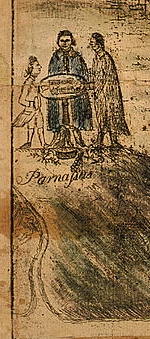
In November, the Connecticut government called a state convention to discuss whether to ratify the new and very different U.S Constitution. During that debate Amos Doolittle issued a year-end-review cartoon titled “The Looking Glass for 1787.” In one section it showed three Hartford Wits on a hill labeled “Parnassus” reading their “American Antiquities”—the supposed fragments of The Anarchiad. At least in Connecticut, they had been a prominent voice of the debate.

Tuesday, December 07, 2021

The Hartford Wits and the Voice of Anarch

The “Poetry and the Constitution” event I described yesterday made me think there must have been poetry about the Constitution, part of the debate around that document. So I went looking.

In October 1786, some fraction of the “Hartford Wits”—David Humphreys (shown here twenty years later), Joel Barlow, John Trumbull, and Dr. Lemuel Hopkins—published a poem in The New Haven Gazette and Connecticut Magazine.

Those verses were represented to the public as fragments of an ancient text found in a fort somewhere off to the west, like Ohio.

Over the next several months the Wits produced more verses for the newspaper, most supposedly pieces of a mock epic called The Anarchiad. This text told the story of a war between the spirit Anarch [boo! hiss!] and Hesper, “the guardian of the clime.”

By presenting these poems as “fragments,” the authors could eschew narrative or logical coherence and present their views on current troubles, such as:
  • The Articles of Confederation just weren’t working out, and Connecticut hadn’t even participated in the Annapolis Convention to fix them.
  • In western Massachusetts middling farmers were resisting taxes and shutting down courts while Rhode Island was issuing lots of paper money.
  • A couple of local officials were being a real bother. (The Wits were already feuding with those men in the newspapers.)
  • Young people today.
Here’s a short taste from Book IV, in the voice of Anarch:
Behold the reign of anarchy, begun,
And half the business of confusion done.
From hell’s dark caverns discord sounds alarms,
Blows her loud trump, and calls my SHAYS to arms,
O’er half the land the desperate riot runs,
And maddening mobs assume their rusty guns.
From councils feeble, bolder faction grows,
The daring corsairs, and the savage foes;
O’er Western wilds, the tawny bands allied,
Insult the States of weakness and of pride;
Once friendly realms, unpaid each generous loan,
Wait to divide and share them for their own.

Now sinks the public mind; a death-like sleep
O’er all the torpid limbs begins to creep;
By dull degrees decays the vital heat,
The blood forgets to flow, the pulse to beat;
The powers of life, in mimic death withdrawn,
Closed the fixed eyes with one expiring yawn;
Exposed in state, to wait the funeral hour,
Lie the pale relics of departed power;
While conscience, harrowing up their souls, with dread,
Their ghost of empire stalks without a head.
That installment was first published on 11 Jan 1787. A couple of weeks later, Daniel Shays’s Regulator force tried to seize the federal armory in Springfield. Militia general William Shepard and his men fought them off, killing four. “Behold the reign of anarchy,” indeed.

TOMORROW: More constitutional commentary.

Monday, December 06, 2021

“Poetry and the Constitution” panel, 8 Dec.

On the afternoon of Wednesday, 8 December, the National Constitution Center will host an online panel discussion about “Poetry and the Constitution.”

That may seem like an incongruous pairing of topics. As New York governor Mario often remarked, “You campaign in poetry. You govern in prose.” But here’s the event description:
How have poets and poetry—from John Milton to Mercy Otis Warren and Phillis Wheatley—influenced the Constitution and America’s core democratic principles?

Join Vincent Carretta, editor of the Penguin Classics editions of the Complete Writings of Phillis Wheatley and professor emeritus of English at the University of Maryland; Eileen M. Hunt, professor of political science at the University of Notre Dame; and Eric Slauter, associate professor and director of the Karla Scherer Center for the Study of American Culture at the University of Chicago, for a discussion exploring the ways poetry has intersected with the Constitution and constitutional ideas throughout American history.

Jeffrey Rosen, president and CEO of the National Constitution Center, moderates.
Prof. Hunt tweeted that she plans to “talk about Mercy Otis Warren’s all-too-prescient critique of the potential tyranny of the Supreme Court in her 1788 ‘Observations on the New Constitution’.” That pamphlet was, of course, not poetry, but Warren did write verse on political topics, such as the 1778 ode I discussed back here.

Prof. Slauter is the author of The State as a Work of Art: The Cultural Origins of the Constitution. It includes a detailed discussion of how American Revolutionaries responded to Alexander Pope’s 1733 couplet “For Forms of Government let Fools contest; / Whate’er is best administer’d is best.”

This discussion will start at noon and last for an hour. It is free for people registering here.

Sunday, December 05, 2021

A Spatial Analysis of the Declaration of Independence’s Grievances

Jack Rakove’s comment on the different sorts of grievances in the Declaration of Independence, quoted yesterday, led me to explore more deeply into their lack of parallel grammatical structure, also discussed yesterday.

I took a closer look at every jot of the Declaration, exercising the “punctuation is a moral issue” attitude of a former book editor.

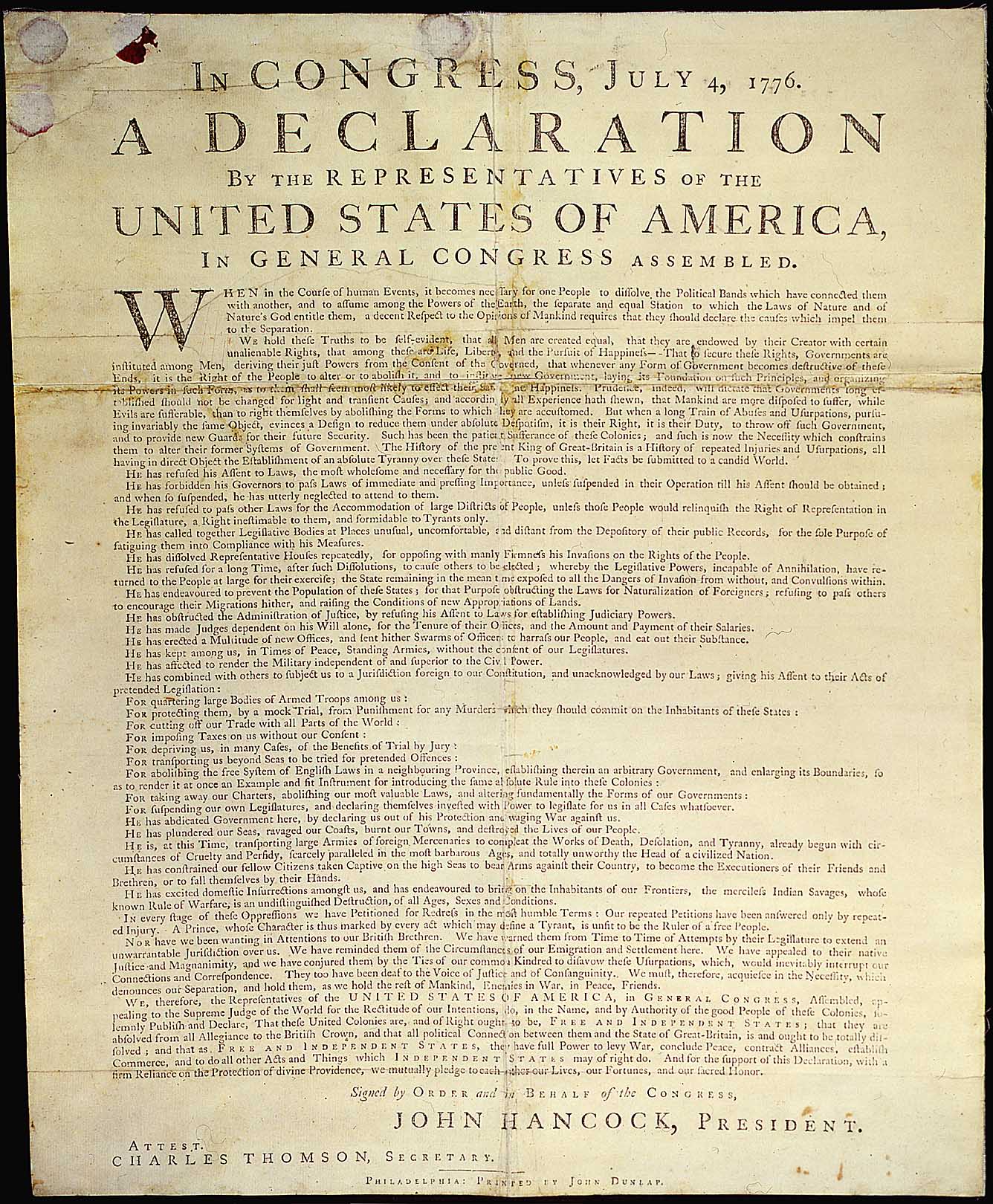
To start with, though the grievances in the official text are all formatted to start with the same indentation, the punctuation at the ends of the lines is different. Instead of ending with a period, all the “For…” items end with a colon. (As first printed by John Dunlap, that is. Timothy Matlack apparently left out a colon after one line on the handwritten parchment.)

We no longer use a colon that way, but it eighteenth-century style it signaled a pause of less weight than a period but more than a semi-colon. In other words, while the other grievances were full sentences in their own right, those “For…” grievances were all parts of a single sentence.

I then looked at earlier drafts, starting with the text that Thomas Jefferson shared with his colleagues on the Continental Congress’s Declaration-drafting committee, as shown here by the Library of Congress. Jefferson had some idiosyncratic style preferences, such as the possessive “it’s” and much less fondness for capital letters than his contemporaries. He ended the grievances with colons and semi-colons instead of periods and colons.

What’s important to this discussion is that Jefferson didn’t start a new line for his first “for…” clause. Rather, that phrase was a continuation after a comma of the preceding “He has…” clause. Jefferson also indented the following “for…” lines more than the “he has…” lines, and he ended them with semi-colons instead of colons.

Then there’s John Adams’s early copy from June 1776, at the Massachusetts Historical Society. Adams copied all the “for…” items as part of the “He has…” clause that preceded them in one long paragraph at the bottom of page 2, as shown above.

Jefferson also made a copy of the committee’s draft, now at the Massachusetts Historical Society. In this version the “he has…” lines end with periods. It’s ambiguous whether the first “for…” item is part of the preceding clause or not. But there’s no question that Jefferson put a larger indent before all the other “for…” lines before returning to “he has…”

The full Congress adopted different punctuation and capitalization, and it wasn’t careful about keeping Jefferson’s original spatial formatting. The officially adopted text made no typographical distinction between “He has…” sentences and “For…” sentence fragments. They all start flush left with a capital letter.

But the earlier drafts let us see what we might call the committee’s original meaning of those lines. The “For…” items were all subordinate parts of the preceding “He has…” clause, serving to spell out the “Acts of pretended Legislation”—i.e., laws enacted by Parliament despite the colonists having no representation in that body.

For logical clarity in the outline form, the published Declaration should have been formatted the way Jefferson wrote those lines, with two levels of indentation:
  • . . . He has affected to render the Military independent of and superior to the Civil power.
  • He has combined with others to subject us to a jurisdiction foreign to our constitution, and unacknowledged by our laws; giving his Assent to their Acts of pretended Legislation:
  • For Quartering large bodies of armed troops among us:
  • For protecting them, by a mock Trial, from punishment for any Murders which they should commit on the Inhabitants of these States:
  • For cutting off our Trade with all parts of the world:
  • For imposing Taxes on us without our Consent:
  • For depriving us in many cases, of the benefits of Trial by Jury:
  • For transporting us beyond Seas to be tried for pretended offences[:]
  • For abolishing the free System of English Laws in a neighbouring Province, establishing therein an Arbitrary government, and enlarging its Boundaries so as to render it at once an example and fit instrument for introducing the same absolute rule into these Colonies:
  • For taking away our Charters, abolishing our most valuable Laws, and altering fundamentally the Forms of our Governments:
  • For suspending our own Legislatures, and declaring themselves invested with power to legislate for us in all cases whatsoever.
  • He has abdicated Government here, by declaring us out of his Protection and waging War against us. . . .
Those laws start before the Coercive Acts with Britain’s imperial trade laws, Quartering Act, and the new taxes of the 1760s. Only the last five “For…” items relate directly to the laws of 1774. The grammatical outliers thus don’t map exactly onto one of Rakove’s three categories of grievances, though it’s still useful to look on them all as basically chronological.

So if the nine “For…” lines in the Declaration are actually part of the preceding “He has…” clause, does that mean the Declaration has only eighteen grievances?

Saturday, December 04, 2021

The Aspect of the Declaration of Independence that Bothers Me

For decades, something about the grievances in the Declaration of Independence has bothered me: They’re not grammatically parallel.

I know this problem might not look as weighty as one-sided descriptions of policy, piling all the blame onto King George, the hypocrisy of complaining about wartime measures the Continental governments had also taken, or the hollowness of those “self-evident” truths in practice, but it really did bother me.

The Continental Congress listed twenty-seven grievances, starting with “He has refused his Assent to Laws, the most wholesome and necessary for the public good” and ending with “He has excited domestic insurrections amongst us, and has endeavoured to bring on the inhabitants of our frontiers, the merciless Indian Savages, whose known rule of warfare, is an undistinguished destruction of all ages, sexes and conditions.”

As you see, the grumbling moves from a vague disagreement about policy and governance to incendiary language about non-white warriors killing women and children.

Along the way, the grammatical structure of those grievances changes. The first thirteen are complete sentences beginning “He has…” Then come “For Quartering large bodies of armed troops among us” and eight more similarly constructed phrases that are not even complete sentences. The list resumes the “He has…” for the last five complaints.

The first printing of the Declaration by John Dunlap, the first newspaper printing, and the official government transcript all format those grievances with the same indentation and emphasis.

The famous handwritten copy likewise makes no clear distinction among the grievances. That’s because none of those clauses are set out in separate paragraphs, scribe Timothy Matlack formatting the whole thing in just two blocks of text.

So if all those complaints are supposed to be parallel, why aren’t they worded in the same way?

Last month in a series of Twitter postings starting here, Jack Rakove, emeritus William Robertson Coe Professor of History and American Studies and professor of political science at Stanford, wrote:
The real structure of the DoI, once past its Preamble, has three distinct parts: a summary of longstanding grievances of imperial governance; a denunciation of all the recent acts adopted in response to the Boston Tea Party and other acts of intercolonial resistance; and a concluding set (I would say the last 5 listed) relating to the forms of military repression and violence directed against the colonists, obviously including but hardly limited to the invitation to insurrection on the part of the enslaved and indigenous peoples.
In other words, the first batch of grievances covered the years 1760 to 1773, the next batch the Coercive Acts of 1774, and the last bunch the British government’s decisions since the start of the war.

I wondered if those three categories mapped onto the three grammatically distinct groups of complaints. In the end, I concluded they don’t match up exactly, but Rakove’s observation got me thinking about how those groupings pointed in somewhat different directions rather than running in parallel.

TOMORROW: Sorting out the lists.

Friday, December 03, 2021

“To that virtue which for a series of years resisted oppression”

In 1784 Sir Thomas Gascoigne, baronet, got serious about one of the principal responsibilities of a titled British gentleman: producing an heir to inherit his estate, centered at Parlington Hall in Yorkshire.

In November of that year he married the young widow Lady Mary (Shuttleworth) Turner, becoming stepfather to her children by Sir Charles Turner, a York politician. In January 1786 the couple’s first son, Thomas Charles Gascoigne, arrived. Sadly, only a month later, Lady Mary departed at age thirty-four.

Sir Thomas Gascoigne had been commissioning plans for a new mansion, having stone hauled in from his quarries. According to tradition, after his wife died he decided instead to use that stone to build a memorial.

Except it didn’t turn out to be a memorial to a lost wife. Instead, it was a triumphal arch modeled on the Arch of Constantine, which Sir Thomas had seen in his travels to Rome. The architect, Thomas Leverton, had exhibited plans for such an arch as early as 1781.

The triumph this arch commemorated was the 1783 Treaty of Paris with America. It thus implicitly praised the Rockinghamite Whig faction in Parliament that had pushed to end the war (including Sir Thomas Gascoigne himself).

Originally, according to archived plans, Sir Thomas wanted this statement on the structure:
To that virtue which for a series of years resisted oppression and by a glorious race rescued its country and millions from slavery
That was deemed too long to be visible in the available space and edited down to:
Liberty in N. America Triumphant MDCCLXXXIII
The result is Britain’s first and biggest monument to the American War for Independence. The Parlington Arch still stands on a hill in Yorkshire, though Parlington Hall fell down over the 1900s.

As for Sir Thomas Gascoigne, he continued his aristocratic life. He stayed wealthy by developing the coal mines on his land, as did his son and heir. However, Thomas Charles Gascoigne died in a hunting accident in 1809, and Sir Thomas passed away four months after his son in February 1810.

The baronetcy therefore died with them. Their properties descended to Lady Mary’s descendants by her first husband on condition that those lines took the Gascoigne name.

Thursday, December 02, 2021

How to Become the Member from Thirsk

Under the subject of “Eighteenth-century British aristocrats are not like us,” I’ve been looking into the life of Thomas Gascoigne (1745-1810).

Gascoigne was born not in Britain but in a convent at Cambrai in northern France. He was the third son of Sir Edward Gascoigne, baronet, and his wife. The Gascoignes were Catholic and had long ties to that convent, which was part of the English Benedictine Congregation.

Thomas grew up in France, educated by monks at Douai. In 1762, when he was sixteen years old, his older brother died, and he succeeded to the baronetcy. From then on he was Sir Thomas Gascoigne, baronet.

To prepare for his responsibilities as an estate owner, the teenager was sent to Paris for more schooling, visited Britain for the first time, and in 1764 embarked on a Grand Tour of southern Europe.

That travel ended abruptly in March 1765 when, it appears, a traveling companion killed a coachman in Rome and young Sir Thomas was peripherally involved. He had to hurry back to England, though his connections secured a papal pardon later in the year.

For the next decade Sir Thomas Gascoigne settled into life as a British gentleman. He developed his estates, including the usual improvements: scientific gardening, breeding race horses, funding coal mines, founding a spa. He had a romance with Barbara Montgomery (1757-1788), one of the three sisters Joshua Reynolds painted as “Three Ladies Adorning a Term of Hymen” in 1773.

By 1774 it was safe to visit Europe again, and Sir Thomas spent the rest of the decade outside Britain. He traveled with the author Henry Swinburne, paying most of the bills. During those years Britain declared war on France and Spain, but that doesn’t appear to have greatly affected Sir Thomas’s movements because he was traveling in Catholic circles. His faith kept him out of the British government, after all.

That all changed soon after Sir Thomas Gascoigne returned to his seat in the middle of 1779. He decided to get involved in politics. As a baronet, he had inherited a title but not a peerage, so he wasn’t in the House of Lords and could run for the House of Commons. However, the law barred him from Parliament as a Catholic.

On the king’s birthday in June 1780, therefore, Sir Thomas Gascoigne renounced his Catholicism before the Archbishop of Canterbury. (He never stopped supporting Catholic missions.) Three months later, he entered Parliament as the member from Thirsk, a seat recently purchased by the Marquess of Rockingham for his faction of Whigs. Later he represented Malton and Arundel.

As a Rockinghamite, Sir Thomas opposed continuing the war in America and supported some electoral reforms. Within the larger Whig faction he favored Charles James Fox over the younger William Pitt, which left him once again excluded from power after 1784.

TOMORROW: Sir Thomas Gascoigne’s mark on history.

Wednesday, December 01, 2021

“Present Insignificance of all Degrees.—A Beatified Lawyer”

A couple of years ago I discussed the origin and spread of the motto “Rebellion to tyrants is obedience to God,” linked to Benjamin Franklin and Thomas Jefferson.

One of the books I looked at was Howard Payson Arnold’s Historic Side-Lights (1899). Arnold was a Boston lawyer who wrote on a number of topics, including the Warren family.

Try to figure out his topic in this book from the start of the table of contents.

Did you guess, “The development of the Great Seal of the United States”? The contents table did mention it at the start of Part IV, but it gets kind of lost in the shuffle. 

Tuesday, November 30, 2021

Two Talks about the Women behind the Commanders

Here are two more online talks to consider, both happening on Thursday but fortunately at different times.

Thursday, 2 December, 1:00 P.M.
New England Historic Genealogical Society
Julie Flavell, “The Howe Dynasty”

Many historians have documented the lives and exploits of Howe men including Richard Admiral Lord Howe and his younger brother British General Sir William Howe, victor in the Battle of Bunker Hill. But few have measured the influence of the Howe women including sister Caroline Howe, a friend of Benjamin Franklin, and her savvy aunt Mary Herbert Countess Pembroke.

Drawn from letters and correspondence, The Howe Dynasty sheds new light one of one of England’s most famous military families and forces us to reimagine the Revolutionary War. Don’t miss hearing about this unique and riveting narrative work and Julie Flavell’s discussion with the celebrated historian Mary Beth Norton.
Julie Flavell was born in Massachusetts and now lives in Britain. Her first book was When London Was Capital of America. Mary Beth Norton is the Mary Donlon Alger Professor of American History Emerita at Cornell University, and her latest book is 1774.

Register for this event here.

Thursday, 2 December, 6:30 P.M.
Fraunces Tavern Museum
Martha Sexton, “Mary Ball Washington: George’s Good Enough Mother”
This lecture provides a sketch of the challenging life of Mary Ball Washington, who raised George and his four siblings largely alone—as well as her unfair treatment at the hands of his biographers.

Saxton’s book The Widow Washington is the first life of Mary Washington based on archival sources. Her son’s biographers have, for the most part, painted her as self-centered and crude, a trial and an obstacle to her oldest child. But the records tell a very different story.

Mary Ball, the daughter of a wealthy planter and a formerly indentured servant, was orphaned young and grew up working hard, practicing frugality and piety. Stepping into Virginia’s upper class, she married an older man, the planter Augustine Washington, with whom she had five children before his death eleven years later. As a widow deprived of most of her late husband’s properties, Mary struggled to raise her children, but managed to secure them places among Virginia’s elite. As such, Mary Ball Washington had a greater impact on George than mothers of that time and place usually had on their sons.
Martha Saxton is a professor of history and women’s and gender studies at Amherst College. She is the author of several books, including Louisa May Alcott: A Modern Biography.

This lecture will take place via Zoom. Register here by 5:30 P.M. on the day of the lecture.

Monday, November 29, 2021

Upcoming Online Talks by Holton and Philbrick

Here are two notable online events over the next couple of days.

Tuesday, 30 November, 7:00 P.M.
American Antiquarian Society
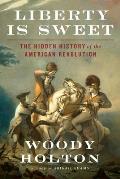
Woody Holton, “The Hidden History of the American Revolution”

A sweeping reassessment of the American Revolution, Woody Holton’s new book, Liberty Is Sweet: The Hidden History of the American Revolution, shows how the Founders were influenced by overlooked Americans—women, Native Americans, African Americans, and religious dissenters.

Using more than a thousand eyewitness accounts, the book explores countless connections between the Patriots of 1776 and other Americans whose passion for freedom often brought them into conflict with the Founding Fathers. It also considers other underappreciated factors such as weather, North America’s unique geography, chance, misperception, attempts to manipulate public opinion, and (most of all) disease.

“It is all one story,” Holton writes, and in this program, he will discuss how, when examined together, these perspectives broaden and revivify a story we thought we already knew.
Holton is McCausland Professor of History at the University of South Carolina. His previous books include Abigail Adams (2010), which was awarded the Bancroft Prize, and Unruly Americans and the Origins of the Constitution (2008), a finalist for the National Book Award.

This event is free, but registration is required starting here. (That webpage says Thursday, but the registration is definitely for 30 November.)

Wednesday, 1 December, 7:00 P.M.
Lexington Historical Society
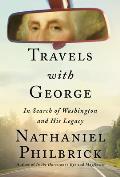
Nathaniel Philbrick, “Travels with George”
In the fall of 2018, Nathaniel Philbrick endeavored to follow in the literal footsteps of George Washington: tracing his 1789 presidential tour of the new United States.

Just months into his presidency, Washington was tasked with uniting a nation of thirteen disparate colonies with very different experiences and thoughts about their new leader. Hoping to prove that the American people were not simply trading one King George for another, he made his way from Maine down to Georgia to meet with the inhabitants of the fledgling country and prove his mettle.

Philbrick’s new book Travels with George echoes this inaugural tour, as he traveled from historic sites across the original 13 colonies, meeting with reenactors, tour guides, museum curators, and others who grapple with Washington’s iconic status and contradictions. At a time when the American public, and museums in particular, are trying to make sense of this enigmatic founding father during a time of deep political division, Philbrick learned not just about this snippet of Washington's life, but the hold that his story still has on America.
Nat Philbrick is the author of three Revolutionary War histories—Bunker Hill, Valiant Ambition, and In the Hurricane’s Eye—in addition to the National Book Award-winning In the Heart of the Sea and other narratives from American history.

Philbrick will be in a virtual conversation with Dr. Samuel A. Forman of the Lexington Minutemen, himself the author of Dr. Joseph Warren: The Boston Tea Party, Bunker Hill, and the Birth of American Liberty.

The Lexington Historical Society welcomes donations for this event. Register through this page.

Sunday, November 28, 2021

Glimpsing Another Copy of Revere’s Massacre

Ben Edwards alerted me to this report from Antiques and the Arts about sales at the Doyle auction house early this month that set records for works by Paul Revere.

The items on sale all appear to have come from the collection of Monroe F. Dreher, an mid-20th-century advertising executive, and his wife Elizabeth. The “period rooms” in their Connecticut home was featured in The Magazine Antiques in 1954. Dreher was known for recording the provenances of the pieces he bought, many descended within families, and his collection hasn’t been on display or on the market for decades.

Among the silverware sold was a “Liverpool” pitcher by Revere from 1805 that sold for $94,500, or about three times the estimated price, and a cream jug made by Paul Revere, Jr., in 1783 for $22,680.

But the major sale was a copy of Revere’s “Bloody Massacre” engraving for $429,000, a new record for that print.

This is yet another example of the print with the face of one victim, upside-down and half-hidden within the crowd in the lower left corner, colored a little darker than the faces of other people around him.

This coloring can be only subtly different, enough to make one wonder whether it’s just an artifact of time, or that face can be a dark brown, as in the Philadelphia public library’s copy. This example is somewhere in between.

That pattern of an extra color wash, along with the dual chest wounds painted onto several copies, has convinced me that figure was always supposed to represent Crispus Attucks. Revere wasn’t able to depict him as a person of color in the engraving alone, but the coloring rendered him an individual.

Saturday, November 27, 2021

A Selection of Weekend Events

Local historical sites are offering a variety of special programs this weekend for families wishing to share more Revolutionary history with visitors or just get out of the house.

At Historic Deerfield, these culinary presentations are included with regular museum admission.

Saturday, 27 November, 9:30 to 11:00 A.M. and 12:30 to 4:00 P.M.
Hearth Cooking
See cooks prepare traditional Thanksgiving dishes over a warm open hearth. Learn about the history of harvest celebrations and the evolution of the American Thanksgiving holiday.

Saturday and Sunday, 27–28 November, 12:00 noon to 4:30 P.M.
Seek No Further: Heritage Apple Time
Apples were dried for winter keeping, pressed for cider, and covered with cloves to make decorative, aromatic objects known as pomanders. Visit the History Workshop to sample some unique apple varieties, including Westfield’s Seek No Further from the museum village’s rare tree.

The Paul Revere House in Boston’s North End has its period rooms decorated to reflect winter usage in the 17th and 18th centuries. This weekend and in December there will be author signings, free with museum admission.

Sunday, 28 November, 1:30 to 3:30 P.M.
Ben Edwards, One April in Boston
The Boston tour guide, educator, and perambulator will sign his children’s book following a boy who was a contemporary of Paul Revere (as well as a future in-law and Edwards’s ancestor).

Saturday, 11 December, 1:30 to 3:30 P.M.
Robert Martello, Midnight Ride, Industrial Dawn
Prof. Martello of the Olin College of Engineering will autograph this fine study of Paul Revere as an early American industrialist and manufacturer.

During both signings David Neiman will play seasonal music on the hammered dulcimer in the Revere Room of the Visitor Center.

Finally, this is the last weekend in 2021 to visit the Lexington Historical Society’s Hancock-Clarke House and Munroe Tavern, though its Buckman Tavern will continue to be open on winter weekends. The opening hours are—

Saturday and Sunday, 27–28 November
  • Buckman Tavern: 9:30 A.M. to 4:00 P.M.
  • Hancock-Clarke House: 10:00 A.M. to 4:00 P.M.
  • Munroe Tavern: 12:00 noon to 4:00 P.M.

Friday, November 26, 2021

Hannah Glass’s Amulet

This recipe from a 1774 edition of Hannah Glass’s Art of Cookery makes much more sense once one realizes that “amulet” was Glass’s way of spelling the unfamiliar word “omelette.”

Notably, this omelette is made with egg yolks only, and the beans or other vegetables are on top, not inside.

For a modernized version of the recipe, check out Colonial Williamsburg.

Thursday, November 25, 2021

Meeting the Clerks of Faneuil Hall Marketplace

Just to make matters confusing, the twelve men elected by the Boston town meeting to be clerks of the market for one year weren’t the only people in town with that title in the eighteenth century.

The town also chose one full-time clerk for each market. This man was in charge of assigning stalls to different provisioners, collecting rents, enforcing rules, and maintaining the infrastructure.

In the early eighteenth century Boston had three marketplaces, each with its own full-time clerk. After some argument, in 1742 the town consolidated those commercial spaces into one near the center of town. Thus, we need context to know what “Clerk of the Market” referred to.

In September 1742, the merchant Thomas Jackson was announced as “Clerk of the Market on Dock-Square.” According to Abram Brown’s Faneuil Hall and Faneuil Hall Market or, Peter Faneuil and His Gift (1901), the town gave Peter Faneuil the honor of naming the superintendent since he’d paid for the building. Jackson in turn hired Joseph Grey as assistant in charge of sweeping. When Faneuil died the next March, the market was named after him.

By 1749, Abijah Adams was the full-time clerk of Faneuil Hall Market, and Samuel Adams was an elected clerk of the market, starting his political career. There was a bad fire in 1761, and Abijah Adams rescued valuable goods and papers from the building, only to have to wait for the town to rebuild and repair it.

Abram Brown erred in writing that Adams was succeeded by Benjamin Clark as the pre-Revolutionary turmoil heated up; Clark was one of the elected clerks. The published selectmen’s records show how they chose a man to replace Adams in 1767 and what the daily duties of the clerk of Faneuil Hall Marketplace were:
The Selectmen having appointed Capt. James Clemmens to be Clerk of Faneuil Hall Market in the room of Mr. Abijah Adams who is in a declining state and as it is feared not like to appear abroad again, the following Orders were given said Clemmens, which bears date the Day on which he entred upon duty—vizt.—

Boston August 13. 1767
Capt. James Clemmens
Sir

You being by the Selectmen of Boston chosen to act as Clerk of Faneuil Hall Market it is our directions That you observe that the Butchers who hire the Stalls do conform to their Leases. Vizt.—

That they bring into the Market all the Hydes Skins and Tallow of all such Creatures as they kill; that they keep their respective Stalls clear, and at the shutting up of the Market at One O’Clock carry out all the Hydes Skins and Tallow and also all the Beef that shall be cut up that is less than a Quarter and all other sorts of Meal of what kind so ever—

that those Butchers who occupy the Stalls do not bring into the Market any kind of Poultry other than of their own raising to sell—

You’l Observe that every Person who erects a Stall or puts their Panyers or Carts, within the limits of the Market do pay for the same as follows—Vizt.—
  • For every Stand or Stall from the middle West Door on each side down to the Street Eight Shillings p. Month or eight Coppers p. Day,
  • for each Stand or Stall on the other parts of the West end of the Market Six Coppers p. Day—
  • For each Cart with Beef or Sauce or any other Article for Sale that stands in any other place within the Limmits of the Market four Coppers p. Day—
  • For each pair of Panyers two Coppers p. Day.
By Order of the Selectmen
WILLIAM COOPER Town Clerk.
Abijah Adams died a few months later in February 1768, aged 66 years.

James Clemens had been a sea captain, then a seller of spermaceti candles. In 1763 he announced he had become a licensed gauger, checking weights and measures, so people had come to trust him. Capt. Clemens died inside besieged Boston in February 1776, and in June the town chose George Lindsay Wallace to take his place.

Wednesday, November 24, 2021

“Walk’d with Mr: English, as clerk of the market”

For evidence of what the job of clerk of the market in Boston actually entailed, we need to find a man not only conscientious enough to accept that job but also dedicated to write down and preserve his daily activities.

Fortunately, in 1792 the Boston town meeting elected “John Q. Adams” to be a clerk of the market.

Adams was then twenty-five years old, a young lawyer. He had seen a lot of Europe as a teenager working for his father and Francis Dana, the U.S. of A.’s minister to Russia. His father was now Vice President. He had just started to serve on town committees. And it was time for him to inspect bread.

Adams was not one of the twelve men chosen as clerks of the market in the first session of Boston’s big town meeting on 12 March. But some of those men begged off, and he was elected last among five new men on the afternoon of 27 March.

Adams didn’t record that election in his diary. In fact, he wasn’t even in town, having ridden out that morning to Worcester. (“Dined at How’s Marlborough. Singular couple he 6 1/2 feet long. She as much round.”) So I have no record of how he took the news. Maybe he was chosen because he wasn’t present to object.

Nonetheless, John Quincy embarked on his civic duty. The first mention appeared in his diary for 23 April:
Walk towards Eveg: Clerks of the market met at Coleman’s [tavern], but were interrupted by a cry of fire. Adjourned till to-morrow. fire soon extinguished.
The next day he wrote:
At Court all day. No business of much consequence done. Met the clerks of the market as by adjournment. Agreed upon our proceedings. To walk with Mr: [Thomas] English.
This tells us a couple of things. First, it took almost a month after election for the new clerks of the market to get organized. Second, they paired off to “walk,” or patrol the Faneuil Hall Market and the area surrounding it.

Adams made his first patrol on Tuesday, 1 May, and it was eventful:
Walk’d with Mr: English, as clerk of the market at 6. A.M. before breakfast, and again at 11. Seized a quantity of bread. A busy forenoon.
Clerks of the market were empowered to seize loaves of bread they deemed underweight for their prices. Sometimes this led to conflicts, as in this notice in the selectmen’s minutes for 29 Nov 1769:
Mr. [Joseph] Barrel, [Joseph?] Calf & [Benjamin] Andrews, a Committee from the Clerks of the Market Complain of Mr. Harris the Baker & his Servant Robert Davis, as having abused Mr. Barrel & Andrews, by charging the former with stealing their Bread & other ill Language & also Mr. Sircombs man named Cook—abused Mr. John Bernard.
The selectmen summoned all three of those bakers and presumably admonished them. (John Bernard was the son of the highly unpopular departed governor, but he was also a duly chosen town officer.)

John Quincy Adams didn’t record such friction. It’s tempting to think he and English took strict action on their first day to make sure the bakers understood their authority.

Adams never mentioned his market duty again until 2 November:
Eve & supper with Clerks of the market. Dull time.
And then on Wednesday, 28 November:
Snow almost gone. Walk’d with [Simon] Elliot as Clerk of the Market. 
Such sporadic references suggest that a clerk of the market didn’t patrol every day or even every week. Of course, it’s possible Adams did walk by the market stalls more regularly, but he was pretty thorough in recording his daily activities.

In March 1793 the Boston town meeting chose twelve new men to be clerks of the market for the following year. Again, John Quincy Adams didn't mention that election in his diary. His next remark about the position suggests that a year later he felt a little nostalgia for it, enough to attend an event on 28 March 1794:
Dinner of the Clerks of the market. Convivial; but too numerous; attended electioneering meeting.— returned to C[oncert?]. Hall. Stayed not long there. 
But only a little nostalgia.

Tuesday, November 23, 2021

Meeting the Clerks of the Market

Last week at dinner, the conversation turned to the question of what colonial Boston’s clerks of the market did. This is the kind of the dinner I like.

The post of clerk of the market was established in English law well before the kingdom colonized America, and it came to the colonies in different ways. In Philadelphia, the city charter of 1701 gave the mayor the power to appoint those officials. In contrast, the Boston town meeting elected clerks of the market, starting with two men in 1649. By the mid-1700s, there were twelve, one for each ward.

Clerks of the market were among the town’s lowest-ranking elected offices. But the post was a stepping-stone for young gentlemen seeking higher positions in politics or society. Many prominent men once served as clerks of the market for a year.

In March 1769, for example, the new clerks of the market included John Singleton Copley, Elisha Hutchinson, John Bernard, and John Gore, Jr. In 1770 the nod went to John Pulling, John Andrews, Nathaniel Wheatley, and Henry Jackson, among others.

The main stated duty of the clerks of the market was to ensure that the loaves of bread and the butter sold at the town market conformed to the selectmen’s stipulations. Each year, those officials announced what would be a fair weight for a loaf of bread of a standard price and quality. The price stayed the same, but the weight varied depending on the cost of grain, with a fair profit for the bakers mixed in.

For instance, in February 1773 the selectmen
Ordered that the Assize of Bread be set at Wheat at 7/ [seven shillings] p. bushel, and that 6d. [sixpence, or about 7%] p. bushel be allowed to the Bakers for their Charges Pains and Livelihood, which is computed as follows Vizt.
  • A Loaf of Brown Bread 3/4 Wheat 1/4 Rye meal must weigh 2 [lbs.] 8 [oz.]
  • a 4d. Ditto not above 1/2 Indian Meal must weigh 3 [lbs.] 8 [oz.]
  • Bisket of a Copper price 4 [oz.] 2 [drachms]
This was a long-established form of price-fixing, designed to avoid food riots like those in the 1710s. The selectmen tried to balance the needs of the populace against those of the bakers, as we can see in this extract from the town records in 1789:
On the application of Majr. [Edward] Tuckerman & Mr. [William] Breed two of the Town Bakers — It was agreed by the Selectmen that there should be 4 ounces instead of 2 ounces difference in the weight between 4d. white Loaf Bread & 4d. Superfine Brick Bread — and the Clerks of the Market were accordingly acquainted with this alteration, for their government in the weighing the same —
As that entry shows, the clerks of the market were supposed to enforce the bread rules. The law empowered them to seize loaves that were underweight, and even to go into any bakery or house where they knew bread was being baked for sale and check on how heavy the loaves were.

But did the elected clerks of the market really do that work? Usually a few of the men selected on the first round excused themselves by pleading inability and/or paying a fine, necessitating a second round. That suggests that many of those gentlemen weren’t actually that keen on the honor of serving their town that way.

Boston already had a full-time clerk of Faneuil Hall Market administering the rent on stalls, maintaining the infrastructure, and overseeing the maintenance staff of one. So were the gentlemen chosen to be clerks of the market actually out inspecting the bakers’ stalls every week? 

TOMORROW: Reading a clerk of the market’s diary.

[The image above comes from Food and Streets’ posting about making and tasting bread from an eighteenth-century recipe.]

Monday, November 22, 2021

New Movies about Arnold and Adams

A couple of films about the Revolutionary War debuted this month. I haven’t seen them, but I know and respect historians involved in these projects, so I’m passing on the news for folks who like to take in historical stories that way.

Benedict Arnold: Hero Betrayed is a docudrama available to rent or buy on YouTube, AppleTV, Amazon, and other platforms. It was directed by Chris Stearns and produced by Thomas Mercer and Anthony Vertucci, with co-producers Steve Letteri and Michael Camoin.

The main source was James Kirby Martin’s biography of Arnold. Martin was involved in the film as both an executive producer and an actor.

The trailer shows battle reenactments, enhanced with C.G.I., and dramatizations of important moments featuring Peter O’Meara as Arnold. The press release says the movie also “features insightful interviews with leading experts.” Martin Sheen supplied the narration.

The press material emphasizes how this movie gets beyond the caricature of Arnold as a treacherous villain. We probably haven’t seen authors offer such a one-sided portrayal in over a century, though. Dramas like the 2003 television movie Benedict Arnold: A Question of Honor with Aidan Quinn and the later seasons of Turn: Washington’s Spies with Owain Yeoman also tried to depict why an American battlefield hero came to plot with the enemy and defect.

That said, phrases in the press release like “self-serving political and military leaders” and “an arbitrary system of personal favoritism and cronyism” make me suspect this movie goes further in portraying the situation as Arnold himself saw it.

Folks can watch the trailer for Benedict Arnold: Hero Betrayed on YouTube or I.M.D.B.

Quincy 400 just celebrated the local premiere of a feature-length documentary titled Beyond the Bloody Massacre. It features interviews with several historians who have written on that event: Hiller B. Zobel, Serena Zabin, Robert Allison, Kerima Lewis, and Daniel Coquillette.

The announcement of this movie says:
Beyond the Bloody Massacre presents the intersecting histories of the Boston Massacre Trials through the words and experiences of John Adams, and Josiah Quincy Jr., the two Quincy (formerly Braintree) born lawyers who defended a British Captain and seven [eight] soldiers in two murder trials in the late fall of 1770.
In addition, another local boy, Josiah’s older brother Samuel Quincy, was one of the prosecutors. And Christopher Seider, the young boy killed in Boston eleven days before the confrontation on King Street, was also born in the part of Braintree that became Quincy after the war.

This documentary was filmed last fall during the 250th anniversary of the Rex v. Preston and Rex v. Wemms et al. trials. The pandemic made it impossible to reenact those trials as we’d hoped. But this film promises to explore some of the legal, political, and moral issues they raised.

Quincy 400 appears to be an initiative of the city of Quincy, and particularly of longtime mayor Thomas P. Koch. The name refers to the 400th anniversary of British settlement of the area that includes Quincy in 2025.

I can’t find any information on who made Beyond the Bloody Massacre or how people can see it now. It’s not yet viewable online, but the Quincy 400 Facebook page promises “age appropriate school curriculum materials, live roundtable discussions, collaborative programs and future public viewings.” Plenty to come in three more years before that quadricentennial.

Sunday, November 21, 2021

“The opportunity to provide serious learning”?

Last week I received a spam message offering this ridiculous take on the U.S. Constitution.

What mildly educated American would believe that “The Constitution [does] not change”? The word “Amendment” means change. The Constitution has been formally changed twenty-seven times.

Likewise, this advertisement claims the Constitution’s “underlying principles do not change.” Somehow the same principles could provide electoral advantages for voters in states allowing slavery until 1865 and then abolish slavery after that date.

The principles defining the relationship between the national and state governments were somehow the same before and after the Fourteenth Amendment, even though its clauses fundamentally rewrote the rulebook for that relationship.

Those unchanging principles could change the unchanging Constitution to establish a national prohibition on alcohol in 1919 and end it fourteen years later.

And somehow without changing, those principles barred women from voting before 1920 and empowered them to vote after that.

Obviously, that claim is nonsense. It’s an expression of faith contrary to evidence. As such, it’s a fine way of sorting out who might be interested in “serious learning” from Hillsdale College.