J. L. BELL is a Massachusetts writer who specializes in (among other things) the start of the American Revolution in and around Boston. He is particularly interested in the experiences of children in 1765-75. He has published scholarly papers and popular articles for both children and adults. He was consultant for an episode of History Detectives, and contributed to a display at Minute Man National Historic Park.

Subscribe thru Follow.it


•••••••••••••••••


Sunday, November 09, 2025

“Let not that man be trusted who can voilate private faith”

The Massachusetts Whigs were flabbergasted by the evidence that Dr. Benjamin Church, Jr., was corresponding with someone behind enemy lines.

By the fall of 1775, those men had worked alongside Dr. Church for a decade. He had helped to compose instructions for representatives, correspondence to Whigs in Britain, and political verse for engravings.

The doctor had delivered the Massacre memorial oration in 1773. He had represented Boston in the Massachusetts Provincial Congress and then the General Court, serving on the most sensitive committees.

His fellow legislators had chosen Church to take important documents to the Continental Congress in Philadelphia, and then to escort Gen. George Washington across the state from Springfield. He was serving as the top doctor in the Continental Army.

Church’s erstwhile colleagues wrote to each other in astonishment.

One group of Massachusetts Patriots who didn’t express such surprise, however, were the Massachusetts Whigs’ wives.

Those women had noted Church’s habit of extramarital affairs, rumored as early as 1769. By 1774 he was maintaining a mistress outside of Boston. To other men’s wives, the doctor’s betrayal of Sarah Church made it easy to believe he’d betrayed his political movement as well.

Abigail Adams wrote to her husband John on October 9:
You have doubtless heard of the viliny of one who has professd himself a patriot, but let not that man be trusted who can voilate private faith, and cancel solem covanants, who can leap over moral law, and laugh at christianity.
Mercy Warren, wife of Massachusetts house speaker James Warren, added her voice three days later:
I fear a Late Instance of perfidy and Baseness in one who Rancked Himself among the Friends to the Rights of society and the Happiness of the Community Will occasion many Inviduous Reflections from the Enemies of the American Cause.

I was Ever sorry that there should be one among the Band of patriots Whose Moral Character was Impeachable for when the Heart is Contaminated, and the Obligations of private Life Broken through, And the man has thrown of[f] the Restraints Both of Honour and Conscience with Regard to His own Domestic Conduct, what Dependance is to be Made on the Rectitude of His public Intentions.
Abigail Greenleaf, wife of the publisher Joseph Greenleaf, wrote to her brother Robert Treat Paine on 14 October:
How Sir, did you receive the news of the Perfidy & treachery of Docter Church? Was it not in Silent astonishment? It will I believe, bow down the grey hairs of his Father & Mother, with Sorrow to the grave. His Poor wife too, is an object of the Pitty, & Compassion of every one. She still Loves him, tho, he has treated her in so base a manner. If she looses her senses I think twill not be strange; but it will be melancholy.
Abigail Adams came back to the topic on 21 October:
What are your thoughts with regard to Dr. Church? Had you much knowledg of him? I think you had no intimate acquaintance with him.

“A foe to God was ne’er true Friend to man
Some sinister intent taints all he does.”
The wise response to such questions from a spouse was of course: ‘I agree with you, dear. I barely knew the man. You’re so right.’

Saturday, November 08, 2025

“A proper Method for bringing Dr. Church before the House”

As described yesterday, on 17 Oct 1775 the Massachusetts General Court decided to summon Dr. Benjamin Church to Watertown to explain why he’d sent a ciphered letter into British-occupied Boston.

Dr. Church’s first response to that action arrived on 23 October, as reported by James Warren: “The Speaker communicated to the House a Letter received from Dr. Church, wherein he expresses a Desire to resign his Seat in the House of Representatives.”

The previous month, Church had also tried to resign as Surgeon-General of the Continental Army, following a month of turf disputes with regimental surgeons. Gen. George Washington and his aides had urged him to stay, only to be blindsided by that ciphered letter. Those two resignations suggest that Church was realizing what a hole he’d dug for himself and just wanted to go away.

The legislators didn’t want to let Church go, though. Particularly Speaker Warren. He’d been immersed in this case since Washington had called him to Cambridge to share the first hints of the doctor’s dealings.

Back on 1 October, Warren had written to his friend John Adams:
Dr. C——h has been detected in a Correspondence with the Enemy at least so far that a Letter wrote by him in Curious Cypher . . .

We all thought the Suspicion quite sufficient to Justify an Arrest of him and his Papers, which was done, and he is now under a Guard. He owns the writeing and sending the Letter. Says it was for [John] Fleeming in Answer to one he wrote to him, and is Calculated, by Magnifying the Numbers of the Army, their regularity, their provisions and Ammunition &c, to do great Service to us. He declares his Conduct tho’ Indiscreet was not wicked.
Something had to be done. The legislature therefore voted on 23 October to let Church’s resignation letter “lay on the Table, till the Committee who are directed to consider a proper Method for bringing Dr. Church before the House shall report.”

As Warren and others understood by this time, the Continental Army rules and regulations didn’t allow a court-martial to sentence a spy to death. Gen. Washington was therefore holding off on formal proceedings. His most recent council had decided “to refer Doctor Church for Tryal & Punishment to the General Court of Massachusetts Bay.”

On 26 October the house committee came back with their recommendation. They started by stating that Church “has been convicted by the Judgment of a Council of War, at which his Excellency [Gen. Washington] presided, of having carried on a criminal Correspondence with the Enemy.”

In fact, Washington’s councils weren’t courts and had no power to convict anyone. But neither did the legislature have the power to try and punish Church as the last council suggested—all the General Court could do was expel the doctor. Each body was pushing for the other to take on the authority of judging Dr. Church. And everyone was still waiting for guidance from the Continental Congress.

The General Court voted:
…whereas the said Benjamin Church is also a Member of this House, and the Charge brought against him is of so criminal a Nature, that it is the Duty of the House to make strict Enquiry into the Fact, and upon Proof of the same to manifest their utter Abhorrence thereof:

Therefore, Resolved, That Mr. William Howe, the Messenger of this House, be and he hereby is directed on Friday the 27th of October Instant [i.e., this month], to apply to his Excellency George Washington, Esq; for a sufficient Guard, safely to conduct the said Benjamin Church to and from the Barr of this House, and being furnished therewith, to take the Body of the said Church and bring him to the Barr of the House accordingly, at Ten o’Clock in the Forenoon of the same Day.
On that Friday morning, there was a motion “That there be fixed in the Alley [i.e., aisle] a Bar, at which Dr. Church will be brought.” The stage was set.

I’ll speak about what happened next in Watertown on Sunday afternoon, as detailed here.

TOMORROW: Records of the case.

Friday, November 07, 2025

“The House being jealous of their Priviledges”

As recounted yesterday, on 4 Oct 1775 Gen. George Washington and his fellow generals realized that the Continental Congress’s articles of war weren’t strict enough about passing information to the enemy.

Which was a problem since they had just uncovered evidence that the head of the army’s hospitals, Dr. Benjamin Church, had been doing just that.

In reporting the situation to John Hancock as chairman of the Congress, Washington respectfully wrote that he was “suggesting to their Consideration, whether an Alteration of the 28th Article of War may not be necessary.”

Dr. Church didn’t just have a military appointment. He was also one of Boston’s four representatives in the Massachusetts General Court, elected back on 18 July. Of course, that town meeting hadn’t happened inside British-held Boston. Instead, the “dispersed” inhabitants had gathered in the meetinghouse at Concord.

Dr. Church was active in the first few days of the legislative session in Watertown’s meetinghouse. But in August he took up his new job overseeing the medical care of the army. Two of the other men chosen to represent Boston, Samuel Adams and John Hancock, were away in Philadelphia. That left John Pitts to speak for the town. But that assembly couldn’t do much to affect life in Boston then anyway.

Then in early October came the bombshell news that the army had put Church under arrest. People were soon hearing about why, but this was the house’s first formal response on 14 October:
ORDERED, That Mr. [James] Sullivan bring in a Resolve making a proper Application to General Washington, relative to the imprisonment of one of the members of this House, viz. Doctor Benjamin Church.
The resulting resolution said:
…the House being jealous of their Priviledges, and desirous to know the Cause of said Imprisonment:—— Therefore

Resolved, That the Speaker [James Warren], Mr. Sullivan and Major [John] Bliss, be a Committee to apply to is Excellency George Washington, Esq; requesting him as soon as may be to certify to this House the Cause of the Detention and Imprisonment of said Benjamin Church, Esq; that they may advise thereon.
On 17 October, Warren reported that he had received from Joseph Reed, Washington’s military secretary, “a Letter from Dr. Church to the Enemy, as decyphered by the Rev. Mr. [Samuel] West.” The house voted:
Resolved, That Dr. Church ought to be brought to the Bar of this House, to shew Cause, if any he has, why he should not be expell’d the same.
The next day, Gen. Washington sat down for a council with Benjamin Franklin, Benjamin Harrison, and Thomas Lynch from the Continental Congress and with officials from the New England governments. That meeting would run through 24 October and cover many topics. One item on the agenda was “What Steps are necessary to be pursued with Regard to Dr Church?”

The developments in Watertown offered an out: “Upon a Discussion of all Circumstances it was agreed to refer Doctor Church for Tryal & Punishment to the General Court of Massachusetts Bay.” As for what the army should do, given the articles of war, Washington would wait for the Congress’s guidance.

TOMORROW: Dr. Church makes his move.

Thursday, November 06, 2025

“Examining Dr. Church” in Watertown, 9 Nov.

As previously announced, on Sunday, 9 November, the Historical Society of Watertown and Watertown Free Public Library will host me speaking about “Examining Dr. Church: The Trials of the Revolutionary War’s First Notorious Spy.”

Our event description:
In October 1775, Massachusetts politicians gathered in Watertown to try one of their own on the charge of supplying intelligence to the king’s army.

Dr. Benjamin Church, Jr., had been a leader of Boston’s resistance and then Surgeon-General of the Continental Army. The rebel authorities had collected the reluctant testimony of Church’s mistress and a letter written in cipher—but was that evidence strong enough to impeach the doctor as an enemy spy?
This Sestercentennial talk will start at 2 P.M. in the Watertown Savings Bank Room on the library’s first floor. It will be free and open to the public, thanks to a grant from the Watertown Community Foundation.

Here’s how this inquiry into the Continental Surgeon-General’s actions came to be held in Watertown.

On 14 June, 1775, the Continental Congress created a committee “to bring in a dra’t of Rules and regulations for the government of the army.” To chair that committee, the delegates chose George Washington, formerly colonel in charge of the Virginia regiment, just as they had put him in charge of previous committees on military topics.

However, the next day the Congress voted to make Washington commander-in-chief of that army. So the task of completing those rules shifted to other committee members—probably Silas Deane, Thomas Cushing, and Joseph Hewes. On 17 July the Pennsylvania Packet printed “the rules and articles of war agreed to by the Congress.”

Among those articles was:
Art. XXVIII. Whosoever belonging to the continental army, shall be convicted of holding correspondence with, or of giving intelligence to, the enemy, either directly or indirectly, shall suffer such punishment as by a general court-martial shall be ordered.
In late September, Gen. Washington learned that Dr. Church had broken that rule, at least the part about secretly corresponding with people inside Boston. As serious as that charge was, a Continental court-martial couldn’t order just any punishment. Its options were limited by another article:
Art. LI. That no persons shall be sentenced by a court-martial to suffer death, except in the cases expressly mentioned in the foregoing articles; nor shall any punishment be inflicted at the discretion of a court-martial, other than degrading, cashiering, drumming out of the army, whipping not exceeding thirty-nine lashes, fine not exceeding two months pay of the offender, imprisonment not exceeding one month.
The commander-in-chief called his generals together as a council of war on 4 October. According to the notes of that meeting:
after examining the Regulations of the Continental Army & particularly the Articles 28 & 51—

It was determined from the Enormity of the Crime, & the very inadequate Punishment pointed out that it should be referr’d to the General Congress for their special Direction & that in the mean Time he be closely confined, & no Person visit him but by special Direction.
The Continental commanders couldn’t ignore what Church had done. But they also couldn’t proceed against him, lest they have to let him off with punishment that would be, though degrading to a gentleman, far less than they thought a traitor deserved.

TOMORROW: Passing the buck.

Wednesday, November 05, 2025

“The English have a great festival”

Back in July, I discussed how Simeon Potter of Rhode Island had commanded a privateer in 1744 and attacked “Fort d’Oyapoc,” a small French settlement in Guyana.

In Historical Scenes from the Old Jesuit Missions, the Right Rev. William Ingraham Kip included a translation of a long report from Father Elzéar Fauque about that raid.

Writing from the port of Cayenne on 22 Dec 1744, Father Fauque described this exchange with Capt. Potter:
“Monsieur,” he said to me, “do you know that tomorrow, being the fifth of November, according to our method of computation” [for we French people count it to be the fifteenth], “the English have a great festival?”

“And what is the festival?” I asked him.

“We burn the Pope,” he answered, laughing.

“Explain to me,” I said; “what is this ceremony?”

“They dress up in a burlesque style,” he said, “a kind of ridiculous figure, which they call the Pope, and which they afterwards burn, while singing some ballads; and all this is in commemoration of the day when the Court of Rome separated England from its communion. To-morrow,” he continued, “our people who are on shore will perform this ceremony at the fort.”

After a while, he caused his pennon and flag to be hoisted. The sailors manned the yard-arms, the drum was beaten, they fired the cannon, and all shouted, five times, “Long live the King!” This having been done, he called one of the sailors, who, to the great delight of those who understood his language, chanted a very long ballad, which I judged to be the recital of all this unworthy story.

You see in this, my Reverend Father, an instance which fully confirms what all the world knew before, that heresy always pushes to an extreme its animosity against the visible Head of the Church.
This anecdote confirms the popularity of the holiday called Pope Night in New England and Guy Fawkes Day in Britain today. This Rhode Island crew was even exporting the practice into Catholic territory.

It also confirms that the popular knowledge of the history behind commeorating the 5th of November was fuzzy. That holiday was the anniversary of the foiling of the Gunpowder Plot in 1605, not of England’s break with the Roman Catholic church nor (as a broadside in Boston said) the Spanish Armada.

Tuesday, November 04, 2025

“So soon as any coroner shall be certified of the dead body”

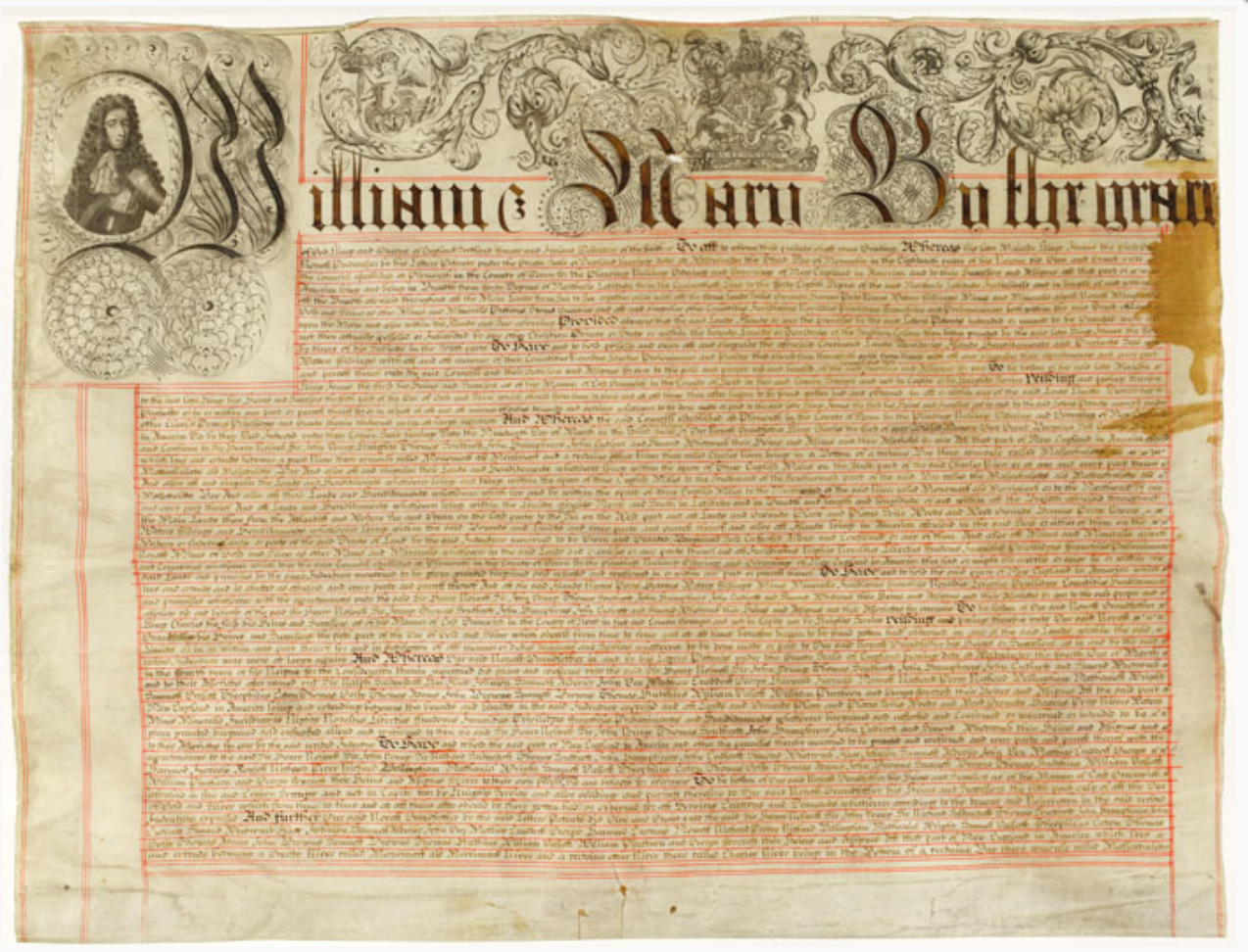
The Pilgrims of the Plymouth Colony established coroners as an elected office in 1636. By the end of the century, however, that colony had been absorbed into the province of Massachusetts Bay, and the monarchs William and Mary had issued a new charter for the province (shown above).

That 1691 charter stipulated:
it shall and may be lawfull for the said Governour with the advice and consent of the Councill or Assistants from time to time to nominate and appoint Judges Commissioners of Oyer and Terminer Sheriffs Provosts Marshalls Justices of the Peace and other Officers to Our Councill and Courts of Justice belonging…
The charter didn’t mention coroners, but everyone probably assumed they fell within the “other Officers” category. Such officials had presided over inquests in England for centuries, and in Massachusetts for decades. The big difference was that now the royal governor of Massachusetts, appointed by the ministry in London, would name coroners in every county, subject to the consent of the Council.

In 1700 the Massachusetts General Court got around to passing an act on “the office and duty of a coroner.” It stated:
every coroner, within the county for which he is appointed, shall be, and hereby is empowered to take inquests of felonies, and other violent and casual deaths committed, or happening within his precinct.
The law then devoted many more words to spelling out the oath that coroners would swear.

The next section said:
when and so soon as any coroner shall be certified of the dead body of any person supposed to have come to a violent and untimely death, found or lying within his county or precinct, he shall make out his warrant directed unto the constables of the same town where such dead body lies, or of three or four of the next adjacent towns, if need be, requiring them forthwith to summon a jury of good and lawful men of the same town, or such number as shall be sufficient, with those sent for from the neighbouring towns to make up eighteen in all, to appear before him at the time and place in the said warrant expressed
Then the law specified the language of the summons, the oath for the jury foreman chosen by the coroner, the oath for those jurors, and the fines to be levied if the constables or prospective jurors didn’t do their duties. I’m pleased to report that the law let the coroner swear in jurors “by three or four at once,” or else we’d still be waiting.

Out of the pool of eighteen men called, the coroner would choose “fourteen or more” for a jury and give them this charge:
You shall diligently inquire, and true presentment make, on the behalf of our sovereign lord the king, how and in what manner A. B. here lying dead, came to his death; and you shall deliver up to me, his majesty’s coroner, a true verdict thereof, according to such evidence as shall be given to you, and according to your knowledge. . . .

to declare of the death of the person, whether he died of felony, or by mischance and accident? and if of felony, whether of his own or of another’s? and if by mischance or misfortune, whether by the act of God or of man? and if he died of another’s felony, who were principals and who accessaries? who threatened him of his life or members? with what instrument he was struck or wounded? and so of all prevailing circumstances that can come by presumption.

And if by mischance or accident, by the act of God or man, whether by hurt, fall, stroke, drowning, or otherwise, to inquire of the persons that were present, the finders of the body, his relations or neighbours, whether he was killed in the same place, or elsewhere? and if elsewhere, by whom and how he was thence brought? and of all other circumstances.

And if he died of his own felony, then to inquire of the manner, means or instrument, and circumstances concurring.
Coroners could also summon witnesses, and of course they had their own oaths to swear.

The jury findings were specified in such detail that coroners came to use printed forms, filling in the blanks with information about the dead person, the date, the jurors, and so on.

The 1700 law said coroners could collect 10s. per day for travel and expenses, plus 2s. per day for each juror, to be collected from the dead person’s estate (or a dead child’s parents). If not enough money was available, the county treasurer would pay out what was needed.

In 1726 a new law allowed coroners to appoint deputies. In 1739 the legislature decided “some of the coroners within this province have of late greatly multiplied their deputies, and under colour of such deputation persons have pretended to be exempted from duties,” so it made such deputies a temporary appointment.

In contrast, coroners, like justices of the peace, kept their jobs for life—but that meant either their own lifespan, or the lifespan of the monarch under whom they were appointed.

COMING UP: Up for renewal.

Monday, November 03, 2025

“The Disease was rapid and poignant”?

Last month I faced a Boston 1775 emergency.

Which was, of course, not really an emergency. No one was in the least danger. I just felt an urgent need to confirm a statement I’d been repeating for years and suddenly had reason to question.

This dire situation arose because I asked myself how the coroners of Suffolk County responded to the death of William Molineux on Saturday, 22 Oct 1774.

John Rowe wrote in his diary that Molineux died “suddenly,” though Dr. Joseph Warren had visited the man the day before. Thomas Newell recorded death came “after three days’ illness,” Molineux’s political work having “produced an inflammation of the bowels.” John Andrews said Molineux died “After surviving a fit of apoplexy two days.”

By the time the Monday newspapers appeared, the Patriots had their story down. Edes and Gill’s Boston Gazette declared:
His Watchfulness, Labours, Distresses and Exertions to promote the general Interest, produced an Inflammation in his Bowels: The Disease was rapid and poignant; but in the severest Pangs, he rose superior to Complaint; he felt no Distresses but for the Public.
As for the Boston Post-Boy and Boston News-Letter, friendly to the royal government, they didn’t report Molineux’s death at all.

Some diarists and the Boston Gazette said that Molineux’s last words were “O SAVE MY COUNTRY HEAVEN!” That may even have been true, but I must note that “Oh, save my country, heav’n!” is a line from Alexander Pope’s Moral Essays. And that Molineux was notorious in his time for being a deist.

By March, Loyalists were publicly hinting that Molineux had committed suicide: through “the Laudanum of Doctor Warren, he quitted this Planet.” But there were also rumors, recalled by George Robert Twelves Hewes, that British army officers had poisoned the man.

That muddled situation led me to wonder if there was any official verdict on Molineux’s death. Massachusetts had inherited the English system of county coroners convening juries and holding inquests on suspicious deaths.

Unfortunately, not much paperwork seems to survive from inquests in pre-Revolutionary Massachusetts. There’s a small cache of documents relating to the Boston Massacre, probably saved those for their historic significance. Otherwise, collectors preserved a few determinations of coroners’ juries because they contained notable signatures.

Furthermore, in late 1774 the Massachusetts judicial system was being brought to a standstill by Patriot protests over judicial salaries and the Massachusetts Government Act. Some men, most prominently Molineux, refused to serve on juries. Outside Boston, crowds were blockading courthouses. Did that shutdown extend to coroners’ inquests as well?

Those questions led me to look more deeply into the coroners. How many were there? How long did they serve? How did they operate?

TOMORROW: Reading the law.

Sunday, November 02, 2025

“Washington in American Memory” Series in Cambridge, Starting 10 Nov.

The Longfellow House–Washington’s Headquarters National Historic Site, working with History Cambridge, the Cambridge Historical Commission, and Cambridge MA250, has organized a series of Sestercentennial panel discussions and talks at the Cambridge Public Library on the theme of “Washington in American Memory.”

This series runs through April 2026. Here are the events scheduled for this calendar year.

Monday, 10 November, 6 to 7:30 P.M.
From Revolution to Remembrance: Memory of the American Revolution
Cambridge Public Library and online

Explore how Americans have remembered, reinterpreted, and reshaped the meaning of the American Revolution from 1776 to today, featuring:
  • Michael Hattem, author of Past and Prologue: Politics and Memory in the American Revolution and Associate Director of the Yale-New Haven Teachers Institute
  • Nikki Stewart, Executive Director of Old North Illuminated
Register here.

Tuesday, 2 December, 6 to 7:30 P.M.
The First Commander Remembered: Washington’s Legacy in Cambridge
Cambridge Public Library and online

Debunk myths and trace the evolution of the public memory of George Washington in Cambridge, Massachusetts, featuring:
  • J. L. Bell, author of The Road to Concord: How Four Stolen Cannon Ignited the Revolutionary War and proprietor of Boston 1775
  • Charles Sullivan, co-author of Building Old Cambridge: Architecture and Development and Executive Director of the Cambridge Historical Commission
Register here.

All these events will be free thanks to funding from Eastern National.

Unfortunately, some of the people who worked hard to organize this series are now not being paid and legally barred from their jobs in the National Park Service because of the federal government shutdown. Because these panel discussions will be at the city library, they will go on, unlike events scheduled at parks themselves. But it’s a hell of a way for the U.S. government to celebrate the 250th.

Saturday, November 01, 2025

Revolutionary Music Coming out of the North End

Our favorite Revolutionary sites in the North End are concatenating again with two musical events coming up early this month.

Wednesday, 5 November, 7 to 8:30 P.M.
Music-Making in Colonial Boston
Laura Zoll
Online from Old North Illuminated

Colonial Boston was home to a rich soundscape of music that helped define the lives of early New Englanders. Music-making set the tone and tempo of militia, home hospitality, tavern frivolity, and community singing circles. This talk will explore questions like:
  • What did music sound like during the colonial era?
  • Who played it?
  • What sort of instruments were played?
  • How did music reflect contemporary culture and beliefs?
Laura Zoll is a musicologist with degrees in Music Theory and Medieval Musicology. She plays numerous modern and historic instruments.

Register for the link to this event with a donation of any amount.

Thursday, 13 November, 7 to 8:30 P.M.
A Revolutionary Concert: Paul Revere, the Man, the Myth, and the Music
Regie Gibson and Ensemble
Converse Hall, 88 Tremont Street

Join the Paul Revere Memorial Association, Massachusetts Poet Laureate Regie Gibson, and Paul Revere for an engaging and immersive free program to commemorate the 250th anniversary of the Midnight Ride. From the loyalist anthems of the Tories to the fiery songs of the Revolutionaries and original 19th-century compositions written to further Revere’s legacy, this program brings 18th- and 19th-century America to life through the music of the times. The evening will include performances by some of Boston’s finest musicians.

Blending rich narration, historical images, and live music, this program offers a fresh, moving, and insightful take on one of the Revolution’s most misunderstood heroes. Far more than just a messenger on horseback, Paul Revere was a devoted family man, a savvy businessman, and a respected civil servant. This special evening promises to be a powerful journey through sound and story, separating fact from folklore while painting a vivid portrait of one of America’s most iconic patriots.

This concert is free, but please register for a seat here.

Friday, October 31, 2025

“Sparking the Revolution” conference in Springfield, 20–21 Nov.

On 20–21 November the Springfield Armory will co-host the 2025 Fall Conference of the Firearms Research Center, on the topic of “Sparking the Revolution: Flintlocks, Gunpowder, and Policy in America’s War for Independence.”

The Firearms Research Center is based at the University of Wyoming law school. It states its mission as “to foster a broad discourse and produce meaningful change in how firearms are discussed and understood.”

The conference will open the afternoon of Thursday, 20 November, with a reception and fireside chat on the theme “Exercising the Bruen Test: A Study in the Modern-Day Debate on the Second Amendment.”

“Examining Revolutionary-era topics through the lens of today’s constitutional debates” will be Firearms Research Center director George Mocsary, Megan Walsh of the Gun Violence Prevention Law Clinic at the University of Minnesota, and moderator Ashley Hlebinsky, the center’s executive director.

The “Bruen test” is the outcome of a 2022 U.S. Supreme Court decision that stated the constitutionality of gun restrictions must be “consistent with the Nation’s historical tradition of firearm regulation.” Since there isn’t a consistent, unchanging, and non-discriminatory tradition of firearm regulation, judges have struggled to understand and apply that test. The Brennan Center for Justice says it’s unworkable. In a follow-up case this year, United States v. Rahimi, the nine Supreme Court justices issued seven opinions to tweak the Bruen language.

That opening session is scheduled to take place at the Springfield Armory National Historic Site. As a National Park Service unit, that’s currently closed because of the lapse in Congressional funding with almost all the employees furloughed. I suppose that location may change before 20 November.

On Friday, 21 November, the conference will move across the street to Springfield Technical Community College’s Scibelli Hall. That day’s program will include these parts.

Panel 1: Disarmament and the Revolution
  • Bob Cottrol, George Washington University
  • E. Gregory Wallace, Campbell University
  • James Slaughter, Marshall University
Guns of the American Revolution
Erik Goldstein, Colonial Williamsburg

The Earliest Days of Springfield Armory
Alex Mackenzie, Springfield Armory

Panel 2: The Colonial Militia
  • Jody Madeira, Indiana University
  • Joyce Malcolm, George Mason University
  • Alexander Cain, Author, We Stood Our Ground
Creating an Arsenal of Liberty
Andrew Fagal, Princeton University

Early Ballistics of the American Revolution
Joel Bohy, Antiques Roadshow

Find the full schedule here. Anyone can register to attend all of the sessions for free either in person or virtually.

Thursday, October 30, 2025

“Complicated US peoples’ relationship with Loyalists”

H-Net’s online collection Remembering the American Revolution at 250 shares G. Patrick O’Brien’s article “‘Men who Deserve Nothing Better from a Wronged and Insulted Country than Exile’: The Loyalists and Popular American Misunderstanding.”

Here’s a taste of its analysis:
In the early twentieth century, the emergence of the United States as a world power and its strengthening political and cultural ties with Britain led English-speaking people on both sides of the Atlantic to reexamine the historical relationship between the two nations. During the so-called Great Rapprochement, scholars in the United States again revisited the revolution eager to highlight the ways the war grew from, rather than rejected, British traditions. Like [Lorenzo] Sabine decades before, these historians took the view that the Loyalists had been unjustly exiled, not only depriving the young nation of strong leaders, but also unnaturally dividing English-speaking people. . . .

But these scholarly approaches to revolutionary loyalism appear to have done little to sway popular opinion. If anything, they may have further complicated US peoples’ relationship with Loyalists at a time when traditional conceptions of US nationalism were being reworked. Those who decried what they saw as an increasingly Anglophilic US identity came in myriad forms, but a new wave of anti-Loyalist sentiment was among the most popular. . . .

Isolationists criticized prominent historians for rewriting US history in favor of the Anglo-American alliance. “It is in order now to admit that the Loyalists had a fair cause to defend,” balked one writer for the Nonpartisan Leader, who also predicted that Anglophilic promoters “will put into our schools and universities a series of royalist textbooks to poison the minds of our youth against the American Revolution.”
That didn’t happen. And in this century, we’ve seen hyperpatriotism and royalist policies grow closer together.

It’s very hard for the public to resist identifying “good guys” in our national origin story, as this anecdote from the Bicentennial period shows:
In Boston’s famed Quincy Market, an exhibit installed by Boston 200, the nonprofit agency created in 1972 to plan celebrations in the city, used a computer program to probe visitors’ loyalties by asking them how they would respond to events leading up to and in the earliest days of the war. For the price of admission—$1.50 for adults and 75 cents for children—the computer labeled respondents on a scale from vehement Patriot to resolute Tory, and even compared visitors’ views to those of historical figures, including Thomas Hutchinson and Samuel Adams. Unsurprisingly, most visitors, especially Boston locals, tried to skew their answers to earn a Patriot label. Visitors could also take with them a “Patriot” or “Tory” button as a souvenir, with most choosing the former.
This past 18 April I spoke about what led up to Paul Revere’s ride at the U.S.S. Constitution Museum. On the street afterward I met a couple of ladies who’d heard my talk, and one told me that, to her surprise, she’d ended up siding with the Loyalists.

That wasn’t my intention, but I did try to illuminate the real political arguments—not just us vs. them, but how we got to the point of drawing the line between us and them when we started with so much in common.

Wednesday, October 29, 2025

“Fully compensate for all the Insults and Indignities”?

Enemies to Their Country: The Marblehead Addressers and Consensus in the American Revolution is Nicholas W. Gentile’s first book, just published by the University of Massachusetts Press.

Timothy Symington’s review for the Journal of the American Revolution says:
Marblehead was an important fishing community, with an aristocracy created by the cod fishing industry. . . . the town’s harmony was threatened by the signatures of thirty-three residents to a letter published in the Essex Gazette in May 1774. The letter was a “send-off” to departing governor Thomas Hutchinson. . . . The thirty-three residents who added their names to the letter were hoping that Hutchinson would return to London and try to use his influence to calm the situation.

The letter thanked Hutchinson for his involvement on behalf of the fishing industry, and then ended on a conciliatory note: “‘We heartily wish you, Sir, a safe and prosperous Passage to Great-Britain, and when you arrive there may you find such a Reception, as shall fully compensate for all the Insults and Indignities which have been offered you.’”

The idea of apologizing to a man like Hutchinson was anathema to many who subscribed to the Patriot cause (which, at this point, meant a return to no taxation and stopping the abridgement of British liberties). Most of the Marblehead residents considered themselves Whigs and were incensed at the letter. Gentile describes the importance of everyone in the community at that time in history being on the same page. Giving up one’s individual needs for the common good helped to create social harmony. . . .

Most Addressers ended up offering recantations, and some then took active roles in fighting on the Patriot side after war broke out. Some Addressers were truly contrite and regretted signing the letter, claiming that they did not truly understand Hutchinson’s character. Other Addressers took a longer time to recant, which some did more than once since their first attempts were not accepted by the community. All Addressers did recant at some point, but some of them could not reconcile their politics for the good of the community.
The Marblehead Addresser I’ve written about most was John Pedrick, who after another century was turned into a Patriot hero through the stories of his daughter and granddaughter.

Gentile will speak about his book at the Marblehead Museum on Thursday, 6 November, at 7 P.M. For tickets to attend that event in person, go to this page. To watch online, go here. Tickets are $15, or $10 for museum members.

Tuesday, October 28, 2025

“The history that does work in the world”

At the end of 1929 Prof. Carl Becker (1873–1945) of Cornell University addressed the American Historical Association as its president.

Among Becker’s previous books were The History of Political Parties in the Province of New York, 1760–1776; The Eve of the Revolution: A Chronicle of the Breach with England; and The Declaration of Independence: A Study in the History of Political Ideas.

He tended to study the formal political history of legislation and pamphleteering, though with a slightly jaundiced eye about what good that activity did.

The title of Becker’s talk in 1929 was “Everyman His Own Historian,” and it addressed the gap between the academic historian’s approach to the past and that of “an ordinary citizen without excess knowledge” or representative of “every normal person,” Mr. Everyman. (The norm, of course, being male.)

Becker said:
Mr. Everyman has a wholesome respect for cold, hard facts, never suspecting how malleable they are, how easy it is to coax and cajole them; but he necessarily takes the facts as they come to him, and is enamored of those that seem best suited to his interests or promise most in the way of emotional satisfaction. The exact truth of remembered events he has in any case no time, and no need, to curiously question or meticulously verify.

No doubt he can, if he be an American, call up an image of the signing of the Declaration of Independence in 1776 as readily as he can call up an image of Smith’s coal wagons creaking up the hill last summer. He suspects the one image no more than the other; but the signing of the Declaration, touching not his practical interests, calls for no careful historical research on his part.

He may perhaps, without knowing why, affirm and hold in memory that the Declaration was signed by the members of the Continental Congress on the fourth of July. It is a vivid and sufficient image which Mr. Everyman may hold to the end of his days without incurring penalties. Neither Brown nor Smith has any interest in setting him right; nor will any court ever send him a summons for failing to recall that the Declaration, “being engrossed and compared at the table, was signed by the members” on the second of August.

As an actual event, the signing of the Declaration was what it was; as a remembered event it will be, for Mr. Everyman, what Mr. Everyman contrives to make it: will have for him significance and magic, much or little or none at all, as it fits well or ill into his little world of interests and aspirations and emotional comforts.
But of course Becker concluded with a slightly jaundiced view of his own profession’s work:
Berate him as we will for not reading our books, Mr. Everyman is stronger than we are, and sooner or later we must adapt our knowledge to his necessities. Otherwise he will leave us to our own devices, leave us it may be to cultivate a species of dry professional arrogance growing out of the thin soil of antiquarian research. Such research, valuable not in itself but for some ulterior purpose, will be of little import except in so far as it is transmuted into common knowledge. The history that lies inert in unread books does no work in the world.

The history that does work in the world, the history that influences the course of history, is living history, that pattern of remembered events, whether true or false, that enlarges and enriches the collective specious present, the specious present of Mr. Everyman. It is for this reason that the history of history is a record of the “new history” that in every age rises to confound and supplant the old.

It should be a relief to us to renounce omniscience, to recognize that every generation, our own included, will, must inevitably, understand the past and anticipate the future in the light of its own restricted experience, must inevitably play on the dead whatever tricks it finds necessary for its own peace of mind.

Monday, October 27, 2025

“Great Trade to Bilbao” Symposium in Salem, 8 Nov.

On Saturday, 8 November, Salem State University will host a symposium titled “’To Drive a Great Trade to Bilbao’: Rediscovering New England’s Iberian Ties, 1640s–c.1830.”

This scholarly event coincides with the Marblehead Museum’s ongoing exhibition “Bilbao Bound,” created with the Itsasmuseum Bilbao (Bilbao Maritime Museum).

The symposium brings together an international group of historians and curators to examine a largely forgotten aspect of early New England history: the trading connections between Boston’s North Shore and the Spanish Basque port of Bilbao. Those commercial ties played a part in securing Spanish Crown support for the American Revolution.

10 to 11:30 A.M.
“Bilbao Bound” exhibit tour
Donald C. Carleton, Jr., guest curator
Marblehead Museum

All the symposium presentations will take place in the Petrowski Room of Marsh Hall at Salem State University.

1:30 to 1:45 P.M.
Greetings and Welcome
Brad Austin, Chairman, History Department, Salem State University
Rafael Orbegozo Guzmán, Advisor to the Chairman, Iberdrola

1:45 to 2:05 P.M.
“James G. Lydon and the Rediscovery of New England’s Iberian Trade(s)”
Donald C. Carleton, Jr., exhibit curator

2:15 to 3:45 P.M.
New England and Iberia: Peoples, Ports, Perspectives
  • “Dowries of Cod and Prayers against Shipwreck: Women and Their Atlantic World in the Early Modern Basque Country” by Amanda L. Scott, Associate Professor of History and Women’s, Gender, and Sexuality Studies, The Pennsylvania State University
  • “El papel de cádiz en las primeras redes comerciales atlántico-mediterráneas de nueva inglaterra (1770–1820)” [“The Role of Cádiz in the early Atlantic-Mediterranean Commercial Networks of New England (1770–1820)”] by Guadalupe Carrasco-Gonzalez, Profesora Titular, Universidad de Cádiz via Zoom
  • “Fish for Faience: Archaeological Evidence of Early New England’s Trade with Portugal” by Emerson Baker, Professor of History, Salem State University
Moderator: Donald C. Carleton, Jr.

4:00 to 5:15 P.M.
Yankees, Cod, Spain, and Revolution
  • “Spain and the American Revolution: The View from Madrid” by Larrie D. Ferreiro, George Mason University
  • “Fish to Firearms: How Lee, Gerry, and Gardoqui Helped Arm a Revolution” by JosĂ© Manuel Guerrero Acosta, Project Director and Curator, Spain and the Support for the American Revolution, a Project by Iberdrola
Moderator: Dane Morrison, Professor Emeritus of Early American History, Salem State University

5:15 to 5:30 P.M.
Concluding Remarks
Brad Austin

The symposium is free, but attendees must register in advance. For in-person seats, sign up here. To watch the presentations online, use this link.

Sunday, October 26, 2025

A New Job for the Rev. Edward Bass

As the Revolutionary War wore on, the Rev. Edward Bass of Newburyport sent letters to the Society for the Propagation of the Gospel in Foreign Parts (S.P.G.) in London, begging to remain in good standing as an Anglican minister.

Bass asked congregants and colleagues to write and even speak to people in London on his behalf. They argued that he’d never embraced the new American governments and merely compromised on small matters for the good of his congregation.

By the end of 1781 the S.P.G. had considered Bass’s case three times, and each time it came to the same conclusion: he was no longer behaving like a loyal representative of the Church of England.

In 1786 the minister appears to have given up on getting anything but the last word since he paid to publish his side of the case in London:
A Brief Account of the Treatment which Mr. Bass, Late Missionary from the Society for the Propagation of the Gospel in Foreign Parts, at Newburyport, New England, Hath Received from Said Society. Drawn up by Himself, with Remarks upon Particular Parts of It, and Addressed to the Impartial Public.
Even as Bass burned his personal bridges, other American Anglicans were trying to build new ones before the supply of priests ran out.

American ministers were casting about for how to institute a national church hierarchy while being independent from the British Crown. Previously all aspiring Anglican priests had gone to England to be ordained since there were no bishops in North America. (Indeed, the threat of a bishop had kept many New Englanders in a state of alarm for years before the war.) And as part of that ordination, men swore the Oath of Supremacy, promising loyalty to the monarch of Great Britain.

In 1783 the formerly Anglican clergymen of Connecticut gathered and elected their first bishop: Samuel Seabury (1729–1796, shown here). Yes, this was the same pamphleteer who serves as the voice of Loyalism in Hamilton. Seabury went to Britain, seeking people in authority to consecrate him as an American bishop, and eventually found those officials in the Scottish Episcopal Church, which had slightly different rites.

In 1785 Seabury began to ordain new ministers in America, and a general convention of former Anglicans drafted a constitution and proposed an American Book of Common Prayer. American representatives negotiated with Church of England officials. To preserve some authority, the English episcopate decided to make some compromises.

In February 1787 bishops in London consecrated two American ministers as bishops. A second general convention in Philadelphia in July–August 1789, with delegations from New York south to South Carolina, approved an Episcopal Church constitution and formed a House of Deputies and House of Bishops.

Meanwhile, in May 1789 formerly Anglican ministers from New England had convened in Salem. They elected a bishop for Massachusetts and Rhode Island. And the man they chose was the senior minister in the state, the chair of their convention, a man who had stuck it out through the war: the Rev. Edward Bass.

The convention in Philadelphia approved of that choice. However, New Englanders had come to value having some say in the choice of their clergy, and only ministers had voted for Bass. Therefore, there was another, broader election for a bishop of Massachusetts, Rhode Island, and New Hampshire seven years later in 1796. The Right Rev. Mr. Bass was officially consecrated the following year.

Saturday, October 25, 2025

“Mr. Bass was conducted into his deviations”

The Rev. Edward Bass of Newburyport was under pressure from both sides during the Revolutionary War.

As a minister in the Church of England, still feeling personal loyalty to the Crown, he tried to avoid complying with the independent governments’ demands.

But that exposed him to attacks from the Patriot populace. On 4 May 1782 the Rev. Jacob Bailey (1731–1808, profile shown here), an Anglican minister who moved around the New England frontier, wrote to the Society for the Propagation of the Gospel in Foreign Parts (S.P.G.) in London:
I am very confident, both from the repeated assertions of Mr. Bass himself, and other circumstances, that he refused to read the Declaration of Independency, and he became, on that account, extremely obnoxious to the violent party.

I am certain that he was publicly reported for a Tory, and I was, one evening just upon my arrival at his house, witness to a scene equally ludicrous and indecent, for as he was returning from an entertainment with his wife, he was pursued along the street by near two hundred persons, who pelted him with dirt and stones, and treated him with the most indelicate language.
Meanwhile, Anglican ministers who had fled New England complained that Bass was too compliant toward the Patriot authorities. The Rev. Joshua Wingate Weeks of Marblehead reported that Bass had preached in support of American soldiers—and he said he’d heard that from Bailey.

Bailey wrote his 1782 letter to refute that charge. He recalled:
being compelled to leave my family to avoid confinement on board a guard ship, I wandered through the country, and about the middle of November came to Newburyport, and was at Church on a day of public thanksgiving appointed by the Congress. Mr. Bass desired me to preach, but I refused, assuring him that I would never deliver a charity sermon to collect money for clothing the rebel soldiers.

This I repeated soon after to Mr. Weeks, but, as nearly as I can remember, Mr. Bass gave us a general discourse, without descending to particulars, or even mentioning the occasion of the solemnity. After sermon, the collection was made. Many refused to contribute, and a lady of some distinction declared with a spirited voice, “I will never give a single penny towards the support of rebels.” This bold declaration was perhaps the occasion of my retaining the above in my memory.

On the whole, I am persuaded that Mr. Bass was conducted into his deviations, not from even the least inclination to the cause of the revolters, but from a mistaken zeal for the Church, which, he imagined, in some measure, would justify his compliance.
As noted yesterday, by 1776 Bass had stopped receiving the half of his salary paid by the S.P.G. Later in the war he realized his situation was even worse: the organization had marked the St. Paul’s pulpit as empty, no longer recognizing his existence as a minister.

TOMORROW: Routes to reinstatement?

Friday, October 24, 2025

“In Lieu of that Part of his Salary received annually from England”

New England’s Puritan heritage made those colonies less than welcoming for the Church of England.

There was an Anglican missionary organization called the Society for the Propagation of the Gospel in Foreign Parts (S.P.G.). It paid for ministers to visit Native American communities.

It also supplemented the salaries of ministers in New England on the assumption that their congregations were small and their work difficult.

The Rev. Edward Bass was one of those ministers. He was born in 1726 in Dorchester into a family that had arrived early in the English settlement of Massachusetts. He studied at Harvard College and spent a couple of years teaching and preaching in Congregationalist meetings.

But by 1752 Bass decided that he really belonged in the Church of England. He sailed to Britain to be ordained, returning to take up the pulpit of St. Paul’s church in Newburyport.

Twenty years later came the war. As quoted yesterday, news of the Declaration of Independence prompted the wardens and vestrymen of St. Paul’s to ask their minister to leave prayers for King George III and his family out of their services for the sake of the church. On 16 July 1776 the Rev. Mr. Bass agreed: “I think it incumbent on me for so important an end to comply with this request during the present state of our political affairs.”

Bass tried to walk a narrow line. He dropped the public prayers for the king but continued to support the Crown personally. When the Massachusetts Council ordered all ministers to read the Declaration of Independence to their congregations, he declined to declaim it from the St. Paul’s church pulpit but evidently allowed a lower church official to do so.

But already other Anglican ministers were complaining about Bass’s conduct. On 15 July 1775 the Rev. Dr. Henry Caner of King’s Chapel in Boston had written to the S.P.G.: “Mr. Bass has complied perhaps too far with the orders of the Rebels.”

The war stopped the S.P.G.’s regular payment to Bass. On 25 Nov 1776, nine Newburyport men signed this pledge:
We the Subscribers of St. Paul’s Church in this town being truly sensible of the Distress which our worthy minister must suffer without some Relief in Lieu of that Part of his Salary received annually from England, and which the present unhappy Times prevent his obtaining, do promise to pay on Demand to Mr. John Vinal the several sums affixed to our Names to be by him delivered to the Rev. Mr. Bass.
The promised amounts ranged between £10 from Tristram Dalton and John Tracy to 18 shillings from Abram Gallisham. As for Vinal the schoolteacher and church warden, his signature doesn’t appear on this document. Perhaps he chipped in on his own, or perhaps his contribution lay in wrangling the contributions of others.

TOMORROW: Did that settle matters?

Thursday, October 23, 2025

The “Doctrine of Projectiles” and Other Doctrines

On 10 Aug 1775, the Newburyport schoolmaster John Vinal wrote out the text of a new advertisement to appear in the next day’s Essex Journal and succeeding issues.

That was nearly four months into the war, and Vinal’s ad reflected that situation:
AT a Time when our Enemies are endeavouring our Ruin it is highly proper to qualify ourselves in the best Manner we can to defend our injured Country:

And as the Doctrine of Projectiles, or Art of GUNNERY is of such Importance that no Person should undertake the Direction of any Piece of Ordnance without a competent Knowledge of it, the Want of which has proved fatal to many:

The Subscriber therefore proposes to instruct those who may incline to attend four Afternoons in a Week, from five to seven o’Clock, or from eleven to one A.M. [sic] in the above Art at a very moderate Price

JOHN VINAL.

N.B. The Subscriber received his Knowledge of the above Art from a Gentleman who was an Engineer in the British Army the whole of the last War.

Newbury Port, August 10th, 1775.
In April and October 1776 Vinal went back to advertising private lessons for the “youth of both sexes” in the standard school subjects, not gunnery.

Vinal was also a warden of St. Paul’s, the town’s Anglican church, founded in 1711. On 16 July 1776 he, fellow warden Joseph Cutler, and eight vestrymen gave this letter to their minister, the Rev. Edward Bass (1726–1803):
Rev’d Sir;—

The Representatives of the United Colonies in America, having in Congress declared s’d colonies free and Independent States, and disavowed all Allegiance to the King of Britain and the service of the Church to which we belong, prescribing certain prayers, &c., to be used for s’d King, his Family & Government, We find ourselves under the necessity of requesting you to omit in your use of the Service all Prayers, Collects, or Suffrages which relate to the King, Royal Family, or Government of Great Britain, both as we would avoid great Inconsistency and as we value the welfare of the church, being assured that without such omission the Existence thereof would immediately cease.
Most of Boston’s Anglican clergymen had left with the British military, and others in Massachusetts were keeping a low profile. Bass had to worry about local opinion, his congregation, his sacred oaths—and his salary.

TOMORROW: A special collection.

Wednesday, October 22, 2025

“To open his EVENING-SCHOOL, as usual”

Isaiah Thomas and Henry-Walter Tinges launched the Essex Journal newspaper in Newburyport in 1773.

Among its advertisers was town schoolmaster John Vinal, offering private lessons in a broad range of subjects. His notice on 5 Oct 1774 said:

JOHN VINAL,
INTENDS to open his EVENING-SCHOOL, as usual at the NORTH-SCHOOL the 10th Instant, for Writing and the several practical Branches of the Mathematics, enumerated in a former Advertisement of his.
Alas, I haven’t found that “former Advertisement.” 

On 15 Mar 1775 Vinal was more expansive:
JOHN VINAL,
ACQUAINTS his Friends that he intends to begin his private School for Youth of both Sexes, on Monday the third of April next at 11 o’Clock A.M. in the room he improved the last Summer, nearly opposite Mr. Davenport’s Tavern, and from 5 to 7 o’Clock, P.M. at the Town School House for those who can best attend in the Afternoon.

N.B. The Said VINAL has a very genteel BOWFAT, with a Glass Door to dispose of, very cheap, for almost any Pay that will suit the Purchaser.
A what now?

A week later the same ad ran again except the item offered for sale was “a very genteel BUFFET, (commonly pronounced Bowfat,) with a Glass Door.”

Ah.

Dr. Samuel Johnson’s dictionary defined a buffet this way:
Buffet. n.s.  [buffette, Fr.] A kind of cupboard; or set of shelves, where plate is set out to shew, in a room of entertainment.
The rich buffet well-colour’d serpents grace,
And gaping Tritons spew to wash your face.
Pope.
”Mr. Davenport’s Tavern” referred to the tavern started by William Davenport and inherited by his sons Anthony and Moses in 1773. Its sign showed Gen. James Wolfe, so it was also called the Wolfe Tavern.

Vinal’s eagerness to sell that genteel piece of furniture suggests a need for quick cash. Of course, he often seems to have wanted extra cash. But the spring of 1775 wasn’t the best time for selling a luxury item, especially one you didn’t know how to spell.

TOMORROW: War!

Tuesday, October 21, 2025

“A Sett of Globes (which came over by Mistake)”?

In eighteenth-century New England, booksellers sold more than books, pamphlets, and magazines. 

As the business letters of Thomas Hancock and Henry Knox show, they also purveyed medicines, tea, “Instruments,” quills, stationery, snuff, and other genteel goods.

In the spring or summer of 1773, Knox received a set of globes from one of his London suppliers. This set probably consisted of a terrestrial globe—the spherical representation of Earth that we’re used to—and a celestial globe showing the constellations and other stars.

We have a bunch of Knox’s incoming correspondence, published by the Massachusetts Historical Society in 1928, but I don’t see a clue about who sent those globes.

Some London merchants, such as the publisher Thomas Longman, just shipped Knox the latest magazines and the books reviewed in those magazines without waiting for an order. So it’s possible one of the young bookseller’s suppliers put those globes on a ship expecting he would find a market for them.

Fortunately, a customer appeared. On 6 August, the schoolmaster John Vinal wrote to Knox from Newburyport:
Mr. [Tristram?] Dalton informed me that you had a Sett of Globes (which came over by Mistake) that you would dispose of at the Sterling Cost and Charges. I was just going to write to London for such a Sett; but if you have not disposed of yours, and the price is agreeable, and they are the right sort I will purchase them. I should be glad of a Line immediately; you may inclose one to me directed to my Friend Mr. Wm. Miller Collector.

I should be glad to know the following particulars, vizt. Whither they are Senex’s Globes—who they are made by, if they have a Magnetic Needle and Card, if they have a Nonius Scale and Analemma, Quadrant of Altitude, etc. and what Cases they are in. . . .

Please to express the Price either in Sterling or L[awful] M[one]y.
As published, this letter told Knox to send mail through “Wm. Millen,” but the deputy collector of customs in Newburyport was another of Knox’s customers, William Miller. Since Vinal was officially a handwriting master, you’d think he’d render his friend’s name unmistakably.

As a teacher of adult classes in navigation, among other subjects, Vinal’s wanted to know this product’s features. “Senex’s Globes” meant those modeled on the work of cartographer John Senex (1678–1740). A “Nonius Scale” was the invention of the Portuguese scientist Pedro Nuñez (1492–1577). An “Analemma” is the figure-8 pattern traced by the Sun when viewed from the same spot day after day over a full year.

As for the price, that probably depended on how large these globes were. Sets ranged from small enough to fit in a pocket to large enough to count as furniture, and their price tags were proportional.

Did Knox and Vinal close the deal? We don’t know because we don’t have both sides of the bookseller’s correspondence. But on 27 June the Rev. John Murray had written to Knox from Boothbay in Maine asking for “one pair of 18 inch Globes.” (Murray also complained about how Knox had supplied “Copies of the Classical authors,” nonetheless ordered some other books, and asked how to reach Knox’s childhood friend the Rev. David McClure.) So if those globes from London were 18 inches across, they were probably on their way past Newburyport to Boothbay.

TOMORROW: Mr. Vinal’s notices.