






“To hear the proclamation for independance read and proclamed”
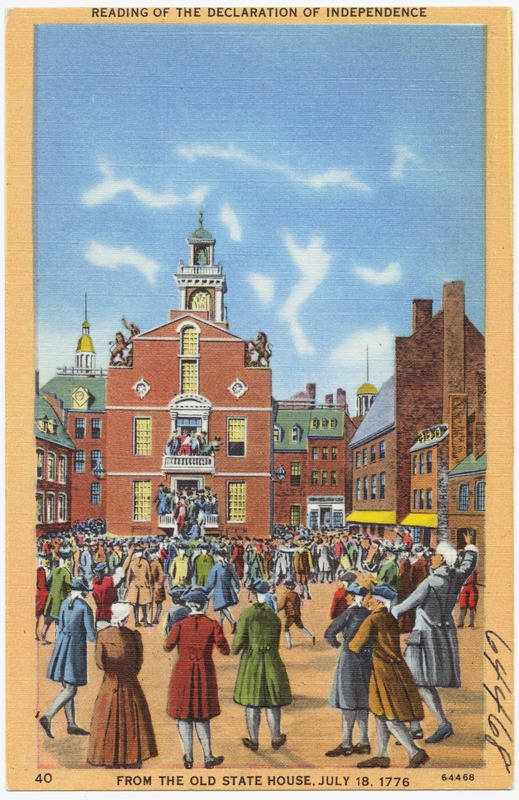
People had already heard about the Continental Congress’s vote, and many had probably read the Declaration in newspapers. But this was a governmental ceremony. It happened in two places, and on two levels.
With no governor, the highest executive authority in Massachusetts was the Council. Most of its members were meeting in the Edmund Fowle house in Watertown.
Therefore, one part of the official reading was performed by Council secretary Perez Morton, reading the Declaration to the Council and to a crowd gathered outside. Also present were delegates from the Mi’kmaq and St. John’s/Maliseet communities, ready to sign a treaty of friendship with this new United States.
In Boston, there was a parallel, larger ceremony. Inside the Council’s chamber in what was now the State House, Suffolk County sheriff William Greenleaf read the Declaration to some Council members and other officials.
Col. Thomas Crafts of the Massachusetts artillery regiment, who had a bellowing voice, then “deaconed” or repeated the text phrase by phrase from the balcony of the Council chamber to the crowd gathered on the street below.
Thus, most Bostonians at the event heard Col. Crafts’s reading, but the official proclamation in Boston came from Sheriff Greenleaf. The ceremony was meant for both government officials and the “people out of doors.”
On 21 July, Abigail Adams reported to her husband:
Last Thursday after hearing a very Good Sermon I went with the Multitude into Kings Street to hear the proclamation for independance read and proclamed. Some Field peices with the Train were brought there, the troops appeard under Arms and all the inhabitants assembled there (the small pox prevented many thousand from the Country).Not everyone was entirely pleased. Merchant John Rowe characterized the celebration as “a Great Confusion in Town.”
When Col. Crafts read from the Belcona of the State House the Proclamation, great attention was given to every word. As soon as he ended, the cry from the Belcona, was God Save our American States and then 3 cheers which rended the air, the Bells rang, the privateers fired, the forts and Batteries, the cannon were discharged, the platoons followed and every face appeard joyfull.
Mr. [James] Bowdoin [a senior member of the Council] then gave a Sentiment, Stability and perpetuity to American independance.
After dinner the kings arms were taken down from the State House and every vestage of him from every place in which it appeard and burnt in King Street. Thus ends royall Authority in this State, and all the people shall say Amen.
Pulling the royal emblems of the lion and unicorn down from the State House roof was probably inspired by reports of New Yorkers toppling the statue of King George III after that city’s reading of the Declaration on 9 July. But the street was still called King Street until 1784.

3 comments:
I'm interested in your statement that Col. Crafts verbally repeated the reading of the Declaration occuring within the Council Chamber to the crowd gathered in King Street--as opposed to reading the text from the document himself. Yet Abigail Adams herself reported that he "read" it. Most curious about your source, which I am sure is a good one!
The Council’s 17 July order was for the sheriff of Suffolk County to read the Declaration the next day. Different Boston newspapers reported the text was read by the sheriff or by Col. Crafts.
The Greenleaf family tradition was: “As [the sheriff’s] voice was rather weak, he requested Colonel Crafts to act as his herald; they stood together at the front of the balcony, and my father read a sentence, which was immediately repeated by Crafts, and so continued to the end.” However, Abigail Adams and some newspapers didn’t mention Greenleaf at all.
I therefore surmised that Greenleaf read the text inside the Council chamber while Crafts delivered the text to the crowd below. A spectator on the street, like Adams, could have seen and almost certainly heard only Crafts. The colonel may have consulted a printed text or repeated what he heard from the sheriff.
I used the verb “deaconed,” but that’s not an exact analogy. A deacon would deliver each line of a hymn before the congregation sang it rather than repeating it after another reader. But I think that verb reflects the likely pauses between lines in Crafts’s delivery.
Some accounts say the deputy secretary of the Council who read the Declaration in Watertown was John Avery, not Perez Morton. Avery definitely signed the order to have more copies printed on 5 August. I haven’t found definite evidence on that question about 18 July, though.
Both Avery and Crafts were members of the “Loyall Nine” club that organized the first public Stamp Act protests in 1765, almost eleven years before. So independence was a high point of a movement they helped to kicked off.
Post a Comment