J. L. BELL is a Massachusetts writer who specializes in (among other things) the start of the American Revolution in and around Boston. He is particularly interested in the experiences of children in 1765-75. He has published scholarly papers and popular articles for both children and adults. He was consultant for an episode of History Detectives, and contributed to a display at Minute Man National Historic Park.

Subscribe thru Follow.it


•••••••••••••••••


Monday, May 18, 2009

Seven Founders

Last week guest blogger Ray Raphael laid out a challenge: Choose seven people to follow through the entire American Revolution whose stories, when combined, would tell the whole of that political, military, and social change.

I shared my thoughts, and Boston 1775 readers rose to the challenge with many more suggestions. I also promised to reveal the folks whom Ray chose to follow in Founders: The People Who Brought You a Nation, and here they are:

Choosing these particular people allowed Ray to play them off each other. For example, Dr. Young was one of the most radical and democratic politicians of the period while Laurens was fundamentally conservative. Warren strenuously opposed Morris, who in turn distrusted Young.

Washington, Martin, and Bigelow were all in the army at Valley Forge and Yorktown, but, holding different ranks, experienced the war in different ways. Morris and Laurens were very important figures in the civil government while Warren and Young wrote political essays and exercised behind-the-scenes influence. Washington, Morris, and Bigelow all invested in land development after the war; Martin was one of the small farmers who settled on such newly developed land. Only one of these people didn’t live to see Britain acknowledge American independence.

Sunday, May 17, 2009

Do You Recognize This Person?

This is a detail from a lesser-known portrait of a better-known figure from Revolutionary history. In fact, this individual is one of the most easily recognized people in all of American history—but our image of the person comes from a different point in life. Can you guess who it is?

The full portrait and name of the subject appear here.

The original painting is in the collection of Harvard University, a donation from Dr. John Collins Warren. [Ooh, is that a clue?]

Saturday, May 16, 2009

A Close Look at a Ciphered Diary

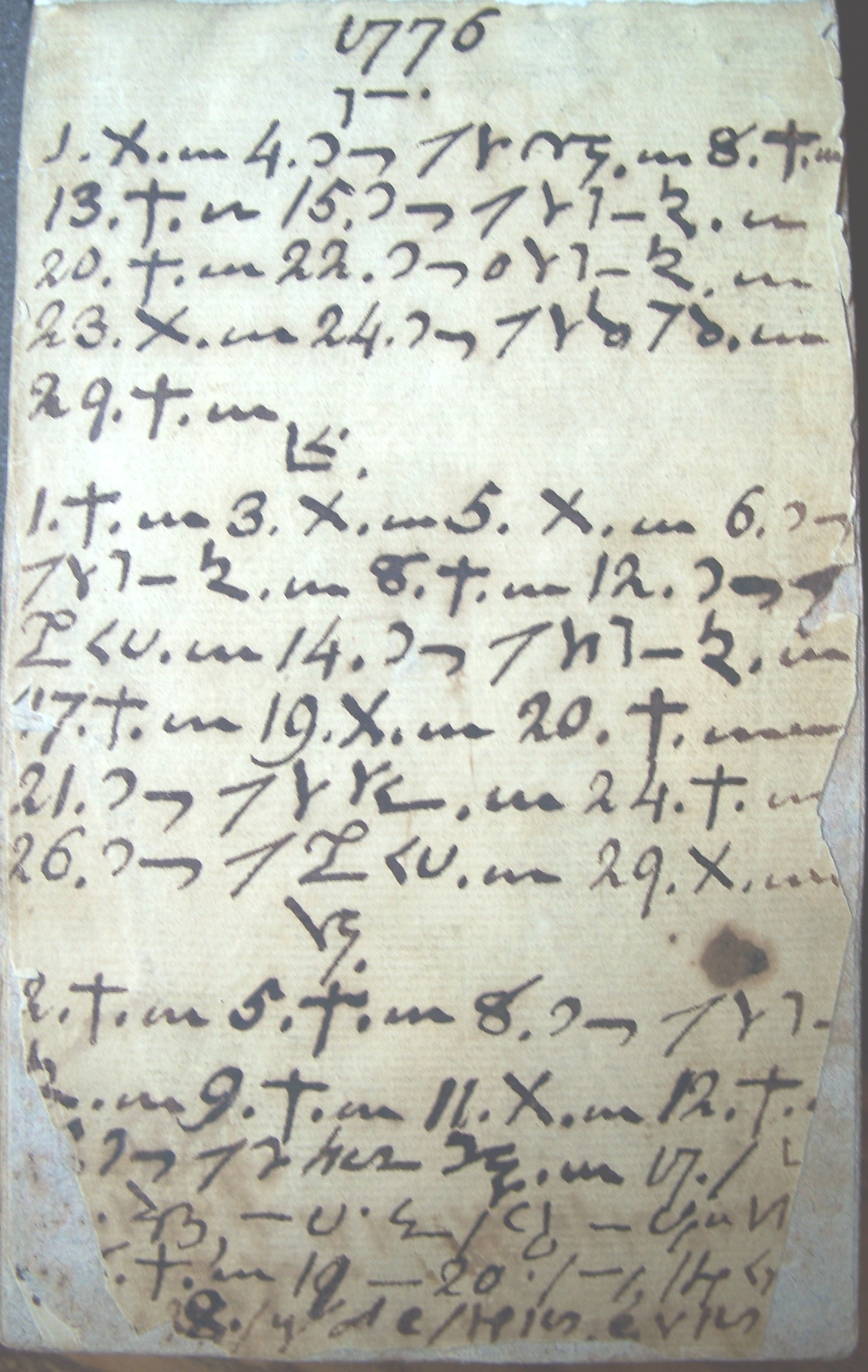
Jeremy Dibbell (of PhiloBiblos) has convinced his colleagues at the Massachusetts Historical Society to launch its own blog, the Beehive. One intriguing entry this week displays some pages from Manuscript Sbd-133: “Anonymous cipher diary, 1776-1795.” Jeremy explains:

It is a small bound volume containing ciphered or shorthand notations broken down by years, months, and days, with long entries on one side of the sheets and shorter entries on the opposite side. The writer used Arabic numerals, so tracking years and dates is possible, and the notations for each month are evident from the entries. Beyond that, the contents are almost a complete mystery (and since the years covered by the diary are of some considerable interest, I’ve long thought it would be fascinating to try and puzzle this out).
Samuel Pepys’s diary was once thought to be in an unbreakable cipher, but that turned out (after one scholar had spent years breaking it) to be a shorthand published at the time. So, Jeremy asks, is this code actually a standard eighteenth-century shorthand?

Which brings me to the Beehive’s next entry. Google Books strikes again. More will, no doubt, be revealed in the coming days. We just have to hope the entries say more than: October 5. Rainy. 6th. Rainy. 7th. Some sun, then rain. 8th. What news from the south! Rain.

Other examples of coded documents from the period include Dr. Benjamin Church’s secret letters into Boston; teams of Patriots cracked his simple substitution cipher in a few days. Then there’s the Rev. Jonathan Fisher (1767-1847), a Maine minister who devised his own phonetic code and recorded all his sermons and diaries in it.

Friday, May 15, 2009

Mutiny Aboard the Tyrannicide, 17 May

Here’s an announcement from the Beverly, Massachusetts, library about a free talk scheduled for this Sunday, 17 May, at 2:00 P.M.:

In November of 1776, Captain John Fisk of the brigantine Tyrannicide set sail from Salem in search of British merchantmen. Crewed, in part, by local Beverly, Gloucester and Salem men, the events of this voyage were lost in the mists of time until speaker Dennis Ahern started reading the logbook of their voyage. This is the story of that voyage, the story of a mutiny on board one of America’s first commissioned warships.
The Tyrannicide was actually commissioned by Massachusetts, as part of the state’s own navy. There’s a little of this story in Paul A. Gilje’s article “The Meaning of Freedom for Waterfront Workers” in Devising Liberty: Preserving and Creating Freedom in the New American Republic.

The “Partners in Preservation” Competition

The National Trust for Historic Preservation and American Express have a program called “Partners in Preservation,” which invites the public to vote online for which historic sites deserve funding.

In fact, we can vote repeatedly, once a day—though only for two more days. For that audience-participation feature, this funding program was dubbed “Preservation Idol” in the Boston Globe last week.

In the current competition for sites in Massachusetts, those which date back to Revolutionary times are:

As of this writing, the site with the most votes is...a carousel in Hull.

The site that receives the most votes will get a guaranteed $100,000. Another $900,000 will be divided among the other sites by the program’s administrators; it’s unclear how much weight they’ll put on the popular voting in making that decision.

The program is not without controversy. A Founding Director of the Historic House Trust of New York City commented at Philanthropy Today that such competition was “repulsive”:
all sites have a special niche, cultural or historic importance, relevance, and they all deserve grants. Shame on NTHP & Am Ex for turning them into competitors instead of collaborators.
I suspect that the program was designed to get just this sort of publicity and draw people into thinking about historic preservation. But it does turn the enterprise into a popularity contest. Not that popularity wasn’t part of the preservation movement from the beginning; this just formalizes the process.

Thursday, May 14, 2009

Privateers and Patriots

From the On Point radio show earlier in the week:

Plus a link to another recent book on the war at sea, James Nelson’s Washington’s Secret Navy.

Nicolson to Unveil Francis Bernard Papers

Colin Nicolson has sent news of the first volume of The Papers of Francis Bernard: Governor of Colonial Massachusetts, 1760-1769. It covers the years 1759 to 1763, when Bernard arrived in Boston as the new governor. The announcement says:

This 544-page book reveals much new evidence about the Town of Boston and the Province of Massachusetts at the end of the last French and Indian War. [Bernard’s] correspondence with Lord Jeffrey Amherst, his reports to the Board of Trade in London, his messages to royal officials on both sides of the ocean tell us of a maturing society and economy in a growing conflict with its mother country.
Many of these documents haven’t been published before.

When Bernard (1712-1779) arrived in Massachusetts, he came from two successful years as governor of New Jersey. His Bay Colony predecessors, William Shirley and Thomas Pownall, were both popular locally, and people appear to have seen the same potential in Bernard.

But the new governor sided with the London government in one dispute after another. Soon after he arrived, George II died, and the Boston merchant community seized on the chance to challenge the legality of writs of assistance, used for searching for smuggled goods. Bernard also alienated the rising lawyer James Otis, Jr., by passing over Otis’s father for a seat on the high court in favor of Thomas Hutchinson. Otis therefore resigned his royal post, allied himself with the merchants, and became the political leader of the Boston Whigs.

In the late 1760s, during the resistance to the Stamp Act and Townshend duties, Bernard sent his superiors many complaints about Massachusetts politics, riots, and how the colonial constitution should be changed. Whigs in London leaked those documents, causing Bostonians to view their governor as not simply a political obstacle but a back-stabber. When Bernard sailed out of Boston harbor in 1769, the town had a spontaneous public celebration. Still, Massachusetts remembers this governor in the name of Bernardston, which he modestly approved in 1762.

Nicolson, a Lecturer on U.S. History at the University of Stirling in Scotland, is author of The “Infamas Govener”: Francis Bernard and the Origins of the American Revolution. He’ll celebrate the launch of the Bernard Papers series on Thursday, 21 May 2009, at 5:30 P.M. at the Colonial Society of Massachusetts, 87 Mount Vernon Street, Boston.

Wednesday, May 13, 2009

Detwiller Surveys “Liberty Road,” 21 May

Longfellow National Historic Site in Cambridge has been celebrating the 250th anniversary of its construction with a series of lectures. I spoke in March, for example, about John Vassall, the man who commissioned that mansion and then moved out suddenly in September 1774.

On Thursday, 21 May, at 6:30 P.M., the site will host a photographic lecture by someone who really knows about the region’s Georgian architecture: Frederic C. Detwiller, architect and historic preservation planner of New England Landmarks.

Rick’s lecture will be titled “Liberty Road: Building a Revolution,” and will illustrate the literal “buildup” to the American Revolution by examining homes and landmarks erected by people on both sides of the political conflict. Among the topics he’ll build on:

  • The Vassall-Craigie-Longfellow House (shown above), including its role as the first headquarters of Gen. George Washington.
  • Other homes and buildings along “Tory Row” in Cambridge and beyond.
  • The social clubs, fraternal groups, and spies whose activities reflected the differing values of the time.
  • Public architecture such as the original Faneuil Hall and Hollis Hall at Harvard.
  • Vanished landmarks like Gov. Thomas Hutchinson’s Milton mansion.
  • The revival of eighteenth-century styles in Colonial Revival architecture.
This free event honors the memory of architectural historian Margaret Henderson Floyd, a founding member of the Friends of the Longfellow House. It will be held in the Longfellow Carriage House, behind the mansion at 105 Brattle Street. To reserve a space, call Longfellow National Historic Site at 617-876-4491.

Tuesday, May 12, 2009

More Suggestions for Whom to Follow through the Revolution

On Monday, guest blogger Ray Raphael asked which eighteenth-century Americans you might follow to tell the story of the overall Revolution. I shared some of my ideas this morning.

Boston 1775 reader David Churchill Barrow braved the challenge and suggested:

  • Nathaniel Greene: Lapsed Quaker, so perhaps there was some struggle of conscience, or a rebellion against upbringing. Saw and influenced the war in both the north and the south. Washington would have wanted him as his own replacement, should he have gone down in the fight.
  • Benedict Arnold: Saw the war from both sides. Snubbed early hero. Very complex character, and again with a family background that may have inspired him for both good and bad. He and Peggy were an “it” couple, Like Brad Pitt and whoever today.
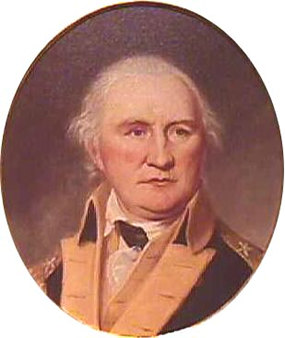
  • Daniel Morgan [shown here]: Coolest and most mysterious character of them all. Makes Davy Crockett look like a mere piker.
  • William Lee (Washington’s valet): Personal perspective from inside the inner circle. Also an African-American point of view.
  • Andrew Jackson (as a boy): How the hardships of the war had lasting effects.
Ooh—a young person’s experience! Intriguing. And good coverage of the crucial southern theater.

In addition, Bloomfield Bob commented:
I, for one, hope James Otis is a character! I'd love to learn more about this guy.
Otis is indeed a fascinating character, but his story really ends before the war begins. Though he lived to 1783, Otis was so mentally unstable after 1770 that the Boston Whigs had to worry about him more than the Crown. The best modern discussion of him appears in John J. Waters’s The Otis Family in Provincial and Revolutionary Massachusetts (1968).

More suggestions and comments welcome!

Individuals to Follow through the Revolution?

Yesterday Ray Raphael described a challenge he set for himself: find a bunch of individuals to follow through the Revolution whose stories could also tell the story of the founding of the U.S. of A. He chose seven people. As a proud owner of a copy of the resulting book, Founders, I can’t fault those choices. But just for fun, I can second-guess them.

Ray wrote that George Washington is virtually a given. So naturally, to be perverse, I have to question that conclusion. Henry Knox (shown here, later in life) spent nearly the whole war at Washington’s side, so it would be possible to follow the Continental Army’s top command through his eyes rather than through the commander’s. And Knox would bring some further advantages:

  • He was present at the Boston Massacre and may have been a crucial informer for Paul Revere just before the war.
  • After Washington’s first farewell in 1783, Knox became Secretary of War for the Confederation while the commander went home to Mount Vernon.
  • Knox’s alarmist letter to Washington about Shays’ rebellion convinced the older man to throw his prestige behind a movement for a new constitution.
  • Knox served as Secretary of War again under President Washington.
  • Knox’s personal story from fatherless apprentice bookseller to general, large landowner in Maine, and founder of the Society of the Cincinnati exemplifies the social mobility possible in the Revolution.
Following Nathanael Greene offers some of the same possibilities: involvement in prewar conflicts (Greene was probably involved in the Gaspee incident of 1772) and social mobility. In addition, his handling of the Continental forces in the southern states was crucial to the end of the war. Greene’s support for black soldiers is interesting, as is his turn to being a southerner with his own slave-labor plantation.

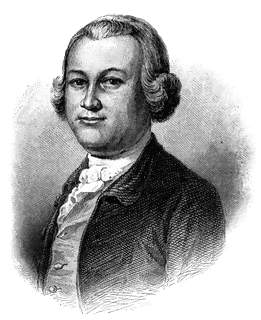
Such a book would need to follow someone deeply involved in running the American government—i.e., the Continental Congress—during and shortly after the war. My perverse suggestion for that figure is James Lovell. Son and assistant of the Loyalist master of Boston’s South Latin School, he was a Whig politics newspaper essayist and orator. The British military arrested him as a spy in 1775 after officers found his letters on Dr. Joseph Warren’s body. He was reportedly taken to Halifax in chains.

After James Lovell was exchanged and returned to Massachusetts, the state elected him to the Congress. He supported Gen. Horatio Gates over Washington in 1777, and wound up virtually running American foreign policy and intelligence efforts since no one else wanted those responsibilities so badly. His father and siblings were in exile, and his illegitimate son was in the Continental Army. For added interest, in Philadelphia he reportedly roomed in a brothel while his wife and children were back home in Boston. On the down side, Lovell’s a hard man to understand—John Adams reportedly paced the floor in Holland, trying to figure out what his official instructions meant—and to sympathize with.

Another potentially exemplary character is Thomas Machin, a British veteran who ended up as a captain in the American engineering corps. He oversaw the effort to build a chain of obstacles across the Hudson River to prevent the Royal Navy from sailing too far north—a major industrial undertaking in a sparsely settled area. Later Machin was one of the artillery officers who accompanied Gen. John Sullivan on an expedition against the Crown’s Native American allies in upper New York. And, as a kicker, the standard story of Machin before joining the Continental Army in 1776 is a lie; this immigrant (or his descendants) reinvented his life in the New World.

For a southern perspective, I might consider John Laurens: son of a bigwig in Congress, young Continental Army officer, proponent of emancipation, prisoner of war, diplomat, and army officer again. Regardless of what far one concludes that Laurens went with Alexander Hamilton, the close relationship of those two young men shows how military service shaped them.

A book like this needs at least one female figure. Since most women, even those who became involved in political causes, stuck close to their homes, I’d look for candidates in the Middle and Southern states where most of the fighting was. Those women saw the most of, and suffered the most from, the war.

One possibility would be Esther Reed of Pennsylvania: wife of a Continental Congress delegate, military officer, and governor. In 1777 she had to flee from her home. Three years later she organized an effort to support the army, struggling against both wartime shortages and Washington’s expectations for women.

Another candidate is Annis Boudinot Stockton of New Jersey, who became a refugee in 1776. She wrote some political poetry, and had a close-up look at developments in the government through her brother, Elias Boudinot; son-in-law, Dr. Benjamin Rush; and husband, Richard Stockton. Unfortunately, little of her writing is very personal.

And of course a book like this needs to reflect the American enlisted man’s experience. One possibility would be to stitch together three or four people’s accounts of serving in the ranks, both to cover the waterfront and to emphasize how the army was composed of many men working together rather than individuals standing out on their own. (Yes, that goes against the very idea of focusing on individuals that Ray set out to try.)

Among the soldiers who left enough personal material to follow might be fifer and private John Greenwood, privateer sailor and prisoner of war Ebenezer Fox, and soldier’s wife and camp helper Sarah Osborn. Adding dragoon Boyrereau Brinch to that mix would mean bringing in the rarely documented African-American soldier’s experience.

Folks might notice that a lot of my choices lean toward people from greater Boston, simply because I know that region best. In addition, my list leaves out some really obvious candidates. I didn’t pick any of the people Ray Raphael followed in Founders, even if they’d be my first choices as well—which is a good clue to the names he actually picked.


Monday, May 11, 2009

Choosing Seven Characters to Tell a Revolution

Today Boston 1775 welcomes author Ray Raphael as a guest blogger, discussing how he approached his latest book on the American Revolution.

All of us who live part of our lives in Revolutionary America have a story to tell, a journey. My path has taken me from the under-reported common people (People’s History of the American Revolution) to the amazingly forgotten Massachusetts Revolution of 1774 (First American Revolution) to a realization that what we choose to remember (and what we therefore forget) is unduly shaped by narrative demands, nation-forming, and ideological slant (Founding Myths). From there, though, I found myself at a crossroads: should I just throw up my hands and admit that good stories are bound to distort history, or should I try my hand at weaving an honest national narrative that is more genuinely true to the people and spirit of the times?

Any good story, we all know, requires lead characters, and that has been part of the problem, for we hear from grade school on that a handful of very special men bequeathed us a nation. We in the Revolutionary War community understand how limiting and destructive that is. But can we do any better? Could we possibly choose a different set of individuals to anchor a broader tale, one that is more representative yet still personal and intimate?

That’s what I tried to do in Founders: The People Who Brought You a Nation. I’ve chosen seven diverse characters, some high and some low, from different classes and regions and ways of thinking, who had a strong impact on the American Revolution and the shaping of the young nation. By interweaving these real-life stories, I hoped to access some of the deeper meanings—and also reveal the concrete, local, and very personal experiences of real people of those times.

Clearly, the selection of characters in this experiment determines the shape of the story, so my choices for the lead roles were critical. I looked over dozens of contenders and finally settled on my cast. In some sense it was arbitrary, but in another sense not, for there were serious criteria to consider:

  • Candidates needed a written record to follow over an extended period of time.
  • They had to appear and reappear at critical junctures so they could anchor the larger story.
  • Their stories needed to overlap in some way, at least thematically and preferably in actual events, so we could gain multiple perspectives.
  • They had to reveal that power passed both ways during the Revolution, from the bottom up and from the top down.
Are you with me so far? If so, given these parameters, whom would YOU choose for this experiment?

One of the characters is a given: George Washington. There is absolutely no way we can tell the larger story of the war and the nation’s founding without him. We know this. But who else?

Try this: Transport yourself to December of 1781, after the battle of Yorktown, and imagine you are pondering the historical significance of the amazing drama that has encompassed America. Which individuals, you wonder, will stand out in stories told by future historians? In other words, try to forget what happened since and ask, as a person of that time: who are the most powerful and significant players in these grand events?

I asked myself that question, and that’s how I came up with another of my central characters. One man, virtually unknown today, was undoubtedly the most powerful non-military figure in Revolutionary America. Like George Washington, he had to be in the story, for nobody else could play his role.

Beyond that, though, the choices were many. I needed to include people who were not high and mighty, for surely such folks carried their fair share. I made my final selections, and you can judge for yourselves whether these true Americans lead us to new corners, help us understand the multiple perspectives of the Revolution, and above all, make those times spring to live for us today.

But I don’t want to prejudice the case. Please “try this at home,” before looking at my book or hearing my spiel. Then, we can share and discuss our choices and reasons. There are no “correct” answers, but some choices are better than others to the degree that they open the inquiry, and all choices, I contend, will help expand the narrow textbook version that simply cannot represent the whole. We owe it to ourselves and our country to think outside that box, because until all the stories are told, we cannot sit back and say, “This is who we are as a nation.”

I’ve got a copy of Founders, so I know which people Ray chose. But tomorrow I’ll ponder how I might have tackled the same task differently (just to be perverse), and I’ll post all the suggestions and commentary you folks share. And later in the week we’ll reveal the six individuals beyond Washington that Ray focused on.

Ray Raphael will be speaking on
Founders and signing copies at three historic sites in Massachusetts this week: After that, Ray’s schedule will take him to Saratoga National Historical Park on the 17th, Independence National Historical Park and Valley Forge National Historical Park on the 21st, and the Politics & Prose bookstore in Washington, D.C., on the 22nd.

Sunday, May 10, 2009

October 1780: The Deadliest Month

The Newfoundland Hurricane of September 1775, latterly dubbed the “Independence Hurricane,” killed an estimated 4,000 people—but it wasn’t the deadliest Atlantic hurricane during the Revolutionary War.

On 6 Sept 1776, a hurricane hit the French island of Guadeloupe and killed about 6,000 people. And that wasn’t the deadliest of the period, either.

The era’s worst storm was the Great Hurricane of 1780, which roared across the Caribbean on 10-16 October. It reportedly knocked down every tree and every house on Barbados, and damaged every fort. About 4,500 people died on that island.

At Port Castries on Saint Lucia, rough seas destroyed Admiral George Rodney’s Royal Navy fleet. A ship landed on the port’s hospital and totaled the building. About 6,000 people died.

A fleet of forty French ships involved in the war in America capsized off Martinique, with the loss of about 4,000 soldiers. The 25-foot storm surge on that island killed about 9,000 more people. Another storm surge on Saint Eustatius took 4,000 more lives.

There was heavy damage on many other Caribbean islands, and historians estimate the total deaths as 20,000 to 27,500 people within one week.

As a comparison, the total number of American fighters dying during the entire Revolutionary War from all causes (most dying in camps or prisons) is about 25,000. Historians think the total number of British military deaths is about 44,000.

The Great Hurricane of 1780 was not only the deadliest storm of the Revolutionary War, but the deadliest hurricane ever in Atlantic history. And two other storms caused 1,000 deaths apiece in the same month.

Saturday, May 09, 2009

Fires Big and Small

On Tuesday, 12 May, the Lincoln Minute Men will host a slide show and lecture by John Horrigan on “Great Fires of the American Revolution.”

Among the New England towns he’ll talk about are Concord, scorched a little during the army raid on 19 Apr 1775; Charlestown destroyed during the Battle of Bunker Hill; what’s now Falmouth, Maine, under attack by the Royal Navy in October 1775; and New London, Connecticut, burned during Gen. Benedict Arnold’s 1781 attack. Outside the region he’ll visit Norfolk, Charleston, and New York. Most of those fires were deliberately set since flame was the eighteenth century’s most potent weapon.

This free event will take place in Bemis Hall at 15 Bedford Road in Lincoln, starting at 7:30 P.M.

Storms with Revolutionary Consequences

The September 1775 hurricane that got dubbed the “hurricane of independence” didn’t actually affect the course of the Revolutionary War. But other storms did.

Boston, 5 Mar 1776. Having spotted the new Continental Army artillery batteries on Dorchester Heights, Gen. William Howe ordered an amphibious assault on that peninsula. But, as Boston selectman Timothy Newell recorded, “a Hurrycane, or terrible sudden storm,” arrived, battering the boats and rendering firelocks useless. The general called off the attack. By the time the weather cleared, the American position was too strong, and Howe chose to evacuate Boston, ending the war’s oldest campaign with an American victory.

Trenton, 25 Dec 1776. Because of freezing temperatures and a mix of sleet, snow and icy rain, the Hessian troops at Trenton felt secure enough to pull back their picket sentries. Desperate for a victory, Gen. George Washington led columns of Continental Army soldiers across the icy Delaware River under cover of that same storm. Though not all the American forces managed to get across, those that did routed the Hessians and broke a long string of demoralizing battlefield losses.

Newport, 11-12 Aug 1778. A French fleet and an American army were supposed to collaborate on driving the British military out of Rhode Island. Adm. d’Estaing chose instead to engage the British fleet. Then a heavy storm hit the area, scattering and damaging the French ships. D’Estaing headed to Boston for repairs rather than try another attack, and the British drove back an American advance at the end of the month. Newport remained in British hands.

Yorktown, 16-17 Oct 1781. In a desperate move, Gen. Cornwallis started to have men ferried across the James River from Yorktown to Gloucester Point to counterattack the French and American forces. But after the first trip, the general wrote, “the weather from being moderate and calm, changed to a most violent storm of wind and rain,” and scattered the British boats. With no other options, the next day the British commander opened negotiations with Gen. Washington to surrender.

And there are probably other examples as well, especially when it came to the war at sea. Plus, long-term meteorological or environmental events, such as famine in India, the loss of good farmland in New England, and a dip in the “little Ice Age,” probably had even bigger long-term effects.

TOMORROW: The biggest storm of all.

[The portrait of D’Estaing above comes from this webpage describing how Haitian soldiers fought alongside Americans at Savannah.]

Friday, May 08, 2009

Thick and Stormy

These days, we track storms and hurricanes with planes, radar, and satellites. We all have experience watching big storms pass over Caribbean islands and head for the U.S. mainland, gaining alphabetical and increasingly inclusive names along the way.

Before radio, however, storms seemed to blow out of nowhere. People couldn’t track a hurricane at sea in real time. Any ship lucky enough to survive an encounter with such a storm would limp into port after the storm itself had arrived or passed by. Only in retrospect might scientists string together a series of reports from various islands, ships, and seaboards and posit that they were all about the same storm.

There’s just such a series of reports of bad weather from the late summer of 1775, starting in Santo Domingo and the Outer Banks of North Carolina in late August and then moving to Williamsburg, Annapolis, Philadelphia, New York, and Boston in early September. But the British colony hit worst by far was Newfoundland, where 4,000 people died on 9-11 Sept 1775, mostly fishermen. Waters rose so high there, in fact, that some latter-day scientists suggested there was an undersea earthquake and tsunami, though no one reported shaking.

That storm was labeled the “Independence Hurricane of 1775” in David M. Ludlum’s Early American Hurricanes, 1492-1870. The label might be older, but I haven’t found it in earlier books. It doesn’t seem appropriate to name Canada’s deadliest natural disaster after a political development in the U.S. of A., but that’s cultural imperialism for you.

Tony Williams heard about that storm on television, got intrigued, and started researching it. The result was a book published last year, Hurricane of Independence: The Untold Story of the Deadly Storm at the Deciding Moment of the American Revolution. It tracks the 1775 storm that from its appearance off Santo Domingo to rainstorms in Newfoundland on 4-5 September.

And then the book argues that a second, more destructive hurricane hit Newfoundland a few days later, causing all those deaths—more than 90% of the total. The first hurricane, Williams posits, kept going north from Philadelphia and blew itself out in upstate New York and Upper Canada. So we might have a use for both labels: America’s “Independence Hurricane” and Canada’s “Newfoundland Hurricane of 1775.”

Hurricane of Independence attempts to justify its title by tying the meteorology to the development of the American independence movement. For instance, Chapter 15 is titled “General Washington Battles the British and the Weather.” There’s an ongoing discussion of how Washington and his contemporaries thought of “providence,” a way of thinking about both natural and political events that seemed beyond humans’ control.

The problem with that approach is that this hurricane really didn’t affect the American independence movement. Its biggest impact on the war? A Royal Navy ship called the Otter was washed ashore in Hampton, Virginia, and some locals plundered and burned it.

There was rain in Philadelphia, but the Continental Congress wasn’t in session and that city didn’t see any deaths. In the main military theater around Boston, here’s how the weather played out according to the diary of Pvt. Caleb Haskell of Newburyport:

September 3rd, Sunday.—This morning there was a storm of rain. In the afternoon had several shells thrown at us from Bunker's Hill. Our guard killed and 15 of the enemy.

September 4th, Monday.—This morning is thick and stormy. Clears off pleasant in the afternoon.

September 5th, Tuesday.—A pleasant morning after a long storm. All still here. At night I went on guard at P[rospect]. Hill.
Big whoop.

On the 11th Haskell left with Gen. Benedict Arnold on his march north through the Maine wilderness. In October that column encountered terrible weather, but the “independence hurricane” was long gone.

It’s also difficult to see how early September 1775 was “the Deciding Moment of the American Revolution,” as the book’s subtitle would have it. That was about five months after the war had started, three months after the Congress had adopted the army around Boston and sent Washington north, and half a year before the colonies moved toward independence. What big events occurred in that month, and how did the storm affect them?

Hurricane of Independence spends many pages on quick summaries of what led up to the Revolutionary War, which are generally what we find in many other books. (One glitch: Page 178 mixes up Dr. Samuel Prescott with Col. William Prescott.) But I didn’t see evidence that the hurricane(s) of September 1775 affected even one American’s thinking about the political conflict, or for that matter about providence.

In sum, the old label “hurricane of independence” seems more hysterical than historical. That storm happened to hit a number of American ports near independence, and got a great publicity boost about two centuries later. Williams didn’t come up with the “independence” label, but it was what intrigued him about the topic, so he was stuck with it. He might have been better off setting it aside and looking at how some storms really did shape the Revolutionary War.

TOMORROW: How some storms really did shape the Revolutionary War.

Thursday, May 07, 2009

Benjamin Franklin: Lefty or Righty?

Back at this posting, a long-time Boston 1775 reader asked whether Benjamin Franklin was left-handed, as portrayed (by Howard Da Silva) in the movie 1776 and as stated on many websites.

In the book Right Hand, Left Hand, Chris McManus considers the evidence. In 1779 Franklin wrote an essay titled “A Petition of the Left Hand,” which laments the neglect of the sinister. Of course, Franklin also wrote a “Petition of the Letter Z” (1768), and no one argues that we should assume he spelled his name with a Z.

In 1762, Mason Chamberlin (1727-1787) painted Franklin from life, as shown here. This portrait is now at the Philadelphia Museum of Art, though this image comes from a Smithsonian webpage. And it shows Franklin holding a quill in his right hand.

Of course, a painting isn’t a photograph; it reflects how the artist chooses to portray the subject. And it’s possible that Franklin learned to write this way even though he was naturally a lefty. But until folks find better evidence, it looks like Benjamin Franklin was right-handed.

Wednesday, May 06, 2009

Seeking Meaning in Tea Parties

Prof. Benjamin Carp of Tufts is at work on a thorough new study of the Boston Tea Party. He’s been mulling over the connections and disconnects between that 1773 crowd action and the recent political protests that invoke it. It’s been interesting to watch his considerations evolve.

On 10 April he wrote on the Publick Occurrences blog:

I think the easiest thing to do would be to start picking out all the bad historical analogies and use it as an excuse to guffaw at the “Tea Party” movement that’s scheduled to demonstrate on April 15, 2009 (tax filing day). But I’m not going to do that–instead I’m going to try and be even-handed about this, and see if there’s anything to this grassroots conservative invocation of the Boston Tea Party.

Unfortunately, the ideology behind all of this seems rather vague. . . . There’s not much there: the protesters are in favor of “basic free-market principles” and “freedom.” (Well, me too!) The site doesn’t say how the government is ignoring the Constitution, exactly–and if you dig a little further, it all goes back to Rick Santelli’s displeasure with the stimulus plan and the budget.
I believe Santelli’s displeasure actually focused on a single aspect of the Obama administration’s economic policy—the plan to keep people from losing their homes when they can pay only part of their mortgage bills. I doubt he would have gotten much support from his audience of Chicago commodities traders if he’d widened his criticism to, say, the vastly more expensive financial-industry bailouts. (Which is not to say that others didn’t protest those bailouts, at the “tea party” events and elsewhere.)

Ben shared further thoughts on 19 April in the Washington Post after observing one protest in New York:
Although I study early American history, I wasn’t trying to check the protesters’ creative interpretations against my footnotes. Instead, I tried to appreciate the bizarre nature of a day that began for me with work on a chapter on tea boycotts for my new book and ended with a modern crowd’s interpretation of the historical period I study. It was a great reminder that the original Tea Party had made this civilized re-enactment possible and, ultimately, anti-climactic by comparison. . . .

In Boston in 1773, the men who boarded the tea ships had to conceal their identity or risk punishment—perhaps even being hanged for treason. Last week, the merry protesters chatted with journalists about their complaints, then folded up their “Welcome to the Second American Revolution” signs and went home. The original Tea Party had helped make free speech possible, but these modern protests didn't seem likely to change the world just yet.
That editorial also had the most to say about historical parallels—and historical perpendiculars—between the issues of 1773 and today. Back then, Parliament deemed the East India Company too big to fail, for instance. But the fundamental disconnect is that today we have a representative government with wide public support. “Taxation without representation” is no longer a national issue. In addition, the current economic crisis affects far more than a single well-connected company.

Most recently, on 23 April, Ben wrote at the Oxford University Press blog:
it’s true that many (though not all) of the conservative protesters were invoking the “tea party” mostly as empty symbolism and not as an explicit historical parallel. But such unthinking (not to say cheap) symbolism can be potentially dangerous. After all, the actual perpetrators of the Boston Tea Party destroyed over £9000 worth of goods (the equivalent of between $1 and $2 million dollars in today’s money), and this was after weeks of threatening the British tea agents at their homes and places of business.

Perhaps we might agree today that the colonists were forced to resort to violence and destruction because they suffered under a “tyrannical” empire that ignored their arguments—but in a representative government, we have other alternatives. Despite the signs calling for “tarring and feathering,” in New York City, the strong police presence probably discouraged any real thoughts of violence. But will those protesters who were calling for “rebellion” be content with civil disobedience in the future? . . .

Certainly the tea party protests weren’t primarily populated by hate groups or domestic terrorists—but we still might want to be wary of “heritage” groups who take their revolutionary rhetoric too far. There were plenty of angry left-wing groups when the left was out of power, and now there are plenty of angry right-wing groups now that the right finds itself out in the cold. The vast majority of this anger will never be channeled into violence; but when protesters begin using “tea party” talk, we have to hope they’re not taking the analogy to an extreme.
I think American extremists are no different from any other American political group in seeking to link their causes and methods to the nation’s founders. But the shift to a republic produced a fundamental disconnect between the Revolutionaries and the dissatisfied voters of later generations. After 1776, American white men with property could no longer complain they had no say in their government. Well, they could still complain, and some do, but those complaints hold less water than a teacup.

Tuesday, May 05, 2009

Another Mistaken Quotation

And speaking of ersatz Samuel Adams quotations, here’s another one that’s been spread around:

When the government fears the people, there is liberty. When the people fear the government, there is tyranny.
The Oklahoma City bomber Timothy McVeigh had a bumper sticker with this statement in his possession when he was arrested. I can’t tell if that sticker attributed those words to any particular political thinker, but people writing about McVeigh said they came from Adams.

Other writers, however, give credit to Thomas Jefferson (shown here) and to Thomas Paine.

In fact, the quote appears to be a modern derivation of these words from Amos Pinchot, a Progressive who turned to the right in the late 1930s:
Today, the nations of the world may be divided into two classes—the nations in which the government fears the people, and the nations in which the people fear the government. It is the New Deal’s tragedy that it is moving this country into the second class.
H. L. Mencken picked that up in his 1942 New History of Quotations on Historical Principles. Prof. Gary Dean Best quoted Pinchot in Peddling Panaceas and The Retreat from Liberalism, two histories of twentieth-century U.S. economics.

Some webpages credit Pinchot but transform his name into Pinochet, who really knew how to make the people fear the government.

ADDENDUM: Monticello has found an earlier version of this quotation from 1914. The speaker was John Basil Barnhill, and the occasion was “a series of debates on socialism.” There are so many spurious Jefferson quotations floating around that Monticello has a whole category of its Wiki about them.

Monday, May 04, 2009

Samuel Adams and “Brush Fires in People’s Minds”

In February, Brendan Steinhauser, an organizer for the FreedomWorks lobbying organization, posted advice on “How to Start Your Own Tea Party Protest,” and invited people to contact him at FreedomWorks for more advice. For some people, the result would be a spontaneous, grass-roots protest.

Steinhauser closed those postings with a picture of the torch-bearing mob of Springfield, apparently to show respect for populist politics, and what he claimed was a quotation from Samuel Adams:

It does not require a majority to prevail, but rather an irate, tireless minority keen to set brush fires in people’s minds.
Steinhauser is far from alone in crediting those words to Samuel Adams. They appear on a variety of political websites, from both the left and the right, and in several titles on Google Books, all but one published in the last ten years. (The outlier is a study of Sudanese politics dated to 1990, of all things.) Among the books that include this Adams quotation is Bob Gingrich’s Founding Fathers Vs. History Revisionists, which makes what follows amusingly ironic.

One place that sentence about “an irate, tireless minority” doesn’t appear is in the published writings of Samuel Adams. In fact, my Oxford English Dictionary’s earliest citation of the term “brush fire” is dated 1850, decades after Adams’s death. Its first use of the phrase as a political metaphor is from 1947.

The quotation is not only inaccurate, but it misrepresents Adams’s political situation. He usually led the majority in Boston’s town meeting and in the Massachusetts legislature. He rarely needed to win the majority over to his principles; rather, his challenge was convincing people to follow his plans for action. Therefore, he called over and over for unity, resolve, and mutual sacrifice from the majority, not “an irate, tireless minority keen to set fires.”

Sunday, May 03, 2009

Sampling of Events in May

Here are some of the upcoming Revolutionary-history events in greater Boston which have caught my eye.

Thursday, 7 May, 5:15 P.M.
Eliga H. Gould, University of New Hampshire
“An Empire of Peace: The International Origins of the American Revolution”

This is part of the Massachusetts Historical Society’s Boston Area Early American History Seminar. Participants are invited to read Gould’s (44-page) paper in advance. Maya Jasanoff of Harvard University will comment on it, Gould will respond, and then there will be an open discussion about the questions he has raised.

Tuesday, 12 May, 6:00 P.M.
Nina Zannieri, Executive Director of the Paul Revere House
“Myth and Memory: The Legacy of Paul Revere

This lecture at the Massachusetts Historical Society is co-sponsored by the Concord Free Public Library and Minute Man National Historical Park. It’s part of the Minute Man Anniversary Lecture Series celebrating the 50th anniversary of that national park. There will be refreshments beforehand at 5:30 P.M.

Thursday, 14 May, 7:00 P.M.
Ray Raphael, author of Founders: The People Who Brought You a Nation
A book talk and signing at the Minute Man N.H.P. Visitor Center in Lexington. Raphael’s previous books include The First American Revolution (discussed here and here), Founding Myths, and A People’s History of the American Revolution.

Wednesday, 20 May, 12:00 P.M.
Jennifer Egloff, New York University
“Popular Numeracy in Early Modern England and British North America”

This is one of the Massachusetts Historical Society’s “Brown Bag Lunches”: a scholar working in that archive discusses the questions she’s researching, along with practical challenges, methodological issues, and preliminary findings. Everyone else eats lunch and discusses the speaker’s work while she becomes more and more hungry.

Wednesday, 10 June, 7:00 P.M.
David Glassberg, University of Massachusetts-Amherst
Minute Man Lecture

Another lecture on the heritage of the Minute Man National Historical Park, this time in its Visitor Center in Lexington. At least that’s what the flyer I got in the mail says—nothing’s on the website yet. Looks like the title hasn’t been decided yet, either, but Glassberg’s research focuses on “popular historical consciousness in America as represented in politics, culture, and the environment.”

Saturday, May 02, 2009

A Long-Running Revolutionary War Comic

Today is Free Comic Book Day, so I’m featuring another Revolutionary War comic, brought to my attention by Boston 1775 reader Judith Cataldo. This series appeared at different rates from 1966 to 2000—in Italy, of all places.

Il Comandante Mark seems to have been the Italian fumetti version of DC Comics’s Tomahawk, a frontier warrior. Here is a website devoted to him—in Italian, naturally.

This is the most detailed description of the comic I could find in English. The translation mixes up our Revolutionary War with our Civil War, but then Comandante Mark’s costume mixes up the centuries as well. (And the American Revolution was a civil war.) The story begins in 1966:

Pietro Sartoris, Dario Guzzon and Giovanni Sinchetto, or better known has the EsseGesse trio, proposed to Sergio Bonelli a project regarding...a leader of a valiant group of patriots: the Comandante Mark (Commander Mark).

Mark is a French nobleman, as a child he was shipwrecked thanks to the English, but survived when a patriot saved him; he was than raised by a tribe of Native American Indians. His adoptive father teaches him fighting and fencing, as well as the values of liberty, loyalty and defending those oppressed. Following his father’s hanging, Mark becomes the leader of a group of patriots: the Lupi dell’Ontario (Ontario’s Wolves). They fight against the hated Giubbe Rosse (Red Coats) in an idealistic universe that’s severely split into good and bad guys.
The facts that there would have been no distinction between “the English” and “a patriot” when Mark was a shipwrecked child, and that Ontario remained British throughout the war and for decades afterward, might give us pause about this comic’s historical accuracy.
Mark also has two inseparable stooges, the often main characters of comic relief: Mister Bluff and Gufo Triste. The first is an always happy individual from a mysterious past, the second, is an Indian who’s always intent in predicting misfortune and fighting against Flok, Mister Bluff’s dog. Mark also has a fiancĂ©e, the blond Betty who he’ll eventually marry...
The fumetti covers indicate that Mark he took time away from redcoats to fight a samurai, a tiger, and ghosts. I would, too, if I were saddled with “inseparable stooges.”

Here are entries on Comandante Mark at the Italian version of Wikipedia and Cartoni Online. In 1971 the comic inspired a Turkish movie called Captain Swing.

Friday, May 01, 2009

“Loyalism” Conference in Maine, 4-7 June

The University of Main at Orono will host a conference on “Loyalism and the Revolutionary Atlantic World” on 4-7 June 2009. The keynote speakers are:

  • Robert Calhoon, Emeritus Professor of History, University of North Carolina, Greensboro
  • Philip Gould, Professor of English, Brown University
  • Maya Jasanoff, Associate Professor of History, Harvard University
I see papers on the Rev. Dr. Mather Byles and James Murray, prominent friends of the royal government in Boston, and recognize such speakers as Todd Braisted of the Institute for Advanced Loyalist Studies. Registration deadline is 15 May.

The image above shows an encampment of Loyalists in Johnstown, Ontario, in 1784.

Thursday, April 30, 2009

Pirates, Corsairs, and Privateers

Earlier this spring many Americans seemed to discover that there’s a piracy problem off the eastern coast of Africa. The international news media had reported about Somali pirates for years, but this time four of them took an American captive, and suddenly all our fond thoughts about Capt. Jack Sparrow vanished.

Folks who at other times express little sympathy for Americans who get in trouble delivering aid to a war zone suddenly advocated severe military action to rescue Capt. Richard Phillips. Some suggested punishing Somalis collectively for the actions of those four young men. The noise tapered off considerably when the U.S. Navy rescued Phillips, killing and capturing those particular pirates, but the larger problems in the Indian Ocean and Gulf of Aden remain.

During that national discussion, many people invoked the historical antecedents of American actions against the Tripolitan states of North Africa starting in 1801. Few noted how for the previous fifteen years Congress had allocated money—up to 20% of the federal budget—to buy protection from those governments and to ransom prisoners from their corsairs.

One of the first popular American novels was Royall Tyler’s The Algerine Captive (1797), about such a captured sailor. (In the department of meaningless coincidence, that novel’s hero is named Underhill and Tyler became chief justice of Vermont; the rescued Capt. Phillips was from Underhill, Vermont.)

That novel portrays some other facts that Americans don’t always recall in discussing the “Barbary pirates.” Corsairs seized American ships only if they came close to North Africa; their waters, their rules. A lot of the American ships which did sail there were in the slave trade, and the number of Africans taken in captivity to North America was much larger than the number of North Americans held captive in Africa.

Rep. Ron Paul suggested a response to the current piracy problem based on Article 1 of the U.S. Constitution, which gives Congress these powers:

  • To define and punish piracies and felonies committed on the high seas, and offenses against the law of nations;
  • To declare war, grant letters of marque and reprisal, and make rules concerning captures on land and water;
  • To raise and support armies, but no appropriation of money to that use shall be for a longer term than two years;
  • To provide and maintain a navy;
  • To make rules for the government and regulation of the land and naval forces;...
As a libertarian, Paul sought a small-government, market-driven solution: post a large reward for pirates and “grant letters of marque and reprisal” allowing U.S. citizens to compete for that reward. In other words, charter a new generation of privateers.

At Talking Points Memo, Josh Marshall (a historian who’s found a way to make a living with a website) pointed out the flaw in this proposal. During the Revolutionary War people invested their money, ships, and labor in privateering voyages because they hoped to share in the high profits that could come from selling captured British ships and cargoes. But even with a reward, there really isn’t a market for Somali sailors and their small boats.

I think this whole situation just highlights how much things have changed for the U.S. of A. The young men aiming for easy targets off their coast with the support of their families and neighbors back home—those were the American privateers in 1776, the Somali pirates today. The most powerful navy in the world trying to keep shipping lanes open, supply far-flung troops, and joust with other empires—that was the Royal Navy in 1776, the U.S. Navy today.

Wednesday, April 29, 2009

Franklin’s Lost “Quire Book of Letters”

While I was away last weekend, Boston 1775 reader Guy Curtis kept me up to date with this C.N.N. report on a recent discovery of copies of lost letters by Benjamin Franklin. Actually, they weren’t lost; they were apparently in the repository’s catalogue. But scholars didn’t recognize their significance until Prof. Alan C. Houston visited London to research his upcoming book Benjamin Franklin and the Politics of Improvement. (Franklin’s thoughts on a peculiarly Boston use of the verb “improve” are back here.)

Houston, a professor at the University of California at San Diego, discovered the letters on the last day of his last research trip to London, just before the library’s closing time.

“The first item was a letter from Benjamin Franklin to the secretary of the governor of Maryland, and I looked at it and I started to read, and I thought, ‘This doesn’t look familiar,’” Houston told CNN. “I’ve read everything Franklin ever wrote.”

Houston said he quickly began to realize he had uncovered something previously unknown to historians.

“I swear, I just about shot through the ceiling I was so excited,” he said.
The thrill of discovery can indeed be levitating. The letters documented Franklin’s role in securing wagons for Gen. Edward Braddock during his 1755 campaign against Fort Duquesne—a campaign that ended in disaster, but not for want of wagons.
When Franklin was sent to London in 1757 as a representative of the [Pennsylvania] assembly, he brought with him a collection of letters detailing that success. It was proof of his political value to Great Britain and that the assembly’s loyalties had been on the right side.

This collection of letters, which Franklin referred to in his autobiography as his “quire book,” was never found, however—until now.

Houston said he believes the documents he read at the British Library are copies of that collection. They were made by Thomas Birch, an industrious and obsessive transcriber of historical documents who copied anything he could get his hands on.
The modern equivalent might be a copy of someone’s emails copied onto a forgotten hard drive. The text of these letters will appear in an upcoming issue of the William and Mary Quarterly.

(The thumbnail Norman Rockwell image of Franklin above links to the Benjamin Franklin House in London.)

Tuesday, April 28, 2009

“A Stop to All Credit Was Expected”

If you haven’t already read the fourth-quarter 2008 issue of Massachusetts Banker magazine (and I know you’ve been busy), you can download a copy here. It’s 4.9 MB, but some of those bytes consist of my article “A Bankruptcy in Boston, 1765.”

Nathaniel Wheelwright was one of Boston’s leading businessmen in the early 1760s: a merchant, wharf owner, supplier of specie to the British army, and backer of financial notes for people of all classes. He had married into the wealthy Apthorp family, and was the father of three young sons. To quote myself:

Then, in January 1765, Wheelwright suddenly stopped honoring his debts. There is no clue about what exactly prompted this decision, but its consequences were staggering. Governor Francis Bernard reported to London: “This was like an earthquake to the town; numbers of people were creditors, some for their all. Every one dreaded the consequences; lesser merchants began to fail; a stop to all credit was expected and a general bankruptcy was apprehended for a time.”
Eventually this financial crisis caught up several men who might be familiar to Boston 1775 readers: William Molineux, John Scollay, John Rowe, and especially Dr. Joseph Warren, whom Thomas Hutchinson as probate judge assigned to administer Wheelwright’s tangled estate. The repercussions of that crisis, I argue, helped to increase Bostonians’ anxieties about the Stamp Act later in 1765.

Check out Massachusetts Banker for the whole story. I wrote that article in a previous financial quarter, of course, but it seems to have only become more timely.

Monday, April 27, 2009

Looking for “Taxation Without Representation”

As I wrote yesterday, most sources credit James Otis, Jr., with coining the phrase “taxation without representation,” but he never actually used that phrase in his writings, and no contemporary quoted him directly as doing so. Otis certainly wrote about the problem, putting it at the center of the American objections to Parliament’s taxes in the 1760s and 1770s, but not in that exact way.

So is the phrase “taxation without representation” authentically Revolutionary, or actually a coinage of later years applied backwards, as the terms Intolerable Acts, lobsterback, and tricorn appear to be?

And I’m pleased to report that yes, we can document the phrase being used in the Revolutionary years. In 1769 the Rev. John Joachim Zubly (1724-1781) of Georgia authored a pamphlet titled An Humble Enquiry into the Nature of the Dependency of the American Colonies upon the Parliament of Great-Britain, and the Right of Parliament to Lay Taxes on the Said Colonies. He wrote:

In England there can be no taxation without representation, and no representation without election; but it is undeniable that the representatives of Great-Britain are not elected by nor for the Americans, and therefore cannot represent them...
The available databases being incomplete, I’m not entirely sure Zubly coined the phrase “no taxation without representation,” but so far his pamphlet is the earliest use I’ve seen.

James Burgh (1714-1775) also used the phrase in his long work Political Disquisitions; or, An Enquiry into Public Errors, Defects, and Abuses, published in 1774. He even titled the second chapter of his Book II “Of Taxation without Representation.”

So “taxation without representation” is authentically American! Well, it’s a little more complicated than that. Zubly was Swiss by birth and, though he represented Georgia in the Second Continental Congress, advocated reconciliation with Britain. He was driven out of Savannah when it was under independent government and returned there and died under royal rule.

As for Burgh, he was a Scottish by birth, and a clergyman in a parish near London. He advocated the American cause, and Political Disquisitions became quite popular in the U.S. of A. But, like Zubly, Burgh considered himself British.

But don’t worry! I’ve also found some examples of Americans using the phrase. “Taxation without representation” appears in statements issued by Dover, New Hampshire, on 10 Jan 1774; by York, Massachusetts (Maine), on 20 Jan 1774; and by John Smith on 6 July 1775, while he was locked up in “Strafford Prison” as a suspected Loyalist. But the fact that I didn’t stumble across more citations might indicate that the phrase wasn’t as dominant as we’ve come to expect.

“Taxation without representation” appeared in several early histories of the conflict:
  • David Ramsay’s History of the Revolution of South-Carolina (1785) and History of the American Revolution (1789).
  • William Gordon’s History of the Rise, Progress, and Establishment, of the Independence of the United States of America (1789).
  • Tobias Smollett’s The History of England, from the Revolution to the End of the American War, and Peace of Versailles in 1783 (1796), discussing how the same issue was raised in Ireland.
So historians might have snatched up that quick, three-word formulation of the colonies’ problem soon after the war, and it became one of the major ways we remember the American Revolution.

Sunday, April 26, 2009

James Otis, Jr., on Taxation Without Representation

Until 2 Nov 2005, the phrase “taxation without representation” has almost always been credited to the Boston lawyer and legislator James Otis, Jr. The basis for this attribution is John Adams’s recollection of how Otis argued the writs of assistance case in 1761, in a letter to Otis’s biographer William Tudor, Jr., in 1818. After quoting that letter at length Tudor wrote:

From the navigation act the advocate [Otis] passed to the Acts of Trade, and these, he contended, imposed taxes, enormous, burthensome, intolerable taxes; and on this topic he gave full scope to his talent, for powerful declamation and invective, against the tyranny of taxation without representation.

From the energy with which he urged this position, that taxation without representation is tyranny, it came to be a common maxim in the mouth of every one. And with him it formed the basis of all his speeches and political writings; he builds all his opposition to arbitrary measures from this foundation, and perpetually recurs to it through his whole career, as the great constitutional theme of liberty, and as the fundamental principle of all opposition to arbitrary power.
However, neither Adams’s contemporaneous notes on what he’d heard in 1761 nor his letter contained the “taxation without representation” phrase or argument. We know he was urging Tudor to write about Otis as a way to capture some of the attention that William Wirt’s romanticized biography had brought to Patrick Henry of Virginia. Adams and Tudor had strong motives to present Otis, a Massachusetts man, as the first to establish the fundamental political conflict of the Revolution.

And in fact Otis did so—even if he didn’t use the words we remember. In his 1764 pamphlet The Rights of the British Colonies Asserted and Proved (extensive extracts here), Otis concluded:
The sum of my argument is: that civil government is of God; that the administrators of it were originally the whole people; that they might have devolved it on whom they pleased; that this devolution is fiduciary, for the good of the whole; that by the British constitution this devolution is on the King, Lords and Commons, the supreme, sacred and uncontrollable legislative power not only in the realm but through the dominions; that by the abdication, the original compact was broken to pieces; that by the Revolution it was renewed and more firmly established, and the rights and liberties of the subject in all parts of the dominions more fully explained and confirmed; that in consequence of this establishment and the acts of succession and union, His Majesty GEORGE III is rightful King and sovereign, and, with his Parliament, the supreme legislative of Great Britain, France, and Ireland, and the dominions thereto belonging; that this constitution is the most free one and by far the best now existing on earth; that by this constitution every man in the dominions is a free man; that no parts of His Majesty’s dominions can be taxed without their consent; that every part has a right to be represented in the supreme or some subordinate legislature; that the refusal of this would seem to be a contradiction in practice to the theory of the constitution; that the colonies are subordinate dominions and are now in such a state as to make it best for the good of the whole that they should not only be continued in the enjoyment of subordinate legislation but be also represented in some proportion to their number and estates in the grand legislature of the nation; that this would firmly unite all parts of the British empire in the greater peace and prosperity, and render it invulnerable and perpetual.
In case you missed it within that magnificent 311-word sentence, Otis wrote: “that no parts of His Majesty’s dominions can be taxed without their consent; that every part has a right to be represented in the supreme or some subordinate legislature;...”

So James Otis certainly focused on the idea that the Parliament in London couldn’t lay taxes (or Customs duties) on American colonists because that legislature didn’t represent those colonists, that the only legislatures which could impose such taxes were those the colonists elected according to their charters. But Otis didn’t phrase his argument in rhyme.

TOMORROW: So did any Americans in the Revolutionary era use the phrase “taxation without representation”?