J. L. BELL is a Massachusetts writer who specializes in (among other things) the start of the American Revolution in and around Boston. He is particularly interested in the experiences of children in 1765-75. He has published scholarly papers and popular articles for both children and adults. He was consultant for an episode of History Detectives, and contributed to a display at Minute Man National Historic Park.

Subscribe thru Follow.it


•••••••••••••••••


Monday, March 23, 2015

Anderson on Marblehead Furniture Makers and Buyers, 26 Mar.

On Thursday, 26 March, at 7:00 P.M. the Salem Maritime National Historic Site in Salem will host a free talk by Judy Anderson on “Eighteenth-Century Furniture Craftsmanship and Patronage in Marblehead.”

This talk was inspired by the Peabody Essex Museum’s exhibit of work by the Salem cabinetmaker Nathaniel Gould, which closes on 29 March. As noted back here, when genealogist Joyce King and furniture expert Kemble Widmer spotted Gould’s account books in the papers of his attorney at the Massachusetts Historical Society, they were able to match existing examples of Gould’s work with specific sales, shedding new light on both his business and his art.

One of Gould’s most important clients in the years just before the Revolutionary War was the wealthy merchant Jeremiah Lee, who was furnishing his home across the harbor in Marblehead. Anderson has been curator of the Jeremiah Lee Mansion, and in 2003 she collaborated with Widmer on a study of his town’s cabinetmakers. Her fully illustrated talk will explore furniture craftsmanship and patronage in Gould’s time. It includes “some remarkable surprises uncovered by the Gould research and several stories of compelling social history.”

Anderson will deliver the same talk on Friday, 27 March, at 11:00 A.M. at the Salem Athenaeum. For that event, she suggests $5 or $10 donations to benefit the Athenaeum.

Sunday, March 22, 2015

Stamp Act Approved by King, Leading to a Change of Government

On 22 Mar 1765, the Stamp Act for North America received the royal sign-off necessary before becoming law. However, George III never approved the bill. He approved of it, it’s clear, but in March 1765 when the bill reached that stage he was ill and confined to his room. Therefore, a special royal commission approved the Stamp Act for the king.

That process led to the fall of George Grenville’s ministry—but not because the Stamp Act kicked up so much opposition in America, much as we might like to believe that. Grenville was replaced before those protests became widespread.

Instead, this is how Edward Baines described the situation in his History of the Reign of George III (1820):
This event impressed upon his majesty’s mind the propriety of appointing some individual, who might, in case of the royal demise, exercise the functions of royalty during the minority of the Prince of Wales. The troubles in which the country had been involved by regencies obnoxious to the parliament and the nation, induced the king to desire parliamentary sanction to his appointment; and for the attainment of this object he went to the house of peers on his recovery, and recommended the two houses to pass a bill, enabling him to vest the regency in the hands of some one personage, from any number which parliament might nominate, with a council composed of individuals, whose relationship, offices, or rank might render them fit advisers to the regent.

The house of peers accordingly passed a bill, empowering his majesty to appoint as regent, the queen, or any member of the royal family, by which was meant only the descendants of George II. usually residing in Great Britain, till the Prince of Wales attained the age of eighteen years. The council whom they appointed was composed of the Dukes of York and Gloucester, his majesty’s brothers; the Duke of Cumberland, his uncle; Princes Henry Frederick and Frederick William, his youngest brothers; and the chief officers of state tor the time being.

By these provisions, the Princess of Wales, his majesty’s mother, was excluded from the number of those who might be appointed regent, as well as from the council.
In some quarters, whispers held that the king’s mother [shown above] was already guiding him, on her own and through his former tutor and first choice for chief minister, the Earl of Bute. Some folks even suggested that the Princess of Wales and Bute had been having an affair.

After the 1763 Treaty of Paris, Bute’s opponents had complained that he was too lenient on France and Spain. Bute had resigned, to the king’s dismay, and his deputy Grenville took over. Bute and Grenville had basically the same policies, but the king never liked his new prime minister personally.

Back to Baines on the regency bill and the Princess of Wales:
In the house of commons,…Lord Bute’s influence was sufficient to procure her nomination as one of the personages eligible for the regency; but this compliment was paid with so indifferent a grace, that it was not proposed to add her name to the list of the council, and the bill, with its amendment, being returned to the lords, was agreed to and passed.

The conduct of ministers on this occasion was considered by the Princess of Wales as a studied insult towards herself; and the downfall of the administration, which had been long anticipated, became now no longer doubtful.
Here’s the text of the final bill. One lesson from this episode seems to be that if you’re worried about the king’s mother having too much power, you’d better make sure you can cut her off, or else she’ll take you down.

In July, George III offered the prime minister’s job to the Marquess of Rockingham, heretofore the leader of the opposition in the House of Lords. I guess the king figured if he wasn’t going to get along with the chief minister, it might as well be about politics instead of personalities.

That led to five years of Whig reformers sharing power in London. North Americans expected the London government to be a lot more friendly to them, and Rockingham did repeal the Stamp Act. But he and his successors saw the same needs as Grenville to maintain Parliament’s sovereignty and raise money from the colonies.

Saturday, March 21, 2015

A Mohegan Woman’s Deathbed Remarks

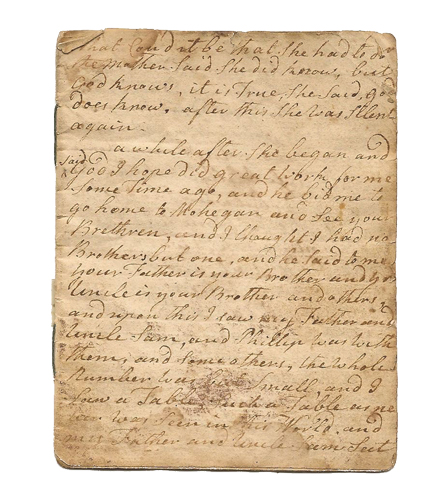
A recent issue of the Yale magazine offered a look at a newly recognized document in the handwriting of the Rev. Samson Occom. Apparently in 1776 he took down the deathbed statement of a young woman:
That December, a daughter of Mohegan leader Robert Ashbow, motivated by a religious vision, returned home after what appears to have been a long absence. By the end of the month, the young woman was dying. On Christmas Eve, Occom wrote an account of the last moments of her life, which included a conversation with her mother. (The daughter’s name, unfortunately, is never given.)

The beginning is typical for Christian deathbed narratives—a confirmation of belief in God and an acceptance of death. But then the woman declares, “No one that fights Shall ever enter the Kingdom of Heaven, nor them that Cary Sharp Weapons and Heavy things for the first Christians did not fight but were Loving.” She adds that her aunt Hannah thought herself “better and above” Hannah’s daughter-in-law, Jerusha, but Jerusha had “better inheritance.” These are unusual, unexplained statements.

At first, we thought “inheritance” referred to spiritual redemption. But as we reconstructed the lives of the people in the narrative, another explanation seemed plausible. Hannah’s husband, we found, was Rev. Samuel Ashbow, Robert Ashbow’s brother. The couple had lost one of their sons, Samuel Jr., at Bunker Hill—the first Native American killed in the Revolution. For Hannah and Samuel, that death would begin their family tragedy: they would lose three more sons before the war was over. On the other hand, Jerusha, the widow of Samuel Jr., had a young son whose life was just beginning. Were the dying woman’s remarks a comment on the futility of war? A portent of the immense physical and cultural losses the Mohegans would endure as a result of that war?
Did they reflect that particular moment during the war in late 1776, when the royal forces were handily dispatching the Continental Army and armed resistance seemed like a poor idea? With so few written sources preserved, we‘re unlikely to have the answers to those questions.

The same magazine also notes a rare harpsichord from about 1770 that somebody decided to make look like an even rarer harpsichord from several decades before.

Friday, March 20, 2015

Freedom’s Way Conference in Concord, 26-28 March

This is the last day to register for the Freedom’s Way National Heritage Area’s three-day conference on interpreting “Community Character and Common Themes” in local history.

This event will take place in Concord, 26-28 March, and use that historic town as a laboratory to investigate engaging ways to interpret the meaning and memory of place.

The conference description says:
In a rapidly globalized increasingly homogeneous world, it is the character of the places in which we live that define us. Local stories and places provide a lens through which to develop community identity and sense of place. The conference will explore the intimate link between discovery and interpretation as a means of bringing local stories to life within individual communities, connecting them to themes within the National Heritage Area.
John R. Stilgoe, Harvard University’s Robert & Lois Orchard Professor in the History of Landscape, will deliver the keynote address, “Verandas and Dooryards: Observing Landscape Close to Home.” Historian Bill Fowler of Northeastern University will speak on how regional history shapes the way we think. Case studies, presentations, and round tables will explore best practices in interpretation and educational programming using local resources.

The organizers are offering behind-the-scenes tours of The Wayside at Minute Man National Historical Park, The Thoreau Institute at Walden Woods, The Old Manse (shown above), and other historic locations in Concord.

This conference is aimed to counteract a common challenge for local historical societies and small sites: focusing on local places, artifacts, and stories so closely as to omit the connections with other sites in neighboring towns that, when woven together, can tell a larger story that’s still grounded in the local communities. For example, every Massachusetts town has its own story of citizens responding to the Massachusetts Government Act of 1774 and deciding whether to switch allegiance (and tax funds) to the extralegal Massachusetts Provincial Congress. Together those stories add up to a mass movement and a governmental revolution in the province.

As a sign of how many different organizations are involved in this event, the Freedom’s Way National Heritage Area is working in partnership with the U.S. National Park Service, Minute Man National Historical Park, Boston National Historical Park, John H. Chafee Blackstone River Valley National Heritage Corridor, American Antiquarian Society, The Drinking Gourd Project, Fitchburg Art Museum, The Guild of Historic Interpreters, Mass Audubon Society, Nashua River Watershed Association, New England Scenic Trails, The Thoreau Institute at Walden Woods, The Thoreau Society, The Trustees of Reservations, Walden Pond State Reservation (DCR), and Wachusett Mountain State Reservation (DCR).

As I said above, registration closes 20 March, and space is limited. The full conference costs $30, and cheaper registration is available for certain days only. Click the link above for more information.

Thursday, March 19, 2015

Women to Meet at the Shirley-Eustis House this Spring

This spring the Shirley-Eustis House in Roxbury is hosting a series of first-person interpretive presentations on women of Revolutionary Boston and later periods.

Sunday, 22 March, 2:00 P.M.
Meet Phillis Wheatley
Valerie Link Foxx kicks off the series with a poignant first-person performance of the life of Phillis Wheatley. Brought to Boston from Africa at about the age of seven, little Phillis learned English so quickly that she was composing impressive verse while she was still in her teens. As a young woman she pursued literary success with a trip to London even while she was still enslaved, then personal independence as an author, wife, and mother in Boston.

Foxx is an actor, author, wife, and mother. She is also a native of Roxbury and has performed since the age of seven. In 1977, Valerie and her mother, Bernice Link, co-founded Link & Foxx Productions to produce one-woman and family skits and stage plays.

Sunday, 29 March, 2:00 P.M.
Meet Rachel Revere—Petticoats at the Revolution
Hear a remarkable story of tea and Revolution from the woman who rode through life with Paul Revere. Rachel Revere tells of the Boston Tea Party, the midnight ride, and the siege of Boston through the eyes of a woman who had to keep the home fires burning while her husband fanned the flames of Revolution.

This presentation will be performed by Joan Gatturna, creator of Petticoat Adventures. Gatturna is an actor and storyteller. She has been named as a Creative Teaching Partner of the Massachusetts Cultural Council and is on the Touring Roster of the New England Foundation for the Arts.

Sunday, 12 April, 2:00 P.M.
Meet Elizabeth Murray—Shopkeeper to Farmstead
Elizabeth Murray, a Scottish immigrant, developed a successful retail business in colonial Boston. By offering the latest fashions and teaching advanced crafts, and by insisting on prenuptial agreements in two of her three marriages, she achieved economic independence and became a mentor for younger women. Through the upheavals of the American Revolution, Elizabeth (Murray Campbell Smith) Inman faced the challenge of separating from Tory family members while maintaining her home in Massachusetts.

Una McMahon, Founder-Owner of Acorn Tours, provides customized sightseeing tours of Boston and New England and specializes in their rich colonial histories. She is a Governor/Board Member and the Chair of the Events Committee for the Shirley-Eustis House Association. McMahon has taught French Language, led student tours to France and Canada, and established organizations such the Irish Business Network Small Business Forum.

In addition, on 26 April Marcia Stein-Adams will present “Meet Isabella Stewart Gardner,” and on 3 May Jan Turnquist will offer “Meet Louisa May Alcott.”

Admission for each lecture is $10 per person.

(The copy of Gilbert Stuart’s portrait of Rachel Revere above comes courtesy of Oceansbridge.)

Wednesday, March 18, 2015

History Camp in Boston, 28 March

Boston’s second annual History Camp will take place on Saturday, 28 March, at the Harriet Tubman House of the United South End Settlements at 566 Columbus Avenue in Boston.

History Camp is a self-organizing conference for people interested in all sorts of history in all sorts of ways. That means the schedule of presentations and panels will be decided on the day of the event, with folks then choosing which sessions to attend.

Who’s going to be there? Paula Bagger, who put together the pieces of evidence about Prince Demah. Jason Rodriguez, editor of Colonial Comics. Elizabeth Sulock from the Newport Historical Society. Liz Covart from the Ben Franklin’s World podcast. Salem Witchcraft Trial experts Marilynne Roach and Emerson “Tad” Baker. Erik Bauer from the Peabody Library. Dr. Sam Forman, Judy Cataldo, and many more.

Including me. Here’s the presentation I’m preparing:

“How Would-Be Assassin Samuel Dyer Nearly Triggered the Revolutionary War”

In October 1774 an angry seaman named Samuel Dyer arrived in Newport, describing how the Royal Navy had kidnapped him from Boston to London, how high government ministers had interrogated him about the Boston Tea Party, and how the Lord Mayor of London had helped him to return to America. Rhode Island Patriots fêted Dyer and sent him back to Boston. Soon after arriving, Dyer confronted two Royal Artillery officers on the street and shot at them before escaping to the rebellious Provincial Congress in Cambridge—only for those Patriots to send him back to the royal authorities and the Boston jail. This talk digs into Dyer’s story: how he came close to setting off war in Massachusetts, what happened to him next, and how much of the outlandish story he told was true.
This is a story I haven’t told in full on this blog or anywhere else.

The Harriet Tubman House is five minutes by foot from the Mass. Ave. T stop and ten minutes by foot from a large covered parking garage that serves Jordan Hall. Here are directions.

Last year’s History Camp filled up in advance. There’s still time to register for this one.

Tuesday, March 17, 2015

Paul Revere at Old South and Old North

Fans of Paul Revere can attend two talks about his Revolutionary activities beyond his famous and less-famous rides of 1774 and 1775.

Friday, 20 March, 12:15 P.M.
Old South Meeting House
The Picture of Innocence: Symbols and Propaganda from the Boston Massacre
The Boston Massacre became infamous throughout the American colonies in a matter of weeks. Patriot leaders immediately circulated the news with heavy doses of propaganda. So what really happened on March 5, 1770? Historian and Old South Meeting House Educator Tegan Kehoe will walk you through the facts and fictions of Paul Revere’s famous print and several other contemporary depictions of the “bloody massacre on King Street.”
Admission $6; free for Old South Meeting House members.

Wednesday, 25 March, 6:30 P.M.
Old North Church
Paul Revere: Beyond the Midnight Ride
Author and attorney Michael Greenburg will talk about Revere’s lesser-known travails and ultimate court-martial following the doomed Penobscot Expedition, an often-ignored chapter in the life of this beloved American icon. Following the lecture will be a reception and book signing of Greenburg’s book, The Court Martial of Paul Revere: A Son of Liberty & America’s Forgotten Military Disaster.
Free and open to the public.

One nice thing about lectures in these eighteenth-century Boston churches is that you can almost always get a seat. A hard, flat seat.

Monday, March 16, 2015

Jane Nylander and the Bedrooms of Concord and Deerfield

On Thursday, 19 March, Jane C. Nylander will speak at the Concord Museum on the topic “Handsome Drapery and Sweet Repose: Looking Even Closer at New England Beds and Bedrooms, 1740-1860.”

Nylander is President Emerita of Historic New England, author of Our Own Snug Fireside, and a consulting curator of the museum’s “Behind Closed Doors: Asleep in New England” exhibit.

That exhibit posits, “What goes on behind the closed doors of the bedroom raises interesting questions of privacy, comfort, intimacy, and fashion that can be examined through objects as varied as bedsteads and coverlets, nightclothes and cradles, tin tubs and mahogany high chests.” Nylander’s talk will expand on many of its themes, “weaving together diary entries, snippets from household advice books, sewing instruction manuals, and antiquarian memoirs with a host of additional illustrations.”

This free event begins with a reception at 6:00 P.M. in French Hall, and the lecture will start at 7:00. To reserve space, use the museum’s website or call 978-369-9763, ext. 216. “Behind Closed Doors” closes at the Concord Museum on 23 March, so this is last week to see it.

If you’re restless for more information on bedrooms of the past, Historic Deerfield is hosting a one-day seminar on the topic on 11 April, titled “Pillow Talk: Discovering Early New England Bed Chambers.” And the keynote speaker is none other than Jane Nylander.

Among the other speakers is Prof. A. Roger Ekirch from Virginia Tech, author of At Day’s Close: Night in Times Past. He has concluded that before widespread artificial illumination, “people enjoyed two sleep sessions in one night: a first sleep and a second sleep, with as long as two hours of wakefulness in between.” The B.B.C. reported:
Ekirch found that references to the first and second sleep started to disappear during the late 17th Century. This started among the urban upper classes in northern Europe and over the course of the next 200 years filtered down to the rest of Western society. By the 1920s the idea of a first and second sleep had receded entirely from our social consciousness.
Knowledge like that can keep you up nights.

Sunday, March 15, 2015

Constitutional Correlations

In a recent issue of the New Yorker, Jill Lepore reviewed some recent books about economic inequality, which has been measured for a century on the Gini scale, and what that phenomenon might say about and mean for different societies.

Toward the end of her review Lepore mentions some work by the political scientists Alfred Stepan and Juan J. Linz that found correlatioons between economic inequality and the political structures that different nations had established:
Stepan and Linz identified twenty-three long-standing democracies with advanced economies. Then they counted the number of veto players in each of those twenty-three governments. (A veto player is a person or body that can block a policy decision. Stepan and Linz explain, “For example, in the United States, the Senate and the House of Representatives are veto players because without their consent, no bill can become a law.”) More than half of the twenty-three countries Stepan and Linz studied have only one veto player; most of these countries have unicameral parliaments. A few countries have two veto players; Switzerland and Australia have three. Only the United States has four. Then they made a chart, comparing Gini indices with veto-player numbers: the more veto players in a government, the greater the nation’s economic inequality. This is only a correlation, of course, and cross-country economic comparisons are fraught, but it’s interesting.

Then they observed something more. Their twenty-three democracies included eight federal governments with both upper and lower legislative bodies. Using the number of seats and the size of the population to calculate malapportionment, they assigned a “Gini Index of Inequality of Representation” to those eight upper houses, and found that the United States had the highest score: it has the most malapportioned and the least representative upper house. These scores, too, correlated with the countries’ Gini scores for income inequality: the less representative the upper body of a national legislature, the greater the gap between the rich and the poor.
The U.S. Constitution produced our malapportioned Senate because it was designed to respond to two of the pressing concerns of 1787: the small-population states didn’t want to give up the “one state, one vote” system of the Articles of Confederation and Perpetual Union; and the elite men at the Constitutional Convention had been spooked by the Regulator uprising in Massachusetts and didn’t trust democracy. Their design for the new federal Congress in turn led to the lesser but still significant malapportionment in the Electoral College.

Our Revolution was a step away from aristocratic government, in which hereditary monarchs and nobles had a disproportionate say on the basis of birthright. The new Senate wasn’t hereditary like the House of Lords, but it was initially designed to insulate its members from the voting population. The Seventeenth Amendment changed that. Senators’ six-year terms preserve them from facing the voters as often as other federal elected officials, but the fact that they represent states means that they can’t benefit from gerrymandering—producing more turnover in the Senate than in the House.

As for the veto players, I guess the four American ones are the House, Senate, President, and Supreme Court. The Constitution set up the first three to create “checks and balances”—a term coined by John Adams in 1787 (based on older British Whig phrases). The Supreme Court established itself as another veto player through decisions under Chief Justice John Marshall in the early 1800s.

Many other countries with legislatures also modeled on Britain’s bicameral Parliament have gradually removed veto power from their upper houses, rendering some almost symbolic. Most of those countries also have a weak or even symbolic head of state, concentrating legislative and executive powers in a prime minister. That’s how they get by with so few veto players/checks and balances—yet they remain “long-standing democracies with advanced economies.”

How much effect do those modern government structures have on economic inequality in those countries? As Lepore wrote, Stepan and Linz were finding correlations, not necessarily causes. Linz much preferred parliamentary systems over the U.S. of A.’s separation of powers, so these findings fit into his life’s work. Still, Stepan and Linz’s work makes one think about the unforeseeable consequences of laying out a constitution in the late 1700s.

Saturday, March 14, 2015

Proposal for a Bill of Attainder with Corruption of Blood

I had reason this week to look up information about Sen. Tom Cotton of Arkansas (shown here), and I found this curious line on Wikipedia:
Corruption of Blood

In 2013 Cotton introduced legislative language to overturn the United States Constitution prohibition of attainder.
The citation for that statement led to a Huffington Post article. With further searching, I found the transcript of a markup session of the House Foreign Affairs Committee on 22 May 2013 (preserved in this very large P.D.F. file). The discussion turned out to reveal both less and more than the line on Wikipedia suggests.

In that session, House members were hammering out details of a law to impose sanctions on government officials in Iran. Cotton, then in the House, had proposed amending the bill to extend those travel and financial restrictions from officials “responsible for Human Rights violations, for engaging in censorship or otherwise diverting goods designated for common Iranian people” to “any family member of such official (to include a spouse and any relative to the third degree of consanguinity).”

Cotton’s point was to prevent such people from protecting their money by transferring it to relatives. The relatives affected by the law would include, he stated, “parents, children, aunts, uncles, nephews, nieces, grandparents, great-grandparents, grandkids, great-grandkids.”

But how would the U.S. government know that any property held by such potentially far-flung people had come from an Iranian government official? Cotton said that didn’t matter: “There would be no investigation. If the prime malefactor of the family is identified as on the list for sanctions, then everyone within their family would automatically come within the sanctions regime, as well.”

And that’s where the constitutional questions arose. Rep. Alan Grayson, one of the House’s boldest voices on the left, objected to the amendment on the grounds it would “allow the sins of the uncles to descend on the nephews.” He noted that its confiscations, fines, and other penalties would violate our Constitution in multiple ways. The particulars:
  • Article One, Section 9: “No Bill of Attainder…shall be passed.” A “bill of attainder” was a British term for a law deeming someone guilty without benefit of a trial. (Section 10 forbade the states from passing such laws as well, so the Founders really didn’t like them.)
  • Article Three, Section 3: “no Attainder of Treason shall work Corruption of Blood.” The old phrase “Corruption of Blood” referred to punishing relatives of a person convicted of a heinous crime simply because they were related. Even for treason, the Founders didn’t want the U.S. government to go after “grandparents, great-grandparents, grandkids, great-grandkids,” and so on.
  • Amendment Five: “No person shall be…deprived of life, liberty, or property, without due process of law.” Again, since the passage of the Bill of Rights, Congress can’t simply confiscate property from people “automatically” with “no investigation” and no judicial process, as Rep. Cotton wanted.
Grayson later added that the law would also violate the Eighth Amendment against “cruel and unusual punishments,” though that’s not so specific.

Cotton’s first response to Grayson’s objections was, “Iranian citizens do not have constitutional rights under the United States Constitution.” As Grayson replied, his colleague was “completely and utterly mistaken” on that point. The Fifth Amendment and other parts of the Constitution specify that they apply to any “person,” not just citizens. The lines prohibiting bills of attainder and corruption of blood say nothing about citizens only—they just prohibit such laws. There are decades of case law backing that up, which Cotton, as a lawyer, should have known.

That discussion ended with Cotton withdrawing his amendment under pressure from Grayson. It seems clear to me that Cotton didn’t knowingly try to “overturn the United States Constitution prohibition of attainder,” as the line on Wikipedia said. Rather, Cotton ignorantly tried to get around the Constitution because he thought punishing Iranian officials was really, really important. That would not be the last time Iran policy would lead him into breaking long-established American precedents.

Cotton’s claim about rights being restricted to citizens raises bigger questions. Obviously such rights as being able to vote in U.S. elections are exclusive to U.S. citizens. But the Founders and subsequent American leaders viewed more fundamental freedoms through a “natural rights” philosophy, or as what today we call “human rights.” (Cotton himself used that phrase, as quoted above.) We all deserve those rights simply because we’re alive.

So do Cotton and others who adopt his position actually believe in human or natural rights as the Founders described? Do they truly believe those rights are endowed by a creator? If so, how can they deny those rights to most of the human population simply because those people were born citizens of other countries?

Friday, March 13, 2015

Has General Washington’s Riband Come Back Around?

Back in 2010 I wrote some articles about Gen. George Washington’s decision in July 1775 to adopt a blue sash or “ribband” across his chest as the sign of his rank in the new Continental Army.

It turns out that Washington’s riband might survive in the collections of Harvard University’s museums, having come back to Cambridge after passing through the hands of painter Charles Willson Peale, who owned a museum himself.

In this Common-Place article, Philip C. Mead of the Museum of the American Revolution writes of the general:

The decoration he chose, a blue silk moiré ribbon worn across his breast, made allusions to both one of the traditional colors of Whigs, the British political party with which American Revolutionaries identified, and the aristocratic decorations of Europe. At first, he wore the ribbon regularly, and then only on ceremonial occasions and in battles, until he phased the decoration out in 1779, replacing it with stars on his epaulettes. Examples of Washington’s epaulettes have survived and appeared in several publications, but his silk ribbon has remained largely obscure among students of Washington objects and the American Revolution.

A recently re-examined silk moiré ribbon in the collections of Harvard University’s Peabody Museum of Archaeology and Ethnology may well be the very ribbon depicted in the Washington portrait paintings by the Revolutionary artist Charles Willson Peale. It may even have been the one worn by Washington from 1775 to 1779 as referenced in various writings during the war. It may also be the ribbon displayed at Peale’s museum in the nineteenth century.
Harvard received the artifact in 1899 and immediately loaned it to the Old South Meeting-House, one of Boston’s historic sites most associated with the Revolutionary War. It stayed there until shortly after the Bicentennial. When it came back to Harvard, the cloth no longer had its label from Peale’s museum, and, more importantly, the cultural climate had changed since its first arrival. Both museum curation and historiography had become more professionalized, a process that encourages skepticism about the claims of tradition and enthusiastic amateurs. So was this artifact genuinely the general’s?

Mead’s investigation includes the process of making “watered” silk, how this riband compared to what Peale painted in the 1770s, why Washington stopped wearing the sash midway through the war, and how such an artifact does and doesn’t fit into the mission of the museums where it has appeared.

Now if this sash belonged to the Harvard Art Museums, it might be possible to request a personal examination through Harvard’s Art Study Center. But it came to the Peabody Museum. So I don’t know how it might be seen.

Thursday, March 12, 2015

Washington Jumping Rope and Sleeping with a Black Soldier

Here are two anecdotes of Gen. George Washington and an African-American soldier from Massachusetts, as reported by the Rev. Henry F. Harringon in Godey’s Magazine and Lady’s Book, July 1849:
There lately died [in 1842 actually], in the city of Boston, a very respectable negro, named PRIMUS HALL. He lived to an advanced age, and was the possessor of considerable property. Throughout the Revolutionary war he was the body servant of the late Col. [Timothy] Pickering, of Massachusetts. He was free and communicative, and delighted to sit down with an interested listener and pour out those stores of absorbing and exciting anecdotes with which his memory was stored.

It is well known that there was no officer in the whole American army whose friendship was dearer to Washington, and whose counsel was more esteemed by him, than that of the honest and patriotic Col. Pickering. [So much for Lafayette.] He was on intimate terms with him, and unbosomed himself to him with as little reserve as, perhaps, to any confident in the army. Whenever he was stationed within such a distance as to admit of it, he passed many hours with the colonel, consulting him upon anticipated measures, and delighting in his reciprocated friendship.

Washington was, therefore, often brought into contact with the servant of Col. Pickering, the departed Primus. An opportunity was afforded to the negro to note him, under circumstances very different from those in which he is usually brought before the public, and which possess, therefore, a striking charm. I remember two of these anecdotes from the mouth of Primus. One of them is very slight indeed, yet so peculiar as to be replete with interest. The other conveys a high and holy moral, and deserves to be recorded among the public and remarkable acts of our country’s saviour, as a brilliant illustration that disinterestedness and true humility were guiding principles of his character. The authenticity of both may be fully relied upon.

Washington once came to Col. Pickering’s quarters, and found him absent.

“It is no matter,” said he to Primus. “I am greatly in need of exercise. You must help me to get some before your master returns.”

Under Washington’s directions, the negro busied himself in some simple preparations. A stake was driven into the ground about breast high, a rope was tied to it, and then Primus was desired to stand at some distance and hold it horizontally extended. The boys, the country over, are familiar with this plan of getting sport. With true boyish zest, Washington ran forwards and backwards for some time, jumping over the rope as he came and went, until he expressed himself satisfied with the “exercise.”

Repeatedly, afterwards, when a favorable opportunity offered, he would say—“Come, Primus, I am in need of exercise;” whereat the negro would drive down the stake, and Washington would jump over the rope until he had exerted himself to his content.

On the second occasion, the great general was engaged in earnest consultation with Col. Pickering in his tent until after the night had fairly set in. Head-quarters were at a considerable distance, and Washington signified his preference to staying with the colonel over night, provided he had a spare blanket and straw.

“Oh, yes,” said Primus, who was appealed to; “plenty of straw and blankets—plenty.”

Upon this assurance, Washington continued his conference with the colonel until it was time to retire to rest. Two humble beds were spread, side by side, in the tent, and the officers laid themselves down, while Primus seemed to be busy with duties that required his attention before he himself could sleep. He worked, or appeared to work, until the breathing of the prostrate gentlemen satisfied him that they were sleeping; and then, seating himself on a box or stool, he leaned his head on his hands to obtain such repose as so inconvenient a position would allow. In the middle of the night Washington awoke. He looked about, and descried the negro as he sat. He gazed at him awhile, and then spoke.

“Primus!” said he, calling; “Primus!”

Primus started up and rubbed his eyes. “What, general?” said he.

Washington rose up in his bed. “Primus,” said he, ”what did you mean by saying that you had straw and blankets enough? Here you have given up your blanket and straw to me, that I may sleep comfortably, while you are obliged to sit through the night.”

“It’s nothing, general,” said Primus. “It’s nothing. I’m well enough. Don’t trouble yourself about me, general, but go to sleep again. No matter about me. I sleep very good.”

“But it is matter—it is matter,” said Washington, earnestly. “I cannot do it, Primus. If either is to sit up, I will. But I think there is no need of either sitting up. The blanket is wide enough for two. Come and lie down here with me.”

“Oh, no, general!” said Primus, starting, and protesting against the proposition. “No; let me sit here. I’ll do very well on the stool.”

“I say, come and lie down here!” said Washington, authoritatively. “There is room for both, and I insist upon it!”

He threw open the blanket as he spoke, and moved to one side of the straw. Primus professes to have been exceedingly shocked at the idea of lying under the same covering with the commander-in-chief, but his tone was so resolute and determined that he could not hesitate. He prepared himself, therefore, and laid himself down by Washington; and on the same straw, and under the same blanket, the general and the negro servant slept until morning.

I say that this lost incident conveys a high and holy moral. It affords additional evidence, and that of the clearest nature, that the reverential admiration of the American people for their Washington is not misplaced. He acted from that pure and deep-seated principle, that true nobility of character and self-respect, which enabled him to bear himself with lofty dignity in the presence of the proudest, and, at the same time, impelled him to respect the rights and sympathize with the sufferings of the humblest.
Hall did work as a waiter for Pickering toward the end of the war, as he stated in his pension applications. Otherwise, I don’t believe a word of this.

Hall never mentioned such close encounters with Washington in his applications or, so far as I know, anywhere else. As Harrington told the story, it reinforced everything that Sarah Josepha Hale’s ante-bellum magazine readers would want to believe: Washington a “saviour” kind even to blacks rather than a slightly conflicted slaveholder totally invested in formal hierarchy and manners, Hall an obedient servant to his “master” and to Washington rather than a stubborn fighter for his pension and for civil rights in the new republic.

Tonight I’ll speak about how Washington started to think differently about black soldiers and African-Americans in general. But I really don’t think that ever extended to sharing his bed.

Wednesday, March 11, 2015

Congress Argues about the Black Soldiers in the Continental Army

The official record of the Continental Congress on 26 Sept 1775 says:
The Committee appointed to prepare an answer to General [George] Washington’s letters, reported the same, which was read and agreed to.

Ordered, That the same being transcribed be signed by the president and forwarded immediately.
In fact, there was quite a vigorous debate that day, but secretary Charles Thomson (shown above) was suppressing news of any potential rifts among the colonies.

New Jersey delegate Richard Smith kept a private diary of the proceedings, and his entry for that day began:
Tuesday 26 Septr. Comee. brought in a Letter to Gen Washington, in the Course of it E[dward] Rutledge [of South Carolina] moved that the Gen. shall discharge all the Negroes as well Slaves as Freemen in his Army, he (Rutledge) was strongly supported by many of the Southern Delegates but so powerfully opposed that he lost the Point
The presence of black soldiers in the Continental Army remained a potent issue. On 5 October, John Adams wrote to two of Massachusetts’s generals asking for more information. This is what he told William Heath:
It is represented in this City by Some Persons, and it makes an unfriendly Impression upon Some Minds, that in the Massachusetts Regiments, there are great Numbers of Boys, Old Men, and Negroes, Such as are unsuitable for the service, and therefore that the Con­tinent is paying for a much greater Number of Men, than are fit for Action or any Service. I have endeavoured to the Utmost of my Power to rectify these Mistakes as I take them to be, and I hope with some success, but still the Impression is not quite removed.

I would beg the favour of you therefore sir, to inform me Whether there is any Truth at all in this Report, or not.

It is natural to suppose there are some young Men and some old ones and some Negroes in the service, but I should be glad to know if there are more of these in Proportion in the Massachusetts Regiments, than in those of Connecticutt, Rhode Island and New Hampshire, or even among the Rifle Men [from the Middle Colonies].
Presumably Adams wrote much the same thing to Gen. John Thomas, but that letter appears to have gone underground since a sale in 1948. I discussed Heath’s and Thomas’s replies back here.

Gen. Washington himself had grumbled to the Congress back in July about “the Number of Boys, Deserters, & Negroes” in the Massachusetts force. However, only the black men had become such a bone of contention in the Congress. And though Rutledge didn’t carry his point in September, the southerners won the debate the next month: Washington and a three-man Congress committee that included two southern planters agreed to remove all black soldiers from the Continental Army at the end of the year.

But that wasn’t the end of the story, as I’ll describe tomorrow evening in Cambridge.

Tuesday, March 10, 2015

The Men of Drury’s Company

Looking for documents about African-Americans in the New England ranks before Gen. George Washington’s arrival, I checked the new Harvard database of Massachusetts Anti-Slavery Petitions. As I noted before, it contains many documents that don’t touch directly on slavery.

I found this petition to Gen. Artemas Ward signed on 5 June 1775 by more than two dozen men serving under Capt. Thomas Drury (1735-1790) of Framingham. They wrote:
the Subscribers, Soldiers in the Compy. Commanded by Capt. Drury, Humbly showeth—

that your Petitioners With the utmost Concern find themselves Shifted Out of Col. [John] Nixons Regt. into that of Col. [Thomas] Gardners, Contrary to Our Inclination and Repugnant to the promise made us at Our Inlisting

We theirfore Begg that your Excellency Would be Pleased to Continue us in the Regiment We Engaged to serve in—and not to be Removed for the Future Only to Serve the Malevolent Disposition of Our Captain.
New England soldiers viewed their enlistments as contracts to serve under particular officers. It appears that Capt. Drury had promised to serve under both Nixon and Gardner, but he was listed higher on the seniority list in Gardner’s regiment, so that’s the assignment he preferred.

Twenty-eight men didn’t want to make the switch. Maybe they trusted Col. Nixon, who was from their home town of Framingham, more than Col. Gardner from Cambridge. Those men were bold enough not only to go over Drury’s head but also to criticize his “Malevolent Disposition.”

In his Patriots of Color study, George Quintal identified three of the soldiers who signed this petition as men of color: later war records identify Blaney Grusha and Peter Salem as “Negro” and Joseph Paugenit as “Indian.” However, on this document there’s no indication that those soldiers were racially distinct from the other signers. (Salem and Grusha both signed with their marks, but none of the men had genteel, practiced signatures.)

In addition, Quintal’s study identified two more black men in the same company—Cato Hart and Jeffrey Hemenway. They didn’t sign this petition.

In fact, the Committee of Safety found that the company was split. On 14 June it determined:
A number of men belonging to the company of Capt. Drury, having petitioned that they might be permitted to join, some, the regiment commanded by Col. Gardner, and others, the regiment commanded by Col. Nixon; and the committee having considered their several requests, Voted, as the opinion of this committee, that said company be joined to such regiment as it shall appear the major part of said company are in favor of, when called upon for that purpose.
Three days later, Nixon’s and Gardner’s regiments both fought in the Battle of Bunker Hill. Both colonels were wounded, and Gardner died on 3 July. I don’t know if Drury’s men ever got around to voting, but the company remained in Nixon’s regiment.

Meanwhile, a new commander-in-chief arrived, and in his first report back to the Continental Congress he complained about “the Number of Boys, Deserters, & Negroes which have been listed in the Troops of this Province.” On Thursday I’ll talk about how Washington came to think differently.

Monday, March 09, 2015

The Massachusetts Government on Black Soldiers in the Summer of 1775

On 20 May 1775, one month into the Revolutionary War, the Massachusetts Provincial Congress’s Committee of Safety made this statement about the war it had undertaken and the troops it would employ:
Resolved, That it is the opinion of this committee, as the contest now between Great Britain and the colonies respects the liberties and privileges of the latter, which the colonies are determined to maintain, that the admission of any persons, as soldiers, into the army now raising, but only such as are freemen, will be inconsistent with the principles that are to be supported, and reflect dishonor on this colony, and that no slaves be admitted into this army upon any consideration whatever.
That policy barred slave owners from enlisting their human property, who presumably had less stake in the conflict. It preserved the public image, and self-image, of the New England army as freemen fighting for their traditional rights.

On that same day the committee asked that “Nicholas, a black fellow, now under guard,” be brought to Cambridge and jailed for examination. That was Thomas Nichols of Natick. He was accused of trying to entice black slaves to resist their masters, showing that the Patriot leadership was well aware that other people might fight for freedoms as well.

Seven weeks later, on 8 July, the committee proposed a further restriction on the types of soldiers who could enlist in its army:
Resolved, That the instructions to be given to the officers of the regiments, be sent to the council of war, and if approved, be forwarded: they are as follow:
Instructions for the officers of the several regiments of the Massachusetts Bay forces, who are immediately to go upon the recruiting service.

You are not to enlist any deserter from the ministerial army, nor any stroller, negro, or vagabond, or person suspected of being an enemy to the liberty of America, nor any under eighteen years of age.

As the cause is the best that can engage men of courage and principle to take up arms, so it is expected that none but such will be accepted by the recruiting officer; the pay, provision, &c., being so ample, it is not doubted but the officers sent upon this service, will, without delay, complete their respective corps, and march the men forthwith to camp.

You are not to enlist any person who is not an American-born, unless such person has a wife and family, and is a settled resident in this country.

The persons you enlist, must be provided with good and complete arms.
The new commander-in-chief, Gen. George Washington, and his council evidently did approve that language because it appeared on handbills over the signature of Gen. Horatio Gates two days later.

Back when the war had started on 19 April, the first day’s casualties included Prince Estabrook, still legally a slave and yet in the Lexington militia. Yet a month later, Massachusetts pulled back from enlisting slaves in its army. And in July, the authorities barred enlisting any black men at all. In October, the Continental Army commanders, in consultation with members of the Continental Congress, agreed further to bar any black soldiers already in the ranks from reenlisting in the new year.

The New England authorities almost certainly made those changes under the influence of Gen. Washington, a Virginia plantation owner. They also probably reflected what people thought the Congress that appointed Washington would want. Indeed, the black soldiers already in the ranks became an issue in Philadelphia, as I’ll discuss tomorrow.

I think most Americans see our national history as a story of gradually but unstoppably growing liberties, with equality and legally protected rights spreading from white men of property to poorer white men and then black men and then women and so on. But of course the story isn’t so simple. Progress in achieving individual rights hasn’t always been smooth and one-way. The end of Reconstruction and the imposition of Jim Crow laws are the clearest example of retrograde motion.

This period in 1775 is a smaller example as Massachusetts’s Patriot government deferred to a Virginia slaveowner on the question of the black men already in its army. Had the new summer policy prevailed, the enlisted ranks of the Continental Army would have become racially exclusive. The consequences could have been far-reaching: a smaller, weaker army, to judge by estimates from late in the war of how many American soldiers were black men; and less cultural pressure for abolishing slavery, as happened in New England and Pennsylvania in the 1780s.

On Thursday evening I’ll speak at Longfellow House–Washington’s Headquarters National Historic Site about how Washington changed his mind at the end of 1775. That talk starts at 6:30 P.M., and the site asks people to reserve seats by calling 617-876-4491.

[The photo above shows the Edmund Fowle House in Watertown, used by the Massachusetts Provincial Congress for committee meetings in 1775 and 1776.]


Sunday, March 08, 2015

Stamp Act Approved by Lords

On 27 Feb 1765 the House of Commons gave final approval to the new Stamp Act for North America. The bill then moved on to the House of Lords.

The North American colonies had some friends in the British peerage, or at least men willing to argue against chief minister George Grenville. However, the Duke of Newcastle (1693-1768), a former chief minister, seems to have been mostly retired. The Marquess of Rockingham (1730-1782, shown here) was the rising leader of the Whig opposition, but on this point he was silent.

In another year, Rockingham’s legal ally Charles Pratt (1714-1794) would be Baron Camden, and wartime minister William Pitt (1708-1778) would be the Earl of Chatham. They would advocate for North America in the upper house during the following years, but not yet.

The Lords approved the law on 8 Mar 1765. There was no debate and no vote against.

The Stamp Act went to King George III for final approval. And then it ran into unexpected trouble.

Saturday, March 07, 2015

John Green’s View of the Massacre

On 24 Mar 1770, five days after a draft of Boston’s report on the Massacre was submitted to the town meeting, justices of the peace John Ruddock and John Hill quizzed John Green about what he’d seen on the night of the 5th.

I spent some time earlier this week trying to figure out who John Green was, and this is my best guess. He was descended from a line of three Bartholomew Greens. His great-grandfather and grandfather were both newspaper printers, and his uncle John (1731-87) was still in that business as co-publisher of the Boston Post-Boy until 1773. But, as Isaiah Thomas described, John Green’s father had carved out his own niche:

Bartholomew, the eldest [son]…, never had a press of his own. The following peculiarity in his character introduced him to a particular intercourse with the merchants of the town; he made himself so well acquainted with every vessel which sailed out of the port of Boston, as to know each at sight. Perpetually on the watch, as soon as a vessel could be discovered with a spyglass in the harbor, he knew it, and gave immediate information to the owner; and, by the small fees for this kind of information, he principally maintained himself for several years. Afterwards he had some office in the custom house.
John’s ship-spotting father Bartholomew looked after the Customs office on King Street, with his unmarried daughter Ann helping out. The printer John Green also had ties to the Customs service; its officials granted him printing contracts, and his newspaper tended to support the royal government.

The younger John and his brother Hammond, who had been given their grandmother’s maiden name and was legally a “boat-builder,” both went to the Customs office on the evening of 5 Mar 1770, probably to make sure their relatives were all right. This is how John later described his experience to the magistrates in a deposition:
I, John Green, of lawful age, testify and say, that on Monday evening the 5th instant [i.e., of this month], just after nine o’clock, I went into the Custom-house, and saw in the kitchen of said house two boys [Edward Garrick and Bartholomew Broaders] belonging to Mr. [John] Piemont the barber, and also my brother Hammond Green;

upon hearing an huzzaing and the bell ring, I went out, and there were but four or five boys in King street near the sentinel [Pvt. Hugh White], who was muttering and growling, and seemed very mad. I saw Edward Garrick who was crying, and told his fellow-apprentice that the sentinel had struck him.

I then went as far as the Brazen-Head [importer William Jackson’s shop sign], and heard the people huzzaing by Murray’s barrack [rented to the army by James Murray on behalf of his sister Elizabeth Smith], I went down King-street again, as far as the corner of Royal Exchange lane, by the sentry, there being about forty or fifty people, chiefly boys, near the Custom-house, but saw no person insult, or say anything to the sentry; I then said to Bartholomew Broaders, these words, viz.: the sentry (then standing on the steps and loading his gun), is going to fire;

upon which I went to the Custom-house gate and tried to get over the gate, but could not; whilst standing there, I saw [Customs tide waiter] Thomas Greenwood upon the fence, to whom I said, open the gate; he said that he would not let his [own] father in, and then jumped down into the lane and said to the deponent, follow me; upon which I went down the lane with him, and round by the Post-office, to the main-guard;

he went into the guard-house and said, turn out the guard, but the guard was out before, and I heard that a party was gone to the Custom-house; I then heard the guns go off, one after another, and saw three persons fall;

immediately after, a negro drummer [of the 29th regiment] beat to arms, upon that the soldiers drew up in a rank (and I did not see Greenwood again, until the next morning), after that I saw the 29th regiment drawn up in a square, at the south-west corner of the Town-house; soon after I went home; and further I say not
When John Green testified, Boston officials suspected that Customs service employees had killed people in the crowd by firing guns from an upper window of the building. Green’s brother Hammond and Thomas Greenwood were indicted for murder—despite Green putting Greenwood at the guard-house when the shooting started.

At the end of the year those two men stood trial alongside Customs official Edward Manwaring and notary John Munro, all accused on the basis of dubious testimony from a teen-aged servant named Charles Bourgate. They were quickly acquitted.

The statements of John Green, his relatives, and Thomas Greenwood fit well together and also match testimony from other witnesses, unrelated and unindicted. Those accounts helped to inform the script of tonight’s reenactment of the Boston Massacre outside the Old State House.

Friday, March 06, 2015

A Modern Look at Crispus Attucks

The new Digital Public Library of America is now aggregating public-domain material from other websites. I tried a search for “Boston Massacre” and saw this image for the first time.

This image, “Crispus Attucks,” was painted by William H. Johnson (1901-1970) about 1945, which would make it one of his last works before he was institutionalized for mental illness.

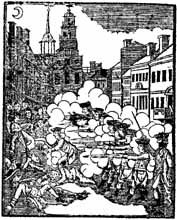
It literally reflects the famous 1770 engraving of the Massacre by Henry Pelham with the soldiers lined up and firing together (on the left instead of the right) and the spires behind. But this portrayal emphasizes the civilian reaction to the soldiers, with the three lamenting women.

Johnson put Crispus Attucks alone at the center, gave him a Christ-like beard and pose, and named the painting after him. That reflects the importance of his memory in the African-American struggle for rights.

This painting is now part of the Smithsonian Institution’s collection.

Thursday, March 05, 2015

“Snowballs covering stones” at the Massacre

In his 1789 History of the American Revolution, the South Carolina physician and historian David Ramsay (1749-1815, shown here) wrote that the crowd at the Boston Massacre was “armed with clubs, sticks, and snowballs covering stones.”

I believe that’s the first printed statement that Bostonians packed snow around rocks to throw at the soldiers. Earlier I’ve said that the earliest place I’d found that detail stated was in Sgt. Roger Lamb’s Journal, published twenty years later. It appears Lamb picked up the detail from Ramsay.

Or from intervening authors. The “snowballs covering stones” also appeared in Jedidiah Morse’s The American Geography (London: 1794), “History of the Rise and Fall of the British Empire in America” in The Britannic Magazine (1795), and William Winterbotham’s An Historical, Geographical, Commercial and Philosophical View of the American United States (London: 1795).

The snowballs with stony cores became a standard detail of descriptions of the Massacre in the nineteenth century. Even though that detail can’t be traced back to anyone who was at the event. Following the standards of his time, Ramsay didn’t specify his source, and the many authors who copied his language (at much greater length) didn’t even cite him.

A lot of eyewitnesses to the Massacre left testimony about it, and none described people packing snow around rocks. Lots of people said there was snow and ice on the ground, and in the air. Thomas Hall and Daniel Cornwall testified to seeing people throw oyster shells at the soldiers. An enslaved man named Andrew testified that people threw “pieces of sea coal” (i.e., coal imported from Cape Breton). So there’s better evidence that the locals didn’t even bother padding their stones with snow.

Wednesday, March 04, 2015

A Civilian Casualty in the Bombardment of Boston

A few months back Boston 1775 reader Boyan Kurtovich sent me a question about whether any civilians were killed or wounded during the American artillery assault on British-occupied Boston in March 1776.

Early in the bombardment, on 3 March, Lt. John Barker of the 4th Regiment wrote, “Very remarkable no hurt was done as the most of their Shot and Shells fell in the Town.” (Back on 23 Sept 1775 Barker had noted Capt. William Pawlett of the 59th being wounded during breakfast.) Likewise, selectman Timothy Newell wrote, “tho’ several houses were damaged and persons in great danger, myself one, no one as I can learn received any hurt.”

But that luck didn’t hold the next day. Newell recorded:
4th March. Monday — soon after candle light, came on a most terrible bombardment and cannonade, on both sides, as if heaven and earth were engaged. Five or six 18 and 24 lb. shot struck Mr. Chardon’s house, Gray’s, Winnetts,—our fence &c.—

Notwithstanding, the excessive fire till morning, can’t learn any of the Inhabitants have been hurt, except a little boy at Mr Leaks, had his leg broke—it is said some of the soldiery suffered.
The merchant Peter Chardon’s house appears to have been on the corner of what became Chardon and Cambridge Streets. (Chardon was reconfigured into New Chardon Street in the Government Center development of the 1960s.) Those cannonballs probably came from the Continental battery at Lechmere’s Point. That house burned down in January 1778.

The next day the merchant John Rowe wrote in his diary:
All night Both sides kept a Continuall Fire. Six men of the 22nd. are wounded in a house at the So. End. One Boy lost his Leg.
That’s probably the same unfortunate boy, and we can hope Rowe heard an exaggerated rumor about the extent of his injury.

In his 1849 history of the siege of Boston, Richard Frothingham wrote that “one shot wounded six men in a regimental guard-house.” He didn’t cite a source for that statement, but it fits with Rowe’s remark and probably referred to the men of the 22nd. Frothingham didn’t mention the boy, and I haven’t found a trace of him elsewhere.

Tuesday, March 03, 2015

What’s Up with Minute Man Park This Month

Today the North Bridge Visitor Center of Minute Man National Historical Park is scheduled to reopen for the season.

It will be open through the end of the month on Tuesday through Saturday, 11:00 A.M. to 3:00 P.M. In April, with the anniversary of the Battle of Lexington and Concord coming up, the park’s facilities will surely open for longer hours.

Meanwhile, the Friends of Minute Man Park is sponsoring two lectures this month.

Sunday, 15 March
“Parker’s Revenge Project: Notes from the Field”
Principal investigator Margaret Watters, Ph.D., will give an update on the Friends initiative to study and interpret the site traditionally associated with the afternoon assault on the withdrawing British army column by Capt. John Parker and his Lexington militiamen.

Sunday, 29 March
“War and Slavery in Revolutionary Massachusetts, 1775-1783”
John Hannigan, Rose and Irving Crown Fellow in the History Department at Brandeis, will share his research on how men of color participated in the opening of the American Revolution, and the effects of their activity on the institution of slavery in Massachusetts.

Both talks will take place in Bemis Hall, 15 Bedford Road in Lincoln. They will start at 3:00 P.M., and are free and open to the public.

Monday, March 02, 2015

Talk on Washington’s Black Soldiers in Cambridge, 12 Mar.

On Thursday, 12 March, I’ll again speak at Longfellow House–Washington’s Headquarters National Historic Site in Cambridge honor of the upcoming Evacuation Day anniversary. This year’s talk is titled “When Washington Changed His Mind: The Question of African-American Soldiers in the Continental Army.”

In his first report back to the Continental Congress after taking command in Boston, Gen. George Washington wrote on 10 July 1775 that they shouldn’t expect quick results. The New England recruiters, he said, had already scraped the bottom of the barrel for soldiers:
Upon finding the Number of Men to fall so far short of the Establishment, & below all Expectation I immediately called a Council of the general Officers whose Opinion as to the Mode of filling up the Regiments; & providing for the present Exigency, . . . From the Number of Boys, Deserters, & Negroes which have been listed in the Troops of this Province, I entertain some Doubts whether the Number required can be raised here…
For a Virginia planter like Washington, whose entire life depended on managing enslaved people of African descent, the sight of black soldiers in fighting regiments wasn’t just a surprise. It was a profound contradiction of the social order.

That day Washington’s hand-picked adjutant general, Horatio Gates, issued recruiting orders that barred “any Stroller, Negro, or Vagabond” from enlisting. The Massachusetts legislature, which had approved all the existing regiments with black soldiers, reversed itself and told officers to stop signing up such men, whether free or enslaved.

At a council of war in October, Washington quizzed his generals on the issue. All but two agreed with the policy of excluding African-Americans from the army. So did the committee of the Continental Congress who met with Washington soon afterwards. Which wasn’t a surprise when the agenda for that meeting expressed the question this way:
Ought not Negroes to be excluded in the New Inlistment? especially such as are Slaves—By a Council of Officers both are.
On 31 October Washington’s general orders put that policy into practice by inviting all American soldiers around Boston to sign up for another year in the army—“(Negroes excepted, which the Congress do not incline to inlist again).”

And yet on 30 Dec 1775 Washington wrote in his general orders that recruiting officers could sign up “Free Negroes.” The next day he took responsibility for that new policy in a letter to the Congress:
I have presumed to depart from the Resolution respecting them, & have given Licence for their being enlisted, if this is disapproved of by Congress, I will put a Stop to it.
As he anticipated, the Congress did not overrule that policy.

In this talk I’ll explore the factors that pressed the commander-in-chief change his mind, and the repercussions of that decision for the Continental Army and for Washington personally.

I’m scheduled to begin speaking at 6:30 P.M. in the Longfellow carriage house. Parking restrictions ease up along Brattle Street to the west at 6:00—not that this winter is making parking easy. This event is free, but because of limited seating the site asks people to make reservations by calling 617-876-4491.

Sunday, March 01, 2015

Big Plans for the Massacre in Boston

This is the time of year that Boston 1775 starts pinging the Department of Homeland Security servers by talking about our big plans for the Massacre.

That’s the Boston Massacre, of course, which took place on the 5th of March in 1770. This year the event will be reenacted on the evening of Saturday, 7 March, outside the Bostonian Society’s Old State House Museum—assuming that the snow has been cleared from the area. Here’s the schedule of events for that day.

10:30 A.M.
Little Redcoats and Little Bostonians
This interactive program for children explores what life was like for Bostonians and British soldiers in Boston in the months leading up to the Boston Massacre. Free; in front the Old State House.

11:00 A.M.
Blood on the Snow
Delve into the stark choices that faced the acting governor Thomas Hutchinson in the aftermath of the Massacre as shocked Bostonians demanded immediate action to prevent further bloodshed. Actors will present a scene from Patrick Gabridge’s original drama Blood on the Snow. Free with museum admission; inside the Old State House.

11:30 A.M.
Trial of the Century
Watch lawyers John Adams and Josiah Quincy defend the British soldiers accused of murdering Bostonians. Audience members are invited to act as witnesses and jurors for this celebrated case. For all ages. Free with museum admission, but space is limited; tickets go on sale at 9:00 A.M. at the Old State House Museum front desk.

1:30 P.M.
Little Redcoats and Little Bostonians reprise

2:00 P.M.
Blood on the Snow reprise

2:30 P.M.
Trial of the Century reprise

Weather permitting, volunteers may be recreating other scenes of historical conflict that afternoon outside Faneuil Hall, at the Old State House, or in other public spaces. Keep your eyes open.

7:00 P.M.
Boston Massacre Reenactment
The big event! Witness the argument, riot, and shooting reenacted in front of the Old State House, in the very area where it took place in March 1770. Before the action unfolds, hear from Patriots, Loyalists, and moderates who will talk about the events and attitudes that led to that fateful night. Free; in front of the Old State. (Once again I’ll be there as narrator.)

And if that’s not enough, on Wednesday, 11 March, from 6:00 to 7:30 P.M. the Old South Meeting House will host an event called “The Fifth of March Anniversary Orations–Speak Out!” From 1771 to 1783, the town of Boston invited prominent gentlemen to speak in memory of the Massacre at Old South Meeting House. Among the men thus commemorating the anniversary were James Lovell, Dr. Joseph Warren, Dr. Benjamin Church, and John Hancock. Hear selections from their speeches performed by an intergenerational group. Co-sponsored by the History Department of Suffolk University. This event is free and open to the public, but registration is requested.

(And if you are from the Department of Homeland Security, come to these events! You may have some time to fill.)