J. L. BELL is a Massachusetts writer who specializes in (among other things) the start of the American Revolution in and around Boston. He is particularly interested in the experiences of children in 1765-75. He has published scholarly papers and popular articles for both children and adults. He was consultant for an episode of History Detectives, and contributed to a display at Minute Man National Historic Park.

Subscribe thru Follow.it


•••••••••••••••••


Sunday, March 11, 2007

Mather Byles, Sr., and "three thousand tyrants"

The Rev. Dr. Mather Byles, Sr. (1706-1788), was the minister of the Hollis Street Meeting-house, in the far South End of Boston. He was unusual among the town’s Congregationalist pastors in siding with the Crown rather than the Whigs. But he refused to leave Boston in March 1776 even as his sons and the other Anglican ministers did. His congregation voted to dismiss him, and the legislature placed him under house arrest. The congregants were never able to get him out of the house they had bought, and his daughters reportedly refused to pay local taxes while they lived in it for a couple more decades, too.

What Bostonians remembered most about Byles was his love of puns. In his autobiography John Adams referred to him as “Dr. Byles of punning Memory.” I suspect that locals in the next century dropped his name the way we say, “As Mark Twain said,...” or “As Will Rogers once remarked,…” to signal that we’re about to recite a joke. Which might mean that Byles didn’t necessarily voice every remark ascribed to him.

Among the most famous of those witticisms was one Dr. Byles reportedly delivered on 8 March 1770, during the funeral for the first four victims of the Boston Massacre. Witnesses estimated that several thousand people participated in the processions that day, dwarfing even the ceremony for Christopher Seider. Watching this crowd, Byles is said to have asked a young companion:

which is better—to be ruled by one tyrant three thousand miles away, or by three thousand tyrants not a mile away?
That remark even got into Mel Gibson’s mouth in the movie The Patriot. But how reliable is the quotation?

Byles’s witticism turns out to be an oral tradition not committed to paper until 1897, more than a century and a quarter after the occasion. But it has an easily traceable provenance. It appeared in an article by journalist James R. Gilmore (1822-1903) in the August issue of New England Magazine. In “Nathaniel Emmons and Mather Byles,” Gilmore described a conversation “early in 1840” with the Rev. Dr. Nathaniel Emmons, a ninety-five-year-old Congregationalist clergyman who died later that year. Emmons, in turn, reportedly described a conversation with Dr. Byles in March 1770 when he was a young man like Gilmore. He quoted Byles saying:
throwing out Sam and John Adams and John Hancock and some few other leaders, the majority of our New England patriots were a sorry set.

I stood with Parson Byles on the corner of what are now School and Washington Streets, in March, 1770, and watched the funeral procession of Crispus Attucks—that half Indian, half negro and altogether rowdy, who should have been strangled long before he was born.

There were all of three thousand in the procession—the most of them drawn from the slums of Boston; and as they went by the Parson turned to me and said: “They call me a brainless Tory; but tell me, my young friend, which is better—to be ruled by one tyrant three thousand miles away, or by three thousand tyrants not a mile away?”
Emmons was known for his fervent opposition to Unitarianism, Universalism, and almost any doctrine but evangelical Calvinism. He preached against Thomas Jefferson. The educator Horace Mann, a childhood congregant of Emmons, recalled that he
expounded all the doctrines of total depravity, election, and reprobation, and not only the eternity but the extremity of hell’s torments, unflinchingly and in their most terrible significance, while he rarely if ever descanted on the joys of heaven, and never, in my recollection upon the essential and necessary happiness of a virtuous life.
And if Gilmore recalled Emmons’s remarks accurately, he was also free to express prejudice about class and race. He strikes me as having been a temperamental conservative, disliking any new idea and any person not from his high class. He also seems to have had a talent for pithy quotes.

I can’t help but note that the “three thousand tyrants” quote resembles shopkeeper Theophilus Lillie’s complaint about being a slave to a hundred masters, published in January 1770. So Byles would have had several weeks to improve on Lillie, Emmons seventy years to polish Byles’s remark in his memory, and Gilmore another half-century to touch up Emmons’s anecdote for print. No wonder the quotation works so well.

Saturday, March 10, 2007

Robert Treat Paine's New Clothes

Last November I quoted a letter from Robert Treat Paine’s sister Abigail reminding him to send his laundry home from college. Paine went on to try schoolteaching and merchant sailing before he became one of the province’s leading lawyers. He married at age thirty-nine to Sally Cobb, a young woman from a prominent Taunton family.

The Papers of Robert Treat Paine, published by the Massachusetts Historical Society, offers a few more glimpses of their family life. Here’s a letter that Sally wrote to Robert on 9 Apr 1775. He was then at the Massachusetts Provincial Congress meeting in Concord, looking ahead to returning to the Second Continental Congress in Philadelphia after a stop in Taunton. Sally contacted Robert with a familiar spousal reminder: errands he shouldn’t forget on his way home.

Dear Husband,

I have Sent your Breeches to be Colour:d. I am in hopes they will be done for you to Bring home. You must Call upon Allen Crocker for them and pay him for the Colouring. If your Cloaths should be wove befor your return I Shall Send it to Liscumb to be Colour:d pea Green unless I hear from you.

I am in Great want of that Cambrick if you have an opportunity due Send it up.

I want to know when you expect to come home, I hope I Shall See you with your head on your Shoulders once more but my Stout heart begins to quiver for fear of blood Shed. I hear their is a great number going to see Col G—— to night with a Desire to carry him to providence but what the event of this will be I do not know.

Our family are well at present. Give my Love to your Sisters. I am in haste your Loving wife,

Sally Paine

Friday, March 09, 2007

Alexander Cruden: an early case of Asperger Syndrome?

I read Alexander the Corrector, by Julia Keay, many months ago, and don’t have a copy available. So I might not remember some details, but the book itself isn’t really the focus of this posting.

Alexander Cruden (1699-1770) was a Scottish-born scholar who moved to London and became a proofreader and moral scold. His great achievement was a complete concordance of the Bible; his one-man production proved even more authoritative for the next century and and half than Johnson’s dictionary.

The Notable Names Database entry on Cruden restates the understanding of the man’s difficult life that’s prevailed since the first book about him, by a sympathetic colleague in the London publishing world:

He took the degree of master of arts, but soon after began to show signs of insanity owing to a disappointment in love.
Specifically, according to his earliest biographer, Cruden was shocked to find that a young woman he fancied had been impregnated by her brother. Because he was locked up as insane shortly after this shock, the authorities were quick to lock him up again later in life, Keay argues.

Keay does some fine genealogical and bibliographical detective work to identify that young woman. She was Elizabeth Blackwell (1700-1758), who became a prominent botanical artist in London. The British Library offers a very elaborate way to view her magnum opus online through its Turning the Pages program; look under “Classic of Botanical Illustration.” Here are some prints of her work for sale.

As this biography of Blackwell states, she was long thought to have been born Elizabeth Blachrie, and to have married her cousin Alexander. Keay assembles the evidence that the artist’s maiden name was Blackwell, and her “husband” was actually her younger brother; Keay deduces that their brother Thomas impregnated Elizabeth, thus forcing her to leave Scotland and set up in London with Alexander. Cruden knew the family first in Scotland, then ran into Elizabeth again by surprise in London, and finally left a small bequest to her daughter Christina. Keay suggests that the Blackwells forced Cruden’s first confinement to prevent their dreadful family secret from getting out.

I suspect that biographers are still missing the true nature of Cruden’s condition, however. As The New Statesman’s review of Keay’s book said:
Keay never fully explains how Cruden managed to produce his immense book all by himself at the same time as holding down the job of bookseller to the queen and then proof-reader. He must have had a mind like a human search engine, coupled with incurable logorrhoea. . . . What made Cruden so single-minded? Why did he dare take on a task similar to Samuel Johnson's dictionary but with none of Johnson's resources? And how on earth did he pull it off? The odd banal judgement such as “Alexander Cruden was a deeply religious man” does little to clear up matters.

At the end of this engaging book, I was left wishing that, instead of spending quite so much time protesting Cruden’s sanity, Keay had done more to unravel the brilliant product of this strange mind.
There are really four mysteries to Cruden, not just the reason for his first confinement. There is, as this reviewer says, the question of why he was so good at this type of detail-oriented work. Not only was his Bible concordance a monumental task in a pre-digital age, but, the NNDB says, “several editions of Greek and Latin classics are said to have owed their accuracy to his care.”

We must also ask why throughout his life sympathetic people intermittently thought Cruden needed to be locked up for his own good. As NNDB goes on to say:
In spite of his earnest and self-denying piety, and his exceptional intellectual powers, he developed idiosyncrasies, and his life was marred by a harmless but ridiculous egotism, which so nearly bordered on insanity that his friends sometimes thought it necessary to have him confined.
Finally, there’s the question of why Cruden had such difficulty dealing with people, from refusing to recognize the Earl of Derby’s dismissal from employment as final to not realizing when Cambridge students were making a game of him. Elizabeth Blackwell wasn’t the only woman he seems to have been infatuated with; in at least one other case, his inappropriate behavior toward a woman led to his being locked up. Cruden never married.

I think the answer to all those mysteries is that Alexander Cruden had what we now term Asperger Syndrome. Though that condition has been recognized in the medical literature only since 1944, some people have probably had it (or something like it) throughout history. Online Asperger Syndrome Information and Support offers this description of the condition:
Persons with AS show marked deficiencies in social skills, have difficulties with transitions or changes and prefer sameness. They often have obsessive routines and may be preoccupied with a particular subject of interest. They have a great deal of difficulty reading nonverbal cues (body language) and very often the individual with AS has difficulty determining proper body space. . . .

By definition, those with AS have a normal IQ and many individuals (although not all), exhibit exceptional skill or talent in a specific area. Because of their high degree of functionality and their naiveté, those with AS are often viewed as eccentric or odd and can easily become victims of teasing and bullying.

While language development seems, on the surface, normal, individuals with AS often have deficits in pragmatics and prosody. Vocabularies may be extraordinarily rich and some children sound like “little professors.” However, persons with AS can be extremely literal and have difficulty using language in a social context.
A lot of that description seems to apply to Alexander Cruden. He was exceptionally intelligent, obsessed with Biblical language, and so socially inept that throughout his life many people judged him to be insane. He was probably “high functioning,” in modern terms, and well born enough to benefit from a top education and some of the deference offered to gentlemen. But never in his adult life did he think or act like most other people.

Historians shy from applying modern diagnoses to people of the past, especially recent psychiatric labels. Many medical and psychological notions have turned out to be reflections of their cultures. Obviously we can’t check Cruden against the criteria for Asperger Syndrome in the DSM IV or other modern references.

Nevertheless, in the case of Asperger Syndrome and some other neurological conditions, I suspect that historians will come to treat them (or refined understandings of them) in much the same way we now discuss physiological conditions and diseases. We don’t discuss smallpox epidemics in the eighteenth century without applying what we know about viruses. Similarly, we won’t discuss mental difficulties without considering what we know about congenital brain conditions.

As I wrote in connection to early American hermitess Sarah Bishop, biographers have often sought to explain a person’s unusual behavior as a response to a traumatic event. We want a reason for someone to act oddly. But sometimes people act unusually because they’re born thinking and seeing the world in unusual ways. The same qualities that might make a man excellent at Biblical concordance might also make him terrible at social interaction. In the case of Alexander Cruden, the sad tale of Elizabeth Blackwell probably had little or nothing to do with his odd behavior.

Thursday, March 08, 2007

The First Newspaper Reports on the Massacre

In colonial Boston, some newspapers published each Monday, and some each Thursday. Because the Boston Massacre occurred on a Monday evening, the first press reports appeared on Thursday the 8th—237 years ago today. The Massachusetts Gazette and Boston News-Letter listed the casualties this way:

Mr. Samuel Gray, Ropemaker, killed on the Spot, the Ball entred his Head broke the Skull.

A Mollatto Man, named Johnson, who was born in Framingham, but lately belonging to New-Providence, and was here in order to go for North-Carolina, killed on the Spot, two Balls entering his Breast.

Mr. James Caldwell, Mate of Capt. Morton’s Vessel, killed on the Spot, two balls entering his Breast.

Mr. Samuel Maverick, a promising Youth of 17 Years of Age, Son of the Widow Maverick, and an Apprentice to Mr. Greenwood, Joiner, mortally wounded, a Ball went through his Belly, and came out at his Back: He died the next Morning.

A Lad named Christopher Monk, about 17 Years of Age, an Apprentice to Mr. Walker, Shipwright; Mortally wounded, a Ball entered his Side and came out of his Back; apprehended he will die.

A Lad named John Clark, about 17 Years of Age, whose Parents live at Medford, and an Apprentice to Capt. Samuel Howard of this Town; Mortally wounded, a Ball entered just above his Groin and came out at his Hip, on the opposite side, apprehended he will die.

Mr. Edward Payne, of this Town, Merchant, standing at his Entry Door, received a Ball in his Arm, and shattered some of the Bones.

Mr. John Green, Taylor, coming up Leverett’s Lane, received a Ball just under his Hip, and lodged in the under Part of his Thigh, which was extracted.

Mr. Robert Patterson, a Seafaring Man, who was the Person that had his Trowsers shot thro’ in [Ebenezer] Richardson’s affair, wounded; a Ball went thro’ his right Arm.

Mr. Patrick Cole, about 30 Years of Age, who work’d with Mr. Field Leather- Breeches-maker in Queen-Street, wounded, a Ball entered near his Hip and went out at his Side.

A Lad named David Parker, an Apprentice to Mr. Eddy the Wheelwright, wounded, a Ball entered his Thigh.
What seems off about this list? Well, for one thing, though people expected apprentices Christopher Monk and John Clark to die shortly, neither did. Monk remained disabled by his wound for several years before dying, so he’s not memorialized among the standard five Massacre victims.

The Boston Gazette, published the same day, ran a similar list, emphasizing the three wounded apprentices ahead the working-men. The Gazette also gave different names for two men. The first was Patrick Carr, an Irish-born laborer I’ll have more to say about soon. While the two apprentices survived, Carr turned out to have been mortally wounded.

The Gazette also reported the one name people today are most likely to connect to the Boston Massacre: Crispus Attucks. Apparently he was living in Boston under the alias “Michael Johnson,” the name on the coroner’s report on his death (now in the collections of the Old State House Museum). Both the News-Letter and the Boston Chronicle reported the mulatto sailor’s name as Johnson. But the Boston Gazette had the name that appeared on all the subsequent legal proceedings, the name that’s come down in history.

Oddly enough, however, the News-Letter and Gazette had the same description of the man’s history: born in Framingham, working as a sailor out of the Bahamas, in Boston between voyages. Both identified him as mulatto, and therefore didn’t grant him the honorific title of “Mr.” In the 1850s historians found a newspaper ad that implied Attucks had escaped from slavery in Framingham twenty years before, which would explain why he used an alias while back in his home province. But how Bostonians discovered the history of that dead man, and how details reached one newspaper before the others, is still a gnawing mystery.

Wednesday, March 07, 2007

Modern Bird's-Eye View of Colonial Boston

Richard Burke Jones is a lawyer and court official in Newburyport who also paints historical scenes. Many of his images show Newburyport, but he’s recently completed a bird’s-eye view of Boston just before the Revolution. Here’s Jones’s website, which displays some of his images, including close-ups of the Boston canvas.

Jones took a perspective similar to Paul Revere’s engraving of British troops marching up Long Wharf in 1768. Look closely at the close-up of the Town House, and you’ll see gun-wielding soldiers confronting a crowd, an image based on Henry Pelham’s engraving of the Massacre. Take in the whole image, and it’s a good reminder of how small the town was back then. (The opening shot of Disney’s Johnny Tremain movie does the same thing from a different perspective.)

Here’s a story from a regional section of the Boston Globe that profiles Jones, and offers an interview/slide show as well.

Reward for Return of 10th Regiment Colours

His Majesty’s 10th Regiment of Foot, American Contingent, which reenacts a unit of the British Revolutionary army, is offering a reward of $1,000 for the return of two stolen flags, no questions asked.

These battle flags, or Colours, disappeared from an automobile in Waltham in early January. They are not Revolutionary artifacts; rather, they represent friendship between the U.K. and U.S. of A., having been presented to the group by British supporters in the 1970s.

The flags are made of embroidered silk, over six feet by six feet in size. Their designs appear on this page (which—be warned—also plays music). People can contact the group’s leaders through this page. On each Patriot's Day, the 10th Foot leads the charge on Lexington Green, re-enacting the skirmish that began the Revolutionary War.

I’d like to be able to report the return of these Colours soon.

Tuesday, March 06, 2007

Reading More about the Boston Massacre

The Boston Massacre anniversary is over—whew! As you might have noticed, I’d worked up to that event with a series of postings about some of the people involved.

My summary of the Massacre itself left out a lot of detail, and may not connect all the dots exactly right. (For example, when did Dr. Thomas Young tell people to go home? Did Pvt. Montgomery shoot first or yell “Fire!” first?) We have more testimony about this event than any other in Revolutionary America, I suspect, so describing and reconciling everyone’s point of view would fill several books. A person could write a long blog entry simply from the point of view of Ann Green, one of the (probably) teenage girls that Bartholomew Broaders escorted home from the apothecary—and maybe next year I’ll do that.

For folks who want to read a full history of the fatal event, the best book is Hiller B. Zobel’s The Boston Massacre, published by W. W. Norton to coincide with the 200th anniversary. While the shootings on King Street on 5 March 1770 are the center of this history, it also covers the years of violent conflict in Boston before then and the immediate aftermath. Zobel prepared for this study by co-editing The Legal Papers of John Adams. Volume 2 of that series includes the records of the trial of Ebenezer Richardson; volume 3 is devoted to the trials of Capt. Thomas Preston and the eight soldiers.

There are, inevitably, some flaws and holes in Zobel’s study. Prof. Pauline Maier of M.I.T. pointed out the Tory slant of the book’s rhetoric in reviewing it for the Journal of Interdisciplinary History. [Her method inspired my posting about another author’s treatment of Samuel Adams here on Boston 1775.] Prof. John Philip Reid argued against Zobel’s analysis of John Adams’s courtroom behavior in an American Journal of Legal History article a few years later.

I think that The Boston Massacre is a masterful recreation of events from a variety of sources, but agree that in its analysis and rhetoric it leans to the right. So for determined researchers I also recommend seeking out a copy of Dirk Hoerder’s Crowd Action in Revolutionary Massachusetts, 1765-1780, which leans to the left. Unfortunately, that book’s not nearly so engaging or well written as Zobel’s. (I shouldn’t complain: Hoerder writes so much better in English than I could write in German.)

There have also been thirty-seven more years of research since Zobel was at work, with personal computers, digital databases, and the internet making it so much easier to collect information. So now we have even more information about the Massacre. In fact, my postings about it have focused on stuff that you won’t find in The Boston Massacre:

I understand at least one Harvard professor is working on a new book about the Boston Massacre now, so there will no doubt be more new information and new interpretations in time for the 240th anniversary.

Monday, March 05, 2007

King Street on the 5th of March 1770

As night fell on the 5th of March, 1770, small groups of British soldiers and Boston workers resumed the fights of the previous week. These confrontations coalesced into a big brawl around “Murray’s barracks,” named for the man who had rented his widowed sister’s idle distillery to the army to house much of the 29th Regiment.

King Street in the center of town was still peaceful, though. Teenaged apprentice Edward Garrick was standing there, near the shop where he worked for wigmaker John Piemont. Capt. John Goldfinch of the 14th Regiment passed by. Edward yelled out that the officer had not paid his barber’s bill.

Capt. Goldfinch showed young Edward the receipt he had in his pocket and— No, of course he didn’t. The captain did have a receipt in his pocket, but he was a British officer and gentleman, and he didn’t deign to reply to a greasy barber’s boy yelling in the street. (Grease was a necessary ingredient in shaping and styling wigs.) Especially with all the insults that Bostonians had yelled at the army since 1768.

Nearby, at the mansion rented by the Customs Service for its office, stood Pvt. Hugh White of the 29th Regiment. He was thirty years old and had served in the British army for eleven years. [Thanks to Don Hagist for alerting me to the British National Archives online record that contained that info.] Though Capt. Goldfinch ignored the barber’s boy, Pvt. White didn’t. He told the teenager that the officer “is a gentleman, and if he owes you any thing he will pay it.” Edward, who had visited with other soldiers of the 29th the night before, replied that there were no gentlemen in the 14th regiment.

Then Edward’s fellow apprentice Bartholomew Broaders arrived with a young woman on each arm. Those women, probably teenagers as well, were servants in the Customs House. The father of one of them had asked Bartholomew to escort the girls to the apothecary. Edward joined the party, and all four young people went into the mansion’s kitchen for a visit.

Meanwhile, Capt. Goldfinch arrived at Murray’s barracks. As the senior officer on the scene, Goldfinch broke up the brawl, shoving and ordering soldiers indoors. Merchant Richard Palmes and Dr. Thomas Young, the most radical of Boston’s Whig leaders, told locals to go home.

Back at the Customs House, one young woman’s brother came into the kitchen and told the barber’s boys that it was getting late. Having spent about an hour inside, Bartholomew and Edward went back out onto King Street. They headed home quietly and— No, that would be too sensible. Edward Garrick started complaining about Capt. Goldfinch’s bill again.

But Pvt. White ignored him and— No, of course he couldn’t let that go. The sentry called Edward over. “I’m not afraid to show my face,” said the apprentice, and walked up. White clonked the boy on the side of the head with the butt of his musket.

Edward staggered back and burst into tears. Bartholomew yelled at White, demanding “what he meant by thus abusing the people”—elevating an individual attack into tyranny. A sergeant chased the apprentices away with his sword, but they found another young wigmaker, Richard Ward. Soon several teenagers were running around the center of town, telling people about the sentry’s assault. One witness recalled them yelling, “you Centinel, damned rascally Scoundrel Lobster Son of a Bitch”!

It had been only a week since Boston’s huge funeral for Christopher Seider, a boy about eleven years old shot dead by a Customs officer. Now folks heard about the man guarding the Customs office abusing another boy. Naturally, this upset people. While some passersby told the boys to disperse, others joined them or at least stopped to watch. (Among the men who eventually joined the throng was Robert Paterson, a sailor whose trousers had been cut by the same shot that killed Seider.)

A town watchman named Edward Langford arrived. He told the apprentices “to let the Sentry alone” and told that soldier “not to be afraid, they were only boys, and would not hurt him.” But around the same time, some of the boys had gotten into the First Meeting and started ringing its bell—the town’s fire alarm.

The crowd swelled quickly as people arrived with their fire buckets. Some private fire companies rolled their engines toward the center of town. It soon became clear that there was no fire, but people spread the news about the big fight at Murray’s barracks, about the sentry at the Customs House. The crowd grew larger and angrier—at least 200 people.

Pvt. White sent two messengers from the Customs House to the Main Guard on the other side of the Town House, asking for reinforcements. Eventually the senior officer there, forty-year-old Capt. Thomas Preston, sent a squad of seven privates under Cpl. William Wemms. After a few more minutes, Preston followed.

All those reinforcements were grenadiers of the 29th. Two of the privates—Edward Montgomery and James Hartigan—had wives in Boston. Three—Mathew Kilroy, William Warren, and John Carroll—had been involved in the fights between soldiers and ropemakers at the end of the previous week. They pushed through the crowd to White’s side, poking men with their bayonets and shouting, “Damn your blood, stand out of the way.”

The soldiers ranged themselves in an arc around the Customs House door. By this time the barber’s boys all seem to have gone home. Among the people toward the front of the crowd were Samuel Gray, one of the brawling ropemakers, watching happily. Bookseller Henry Knox, young and burly, buttonholed Capt. Preston and warned him, “For God’s sake, take care of your men.” Richard Palmes and other gentlemen reminded Preston that without a magistrate he had no legal authority to order his men to fire.

Then twenty or thirty sailors and dock workers arrived from Dock Square. A gentleman had told them that the Customs service was behind all of Boston’s troubles—a common political position. On their way from the docks these men had picked up stout sticks from a pile of firewood. They moved through the crowd to the front, close enough for one sailor, a man of African and Native American ancestry over six feet tall, to grab a bayonet and jerk it back and forth. Benjamin Burdick, Constable of the Town House Watch, arrived, carrying a broadsword at his wife’s insistence. He yelled at the locals to stand back for their own good. Some civilians were throwing snowballs, ice, and lumps of coal.

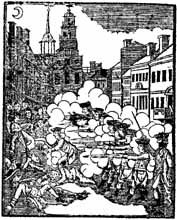
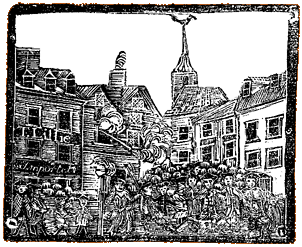
Someone in the crowd threw a stick. It hit Pvt. Montgomery, on the right side of the line of soldiers, and knocked him down. He scrambled back to his feet, fired his musket, and yelled, “Fire!” His comrades responded by shooting, not together but in a ragged sequence. One man didn’t fire—probably Cpl. William Wemms, on the far side of the line.

At first many in the crowd didn’t believe the soldiers’ guns were loaded. But the tall sailor collapsed in the gutter, two balls through his chest. Samuel Gray fell dead on watchman Langford’s foot. Other men and teenagers were also struck, some in the front of the crowd, some in the back, one on his doorstep across the street. Each musket had probably contained two balls, so the seven shots produced a dozen wounds.

The crowd fell back. Constable Burdick tried to take charge for the town, fetching a doctor and another man to carry away the bodies and then trying to memorize the soldiers’ faces. People carried dead and wounded men to taverns, doctors’ offices, or their homes. Capt. Preston swatted up his men’s muskets to stop them from firing again, then marched them back to the Main Guard. Hearing the shots from blocks away, Capt. Goldfinch said, “I thought it would come to this.” His wigmaker’s receipt was still in his pocket.

Sunday, March 04, 2007

Piemont’s Boys Visit the Barracks of the 29th

Though soldiers and locals had brawled in Boston on the 2nd and 3rd of March, the town was quiet on the 4th. After all, it was the Sabbath.

That evening, three young wigmakers went to visit a co-worker—but not just any co-worker. One of those fellows, Richard Ward, recalled:

on the Lord’s day evening preceding the fifth day of March instant, about dusk, he went to see one Mr. Dines (who is a soldier of the 29th regiment, and work worked, when he was not upon duty, in Mr. John Piemont, peruke maker’s shop, with the deponent, a journeyman to said Piemont); the said Dines lives near the barracks at New Boston [i.e., the western wing of the peninsula]; when your deponent was there, he heard one of the officers of the said 29th regiment say to the sergeants, “Don’t let any of your people go out unless there be eight or ten together.”
I’m not sure Ward was a journeyman, as he described himself, since his co-worker Bartholomew Broaders later called him a “fellow-apprentice.” Here is Broaders’s recollection of the same visit:
he went up to see Patrick Dines, a soldier of the 29th regiment, who worked with Mr. Piemont, and in Dawson’s room heard Sergeant Daniels say, that the officers said, since patience would not do, force must. And the soldiers must not bear the affronts of the inhabitants any longer, but resent them, and make them know their distance; and further, that the inhabitants would never be easy, and that he should desire to make the plumbs fly about their ears, and set the town on fire around them, and then they would know who and who were of a side—

said Daniels asked Edward Garrick, fellow-apprentice to the deponent, if he knew where he could get a stick that would bear a good stroke?

Garrick replied, you must look for one.
I interpret young Garrick’s reply to mean, “If you want a club, that’s your problem; leave me out of it.”

What’s so interesting about this episode is the friendly relationship between these apprentices and their fellow worker Dines, and by extension to the rest of the 29th. The young men had apparently gone to socialize with some of the soldiers occupying their town. Officers and sergeants seem to have felt no compunction about speaking frankly in front of the apprentices. Garrick resisted being drawn into the fights of the previous two days, but he doesn’t seem to have complained about Sgt. Daniels to anyone.

In contrast, Garrick and his fellow Piemont apprentices had a grudge against another British military man: Capt. John Goldfinch of the 14th regiment. According to the 1835 book Traits of the Tea-Party:
Mr. [George R. T.] Hewes states...there was a barber at the head of the street [King Street], on the north side, named Piemont, a Frenchman, who usually kept several apprentices; that some of the British officers were in the habit of resorting there; that one of them had come there some months previous, to dress by the quarter, whose bill Piemont promised to allow to the boy who shaved him, if he behaved well; that the quarter had expired, but the money could not be got, though frequent applications had been made for it...
The custom of the time was to give people three months (“the quarter”) to pay their bills; if Goldfinch’s bill became overdue in early March, then he’d had his head shaved in early December. Piemont’s promise may therefore have been a version of the other small bits of money apprentices collected toward the end of the year: at Pope Night, through tip boxes, through New Year’s verses. In any event, in early March those apprentices were getting impatient.

The next time Edward Garrick saw Capt. Goldfinch, he yelled to any and all passersby that the officer “owed my fellow Prentice”! That was Monday evening, on King Street.

(Today’s illustration, showing a barber’s boy being rejected and ejected for trying to collect on a bill, is from the 1896 novel Under the Liberty Tree, by James Otis [real name: James Otis Kaler]. Click on the illustration for a closer look. In that fictional retelling of the riots in Boston in February and March 1770, the barber’s boy is named Hardy Baker, and he’s a troublemaker. Many accounts of the Boston Massacre, fiction and nonfiction, depict the barber’s boys as deliberately provoking British soldiers. But I think the situation was a lot more nuanced than that, as shown by their visit to the barracks the night before.)

Saturday, March 03, 2007

Benjamin Burdick, Jr., Constable of the Town House Watch

Benjamin Burdick, Jr., was born on 23 May 1742, son of a shoemaker. He trained as a barber, advertised his services as a “peruke-maker and hair-cutter” in the Boston News-Letter in June 1765, and under the legal conventions of the time was legally identified with that profession.

But the month he turned twenty-one, Burdick took a different job: he became one of Boston’s town watchmen. After a few years, he became the head of his four-man squad, with the title “Constable of the Watch” for the center of town. He stayed in that job at least until the outbreak of the war in April 1775.

Here are the duties of a Constable of the Watch, as spelled out by Boston’s town clerk in 1767:

1st:— That you with the Watchmen under you attend at said Watch house at the hours of 9 oClock every Night from the 20th: of September to the 20th: of March and continue till clear daylight & at the hour of ten oClock from the 20th: of March to the 20th: of September & that you & each of your [men] continue upon duty untill Sun rise, and if any of your division should misbehave you must inform the Selectmen of it.

2d:— That you keep a fair journal of your doing every Night how you find the State of the Town, and who of the Watchmen are on duty and Report to the Selectmen every Wednesday.

3d:— That two at least of your Division taking their Staves with them walk the Rounds within your Ward to the Westward of your Watch house twice every Night, and oftner if necessary & that other two of your Division walk the rounds in the same manner to ye Eastward of the Watch house...

4th:— In going the rounds care must be taken that the Watchmen are not noisy but behave themselves with strict decorum, that they frequently give the Time of the Night & what the Wheather is with a distinct but moderate Voice; excepting at Times when it is necessary to pass in Silence in order to detect & secure Persons that are out on unlawful Actions.

5 You & your division must endeavour to suppress all Routs Riots & other disorders that may be committed in the Night and secure such Persons as may be guilty; that proper Step’s may be taken the next Morning for a Prosecution as the Law directs we absolutely forbid your taking private satisfaction or any bribe that may be offered you to let such go free or to conceale their Offence from the Selectmen.

6:— You are to take up all Negroes Indian & Molattoe Slaves that may be absent from their Masters houses after 9 oClock at Night & passing the Streets unless they are carrying Lanthorns with light Candles and can give a good & satisfactory Account of their Business that such Offenders may be proceeded with according to Law.
Watchmen carried staffs and lanterns as they patrolled, and also had long bill-hooks in their watch-houses for more difficult jobs, but the town didn’t supply them with swords, guns, or rattles to summon help.

In April 1763 Benjamin Burdick married Jane MacNeal at the town’s Presbyterian meeting-house. Vital records show they had four children in Boston between 1764 and 1774, and the records of a family doctor add a fifth child: Robert, who needed a tooth extracted in 1768.

In 1771, Burdick found another source of income: he took over the bar at the Green Dragon Tavern, home of the St. Andrew’s Lodge of Freemasons, shown above. [As Capt. Ellerby tells Sgt. Dignam in The Depahted, “Hey, world needs plenty of bartenders.”] And the Burdick family also took in boarders.

The arrival of the army regiments in 1768 created problems for Boston’s watchmen: almost immediately, there was a conflict of authority. On 14 November, Burdick and two of his men reported to the Selectmen about a confrontation on the night of the 12th:
Two Persons who were passing were challenged by one of us, when they come to the Watch House & demanded what authority we had for challenging the Kings Soldier. . . . we took [them] to be Officers with their Swords under their Arms; they then forbid us to give the time of Night saying if we did they would put us all in Irons for we had not orders so to do only what the Selectmen gave us which they had no power to do, and also forbid our giving the time of Night any more or keeping any more in the Watch House—they called us damned Scoundrels, threatning that they would bring four Regiments & blow us all to Hell; and likewise threatned to give us a drubbing; they also said they were Kings Soldiers & Gentlemen, that they had Orders from his Majesty, and they were above the Selectmen.
Well-born officers no doubt objected to having to answer to working-class men like Burdick. In return, Whig newspapers complained about army sentinels demanding that locals identify themselves.
The town watch is appointed for our security in the night; to them and not to the military are the inhabitants legally obliged to give an answer, when properly hailed.
It’s hard to imagine a clearer example of conflict between the authority of the London government and the authority of the local government.

In early March 1770, Burdick got swept into the periphery of the fights between ropemakers and soldiers. One of his boarders was a young man who worked at Gray’s ropewalks, perhaps John Wilson. That boarder told Burdick that he felt soldiers were stalking him. The Constable of the Watch later testified:
I had seen two soldiers about my house, I saw one of them hearkening at the window, I saw him again near the house, and asked him what he was after;

he said he was pumping ship: [An allusion to William Green’s insult to Pvt. Patrick Walker?]

Was it not you, says I, that was hearkening at my window last night?

what if it was, he said,

I told him to march off, and he damned me, and I beat him till he had enough of it, and he then went off.

Friday, March 02, 2007

Brawl at Gray’s Ropewalks

On 2 March 1770, Pvt. Patrick Walker of the 29th regiment passed John Gray’s ropewalks in Boston on an errand. Months later, he left a blunt and unhelpful description of what he experienced there:

That about the latter end of February Last, Deponant having Occasion to go by the Ropewalkes in Boston, he was assaulted, knocked Down, trod under feet, Cut in several places, and Very much bruised, without any Provocation Given, by about twelve of the Inhabitants of Boston, (supposed Rope makers) and Left in Danger of his Life
Pvt. Walker had to sign his deposition with his mark, didn’t recall the exact date of this assault, and didn’t accurately describe the details of what led up to his beating. But Walker was correct about minding his own business, fetching water, as he passed the ropewalks. Ropemaker William Green called out a question: did he want work? (Soldiers were allowed to moonlight, which lowered the wages for locals.) Walker asked Green what the work was. For three descriptions of Green’s insulting reply, see my posting on the term “little-house.”

Witnesses differ about what happened next. Drummer Thomas Walker (no relation to Patrick) recalled meeting the private “in the Street cut & bleeding very much” because he and Green had fought. The two soldiers then gathered several of their fellows and returned to the ropewalks.

On the other side, ropemaker Nicholas Feriter stated:
about half past 11 o’clock, A.M., a soldier of the 29th Regiment came to Mr. John Gray’s ropewalks, and looking into one of the windows, said, by God I’ll have satisfaction! with many other oaths; at the last he said he was not afraid of any one in the ropewalks. I stept out of the window and speedily knock’d up his heels. On falling, his coat flew open, and a naked sword appeared
Another ropemaker, Samuel Bostwick, insisted that “Green...took no further notice of” Walker after getting off his clever line, but the soldier came back “with a party of thirty or forty soldiers, headed by a tall negro drummer.” That drummer was Thomas Walker, quoted above; since 1759, the 29th had used black men as its regimental drummers.

Whoever was the first to get physical, Green’s gratuitous insult quickly escalated into a brawl between dozens of soldiers and dozens of ropemakers. Even young apprentices got into the action: Peter Slater, only nine years old, recalled bringing the ropemakers their “way-sticks” or “wouldring-sticks”—each two feet of hickory, used for twisting and laying out strands of hemp.

Sixty-nine-year-old Justice of the Peace John Hill testified:
I was at a house the corner of a passage way leading from Atkinson’s street to Mr. John Gray’s rope-walks, near Green’s barracks so called, when I saw eight or ten soldiers pass the window with clubs. I immediately got up and went to the door, and found them returning from the rope-walks to the barracks; whence they again very speedily re-appeared, now increased to the number of thirty or forty, armed with clubs and other weapons.

In this latter company was a tall negro drummer, to whom I called, you black rascal, what have you to do with white people’s quarrels?

He answered, I suppose I may look on, and went forward.

I went out directly and commanded the peace, telling them I was in commission [i.e., was a magistrate]; but they not regarding me, knocked down a rope-maker in my presence, and two or three of them beating him with clubs, I endeavoured to relieve him; but on approaching the fellows who were mauling him, one of them with a great club struck at me with such violence, that had I not happily avoided it might have been fatal to me.

The party last mentioned rushed in towards the rope-walks, and attacked the rope-makers nigh the tar-kettle, but were soon beat off, drove out of the passage-way by which they entered
Though it’s clear Green’s gratuitous insult had started this conflict, I think it probably escalated in a tit-for-tat pattern, each side bringing in more fighters and thus prompting the other side to do the same. Among the ropemakers involved was a young man named Samuel Gray—no relation to the ropewalks owner. Among the soldiers were Pvts. William Warren and Mathew Kilroy and (during follow-up brawls the next day) John Carroll, all grenadiers in the 29th.

All in all, the ropemakers seem to have gotten the better of the fights. Drummer Walker and Pvt. John Rodgers had to be taken to the hospital on Saturday, and several more soldiers described their injuries in depositions months later. In contrast, though ropemakers complained about the soldiers’ aggression, none reported serious injuries.

On Saturday the owner of those ropewalks, John Gray, visited the colonels of the two regiments in Boston. Gray was very wealthy, not politically active but leaning toward the Crown. (His brother Harrison was the provincial treasurer.) He made a deal with the colonels: he would dismiss Green from his employ, they wouldn’t enter his property without his permission, and each side would try to calm their own men. How well that worked became clear the following Monday night.

(The modern picture of a colonial ropewalk above comes from a webpage about ropemaking in Alexandria, Virginia. There are other useful sites about the cordage industry from Lewis-Clark.org, kite flyer Uli Wahl, and the Historic Naval Ships Association. Incidentally, in January 1771 the fired ropemaker William Green started working at the Box & Austin ropewalk on the other side of town. One of that firm’s account books is in the Winterthur library.)

Thursday, March 01, 2007

Edward Montgomery: private, family man, defendant

Pvt. Edward Montgomery arrived in Boston in 1768 along with the rest of Capt. John Corrance’s grenadier company in His Majesty’s 28th Regiment of Foot. Like many of his fellow soldiers, he was ethnically Irish and most likely Catholic. This background made them very unpopular in pre-Revolutionary Boston, which had a whole holiday devoted to defaming the Pope.

But Bostonians didn’t really need their anti-Catholicism to resent the arrival of the 29th and three other regiments, probably about 1,200 soldiers in all, in late 1768. The town then had fewer than 3,000 white men—i.e., potential voters and militia fighters. The equivalent military presence in Boston today, with approximately 470,000 adults of both sexes and all ethnicities, would be 188,000, or far more than the entire U.S. troop strength in Iraq, all concentrated in a single city. (Even if we compared the men in the regiments to Boston’s total population in 1770, more than half of which was under age 16, the equivalent number of soldiers today would be nearly 50,000.)

Boston felt like a town under military occupation, with sentries at the gates and various corners challenging people as they walked by. Even after the royal authorities removed two regiments in late 1769, the locals still resented their presence.

Montgomery was unusual in his company, though probably not unique, because he brought his family with him. His wife Isabela and their children Mary, Esther, and William took lodgings near the North Battery in the North End, in a building owned by Royall Tyler, a wealthy and Whiggish politician. (He was the father of the Royall Tyler who became America’s first homegrown playwright and Chief Justice of Vermont.)

The family’s relationship with their neighbors might be summed up by this testimony from Caleb Swan:

at the time of the bells ringing for fire [on 5 Mar 1770], he heard a woman’s voice, whom he knew to be the supposed wife of one Montgomery, a grenadier of the 29th regiment, standing at her door, and heard her say it was not fire; the town was too haughty and too proud; that many of their arses would be laid low before the morning.

Upon which Susanna Cathcart said to her, I hope your husband will be killed.

On which the woman replied, my husband is able and will stand his ground.
(I especially admire the term “supposed,” with the implication that the Montgomerys might not really be married.)

That night Pvt. Edward Montgomery was indeed caught up in the violence soon dubbed the “Boston Massacre.” For some reason, when he was indicted for his role, his first name was set down as “Hugh.” After that, in all the court records for the case and the published transcript, he was called “Hugh.” However, all the regiment’s muster rolls and the town’s record of his family state his name as Edward.

I won’t yet mention what Pvt. Montgomery did on the night of 5 Mar 1770, or how the soldiers’ trial turned out for him. But in late 1770 he and all the other indicted soldiers sailed to New Jersey to rejoin their regiment. On 18 May 1771, Montgomery was listed as being on “Furloe.” On 23 Nov 1772 he was on duty in St. Augustine, Florida, and then on 4 Aug 1774 at Dover Castle in the U.K.

The 29th regiment was sent back to America in 1776 to relieve Québec from the American siege. The next year, the grenadier company was attached to Gen. John Burgoyne’s army attacking southward from Canada, which surrendered to the U.S. forces in the fall. If Pvt. Edward Montgomery was still with his company then, he was marched back to greater Boston as a prisoner of war in what became known as the “Convention Army.” I have no idea what he or his family thought of that fate, but I imagine it couldn’t have been pleasant.

Wednesday, February 28, 2007

Boston Massacre Weekend at the Old State House

Next Monday will be the 237th anniversary of the Boston Massacre, which took place on Monday, 5 March 1770, about one block from the Town House. That building, now called the Old State House, is the headquarters and museum of the Bostonian Society. Starting tomorrow it will host a series of events commemorating the Boston Massacre. Here’s the schedule they sent me.

Thursday, 1 March, 6:30
Suffolk University professor Robert Allison begins the annual commemoration with a talk on his short new book, The Boston Massacre. Discussion and refreshments. Free.

Friday, 2 March, 11:00 and 2:00
“Witness to a Massacre,” a short play presented by The Freedom Trail Foundation. Richard Palmes, the man defense attorney John Adams called “the most material witness to the Boston Massacre”, presents his version of the notorious event. Discussion. Free with museum admission.

Saturday, 3 March, 11:00 and 2:00
Young visitors will be the stars in a reenactment of the Boston Massacre, led by rangers from the Adams National Historical Park. Fun for the whole family! Free; on the mall outside of the Old State House.
11:30 and 2:30
Watch patriot lawyers John Adams and Josiah Quincy defend the British soldiers accused of murdering Bostonians while Samuel Quincy prosecutes inside the historic Old State House. Self-defense or cold-blooded murder? Audience members act as jurors for this celebrated case. Program led by rangers from the Adams National Historical Park. Free with museum admission.

Sunday, 4 March, 1:30
Discover the connection between ropemaking and the Boston Massacre. Watch rope being made and learn about the importance of rope and ropemaking in revolutionary Boston. Appropriate for age 6 and up. Free with museum admission.

Monday, 5 March, 11:00 and 2:00
“Witness to a Massacre” reprise—see above
5:30 and 6:30
Noted reenactor David Connor portrays Revere, talking about his involvement with the Boston Massacre and his famous engraving. Free with museum admission.
8:00 P.M.
Boston Massacre Reenactment. See the event that sparked the Revolution! The Massachusetts Council of Minutemen and Militia and His Majesty’s 5th regiment of Foot will reenact the famous incident outside the Old State House. Light refreshments after the event in the Old State House. Free.

Tuesday, February 27, 2007

John Piemont: wigmaker, tavern-keeper, assailant?

John Piemont was born in 1717 or so. He was later referred to as “a Frenchman,” so he probably came to Boston from France or French Canada. I can’t find anything else about Piemont’s life before late 1759, when he advertised in the Boston News-Letter that he was working out of Peter Smith’s house on Union Street. In any event, his trail grows clearer at the end of that year.

On 20 Oct 1762, John Piemont married Hannah Crosby (born in Jan 1739) at Christ Church (now called Old North). They had four children baptized at King’s Chapel: Hannah (1763), John (1766), Elizabeth Murray (1767), and Thomas (1769). In Feb 1766, the couple also sponsored the baptism of John’s apprentice Thomas Allen.

In the 1760s Piemont established himself as a wigmaker on King Street in Boston, one of the town’s busiest streets. In 1767, for example, he sold a bag wig to James Bowdoin, one of the town’s leading merchants and Whigs, but he also served Lt. Gov. Thomas Hutchinson, leader of the court party. In the summer of 1766, Dr. Joseph Warren visited Piemont’s home twice and sold him medicine for a “Servt.,” which was colonial Boston’s usual euphemism for a slave. In 1769, Piemont sold tickets for a fireworks artist and hosted a confectioner—both these men had French names, so he may have been helping out his countrymen.

That same year, according to Pvt. John Timmons of the 29th regiment, Piemont participated in an assault on him. On 28 July 1770, Pvt. Timmons swore to this deposition before the chief justice of New Jersey:

That on the Fourteenth June, One Thousand Seven Hundred and Sixty Nine, he had the Main Guard [i.e., was on sentry duty] in Boston, and between the Hours of Nine and Ten O’Clock at Night, was Knocked down in the Street, by the Blow of a Stone, or Brickbatt, as this Deponant Supposes, and after he Recover’d Himself, he heard a Woman shout Murder, & said the Rogues that struck this Deponant was gone up that way, Pointing towards the South Meeting House, upon which word she was pushed down, and Damn’d for a whore to Keep Silance,

this Deponant then persued according to her Directions, and turning the Corner of the Meeting House, was met by three persons armed with Clubs, who Gave this Deponant a blow on the Forehead, which Knocked him down and Cut him very much, that on this Deponant attempting to rise to Defend himself, they Gave this Deponant another most Desperate Cut on the head, which Rendered this Deponant incapable of helping Himself, and Quite Sensless, they afterwards most Terably Kicked this Deponant, and Dragged him along the Streets but hearing the Main Guard was coming, they left this Deponant for Dead, upon which one Mr. Winslow an Inhabitant, ordered this Deponant to be carried into a House, and Sent for the Docter of the Fourteenth Regiment, who Dressed this Deponant’s wounds, and with a great Deal of Difficulty stopt the Blood,

The Docter at the Same time Asked Mr. Winslow, if those Villians could not be found out, Mr. Winslow told the Doctor, they should be found out, and the Next Morning Mr. Winslow and Mr. [Harrison] Gray (Provincial Treasurer) informed this Deponent of three of the Men they knew, which were John Reed, Josiah Davis, & John Paymount all three Wigmakers and Inhabitants of Boston, and advised this Deponant, to take the Civil law of them, upon which this Deponant applyed to Justice [Edmund] Quincey, when after informing him of the abuse Received, the said Justice advised this Deponant to drop it, if the said Reed, Davis and Paymount would make the Deponant any Restitution, telling this Deponant, it would put Him to more expense then he could afford saying they might postpone it from Court, to Court, upon which this Deponant Imagined the Said Justice Mean’d to baffle him, and insisted for a Warrant, which the said Justice Refused at that time, telling this Deponant he had too Much business in hand, and Desired this Deponant to Come in the Evening, which he accordingly did,

The Said Justice then advised this Deponant to make it up, and said he would send for Mr. Davis, to whome he had Given a Warrant against this Deponant, after this Deponant had left his, the Said Justices House in the Morning, Which this Deponant Refused. Desireing the Said Justice again to Grant a Warrant, which the Chief Justice Refused a Second time, on pretence of Business, Upon which this Deponant, apply’d to two other Magistrates Justice Deney [Francis Dana?] & Justice [John] Hill who both put this Deponant off with Excuses of the same Nature, nor could this Deponant Gett any Satisfaction, for the Injury he had Received, and further Saith not.
There were many brawls like this between soldiers and locals in 1768 and 1769. Some Boston magistrates, including Quincy, Dana, and Hill, did discourage British soldiers from taking legal action after these fights, and put obstacles in their way. Crown authorities took Pvt. Timmons’s deposition, along with scores of others, in mid-1770 in order to document how badly Boston had treated those soldiers.

However, the notion of Piemont assaulting a soldier like this doesn’t add up for me. It seems a bit extreme for a fifty-two-year-old man. It also seems odd that Winslow and Gray were able to track down the soldier’s mysterious assailants overnight. In fact, I can’t track down wigmakers named John Reed and Josiah Davis at all.

Most important, this assault doesn’t fit with how we know Piemont was running his wigmaking business in 1769-70. Not only did he serve royal officials and British army officers, but in March 1770 he was employing Pvt. Patrick Dines of the 29th regiment. Soldiers were allowed to moonlight in order to earn extra cash; this produced some resentment among local workers, but employers like Piemont probably liked a larger labor pool.

Furthermore, within five years Massachusetts Patriots were whispering that Piemont was a Tory. In June 1773, he announced that he was quitting the wigmaking business and moving to Danvers, where he opened a tavern. John Adams stayed there in June 1774. Three days after the Revolutionary War began, a committee from Danvers put the following certificate in the Essex Gazette:
This may certify, That about two years ago Mr. John Piemont came to dwell in the Town of Danvers, and was well recommended by the Selectmen of the Town of Boston, and though some Persons have called him a Tory, to his great Damage, yet we as a Committee of Inspection for the Town of Danvers, have carefully examined into Mr. Piemont’s character, and are fully satisfied that he is a friend to us in the common cause of our country, and we hope all our friends will treat him as such, and call upon him for Entertainment, as he keeps a large public House in said Danvers.
People in Salem probably whispered about Piemont’s loyalties because he was a stranger to town, a foreigner, and an Anglican. But if he’d been such a fervent Whig as to attack a soldier on duty, why did neighbors have any doubt about his politics?

Of course, the historical record is full of holes. I can imagine reasons why Piemont might have attacked Pvt. Timmons in 1769 yet employed Pvt. Dines in 1770. But I must also entertain another reason why Timmons named Piemont as his assailant.

Pvt. Timmons knew that his superiors were gathering depositions as a response to the Boston Massacre of March 1770. And, as I’ll discuss later this week, apprentices from Piemont’s shop helped to instigate that event. [Yes, you thought this was yet another post about wigs, but it’s actually about the Massacre.] So Timmons might have thought that his superiors would be pleased with information that could exonerate his companions back in Boston—such as a tale of a violent barber.

As for Piemont, he was still in Danvers in 1776 when he billed the new state for “supplies to the provincial army.” In 1783 he was keeping an inn in Ipswich, and lost his barn and one cow in a fire; the next year, he assured customers that he could once again stable their horses. By 1789, according to Boston’s first business directory, John Piemont was back in Boston. Indeed, he was back on King Street, now renamed State Street. He was retailing liquor that year, and in October 1791 he took over the Eastern Coffee House (again advertising “Good Stabling for Horses”).

John Piemont died in Boston on 15 Sept 1802, aged 85. The Columbian Centinel said that he would be buried out of his home on Ann Street, and “the Brethren of the Ancient and Honorable Fraternity of Masons (of which he has been an able and eminent Member) are invited to attend.” His wife and all four children survived him.

A Birthday Tribute (of Sorts) to H. W. Longfellow

Today is the bicentennial of American poet Henry Wadsworth Longfellow, born in Portland on 26 Feb 1807. He was the U.S. of A.’s most widely read, memorized, and parodied poet in the late nineteenth century, when people reread and quoted poetry to express their emotions the way we now recall recordings of popular songs.

Along with friends like Hawthorne and Emerson, Longfellow helped to create the first American literary canon, adapting European epic and ballad forms to tell such North American stories as The Song of Hiawatha (Native Americans), Evangeline (Acadians expelled from Canada to Louisiana), “The Courtship of Miles Standish” (Plymouth settlers), and, most famously, “Paul Revere’s Ride” (the first day of the Revolution).

It thus seems a most opportune day to point to “The Misplaced Bones of William Dawes,” by Timothy Abbott at Walking the Berkshires, inspired by Sunday’s Boston 1775 posting about the remains of Paul Revere’s companion during their interrupted ride from Lexington to Concord early in the morning of 19 April 1775. Longfellow parody lives!

Monday, February 26, 2007

The Funeral of Christopher Seider

Today is the 237th anniversary of the funeral of Christopher Seider, a young servant killed by a Customs official during a riot in February 1770. Boston’s Whigs made as much of the boy’s death as they could, portraying him as a martyr for liberty and a victim of tyranny. Several newspapers ran this notice:

he will be buried from his father’s house in Frog Lane [now Boylston Street], opposite to Liberty Tree, this afternoon; when all the friends of Liberty may have an opportunity of paying their last respects to the remains of this little hero and first martyr to the noble cause, whose manly spirit (after the accident happened) appeared in his discreet answers to his Doctor, his thanks to the clergyman who prayed with him, and the firmness of mind he showed when he first saw his parents, and while he underwent the great distress of bodily pain, and with which he met the king of terrors. . . .
The 1 March 1770 Boston News-Letter described the funeral procession this way:
It began about three o’clock from Liberty Tree, (the dwelling-house of the parents of the deceased being but a little distance from thence), the boys from several schools, supposed to be between four and five hundred, preceded the corpse in couples.

After the sorrowful relatives and particular friends of the youth, followed many of the principal gentlemen and a great number of other respectable inhabitants of this town, by computation exceeding thirteen hundred: about thirty chariots, chaises, etc., closed the procession. Throughout the whole there appeared the greater solemnity and good order, and by as numerous a train as was ever known here.
The velvet pall that covered the small coffin had a Latin inscription:
Latet Anguis in Herba.
Hoeret Lateris lethalis Armada.
Innocentia nusquam in tuta.

(The serpent lurks in the grass. [A quote from Virgil’s Third Eclogue]
The fatal dart is thrown.
Innocence is nowhere safe.)
As the procession passed Liberty Tree, people could read these Biblical comments on boards nailed to the elm:
Thou shalt take no satisfaction of the life of a murderer. He shall surely be put to death.
Though hand join hand, the wicked shall not pass unpunished.
The first line is from Numbers 35, the second Proverbs 16. (Congregationalist Boston did not rely on the Anglican church’s King James translation.)

John Adams, having ridden to Boston from legal business in Weymouth, wrote in his diary:
When I came into Town, I saw a vast Collection of People, near Liberty Tree — enquired and found the funeral of the Child, lately kill’d by [Ebenezer] Richardson was to be attended. Went into Mr. Rowes, and warmed me, and then went out with him to the Funeral, a vast Number of Boys walked before the Coffin, a vast Number of Women and Men after it, and a Number of Carriages. My Eyes never beheld such a funeral. The Procession extended further than can be well imagined.

This Shewes, there are many more Lives to spend if wanted in the Service of their Country.

It Shews, too that the Faction [i.e., the royal appointees that Adams and his fellow Whigs thought were angling for power] is not yet expiring — that the Ardor of the People is not to be quelled by the Slaughter of one Child and the Wounding of another.
Merchant John Rowe wrote in his diary, “I am very sure two thousand people attended his funerall.” The Rev. William Gordon later reported that the procession was a quarter-mile long.

Showing less sympathy, Gov. Thomas Hutchinson would write in his History of the Province of Massachusetts Bay:
The boy that was killed was the son of a poor German. A grand funeral was, however, judged very proper for him.

Sunday, February 25, 2007

William Dawes, Jr., Found in Jamaica Plain?

Today’s Boston Globe breaks the story that the remains of militia organizer and midnight rider William Dawes, Jr., might be in the Forest Hills Cemetery in Jamaica Plain rather than (as modern guidebooks state) the burying-ground next to King’s Chapel in downtown Boston.

Historical tour guide Al Maze recently discovered a document putting Dawes in Forest Hills, the article says. His suggestion has support from local historian Charles Bahne, also quoted in the article, who tipped me off about this possibility a couple of weeks ago.

Maze hasn’t found the record of Dawes’s original burial in 1799. Instead, he found a record from Forest Hills indicating that one body interred in the May family area was “William Dawes Mar. 30, 1882 In Tomb, Died 1799. . . . These remains removed from Boylston Street Burial Grounds.” Why would Dawes be buried with the May family? Because his first wife was Mehitable May.

As for Dawes’s original interment, the “Boylston Street Burial Grounds” is a late-nineteenth-century term for the Central Burying-Ground on the south side of Boston Common, shown above. It expanded in the 1790s as the cemeteries close to the center of Boston filled up, so that would have been a logical place for a man of Dawes’s class to be interred at the time.

According to Bahne, the public identification of the Dawes family tomb in the King’s Chapel burying-ground with the rider dates only from 1899, when the Sons of the American Revolution was eager to identify Patriots’ resting-places. As I noted in my first article about Christopher Seider, the SAR’s monuments, while helping to preserve the memories of many historical figures, don’t always identify them and their whereabouts correctly.

Another factor in the possible confusion was how many generations in a family had the same name. The Revolutionary leader Samuel Adams was the son of a Samuel Adams and the father of another Samuel Adams. The same goes for Paul Revere, John Hancock, and other men of the time. William Dawes’s father was named William, and his first son was named William, so it might have been easy to see that name on a document and assume it referred to the most famous William. But only one died in 1799.

Saturday, February 24, 2007

William Molineux Saves Ebenezer Richardson's Neck

When Ebenezer Richardson shot Christopher Seider from his window on 22 Feb 1770, the Bostonians watching were naturally upset. Richardson was already unpopular, and shooting an eleven-year-old in broad daylight didn’t improve his image, even though a mob of boys was attacking his house. A witness taking notes for the Crown said:

they Rang the Brick meeting bell as if for fire which soon Collected a vast Concourse of people, who broke down the side of his house & when they had made a breach wide enough several entered & took Richardson & one Wilmot who assisted him, seized him and his companion George Wilmot, and marched them outside.
Wilmot, a sailor for the Customs service, quickly gave up, protesting that his gun was defective and couldn’t have fired even if he’d tried. Richardson, in contrast, had briefly fended off the crowd with a cutlass, shouting about the wounded boys, “Damn their blood! I don’t care what I’ve done!” Some in the mob prepared to hang Richardson right there, even though those two boys were still alive.

By this time the merchant William Molineux had arrived on the scene. He was one of the most radical Whigs in Boston, shocking even fellow gentlemen with his extreme comments. (Gentlemen were never supposed to be extreme.) For example, after a meeting of merchants on nonimportation on 12 Jan 1770, the Crown informant reported:
Many were disgusted at Mollyneaux’s violent proposals particularly at a speech made at the meeting at which the vote against [Joseph] Green [Theophilus] Lillie &c was pass’d, wherein he declared that were it not for the Law he would with his own hands put to Death any person who should presume to open their goods [i.e., sell goods they had imported and then stored]
At another of the big nonimportation meetings that month, Molineux proposed that the whole crowd visit two importers at their father’s house. However, their father was Thomas Hutchinson, lieutenant governor and acting governor. Young lawyer Josiah Quincy, Jr., warned dramatically that such an action was a trap, that confronting the representative of the king that way could be taken as treason. Molineux agreed to a small committee instead, but then several upper-class gentlemen declined to serve on it.

The informant described the dramatic result:
It would be impossible Sir to describe the looks of Mollineaux when he found so many had deserted him, he drew his hand across his Throat, and declar’d he was ready to Die that Minute, that for his part he scorn’d to have any thing more to do with them, and then immediately Jump’d down from his Seat among the People with a view to march off, upon this Dr. [Thomas] Young ascended a Form [i.e., a bench], and in the most earnest manner beg’d him for Gods sake to stay, otherwise their Plan would be entirely overthrown, with much perswasion and a great deal of pulling, he was at last fix’d in his former Seat
(Another source quotes Dr. Young this way: “Stop Mr. Molineux, stop Mr. Molineux...If Mr. Molineux leaves us we are forever undone, this day is the last dawn of liberty we shall ever see.” Young was much cheerier than Molineux, but equally hyperbolic.)

Earlier in February 1770, witnesses saw Molineux looking on with approval the first time that boys had picketed an importer’s store. And he may well have known Christopher Seider personally; the boy worked in the household of wealthy widow Grizzell Apthorp, and Molineux was the Boston agent for the business of her eldest son.

Yet when the mob threatened to kill Richardson, Molineux waded into the crowd, insisting that they let the law take its course. Gov. Hutchinson himself reported that Molineux managed to calm the people and lead the prisoners to Justice John Ruddock. That North End magistrate, also a fervent Whig, decided to take the prisoners to Faneuil Hall, where four other justices gathered. In front of the large crowd, they questioned the two men, charging Richardson with a dangerous assault and Wilmot as his accessory.

Then the justices sent the two prisoners to Boston’s jail in the custody of some town constables. Ordinarily those officials delivered writs and seized property; they really weren’t prepared to be police officers or marshals. The mob once again tried to string Richardson up on his way to jail:
it was with difficulty that they got Richardson there, the mob endeavouring to put a rope about his Neck & take him from the Constables to execute him themselves, but was prevented by some leading men of the popular side.
At last, thanks to Molineux and his Whig colleagues, Richardson was safely behind bars. After Christopher Seider died that evening, the charges against him were upgraded to murder. The superior court was due to open on Monday, 13 March.

Thursday, February 22, 2007

Boston's First Revolutionary Death, 237 Years Ago

For a couple of days I’ve been discussing how in early 1770 Boston was aboil with conflict over a “nonimportation” of goods from Britain to protest the Townshend duties. Most of the town supported this boycott, and Whigs were pressuring the handful of merchants and shopkeepers who refused to sign on.

Part of that pressure in early February were crowds of boys marching outside importers’ stores; these protests appeared every Thursday morning when there was no school. On 22 Feb 1770, these young Whigs focused their attention on small merchant Theophilus Lillie. They set up their “Pageantry” on Union Street: a hand pointing to his shop with the word IMPORTER, and an effigy of Lillie’s head on a pole.

Along came Ebenezer Richardson, a Customs service employee. As I described in a New England Ancestors article available online, Richardson had become notorious in his home town of Woburn for having impregnated his wife’s sister and letting blame fall on the town’s minister for several months. He then moved to Boston and made his living as a confidential informer, first for the Attorney General and then for the Customs service. When that work was exposed in the early 1760s, Richardson became even more unpopular, and started to work openly for Customs since no one else would employ him.

The Customs establishment opposed the nonimportation movement, and Richardson apparently took it upon himself to break up the boys’ protest of Lillie’s shop. First he tried to persuade two farmers in Boston for market day to knock down the carved head with their wagons. The drivers refused. Whig gentlemen watching the action laughed at Richardson’s efforts. He stomped off to his nearby home, shouting, “Perjury! Perjury!”

It’s unclear what Richardson was referring to, but, as the Boston Evening-Post reported, “The Boys on hearing the words began to gather round, and call him an informer.” Richardson and his wife Kezia (the same woman he had impregnated and eventually married years before) shooed them away. The boys said, “they would not, Kings high Way”—meaning they had every right to be on the street.

Richardson flourished a stick. The boys ran around “with the squeeling and noise they usually make on such occasion,” said the newspaper. The young mob, now numbering at least “60 or 70 Boys,” left Lillie’s shop and started pelting Richardson’s house with “Limon Peels,” witnesses later testified. The boys hit Kezia Richardson with an egg. Someone inside the house tossed out a brickbat, striking a sailor. He threw it back through a window.

A low-level Customs employee named George Wilmot came to the house and offered help. According to one of the Richardsons’ daughters, “Wilmot asked [my father] if he had any Gun.” Both men armed themselves with muskets.

Richardson came out his front door and yelled at the boys, “as sure as there was a G[od] in heaven, he’d blow a Lane thro ’em.” He “snapped” his gun—firing it with powder but no ball, like a blank shot. The boys scattered and came back again, no longer tossing “light rubbish of one kind or another” but throwing stones through windows.

Richardson reappeared with his musket at an upper window. The boys continued to throw rocks. Richardson fired his musket again. This time he had loaded it with buckshot pellets, “about the bigness of large peas.”

Some of those pellets sliced through the baggy pants of a sailor named Robert Patterson. A few pierced the right hand and thigh of a nineteen-year-old painter named Sammy Gore. Eleven pieces flew into the chest of Christopher Seider, a servant boy just about eleven years old, who was “stooping to take up a Stone.”

The wounded boys were taken into a nearby house. As the violence continued outside, Dr. Joseph Warren, Dr. Thomas Young, and other surgeons examined them. Christopher’s chest was gradually filling with blood. People brought his parents, poor German immigrants, from their little home at the far end of Boston Common. Clergymen came to pray with the family. Christopher Seider died around nine o’clock on the night of 22 February, the first death of Boston’s Revolutionary conflict.

Restoring Gen. Washington, His Tent, and His Speech

George Washington was born on 11 February 1732, according to the calendar. But that was the Julian calendar, which the British Empire was still using because the more accurate Gregorian calendar had the misfortune to be favored by the Roman Catholic church. By the time Britain and its colonies adjusted their calendars to match the rest of western Europe in 1752, there was an eleven-day difference. Washington therefore recalculated his birthday as 22 February, and that’s the date we still treat as Washington’s “real” birthday.

To observe that occasion, here are links to three news stories about remembrances of the man.
It turns out the Metropolitan Museum of Art isn’t the only institution restoring its painting of Gen. George Washington crossing the Delaware. Boston’s Museum of Fine Arts has people working on Thomas Sully’s “Passage of the Delaware” (1819), shown above. Because of its size, the Boston Globe says, the painting will be conserved in its gallery, and museum visitors can watch the work progress.

The New York Times reported that a strip of linen cloth owned by Yale and on loan at Mount Vernon, said to be from one of the general’s campaign tents, perfectly matched a hole in the campaign tent once on display at Valley Forge. While that tent now appears to be white linen, as shown in a 1909 photograph, close examination of the cloth suggests it originally had blue stripes. The tent will be displayed again when the American Revolution Center in Valley Forge opens.

Finally, the Washington Post reported on how the Maryland state archives is celebrating its acquisition of Washington’s draft of his speech resigning his commission as commander-in-chief in Annapolis on 23 Dec 1783.