J. L. BELL is a Massachusetts writer who specializes in (among other things) the start of the American Revolution in and around Boston. He is particularly interested in the experiences of children in 1765-75. He has published scholarly papers and popular articles for both children and adults. He was consultant for an episode of History Detectives, and contributed to a display at Minute Man National Historic Park.

Subscribe thru Follow.it


•••••••••••••••••


Sunday, October 05, 2008

Finding “Founding Fathers”

Last month I was chatting with Richard Ryerson, former editor-in-chief of the Adams Papers, about not finding any use of the phrase “Intolerable Acts” in 1774-75. He in turn reminded me that many books credit another phrase that we use a lot when speaking of the Revolution—“founding fathers”—to Warren G. Harding. So I figured I’d try to confirm that.

Harding was certainly fond of the phrase, and used it in many speeches. In fact, he used it three times in his address to the 1916 Republican National Convention alone. And he went back to it on a lot of other occasions as well. Folks soon noticed. Authors wrote of it as one of Harding’s favorite phrases. After he became President, the phrase lost its quotation marks and appeared in such popular literature as Eugene O’Neill’s The Hairy Ape (1922).

However, the Oxford English Dictionary gives credit for the phrase to a book called Founding Fathers: Men Who Shaped Our Tradition, by Kenneth B. Umbriet, which it dates to 1914. But that must have been a typo. That book was published in 1941. So Harding’s our man after all, it appears.

But not so fast. Through the magic of Google Books, I found an author using the term “founding fathers” twenty years before Harding. On 8 June 1886, the Rev. Edward Anderson gave an address titled “Patriotism in Our Churches,” published in The One Hundred and Fiftieth Anniversary of the Consociations, Fairfield East and Fairfield West. He intoned:

But a deeper matter than this comes of our Christian patriotism in the churches, and that shows in our process of reconstruction. Our land has been made secure (who doubts it) because of the Christian principle that underlies it, as shown in the deeply religious phaze of our [Civil] war. Are prayers of the founding fathers to be echoed in prayers of the establishing sons, for nothing? Not if God lives, and not if there is truth in the history of his national leading all the way from Israel to now.
I don’t follow the theology, but I can recognize the alliterative phrase when I see it.

I strongly doubt that a privately published celebration of a church anniversary in Connecticut could have influenced the never-very-deep thoughts of a politician in Ohio. So Harding probably came up with the phrase independent of Anderson.

Indeed, they might both have found the words “founding father” in, of all, places, a Robert Browning poem. This is a passage from Red Cotton Night-cap Country, or Turf and Towers, published in 1873:
Red, Red, where is the tinge of promised Red
In this old tale of town and country life,
This rise and progress of a family?
First comes the bustling man of enterprise,
The fortune-founding father, rightly rough,
As who must grub and grab, play pioneer.
A very different picture of a “founding father.”

Saturday, October 04, 2008

The Green States

I’m no fan of the Electoral College. It never decided elections as the Constitution’s writers had hoped, and four times so far has stood in the way of the executive branch “deriving their just powers from the consent of the governed,” in the words of the Declaration of Independence.

One of the Electoral College’s few advantages is that it makes mapping out presidential votes prettier. 270toWin.com offers maps of the Elector breakdowns in every U.S. presidential election going back to 1789. In that year, George Washington (Federalist, shown in green) swept all eleven states that had ratified the Constitution in time to participate. In 1792, the whole country went green.

Then came the stark geographic divides of the John AdamsThomas Jefferson contests, with Democratic-Republican blue appearing on the map and incrementally sweeping up the country until 1820. The website starts using a darker Democratic blue, closer to what the television networks have used lately, at the time of Andrew Jackson’s win in 1828. Whigs are purple.

Wikipedia has its own series of Electoral College maps, taken from the government’s National Atlas of the United States. It’s more accurate in terms of the land that each state claimed at the time of each election, but the colors just aren’t as pretty.

(Thanks to Andrew Sullivan’s Daily Dish for the pointer.)

Friday, October 03, 2008

A Busy Day

Yesterday I hit two archives, and got hit once.

At the National Archives and Records Administration’s Waltham facility, I found some correspondence I was seeking about Col. Richard Gridley, the first commander of the American artillery regiment. With friendly staff help, that took only half an hour, so I got back in the car and drove west to the American Antiquarian Society in Worcester.

I was waiting for an opening in traffic to make the last turn toward that facility when—BOMP!—I got rear-ended. The other car hit hard enough for its grille to shatter, its hood to buckle, and its headlights to go cross-eyed. The driver then found she couldn’t swing her door open. Yet all the damage I could find on my car was a hole in the plastic bumper and a nasty noise—which later went away after three miles. No damage to me or my microfilm printouts from Waltham.

So after exchanging info with the other driver, I went into the A.A.S. to collect the info I was really interested in—material about Col. James Barrett of Concord. I first read about this material in George A. Billias’s biography of Elbridge Gerry, but that book cited “volumes” in a collection that appeared nowhere in the online catalogue. It turned out that in the late 1970s, after Billias published, the A.A.S. disassembled those volumes—scrapbooks, really—and filed the individual documents in folders for easier preservation and consultation. Along the way, the collection got a slightly different name. Again, with friendly staff help, I found some good stuff, which I’ll describe eventually.

But today I’m dealing with the car.

Thursday, October 02, 2008

The Loyalist Experience of the Atlantic World

One of the hot historical phrases of the past decade has been “the Atlantic world.” This is shorthand for recognizing that the histories of the countries that surround the Atlantic Ocean are greatly intertwined. People not only moved (or were moved) across national borders, but in the Age of Empire those borders encompassed a lot more territory. An enterprising Englishman could travel and settle in Ireland, two or three Caribbean islands, and the colonies that became the U.S. of A. and Canada—regions that have been treated as four different historical specialties, at least—without ever leaving the British Empire.

Once scholars had enjoyed the immediate discoveries arising from that change of perspective, people began to specialize again, looking at “the Atlantic world” through various particular lenses: the African experience of the Atlantic world, the Quaker experience, mahogany’s experience. At last spring’s Omohundro Institute Conference, Prof. Christopher Clark (himself a transoceanic migrant) opined, “These days, we can each have our own Atlantic.”

Which brings me to tomorrow’s deadline for proposals for the “Loyalism and the Atlantic Revolutionary World” conference being planned for 4-6 June 2009 at the University of Maine at Orono. The call for proposals says, “The organizers welcome individual paper and panel proposals from scholars in all disciplines who explore loyalism beyond a U.S. national framework. British imperial, Canadian, Atlantic, and global perspectives are all expected to be addressed over the course of the conference.” Paper proposals should take the form of a 750-word abstract and short curriculum vitae, mailed before the end of Friday.

The Way to Subjugate Boston in 1779?

Col. Thomas Goldthwaite (1717-1799, thumbnail image courtesy of the Maine Memory Network) was the militia colonel in charge of Fort Pownall, guarding Penobscot Bay in Maine. He was also a major landowner in that region, and his son ran a trading-post near the mouth of the Kenduskeag.

In April 1775, Goldthwaite surrendered the cannons in Fort Pownall to a British naval vessel. Within a few months he became unpopular with his neighbors, though a few said he’d had no choice. In July, the militia under their new colonel, James Cargill, drove Goldthwaite and his family away, and he appears to have sailed to Nova Scotia.

On 2 Oct 1779, Goldthwaite was in New York, writing to the British commander-in-chief, Gen. Sir Henry Clinton. That letter ended up in the papers of the Royal Institution in London, and was published by the British government in 1906. It’s not entirely surprising, given where he came from, that Goldthwaite thought Boston depended on the natural resources of Maine. He had no doubt made the same argument when convincing men to settle there. He told Clinton:

Since my arrival from Penobscot I have been in hopes of having the honr. of an interview with your Excellency to lay before you the state of that country, & the importance of it to the crown, which by many years experience I must have a more adequate idea of than the cursory acquaintance of gentlemen who may differ from me in opinion.

If it is of any consequence of the crown to subjugate Boston, Salem, Newbury &c. those principal seats of rebellion, the way to effect it is to cut off the eastern part of that province which is their only source for fuel, masts, spars, lumber of every kind &c.

The post taken at Penobscot is a long step towards it, & if it shou’d be soon seconded by taking another post at Casco-bay or somewhere thereabouts, it wou’d compleat it; but if this shou’d be impracticable at this difficult time, it is of the utmost consequence, that the post already at Penobscot is secured. If the present arrangement of his Majesty’s troops wont permit of a reinforcement there, at this time, I myself will undertake to raise a Battalion out of the militia of that country, which notwithstanding their seeming delinquency in their late unhappy situation, I’ll pledge myself for it, that they will make as good subjects as any the King has got.

’Twas I, principally, yt. [i.e., that] settled them in that country; I commanded them, & I fully know their principles, & have estate enough to carry into execution what I propose. Their numbers in this new settlement before these troubles came on were more than 2400 able men & whom I dare vouch, are principally our friends but if we neglect them & throw away that post, they most probably will become our enemies. I will enter into particulars & more fully explain those matters if your Excellency will be pleas’d to give me opportunity.
Apparently Clinton didn’t seize this opportunity, and Goldthwaite soon sailed for England. He arrived in Portsmouth on 15 Feb 1780, according to the diary of former governor Thomas Hutchinson, and settled with his wife at Walthamstow in Essex.

In 1896, a decade before this letter was printed, the Maine Historical Society published a paper titled “Col. Thomas Goldthwait—Was He a Tory?” The author—who, incidentally, was named R. Goldthwaite Carter—concluded that:
he was not a Tory or a Loyalist, in the sense that he took any active part against his countrymen, and then only so far as he was forced, after the dismantlement of Fort Pownall, by the rancorous spirit engendered by this event, increased by the intense excitement which so soon followed the announcement of the battle of Lexington, and the treatment he received at the hands of the turbulent characters about him, and by the Provincial Congress, through garbled and malicious statements. He was then forced to assume, in a passive and dignified manner, the role of a harmless spectator of the strife then on between the colonies and the mother country, instead of taking an active part with his neighbors, the patriotic Whigs of that region.
But Carter hadn’t seen this letter.

Wednesday, October 01, 2008

“As mad now as...in the time of the Witches”

When the Revolutionary War began in 1775, a little more than eighty years had passed since Massachusetts was convulsed by the witchcraft hysteria that began in Salem Village in 1692. As the Enlightenment-era Whig politicians of Boston looked back on that history, did they see it as a quaint oddity? Did they realize that one day it would inspire much of Essex County’s tourist economy?

No, the people of eighteenth-century Massachusetts were deeply embarrassed about the whole witchcraft incident. In 1711, the General Court passed a bill exonerating and compensating the accused (those who had survived). Individuals like Judge Samuel Sewall publicly apologized. New Englanders looked back on those historical events with shame and disbelief, the same way we’re embarrassed at evidence of Jim Crow segregation and other bigotries of eighty years ago.

Thus, one way that the friends of the royal government could hit deep against their Whig opponents was to liken them to the witch-hunters of 1692-93, as in the advertisement from the Boston Chronicle that I quoted yesterday.

In a letter dated 8 Jan 1774, Customs commissioner Henry Hulton wrote:

this last summer I was pelted by the Mob in coming from a public Provincial Entertainment where I had dined by the Governours invitation. . . . they are as mad now as they were in the time of the Witches.
On 5 Mar 1773, when John Adams was feeling unappreciated for his work defending the soldiers after the Boston Massacre, he wrote in his diary:
The Part I took in Defence of Captn. [Thomas] Preston and the Soldiers, procured me Anxiety, and Obloquy enough. It was, however, one of the most gallant, generous, manly and disinterested Actions of my whole Life, and one of the best Pieces of Service I ever rendered my Country. Judgment of Death against those Soldiers would have been as foul a Stain upon this Country as the Executions of the Quakers or Witches, anciently. As the Evidence was, the Verdict of the Jury was exactly right.

This however is no Reason why the Town should not call the Action of that Night a Massacre, nor is it any Argument in favour of the Governor or [government] Minister, who caused them to be sent here. But it is the strongest of Proofs of the Danger of standing Armies.
As Adams sorted out right and wrong, one of his pole-stars was how Massachusetts Puritans had hanged witches and Quakers in the late 1600s—that was wrong.

That attitude has persisted in American politics. We use the term “witch-hunt” (revived in 1938 by George Orwell in Homage to Catalonia) to mean a zealous, unjust search for political enemies that would be ridiculous if only people weren’t being hurt. It’s extremely rare to see the opposite—fear of actual witches—arising in a modern political context. This recently circulated video is an exception, and the minister who seeks both funds and protection from “witchcraft” for the political candidate in his church was speaking from a different theological (and legal) tradition.

Tuesday, September 30, 2008

A Tragedy Acted in Colonial Boston?

The Boston Chronicle, published by Scottish immigrants John Mein and John Fleeming, was the only Massachusetts newspaper that strongly supported the royal government in 1769-70, when Boston’s Whig politicians were promoting a “non-importation” boycott of goods from Britain. Speaking up for Customs enforcement wasn’t easy. Mein was run out of town in October after he published a pamphlet insulting some Whig merchants and offered evidence that they’d imported goods themselves.

In early 1770, Mein was thought to be lying low in the barracks at Castle William while Fleeming and his apprentices, probably including John Howe, kept putting out the newspaper. The Chronicle appeared on Thursdays, which was also a day when the town’s schools let out early. In January, many boys started to use that free afternoon to picket the shops of people who had refused to sign the non-importation agreement.

On 1 Feb 1770, this curious notice appeared in the Chronicle:

Intended speedily to be acted
By a Company of young Tragedians,
A TRAGEDY
(Not acted here these seventy-eight years,)
called the
W I T C H E S,
With many Alterations and Improvements.

The scenery, decorations, &c. for the exhibition to be entirely new, and supplied by Messieurs J——n, L——, B——d and Company.

N.B. Notice will be given for the Rehersal, by ringing of the Town bells, when the Actors are desired to meet at FUNNY-HALL.—But as the young Gentlemen have lately been interrupted at some of their Rehearsals by the intrusion of Improper persons, it is desired that NONE but such as are to be REAL Actors will attend, and that NO ONE will presume to go behind the scenes without a TICKET from the Managers.

The names of the Managers, to whom Gentlemen may apply, with the Dramatis Personae, will be in a future Advertisement.
This advertisement used the phrasing that gentlemen would have recognized from theatrical advertisements in other newspapers—papers from outside New England. Boston had no theater, and still barred any type of theatrical entertainment. Therefore, that language would have immediately caught people’s attention. And I think this is how they decoded it.

The “company of young Tragedians” referred to the schoolboy picketers. The reference to a tragedy called “The Witches” acted out in 1692 was a clear allusion to the Salem witch trials, implying that the boys were engaging in the same behavior as the witch-hunters.

“Messieurs J——n, L——, B——d and Company” were William Jackson, Theophilus Lillie, and John Bernard, merchants who had continued to sell imported goods. Bernard was also the eldest son of Sir Francis Bernard, the recently departed royal governor. In January, the Boston town meeting had condemned those three men and others, as shown in the ad above from the Boston Gazette. Boys had begun picketing Jackson’s brass shop that month, and would move on to Lillie’s dry-goods shop in February.

Bostonians rang the “Town bells” when they wanted to draw a crowd—either to fight a fire or, as this item hints, start a riot. “Funny Hall” is clearly Faneuil Hall, seat of the town government.

And in the sarcastic rhetoric of the ad, “Improper persons” had earlier tried to break up the boys’ picket lines while “the Managers” had supported and—by implication—directed them. In the final line, the Chronicle’s printers threatened to name those managers.

TOMORROW: What Revolutionary Bostonians thoughts about “the witches.”

Monday, September 29, 2008

“Very much pleas’d with thoughts of having the Small pox”

Last week while I was at the Massachusetts Historical Society, I continued perusing of the third volume of The Papers of Robert Treat Paine, which the society published in 2005. Here’s a bit from a letter that Sally Paine sent to her husband from Taunton on 18 Aug 1776, while he was away at the Second Continental Congress in Philadelphia:

You desire’d me to write what my destines ware about the Small pox. Our Justices are to meet this week to determine Where the Hospital Shall be

if it Should be in a pleasant place & the docter think proper for me to have it I Shall go & three of the Children. I Should not think of having it ware it not for the Children but I Chuse to be with them. . . .

Bobe [i.e., Bobby] & Sally Send duty & are very much pleas’d with thoughts of having the Small pox & Tommy promises to be very good if he may goe.
I had to read that over two or three times to be sure. The Paines were discussing smallpox inoculation, of course, but at the time the treatment really did involve deliberately contracting the disease and hoping it was a mild case, not causing permanent disfigurement or death. But I guess the kids thought that would be exciting. Bobby Paine was born in 1770, Sally in 1772, and Tommy in 1773. All lived to adulthood.

Sunday, September 28, 2008

Rock On

A while back, Brad Paisley Jeff Pasley at the Publick Occurrences blog on Common-place posted a couple of items about American rock bands with names recalling the colonial period and early republic.

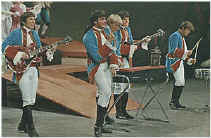
Everybody knows about Paul Revere and the Raiders (or should)—a hard-rocking band out of Idaho by way of Portland, Oregon. They came by their Revolutionary name honestly: their co-founder and keyboards player was really named Paul Revere. (He was also raised as a Mennonite, which I suspect was a rarity among rock and roll musicians.) The other co-founder was vocalist and sax player Mark Lindsay.

The Raiders started to wear historical costumes about the time they signed with Columbia Records, which was trying to get into youth music. At first, Revere and company rented some topcoats from a costume store. Those went over so well with their audiences, especially as part of or in contrast to their antic stage choreography, that they commissioned whole outfits for themselves, including colonial-revival three-cornered hats.

The group’s visual dimension, their sense of a rock-and-roll show as all-around wild entertainment, caught the attention of Dick Clark. In 1965 Paul Revere and the Raiders became the stars of his new television show, Where the Action Is. They got featured in teen magazines. And that promotion finally made their records start selling nationally. In that respect, the Raiders prefigured the Monkees, Archies, Partridge Family, and other T.V.-based rock groups.

That pop success in turn meant the increasingly influential rock critics of the late 1960s disdained the band, even though its members had spent years playing in clubs and released several good songs. In 1969 Lindsay left for a more fulfilling solo career. The band dropped Revere’s name to become the Raiders and in 1971 had their first #1 hit—a political protest song. Of course, “Indian Reservation (The Lament of the Cherokee Reservation Indian)” protested an event of 1838.

As for more obscure rock bands with names from early American history, Pasley and his Common-place correspondents found:

I’d like to see a battle of the bands between the 1971 Raiders and the Andrew Jackson Jihad.

Saturday, September 27, 2008

What’s So Important about Barrett’s Farm?

On Monday, the U.S. House passed the Minute Man National Historical Park Boundary Revision Act, authorizing the Department of the Interior to purchase more land for that national park in Concord. I wrote about this bill back in February.

The land that park managers and local supporters have in mind is the farm that belonged in 1775 to James Barrett, colonel in the Middlesex County militia. The Massachusetts Provincial Congress had commissioned him to collect weapons and other military supplies, which he hid on his farm and on his willing neighbors’ property.

What weapons? Barrett left no records, but Gen. Thomas Gage developed a detailed picture of what was out there. Some spy in the Concord area was communicating with him, and on 8 Mar 1775 the general wrote down the following list.

Four brass Cannon, & Two Cohorns or Mortars (so call’d by the Peasantry) Conceal’d at Mr: B——, (Lately chose or appointed Minute Colo.) Suppos’d to be deposited in his Cellar.—The Calibre of these pieces of Ordnance is not exactly ascertained, but reported to be only Diminutive.

Two pieces of Iron Ordnance (Suppos’d to be 4 or 6 pounders) are mounted, (On carriages said to be very indifferent) in the Courthouse & watch’d at Night, hitherto by a Slender Guard of Minute men.—

Eight more pieces of Iron Ordnance were this day (Le 8 de Mois de Mars) convey’d to Concord from L——— [Lexington? Lincoln? Lancaster?] (where they had been deposited a few days preceeding their Last removal;—Two of the Eight appeard to be Smaller than the rest & about three or four pounders—These last mentioned were met at a small distance from C——— in three Carts there were no appurtenances, but it was said that carriages were made or making at Salem & soon to follow.—

It is conjectured & reported that a Large quantity of [artillery] Cartridges are now preparing at Ch——n [Charlestown]; of Different Sizes, & numbered in order to distribute & distinguish properly.—A Large quantity of Duck [cloth] is also said to be bought up which is said to be & now fabricating these also into Tents.—

It is said with certainty 7 Tons of powder (equal to 13000 net or 280 barells,) is collected at C——d—The greatest part Lodg’d at one Whitings one of together with some small arms near the entrance into the Co[ncord] Vilage on the Road from hence—on the right hand, a White plasterd house, with a Small Yard in front & a Raild fence—a store adjoining the house contains the Powder.—
The list went on to describe where Barrett had arranged to hide small arms, flour, pork, and peas. This portion concluded: “Two Capital Roads Lead to C[oncord]—— one from the Ferry through Cambridge & Lexington—The other through WaterTown & part of Weston—22 miles distant the former only 19. Gage used this intelligence when drawing up orders for the march to Concord on 18-19 April. His soldiers took the shorter route. The main goal of that march—the furthest that British soldiers traveled—was James Barrett’s farm.

That’s why this site would be a most appropriate addition to the national park.

(Photo by Dominic Chavez/Boston Globe Staff.)

Friday, September 26, 2008

Samuel Adams Destroys His Letters

On 17 Sept 1777, six days after the Battle of Brandywine, Samuel Adams wrote to James Warren back in Massachusetts:

The Enemy were left Masters of the Field, but by all Accounts the Advantage was on our side. [Gen. William] Howe and his Army remain near the Field of Battle. They have had much to do in dressing their wounded and burying their dead. General Washington retreated over the Schuilkil to Germantown a few Miles above this City, where he recruited his Soldiers.

He has since recrossed the River and is posted on the Lancaster Road about 12 Miles distant from the Enemy. His Troops are in high Spirits and eager for Action. We soon expect another Battle. May Heaven favor our righteous Cause and grant us compleat Victory! Both the Armies are about 26 Miles from this Place. A Wish for the New England Militia would be fruitless. I hope we shall do the Business without them.
Adams was far too optimistic. The Continental troops had been beaten badly, their commanders outmaneuvered, and their casualties more than twice as high as the British. On 26 September, the Crown forces under Howe marched into Philadelphia, meeting no resistance. Adams and his colleagues in the Continental Congress had fled from the city.

Despite his tough talk, Adams had apparently prepared for such close calls by regularly burning his sensitive correspondence. His cousin John Adams wrote, in a letter to William Tudor, Jr., dated 5 June 1817:
I have seen him, at Mrs. Yard’s [boardinghouse] in Philadelphia, when he was about to leave Congress, cut up with his scissors whole bundles of letters into atoms that could never be reunited, and throw them out of the window, to be scattered by the winds. This was in summer, when he had no fire; in winter he threw whole handfuls into the fire. As we were on terms of perfect intimacy, I have joked him, perhaps rudely, upon his anxious caution. His answer was, “Whatever becomes of me, my friends shall never suffer by my negligence.”
The Congress regrouped in Lancaster and then York, Pennsylvania. Washington found a winter encampment at Valley Forge. After word of the American victory at Saratoga, Samuel Adams began to think that perhaps Gen. Horatio Gates would do a better job as commander-in-chief. I think it’s interesting how as late as 17 September he still expressed confidence in Washington.

Thursday, September 25, 2008

Driving the Battle of Brandywine

Last year I had the pleasure of following this Battle of Brandywine driving tour. Although there’s a Brandywine Battlefield Park, with a nice gift-shop staff, that land is only a small part of the area in southeastern Pennsylvania where the British and American armies fought on 11 Sept 1777. You need a car to take it all in.

The Battle of Brandywine involved 29,000 soldiers, more than any other land battle during the Revolutionary War. Both armies were personally led by their commanders-in-chief, Gen. William Howe and Gen. George Washington. The battle resulted in the British army taking Philadelphia, the U.S. of A.’s largest city and de facto capital (despite John Adams’s confidence that wouldn’t happen). After that, sixty percent of the Continental Army melted away, and Washington had to find winter quarters at Valley Forge.

Obviously, the Brandywine battle was a very significant event. So why doesn’t the park contain more of the battlefield? Why isn’t it a federal park? Why don’t we hear more about the Battle of Brandywine?

Well, the Americans lost. Big. Howe completely outmaneuvered Washington by sending Gen. Cornwallis north to cross the Brandywine at places that Loyalist scouts knew (one of them shown above) but that the American commanders had overlooked. The driving tour is a great way to understand the scope and geography of that move.

There are a few historical monuments along the way: obelisks raised where American officers fell, or a division held out for an hour, or troops made a heroic retreat. But at the end of the day there wasn’t much for the Continentals to celebrate. They had lost a lot of their artillery. Gen. Nathanael Greene estimated that his side suffered about 1,350 men killed, wounded, and captured (compared to the Crown forces’ 600). But even that casualty figure is an estimate; the Americans seem to have been so demoralized and disorganized by the battle that they never made a careful count of their losses.

TOMORROW: Samuel Adams’s reaction in Philadelphia.

Wednesday, September 24, 2008

John Adams Sits Tight in Philadelphia

On 23 Aug 1777, John Adams wrote home to Abigail about the British military’s approach to Philadelphia, where the Continental Congress was meeting:

It is now no longer a Secret, where Mr. [Gen. William] Hows Fleet is. We have authentic Intelligence that it is arrived, at the Head of Cheasopeak Bay, above the River Petapsco upon which the Town of Baltimore stands.

I wish I could describe to you the Geography of this Country, so as to give you an Adequate Idea of the Situation of the two great Bays of Cheasopeak and Delaware, because it would enable you to form a Conjecture, concerning the Object, he aims at.—

The Distance across Land from the Heads of these Bays is but small, and forms an Istmus, below which is a large Peninsula comprehending the Counties of Accomack and Northampton in Virginia, the Counties of Somersett and Worcester in Maryland, and the Counties of Kent and Sussex on Delaware. His March by Land to Philadelphia, may be about sixty or seventy Miles. I think there can be no doubt that he aims at this Place, and he has taken this Voyage of six Weeks, long enough to have gone to London, merely to avoid an Army in his Rear.

He found he could not march this Way from Somersett Court House, without leaving G. Washington in his Rear.

We have called out the Militia of Virginia, Maryland, Delaware, and Pensilvania, to oppose him, and G. Washington is handy enough, to meet him, and as G. Washington saved Philadelphia last Winter, by crossing the Delaware and marching to Morristown, and so getting in the Rear of Howe, so I conjecture he will still find Means to get in his Rear between him and Cheasapeak Bay.

You may now sit under your own Vine, and have none to make you afraid.—I sent off my Man and Horse at an unlucky Time, but, if We should be obliged to remove from hence, We shall not go far.
Adams was apparently sure that Howe feared having Washington “in his rear.” But wouldn’t that mean no Continental troops between the British army and Philadelphia? I might not have been so confident.

TOMORROW: Revisiting the Battle of Brandywine.

(German map of the 1777 Philadelphia campaign above from Wikipedia.)

Tuesday, September 23, 2008

Warren in Worcester, 25 Sept 2008

Also on Thursday, 25 September, the American Antiquarian Society in Worcester is hosting a lecture by author Nancy Rubin Stuart based on her new book, The Muse of the Revolution: The Secret Pen of Mercy Otis Warren and the Founding of a Nation. The description:

Mercy Otis Warren was also the fiery wife of Massachusetts patriot James Warren, the mother of five sons, and friend and close colleague to John and Abigail Adams. Warren secretly authored anti-British plays during the Revolution, penned an influential pamphlet arguing for a Bill of Rights, and authored The History of the Rise, Progress and Termination of the American Revolution.
Warren also produced a mind-bogglingly impressive piece of embroidery now at the Pilgrim Hall museum in Plymouth, so I’ve come to think of her as Revolutionary New England’s “woman who does everything more beautifully than you.”

Stuart has written biographies about spiritualist Maggie Fox, industrialist Marjorie Merriweather Post, and monarch Isabella of Castile.

B.A.E.A.H.S. Starts Up Again, 25 Sept 2008

Every year the Massachusetts Historical Society hosts a series of academic discussions under the unacronymable name of the Boston Area Early American History Seminar. The new season starts up this Thursday, 25 September, at 5:15 P.M.

Prof. T. H. Breen of Northwestern University has shared a paper titled “It Rained Cats and Dogs the Day the Revolution Began: How a Strange London Publication Transformed the American Political Landscape in 1775.” The original, less intriguing subtitle, which indicates Breen’s larger project, is “Political Ideology and Popular Mobilization on the Eve of American Independence.” His most recent book was The Marketplace of Revolution; here’s a review by Prof. Alan Taylor at Powell’s Books.

Some scholarly functions start with an author reading his or her paper aloud. Not in this seminar series—which makes reviewing the paper in advance at the M.H.S. more useful. Breen will offer just a few remarks on what questions he’s hoping to answer, and then Prof. Richard D. Brown of the University of Connecticut will comment on what he’s actually written so far. Discussion then becomes general. Usually there are cookies.

Here’s a complete list of the upcoming year’s seminars in this series.

Monday, September 22, 2008

Medical Lecture in Medway

Boston 1775 reader Graeme Marsden alerted me to this event at the end of the month:

Pills, Potions, Poultices: A Re-enactment of Revolutionary War Doctor Elisha Skinner. Come see Edwin Page portray Dr. Elisha Skinner [1742-1827], regimental surgeon for the Massachusetts Xth Regiment of the Continental Line.

You will learn what sort of anesthesia was used to perform surgery, why infant mortality was so high and how to use an 18th-century remedy to cure your next headache. You will most certainly come away with a greater appreciation for 21st-century health care.
This reenactment/lecture will take place on Tuesday, 30 September 2008, starting at 7:30 P.M., at the Medway Senior Center. The Medway Historical Society promises refreshments for anyone who has an appetite left, and “plenty of free parking.”

Sunday, September 21, 2008

Looking for Mrs. Hannah Winslow

Late last week, Thomas B. Allen, author of George Washington, Spymaster and other history books, asked if I had any ideas about the identity of a woman named among the civilians who evacuated Boston with the British military in March 1776.

The British authorities made a list of all heads of household and the number of people in their parties, about a thousand total. This list was published by the Massachusetts Historical Society and elsewhere. One section in the Ws looks like this:

Winslow, Isaac, 11
Winslow, Pelham, 1
Winslow, John, 4
Winslow, Mrs. Hannah, 4
Winslow, Edward, 1
Who was “Mrs. Hannah Winslow”? Was she a widow, or for some reason not traveling with her husband? And why couldn’t she have had a less common first name than “Hannah,” and a less common last name than “Winslow”?

I did some research and sent off my guess: that she was the wife of Customs collector Edward Winslow, Sr., who was under house arrest in Plymouth. Then I settled down to present the evidence for that guess in this posting. But as I did more research in period newspapers, I came across another candidate. In fact, a more promising candidate.

So, with apologies to Mr. Allen for my email, here’s who I now suspect Mrs. Hannah Winslow was. I’m relying mostly on Eva Phillips Boyd’s article on the Loring family, available from the Jamaica Plain Historical Society

Hannah Loring was born in on 15 Dec 1742 to Commodore Joshua Loring, Sr. In 1760, the family moved into a big house in Jamaica Plain. Three years later, on 26 Dec 1763, Hannah married Joshua Winslow, about to turn twenty-eight and a busy partner in his father’s mercantile firm. John Singleton Copley painted a portrait of the bride showing off her lace, now at the Detroit Institute of Arts.

The young Joshua Winslow took over his father’s place in the family firm in 1767, and in 1773 became one of the tea consignees—the merchants designated in London to receive and resell East India Company tea. He deferred to his colleagues (most of whom were also relatives) and didn’t take a prominent role in defying the tea boycott or trying to get the tea landed. Nevertheless, the political confrontation over that tea put Winslow squarely on the side of the royal government.

On 20 Mar 1775, as the province rolled toward war, Joshua Winslow died. The 23 March Boston News-Letter ran this notice:
Last Monday Afternoon, departed this Life, after a short Illness, in the 39th Year of his Age, Mr. Joshua Winslow, Merchant of this Town:—

A Man in whom was united, almost every useful Accomplishment of Life: To a chearful benevolent Disposition was joined a sound and penetrating Judgment, which enabled him to discharge the various Duties of his Station, to the general Approbation of Mankind; and we trust to his own inward Peace. . . .

As a Husband, he was tender and affectionate: As a Parent kind and indulgent: As a Master, humane and compassionate: As a Friend, faithful and sincere. . . .

He has left a sorrowful Widow and six Children. His Funeral is to be this Afternoon, at which Time the Friends of the Deceased are desired to attend.
Winslow’s death was a shock to his family and friends. On 3 April, Henry Pelham wrote to Copley, his half-brother:
Mr. Joshua Winslow, Commodore Loring’s Son-in-Law was abroad [i.e., out of doors] the 16 of Last Month, and on the 23d was an inhabitant of the silent Tomb.
Hannah was a widow at thirty-three.

A little less than a year later, the refugee list indicates, “Mrs. Hannah Winslow” departed Boston in a party of four. Where were the other three children? Some might have traveled with their Loring grandparents, and some might have died. Some might even have stayed, though I’m not sure where.

The 15 Mar 1777 Freeman’s Journal, published in Boston, printed a long list of Loyalist refugees and where they were reportedly settling. “Mrs. Winslow Widow to Joshua Winslow” is named among the refugees still at Halifax. According to Boyd’s article, Hannah Winslow died in Canada in 1785.

Saturday, September 20, 2008

After John Trumbull

Someone recently sent me this image via the LiveJournal group scans_daily. It comes from Marvel’s easy-to-read comic book Spidey Super Stories—the issue published in July 1976, of course.

Friday, September 19, 2008

More Links on Richard and Annis Stockton

It turns out I’m not the only person writing about Richard Stockton this month. Boston 1775 reader Bill Welsch alerted me to Donald Johnstone Peck’s “New Jersey’s Darkest Hour” in the debut issue of Garden State Legacy, an online magazine of New Jersey history. You can download Peck’s article in P.D.F. form from that website. It offers much more context for Stockton’s choices in 1776-77. Other articles in the magazine discuss whether “urban spelunking” is a way to explore history and how two state authors popularized astronomy, so it’s quite wide-ranging.

Another online resource about the Stocktons comes from the OurStory Project, hosted by Bergen County Technical Schools. Its resources on the Revolutionary War in New Jersey include a “Poem for Washington.” That link brings a P.D.F. file of material from the New Jersey Historical Society: an image from a Stockton family commonplace book with the first lines of a poem by Annis Stockton (shown above), plus background information.

Annis Stockton, Richard’s wife, apparently wrote this poem in honor of Gen. George Washington soon after his victories at Trenton and Princeton in December 1776 and January 1777. Since she lived in Princeton, those battles were very important to her. She probably shared the poem with her friends, but didn’t have it published until ten years later, in the Columbian Magazine for January 1787.

The P.D.F. download contains only the first lines of the poem, and they’re not precisely transcribed. The full text appears in Carla Mulford’s collection of Stockton’s poetry, titled Only for the Eye of a Friend. Washington had obviously inspired Stockton to work in the epic mode, starting with an invocation:

The muse affrighted at the clash of arms,
And all the dire calamities of war,
From Morven’s peaceful shade has long retir’d,
And left her faithful votary to mourn,
In sighs not number’d, o’er her native land.
Dear native land! whom George’s hostile slaves,
Have drenched with blood and spread destruction round.
But thou[,] my country’s better genius comes[,]
Heroic Washington[,] and aid my song!
The reference to “George’s hostile slaves” didn’t mean Washington and his actual slaves, but George III and the soldiers working for him.

Thursday, September 18, 2008

Richard Stockton and the Creation of a Legend

Within twelve months from the spring of 1776 to the spring of 1777, Judge Richard Stockton of New Jersey went from advocate of American autonomy within the British Empire to Continental Congress delegate to signer of the Declaration of Independence to captive of the British military to subject reaffirming his loyalty to the British Empire and retiring from the independence movement.

Stockton’s oath of loyalty to Britain, attested to in letters of the time, explains why after he died in 1781 his family and minister didn’t even mention his weeks in captivity: that period was an embarrassment rather than a source of pride. That history also explains why people told a less than complimentary anecdote about how Stockton wasn’t chosen to be New Jersey’s governor in 1776, and why the Rev. William Gordon felt safe publishing that story in 1788. The judge wasn’t a revered figure, though he also wasn’t reviled.

Then time passed. Stockton’s widow, Annis, developed a reputation as a patriotic poet and correspondent of George Washington. Their eldest son, also named Richard Stockton (shown above), became the first U.S. Attorney for New Jersey. The couple’s other children were respectable local figures. In the 1820s, the U.S. of A. looked ahead to the fiftieth anniversary of the Declaration of Independence, with special reverence for that document’s signers.

Some of the Stocktons’ children were still alive in that decade. During the Revolutionary War, they had been old enough to understand what their father had experienced and done. Even if he hadn’t told them everything, they must have heard important details. Those aged children might have supplied the details of Stockton’s life in Biography of the Signers of the Declaration of Independence—or those details might have come from the next generation, raised on tales of their grandparents.

Whoever the family sources were, the Richard Stockton story of the 1820s came out as a tale of martyrdom to the cause of American liberty. That biography linked Stockton’s imprisonment, his departure from politics, and his death to make one smooth, heroic narrative. He was so patriotic that treacherous Loyalists made a special bid to capture him and treated him badly, so admired that the Congress made a special effort to get him released. The British treatment was so cruel that he couldn’t go back to working for the cause he was still committed to, so cruel that it killed him before the war was over. Not only did that story skip over the embarrassing bits, but it gave Stockton’s life a more coherent meaning by tying everything together as cause and effect.

It shouldn’t surprise us that the Stockton family created this story and believed it whole-heartedly after the first generation. (Even his children might have convinced themselves it had to be true.) Similarly, historians who focused on New Jersey were prone to retell the tale.

But American authors from outside the family and the state also accepted the Stockton legend uncritically, and some even added more details about his suffering. Historians found evidence of Stockton’s oath to the Crown, and the legend still survived. And not just in the “Price They Paid” essay and similar mythologies. Look on the websites of the Richard Stockton College of New Jersey (opened in 1971), the Morven Institute of Freedom, and even the National Park Service, and you won’t find any hint of the more complex tale. (Princeton University’s page on Stockton is a commendable exception, and after some editorial back-and-forth Wikipedia is more reliable than the Columbia Electronic Encyclopedia.)

Many Americans apparently haven’t liked learning that one signer of the country’s founding document later renounced it—and then changed his mind under pressure again. And people of all nations tend to prefer a tidy, admirable legend to more messy human history.

We can see the same thing happening right now with John S. McCain’s biography, and that’s not even over. McCain’s imprisonment in North Vietnam in 1967-73 is well documented, not just because we have lots of papers and video footage, but also through his own memoirs (written with longtime aide Mark Salter). McCain was held in prison for years, much longer than Stockton; suffered much worse treatment; and instead of retiring has served in public office for decades. That’s all beyond dispute. You wouldn’t think anyone would see a need to embellish that story.

Yet, as Peter S. Canellos wrote in the Boston Globe earlier this week, former senator Fred Thompson misrepresented McCain’s history in his speech at the Republican National Convention:

Thompson twisted one of McCain’s most moving revelations—how, while a badly injured POW, he provided some unimportant information to the enemy but felt so disgusted that he wanted to kill himself—into its opposite. “He was offered medical care for his injuries if he would give up military information,” Thompson declared in a sonorous tone. “John McCain said ‘no’.”
Politifact.com called Thompson’s account “false,” noting “he contradicts statements McCain made in his bestselling autobiography.” In fact, McCain made the information-for-medical-care offer to his captors, though not sincerely. He told them he’d talk if they took him to a hospital, secretly planning not to go through with that bargain, and then felt ashamed for compromising even that much. Later, McCain signed an anti-American statement; even though everyone recognized that was a product of torture, he still felt embarrassed.

Thompson’s speech simplified McCain’s real, human history into a false tale of pure heroism, apparently more suitable for prime-time television. And that change was apparently approved by the McCain campaign. It was one of many falsehoods the candidate and his team have told lately, so it was easily overlooked, but it’s the most ironic since it addresses McCain’s personal sense of honor, the quality that he at one point was running on.

Is it any wonder that Richard Stockton’s story—less heroic to begin with, directly tied to the sacred Declaration, and spottily documented—has been embellished and preserved in amber by people who want to admire a Founding Father without doubt?