J. L. BELL is a Massachusetts writer who specializes in (among other things) the start of the American Revolution in and around Boston. He is particularly interested in the experiences of children in 1765-75. He has published scholarly papers and popular articles for both children and adults. He was consultant for an episode of History Detectives, and contributed to a display at Minute Man National Historic Park.

Subscribe thru Follow.it


•••••••••••••••••


Wednesday, March 04, 2009

Moran on Isaiah Thomas at Lexington, 7 March

Before going into the Old State House for the dramatic reenactment of the Boston Massacre this Saturday evening, you can check out a free lecture at the National Heritage Museum in Lexington.

“Diverting the Design of Murder and Robbery: Isaiah Thomas, the Press and the Founding of America”

James David Moran, Director of Outreach at the American Antiquarian Society, will use Isaiah Thomas’ account of the Battles of Lexington and Concord to examine this publisher and Freemason’s role as a colonial printer within the larger context of growing resistance to British rule.
(The National Heritage Museum is, you see, a Masonic institution.)

Edward Payne: genteel shooting victim

On 6 Mar 1770, the day after the Boston Massacre, acting governor Thomas Hutchinson wrote a letter to his superiors in London explaining what they would want to know about the event:

I found two persons killed a third mortally wounded since dead, a fourth dangerously wounded & a fifth, Mr Payne a Merchant of the Town, shot in his arm and the bone splintered as he stood at his door.
Who was “Mr Payne,” and why did he warrant being the only shooting victim the governor named?

Edward Payne (1722-1788) was the only person shot on King Street who came from the genteel class rather than being a craftsman or sailor. That’s why he warranted attention from royal officials. He was also the only man shot on his own property, rather than on the street—though that was apparently a matter of inches.

Benjamin Andrews filed a report for the town on where the soldiers’ musket balls lodged in Payne’s house. He described a “bullet hole in the entry door post..., which grazed the edge of the door before it entered the post where it lodged, two and a half inches deep” and a “hole made by another musket ball through the window shutter of the lower story of the same house, and lodged in the back wall of the shop.” The first ball had gone through Payne’s arm before ending up in that post.

Payne’s testified to the town’s investigating committee about his experience. After describing reports of fights between soldiers and townspeople, he said:
That this deponent then went home, and stood upon the sill of his entry door, which is nearly opposite to the east end of the Customhouse, where he was soon joined by Mr. George Bethune [1720-1785], and Mr. Harrison Gray [Jr.] (c. 1735-1830), that the people round the sentinel were then crying out “Fire, fire, damn you, why don't you fire,” soon after, he perceived a number of soldiers coming down towards the sentinel, with their arms in a horizontal posture, and their bayonets fixed, who turned the people from before the Custom-house, and drew up before the door, the people, who still remained in the street and about the soldiers, continued calling out to them to fire.

In this situation they remained some minutes, when he heard a gun snap, and presently a single gun fired and soon after several others went off, one after another, to the number, of three or four, and then heard the rammers go into the guns as though they were loading; immediately after which, three or four more went off in the same manner; at which time, a ball passed through the deponents right arm, upon which he immediately retired into the house.
The report noted that Payne signed his deposition “with his left hand” because of the injury to his right. Later he testified at the soldiers’ trial, telling much the same story.

William Tudor’s mention of Payne in The Life of James Otis (1823) is probably less accurate, but vivid and amusing:
Among the persons wounded was Edward Payne, Esq. a respectable merchant, who having been attracted by the noise in the street, was standing as a spectator at his own door, at the corner of Congress street when he received two balls through his arm, that afterwards lodged in the door-post.

This gentleman’s mild manner of expressing his vexation, when he found himself wounded, excited a smile among his friends. “I declare,” he said with emphasis, “I think those soldiers ought to be talked to.”
I love the phrase “with emphasis.”

Tudor added, “These balls are now in the possession of his son William Payne, Esquire, and may be considered an interesting relic of the revolution.”

Indeed they are. The two balls now belong to the Massachusetts Historical Society, though this photo of them comes via the Herbert Hoover Presidential Library & Museum website. The labels say the one on the right went through Payne’s arm, the one on the left straight into his house.

After my posting on Monday about soldiers probably double-loading their guns, some Boston 1775 readers commented about the importance of the weight and metal content of the musket balls. I don’t know if anyone’s studied these bullets in that regard. I suspect, given where they ended up, that they came from the same gun.

One more anecdote about Edward Payne and the Massacre comes from Peter Oliver, one of the judges who presided over the trials at the end of the year. As a bitter Loyalist in England in 1783, he wrote this anecdote about the gentleman wounded in the shooting (who must be Payne) and the Rev. Dr. Charles Chauncy:
[The minister] had heard that a Gentleman was wounded, on that unhappy Night when the Soldiers had fired. He waited upon the Gentleman, & asked him, whether he did not design to prosecute Capt. [Thomas] Preston in damages [i.e., file a civil suit against him for assault]?

The Gentleman replied, “No Sir! It will be of no Advantage. Capt. Preston is to be tried for his Life. If he should be convicted he will suffer Death, & then I cannot recover any Damages; & if he is acquitted I shall be in the same Circumstances”: to which this hoary headed Divine…said—“if I was to be one of the Jury upon his Trial, I would bring him in guilty; evidence or no Evidence.”
After the siege of Boston, Payne gave up trading goods and started selling insurance. He died on the anniversary of the Massacre in 1788. Payne’s son William took over the house, office, and business at what became 15 State Street. Edward Payne’s daughter Rebecca married Christopher Gore, one of Hutchinson’s successors as governor of Massachusetts.

Tuesday, March 03, 2009

Dueling Depositions about the 5th of March

Yesterday I quoted from Edward Crafts’s deposition, dated 17 Mar 1770, about what he’d heard from a British corporal named “McCan.” Crafts was testifying about his encounter with soldiers in the hours shortly after the Massacre:

on Monday evening, the fifth instant [i.e., this month], between 11 and 12 o’clock, Mr. Joseph Ayers [Eyres] met me at my gate, and I asked him where he was going. He answered, “To call Mr. Thomas Theodore Bliss to attend at the Council-chamber, to give evidence of the Captain’s giving the soldiers orders to fire on the inhabitants.”

On leaving Mr. Bliss’s door, there passed by us two corporals with about twenty soldiers, with muskets and fixed bayonets; and on their observing our moving towards the Town-house [shown here], the soldiers halted, and surrounded us, saying we were a pack of damn’d rascals, and for three coppers they would blow our brains out.

One of the corporals (viz. Eustice), gave orders for one-half the soldiers to cock, and the rest to make ready. On which we told them, we had nothing to say to them, but were on other business. The corporal, Eustice, struck Mr. Haldan, then in company, and turning to me, aimed a blow at my head with his firelock, which I took upon my arm, and then, with all his might, he made a pass at me, with his fixed bayonet, with full intent to take my life, as I thought. This I also parried with my naked hand. Then a soldier stepped out from among the rest, and presented his musket to my breast, and six or seven more at about eight or ten feet distance also presented.

Upon this I called Corporal McCan, who came to me with a drawn sword or cutlass in his hand, and pushed the gun from my breast, saying, “This is Mr. Crafts, and if any of you offer to touch him again I will blow your brains out.”

Corporal Eustice answered and said, “He is as damn’d a rascal as any of them.”

The next evening about dusk coming by Rowe’s barrack, I saw Corporal McCan who saved my life. He asked me if my arm was broke, I answered no. He said the gun with which Eustice struck me, was broke to pieces. And continued, “You would have been in heaven or hell in an instant if you had not called me by name. One man in particular, would have shot you, seven more presented at you!”
We also have a deposition from Cpl. Hugh McCann of the 29th Regiment about his memories of that night. He was interviewed on 28 July 1770 in Perth Amboy, New Jersey, where the unit had been sent after the Massacre. At the time, royal officials were trying to gather information about how badly Bostonians had treated the soldiers. That effort might even have been designed to respond directly to details in the town report that contained Crafts’s deposition, and that might have reshaped the soldiers’ testimony. In any event, here’s McCann’s recollection:
on the fifth of March at the South End of said Town, in the Evening, as he was walking near the Neck Guard, he was assaulted and struck by Mr. Pierpoint without provocation given and A Mob with him, and with much ado got away with his Life, that the said Pierpoint struck this Deponent with A Broad Bludgeon, and said that the Soldiers were Murdering the Towns People at the Town House, that he the said Pierpoint would never be satisfied while there was A Soldier in the Town.
So who is this “Mr. Pierpoint”? That was almost certainly Robert Pierpont, who owned land near the Neck and made many complaints about soldiers stationed nearby stealing his firewood. In fact, his attempt to serve a writ on an officer there in October 1769 had prompted a nearly fatal riot.

And what do you know? Pierpont also left a deposition about the night of 5 Mar 1770:
that [while he was] going to see a sick neighbor between the hours of seven and eight on Monday evening, the fifth current [i.e., this month], two soldiers armed, one with a broad sword, the other with a club, passed him near the hay market, going towards the town-house, seeming in great haste. In a few minutes they returned and hollowed very loud, “Colonel.”

Before the deponent reached Mr. West’s house, where he was going, they passed him again, joined by another, with a blue surtout, who had a bayonet, with which he gave the deponent a back-handed stroke, apparently more to affront than hurt him. On complaint of this treatment, he said, the deponent should soon hear more of it, and threatened him very hard
Pierpont was one of Boston’s two elected coroners in 1770, so he got to preside over the inquiries into some of the Massacre victims’ deaths—which involved collecting more depositions.

All that legal testimony is wonderful for historians, but it’s vital not to look at the complaints from just one side. As these documents show, almost everybody resented the other side’s actions, and told only part of the story.

Monday, March 02, 2009

How Could Six Shots Hit Eleven People?

Last month a gentleman asked me to give a short speech about the Boston Massacre at a private event. Could I cover the whole event in about fifteen minutes?

Cover the whole event? Hey, I could do fifteen minutes just on how many balls were in the British soldiers’ guns, I said. This was all by email, so I didn’t get to hear him say, “Oh, God, no!”

I was just making a point, not really offering to discourse at length on that one detail. But you folks aren’t so lucky.

On King Street that 5th of March, there were eight soldiers, each with one musket that he could fire only once before reloading. Witnesses testified that Pvt. Edward Montgomery shot into the air, and that the soldier on the other end of the line (probably Cpl. William Wemys) didn’t fire. So that leaves six shots into the crowd.

Yet there were eleven people killed and wounded. Even considering that a musket ball fired at point-blank range would go right through someone’s body, that’s a lot of damage for six balls. Furthermore, Crispus Attucks had twin wounds on his chest, as Dr. Benjamin Church described in his autopsy report.

The most likely explanation is that the soldiers each had two balls in their muskets. Those guns worked more like shotguns than like modern rifles. When gunpowder ignited inside the tubes, it pushed out whatever had been tamped down in there—one ball, two balls, buckshot, nothing but powder (called “snapping” the gun).

In fact, we have evidence of soldiers elsewhere in Boston that night being ordered to put two balls into their muskets. On 17 March, future American artillery captain Edward Crafts (younger brother of coroner Thomas Crafts) told the town’s investigation that the day after the Massacre he’d talked with a “Corporal McCan”—probably Hugh McCann of the 29th Regiment.

McCann reportedly told Crafts that on the night of the 5th:

his orders were, when the party came from the guard-house by the fortification [on the Boston Neck], if any person or persons assaulted them, to fire upon them, every man being loaded with a brace of balls.
”Brace” is an antique synonym for “pair,” usually used these days in the context of hunting. Folks of the late eighteenth century seem to have liked the alliteration of “a brace of balls,” since it shows up in other newspaper stories.

So those eleven people on King Street were probably felled by twelve balls.

Sunday, March 01, 2009

Boston Massacre Week Begins!

Say, kids, what week is it? It’s Boston Massacre Week! The 5th of March is the 239th anniversary of that event, when British soldiers surrounded by an angry crowd killed four men and one boy (or two) outside Boston’s Customs House.

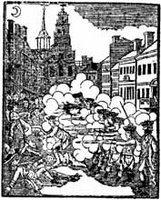
Nearby, as shown in the famous image created by Henry Pelham and recreated by Paul Revere, was the Town House, which is now the Old State House Museum (shown at right in its current context). Its owner, The Bostonian Society, is sponsoring several events this week to commemorate the anniversary. None of them fall on the anniversary, but we’ll leave that aside.

Friday, 6 March, at the Old South Meeting House:

Saturday, 7 March, at the Old State House:
  • 11:00 A.M. & 2:00 P.M. Little Redcoats: Kids Reenact the Massacre. Rangers from the Adams National Historical Park will lead young visitors in a bloodless reenactment of the Massacre. FREE.
  • 11:30 A.M. & 2:30 P.M. Trial of the Century. Rangers from the Adams National Historical Park host John Adams as he defends the British soldiers accused of murdering Bostonians. The audience will act as jurors deciding whether the shooting was self-defense, cold-blooded murder, or something in between. Free with museum admission.
  • 7:00 P.M. Boston Massacre Reenactment. Courageous local reenactors portray the incident that sparked the Revolution on the streets outside the Old State House. See how well the scenario I drafted last year plays out! If no one actually gets shot, it was a success. FREE.
For the rest of this week, Boston 1775 will be exploring the historical nooks and crannies of the Boston Massacre.

(Photo above by Axel R-D, courtesy of Flickr.)

Saturday, February 28, 2009

Francis Williams, Man and Symbol

This interview with Octavian Nothing author M. T. Anderson pointed me to these two webpages about Francis Williams (1697-1762), who held a unique place in the eighteenth-century British Empire because of his combination of learning, property, and African ancestry.

After digging a bit more, I found that only one of those webpages—the first, from the Victoria & Albert Museum—is informed by Prof. Vincent Carretta’s article “Who Was Francis Williams?” published in Early American Literature in 2003. That provided a valuable corrective to what had been written about Williams since shortly after his death.

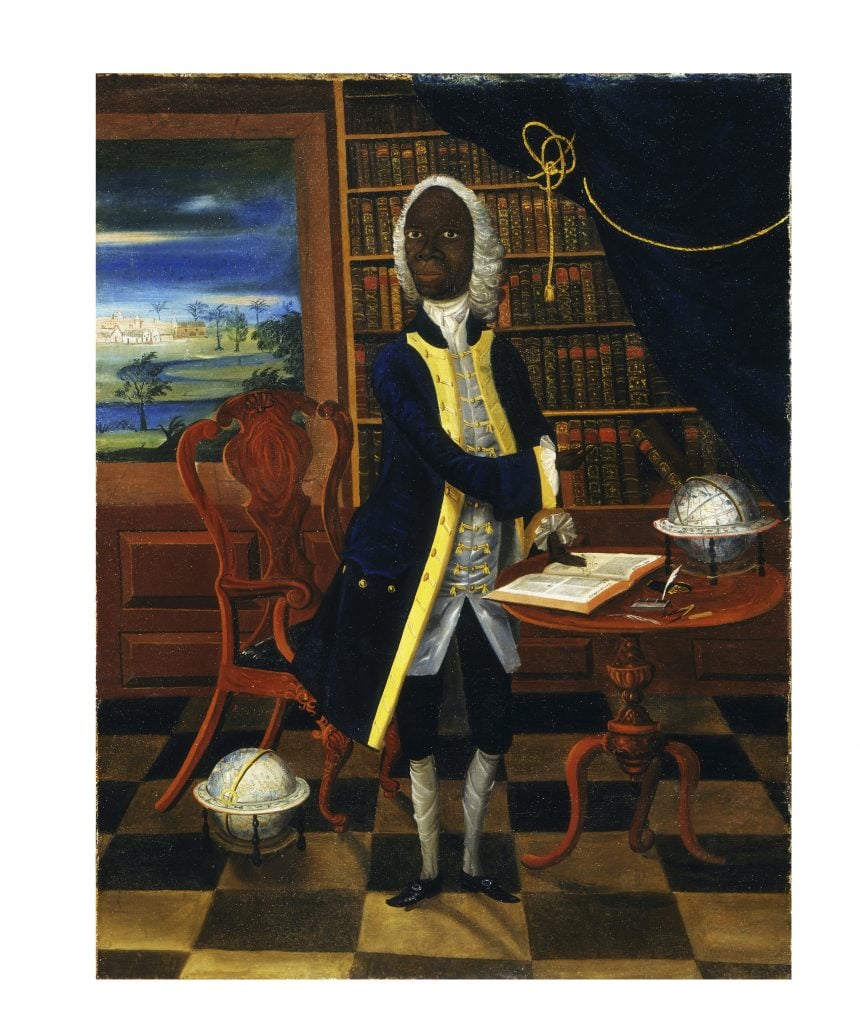
Most of our previous information about Williams came ultimately from Edward Long’s History of Jamaica (1774). That book includes an inaccurate capsule biography, one of Williams’s poems, and the argument that he hadn’t really accomplished much. Long was hostile to the idea of an intelligent, educated, property-owning black man, so why did he mention Williams at all? For one thing, he seems to have been fascinated by the man at some level; the portrait above came down in Long’s family.

More importantly, when Long wrote, Williams had already become a minor celebrity. Anti-slavery authors used him as an example of how people of blacks could succeed very well given a fair chance at education and wealth, and white supremacists struggled to denigrate his accomplishments. Among the writers mentioning (or presumably mentioning) Williams were:
  • Dr. Alexander Hamilton, in his “Itinerarium” of 1744 (not published until 1948): “There, talking of a certain free negroe in Jamaica who was a man of estate, good sense, and education, the ’forementioned gentleman…asked if that negroe’s parents were not whites, for he was sure that nothing good could come of the whole generation of blacks.”
  • David Hume, in “Of National Character” (1748): “In Jamaica, indeed, they talk of one Negro as a man of parts and learning; but it is likely he is admired for slender accomplishments, like a parrot who speaks a few words plainly.”
  • The editors of The Gentlemen’s Magazine in 1771: “About forty years ago, Mr. Williams, an African of fortune, who dressed like other gentlemen in a tye wig, sword, etc. and who was honoured with the friendship of Mr Chelselden [Dr. William Cheselden (1688-1752)], and other men of science was admitted to the meetings of the Royal Society and, being proposed as a member, was rejected solely for a reason unworthy of that learned body, viz. on account of his complection.”
Long claimed that Williams’s education was “the subject of an experiment” by the second Duke of Montagu in educating a black boy. That understanding may have arisen from that peer’s documented sponsorship of another man of African descent, Ignatius Sancho (c.1729-1780). It became part of our received wisdom about Williams. For example, Massachusetts Abolitionist Lydia Maria Child included the tale in her Appeal in Favor of that Class of Americans Called Africans (1833), though she mistakenly credited the “Duke of Montaigne.”

In fact, Carretta dug into primary sources and found that Francis Williams was born the second or third son (he was a twin) of John and Dorothy Williams, a free black couple on Jamaica. John Williams, apparently a former slave, was an established property-owner and trader. In 1708, 1711, and 1716 the colony’s legislature passed laws granting the Williams family legal privileges usually reserved for whites. So already their presence threatened the traditional social structure.

Carretta found that “The register of Lincoln’s Inn in London...records the admission on 8 August 1721 of ‘Francis Williams, youngest son of John W., of Jamaica, merchant,’ confirming the statement of the anonymous author of An Inquiry [into the Origin, Progress, & Present State of Slavery (1789)], though no record has been found of his actually having attained a law degree.” John Williams died in 1723, leaving an estate worth £12,000. Francis soon returned to Jamaica to take up his inheritance.

In 1724, Francis Williams got into a fight with a white man named William Brodrick, who then petitioned the Jamaica legislature to end the Williams family’s legal privileges because they were “of great encouragement to the negroes of this island in general.” The legislature did that in 1730, after the First Maroon War had broken out. Williams protested to the Privy Council in London, insisting it was already “Notorious that no Free Negro [could] wear a Sword or Pistols besides himself.” In November 1732 the council recommended that Jamaica repeal its new law.

Long claimed that Williams set up a school to support himself, but there’s no evidence for that. Instead, he appears to have lived off his inherited property. He wrote poetry on public occasions, and remained a local curiosity. When he died, Williams owned fifteen slaves, but his home was rented and his entire estate worth £525.

The picture of Williams at the upper right comes from the Victoria & Albert Museum in London. I bought a postcard of it a few years ago, not knowing anything about him at the time. The museum’s page on the painting says:
Some writers have suggested that the painting is a caricature of Francis as he has been depicted with a large head and skinny legs. . . . Other critics have considered that the ‘unnaturalistic’ depiction may have been intended to emphasise the subject’s intellectual skills over his physical stature (Francis was alive at the time of the painting’s creation and may even have commissioned it). It may, more simply, be a reflection of the artist’s limited skills.


Friday, February 27, 2009

New Hampshire State Liquor Stores

During the Revolutionary War, the biggest root of domestic conflicts was probably high prices for the necessities of life. American society hadn’t embraced the market system fully, so both people and governmental authorities objected when merchants raised their prices or kept goods off the market, waiting for demand to rise further.

On 27 Feb 1777, the New Hampshire Committee of Safety issued the following order to the sheriff of Rockingham County:

Whereas George Gains of Portsmouth, Esqr. (who was employed by this Committee to procure Rum for the American Army) has inform’d the Committee That Robert Parker, Thomas Martin, Neal McIntire, Mark Hunking Wentworth, Jonathan Warner, Benjamin Austin, George King, Nathaniel Folsom, George Turner, Jacob Treadwell, Ammi Ruhamah Cutter, Robert Furnass, John Hart, Tertius, Daniel & Samuel Sherburne, merchants, each of them, have West India Rum in their possession more than sufficient for their own use and consumption, which they refuse to sell him for the use of said American Army at a Reasonable rate:

Therefore you are hereby required in the name of the Government & the people of the State of New Hampshire (taking with you sufficient assistance) to break open any stores, Warehouses, or other places, where such Rum may be deposited, belonging to the above named persons, or in their possession, and take from thence the following Quantities of Rum: viz. from
  • Robert Parker, four Hogsheads;
  • Thomas Martin, Three Hogsheads;
  • Neal Mclntire, one Hogshead;
  • Jonathan Warner, two Hogsheads;
  • Benjamin Austin, one Hogshead;
  • George King, two Hogsheads;
  • Nathaniel Folsom, three Hogsheads;
  • George Turner, three Hogsheads,
  • Jacob Treadwell, one Hogshead,
  • Ammi Ruhamah Cutter, one Hogshead,
  • Robert Furness, one Hogshead,
  • John Hart Tertius, one Hogshead,
  • Daniel and Saml. Sherburne, four Hogsheads
(if the same may be found as aforesaid) and deliver the same to the said George Gains. You are also to cause all Rum taken as aforesaid to be Gaged by a sworn Gager & make return hereof (as soon as may be) with your doings herein, to the Committee of Safety.
(I reformatted that text to make it easier to read on the internet. Here’s the original transcription.)

The sheriff carried out the order as best he could, collecting fifteen hogsheads. But he reported that eight of those men did not have “more rum than they wanted for their own use.”

Thursday, February 26, 2009

Harry Babcock’s “Distempered Mind”

Yesterday I described how Rhode Island removed Col. Henry Babcock (shown right, from a portrait by Joseph Blackburn) from command of its troops at Newport in April 1776 because, the legislature determined, he was mentally unstable. Unfortunately, the printed record doesn’t give us any juicy details.

Stephen Babcock’s 1903 genealogy of the Babcock family described the colonel’s infirmity this way: “In 1777 he had a severe fit of sickness which so affected his mind that he never entirely recovered.” But the records show people judged Babcock insane early in the previous year, and with hindsight George Washington recalled “Proofs...of a Distempered Mind” in December 1775.

Going back even before then, Babcock’s political loyalties might have been volatile. On 26 Dec 1774 a British officer in Boston wrote to a friend in Edinburgh about New England Loyalists:

You were right in your opinion, Brigadier General [Timothy] Ruggles of the Massachusetts, Colonel Babcock of Rhode-Island, and Colonel [Eleazer] Fitch of Connecticut, are staunch to Government
Was the second man Col. Henry Babcock? He was actually living over the border in Stonington, Connecticut, but closely associated with Rhode Island. I can’t find any other Col. Babcock.

Moving even further back, that Babcock genealogy is one of several books that describe this anecdote about Harry Babcock:
In 1761 he visited England, where he was treated with great respect. He was introduced to the Queen, and it is said that instead of kissing her hand, as was the custom of people in his rank, he boldly kissed her cheek, remarking that such was the “mark of politeness in America.” The correctness of this statement is doubted.
So was that behavior a sign of intermittent mania?

Certainly that diagnosis would fit with how Babcock reacted to being dumped from his Rhode Island command. On 28 May 1776, within a month of his official removal, he was writing to John Hancock with a bright new idea:
I should be extremely obliged to you if you would be pleased to lay before the honourable the Continental Congress the following proposals:

That I have leave to raise two battalions of marines, to consist of five hundred men each, and each battalion to consist of six companies, with a Captain-Lieutenant to each battalion, four officers to each company. Make not the least doubt, provided I have leave to name the officers, that I raise the men in two months. Would recommend the paying two months’ pay in advance, but that I leave to the wisdom of the Congress.

I should expect the rank of Brigadier-General, as the last war I had the rank of Colonel in the years ’58 and ’59, and one thousand in my regiment. . . .

I must desire, if the great load of cares which rests upon you will permit, that I may have the honour of a line from you next post. If the Congress adopt the scheme, which I believe would be of publick utility, [I] will immediately wait upon them.
Congress did not take up Col. Babcock’s offer.

Wednesday, February 25, 2009

“Wild conduct and insanity of our late commander”?

On 21 Apr 1776, less than two weeks after Col. Henry Babcock had helped to drive away the British warship Scarborough away from Newport, as I described yesterday, his fellow Rhode Island colonel, William Richmond, wrote to naval commander Esek Hopkins:

Before this can come to hand, you must have heard of the confusion we have lately been in, occasioned by the wild conduct and insanity of our late commander, who is now under an arrest at Providence, and, we judge, must be discharged from the service: in consequence of which, the command, at present, devolves upon me—a heavy task.
[ADDENDUM: Hopkins’s own letters on 16 and 17 April show that he thought Babcock ranked as a general. Was that the admiral’s mistake, or had the colonel written to him with that title?]

The General Assembly of Rhode Island met in Providence in early May 1776 and concluded:
Whereas, it hath incontestably appeared to this Assembly that Henry Babcock, Esq., Colonel of a Regiment in the service of this Colony, is at times deprived of the perfect use of his reason, and thereby rendered unfit to command; it is voted and resolved, that the said Henry Babcock be, and he is hereby dismissed from the command of said Regiment; and that office is hereby declared vacant.
On 7 May, Gov. Nicholas Cooke sent this act to Continental Congress delegate (and former governor) Stephen Hopkins, along with “an act discharging the inhabitants of the Colony from allegiance to the British King.” (The legislature wasn’t quite ready to use the term “independency.”)

In June 1776 the legislature reimbursed Capt. Benjamin Peirce for expenses in traveling from Newport to Providence “for the Trial of Col. Henry Babcock.” Alas, I haven’t been able to find records of that trial with details of what had caused the colony to remove Babcock from his command.

But here’s a weird clue. Gen. George Washington got the news of Babcock’s arrest in early April, and he wrote back to Gov. Cooke from New York on 28 Apr 1776:
Colo Babcock's misfortune is truly pitiable. the incontestable Proofs which he has given at Cambridge and since, of a Distempered Mind, must to every one acquainted with him, shew how unfit he must be to Command the forces of your Colony.
So Babcock had given “incontestable Proofs...of a Distempered Mind” when he was in Cambridge, seeking the post of brigadier-general under Israel Putnam. Yet Washington had both passed on Putnam’s recommendation to the Congress and, when Babcock was leaving Massachusetts on 7 Dec 1775, gave him letters to carry to Cooke. All I can think is that Babcock’s breeding, intelligence, and major fawning skills made Washington overlook signs of his irrationality.

TOMORROW: Clues to Babcock’s mental problems.

Tuesday, February 24, 2009

“The Clamor made against him of Insanity”

Yesterday I noted how in early 1776 the Rhode Island legislature appointed Col. Henry Babcock, a veteran of the French & Indian War, to oversee the defense of Newport from the Royal Navy. (Click on the thumbnail to the right for a closer look at a 1776 map of the town, courtesy of the Boston Public Library’s Norman B. Leventhal Map Center.)

Though Babcock was living across the border in Stonington, Connecticut, he was son of a former Rhode Island chief justice and speaker of the assembly, so he was well known in the colony. Col. Babcock had reportedly spent some time training at the Royal Artillery’s Woolwich Arsenal in the early 1760s, and therefore seemed like a good choice to strengthen and manage the town’s shore batteries.

The first obstacle to overcome was Babcock’s issues with his fellow officers. The Rhode Island legislative records indicate that he had a dispute with another colonel over seniority in February 1776. Then in March the assembly decided it was “highly expedient for restoring peace to the Brigade, and for the Public Good, to give the said Henry Babcock some Instructions and Directions for his Government.” Very specific instructions.

Finally, there were objections from Newport itself. The town didn’t particularly want to be defended, apparently preferring to remain neutral and busy trading with both sides of the war. But Rhode Island insisted, and in early April 1776 Babcock arrived with troops and cannons (perhaps the same cannons that had been pulled back to Providence in late 1774, to keep them out of royal government hands).

And none too soon. As the 19 Apr 1776 New London Gazette reported, on the evening of 11 April four ships under control of the Royal Navy entered Narragansett Bay:

  • the warship Scarborough, with twenty guns, coming north from Georgia.
  • a smaller transport ship called the Cimitar, with sixteen guns.
  • a brig and a sloop laden with provisions, captured along the coast.
The locals decided to take back those prizes and their cargoes.

Rhode Island had commissioned two “Row Gallies,” the Spitfire under Capt. John Grimes and the Washington under Capt. John Hyers. Powered by both sails and oars, they had top mobility within the bay. Hyers’s ship fired at the Scarborough while Grimes “boarded and sent off the Brig and Sloop.” Then the battery at Brenton’s Point, under Babcock’s command, fired on the Scarborough and forced her to move off. The newspaper declared:
This bold Action, of taking two Vessels close under the Stern of a 20 Gun Ship, may possibly convince our Enemies that the Yankies are not such Dastards, as the Tories in this Country have represented them.
The newspaper added this passage, supplied “by one who was present”:
We are bound in justice to say that the Disposition on Shore, made by Colonel Babcock, was very Soldierlike, and, notwithstanding his Indisposition, he was on Horseback great part of the Night, fired one of the 18 Pounders from the North Battery himself and hulled the Scarborough, and behaved in so cool and composed a manner as made even the Tories fear him.—

The Sons of Liberty take this Opportunity of returning Colonel Babcock their particular Thanks for the Discipline he has established in the Brigade under his Command. Notwithstanding the Clamor made against him of Insanity, we think him perfectly in his sober Senses.
“He who would free from Envy pass his Days,
Must live at Ease, & never merit Praise.”
BRUTUS & CASSIUS
That dispatch from Newport concluded by saying, “Our bay is now free from pirates,” and that on 14 April Col. Babcock and Col. William Richmond had “joined their two regiments and marched into this town.” Still, it’s never a good situation when your supporters have to publicly proclaim that you’re sane. Within six weeks, Babcock was removed from his position.

TOMORROW: What was Babcock’s problem?

Monday, February 23, 2009

Scandalous Conduct of the Connecticut Troops?

Rebellion in the Ranks, the book by John A. Nagy that I described yesterday, lists two mutinies within the Continental Army during the siege of Boston. One was a brief attempt by a Pennsylvania regiment to free a couple of their comrades from military jail, as chronicled two days ago. The other appears in a letter from Gen. Israel Putnam (shown here) to Gen. George Washington dated 1 Dec 1775:

I shall esteem it a particular favor if your Excellency will be so obliging as to recommend my worthy friend, Colonel Henry Babcock, to the Honorable Continental Congress, to be appointed to the rank of Brigadier-General in the Continental army. I have been upon service with him several campaigns in the last war, and have seen him in action behave with great spirit and fortitude when he had command of a regiment. He has this day been very serviceable in assisting me in quelling a mutiny, and bringing back a number of deserters.
Putnam was trying to get a brigadier-general to help manage his division. Babcock (1736-1800) was an old comrade from the French & Indian War. Born the son of Rhode Island’s chief justice, he had graduated from Yale in 1752 at the top of his class. At this time he was making his home in Stonington, Connecticut.

What did Putnam mean by “mutiny” and “deserters”? That becomes clear in Washington’s report to Congress on 4 December:
The scandalous conduct of a great number of the Connecticut troops has laid me under the necessity of calling in a body of the militia, much sooner than I apprehended there would be an occasion for such a step.

I was afraid some time ago, that they would incline to go home when the time of their enlistment expired. I called upon the officers of the several regiments, to know whether they could prevail on the men to remain until the 1st of January, or till a sufficient number of other forces could be raised to supply their place. I suppose they were deceived themselves. I know they deceived me by assurances, that I need be under no apprehension on that score, for the men would not leave the lines.

Last Friday showed how much they were mistaken, as the major part of the troops of that colony were going away with their arms and ammunition. We have, however, by threats, persuasions, and the activity of the people of the country, who sent back many of them, that had set out, prevailed upon the most part to stay. There are about eighty of them missing.
In other words, those troops were mutinying and deserting by leaving for home “when the time of their enlistment expired,” which was on 1 December. Even though their officers had asked them nicely not to! (Well, one reading of the Connecticut militia law had their enlistments ending on 10 December, but commanders were asking those men to stay through the end of the year.) All but one of the Connecticut regiments tried to leave, so this “mutiny” wasn’t the bright idea of a few hotheads.

Prof. Fred Anderson’s article “The Hinge of the Revolution: George Washington Confronts a People’s Army, July 3, 1775” suggests that this dispute reflects a particular regional understanding of military service. As he developed the idea in more detail in A People’s Army, Anderson posits that Calvinist New Englanders viewed their service in the mobilized militia as a “covenant” with society, its parameters defined like a contract. In practice, New Englanders were perfectly willing to do their militia service, but insisted on going home at the end of the stated terms.

In contrast, Washington and his top officers, like the British commanders in the French & Indian War before them, felt that soldiers should continue to serve if the situation required them. By that light, militiamen who left at critical times were “deserters” even if the letter of the law was on their side. The commander-in-chief stopped most of the Connecticut men from leaving and had other units guard their camp for the rest of the year.

As for Putnam’s recommendation of Henry Babcock, Washington passed it to Congress with a note that said, “I know nothing of this gentleman, but I wish the vacancy was filled, as the want of one is attended with very great inconveniences.” But Congress didn’t commission Babcock in the Continental Army. Instead, in February 1776, the Rhode Island legislature put him in charge of defending Newport.

TOMORROW: And then Babcock went mad.

Sunday, February 22, 2009

Reading Rebellion in the Ranks

Rebellion in the Ranks: Mutinies of the American Revolution is a specialized study by John A. Nagy, current president of the American Revolution Roundtable of Philadelphia. It focuses on Continental soldiers’ resistance to their own officers’ orders, particularly late in the war.

The book’s first chapter describes the mutiny of about three dozen men in Col. William Thompson’s battalion of Pennsylvania riflemen, as I described yesterday. That chapter is about mutinies prompted by grievances over military discipline, though in this case even Pvt. Jesse Lukens, a fellow Pennsylvanian, thought the problem for those men was too little discipline.

Subsequent chapters of Rebellion in the Ranks emphasize the scarcities of food, clothing, and money that prompted much larger mutinies late in the war, and tend to sympathize with the enlisted men. Chapters 5 through 11 constitute a detailed history of the defiance of the Pennsylvania regiments in 1781 and 1782, which spread to other units. There are then chapters on the Newburgh conspiracy, a potential uprising of officers against the authority of Congress, and finally three chapters on rebellion at sea. One interesting note is how, especially later in the war and in the static New York theater, a lot of the information on mutinies comes from enemy intelligence.

Appendix A is a comprehensive listing of mutinies by date, divided by Continental Army, Continental Navy, and Crown forces. This shows how few uprisings occurred in the Boston campaign. For all of Washington’s worry about lack of discipline among the New England troops, Nagy counts only two episodes of significant resistance on land: the Pennsylvania riflemen, and a “mutiny” quelled by Gen. Israel Putnam, which was apparently so minor that it gets no description. The book also notes complaints from the crews of four American ships and one British ship between September 1775 and April 1776.

Other appendices classify the mutinies by locations and causes. Nagy argues that the episodes of widespread defiance in the war’s final years were prompted by scarcity of basic needs: food, clothing, shelter, and pay. However, it appears that in 1776 and 1779 most of the small mutinies were protests against discipline. And the year 1776 had the most uprisings of all, at least by number, perhaps because men were just getting used to being soldiers.

TOMORROW: Putnam puts down a “mutiny” in December 1775.

Saturday, February 21, 2009

Lt. Ziegler and “Our Thirty-Two Mutineers”

On 13 Sept 1775, Pvt. Jesse Lukens (1748-1776), son of the Surveyor-General of Pennsylvania, wrote back to his home colony from the siege lines at Boston about the behavior of Col. William Thompson’s battalion of Pennsylvania riflemen. The Pennsylvanians had arrived at the siege of Boston in the summer of 1775. They were specially valued for their marksmanship, so they seem to have been assigned unusually light duty. Their colonel was also apparently not a strict disciplinarian.

Lukens described the result:

They had twice before broken open our guard house and released their companions who were confined there for small crimes, and once it was with the utmost difficulty that they were kept from rescuing an offender in the presence of all their officers. They openly damned them and behaved with great insolence. However, the Colonel was pleased to pardon the men and all remained quiet; but on Sunday last the Adjutant having confined a Sergeant for neglect of duty and murmuring the men began again and threatened to take him out.
That was 10 September. The adjutant was Lt. David Ziegler (1748-1811), born in Heidelberg—one of a number of German immigrants or sons of immigrants in the battalion’s officer corps. I love the charge of “murmuring.”
The adjutant, being a man of spirit, seized the principal mutineer and put him in also, and coming to report the matter to the Colonel, where we were all sitting after dinner were alarmed with a huzzaing and upon going out found they had broken open the guard house and taken the man out.

The colonel and lieutenant-colonel, with several officers and friends, seized the fellow from amongst them, and ordered a guard to take him to Cambridge to the main guard, which was done without any violent opposition, but in about twenty minutes thirty-two of Capt. [James] Ross’ company, with their loaded rifles, swore by God they would go to the main guard and release the man or lose their lives, and set off as hard as they could run. It was in vain to attempt stopping them. We stayed in camp and kept the others quiet.

Sent word to Gen. [George] Washington, who reinforced the guard to five hundred men with fixed bayonets and loaded pieces [i.e., artillery]. Col. [Daniel] Hitchcock’s regiment, (being the one next to us,) was ordered under arms, and some part of Gen. [Nathanael] Greene’s brigade, (as the generals were determined to subdue by force the mutineers, and did not know how far it might spread in our battalion.)

Genls. Washington, [Charles] Lee, and Greene came immediately, and our thirty-two mutineers who had gone about a half a mile towards Cambridge and taken possession of a hill and woods, beginning to be frighted at their proceedings, were not so hardened, but upon the General’s ordering them to ground their arms they did it immediately. The General then ordered another of our companies, Capt. [George] Nagel’s, to surround them with their loaded guns, which was immediately done, and did the company great honor.

However, to convince our people (as I suppose, mind,) that it did not altogether depend upon themselves, he ordered part of Col. Hitchcock’s and Col. [Moses] Little’s regiments to surround them with their bayonets fixed, and ordered two of the ringleaders to be bound. I was glad to find our men all true and ready to do their duty except these thirty-two rascals. Twenty-six were conveyed to the quarter-guard on Prospect Hill, and six of the principals to the main guard.

You cannot conceive what disgrace we are all in, and how much the General is chagrined that only one regiment should come from the South, and that set so infamous an example, and in order that idleness shall not be a further bane to us, the General’s orders on Monday, were “that Col. Thompson’s regiment shall be upon all parties of fatigue, and do all other camp duty with any other regiment.”
So no more special treatment for Thompson’s riflemen.
The men have since been tried by a general court-martial and convicted of mutiny, and were only fined twenty Shillings each for the use of the hospital—too small a punishment for so base a crime. Mitigated, no doubt, on account of their having come so far to serve the cause and its being the first crime.

The men are returned to their camp and seem exceedingly sorry for their misbehavior and promise amendment. I charge our whole disgrace upon the remissness of our officers, and the men being employed will yet, no doubt, do honor to their Provinces. For this much I can only say for them that upon every alarm it was impossible for men to behave with more readiness or attend better to their duty; it is only in the camp that we cut a poor figure.
The picture above is a Pennsylvania long rifle made around 1780, in the collection of the State Museum of Pennsylvania and visible through ExplorePAhistory.com.

TOMORROW: A recent book that puts this mutiny in context.

Friday, February 20, 2009

Digging into Jonathan Armitage

Earlier this month the Boston Globe ran a story about an unexpected discovery at the Old Granary Burying Ground in Boston, site of monuments to Samuel Adams, James Otis, John Hancock, Paul Revere, Christopher Seider, and the victims of the Boston Massacre.

Here’s how that discovery was made, on 31 Jan 2009:

a woman on a self-guided tour of the hallowed cemetery in downtown Boston took a fateful step. The ground gave way, and the woman fell hip-deep into a hidden granite stairwell leading down into an unmarked brick crypt.

The woman, who was not injured, accidentally discovered a long-forgotten entrance to a tomb in the city's most famous graveyard . . . The woman’s foot did not crash into a coffin or come close to coming in contact with bones in the hole, which opened up to about 3 feet deep and 18 inches across.

She fell into a stairway that leads into the tomb like a basement bulkhead. The 8-feet-by-12-feet brick crypt remains intact and structurally sound, [Kelly] Thomas [of the Historic Burying Grounds Initiative] said. The stairs leading to it had been covered by a slate slab that appears to have broken some time ago, allowing dirt to pile on the upper steps.
The Globe article goes on to say:
Records at the Massachusetts Historical Society indicate that it might be the grave of Jono. Armitage, who appears to have died in 1738. A Jonathan Armitage was elected as a Boston selectman in 1732 and 1733, city records show, and a Captain Jonathan Armitage served on The Committee of Fortification in 1733.
Armitage was indeed a selectman starting in 1732/33. Back before the British Empire adopted the Gregorian Calendar, the new year began with spring in mid-March. Therefore, Armitage was elected in early March 1732 according to the records of the time, in early March 1733 as we’d divide the years.

He didn’t die in 1738, however, but continued serving until what we’d now call 1740. That year’s town meeting re-elected him again, but he and another man begged off serving. The town then elected Middlecott Cooke and Thomas Hancock, uncle of John, in their places.

Capt. Armitage continued to be active in business. On 24 May 1742, the Boston Post-Boy ran an ad naming him as executor of an estate. Then the 6 May 1751 issue of that newspaper carried this brief notice:
On Monday last died very suddenly Captain Jonathan Armitage, of this Town, Merchant.
His estate was still being administered (meaning he died without a will) as late as December 1759, when Thomas Pelham placed yet another ad in the Post-Boy.

In addition to the tomb, Armitage owned a house in Boston, which the town permitted him to build on 20 Oct 1720 under these terms:
To Jonathan Armitage of Boston to Erect with Timber a Building for a Dwelling House of Forty foot Long eighteen foot wide & eighteen foot studd, on his Land which he lately purchased of Capt. Cyprian Southack commonly called Southacks Square, situate between the Land of Samuel Lynde Esqr. and the Land of Mr Benjamin Fitch, nigh unto Cambridge Street in Boston, the which Building will stand one end thereof twelve feet distant from the sd Mr Fitches Dwelling House which is by far the nearest Building there now standing. On Condition that the sd Jonathan Armitage shall carry up each End of the sd Building with Solid Brick walls.
The brick walls were intended to keep fire from spreading.

(Photo from the Granary Burying Ground above by lumierefl, courtesy of Flickr.)

Thursday, February 19, 2009

“I do therefore...free him and discharge him”

The New England Historic Genealogical Society is offering an online look at the 28 May 1776 document by which John Hoar of Lincoln emancipated his enslaved worker Cuff. (This article is in the N.E.G.H.S. collection, but was discussed at a Massachusetts Historical Society meeting in 1894. Hmmm.) In the transcription, “the P. Cuff” and “his P. master” should be “the s[ai]d. Cuff” and “his s[ai]d. master.”

I Googled to see if some of the phrases in this document—“he now desiring to be made Free”; “without the denial or contradiction of me”—show up in other manumissions, and didn’t find examples. The term “free [him] and discharge him” has precedents, but in laws covering debts. So it appears that a manumission was still rare enough that Hoar didn’t have formulaic language to follow.

The Seth Kaller documents firm is displaying another manumission document, this one from Stephen Hopkins, chief justice of Rhode Island, in 1772. If anyone would know the legal formulas, Hopkins would. But the language he used to free “a certain Negro Man Named Saint Jago” was mostly religious.

As for the man freed in Lincoln, John C. MacLean describes what few other things we know about him in “Resources for Researching Massachusetts Slaves and Slaveholders”:

Cuff Hoar...was paying a poll tax by 1778. Like many freed slaves, Cuff would soon change his name. In the 1780 tax list the name “Cuff Hoar” was written and then crossed out. His new name of “Cuff Kneeland” was written below. Vital records show that Cuff Kneeland married Sudbury’s Dinah Young on 1 February 1781, but regrettably he died the following month.
Dinah Kneeland, Nealon, or Nealen of Sudbury then married another former slave, Cato Walker of Worcester, on 22 Jan 1783. Dinah was Walker’s third wife, after Dido Chandler in 1771 and Prudence Williams in 1778. He had a son named Cato, born in 1779.

In 1784, the Worcester town meeting authorized its selectmen “to provide a Black Smiths anvel” for Cato Walker as either a loan or a grant—evidently a small-business stimulus to allow him to support his family. That year the town was reimbursing people for food they gave Walker. By 1785, however, Walker was on the tax rolls, though he could pay only a portion of what he owed.

According to their introduction to From Bondage to Belonging: The Worcester Slave Narratives, by B. Eugene McCarthy and Thomas L. Doughton, Walker was one of five African-American heads of household on Worcester tax lists in the late 1780s. His name also appears in Stephen Salisbury’s accounts from the 1790s. Cato Walker apparently died in 1816.

Wednesday, February 18, 2009

Inspiring? Excessively Diverting?

John Fea at The Way of Improvement Leads Home has listed Boston 1775 as one of five “inspiring” blogs.

And the Widow Black at Slightly Obsessed named Boston 1775 as one of seven “excessively diverting” blogs.

I want to acknowledge both designations with thanks, and particular gratitude in that they helped me find other interesting blogs I didn’t know about.

Now I need to put more thought into which further blogs I might apply the same adjectives to.

Memory Creep in Action

The story of Maj. John Pitcairn’s death—like a lot of other dubious stories I write about here on Boston 1775—demonstrates a phenomenon I call “memory creep.” Legends grow not because people set out to tell false stories, but because as time goes on they let their stories become a little clearer and more meaningful, their ancestors’ actions braver and more determined, their home town heroes more significant.

A recent email from the New England Historic Genealogical Society brought my attention to an essay from Dr. John Agnew of Fort Myers, Florida, pleading for truth in obituaries, which shows memory creep at work today:

I read an obituary of a man described as a veteran of World War II, and the dates supplied indicated that he was 12 years old when the war ended. There are two possibilities: he really was in the war at that age, therefore his death should be reported in detail on the front page, or the family should check those numbers again. (A Marine won a Medal of Honor at age 14, but that was hardly an everyday event.)

The next area involves placing a person’s life in Historical Perspective. Another News-Press obituary related that a man enlisted in the Navy the day after Pearl Harbor and fought in the Battle of Wake Island, which events actually began concurrently. Family legends tend to grow like that, a trend that began long before World War II and should be rectified, or at least reconsidered. . . .

When it comes to Interpersonal Relationships, particularly of the marital sort, one should be especially careful. I first thought about this several years ago, when a television newsman died. A lengthy magazine obituary reported that he was “a devoted husband and father,” and also that he had been married four times and had many affairs, during and between. I thought then that “devoted husband” must have some alternative meaning that I had missed.
Similarly, it sometimes appears that almost everyone who lived through the American Revolution and died in the U.S. of A. had been a staunch Patriot throughout that conflict. Well over half the men who served in the Continental Army around Boston in 1775-76 appear to have fought in the actual Battle of Bunker Hill (a surprising number of them shooting Maj. Pitcairn). And it’s hard to find Patriots in Boston who’ve never been placed at the Tea Party.

Tuesday, February 17, 2009

Making Meaning of Major Pitcairn

So what’s the right question about the story of Maj. John Pitcairn’s death in the Battle of Bunker Hill? I think it’s why so many stories—some quite dubious—have grown up around that fatally wounded Marine when he was only one of 226 British men killed that day (including nineteen officers).

We humans want stories with meaning. That instinct might be especially strong when it comes to boiling down big, chaotic events such as battles, and even stronger when they’re battles our side has lost—and, really, everybody lost the Battle of Bunker Hill.

Pitcairn was the officer in charge of the British troops that fired on the militia at Lexington. Though he didn’t order those soldiers to fire, many Americans in the early republic believed he did. Therefore, his death two months later was bound to be treated by American chroniclers as historic justice.

As a result, a lot of stories about killing British officers at Bunker Hill appear to have gravitated toward Pitcairn. So a man who shot an officer (such as Phinehas Whitney and Benjamin Webber) was eventually credited with shooting Pitcairn. Men who simply aimed at an officer (such as Joseph Spalding) were said to have shot Pitcairn.

And as the decades passed, that shooting became the battle in miniature. The proud British officer mounts the embattled redoubt, boasts too loudly (saying the provincials have fled, “The day is ours”), and is shot down. And shot not just by any soldier, but by a “boy” or “black,” the most common of common men. How republican is that! (It’s not surprising that people whose idea of a republic included equal rights for all citizens were most vigorous in promoting the story of an individual soldier shooting Pitcairn.)

For Pitcairn to have been shot as he moved forward in a body with his Marines—to have been shot by multiple soldiers, impossible to identify for certain—to have been shot without having a memorable verbal exchange with his killer—that just wasn’t meaningful enough. It might even get too close to the truth, which was that two groups of close to three thousand men were trying to kill each other, all in the name of British values, over a small peninsula that turned out to be virtually meaningless in the war.

(On the other side of the battle line, Pitcairn’s comrades also sought meaning in his death. Gen. John Burgoyne praised how Pitcairn’s son had carried him from the battlefield and bade farewell, saying the incident belonged “in the hands of a good painter or historian.” A story arose that many of Pitcairn’s Marines wailed with his son that they, too, had lost a father, demonstrating the loyalty of his men. And then there’s the legend of the major’s stoic death somewhere in the North End.)

So did any of the Massachusetts men who’ve been credited with killing Pitcairn have a hand in doing so? I suspect the most commonly named shooter, Peter Salem, got linked to Pitcairn’s death only because Emory Washburn read about that “black soldier named Salem” in Samuel Swett’s history, recalled a black veteran of the battle named Salem from Leicester, and put 2 and 2 together to make 5 for the glory of his home town. Washburn never cited any more specific evidence for his claim about Peter Salem.

I think Salem Poor is more likely the man whom John Winslow recalled as the “black soldier named Salem.” Salem Poor might also be the “negro man belonging to Groton” whom the Rev. Dr. Jeremy Belknap wrote about. He wasn’t from Groton, but Col. William Prescott—who tried to get Poor special recognition from the Massachusetts legislature—was from that town, and people might have assumed it was Poor’s home as well. Whether Winslow correctly reported what Poor did to be commended is another question, but I think the earliest sources put him on top of the list of Pitcairn’s likeliest killers.

As for the other guys, their stories imply that they killed other officers in different circumstances—somebody had to have done so, after all. However, some of those stories appeared in print so late, and were shaped by the growing legend of Maj. Pitcairn’s death, that they might not be reliable.

But when it comes to assigning credit, I think we have to remember Pitcairn died in a pitched battle which involved thousands of men. Most of the provincial soldiers probably never had a clear shot at the Marines major, but by staying in the redoubt and manning the rail fence they held off two British advances while inflicting the worst casualties that army would suffer in the entire war. In the middle of that chaos, Maj. John Pitcairn was fatally wounded—which isn’t that surprising. All the provincial soldiers at Bunker Hill helped to kill Maj. Pitcairn.

COMING UP: Sooner or later, what happened to Maj. John Pitcairn’s body? (But first, another break from CSI: Colonial Boston.)

Monday, February 16, 2009

“He received four balls in his body.”

And at last it’s time to unveil the Boston 1775 answer to that burning question: Which provincial soldier killed Maj. John Pitcairn of the British Marines as he led the final assault on the provincial redoubt atop Breed’s Hill? Was it—

Do we even have enough information to hazard an answer? How much longer can I draw this out?

Okay, okay. My answer to that question is:
Wrong question.

Let’s go back and look at the earliest description of how Pitcairn was shot, the Rev. Dr. John Eliot’s note in his almanac for 1775:
He had been wounded twice; then putting himself at the head of his forces, he faced danger, calling out, “Now for the glory of the marines!” He received four balls in his body.
So according to someone who was actually in Boston when Pitcairn died, the major was struck at least four times, perhaps six. Even if he was wounded twice with a single shot (a possibility with eighteenth-century muskets), that still means there were multiple shooters.

Furthermore, the June 1775 letters of Lt. John Waller cast doubt on Samuel Swett’s 1819 story of Maj. Pitcairn being shot as he “mounted [the works]...and exultingly cried ‘the day is ours’.” And on the 1807 battlefield guide’s tale that “the major called to his soldiers to hasten their speed, as the enemy had abandoned the fort.”

According to Waller, Pitcairn was fatally shot at “the Talus of the Redoubt”—at the bottom of the rise and the wall the provincials had built the night before. Between the Marines and the redoubt were “Hedges,” “the Talus,” “the Ditch,” and “the Parapet.” Furthermore, those British troops were suffering a “very heavy and severe Fire from the Enemy in the Redoubt,” so no one would have considered it empty.

Waller recalled that his men were pinned down in that spot for “Ten Minutes or near a Quarter of an Hour”—in which time Maj. Pitcairn was shot and his son started to carry him back to the waterside. It probably took more minutes for Waller to regain command of that unit and coordinate the final attack with two superior officers as he described. Maj. Pitcairn wasn’t shot during the final storming of the redoubt, as the stories have come down to us, but a significant period before.

TOMORROW: So, jeez already, which provincial soldiers were responsible for Maj. Pitcairn’s death?

Sunday, February 15, 2009

The Growing Memory of Peter Salem

As I noted a couple of days ago, the first history of Framingham published after Peter Salem died there said nothing about the town native fighting at Bunker Hill, much less shooting Maj. John Pitcairn. Elsewhere in New England, other men or families appear to have been making their own claims to having killed the British Marines commander.

Within a couple decades, however, histories were not only naming Salem as Pitcairn’s slayer, but they were illustrating his feat. The picture above first appeared in William Cooper Nell’s The Colored Patriots of the American Revolution (1855), though this version comes from Edward A. Johnson’s A School History of the Negro Race in America (1890). It’s clearly derived from John Trumbull’s painting The Death of General Warren, with the dramatic young white man standing in front of Salem on the canvas shooed out of sight.

Nell’s book was not only a pioneering work of African-American history; it was also part of the Abolitionist argument for emancipation and equal rights for black Americans. Nell and other authors used the story of Peter Salem as evidence of black contributions to the U.S. of A.

Abolitionists worked, against some indifference or hostility, to preserve the memory of that soldier. For example, Theodore Parker wrote to the historian George Bancroft on 16 Mar 1858:

In the engravings of the battle when I was a boy, the black man, Peter Salem, appears in the act of shooting Major Pitcairn; but now-a-days a white man is put in his place. Richard Frothingham, in his account of Bunker Hill battle, makes no mention of Peter. He appears, however, on some of the bills [i.e., currency] of the Monument, Freeman’s and Charlestown Banks.
Eventually, in the same way that Crispus Attucks became better known than other Boston Massacre victims, so Peter Salem became better known than most other veterans of Bunker Hill. They served as defiant symbols of African-American patriotism.

The engraving below, captioned “The shooting of Major Pitcairn (who had shed the first blood at Lexington),” was published by Benson J. Lossing in the late 1800s. Lossing was selling books, not promoting Abolitionism, but by that point he and his engraver had to depict the man who shot Pitcairn as black. It was part of standard American history.
Abolitionists also pointed to Salem Poor, an African-American recognized in 1775 as having fought especially well at Bunker Hill. But because it’s not clear what Poor had actually done to earn officers’ praise, his story never gained as much traction. (No doubt because of that vacuum, a story much like Peter Salem’s developed around Salem Poor, as I described back here.)

Those two men became symbols for many more non-white men who fought with the provincial forces early in the Revolutionary War—over a hundred documented in George Quintal’s report Patriots of Color. It’s easier for us to remember individuals with names than to remember large groups.

Finally, while researching this series of postings, I realized that a third name has become linked to the death of Maj. Pitcairn. In a footnote in The First Year of the American Revolution (1934), Allen French suggested that the American with the best claim to having killed Pitcairn was “Salem Prince, a negro.” That name appeared subsequently in Richard Ketchum’s Decisive Day, John Jakes’s Rebels, David H. Fischer’s Paul Revere’s Ride, and A. J. Langguth’s Patriots. Some websites now say that Salem Prince was, like Salem Middlesex, simply another name for Peter Salem.

However, Quintal found no record of any soldier named Salem Prince in the provincial army in 1775. And I can’t rouse any mention of a “Salem Prince” through Google Books before French’s footnote. I fear it was a simple error that’s now muddied the waters, which were never clear to begin with.

TOMORROW: My conclusions about who killed Maj. John Pitcairn.