J. L. BELL is a Massachusetts writer who specializes in (among other things) the start of the American Revolution in and around Boston. He is particularly interested in the experiences of children in 1765-75. He has published scholarly papers and popular articles for both children and adults. He was consultant for an episode of History Detectives, and contributed to a display at Minute Man National Historic Park.

Subscribe thru Follow.it


•••••••••••••••••


Tuesday, February 10, 2015

Paul Revere House Events in February

February school vacation seems to be coming early this year in greater Boston, what with all the snow keeping schools closed. By the middle of next week, when the schools are actually scheduled to be closed, families could be so desperate to get out of the house that they might brave the worst blizzards.

Fortunately, the Paul Revere House will be open with some special vacation-week programs.

Wednesday, 18 February, 10:30 A.M. to 12:00 noon
The Revere Family at Work
Children (and their accompanying adults) tour the Revere House to learn about the jobs Paul Revere’s family did both in and out of their home. Each participant stuffs and sews a headache bag and engraves a design on a piece of copper to take home. Limited to 20 people. Reservations are required and may be made by calling the Revere House at 617-523-2338. Fee: $4.50 for children ages 5-11 and accompanying adults. Price includes admission to the Revere House.

Thursday, 19 February, 11:00 A.M.
Kids’-Eye-View Tour of the Paul Revere House
Designed especially to answer kids’ most pressing historic house questions: Where did 16 children sleep in this house? How did they bathe & where did they go to the bathroom? Why didn’t playing cards have numbers? And who was this Paul Revere guy anyway? Limited to 20 people. Reservations are required. Fee: $4.50 for children ages 5-11 and accompanying adults. Price includes admission to the Revere House.

Friday, 20 February, 10:00 A.M. to 12:00 noon
Drop-In Colonial Kids Activities
We will open up the first floor of the Pierce/Hichborn House and encourage you to drop in to try on clothes like Paul Revere’s kids wore, and play the same kinds of games they played in an informal setting. This program is free with admission to the house, and reservations are not required.

Saturday, 21 Febuary, 11:30 A.M. to 1:30 P.M.
Vera Meyer on the Glass Harmonica
At the Old South Meeting House
Treat your family to the ethereal tones of this fascinating instrument invented by Benjamin Franklin in 1761. Music will range from special works by Mozart and Beethoven to your requests! Between songs, the musician will answer questions and provide details about the instrument’s history. Included with admission to Old South: $6.00 for adults, $5.00 for seniors & college students, $1.00 for children ages 6-18, and free for Old South and Paul Revere House members.

Monday, February 09, 2015

Missing Stamp Act Sources

Yesterday I quoted an extract from Jared Ingersoll’s letter of 11 Feb 1765, about the House of Commons debate over the Stamp Act, as it appeared in the 27 May Boston Post-Boy. Researching that text was a good reminder of how spotty the historical record remains.

When the Newport Mercury published that same text on the same day, its printer datelined the item “New London, 10 May.” That strongly suggests the text first appeared in print in the 10 May issue of the New-London Gazette. But no copies of that newspaper are known to have survived. Thus, the publication that sparked the “Sons of Liberty” movement is apparently lost.

The same situation applies to other descriptions of the debate. The 13 May Newport Mercury and 13 May Boston Gazette both contained a long description of the discussion in the House of Commons, paraphrasing opposition member Isaac Barré’s speech at length (but not emphasizing the same points as Ingersoll’s letter).

The 13 May article from Newport indicates that its source for that description was the New-York Gazette, or Weekly Post-Boy, published on Thursdays. But the run of that newspaper is not available for 1765. (That article also included the claim that there was “a majority of about forty voices in favour of the bill.” In fact, the vote was 245-49, so that report wasn’t completely reliable.)

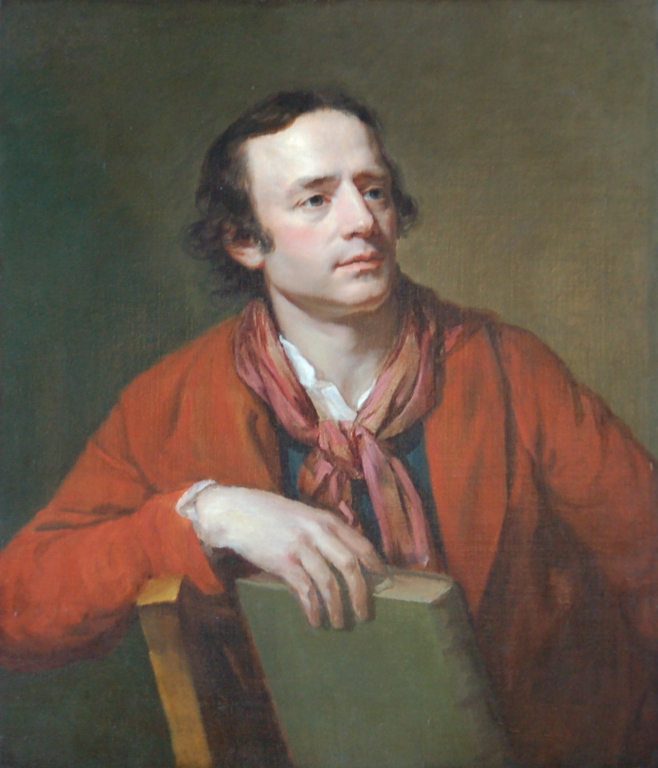
Finally, in 1852 the historian Jared Sparks (shown above as a young clergyman) reported that Francis Dana (1743-1811) of Boston had “heard Barré’s speech, and wrote home an account of it at the time.” As far as I can tell, that letter has never been published. Does its text survive in the Sparks Manuscripts at Harvard (MS Sparks 44)? The Dana family papers at the Massachusetts Historical Society? Or nowhere? How did it accord with the other accounts?

In digging around I was also struck by how Boston shopkeeper Harbottle Dorr began his personal newspaper archive in 1765. Apparently he decided that something big started that year.

Sunday, February 08, 2015

Finally, the Debate Over the Stamp Act

So did Isaac Barré speak against the Stamp Act in the House of Commons on 6 Feb 1765? Edmund Burke recalled that debate as unexciting, but on 12 February Horace Walpole wrote that Barré had delivered “a pretty heavy thump” to bill advocate Charles Townshend.

On 4 May the Providence Gazette cited “several Letters from London” to Newport that characterized Barré’s remarks this way:
Col. B—, confirmed the Equity of the Taxation, but doubted whether the Colonies were in a Capacity to pay it, and seemed inclinable to favor them.
Not very stirring.

But Jared Ingersoll (1722-1781), outgoing agent (lobbyist) for Connecticut, sent a much more dramatic account to Gov. Thomas Fitch. That manuscript, dated 11 Feb 1765, was transcribed and published in 1918.

Part of that letter was also published in America in 1765, including the 27 May Boston Post-Boy:
Mr Charles Townshend spoke in favour of the Bill, (Stamp Duty), and concluded his Speech by saying to the following Effect:

“These Children of our own Planting, (speaking of Americans), nourished by our Indulgence, until they are grown to a good Degree of Strength and Opulence, and protected by our Arms, will they grudge to contribute their Mite to relieve us from the heavy load of national Expence which we lie under?[”…]

Which having said and sat down, Mr. Barre arose, and, with Eyes darting Fire [he was in fact blind in one eye] and an outstretched Arm, spoke as follows, with a voice somewhat elevated, and with a Sternness in his Countenance, which express’d in a most lively Manner, the feelings of his Heart:

“Children planted by your Care? No! Your Oppression planted them in America; they fled from your Tyranny, into a then uncultivated Land, where they were exposed to almost a1l the Hardships, to which humane Nature is liable; and among others, to the Savage Cruelty of the Enemy of the Country; a People the most subtile, and, I take upon me to say, the most truly terrible of any People that ever inhabited any Part of GOD’s EARTH, and yet actuated by Principles of true English Liberty; they met all these Hardships with Pleasure, compared with those they suffered in their own Country, from the Hands of those that should have been their Friends.

“They nourished up by your Indulgence? They grew by your Neglect of them: As soon as you began to care about them, that Care was exercised in sending Persons to Rule over them, in one Department and another; who were, perhaps, the Deputies of some Deputy, of Members of this House, sent to spy out their Liberty, to misrepresent their Actions, and to prey upon them; Men, whose Behaviour, on many Occasions, has caused the Blood of those Sons of LIBERTY, to recoil within them; Men promoted to the highest Seats of Justice: some to my Knowledge, were glad by going to foreign Countries, to Escape being bro’t to a Bar of Justice, in their own.

“They protected by your Arms? They have nobly taken up Arms in your Defence, have exerted their Valour, amidst their constant and laborious Industry, for the Defence of a Country whose Frontier, while drench’d in Blood, its interior Parts have yielded all its little Savings to your Enlargement: and BELIEVE ME, REMEMBER I THIS DAY TOLD YOU SO, That the same Spirit which actuated that People at first, will continue with them still: But Prudence forbids me to explain my self any further. GOD KNOWS, I do not at this Time speak from Motives of Party Heat; What I deliver, are the genuine Sentiments of my Heart: However superior to me in general Knowledge and Experience, the respectable Body of this House may be, yet I claim to know more of America than most of you, having seen and been conversant in that Country. The People there are as truly Loyal, I believe, as any Subjects the King has; But a People jealous of their Liberties, and who will vindicate them, if they should be violated; but the Subject is too delicate, I will say no more.”
That speech inspired American opponents to the Stamp Act to call themselves “Sons of Liberty,” a phrase with deeper roots in British culture that lasted into other political battles as well.

Barré remained one of Parliament’s most vocal opponents of new taxes on the American colonies. Not that his oratory convinced many of his colleagues. His motion to adjourn without approving the bill, which was a form of up-or-down vote, failed by 245 votes to 49.

As for Jared Ingersoll, he decided the fight against the Stamp Act was lost, applied successfully for the position of stamp agent in Connecticut, and became a target of the Sons of Liberty—the very political movement his reporting had helped to inspire.

Saturday, February 07, 2015

The Debate Over the Debate Over the Stamp Act

In 1765, when the House of Commons started to debate the Stamp Act, there was no official record of Parliament’s debates, either from the government or private organizations.

In fact, it wasn’t entirely clear that reporting on parliamentary debates in detail was legal. Newspaper printers protected themselves by not spelling out the full names of politicians, as in yesterday’s report on George Grenville introducing legislation or this account of Lord Camden.

Because there was no authoritative record of those debates, that could produce debates about what Members of Parliament actually said. On 13 Apr 1765, the Providence Gazette reported this scoop:
By a Letter from London in the last Ship to Boston, we are acquainted, that Colonel ISAAC BARRE, Member of Parliament for the Borough of Chipping Wycomb, in the County of Bucks, distinguished himself GLORIOUSLY in Parliament, by a strenuous Opposition of ministerial Projections against the KNOWN RIGHTS of the Colonies, which were most unconstitutionally attacked by the Commons of Great-Britain, when they resolved that Stamp Duties should be charged here.—

He, openly, and with great Firmness, patronized the injured Colonies, and asserted their Privileges.—A COLUMN ought to be erected to him in America, as a LASTING MONUMENT of the Gratitude of the People, for his Virtue, Fortitude, and animated Endeavours to rescue them from Slavery.——
The Boston Post-Boy reprinted that story, but then responded on 29 April:
We hear there is a Letter in Town which says, That Col. BARRE, a Member of the House of Commons, did not say one Word in Opposition to the laying a Stamp-Duty on the Colonies; and if this is true, There cannot be a Word of Truth in that Pompous Account which we Published in our last, under Providence Head, of that Gentleman’s having “GLORIOUSLY distinguished himself, by a strenuous Opposition of the Projections against the KNOWN RIGHTS of the Colonies.”——

However, as the Expectations of the Public have been rais’d, we hope that Gentleman will do something GRAND, in behalf of the distressed Colonies, and if he does, we make no doubt but proper Notice will be taken of him.
On 4 May, the Providence Gazette could only reply:
The Account which was given in our Paper of the 13th of April, of Colonial BARRE’s distinguishing himself gloriously in Parliament in Behalf of the Colonies, is founded on a Letter to a Person of Distinction in this Town, from a certain Agent for one of the Colonies, who, one would think, could not be mistaken as to that Gentleman’s Behaviour in the House; and how a meer Negative should be proved by a Letter in Boston, seems very strange. It remains therefore that the Writer in the Boston Post-Boy be more explicit, if he thinks proper, as to that Matter.——However, it may be Matter of some Doubt, whether Col. BARRE objected against the Legality of taxing the Colonies, when he exerted himself to ward off the fatal Stamp Duties, or not.
(The picture above shows Barré in 1765—though painter Hugh Douglas Hamilton must have smoothed out the scars on his right cheek.)

TOMORROW: The debate at last.

Friday, February 06, 2015

Introducing the Stamp Act

On 6 Feb 1765, two and a half centuries ago, the chief British minister, George Grenville (1712-1770, shown here), formally introduced the Stamp Act into the House of Commons.

That wasn’t a sudden move. Grenville had floated the idea of a stamp tax—in practical terms, a tax on paper—for the North American colonies in the previous spring. That allowed the colonial legislatures to express their responses to the idea of paying new taxes to support the imperial government.

Not surprisingly, those responses were negative. In November the Massachusetts legislature, after much discussion between the House and the Council, had sent the House of Commons a petition which said, in part:
That there have been communicated to your petitioners sundry resolutions of the House of Commons in their last session for imposing stamp duties or taxes upon the inhabitants of the colonies, the consideration whereof was referred to the next session.

That your petitioners acknowledge with all gratitude the tenderness of the legislature of Great Britain of the liberties of the subjects in the colonies, who have always judged by their representatives both of the way and manner in which internal taxes should be raised within their respective governments, and of the ability of the inhabitants to pay them.

That they humbly hope the colonies in general have so demeaned themselves, more especially during the late war, as still to deserve the continuance of all those liberties which they have hitherto enjoyed.
Not surprisingly, those preemptive rejections of a stamp tax (and complaints about the latest Sugar Act as well) didn’t go over well in London. In fact, the 4 May Providence Gazette reported how Grenville handled them:
By several Letters from London we learn, That the Addresses from the Colonies were wrote with such warm and unbecoming Expressions, that it would have been dangerous to have presented them to the Parliament: That when the House of Commons entered upon the Consideration of the Colonies, Mr. G——le said much upon the subject, and with much Moderation; that after he had shewn the Equity and Necessity of taxing the Colonies, he expressed much Concern at the undue Spirit of the Addresses, but forbore to be particular, lest it should exasperate the House; and requested they would proceed with Coolness and Moderation.
So from the start, the American colonists and the Parliament had trouble even finding common ground for a discussion.

COMING UP: The debate in London.

Thursday, February 05, 2015

Cambridge Forum Lectures on Video

In recent years I’ve moderated a series of annual talks at the Cambridge Forum by historians of the Revolutionary era.

These talks all have a link to George Washington since they’re primarily co-sponsored by the Friends of Longfellow House–Washington’s Headquarters and the Massachusetts Society of the Cincinnati.

The Cambridge Forum edits those lectures for a public-radio audience. It also makes them available in long video form on YouTube, and here are the handy links:

Wednesday, February 04, 2015

Eager to Enlist, Yet Easily Overlooked: Eastern Massachusetts Indians in Combat in 1775

Today I’m pleased to share an essay from guest blogger David K. Thomas, a student at Colby College in Maine.

Isaac Comecho. Thomas Cognehew. Alexander Quapish. Joseph Paugenit. Fortune Burnee, Jr. These are not household names. But they are among the many American Indians from eastern Massachusetts who rushed to enlist when hostilities commenced in 1775. Each saw action in the Greater Boston area alongside his white and black neighbors.

The exemplary service of Stockbridge Indians from western Massachusetts and a lack of accessible documentation makes it easy to overlook these eastern Massachusetts Indians’ contributions.

Several dozen Indians from eastern Massachusetts were in action in 1775—while Indians were officially exempt from service. In fact, two hundred Indians from eastern Massachusetts—more than a third of all Indian males—eventually saw combat during the Revolutionary war in nearly all of the conflict’s major campaigns.

These included Mashpees and other Wampanoag Indians from dwindling reservations at Herring Pond, Plymouth, Dartmouth, and elsewhere. Aquinnah Wampanoags from Martha’s Vineyard also served. Nipmucs and Massachusett Indians such as the Naticks and the Ponkapoags—the remnants of Christian “Praying Town” communities—also enlisted. The tribal affiliations of other Indians remain unknown.

Military service provided a respite from a life spent wandering in search of farm work, whaling, or toiling as servants. Indian soldiers hoped that their service would lead to better times and improved treatment. Perhaps this explains why Eastern Massachusetts Indians fought so bravely in the opening battles of America’s war of independence.

Indian soldiers from Massachusetts hastened to enlist when the first Revolutionary shots were fired in 1775. Isaac Comecho, a Natick Indian, was present on the Battle Road between Lexington and Concord on April 19, 1775. Thomas Cognehew, a Mashpee Indian from Sandwich, also “marched on the alarm of April 19, 1775.” A struggling farmer, the Nipmuc Fortune Burnee, Jr., of Grafton, officially enlisted on April 26, 1775, a week after the Battles of Lexington and Concord (see Burnee’s name on a pay petition here).

Some Indians, like Henries Vomhavi (profiled on Boston 1775 in 2009) participated in raids on British posts. Less than two months later, sixteen Indians fought at the Battle of Bunker Hill. Five were from Massachusetts. These men included Natick Indians Alexander Quapish and Joseph Paugenit. Quapish served in Cambridge in 1775, but sickened and died early the next year.

Paugenit was the son of a wounded French and Indian War veteran. His surname is a shortened form of an Indian word for “codfish.” He later saw action at the Battles of Harlem Heights in 1776 and Saratoga in 1777. He died in a military hospital in Albany before the end of 1777, at just 23 years old. An exact death toll for Indian patriots remains unclear, but these deaths strained already struggling Indian communities.

Indians in the army camp at Cambridge in 1775 no doubt met Stockbridge Indians, Connecticut Indians, maybe even Indians visiting from Maine. They may have even been detached to pick off of British sentries and to join an Indian-led attack on British barges sounding the mouth of the Charles River.

In the short term, there were clear financial incentives to join the American cause in the starting phases of the Revolutionary War. Some Indians, like the debt-ridden Jonas Obscow, who had buried three sick children in the years prior to 1775 (as he and his wife wrote in a 27 May 1772 petition to the province), were all but forced to join the Continental Army out of economic necessity.

From the start of the Revolution, all enlisted Massachusetts Patriots of color found generous enlistment bounties and pay equal to that of white soldiers. Moreover, Indians received either a “bounty coat” or the equivalent in cash from the Continental Army. For instance, Wampanoags Samuel James and Robert Pegin, both of Bridgewater, received their bounty coats in December 1775.

Despite the initial reluctance of the Continental Congress to employ Indian (and African American) soldiers, in December of 1775, Massachusetts officials called on Indian soldiers “in the case of real necessity.” New England Indians became more prevalent in the Continental Army.

The services of Eastern Massachusetts’ Indians in 1775 proved to be only the beginnings of many distinguished military careers. Yet despite their services and sacrifices, little improved for these Native Patriots or their Indian communities after the war.

Recent developments, particularly several ceremonies in Natick in the 2000s, have resulted in renewed attention to Massachusetts Indians’ contributions to the American cause and represent an increased interest in their service and contributions.

The major sources for information on Native soldiers in the first year of the Revolutionary War include George Quintal, Jr., Patriots of Color: “A Peculiar Beauty and Merit”; the Massachusetts Soldiers and Sailors of the Revolutionary War series; and the National Society of the Daughters of the American Revolution, Minority Military Service, Massachusetts: 1775-1783.

This article is a nice match to Thomas’s professor Daniel J. Tortora’s article at the Journal of the American Revolution today, tracking Native American soldiers from Massachusetts through the war. Thanks to both men for the contribution! 

Tuesday, February 03, 2015

The Legalities of Licensing Historical Tour Guides

The National Constitution Center has highlighted a case under consideration by the U.S. Supreme Court about whether cities can require tour guides to pass tests of historical knowledge before being licensed.

Federal courts have issued contradictory decisions on that point in cases from Washington, D.C., and New Orleans. Such a disagreement often spurs the high court to issue a decision, but not always.

This question also arose in Philadelphia, and back in 2008 I wrote a bit about it, starting here. I found the libertarian think tank arguing the case (the same as in the current appeals) and its tour-company client were making arguments that didn’t add up, but they were easier to follow than a history professor’s position.

In the end, I concluded that a democratic government could, for the public good, institute a process for certifying guides as meeting certain standards for historical accuracy. But the potential harm to the public from historical misinformation was too small (even though the annoyance factor is high) to justify fining or otherwise punishing guides who don’t meet those standards or seek that certification. Furthermore, the process of approving some versions of history or some guides carries the dangers of oppressive ideology and favoritism.

(The photo above shows Gary Gregory in 2006, courtesy of Anne through Flickr via a Creative Commons license. Gary now operates the Edes & Gill print shop in the North End.)

Monday, February 02, 2015

Another Dimension for Battle Road?

Last week the University of Pennsylvania library announced the purchase of a collection of manuscripts about the occult and alchemy.

The original collector was Charles Rainsford, a British army officer during the Revolutionary War (shown here). But he spent that period enlisting soldiers in the German states, as a ceremonial aide-de-camp to King George III, and suppressing riots in London. So ordinarily that news would hold limited interest for Boston 1775. But then I spotted a familiar name in Mitch Fraas’s announcement:
It was with excitement then that my colleagues and I read the catalog for the sale of some of the 12th Duke of Northumberland’s collection this past July. Amongst the treasures was a somewhat unassuming lot consisting of nearly 60 manuscript volumes from a single 18th century collector. These manuscripts had been left to the 2nd Duke of Northumberland by his friend Charles Rainsford (1728-1809).

Since 1809 they had sat on the shelves at Alnwick Castle, seeing only sporadic use. Rainsford was not only a British general and sometime governor of Gibraltar but an avid alchemist and occultist, fascinated by everything from the philosopher’s stone to Tarot to Rosicrucianism. The manuscript library he left to the Duke of Northumberland contained works he had collected in Gibraltar and on the continent but also a number copied out in his own hand from texts he had seen or borrowed.
The second Duke of Northumberland is better known around here as Colonel Percy, Gen. Thomas Gage’s second-in-command in Boston at the start of the war and officer in charge of the relief column and retreat from Lexington on 19 Apr 1775. As the first Duke of Northumberland’s son, he used the name and title of Earl Percy until he succeeded to the dukedom.

Now I know our Percy didn’t inherit these manuscripts from Rainsford until the early nineteenth century, and Rainsford may not have even have started to acquire them until years after the Revolutionary War. But let’s imagine that Rainsford and Percy started discussing matters of alchemy and the occult early in their careers and made some breakthroughs.

That would open up new dimensions of possibility to Percy’s withdrawal along the Battle Road. Alchemical weapons! Dead soldiers resurrected as unstoppable zombies! The ghost of General Wolfe brought back to lead the redcoats!

Hey, it’s no more outlandish than some parts of Sons of Liberty. 

Saturday, January 31, 2015

More Woes for Cyrus Baldwin

Guest blogger Chris Hurley finishes up his look at the merchant Cyrus Baldwin.

This series so far has revolved around one incident: how Cyrus Baldwin’s 26 pounds of (technically non-odious) Bohea tea was stolen from his brother’s cart near Winter Hill on 4 Jan 1774 and dumped in the river by some who “tho’t it an Insult to be sent through their Town.” The Charlestown Committee of Correspondence refused to involve themselves in the matter.

Baldwin continued to have difficulties as the war approached. His 24 Oct 1774 ad in the Boston Gazette carried a postscript assuring people he was “neither Addresser, Protester, nor Roman Catholick”—suggesting some were saying he was a Loyalist or worse. A 6 Mar 1775 ad in the same newspaper saw him distressed, selling his English and Scotch goods at “50 per cent from the Sterling Cost.”

On 2 May 1776, after the siege of Boston, Baldwin’s ad in the New-England Chronicle indicates that his Boston shop had been looted by the evacuating British troops (and Crean Brush likely). It said that “he once more requests all those who are indebted to him on note, book or otherwise to make speedy payment to him at Woburn, where”—being the indefatigable merchant he was—he was selling sugar, rum, coffee, and “sundry other articles.”

But those setbacks were nothing compared to what Cyrus Baldwin suffered back at Winter Hill in 1784. That was still a sparsely settled stretch on the road between Charlestown and Medford, all but unavoidable if one was traveling to Woburn. Boston’s Continental Journal of 29 July reported:
Mr. Cyrus Baldwin of Woburn, crossing Winter Hill, was attacked by three foot pads who robbed him of his watch and money and, after abusing him very much, made off.
Boston’s Independent Ledger for 26 July had more detail. In addition to robbing Baldwin of 14 shillings and his pinchbeck watch—which this article described very thoroughly—the criminals had beaten Baldwin badly:
during the greatest part of the time they were stripping him, one of the villians was dealing very heavy blows with a club on the left side of his head, and cut his scalp in several places: ’tis hoped they will not prove mortal
The wounds did not prove mortal. And in a stroke of good luck for justice, the theives were apprehended after a subsequent unsuccessful attack on another man. The Continental Journal stated:
At the house where they were concealed was found the watch, purse, pocket-book, &c. of which Mr. Baldwin was robbed.
This time, unlike 1774, the law prosecuted the attack on Winter Hill. The 23 Nov 1784 Connecticut Courant of Hartford reported:
Boston, November 15. Thursday next Barrack and Sullivan, who robbed Mr. Cyrus Baldwin on Winter-hill, and who attempted to rob Major John Swan on Boston neck, as lately mentioned, are to be executed at Cambridge—
(The 27 July Salem Gazette and other Massachusetts papers had reported the second victim was James Swan, shown above.)

The 24 November Massachusetts Spy confirmed the sentence was carried out:
On Thursday last were executed at Cambridge, pursuant to their sentence,…Richard Barrack and John Sullivan for highway-robbery.
Six years later, Cyrus Baldwin died of drowning in Dunstable; that day, 5 Nov 1790, was his fiftieth birthday.

Samuel Thompson of Woburn wrote in his diary two days afterward: “Cyrus Baldwin, Esquire’s, corpse brought to Woburn.” In all the news items and advertisements examined for this story, I never saw Cyrus Baldwin honored with the sobriquet “Esquire” until his death. But that was how the Herald of Freedom reported him on 9 November:
Died]—at Dunstable, the 4th inst. CYRUS BALDWIN, Esq. formerly of Boston.—His funeral will be this afternoon, at two o’clock, from the house of his brother Loammi Baldwin, Esq. at Woburn—where the friends and acquantence of the deceased are desired to attend.
And thus ends the luckless story of Cyrus Baldwin. Thanks for sharing his ups and (mostly) downs, Chris Hurley!

Friday, January 30, 2015

Cyrus Baldwin Can’t Get No Satisfaction

Chris Hurley continues the story of Woburn’s own Baldwin brothers and their unsellable tea.

The story to date: Three weeks after the dumping of the tea in Boston harbor, Cyrus Baldwin, merchant of Boston, and his brother Loammi, gentleman farmer of Woburn, tried to smuggle safely transport tea through Charlestown. A shady “Committee of Suspicion” confiscated and destroyed the tea. In a letter now in the collection of the Massachusetts Historical Society, Cyrus sought redress from the Charlestown Committee of Correspondence.

His letter wasn’t the only one. Four of the five members of Woburn’s Committee of Correspondence also wrote to their counterpart committee in Charlestown, all on behalf of their fifth member—Loammi Baldwin (shown here). After a bit of circumlocution framed in patriotic rhetoric, their letter starts to get specific:

Som* violent measures we know have been rendered necessary, in order to make a proper Stand against those incroachments that have been made upon our Liberties—But the measures that we would now draw your attention to, we look upon as violent, unjust, & cruel.
The Woburn writers then relate the attack on Loammi Baldwin’s ox-cart and teamster, and the confiscation of Cyrus Baldwin’s tea, but pointedly omit Cyrus Baldwin’s name and sibling relationship to Loammi. In fact, they attempt to distance Loammi, themselves, and Woburn as a whole from the tea itself.
[Loammi Baldwin’s] Team was stopped on the King’s highway, in sd Town; his Teamster abused—his Cart robed of several articles, belonging to him, And at the same time about 26 lbs of Tea, not belonging to him, nor any man in this Town—but only to be conveyed for a Gentleman, by his favour, to some distant place.
Ah, so the tea may not have been bound for Woburn after all. It could have been going anywhere. The letter tries to play off the privileged status of the gentility as exempt from interference by commoners. The Woburn letter ends framing their desire for compensation to the Baldwin’s as being one with the cause of liberty, declaring:
We Trust you will by no means encourage or connive at such Conduct as this, which is so dishonorary and predudicial to the Cause in which we are engaged—but will use your influence to detect & punish the aggressors—and will indeavour that proper compensation be made to the Sufferers.
Charlestown replied—first to the Woburn committee, then to Cyrus—with polite “get lost” letters. Here are excerpts from the Charlestown committee’s copies of those two letters:
We conceive, when the Town appointed us to this honorable Trust, they expected that we should attend to such Grievances of a publick Nature only as there was no legal Remedy for. . . . We can no Means suppose ourselves authorized to interfere in private Matters, where the legal Remedy is plainly pointed out. As to the Fact refer’d to in your letter, this is the first authentick Intelligence we have had of it, a Rumour has prevailed, that something of that kind had taken Place.
They then cast doubt on the honesty of Loammi’s teamster and chided Loammi:
It is generaly doubted whether the Teamster was ever assaulted or not. Nay if he was assaulted there is no reason to suppose any of the Inhabitants of this Town were concerned in it.

But this we dare affirm, that either the Teamster Who relates the Matter, or the Persons who are said to have attacked him, were guilty of an infamous Falsehood, in declaring that they were employed in this Business by Charlestown. . . . We are extremly sorry, that Mr. Baldwin at this trying Time after the Body of the People at Boston had resolved “that the Use of Tea was improper & pernicious” should become a Carrier of that detested Article.
Concluding with:
We can take no Notice of this Matter. Whenever the Committee of Correspondence for the Town of Woburn have any thing to communicate to us, which falls within our Province, we will chearfully attend to it. ———— And with sincere Attachement to the Cause of Liberty, your humble Servants
And be sure not to let the door hit you on the way out, Woburn.

What about that asterisk in Woburn’s letter, shown in the first quoted passage above? It led to a footnote which read simply, “Ed. Andrus.” Edmund Andros had been deposed as governor of the Dominion of New England in a popular rebellion in 1689. Interesting that Woburn went back as far as that as an illustration of necessary “violent measures.” I take that as a signal that in early 1774 the town was ready to support another insurrection, if called for. But obviously the Charlestown committee thought that destroying a barrel of tea was acceptable as well.

TOMORROW: More woes for Cyrus Baldwin.

Thursday, January 29, 2015

"This side Winter Hill": Cyrus Baldwin Tells his Story

Yesterday guest blogger Chris Hurley promised untold details about the dumping of a barrel of tea in Charlestown in January 1774. That incident was reported in Massachusetts newspapers with no names attached. This posting picks up the story.

From the Massachusetts Historical Society’s Miscellaneous Bound Manuscripts, a letter from Cyrus Baldwin to the Charlestown Committee of Correspondence:
Boston Jany 25 1774

Gentn.

On the 4th Instant I was sending a quantity of Goods to my brother Mr Loammi Baldwin at Woburn & pack’d a bag containing 26 lb. Bohea Tea into a Barrel not for secrecy but for safety of conveyance. In the evening the Team was stoped just on this side Winter hill and the driver interogated by three or four men who called themselves a Commitee of Suspiscion for Charlestown: what goods he had & whether any Tea? To which he answered generally that he knew nothing what goods were in the Cart. Upon which they insisted upon probing, & abused and drove off the Teamster, broke open the cask that contained the Tea, carry'd off the bag with the Tea—& some other articles are missing.
Cyrus Baldwin’s property had been stolen. But because his property was tea, who would be sympathetic to his complaint?
I cannot harbour the least suspicion that any Gentlemen of Charlestown, much less any of the respectable Committe of Correspondance were knowing to or any way incouraging such high handed Villany, yet as they assumed the character of a Committee from the Town of Charlestown I think it my incumbant duty to the Inhabitants of Charlestown to inform you of the above particulars, not doubting but you will properly resent such Wickedness perpetuated in the name of the Town, & if it is in your power, promise me satisfaction for my loss.
Why ask the Charlestown Committee for redress? Why not go to the Law?
I think it not proper or advisable to make a public stir about it just at present, least the Enemies to the good cause which we have imbarked in should triumph in our Divisions. But unless a speedy & intire stop be put to such attacks upon private property we shall fall into a greater Evil than we are endeavouring to avoid.

All which is submitted to your wisdom and confidence.

Your most respectfull and obediant Humble Serv't,
Cyrus Baldwin.

I shall inteem it a favour you'd return an answer as soon as convenience will permitt.
The Charlestown Committee did answer quickly.

TOMORROW: Cyrus Baldwin can’t get no satisfaction.

Wednesday, January 28, 2015

Tea “not intended to be smuggled”

This “guest blogger” posting continues Chris Hurley’s story of Cyrus Baldwin and his surplus tea.

We left Cyrus Baldwin sitting on a stockpile of tea in January 1774, weeks after the Tea Party. Other Boston dealers in tea were likely in a similar situation.

Early that month, one tea dealer realized there was no future in selling Bohea tea in Boston and tried to move his supply out of town. As reported on page one of the 13 January issue of the Massachusetts Spy:
Last week a barrel of Bohea tea which was attempted to be smuggled into some of the country towns, was detected and stopped at Charlestown, soon after it crossed the ferry, and the whole contents emptied into the river.
And the Spy was late to the story; the Essex Gazette and the Boston Evening-Post had it before them. In fact, the same day as the Spy item, the Boston News-Letter published an update:
We hear that the Barrel of Tea which was emptied into the River at Charlestown last Week, was not intended to be smuggled, as reported; it being Part of some that had been imported here before the East India Company’s Tea arrived, and publickly advertised for Sale: The Tea it is said belonged to Persons who are esteemed Friends to Liberty, and was sent, with other Goods, to a Trader in the Country: But the Inhabitants of Charlestown having resolved against the Use of that Article. and burnt their own, some of them tho’t it an Insult to be sent through their Town, and destroyed it as reported.
Clearly some people knew the names of the “Persons who are esteemed Friends to Liberty” who owned that tea, but that secret did not appear in the newspapers.

There were dozens of tea dealers in Boston, and any of them might have wanted to move their supply out of town. The route across the ferry to Charlestown suggested that the intended destination was north of the Charles River; otherwise, that barrel would probably have been shipped out by the Neck. But otherwise those reports offer no information about who owned this tea.

It’s rare to read a news item like this and have a chance to flesh out the story. In this case, though, more details are available.

TOMORROW: Cyrus Baldwin tells his story.

Tuesday, January 27, 2015

Tea Merchant Cyrus Baldwin Has Too Much Tea

Longtime Boston 1775 readers might recognize the name “Chris the Woburnite” in the comments, usually attached to choice observations and  stories from that old Middlesex County town. 

In real life that’s Chris Hurley, Revolutionary reenactor and researcher. And he generously offered a series of “guest blogger” articles sharing a story of Woburn’s Baldwin family. So let’s get started.

There were three kinds of tea in Boston near the end of 1773, here listed in decreasing level of unacceptability to the Boston Whigs:
  • Detested, new-duty British East India Company tea. Not available, due to premature steeping in the harbor.
  • Old-duty British East India Company tea. Tolerated for years, despite (unenforced) non-use agreements.
  • Smuggled (often Dutch) tea. Free of the taint of duty, but still tainted somewhat, by it being, well, tea.
At the very end of 1773, popular Whig sentiment simplified things by characterizing all tea as odious, which was bad news for Cyrus Baldwin, a Boston merchant of, among other things, tea. His advertisement in the 1 November Boston Gazette had proudly proclaimed in bold type: “Choice Souchong and Hyson Tea.”

Even though he was from a Whig-leaning family, Baldwin continued to advertise tea as the tea crisis deepened that fall. After all, he was not one of the hated new-duty consignees, and selling tea was his livelihood. Some Boston merchants had openly opposed the landing of the new-duty tea.

Some citizens in Boston accused those merchants of plotting to create scarcity, corner the tea market, and raise prices. They could have been talking about Cyrus Baldwin. He appears to have increased his stock of tea that season: when he advertised in the Boston Evening-Post on 20 December, he now included additional tea, some “Choice Bohea.”

In an attempt to render this offering acceptable, this new ad included a disclaimer: “The above Teas were imported before any of the East India Company’s tea arrived.” That continued to run into early January 1774.

Baldwin priced his tea at 18 shillings per pound. That was more than triple the price set on 29 December by the “principal dealers of teas in Boston”—those dealers being anxious to refute any charge of price gouging (as reported the 30 December Massachusetts Spy). But Baldwin’s 18s. price may have applied only to the high-class Hyson tea, and perhaps he priced his Bohea more reasonably.

In any event, those dealers also agreed not to sell any tea at all after 20 Jan 1774. Whether Cyrus Baldwin was then willingly in step with the association of tea dealers or not, his 20 January ad in the Massachusetts Spy no longer boasted tea.

But Cyrus Baldwin still had tea—too much tea. Even in early January 1774 he knew he couldn’t sell all the Bohea he had. What then to do with it? It did him little good in Boston. This valuable property could even have been in danger from the radical tea-burning element of the Patriot faction [Are you listening, Lexington and Charlestown?]. Where then to safely store it?

Luckily for Cyrus, he had a younger brother, Loammi, who lived on a farm in the nearby countryside town of Woburn. Loammi was a gentlemen of position there and on the town’s committee of correspondence, thus putting him beyond reproach. What better person to store the tea until it was marketable again? The brothers might also have been able to transport the tea to somewhere it could be readily sold. Loammi’s farm had at least one team of oxen and probably a number of wagons or carts. But first, could Cyrus get the tea out to Woburn?

TOMORROW: “Not intended to be smuggled”.

Monday, January 26, 2015

Two Different Samuel Adamses

This is Samuel Adams. In 1773 he was fifty-one years old. His father had been a selectman, merchant, and church deacon. He had gone to Harvard College and earned a master’s degree. As a young man he had helped to found a short-lived newspaper, which honed his writing skills, and discovered that he had no interest or luck in business. He turned to the public sector.

As a collector of taxes for the town and province from 1756 to 1765, then one of Boston’s representatives in the Massachusetts General Court from 1765 on, Adams became the town’s leading political organizer. With the salary that came from being chosen Clerk of the House of Representatives and frugal living, Adams was one of the first Americans to support his family in genteel style as a full-time elected official.

Politically Adams was implacably opposed to new royal measures and the men appointed to carry them out, but more hotheaded colleagues like James Otis and Josiah Quincy trusted his judgment to keep them out of trouble.

Adams was a devout Congregationalist, known for his love of psalm-singing (and for recruiting young men to his political cause at psalm-singing practices). In 1749 he had married Elizabeth Checkley, daughter of his minister. She died in 1757, and in 1764 he had married again to Elizabeth Wells, who helped to raise the surviving children. By 1773 his son Samuel, Jr., had also graduated from Harvard College and was training to be a physician.

Samuel Adams had a striking physical trait, described this way in a biography written by a descendant:
Mr. Adams, from about middle life, was more or less affected with a constitutional tremulousness of voice and hand, peculiar to his family, which sometimes continued for several weeks together, and then disappeared for as long a time.
The Rev. William Gordon wrote of Adams confronting Lt. Gov. Thomas Hutchinson after the Boston Massacre “with his hands trembling under a nervous complaint.” John Adams referred to his cousin’s “quivering, paralytic hands.” In recent years this condition was diagnosed as essential tremor.

This is a fictional character named Samuel Adams, who appears in the Sons of Liberty television entertainment. He shares a few traits with the historical figure. Both are white men living in Boston, both have worked as tax collectors, and both in their ways oppose the royal government.

As for that hand tremor, I definitely hope this character doesn’t have one if he’s carrying around two pistols like that.

Sunday, January 25, 2015

Upcoming Events at the Royall House

The Royall House and Slave Quarters in Medford will host a series of book talks on the history of slavery in America over the next three months.

Thursday, 5 February, 7:00 P.M.
Interpreting Slavery at Museums and Historic Sites
This event will launch a new collection of articles edited by Kristin Gallas and James DeWolf Perry from the Tracing Center on Histories and Legacies of Slavery. They will speak about how historic sites and museums can facilitate the sharing of the history of slavery, and how those stories tie into vital contemporary public debates. This event is free. A book signing will follow. (The museum can accept only cash or checks for purchases.)
[ADDENDUM: Because of the weather, this event has been rescheduled to Monday, 23 February. FURTHER ADDENDUM: This event has been rescheduled to Wednesday, May 6.]

Wednesday, 18 March, 7:30 P.M.
Boston: Origin of American Slavery
Journalists Lisa Braxton and Alex Reid will speak about their upcoming book about the ship Desire. Built in Marblehead, the Desire was the first American-built slave ship. In February 1638 William Pierce piloted it into Boston harbor, carrying people captured and bought in Africa to serve the Puritans of the ”City on a Hill.” Though slavery was not written into law until 1641, it thus became part of Massachusetts’s economy and society and would remain so until the Revolutionary War.

Wednesday, 15 April, 7:30 P.M.
The Logbooks: Connecticut’s Slave Ships and Human Memory
Journalist Anne Farrow, coauthor of Complicity: How the North Promoted, Prolonged and Profited from Slavery, will discuss her new book, based on records kept by a New London merchant‘s son starting in 1757. His first voyage was to the tiny island of Bence off Sierra Leone, and The Logbooks uses his records to unearth new realities of Connecticut’s slave trade. A book signing will follow. (The museum can accept only cash or checks for purchases.)

Saturday, January 24, 2015

William Russell’s Toasts on Offer

Last month I quoted an 1874 profile of William Russell that contained a description of a “Sons of Liberty” medal, worn by Boston activists on public occasions. Noting that no example of such a medal survives and no other source describes one, I expressed skepticism about that statement.

That same profile also quoted from a small document said to have been written by William Russell, a document being auctioned on 31 January by Seth Kaller and Keno Auctions. One side appears to have arithmetic exercises, perhaps from Russell’s work as a school teacher. The other reads:
May the Sons of Liberty
Shine with Lustre

Boston

Wilks & Liberty

August the 14th. 1769.

Liberty without
End. Amen.

Americans Wilks
92         45
This appears to be notes for two or three toasts delivered at a celebration of the fourth anniversary of Boston’s first Stamp Act protest. American Whigs saw themselves in league with John Wilkes, a leading political reformer in London. The numbers 45 and 92 gained great symbolic importance in 1760s Massachusetts for reasons which are easy to explain, hard to fathom.

The phrase “liberty without end. Amen” also appears as a refrain in a pamphlet titled Britannia’s Intercession for the Deliverance of John Wilkes, Esq. from Persecution and Banishment, first printed in London in 1763. Daniel Kneeland reprinted that in Boston in 1769, so the phrase was current in the town then.

Both the 1874 article and the auction house’s webpage for this document link it to the Boston Sons of Liberty banquet on 14 Aug 1769, held at the Liberty Tree tavern in Dorchester. However, the 21 August Boston Evening-Post printed all the toasts offered that day—fourteen at Liberty Tree itself in Boston’s South End and forty-five at the tavern—and they don’t include the phrases on this document.

So that left me with a picture of William Russell carefully writing out toasts in case he might be called on, and then watching as other men got invited to voice their thoughts, and the number of those men inexorably climbed to the magical forty-five, when no one else would be called. And then Russell sadly taking his little slip of paper home.

But then I checked the list of gentlemen who attended that Dorchester banquet. William Russell’s name doesn't appear on it at all. He had just turned twenty-one that year and probably wasn’t prominent enough to warrant an invitation.

So my new, cheerier theory is that Russell got together with some other young men in Boston and had their own banquet with their own toasts. Including these.

In any event, this document helps to confirm that, even if there was no Sons of Liberty medal, William Russell was involved in that movement as early as 1769. He’s also linked to the Tea Party and served in the war.

Friday, January 23, 2015

Discovering Prince Demah, an African-American Artist

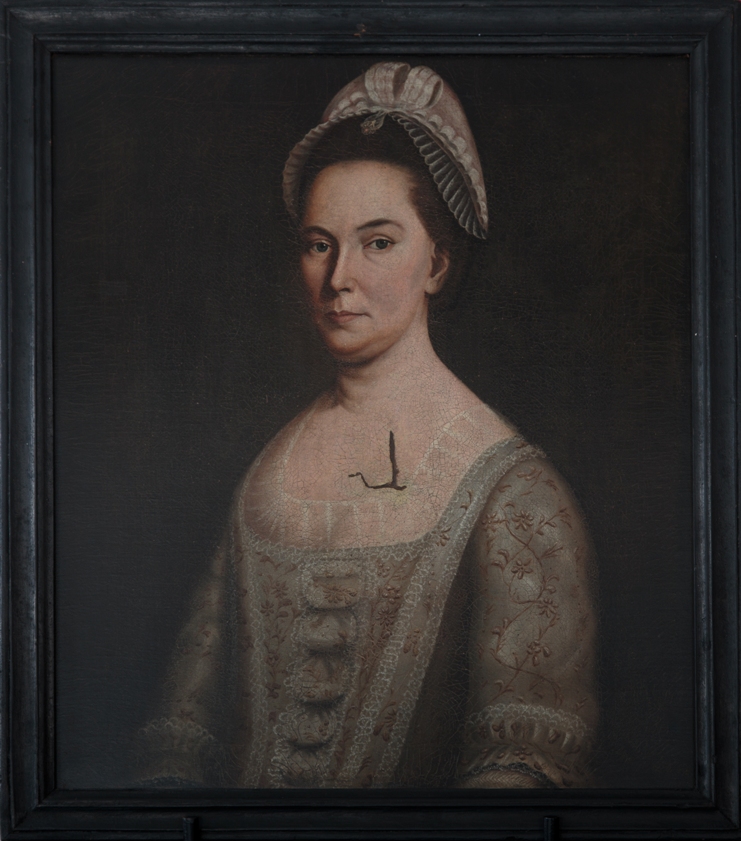
Back in 2006 and 2008 I wrote about a young black artist mentioned in the letters of Christian Barnes, a Marlborough merchant’s wife (shown here). All I knew about him was the given name “Prince.”

Paula Bagger, working with the Hingham Historical Society, has found out a lot more. The society owns portraits of Christian Barnes and her husband Henry, and we know that she sat for Prince to paint her. Then it turned out that the Metropolitan Museum of Art owns a portrait of William Duguid in the same style that’s signed on the back “Prince Demah Barnes.”

Bagger just wrote an article about the artist for the historical society’s blog. And in the January 2015 issue of The Magazine Antiques, she and Amelia Peck of the Metropolitan Museum of Art discuss all three known oil portraits by Prince.

On the blog Bagger filled in more about the artist’s life:
Prince enjoyed a short professional painting career before the Revolution changed the lives of Christian, Henry, and Prince. Christian and Henry fled [as Loyalists,] and Prince enlisted in the Massachusetts militia as a free man–Prince Demah (no more “Barnes”)–and served as a matross. He died, likely of smallpox or other disease, in March 1778. As “Prince Demah, limner,” he wrote his will, leaving all he had to [his mother] Daphney.
Christian Barnes’s letters show that Prince Demah practiced with both oils and pastels. She tried to line up friends to sit for him, and there are several years between when she first mentioned his talent and the disruption of the war. So there might well be more portraits by this newly identified African-American artist and Continental soldier, perhaps in private hands or historical society collections. Bagger and her colleagues are on the hunt!

Thursday, January 22, 2015

Reading the Smiles of 18th-Century Art

The 12 January New Yorker includes Jonathan Kalb’s article “Give Me a Smile,” which describes in personal terms the importance of being able to smile.

Kalb writes, “The spontaneously joyful smile is the facial expression most easily recognized from a distance—as far as a hundred metres, researchers say.” Since the late 1800s, scientists have claimed and amassed evidence that the smile is a universal human expression.

I was struck, therefore, by this Boston Globe interview with Colin Jones about his new book, The Smile Revolution in Eighteenth Century Paris. According to this book, through the early 1700s “smiling widely in portraits meant that you were probably destitute, indecent, or mentally ill.” Here’s more detail:
JONES: The type of facial regime which is prevalent in France in the early 18th century is more negative about the smile. It tends to see the smile as a gesture of superiority over some misfortune, rather like laughter at that time is seen in very negative terms—you’re somehow rejoicing in the suffering of others. So when people smile, they smile, first of all in a restrained way which doesn’t show teeth...but also very often in ways which are seen as sardonic or contemptuous or disdainful.

IDEAS: What changed?

JONES: There are two principal factors....One is the emergence of something which is clearly, for the first time, close to modern scientific dentistry, which highlights good, healthy, and hopefully white teeth, and methods of care which are not simply, as they had been in the past, extraction of bad teeth but also a regime of prevention of mouth ailments and sickness....

Secondly, I try to tie it up with...the emergence of a cult of sensibility. I associate this particularly with the emergence of the novels of sentimentality and sensibility by Samuel Richardson and Jean-Jacques Rousseau, who emphasize the overt and public expression of feelings, rather than their repression or distortion. People who look at the cult of sensibility often stress that people are always weeping in the 18th century—weeping with pleasure, weeping with ecstasy, weeping with anything, if you like. But actually part of that is this new smile, which somehow sends a transcendent message of selfhood and generosity and fellow-feeling.
Of course, the open-lipped smile remained rare in formal portraits. And later, Jones says, portrait photography followed that style for decades, even after better chemistry and quicker exposures could capture natural smiles.