J. L. BELL is a Massachusetts writer who specializes in (among other things) the start of the American Revolution in and around Boston. He is particularly interested in the experiences of children in 1765-75. He has published scholarly papers and popular articles for both children and adults. He was consultant for an episode of History Detectives, and contributed to a display at Minute Man National Historic Park.

Subscribe thru Follow.it


•••••••••••••••••


Sunday, August 06, 2017

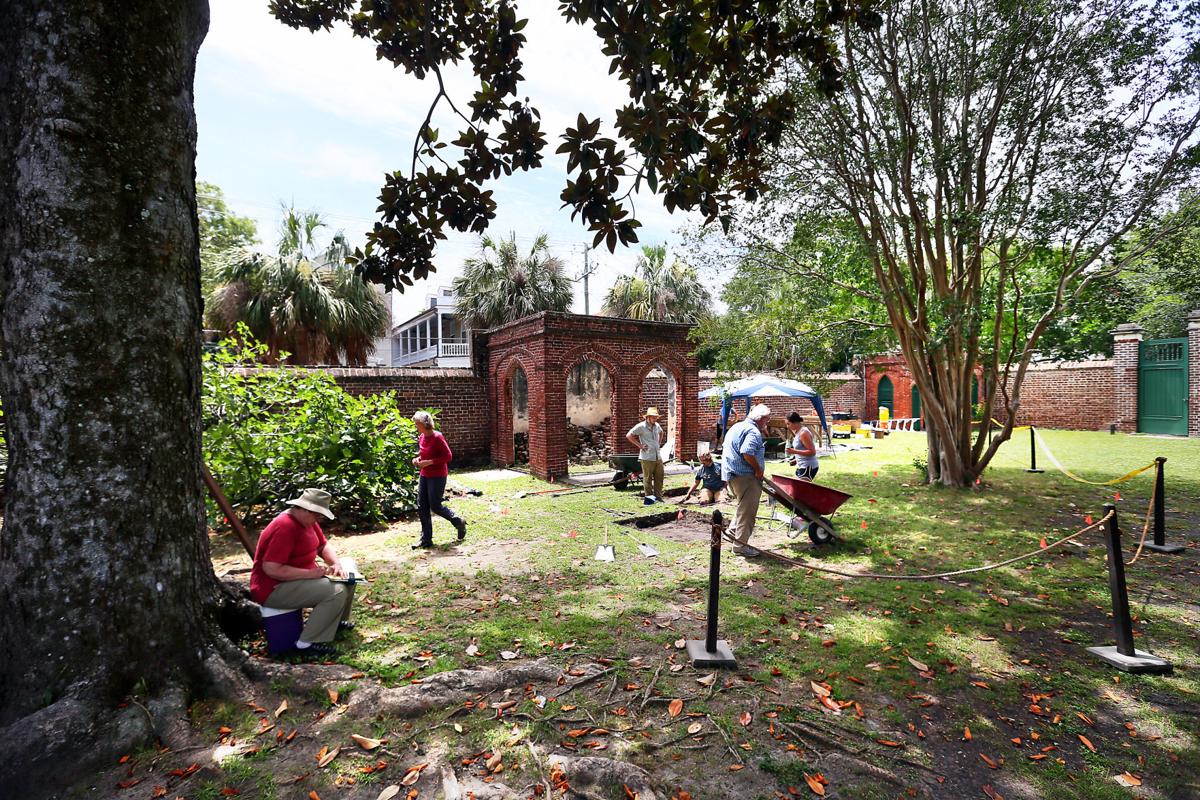
A Filled-In Trench in Charleston?

Here’s an archeological find that caught my eye several weeks back, as reported in the Post and Courier of Charleston, South Carolina:
The Historic Charleston Foundation has been researching the rear yard behind its Aiken Rhett House property [from 1820] to learn more about how wealthy residents and their slaves shared the large area, which might have contained an ornamental garden as well as work space.

Recent ground-penetrating radar showed evidence of a pit and possibly pathways of brick, shell or compacted earth.

But it also found evidence “consistent with a filled ditch.”
That was significant because military historians knew that the British army built trenches on the peninsula during their campaign to take the port city in the spring of 1780.

A later Post and Courier story continued:
In the late 18th century, the city was mostly concentrated below present-day Calhoun Street. British troops dug trenches in the uninhabited areas farther north, allowing them to stealthily move troops across the city from the east to capture the patriots’ fortification in the area now known as Marion Square.

After the British forces seized control of the city, they filled in the trenches to keep them from being used in a counter-attack.

In the decades after the war, new streets and suburban homes, such as the Aiken-Rhett House, were built on top of the filled-in trenches, making it especially difficult for today’s historians to pinpoint where they were.

Martha Zierden, curator of historical archaeology at the Charleston Museum, said if they can verify the location of one trench, they can use old maps to estimate where all the others are buried.

On Friday, the team of archaeologists and students on Elizabeth Street got one step closer to that goal. After they finally finished removing a layer of old bricks and slate in the excavation pit, they reached the soil dating back to the 1780s that indicated the dirt had been disturbed, most likely for a trench.

“There would have been no other reason for anybody to be digging in that area because it was uninhabited in the late 18th century,” said Carl Borick, director of the Charleston Museum.

He said the area also lines up with a map of the trenches drawn by [Charles Blaskowitz,] the British Army’s chief mapmaker for the Siege of Charleston.

Saturday, August 05, 2017

Minute Man Park Presentations in August

Here are free public presentations scheduled for today and the rest of August in Minute Man National Historical Park.

Saturday, 5 August, and Sunday, 6 August, at 2:00 P.M.
The Wayside Living History Players
The Wayside, 455 Lexington Road in Concord
Experience the living history program developed by local high school students celebrating the lives of the teenagers who grew up in The Wayside. Let them take you through their home as it was during different periods of time from 1775 to 1900. Ask the students what it was like to prepare and present the program based on more than two hundred years of history.

Saturday, 12 August, 1:00 P.M.
Abigail Adams: Life, Love, Letters
Buttrick Garden at North Bridge Visitor Center, 174 Liberty Street in Concord
Join Abigail Adams, portrayed by actress and historian Pat Bridgman, as she reflects on her courtship, marriage, and love in wartime.

Saturday, 19 August, 11:30 A.M., 12:30 P.M., and 1:45 P.M.
Colonial Justice
Hartwell Tavern, 106 North Great Road in Lincoln
What crimes came before the local Magistrate in the early 1770s? Come to Hartwell Tavern and meet the Magistrate and the Constable as well as a motley group of offenders (portrayed by the Guild of Historic Interpreters). Will the defendents the fined, sentenced to community service, or be exonerated? You will have a say in the matter!

Sunday, 20 August, 1:00 and 3:00 P.M.
The British Redcoat
Minute Man Visitor Center, Route 2A in Lexington
Why were the Regulars in Massachusetts? Why did they come to Concord? What happened on April 19, 1775 from the perspective of the King’s Army? Join Park Ranger Roger Fuller to explore the answers to these questions.


Friday, August 04, 2017

The Massachusetts Militia, and Its Exceptional Men

Next week I’ll be one of the presenters at a teachers’ workshop organized by Minute Man National Historical Park. My topic will be the Massachusetts militia system and that institution’s role in The Road to Concord.

Preparing for that session, I’ve been reviewing the Massachusetts militia laws. In January 1776 the General Court approved an update of the main law, which dated to the reign of William and Mary.

The new law defined the people required to participate in the militia’s seasonal military training this way [my formatting for clarity]:
That that Part of the Militia of this Colony, commonly called the Training-Band, shall be constituted of all the able-bodied Male Persons therein, from sixteen Years old to fifty, excepting
  • Members of the American Congress,
  • Members of the Council, and of the House of Representatives for the Time being,
  • the Secretary of the Colony, all Civil Officers that have been, or shall be appointed by the General Court or either Branch of it,
  • Officers and Students of Harvard-College,
  • Ministers of the Gospel, Elders and Deacons of Churches, Church-Wardens,
  • Grammar School-Masters,
  • Masters of Arts,
  • the Denomination of Christians called Quakers,
  • Select Men for the Time being,
  • those who have by Commission under any Government or Congress, or by Election in Pursuance of the Vote of any Congress of the Continent, or of this, or any other Colony, held the Post of a Subaltern, or higher Officer,
  • Persons while actually employed as Masters of Vessels of more than thirty Tons Burthen, other than Fishing Vessels, and Vessels coasting this Colony, and to and from this Colony to the other New-England Governments,
  • Constables, and Deputy Sheriffs,
  • Negroes, Indians and Mulatoes,
and shall be under the Command of such Officers as shall be chosen, impowered and commissionated over them, as is by this Act provided;

and the Select-Men, or the major Part of them of each town, shall be, and hereby are impowered by Writing under their Hands, to excuse from Time to Time such Physicians, Surgeons, Ferrymen and Millers in their respective Towns, from common and ordinary Trainings, as they shall judge it necessary to excuse:
In effect, this law excused gentlemen at the top of society (Harvard men, office-holders, and ministers) from training while also barring men from the bottom (non-whites). Some workplaces were deemed so important that their employees could also be excused: transatlantic ships, ferries, mills.

That left the vast majority of white men in the colony in the training band: small farmers, as well as craftsmen. The previous militia law included men between the ages of fifty-one and sixty; this one assumed fiftysomethings didn’t need more training. However, a later clause of the same law stated that white men aged fifty to sixty-five were on the “Alarm List” to be called up in a military emergency—“Provided, That no Persons above sixty Years of Age, nor such Millers and Ferrymen,…shall be compelled to march out of the Town wherein they have their usual Place of Abode.”

Men who had ever been commissioned as military officers didn’t have to show up for drills; presumably, they already knew the drill. And perhaps legislators felt that it would be awkward for such men to stand in the ranks and receive orders from militia officers with less experience.

Not being required to attend training didn’t exclude men from turning out with the militia in an emergency. We know such men of African descent as Prince Estabrook, David Lamson, and Caesar Ferrit marched with the provincial militia companies on 19 Apr 1775. In an actual battle, I suspect, neighbors were happy for all the support they could get. But it’s also possible that by the 1770s towns were ignoring the part of the provincial law that excluded non-whites from training.

Thursday, August 03, 2017

Who Was Behind Samuel Adams’s 1776 “Oration”?

Another reason to doubt that Samuel Adams actually wrote and delivered the oration credited to him by a London pamphlet of 1776 is that he wasn’t known as an orator.

For example, when the town of Boston commissioned annual orations from 1771 into the 1800s on the Fifth of March or the Fourth of July, Adams never took on the task of speaking. He attended, and even took the lead in thanking the orators, but he didn’t seek that spotlight.

One factor was that Adams suffered from what modern physicians have diagnosed as an essential tremor. This affected his speaking voice in unpredictable ways. His biographer William V. Wells wrote:
Mr. Adams, from about middle life, was more or less affected with a constitutional tremulousness of voice and hand, peculiar to his family, which sometimes continued for several weeks together, and then disappeared for as long a time. . .

To the end of his days he continued to wear garments in the style of the Revolution, which, added to his gravity of aspect and dignity of address, gave an impressiveness to his remarks, not lessened by a very clear and decisive manner of speaking, while the tremulousness of voice accorded with his veteran appearance.
Adams certainly did speak in town meetings and legislatures, but if Philadelphians wanted someone to orate about American liberty on 1 Aug 1776 (and there’s no evidence they really did) there were many other men in the Continental Congress better known for public speaking.

Rather than planned public orations, Adams expressed himself in writing through newspaper essays, government statements, and letters. Such publications made his name well known in Britain by 1776. Thus, British readers wouldn’t have been surprised to see an oration credited to Adams—but his friends in Boston were immediately skeptical.

Some scholars have hypothesized that the 1776 “Oration” was created by pro-Crown propagandists in London in an attempt to alarm their British citizens into believing that the Americans were aiming for independence.

If so, those authors missed a number of chances to highlight the danger or hypocrisy of the American cause. There’s no mention of slavery, for example. The pamphlet didn’t bring up attacks on Crown officials, loyal British subjects, or the provinces of Canada, even in the guise of justifying them.

And of course by the time an oration delivered on 1 Aug 1776 could reach London, the imperial capital already had news of the Congress declaring independence on 4 July. So telling the British public that the Americans wanted independence was old news.

Another possibility, which I’m leaning toward after reading the piece, is that it was actually written by a British supporter of America and of political reform—perhaps even republicanism—in Britain. By publishing those arguments in the voice of Adams, the author protected himself (or herself) from charges of sedition.

That’s why the pamphlet engages with European authors like Richard Price (shown above) and Jean-Jacques Rousseau more than with American issues. That’s why it has more to say about Parliament’s corruption than about the new American governments.

If Samuel Adams ever saw this pamphlet, he probably wasn’t upset by the words it put into his mouth. But he might have been puzzled by the choice of himself as a mouthpiece.

COMING UP: A Bostonian chuckles at this oration and other “fake news.”

Wednesday, August 02, 2017

“Purporting to have been delivered by Samuel Adams”

Yesterday I described an oration that Samuel Adams delivered in Philadelphia on 1 Aug 1776—or at least that was what a pamphlet published in London said.

In his 1865 biography of Adams, descendant William V. Wells wrote:
There appeared in London this year a printed oration, purporting to have been delivered by Samuel Adams on the 1st of August at Philadelphia. Written in the style of Adams, with but one or two exceptions, it was evidently prepared by some person familiar with his writings. Even his frequent italicizing of words, intended to convey pointed meanings, is not neglected. It must have had an extended circulation, several copies being now preserved in various libraries. Its spuriousness was not suspected in England, where its effect had been the principal object of the author; but whoever was the writer, it is difficult to see what was the immediate point to be gained by the deception. . . . The only contemporary notice was apparently written in London, after a perusal of the oration; and the writer expresses the general opinion of the subtlety of Samuel Adams as beyond that of all others in Congress.
In a footnote Wells laid out the “numerous and palpable” arguments against the authenticity of the pamphlet:
1. Congress was in session on the 1st of August, when the oration purports to have been delivered. It is hardly possible that on such an occasion, that body would not have adjourned; and the title-page bears the words, “delivered at the State House.”

2. Contemporary records make no mention of any public celebration on the 1st of August; nor could the signing of the engrossed copy of the Declaration of Independence on the following day have had any association with the speech. None of the American reminiscences of those times refer to it, either in diaries, letters, or newspapers, and it is not likely that so interesting an occurrence would have escaped mention.

3. This professes to be a reprint of the original Philadelphia pamphlet. No such American edition has ever been seen, but at least four copies are known of the London issue.

4. Though the oration is dated nearly a month after the Declaration of Independence, it is silent as to that event, which the unceasing efforts of Adams had particularly pushed to consummation, showing that the author (evidently in London) was ignorant of the Declaration. . . .

6. The oration repeatedly alludes to the “present Constitution” as then in force, as being already “composed, established, and approved.” No constitution existed at this date. The only approach to such an instrument were the Articles of Confederation; and Samuel Adams being one of the committee which had reported them in the previous month, none better than he knew that they had not been approved. Congress, on that very day, resolved upon the consideration of them, and the debate continued far into August, when they were laid aside, and not taken up until the next spring.
Wells also stated that “contains certain indecent passages which it would be absurd to suppose for a moment that Samuel Adams could ever have written.” Unfortunately, those were too indecent to point out. Nothing stands out as indecent to my eyes, but I immediately had doubts about Adams quoting Jean-Jacques Rousseau.

In 1875, Charles Francis Adams showed a copy of the oration to the Massachusetts Historical Society while adding that “there was no evidence that Samuel Adams ever delivered such an oration, nor had there ever been discovered a copy published in Philadelphia.”

In the early 1900s, Harry Alonzo Cushing edited a comprehensive collection of The Writings of Samuel Adams. He referred to the pamphlet only in a footnote, citing Wells’s arguments against its authenticity while noting that the text continued to be reprinted “as recently as 1900.” Cushing also quoted a contemporaneous American reference to the “oration” as dubious:
John Eliot of Boston apparently had the matter in mind when he wrote to Jeremy Belknap, June 17, 1777: “Mr S. Adams is a gentleman who hath sacrificed an immense fortune in the service of his country. He is an orator likewise, & there is a famous oration upon the independance of America, which, it is said, he delivered at Philadelphia, January [sic], 1776, but which was never seen in America before.”
Today the oration is recognized as a hoax by bibliographers and booksellers. But with so many anthologies of American oratory reprinting the text in the 1800s and early 1900s, the internet has rediscovered it and brought it back as a seemingly authentic statement by Samuel Adams. The sentence “Truth loves an appeal to the common sense of mankind” seems particularly popular and, given the deceptive source, particularly ironic.

TOMORROW: Who created this hoax?

Tuesday, August 01, 2017

The Philadelphia Oration of Samuel Adams

In late 1776 a pamphlet appeared in London with the title:
An Oration Delivered at the State-House, in Philadelphia, to a very numerous Audience, on Thursday the 1st of August, 1776; by Samuel Adams, Member of the **** ******** the General Congress of the ****** ****** of America.
This speech was said to have been first published in Philadelphia and then reprinted in London by J. Johnson. The price was one shilling.

That material was reprinted in the Gentleman’s Magazine and by several other printers in the British Isles. Adams’s descendant and biographer William V. Wells reported that French and German translations appeared during the war. We can read the whole thing in modern typography here.

The text of the oration began with an acknowledgment of being excited about the prospect of American independence:
I will not deny the Charge of my Enemies, that Resentment for the accumulated Injuries of our Country, and an Ardour for her Glory, rising to Enthusiasm, may deprive me of that accuracy of Judgment and expression which Men of cooler passions may possess. Let me beseech you then to hear me with Caution; to examine without prejudice, and to correct the mistakes into which I may be hurried by my Zeal.
The author linked the political changes in America to the venerated Protestant Reformation: “Our Fore-Fathers threw off the Yoke of Popery in Religion; for you is reserved the honor of levelling the popery of Politicks.” The text also drew on history for examples of the corruption of kings.

The pamphlet then jumped forward to the contribution of the colonies to the British Empire and the rise of the North American colonies in population and production. There are few specifics about the ongoing war, the disputes between colonial Whigs and the Crown over the preceding eleven years, or contemporary political issues in Philadelphia. Indeed, the oratory has more to say about the British Parliament:
When a general Election will be nothing but a general Auction of Boroughs; and when the Parliament, the grand Council of the Nation, and once the faithful Guardian of the State, and a terror to evil Ministers, will be degenerated into a body of Sycophants, dependent and venal, always ready to confirm any measures, and little more than a public Court for registering royal Edicts.—Such it is possible, may, some time or other, be the state of Great Britain.—What will at that period be the duty of the Colonies? 
The pamphlet quotes Richard Price’s Observations on Civil Liberty and Jean-Jacques Rousseau’s Treatise on the Social Contract, but not the Declaration of Independence proclaimed in Philadelphia less than a month before.

Overall, the text is a well-argued case for American independence as the best way to preserve traditional British liberties. It portrays British institutions as corrupt and in decline. In contrast, North America is rising, and the Caribbean colonies will soon “from necessity wish to enjoy the benefit of our [American] Protection.” It tells the audience that they are and should be in control of their government: “You are now the guardians of your own liberties.” To our modern eyes, this pamphlet seems very forward-looking (once we get past that “Yoke of Popery” stuff).

Unfortunately, this oration was almost certainly not written or delivered by Samuel Adams.

TOMORROW: Suspicious circumstances.

Monday, July 31, 2017

“Four Loose Cannons” for Download

Last week I had my post-midnight visit with Bradley Jay at WBZ-AM radio. The conversation was fun and detailed and as coherent as I can be that late at night.

That segment of the Jay Talking show is now available as a podcast episode titled “Four Loose Cannons.” You can find it for streaming or download at any of these links under the date of 27 July 2017:

One of the topics we discussed was the process of firing an eighteenth-century cannon. Click on the image below for a two-minute demonstration from Fort Niagara.

Sunday, July 30, 2017

Capt. John Trull: “Stand trim, men.”

In 1888 Edward W. Pride’s Tewksbury: A Short History recounted the town’s response to the Lexington Alarm and added:
One of the Tewksbury men was Eliphalet Manning. One of Captain [John] Trull’s grandsons, Mr. Herbert Trull, often related that when a boy, on his way to Salem, he used to pass Manning’s door. Eliphalet would call out: “I fought with your grandfather from Concord to Charlestown. He would cry out to us as we sheltered ourselves behind the trees: ‘Stand trim, men; or the rascals will shoot your elbows off.’”
Solid advice for soldiers behind trees, but the habitual past tense means I can’t help but imagine this:

“Oh, lord, it’s old man Manning again. Quick, let’s cross over—too late, he’s seen us! Yes, good morning, sir! Yes, I remember. You tell me every—uh-huh. Uh-huh. ‘Elbows’! Haha. Yes, that’s a good one, sir. We have to be getting along…”

Saturday, July 29, 2017

The Campaign to Repair and Repaint Spell Hall

The Gen. Nathanael Green Homestead in Coventry, Rhode Island, is using Facebook to raise money to fix up the building’s exterior.

The president of the non-profit corporation that maintains the house, Dave Procaccini, says: “we are raising money to be used to repair damaged and rotted clapboards and trim and for a new coat of paint to protect the Greene Homestead, the National Historic Landmark home of George Washington’s Second in Command. Every little bit helps.”

Nathanael Greene, a bachelor forge owner, commissioned that house and moved in in 1770. He referred to the building in letters as “Spell Hall,” perhaps a reference to local children being taught to read there. It remained his residence until 1783, though he was away for significant periods in those years.

Through October, the Greene Homestead is open four days a week.

Friday, July 28, 2017

“Concord Secrets” at the Concord Museum, 31 July

On the evening of Monday, 31 July, I’ll speak at the Concord Museum on the topic of “Concord Secrets of 1775.”

Here’s the event description:
In the early spring of 1775, Concord was full of secrets. One prominent farmer was collecting military supplies, including cannon spirited out of Boston and Salem, for Massachusetts’s rebellious Provincial Congress. A neighbor was sending reports on those supplies to the royal governor. Two army officers slipped into town in disguise. And when members of the congress met in Concord, surrounded by their weaponry, one of them was also spying for the governor. On April 18-19, redcoats marched to Concord seeking that arms cache, setting off a war—but both sides continued to keep their secrets.
This talk will start at 7:00 P.M.  at the Concord Museum. To reserve free seats, use this link or call 978-369-9763 ext. 216.

This event is part of the museum’s summer series titled “People of Concord,” which “seeks to share the histories of the notable, as well as the less well-known, citizens” of that town. The lecture series continues on the following two Mondays:
  • 7 August: Concord Museum Curator David Wood talks about William Munroe, master cabinetmaker, who left account books and an 1839 autobiography describing his rise from journeyman to prosperous artisan.
  • 14 August: Christie Jackson, Senior Curator at The Trustees of Reservations, explores the Windsor writing-arm chair where Ralph Waldo Emerson sat as he authored Nature while looking out over the pastoral grounds of the Old Manse.

Thursday, July 27, 2017

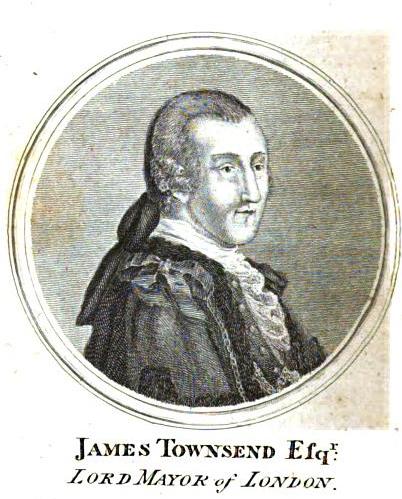
James Townsend, Lord Mayor with a Secret?

James Townsend (1737-1787) was a London alderman from 1769 to his death, sheriff of London in 1769-70 and Lord Mayor in 1772-73.

He was also a Member of Parliament for two stints, in 1767-74 and 1782-87. Unlike his father, who allied with George Grenville, Townsend became part of Lord Shelburne’s wing of the Whigs.

That put him on the left of British politics. The History of Parliament Online says of Townsend:
He made himself conspicuous in Parliament as an advocate of [John] Wilkes’s cause, contributed to his election expenses, and was a foundation member of the Bill of Rights Society. In 1771 he refused to pay the land tax on the ground that Middlesex was not represented in Parliament.
That was, of course, an argument about taxation without representation within greater London itself.

In 1772 Townsend and John Horne Tooke broke with Wilkes while still remaining radical reformists. That year, Wilkes won more votes for Lord Mayor than anyone else, but the sheriff manipulated the voting process to put Townsend in office instead. That prompted riots against the new mayor, and he served only one term.

In October 2016 Notes and Queries discussed another aspect of Townsend’s life: one of his eight great-grandparents was African. In the part of eastern Africa that Europeans then called the Gold Coast, now Ghana, that woman reportedly had a child with a Dutch soldier.

That child, named Catherine, married James Phipps, a long-time employee of the Royal African Company of England. Toward the end of his life Phipps was the Captain-General of the company and Governor of Cape Coast Castle. In 1722 he lost those posts after being accused of embezzling and abusing power, and the following year he died. Phipps had wanted to bring his wife to Britain, even writing incentives for her to do so into his will, but she never left Africa. Instead, she became a major trader (and slaveowner) on the Gold Coast.

Back around 1715, the couple had sent two of their daughters, Bridget and Susanna, to Britain. Both girls, who had one African grandparent, were then around nine years old. Phipps’s family was surprised to receive “some issue” of him, but they duly sent those girls to a school in Battersea. Phipps’s wealth no doubt helped—there might have been something to those embezzlement charges.

In 1730 Bridget Phipps got married in the Fleet Prison, the venue probably chosen to evade parents and guardians. Her new husband was a London merchant and mining investor named Chauncy Townsend. They had many children, including James.

James Townsend’s legal papers in Britain reportedly contain no hint of his African great-grandmother. Nor does that ancestry appear to have come up in gossip about him as a politician. As Wolfram Latsch wrote in Notes and Queries and this blog post, “this fact was either unknown, or went unnoticed, or it was ignored.” His grandmother’s decision to stay away from Britain was probably a factor in how society perceived the Townsend family.

Latsch nonetheless identifies Townsend as “Britain’s first black MP” and the first black Lord Mayor of London. In one way he indeed was. But if no one knew about his ancestry, in another way he wasn’t.

Wednesday, July 26, 2017

“With great zeal I went to Genl Washington”

Elias Boudinot (1740-1821) was a Continental Congress delegate from New Jersey, eventually president of that body, and later a U.S. Congressman and director of the U.S. Mint. He was brother-in-law of Richard Stockton twice over (i.e., each married the other’s sister).

For a considerable period of the war Boudinot was the American commissary of prisoners, meaning he was responsible for feeding and supplying captured British and Hessian soldiers. As such, he often worked closely with the Congress, local authorities, and Gen. George Washington.

Boudinot left behind a manuscript in which he explained:
A great many interesting anecdotes, that happened during the American Revolutionary War, are likely to be lost to Posterity, by the negligence of the parties concerned, in not recording them, so that in future time they may be resorted to, as throwing great light on the eventful Crisis, of this important Æra—I shall therefore without any attention to order, but merely as they arise in my memory, set down those I have had any acquaintance with, attending principally to the TRUTH of the facts.
That manuscript was published in 1890 as Boudinot’s Journal or Historical Recollections of American Events during the Revolutionary War. It’s not really a journal since he didn’t record events as they happened; indeed, most of the stories aren’t tied to specific dates. But they’re valuable nonetheless.

Here’s one example:
In [April] 1777 Genl [Benjamin] Lincoln, was surprised at the Dawn of Day in his Quarters at Bound Brook. by Lord Cornwallis. who had marched from Brunswick passed his out Centinels captured or destroyed his main guard, and was at the Genls Quarters before he knew anything of it. He had but just time to escape out of a back door. Several men were killed and one or two pieces of ordnance taken.

It was sometime a mystery how this had been effected with so much secrecy, till I was well informed by a Gentn of note who was with the Enemy at Brunswick, that a certain Farmer whose name he mentioned and who lived in the midst of our Camp had communicated to Lord Cornwallis our Countersign, by which he had accomplished his intentions,

My spirit was very much aroused ags this Traitor and with great zeal I went to Genl Washington with the information, stating the substance of it. but keeping back the name of my informant; as he had assured me his life depended on my prudence & faithfulness to him; I urged the Genl, (to give) orders to sieze the Culprit without delay & make an Example of him. The Genl did not immediately answer me. on which I repeated my request.

He then said. did not you tell me that the life of your informant depended on your secrecy,—would you take up a Citizen & confine him without letting him know his crime or his accuser.—No—let him alone for the present: watch him carefully. and if you can catch him in any other crime. so as to confront him by witnesses. we will then punish him severely.——

My mortification was very great. to think. that I who had entered the Army to watch the Military & preserve the civil rights of my fellow citizens. should be so reproved by a Military man, who was so interested in having acted otherwise I recd it as a severe lecture on my own imprudence
When I read that story, I thought that the interaction with Washington could have come right out of the television show Turn: Washington’s Spies, given how it presents the commander’s character.

I’ve been reviewing the final season of Turn for Den of Geek; you can find my assessments here. Gen. Washington, played by Ian Kahn, remains one of the decidedly best parts of the show.

Tuesday, July 25, 2017

Thomas Fleming: Four Pages a Day

The author Thomas Fleming died this week at the age of ninety.

As I described back here, in 1960 Tom was a journalist putting out his first book. Now We Are Enemies was the first full-length narrative of the Battle of Bunker Hill published since the nineteenth century. It launched his career as a historical writer.

Inspired by advice he received early on to write four pages a day, six days a week, Tom completed more than fifty books in all. The best-selling title was probably Liberty!: The American Revolution, based on the P.B.S. television series. But his own studies of the Revolutionary War covered everything from a single battle in New Jersey (The Forgotten Victory) to Yorktown (Beat the Last Drum) and beyond (The Perils of Peace).

Tom also wrote on other periods of American history, he wrote historical fiction, and he wrote books for younger readers. In 2010 I got to attend a staged reading of a play he had composed decades earlier about Dr. Joseph Warren and Dr. Benjamin Church.

I had the pleasure of meeting and corresponding with Tom a few times. What struck me most was his enthusiasm for researching history and communicating it. To illustrate that, in 2009 I analyzed how he’d come to misattribute a few words about Dr. Warren to Abigail Adams. The next time we talked, Tom brought up that post, congratulated me on spotting what had happened, and even seemed happy to see an explanation. A small slip fifty years earlier meant much less to him than the pleasure of learning more.

Monday, July 24, 2017

Hannah Snell’s Wound

Last month I quoted a news item from 1771 about Hannah Snell, celebrated in the British Empire for having served as a marine in the late 1740s.

During Britain’s early campaigns in India, Snell was wounded in the legs and groin. Nevertheless, her superiors didn’t discover that she was a woman. That provoked some questions, so I looked up the portion of the book about Snell that described her wounding.

This is from an 1801 edition of The Female Warrior:
During all this time, our heroine still maintained her wonted intrepidity, and behaved in every respect consistent with the character of a brave British soldier. She fired during the engagement, no less than thirty-seven rounds, and received six shots in her right leg, and live in the left; and what was still more painful, a dangerous one in the groin.

Distressed in her mind, lest the surgeons should discover the wound in her groin, and consequently her sex, which she was determined to conceal, even at the hazard of her life.—Confirmed in this resolution, she communicated her design to a black woman, who attended her, and who had access to the surgeon’s medicines, and begged her assistance. Her pain, now became very acute; and with the generosity of the black woman, who brought her lint, salve, &c. she endeavoured to extract the ball; by probing the wound with her finger, till she could feel the ball, after which she thrust in her finger and thumb, and pulled it out. This was a painful and dangerous operation; but she was resolved to brave every difficulty, rather than expose her sex, and in a little time she made a perfect cure.

As the heavy rains, and the violent claps of thunder were now set in, (being what they term in that country, the monsoons) the siege was entirely raised.

Our heroine being so dangerously wounded, was sent to an hospital, at Cuddylorum; and was attended by Mr. Belchier and Mr. Hancock, two able surgeons; from whom she concealed the wound in her groin.

During her residence in the hospital, the greater part of the fleet sailed; but as soon as she was perfectly cured, was sent on board the Tartar Pink, which then lay in the harbour, and continued to do the duty of a sailor, till the return of the fleet from Madras.
Curious as it seems, the Royal Navy did have a ship named the Tartar Pink. In 1739 it brought news of Britain’s rising hostilities with Spain to Boston. That was the start of the War of the Austrian Succession, which was still going on when Snell joined the military in 1747.

At least one later author assumed that the “black woman” in Snell’s eighteenth-century biography was a native of India rather than, say, an African attached to the army. Either way, it’s an interesting example of women working together.

Sunday, July 23, 2017

Talking About Revolutionary Massachusetts This Week

From midnight to 1:00 A.M. on Wednesday, 26 July, I’m scheduled to be interviewed by Bradley Jay on his radio show, Jay Talking. That will be on WBZ, 1030 AM.

[CORRECTION: It turns out that when I agreed to be on the show on 26 July, the producer was thinking that’s the date when I’d show up at the studio for a show to be broadcast on 27 July. So the conversation will actually happen early on Thursday.]

(Assuming, that is, that the U.S. Constitution is still operative and we haven’t stumbled into any wars that will preempt regular programming. Hard to be confident these days.)

I understand that Jay is a fan of Revolutionary history. I expect we’ll talk about The Road to Concord, Gen. Washington in Cambridge, and other gossip I’ve collected over the years. But this will be a new experience.

On Saturday, 29 July, I’ll be one of the many speakers at History Camp Pioneer Valley, to be held at the Kittredge Center at Holyoke Community College. This is the second annual gathering of history enthusiasts sharing their research to be organized by the Pioneer Valley History Network.

My presentation will be “An Assassin in Pre-Revolutionary Boston: The Strange Case of Samuel Dyer.” Other presentations on Revolutionary history include “Resurrecting the Memory of Major Joseph Hawley of Northampton: John Adams’s Campaign for a Forgotten Patriot” by Morgan E. Kolakowski, “A Forgotten ‘HessianPrisoner in Brimfield during the Revolutionary War” by Larry and Kitty Lowenthal, “Early Black American Patriotism” by Adam McNeil, and “Pioneer Valley Gravestones (and some of the men who made them), c. 1650-1850” by Bob Drinkwater.

As of today there are still a few slots available for History Camp Pioneer Valley.

Saturday, July 22, 2017

“Last Argument” Symposium at Fort Ti, 5-6 Aug.

Fort Ticonderoga will host a symposium on 5-6 August titled “New Perspectives on the Last Argument of Kings: A Ticonderoga Seminar on 18th-Century Artillery.”

This event complements the exhibit “The Last Argument of Kings: The Art and Science of 18th-Century Artillery,” which runs at the site through October 29.

Presenters from Fort Ticonderoga’s own staff and elsewhere include:
  • Stuart Lilie, “Artillery at This Post: Three Case Studies of Artillery at Ticonderoga.”
  • Matthew Keagle, “Lost in Boston: The Artillery of Carillon/Ticonderoga” and “Pell’s Citadel: The Ticonderoga Artillery Collection.”
  • Nicholas Spadone, “Green Wood and Wet Paint: American Traveling Carriages at Ticonderoga.”
  • Christopher Bryant, “Ultima Ratio Regum: A Pair of Vallere 4-Pounders at Yorktown and Beyond.”
  • Richard Colton, “The American Foundry-Springfield Arsenal, Massachusetts, 1782-1800: Assuring Independence.”
  • Andrew De Lisle, “If you are satisfied with the methods the workers have found…then so am I: Reproduction as a method of understanding Eighteenth-century Artillery.”
  • Eric Schnitzer, “Pack Horses, Grasshoppers, and Butterflies reconsidered: British light 3-pounders of the 1770s.”
  • Robert A. Selig, “The Politics of Arming America or: Why are there still more than 50 Vallere 4-pound cannon in the United States but only 3 in all of Europe?”
  • Christopher Waters, “When the King’s Last Argument is but a whimper: Artillery Deployment in Antigua’s Colonial Fortifications.”
Registration costs $155 per person, or $135 for Fort Ticonderoga Members. Registration forms can be downloaded from the fort’s website under the “Education” tab, “Workshops and Seminars.”

I’m already signed up.

Friday, July 21, 2017

Colonial Newspaper Subscription Prices

Last month I posted twice about the cost of advertising in colonial American newspapers.

One source of those articles, the 1884 U.S. Census Office report “The Newspaper and Periodical Press” by S. N. D. North, also discussed what pre-Revolutionary newspapers charged their readers for subscriptions:
The colonial newspapers were sold at prices which varied according to the location and the currency of that location. The latter fluctuated so frequently in value that it is not always possible at this date to determine precisely the sum that the publisher regarded himself entitled to receive from his patrons; but there is sufficient reason to believe that this sum was a nearly uniform one in the respective colonies, and that it did not vary greatly in any one colony from the standard established in all the others.

John Campbell, when he founded the News-Letter in 1704, may be said to have established for his own and for subsequent generations the prevailing price of the weekly newspaper. He received the equivalent of $2 of our present currency, but did not think it worth while to advertise his price of subscription in the paper itself. This was a neglect to take advantage of an opportunity which found several imitators in the subsequent colonial newspapers. The Boston Gazette and Weekly Journal (1719) was sold for 16s. a year, and 20s. when sealed, payable quarterly, and at the value of currency at that time this was equivalent to $250 in our present money.

The American Magazine, a monthly periodical of 50 pages, founded in 1743, was sold for 3s., new tenor, a quarter, being at the rate of 50 cents, or $2 per annum. The Rehearsal, founded in 1731, was sold originally for 20s., but was reduced from that price to 16s. when [Thomas] Fleet took possession of it in 1733.

The Boston Advertiser was sold for 5s.4d. “lawful money”, and the Boston Chronicle (1767) for 6s.8d.—“but a very small consideration for a newspaper on a large sheet and well printed,” according to [Isaiah] Thomas, but likely to be regarded as a high price for a similar newspaper in these days.

The Christian History, weekly, 1743, was sold for 2s., new tenor, per quarter, but subsequently 6d. more was added to its price, “covered, sealed, and directed.” The American Magazine and Historical Chronicle, a monthly of 50 pages, sold for 3s., new tenor, per quarter, the equivalent of $150 per year.

Nevertheless, 6s.8d. appears to have been the ruling price at this period, for the Salem Essex Gazette (1768) and the Norwich Packet (1773) were vended at that rate. The New Hampshire Gazette (1756) was sold for “one dollar per annum, or its equivalent in bills of credit, computing a dollar this year at four pounds, old tenor”. The Portsmouth Mercury (1765) was sold for “one dollar, or six pounds o.t. per year; one-half to be paid at entrance”.

Thomas Fleet, who discontinued the Weekly Rehearsal in 1735 and began the publication of the Boston Evening Post on a half sheet of large foolscap paper, regarded the prevailing price for newspapers altogether too low, and in a dunning advertisement to his subscribers he declared:
In the days of Mr. Campbell, who published a newspaper here, which is forty years ago, Paper was bought for eight or nine shillings a Ream, and now tis Five Pounds; his Paper was never more than half a sheet, and that he had Two Dollars a year for, and had also the art of getting his Pay for it; and that size has continued until within a little more than one year, since which we are expected to publish a whole Sheet, so that the Paper now stands us in near as much as all the other charges.
In Pennsylvania the prices of newspapers were more uniform than in New England. The Philadelphia American Weekly Mercury, the first paper founded in that city, and the first outside of New England, being the third in the colonies, was sold for 10s. per annum. The Philadelphia Gazette (1733) was sold for the same price, as was also the Philadelphia Journal (1766), the Chronicle (1767), and the Ledger (1775). The Philadelphia Evening Post, founded in 1775, and issued three times a week, was sold at a price of two pennies for each paper, or 3s. the quarter. The Dutch [actually German] and English Gazette was sold for 10s. in 1749, when it was a weekly publication, and for 5s. in 1751, when it became a fortnightly publication.

The New York Weekly Journal (1733) was sold for 3s. the quarter. The Virginia Gazette (1766) was 12s.6d. per year [Purdie and Dixon offered that price in 1770, William Rind the same in 1771]. There was a notable increase in prices during the war in several cases, and the New Jersey Gazette, which was founded in 1777, fixed its price at 26s. per annum.
Supplementing North’s rundown, here are the subscription prices I found this spring:
  • New-England Courant under (nominally) Benjamin Franklin, 1723, 12s. per year or 4d. each issue.
  • New-York Mercury under Hugh Gaine, 1756, 12s. per year, rising to 14s. in 1757 to defray the cost of a provincial stamp tax, plus another 7s.6d. for delivery to Connecticut.
  • Massachusetts Spy under Zechariah Fowle and Isaiah Thomas, 1770, 5s. 
  • Massachusetts Spy under Thomas alone, 1774, 6s.8d. unsealed, 8s. “sealed and directed.” Thomas continued to charge that price after moving to Worcester in 1775.
  • Pennsylvania Packet under John Dunlap, 1771, 10s.
  • North-Carolina Gazette under James Davis, 1775, 16s.
  • New-York Packet under Samuel Loudon, 1776, 12s.

Thursday, July 20, 2017

An Aged Veteran and “The Young Provincial”

I’ve been discussing the Rev. W. B. O. Peabody’s sketch “The Young Provincial,” published in 1829, and Jacob Frost’s 1832 claim for a pension as a Revolutionary War veteran. Together they raise interesting questions.

First, looking just at the pension file, Jacob Frost’s wound on Breed’s Hill was bad enough to disable him but not to kill him, even with months in prisons and eighteenth-century medicine and hygiene. He must have had one hell of an immune system.

That wound also wasn’t bad enough to keep Frost from reenlisting for a short stint in 1780. Probably his experience as a soldier in battle and a prisoner of war was a reason the company made him its orderly sergeant. Yet that same wound was enough to earn Frost an invalid pension after the war. I suspect it was awarded in recognition of his suffering as a prisoner as much as for actual disability.

Next the bigger question of how Frost’s experiences relate to “The Young Provincial.” Dave Marcus of the Tewksbury Historical Society spotted the strong parallels between “The Young Provincial” and Jacob Frost’s experiences, as this article from the Tewksbury Town Crier in 2014 reported.

The Springfield Republican article from 1829 confirms that connection: “all the narrative parts of it are facts, in the life of a Mr. FROST, now living in Norway, Maine.” Even more clearly it made a connection between that literary sketch and “Dr. JOSHUA FROST of this town,” the veteran’s little brother.

Tewksbury vital records confirm that Jacob Frost, born 9 July 1753, had a little brother named Joshua, born 2 Dec 1765 and thus nine years old at the outbreak of the Revolutionary War, just as the newspaper stated. Dr. Joshua Frost graduated from Harvard in 1793.

(Curiously, Sketches of the Old Inhabitants and Other Citizens of Old Springfield from 1893 says that Dr. Frost was “born in Fryeburg, Me., in 1767.” Fryeburg wasn’t even formed into a town until 1777. It’s about thirty miles from Norway, where Jacob settled, but perhaps the two communities were more closely linked in the eighteenth century. But there’s some mix-up there.)

Given the Springfield newspaper’s hints, it seems likely that the Rev. W. B. O. Peabody heard stories about Jacob Frost from the old soldier himself during a visit, or from Dr. Frost, talking about his big brother.

The next question is whether “The Young Provincial” is a reliable source on Jacob Frost’s military experiences, filling out the bare-bones account that he submitted to the federal government. And on that question I’m skeptical. I think Peabody took so much literary license that we can’t accept any particular detail as reflecting Frost’s own story unless it also appears in his own account.

It’s not just a matter of how much dramatic detail “The Young Provincial” has but also how details contradict Frost’s own statement:
  • Frost stated that after the Battle of Lexington and Concord “he immediately enlisted at Cambridge near Boston for a term of eight months.” The narrator of “The Young Provincial” says he went home after the battle, joined a company in Tewksbury, and “arrived at the camp the evening before the battle of Bunker Hill.”
  • Frost was quite clear that he “was employed on the night previous to the battle of Bunker Hill on the 17th. Day of June 1775, in throwing up breast works.” The “Young Provincial” narrator describes other men doing that work; he “happened to reach the spot just as the morning was breaking in the sky.” (Veterans who worked all night digging and then had to fight the battle tended not to let anyone forget.)
  • Frost was “severely wounded in the hip” during that battle. For the narrator, “the ball entered my side,” and he also “was beaten with muskets on the head.”
  • The “Young Provincial” arrives home “on a clear summer afternoon.” Frost stated it was “the last of September.”
  • The final scene of “The Young Provincial” turns on the soldier’s family believing him to be dead, based on a report from a companion on the battlefield. In 1775 and 1776, Massachusetts newspapers published lists of provincial prisoners from the Battle of Bunker Hill which told everyone that Frost was still alive. His return home was a surprise, but not that much of a surprise.
Thus, I think we have to say “The Young Provincial” was inspired by a true story of a young soldier being wounded, imprisoned, and transported before escaping back home. But we can’t say the sketch is a true story.

(Thanks once again to Boston National Historical Park’s Jocelyn Gould for setting me off on this investigation. The photo above is the headquarters of Norway, Maine’s historical society; Jacob Frost would have known that 1828 building in its original location.)

Wednesday, July 19, 2017

The True Author of “The Young Provincial”

The idea that Nathaniel Hawthorne wrote “The Young Provincial,” the sketch I quoted yesterday from The Token, for 1830, wasn’t a bad guess.

In 1830 Hawthorne wrote to the editor of that volume, Samuel G. Goodrich, proposing a collection titled Provincial Tales. The next year’s volume of The Token contained two sketches unquestionably by Hawthorne, and he wrote more for later volumes—so many that in one year Goodrich worried about publishing too many pieces by one author.

Hawthorne never claimed “The Young Provincial,” but he left some hints about not wanting some of his early literary output rediscovered. And he suppressed his 1828 novel Fanshawe altogether.

In 1890 Moncure D. Conway published a biography of Hawthorne stating positively that “The Young Provincial” was one of his early stories that had “escaped the attention” of scholars. He repeated that claim in an 8 June 1901 article in the New York Times Saturday Review.

Franklin B. Sanborn also argued that Hawthorne wrote seven previously unrecognized stories, including “The Young Provincial,” in the New England Magazine in 1898 and elsewhere. George Edward Woodbury discussed the sketch as likely Hawthorne in his 1902 biography of the author, and John Erskine accepted that possibility in Leading American Novelists (1910).

There were some doubters. Nina E. Browne said the sketch “probably was not written by Hawthorne” in her 1905 bibliography of his work. But there was enough consensus about “The Young Provincial” that variously titled editions of Hawthorne’s collected works published in 1900 included it in an appendix.

However, back in late 1829, when The Token, for 1830 first appeared for sale, the author of “The Young Provincial” was named. The 25 November Springfield Republican reprinted the story and reported:
The Token, for 1830.—This elegant little work, published S. G. Goodrich, Boston, has been before the public some weeks. We have had opportunity to read only the following story; but if this may be considered a specimen of the merits of the other articles, the book must be interesting. Its typographical execution exceeds any thing of the kind we ever saw. It will doubtless be gratifying to our readers in this vicinity, to know that the following story was written by a gentlemen of this town who has contributed much to elevate the standard of American literature; and that all the narrative parts of it are facts, in the life of a Mr. FROST, now living in Norway, Maine, and brother of Dr. JOSHUA FROST of this town. Dr. Frost, who was then about nine years of age, was “the little brother who ran to the meeting-house” to carry the tidings of the young provincial’s return from captivity.
That item was reprinted in the Essex Register, and then in the 13 Feb 1830 Columbian Centinel. Those newspapers added a phrase to the Republican’s identification of the author as a Springfield local: “[meaning, we presume, the Rev. W. B. O. Peabody.]” The Essex Register was published in Salem, Nathaniel Hawthorne’s home town, but he didn’t object to crediting the Rev. W. B. O. Peabody with “The Young Provincial.”

The Rev. William Bourn Oliver Peabody (1799-1847, shown above) was a Unitarian minister in Springfield. He wrote poems, hymns, book reviews, and short biographies for Jared Sparks’s Library of American Biography as well as sermons. The Token, for 1828 contained his poem “To an Aged Elm,” so he was definitely in touch with Goodrich.

After Peabody died in 1847, his twin brother Oliver William Bourn Peabody started to write a biography to be published with his literary work. “A few of his productions may be found in ‘The Token’,” Oliver wrote about his brother William. Oliver also dabbled in literary pursuits, publishing a poem in The Token, for 1831 himself, while working as a Boston lawyer, legislator, bureaucrat, and college professor. But in 1845 the pull of parallelism had become too strong, and Oliver became a Unitarian minister like his twin, preaching in Vermont.

In fact, that parallelism was so strong that Oliver died in 1848, just one year after his brother. The biography of William had to be completed by a friend before being published in a collection of William’s sermons. In 1850, Everett Peabody edited The Literary Remains of the Late William B. O. Peabody, D.D. He chose only reviews and poetry from the North American Review, leaving out “The Young Provincial” and everything like it.

As a result, no book credited W. B. O. Peabody with that sketch until Volume XI of the Centenary Edition of Nathaniel Hawthorne. That scholarly edition of Hawthorne’s tales cited the newspaper articles I quoted above about “The Young Provincial.” It also took four other tales that Conway and Sanborn had attributed to Hawthorne and showed they had been written by Lydia Maria Child, Henry Wadsworth Longfellow, and Edward Everett.

Ironically, the 1900 collections of Hawthorne that include “The Young Provincial” are now in the public domain and thus available on Google Book and as digital texts. The more reliable Centenary Edition is protected by copyright and priced for research libraries. Therefore, people looking into “The Young Provincial” are once again apt to come across statements that it was most likely written by Hawthorne—I did so at first. This book dealer is even selling The Token, for 1830 on the possibility that it might contain an early Hawthorne story.

But all that literary investigation is just in service of the question of whether “The Young Provincial” has historical value. Is it a reliable narration of a certain private’s experiences in the first year and a half of the Revolutionary War?

TOMORROW: Back to Jacob Frost.

Tuesday, July 18, 2017

“The Young Provincial” on Bunker Hill

At the end of 1829 the writer and editor Samuel G. Goodrich published an anthology of short stories and literary sketches by various authors titled The Token, for 1830.

One of those pieces was titled “The Young Provincial,” and it began:
“Now, father, tell us all about the old gun,” were the words of one of a number of children, who were seated around the hearth of a New England cottage. The old man sat in an arm-chair at one side of the fireplace, and his wife was installed in one of smaller dimensions on the other. The boys, that they might not disturb the old man’s meditations, seemed to keep as much silence as was possible for individuals of their age; the fire burned high, with a sound like that of a trumpet, and its blaze occasionally shone on an old rifle which was suspended horizontally above the mantel.
Of course, the Revolutionary-era gun above a mantel in a New England cottage wouldn’t have been a rifle but a musket.

The story the old man tells those boys begins with him as a youth in “Tewksbury, a small town in Middlesex county.” He and the other “younger men of our village” formed a minuteman company. The story says: “Perhaps if you accent the last syllable of that word minute, it would better describe a considerable portion of our number, of whom I was one.”

The narrator of the “Young Provincial” describes experiences that closely parallel those of Jacob Frost, quoted yesterday, except in a much more elevated language. This is how Frost’s pension application of 1832 discussed the Battle of Bunker Hill:
[He] was in the battle and was then severely wounded in the hip, and entirely disabled, and he laid among the wounded until the day after the battle—when he was taken up by the British & carried to Boston & there kept a prisoner
The Token story says:
As soon as Boston was invested, we heard that our services were called for, and nothing more was wanted to fill the ranks of the army. I arrived at the camp the evening before the battle of Bunker Hill. Though weary with the march of the day, I went to the hill upon which our men were throwing up the breastwork in silence, and happened to reach the spot just as the morning was breaking in the sky. It was clear and calm; the sky was like pearl, the mist rolled lightly from the still water, and the large vessels of the enemy lay quiet as the islands.

Never shall I forget the earthquake-voice with which that silence was broken. A smoke like that of a conflagration burst from the sides of the ships, and the first thunders of the revolutionary storm rolled over our heads. The bells of the city spread the alarm, the lights flashed in a thousand windows, the drums and trumpets mustered their several bands, and the sounds, in their confusion, seemed like an articulate voice foretelling the strife of that day.

We took our places mechanically, side by side, behind the breastwork, and waited for the struggle to begin. We waited long and in silence. There was no noise but of the men at the breastwork strengthening their rude fortifications. We saw the boats put off from the city, and land the forces on the shore beneath our station. Still there was silence, except when the tall figure of our commander moved along our line, directing us not to fire until the word was given.

For my part, as I saw those gallant forces march up the hill in well ordered ranks, with the easy confidence of those who had been used to victory, I was motionless with astonishment and delight. I thought only on their danger, and the steady courage with which they advanced to meet it, the older officers moving with mechanical indifference, the younger with impatient daring. Then a fire blazed along their ranks, but the shot struck in the redoubt or passed harmlessly over our heads. Not a solitary musket answered, and if you had seen the redoubt, you would have said that some mighty charm had turned all its inmates to stone.

But when they stood so near us that every shot would tell, a single gun from the right was the signal for us to begin, and we poured upon them a fire, under which a single glance, before the smoke covered all, showed us their columns reeling like some mighty wall which the elements are striving to overthrow. As the vapor passed away, their line appeared as if a scythe of destruction had cut it down, for one long line of dead and dying marked the spot where their ranks had stood.

Again they returned to the charge; again they were cut down; and then the heavy masses of smoke from the burning town added magnificence to the scene. By this time my powder-horn was empty, and most of those around me had but a single charge remaining. It was evident that our post must be abandoned, but I resolved to resist them once again.

They came upon us with double fury. An officer happened to be near me; raising my musket, and putting all my strength into the blow, I laid him dead at my feet. But, meantime, the British line passed me in pursuit of the flying Americans, and thus cut off my retreat; one of their soldiers fired, and the ball entered my side. I fell, and was beaten with muskets on the head until they left me for dead upon the field.

When I recovered, the soldiers were employed in burying their dead. An officer inquired if I could walk; but finding me unable, he directed his men to drag me by the feet to their boats, where I was thrown in, fainting with agony, and carried with the rest of the prisoners to Boston. One of my comrades, who saw me fallen, returned with the news to my parents. They heard nothing more concerning me, but had no doubt that I was slain.
Like Jacob Frost, the “Young Provincial” narrator is kept in the Boston jail for months, then transported to Nova Scotia in March 1776. He and five other men break out of their new prison on a night that’s literally described as “dark and stormy.” He struggles through the wilderness toward Massachusetts, benefiting from strangers’ kindness. At last he arrives in Tewksbury on a Sunday.
I went to my father’s door, and entered it softly. My mother was sitting in her usual place by the fireside, though there were green boughs instead of fagots in the chimney before her. When she saw me, she gave a wild look, grew deadly pale, and making an ineffectual effort to speak to me, fainted away. With much difficulty I restored her, but it was long before I could make her understand that the supposed apparition was in truth her son whom she had so long mourned for as dead.

My little brother had also caught a glimpse of me, and with that superstition which was in that day so much more common than it is in this, he was sadly alarmed. In his fright he ran to the meeting-house to give the alarm; when he reached that place, the service had ended, and the congregation were just coming from its doors. Breathless with fear, he gave them his tidings, losing even his dread, in that moment, for the venerable minister and the snowy wigs of the deacons.

Having told them what he had seen, they turned, with the whole assembly after them, towards my father's house; and such was their impatience to arrive at the spot, that minister, deacons, old men and matrons, young men and maidens, quickened their steps to a run.

Never was there such a confusion in our village. The young were eloquent in their amazement, and the old put on their spectacles to see the strange being who had thus returned as from the dead.
Again, Jacob Frost’s 1832 account said simply that “he finally arrived at his residence in said Tewksbury the last of September 1776”—which was in fact a Monday.

“The Young Provincial” thus seems to be an elevated version of Jacob Frost’s experiences. But did the author really hear about those events from Frost? Might the story’s hero be a composite of Frost and other men with similar war records? Can we use the story’s details to fill out Frost’s bare-bones pension application, or must we assume that the author used a lot of literary license? Those were questions that Jocelyn Gould of Boston National Historical Park and I started discussing earlier this month.

The easiest place to find “The Young Provincial” now is at the end of this volume of The Complete Writings of Nathaniel Hawthorne, published in 1900. The picture above shows Hawthorne in 1841, or about eleven years after “The Young Provincial” was published. By then he had become locally known for his short stories, many based on New England history.

TOMORROW: But this story is not actually by Hawthorne.