J. L. BELL is a Massachusetts writer who specializes in (among other things) the start of the American Revolution in and around Boston. He is particularly interested in the experiences of children in 1765-75. He has published scholarly papers and popular articles for both children and adults. He was consultant for an episode of History Detectives, and contributed to a display at Minute Man National Historic Park.

Subscribe thru Follow.it


•••••••••••••••••


Saturday, May 05, 2018

A Discussion about Writing in Marlborough, 9 May

On Wednesday, 9 May, I’ll appear in the Friends of the Marlborough Public Library’s Author Series, discussing The Road to Concord, Colonial Comics: New England, this blog, and other writing.

Here’s a P.D.F. file of the flyer for this program. The host and interviewer for that evening will be Hank Phillippi Ryan, who’s won multiple awards as both a television reporter and a mystery novelist.

In this sort of event announcement I like to include some material relevant to the venue, so here’s a story about Henry Barnes (1724-1808), Marlborough’s most visible friend of the royal government. He actually held out in town until almost the last moment, as he later told the Loyalists Commission:
He issued out billeting orders for the Kings Troops in 1775 this made him very obnoxious & the Mob threaten’d to pull down his House. He thought himself in danger & went to Boston the 17th of April.
Even then, Barnes’s wife Christian “staid in the Country till the Octr. following.” But then she went into Boston as well, and they sailed for England on 26 December.

That left the Barnes household uninhabited. In November 1775, Henry Knox, about to leave for New York on a mission for Gen. George Washington, petitioned the Massachusetts General Court:
That your petitioner having been obliged to leave all his goods and house furniture in Boston, which he has no prospect of ever getting possession of again, nor any equivalent for the same, therefore begs the Honorable Court, if they in their wisdom see fit, to permit him to exchange house furniture with Henry Barnes, late of Marlborough, which he now has it in his power to do.
The legislators didn’t let Knox simply take possession of the Barneses’ furniture in Marlborough. But they did let him borrow it.

The event at the Marlborough Public Library will start at 7:00 P.M. It is free and open to the public.

Friday, May 04, 2018

“With child Quaco, about nine months old”

Here’s another connection between the Worcester Art Museum’s portrait of Lucretia Murray and the institution of slavery in Massachusetts.

John Singleton Copley painted that portrait in 1763, two years after Lucretia Chandler had married John Murray of Rutland. Copley’s portrait of John, also at the Worcester Art Museum, appears here. (This Murray is often called “Col. John Murray” because he held that rank in the militia and it helps to distinguish him from the Rev. John Murray, the pioneering Universalist.)

Murray was Rutland’s leading gentleman, which meant he had a hand in a lot of legal matters. In 1754, he witnessed this bill of sale, quoted here:
Rutland District, May 4th, 1754

Sold this day to a Mr. James Caldwell of said District, the County of Worcester, & Province of the Massachusetts-Bay, a certain negro man named Mingo, about twenty Years of Age, and also one negro wench named Dinah, about nineteen years of age, with child Quaco, about nine months old—all sound and well for the Sum of One hundred & eight pounds, lawful money, recd. to my full satisfaction: which Negroes, I the subscriber to warrant and defend against all claims whatsoever as witness my hand

Zedekiah Stone.
James Caldwell thus became the owner of a young family consisting of Mingo, Dinah, and baby Quaco.

Nine years later, Caldwell died unexpectedly. How unexpectedly? According to Hurd’s History of Worcester County:
James was killed in 1763, he, with one of his slaves, having taken refuge under a tree during a heavy thunder-shower. The tree was struck by lightning, and falling, killed him and broke a thigh of the negro.
Not expecting a lightning strike, Caldwell didn’t leave a will. John Murray got involved in settling the estate by becoming guardian for Caldwell’s children, preserving their interest in their father’s property. That property included the enslaved family, assigned to Isabel Caldwell as part of her widow’s third.

A lot happened to those families over the next decade:
  • Mingo escaped from Isabel Caldwell, as shown by an advertisement she placed in the Boston News-Letter on 13 and 20 June 1765. 
  • Dinah Caldwell, the wife Mingo left behind, married a black man named Cumberland Chandler in Worcester on 29 Nov 1767. He was no doubt linked to Lucretia Murray’s relations. 
  • Lucretia Murray died in 1768, and John Murray married again at the end of the following year. 
  • On 28 Mar 1769, Isabel Caldwell married Nathaniel Jennison. They lived in the part of Rutland that had become the town of Hutchinson in 1774 and then the town of Barre in 1776. She brought Mingo and Dinah’s enslaved son, now named Quock and in his late teens, to the new household. 
  • In 1774, Isabel Jennison died, and her property went to her husband, Nathaniel.  
  • The uprising in central Massachusetts late that same summer sent John Murray, recently appointed to the Massachusetts Council, fleeing into Boston for safety. He eventually settled in New Brunswick.
According to Quock, James Caldwell had promised him freedom on his twenty-fifth birthday. And Isabel Caldwell reportedly amended that to freedom on his twenty-first birthday, a promise Nathaniel Jennison committed to when he married her. But as the late 1770s went on, Jennison refused to manumit the young man.

In April 1781 Quock, now using the surname Walker, left Jennison’s house and went to the farm of John and Seth Caldwell—sons of the man who had bought him as a baby in 1754. (John Murray had served as their guardian in the mid-1760s.) The Caldwell brothers, who had probably grown up with Quock Walker, were ready to employ him as a free, wage-earning laborer.

Days later, Jennison violently forced Walker back to his own farm, ignoring the Caldwells’ objections that he deserved to be free. Walker sued Jennison. Jennison sued the Caldwells. The dispute landed in the Superior Court in the spring of 1783, becoming one of the cases by which judges declared that Massachusetts’s new constitution provided no protection for slavery.

(Historical Digression has an excellent discussion of this case.)

Thursday, May 03, 2018

More Glimpses of Sylvia and Worcester

Yesterday I left Sylvia and Worcester, a mother and grown son enslaved to John Chandler when he died in 1762, in the household of Sarah and Timothy Paine, Chandler’s daughter and son-in-law/stepson.

The town chroniclers of Worcester left a couple of glimpses of Sylvia and Worcester—not enough to see them in full, but enough to remind us of their individuality.

A Harvard graduate with powerful connections, Paine held many offices, appointed and elected, in Worcester. In 1774, for example, he was in is twenty-third year as clerk of the county court and his thirteenth year as register of deeds.

In the pre-Revolutionary turmoil, Paine favored the Crown. The government in London rewarded his support by appointing him to the new governor’s Council in the summer of 1774. He took the oath as a “mandamus councilor” in late August.

And then all hell broke loose. Crowds in the western part of the province started closing the county courts. The “Powder Alarm” mobilized thousands of militiamen and showed that the royal government had no power outside Boston. And on 6 Sept 1774, more than 5,000 men flooded into Worcester to make sure its courts wouldn’t open, either.

As a court official and a councilor, Paine was the main target of the crowd. He wrote out a resignation for the five-man committee representing those thousands. The committee deemed that sufficient, and one read the document aloud, but the crowd insisted that Paine read his resignation himself—and with his hat off, as a sign of respect.

According to Caleb A. Wall’s Reminiscences of Worcester from the Earliest Period (1877):
Mr. Paine hesitated, and demanded the protection of the Committee; finally he complied, and was allowed to go to his dwelling. Tradition declares, that in the excitement attendant on the scene, Mr. Paine’s wig was either knocked or fell off.

Be this as it may, from that day he abjured wigs, as much as he had done whigs, and never wore one again. The now dishonored wig in question, he gave to one of his negro slaves, named ‘Worcester.’
Worcester thus benefited from the Revolution to the extent of a used wig. I haven’t found any more references to him, but the fact that he was named after the town he lived in makes that search a lot harder.

As for Worcester’s mother Sylvia, she was remembered in the town for two things. Based on the memories of Eliza Bancroft Davis, a great-granddaughter of John Chandler, George Chandler’s The Chandler Family (1883) described how Sylvia welcomed the “young children of widows” who came to her master’s house on legal matters:
She would sit swaying to and fro with them in her arms, and sing, “Pretty baby, pretty baby! Looks jist like its farder, dear! Who is his farder, dear?”
Through the dialect we can see a woman with a maternal instinct. Perhaps that feeling helped inspire John Chandler’s bequest that Worcester be kept “at as little distance from his Mother as may well be.” It also makes me wonder who Worcester’s father was, and what happened to him.

The Chandler Family twice describes Sylvia rocking those babies. One version says she did it when enslaved to Chandler, who was a probate judge before he died in 1762; the other said it was a habit of “her last days,” decades later. One version also spells her name “Silvia.” The details might be foggy, but there’s a sight of a real woman there.

As for Sylvia’s “last days,” they came in 1805, over forty years after John Chandler died, almost thirty years after his widow did, and more than twenty years after Massachusetts’s highest court ruled slavery unenforceable. The 25 May issue of Boston’s leading newspaper, the Columbian Centinel, reported that “In Worcester, Sylvia, a female African, [died aged] Æt. 105.” Worcester’s National Aegis reported the same four days later.

Sylvia may have still been living with Sarah Paine, who survived to 1811. Eliza Bancroft Davis recalled that at age fourteen she had made a shroud for the old family retainer, marveling at how Sylvia had lived about a century longer than she had.

TOMORROW: Another family connection to slavery.

(The building shown above is Worcester’s 1803 courthouse, designed by Charles Bulfinch.)

Wednesday, May 02, 2018

John Chandler’s Human Property

The Worcester Art Museum recently added a label to its John Singleton Copley portrait of Lucretia Murray noting that her father had two slaves named Sylvia and Worcester when he died.

According to the museum’s old webpage for this picture (which doesn’t mention slavery at all), Copley painted Lucretia Murray in 1763. Her father, John Chandler of Worcester, had died the previous year. His will had granted Murray £340 in two installments.

That same will assigned Sylvia and Worcester to other relatives. That means Lucretia Murray had almost certainly grown up with them as part of the family’s domestic staff but was no longer benefiting from their labor when her portrait was made. And to learn more about those two people as individuals, we have to follow another path.

John Chandler’s will was the topic of a 1905 study by Charles A. Chase. Chandler had married twice. By his first wife, born Hannah Gardiner, he had nine children who grew to adulthood. His second wife was Sarah (Clark) Paine, a widow with children of her own. In writing his will Chandler wanted to provide for his widow Sarah, but only as long as she didn’t become a third husband’s responsibility, while preserving as much property as possible for his own children.

Therefore, Chandler set up a bequest in which his wife could live in his house and receive $40 of silver every six months from his estate as long as she didn’t remarry. And part of living in his house was being served by the enslaved woman Sylvia:
I give to my said Wife in Lieu of her Right of Dower or Power of thirds in my Real Estate as follows namely that she be decently and honorably Supported by my Executors for one Year from my decease, and live in my present dwelling house and that my Negro Woman Sylvia serve my said Wife said Year, and be Also supported by my Executors. . . .

And in case my said Dear Wife shall dwell in Worcester my Will and pleasure is that my Negro Sylvia aforesaid serve her mistress during her continuing my Widow. . . .

And Whereas I have given to my Dear Wife the Service of my Negro Woman during her continuing my Widow and dwelling in Worcester, I also order my said Negro woman to have a proper bed and beding to ly on said time.
Thus, Sylvia remained property of Chandler’s estate but was assigned to work for his widow.

To add to the family complexity, John Chandler’s daughter Sarah had married Sarah (Clark Paine) Chandler’s son Timothy Paine. Chandler left a legacy to her, adding a special proviso about his other slave:
…if my son in Law Timothy Paine Esqr. and my Daughter Sarah Paine his Wife incline to have my Negro boy (Worcester) they may for fifty three pounds Lawfull money in part of her Legacy and towards the first third part thereof desiring whoever has him he may be Treated with humanity & Tenderness and at as little distance from his Mother as may well be, and I desire their Spiritual good may be promoted.
The clear implication is that Sylvia was the mother of the enslaved “Negro boy” Worcester. He was probably a grown man at the time, based on later reports of her age. The phrase about “their Spiritual good” strikes me as an afterthought, like the proviso for Sylvia’s “proper bed and beding” above—Chandler thinking first of how he wanted to bequeath his human property and then remembering he had some responsibility to those people as well.

When the widow Sarah Chandler died in 1778, Sylvia became part of Timothy and Sarah Paine’s household, possibly reuniting with her son Worcester at the house shown above.

TOMORROW: Further glimpses of Worcester and Sylvia.

Tuesday, May 01, 2018

New Light from Museum Labels

Last month the Hyperallergic site published an interesting essay by Sarah E. Bond titled “Can Art Museums Help Illuminate Early American Connections to Slavery?”

The essay describes how the Worcester Art Museum has added information about forced labor to its presentation of this 1763 portrait of Lucretia Murray:
While the older museum label for the portrait had underscored the characteristic style of 18th-century painter John Singleton Copley (1738–1815) and pointed to his allusion to styles adopted by the British nobility, a new label now caught my eye. It informed me that Lucretia’s father owned two enslaved persons whom he later left in his will to family members. One was named Sylvia and the other Worcester.
The mere mention of those people enslaved to John Chandler reminds us as we view the painting that the wealth evident in it—evident even in its existence—arose from a slave-owning economy.

Bond elaborates:
The economic benefits of slavery are now explicit on the labels at WAM. Beside a painting by John Wollaston of Charles Willing (1746), a newly added label notes that the Philadelphia merchant owned four slaves. Using a copy of Willing’s will and articles from the Philadelphia Gazette, WAM invites viewers to grapple with the fact that Willing owned: a “Negroe Wench Cloe,” a “Negroe Girl Venus,” a “Negro Man John,[”] and a “Negro Boy Litchfield.” These facts make it harder to deify eighteenth and nineteenth century New Englanders and profoundly alter how we view the portrait.
I’m not sure anyone was “deifying” those New Englanders before, but it was easier for visitors to look at them with unabashed nostalgia.

That said, labels that spotlight slavery may leave other fundamental injustices in shadow. In particular, the land under John Chandler’s home, and under the Worcester Art Museum, and under the house I’m typing in, and probably under the place where you’re reading this, was taken from indigenous peoples without fair compensation.

Highlighting slave ownership by people in portraits can remind us of how slavery was enforced in Massachusetts before 1783. But for decades after that date Massachusetts remained part of the U.S. of A.’s slavery economy. The textile industry that fueled industrialization depended on slave-raised cotton.  And some of the other big fortunes of nineteenth-century Massachusetts, and thus some of the other big philanthropic bequests, grew from trafficking opium into China.

Another set of questions involves the labels themselves. If I read Bond’s essay correctly, the Worcester Art Museum’s label for the Lucretia Murray simply notes two people enslaved to her father. Making those names visible is important; it’s the first step to recognizing them as individuals. But more digging produces more information about Sylvia and Worcester.

TOMORROW: Mother and son.

Monday, April 30, 2018

Clark on Work in Revolutionary Boston at Old North, 2 May

On Wednesday, 2 May, the Old North Speaker Series will host Christopher Clark speaking on “Work and Employment in Late 18th Century Boston.”

The event description:
Labor took many forms for Revolutionary-era Bostonians, who conducted work in many types of locations and under a variety of social arrangements. Occupations, levels of skill, and working conditions varied considerably. Men, women, and children, free and enslaved, conducted work in households and workshops, on wharves and slipways, in ropewalks and printing-shops.

Join Professor Christopher Clark as he provides insights into the Atlantic world, the beginnings of the American Revolution, race and gender relations, and the origins of Boston’s subsequent urban growth through the lens of laboring people.
Clark is a professor at the University of Connecticut, currently Head of its History Department. His books include The Roots of Rural Capitalism: Western Massachusetts, 1780-1860, Social Change in America from the Revolution through the Civil War, and (with Nancy Hewitt and others) Who Built America?: Working People and the Nation’s History.

This event is co-sponsored by the Benjamin Franklin Institute of Technology. After the lecture, there will be a reception and conversation with Clark and institute president Anthony Benoit on the parallels between training and apprenticeships in the eighteenth century and the career training and readiness of our young people today.

The talk is scheduled to start at 6:30 P.M. at the Old North Church, 193 Salem Street in the North End. Register to attend through this webpage.

Sunday, April 29, 2018

“Fresh Goods” at the Concord Museum

Though 8 July, the Concord Museum is hosting an exhibit called “Fresh Goods,” exploring “the sources and context of small-town Massachusetts fashion” in the past.

Curator David Wood worked with historians Jane and Richard Nylander to get the most from “the Museum’s extensive historic clothing, textile, and decorative arts collection, as well as probate inventories, account books, advertisements, photographs, and letters and diaries of the period. . . .  Through twenty evocative documented outfits, the exhibition will consider the shopping habits of Concordians in the 18th and 19th centuries.”

Alongside the exhibition are a range of public programs, including the following.

Thursday, 3 May, 7:00-8:00 P.M.
The Indigenous Look: Attire in 18th-century Massachusetts 
Aquinnah Wampanoag artist and designer Elizabeth James-Perry will discuss the period from 1750 to 1900 in terms of indigenous Massachusetts attire and jewelry. Museum members free, non-members $5.

Saturday, 12 May, and Friday, 8 June, 2:00-2:30 P.M.
Fresh Goods Gallery Talk
Curator David Wood will offer a closer look at the exhibition. Free with museum admission.

Thursday, 31 May, 7:00-8:00 P.M.
Shift, Stays, and Pannier
Join historians and living history interpreters Linda Greene and Michele Gabrielson for an in-depth look at how women got dressed every day in the 1700s. Museum members free, non-members $5.

Saturday, April 28, 2018

“Unfolding Histories” at the Cape Ann Museum

The Cape Ann Museum in Gloucester is hosting its first major archival exhibition, showcasing notable documents from its collection and those of seven other local institutions.

“Unfolding Histories: Cape Ann before 1900” is organized around ten themes: Native American history, education, religion, African-American history, literary imagination, charity and welfare, women’s history, temperance, warfare, and transportation. The museum says:
Organized thematically, Unfolding Histories lets the documents tell the stories of Cape Ann, thereby highlighting often neglected experiences and perspectives. This archival record richly depicts the political and social structures of our nation before its founding, through its early years and on up to 1900, and provides windows into the working and cultural life of a place that would become a haven for artists and writers.
The Boston Globe reported, “The show consists of some 80 items: letters, books, maps (one of them executed by no less than Samuel de Champlain), official documents, photographs, diaries, Native American artifacts, even stereopticon cards.”

The Cape Ann Museum’s Twitter feed has been sharing items from the exhibit under the hashtag #unfoldinghistories. Highlights from the Revolutionary era include:
The exhibit was curated by Gloucester resident Molly O’Hagan Hardy, who is also director for Digital and Book History Initiatives at the American Antiquarian Society. The other organizations lending documents for the exhibit are the Annisquam Historical Society, Essex Historical Society and Shipbuilding Museum, Essex Town Hall, Gloucester City Hall, Gloucester Lyceum & Sawyer Free Library, Manchester Historical Museum, Sargent House Museum, and Sandy Bay Historical Society.

“Unfolding Histories” will be on display until 9 September.

Friday, April 27, 2018

Sometimes a Kitchen Just Wants to Look Pretty

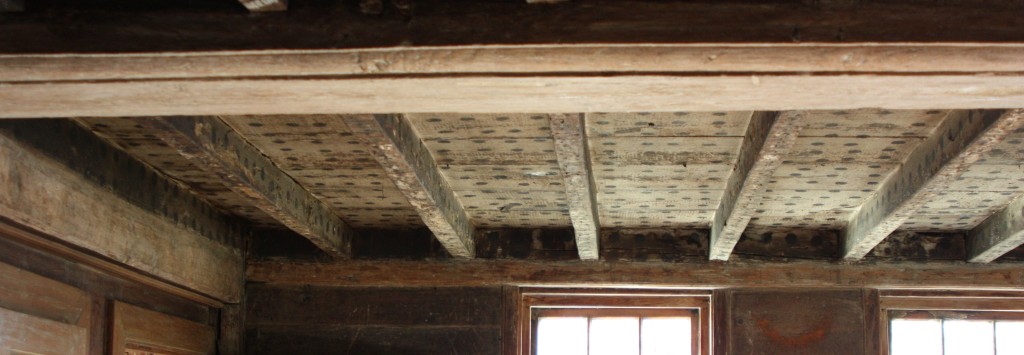
With Patriots’ Day putting the Arlington Historical Society’s Jason Russell House back in the news, I followed a path to this 2015 article from the Arlington Advocate about something else notable in that house: the dotted pattern the kitchen ceiling.
Surviving free-hand painting in Colonial interiors is rare, but it is preserved on the ceilings (and sometimes the wall sheathing) of a few other 17th and 18th century New England houses. For example, the kitchen ceiling of the Buckman Tavern in Lexington is enlivened with roughly painted chevrons; the White-Ellery House in Gloucester displays a pattern of semi-circular slashes; and a portion of a preserved ceiling from a demolished house in Dartmouth goes wild with a combination of commas, chevrons and a few splashes of color.

The decorative technique employed in the Russell kitchen is one that Colonials called “spotting,” now sometimes referred to as “sponge painting.” Only a handful of similar examples still exist. The wall sheathing of the upper hallway of the Boardman House in Saugus reveals a fairly regular pattern of black dots of about one and a quarter inches in diameter on a light background, while the kitchen ceiling of the Sherburne House in Strawbery Banke Museum in Portsmouth, New Hampshire, is boldly decorated with larger grey dots on a dark red ceiling.

Closer to home, the inside of a small, bullet-scarred door panel from the old Adams House, now in the Arlington Historical Society collection, shows an irregular distribution of starburst-like black spots on an unpainted wood ground. In none of these instances does it seem that the painters employed an actual sponge; instead, they may have applied their spots by skillfully twirling a round brush or by stamping the pattern on with a blunt, semi-absorbent object such as the broad end of a corncob.

Spotting and other decorative ceiling designs reached their popular peak around the turn of the 18th century, and the Russells’ spotted ceiling therefore would seem to support an earlier theory that the house was built the 1680s. However, later scholarship and a dendrochronology study in 2012 suggest a construction date of 1740-1750. Such a late date for the Russell polka dots is not out of the question. In 1738, for example, the painter Samuel Heath charged the Province of Boston for “colouring and spotting a Large Kitchen” in the no longer extant Province House.

The Jason Russell House’s polka-dotted ceiling probably owes its survival to the fortunate decision by a later Russell resident of the house to ‘modernize’ by plastering it over. Thus, it was safely preserved until the Historical Society’s restoration in 1924.
The Jason Russell House is open for visitors every Saturday and Sunday from 1:00 to 4:00 P.M. until Columbus Day.

Thursday, April 26, 2018

The Grave of Cato Stedman/Freeman

Earlier this month the Cambridge Chronicle reported on the mystery of Cato Stedman/ Freeman’s gravesite.

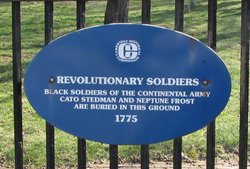
Cambridge records show that Cato Stedman was buried in the public cemetery across from the common. A historical marker memorializes him as well as Neptune Frost, a fellow Continental Army veteran. (That marker includes the date of 1775, but that’s not when they died.)

Ruth Wallis Herndon collected information on Stedman/Freeman in her book Unwelcome Americans. She reports that he was owned as a child and young man by tavern owner and militia captain Ebenezer Stedman of Cambridge. Cato served in the town militia company at the start of the war and became free about the time of the Battle of Bunker Hill in June 1775. He then enlisted in Col. Thomas Gardner’s regiment of the Continental Army under the name of Cato Freeman.

In his report on soldiers of color in the early Continental Army, George S. Quintal states that Stedman is “also listed on a 27 May 1777 roll as having joined the Continental Army from Cambridge, for the length of the war.” His regiment, commanded by Col. William Shepard, served in the Saratoga campaign.

Herndon, however, writes that Freeman/Stedman was at Valley Forge in 1777-78, followed by West Point in 1781. That appears to be based on information the veteran gave to Cranston, Rhode Island, authorities in the early 1800s when he became impoverished. Those authorities sent him back to his original home parish of Cambridge, which is why he was back there using the name Cato Stedman when he died.

Lesley University student Jonathan Hill has noted that sources from the early 1900s say Cato Stedman was buried either in the Stedman family tomb or in a plot next to his former owner. Hill therefore posits that the now-unmarked space next to Ebenezer Stedman’s grave is where Cato Stedman was buried. Unfortunately, a tradition first in print a century after a man’s death isn’t the strongest evidence.

The Cambridge city council has voted to have officials seek more information about Stedman/Freeman and Frost to determine their specific grave sites and mark them. The head of the city’s historical commission isn’t certain that enough evidence will come to light to make that possible. Meanwhile, the veterans’ names continue to appear prominently on the cemetery fence.

Wednesday, April 25, 2018

“Remember the Ladies” and More

The Panorama, the online magazine of the Society for Historians of the Early American Republic, just published an interesting article by Sara T. Damiano on “The Abigail Adams ‘Problem;’ or, Teaching Women’s History of the Revolutionary Era.”

Damiano considers Abigail Adams’s famous letter to her husband written over the week of 31 March to 5 April 1776, easily read at the Massachusetts Historical Society. This is the letter in which she wrote, “I desire you would Remember the Ladies, and be more generous and favourable to them than your ancestors…” But that’s not all she wrote.

Damiano points out:
As a teacher, I am tempted to play up this exchange between Abigail and John. It seemingly stands in for the revolution writ large: Despite some women’s urging, the Founders failed to “Remember the Ladies.” And, it captures undergraduate interest. Particularly in my upper-level women’s history courses, students admire the spunk and assertiveness of Abigail Adams, whom they see as articulating an early version of modern feminism.

Yet…I worry about my role in facilitating such views of the American Revolution and Abigail Adams. If we aim to teach students to analyze the foreignness of the past, then we undercut our work by focusing only on the quest for “rights.” Doing so arguably flattens other aspects of historical actors’ lives and even marginalizes those individuals who were not necessarily thinking in terms of “rights.” . . .

By reading more widely in the Adams letters, students can discover how Abigail Adams’s injunction to “Remember the Ladies” was but one component of the couple’s correspondence. To take just one example, in her March 31, 1776 letter, Abigail devoted only two paragraphs out of twelve to patriarchal authority. She also wrote about Virginia politics, conditions in Boston in the aftermath of the British occupation, neighbors’ illnesses, the health of the Adams’s children, Abigail’s home manufacturing efforts, and a manuscript concerning “the various sorts of powder, as fit for cannon, small arms, and pistols.” Even examining this single letter in its entirety provides a more complete snapshot of the Adams marriage than does the famous quotation extracted from its context.
John’s reply likewise runs through many topics, from privateering to the house of Loyalist colleague Samuel Quincy. But then he got to Abigail’s request concerning women’s rights (most likely property rights, not political rights) and wrote, “As to your extraordinary Code of Laws, I cannot but laugh.”

At the time, the Adamses were writing to each other every couple of days even though the letters took a week to travel, so their correspondence was a set of overlapping exchanges. As Elaine Forman Crane pointed out in her 1999 article “Political Dialogue and the Spring of Abigail's Discontent,” John’s reply broke that pattern. As soon as Abigail received it, she found other tasks besides writing were more important. It wasn’t until 7 May that she replied: “I believe tis near ten days since I wrote you a line. I have not felt in a humour to entertain you.” And then she returned to her plea:
I can not say that I think you very generous to the Ladies, for whilst you are proclaiming peace and good will to Men, Emancipating all Nations, you insist upon retaining an absolute power over Wives. But you must remember that Arbitary power is like most other things which are very hard, very liable to be broken—
So some part of Abigail’s wide-ranging letters may have meant more to her than others.

Tuesday, April 24, 2018

Barbier on Occupation at Old South, 26 Apr.

On Thursday, 26 April, the Old South Meeting House will welcome Brooke Barbier to speak on the topic “Boston in the American Revolution: Occupation 1768.”

This is a Sestercentennial event, examining the 250th anniversary of the arrival of royal troops in Boston in the fall of 1768. It’s part of a series of events Old South is hosting this season titled “Occupation.”

The event description says:
In 1768, British Parliament enacted a military solution to what was not yet a military problem by dispatching thousands of British troops to Boston. Many Bostonians feared standing armies and struggled with the presence of these armed men in their streets and buildings. Brooke Barbier, author of Boston in the American Revolution: A Town Versus an Empire and founder of Ye Olde Tavern Tours, will discuss the bewildering and curious ways the two groups interacted with one another – It will surprise you!
This event is free and open to the public, but Old South asks people to register for a seat at this site. There will be book sales and signing after the talk.

Monday, April 23, 2018

“Dr. F. with a number of boys of his age”

Last year I discussed how the experiences of Pvt. Jacob Frost had inspired and informed the Rev. W. B. O. Peabody’s 1829 sketch “The Young Provincial”—though that account changed significant details for dramatic effect.

Peabody heard about Jacob Frost through the veteran’s younger brother, Dr. Joshua Frost, according to an article in the 25 Nov 1829 Springfield Republican.

That same newspaper also put into print Dr. Frost’s own anecdote about the beginning of the war. Jacob was then “about nine years old” and living in Tewksbury:
We cannot help here adding an anecdote related to us by Dr. F. as it illustrates so well the feeling which prevailed even among children at the time to which the story relates. His parents lived not many miles [actually fifteen] from Lexington, and on the morning of the memorable 19th of April, when every person capable of bearing arms had gone to the theatre of action, it was feared by the women and small boys that a certain “old tory” in the neighborhood would communicate such information to the enemy, as would injure the cause of liberty, or bring destruction upon their heads. Accordingly Dr. F. with a number of boys of his age, went to the house of this tory, and pinioned him down in his bed.
I haven’t found any other version of this tale or identified a notorious “old tory” in Tewksbury. But I can’t help but sympathize with a man who, simply because of political differences, was suddenly attacked in his own bedroom by a riled-up bunch of ten-year-olds.

[The picture above doesn’t actually illustrate this anecdote. It’s from Bill Nye’s History of the United States (1894) and reflects that humorist’s version of the moment in January 1775 when Boston schoolboys protested to Gen. Frederick Haldimand about not being able to sled outside his house on School Street.]

Sunday, April 22, 2018

Another Robert Newman Story

As a postscript to last week’s discussion of the stories of hanging lanterns in Old North Church, I have to acknowledge yet another version of that tale from Robert Newman.

This version was preserved by Edward Everett—later a governor, senator, Secretary of State, and president of Harvard University—in a footnote to the published edition of the oration he delivered in Concord on 19 Apr 1825, the fiftieth anniversary of the battle there.

Carefully following Paul Revere’s own account of that day, Everett mentioned the signal lanterns hung in the Christ Church spire. His note added this anecdote:
A tradition by private channels has descended, that these lanterns in the North Church were quickly noticed by the officers of the British army, on duty on the evening of the 18th. To prevent the alarm being communicated by these signals into the country, the British officers, who had noticed them, hastened to the church to extinguish them.

Their steps were heard on the stairs in the tower of the church, by the sexton, who had lighted the lanterns. To escape discovery, he himself extinguished the lanterns, and passing by the officers on the stairs, concealed himself in the vaults of the church.

He was, a day or two after, arrested, while discharging the duties of his office at a funeral, tried, and condemned to death; but respited on a threat of retaliation from Gen. Washington, and finally exchanged.

This anecdote was related to me, with many circumstances of particularity, by one who had often heard it from the sexton himself.
That sexton had to be Robert Newman. And that story had to be balderdash.

First, there’s only one way up or down to the upper windows in the steeple, and those stairs are narrow. There’s no way people can “pass” each other unnoticed. Perhaps a man who knew the building well could hide on the second or third level while others climbed past him, but could he go down to the vaults without being sure there weren’t more soldiers waiting on the ground floor? Plus, Newman’s family later stated that he had locked the church doors so British troops couldn’t easily enter. And escaped out a back window.

Second, there’s no evidence from British sources of them catching Newman, let alone trying him and condemning him to death.

Third, George Washington didn’t arrive to take command of the Continental Army until 2 July, more than two months after Newman’s supposed arrest and conviction. And there’s no evidence in the general’s papers that he ever heard of the sexton, much less made “a threat of retaliation” to get him freed.

It seems significant that the outlandish details of this story weren’t part of what Newman’s son told the rector at Christ Church around 1870. If Robert Newman told this hair-raising tale in the early republic, and I rather suspect he did, he reserved it for tourists.

Saturday, April 21, 2018

Wilkes on the “Parker’s Revenge” Study in Marlborough, 25 Apr.

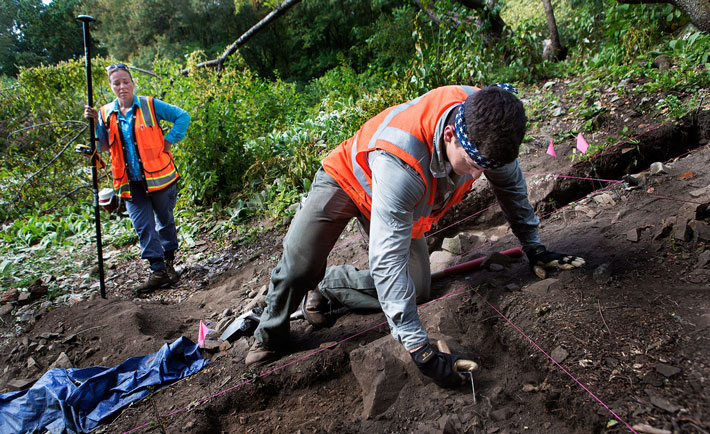
On Wednesday, 25 April, archeologist Meg Watters Wilkes will speak about “Parker’s Revenge Revealed: Archaeology on a Revolutionary War Battlefield” at the Skinner Marlborough Gallery in Marlborough.

Here’s the event description:
On the morning April 19th, 1775, British troops marched from Boston to Concord, Massachusetts, to destroy supplies stockpiled in the town to form a provincial army. As the British soldiers reached the town of Lexington, militia had formed on the common. A shot was fired, and the British regulars fired into the militia killing eight and wounding ten. The regulars then proceeded to Concord. After taking care of their dead and wounded, the Lexington men formed and marched towards Concord to lay in wait for their return back to Boston. A brief engagement ensued.

Primary accounts of this event placed it on the Lexington/Lincoln town lines, but where was it? Join Dr. Watters as she explains the methodology and results of finding a battlefield from the first day of the American Revolution.
Meg Watters Wilkes has over twenty years of experience as a remote sensing specialist in archaeology. She holds a B.A. in Classical Studies from Trinity College in Hartford, an M.A. in Remote Sensing and G.I.S. in Archaeology from Boston University, and a Ph.D. in Archaeological Landscape Remote Sensing and 3D Visualization from the University of Birmingham.

This event will take place at the Skinner auction house’s Marlborough facility, 274 Cedar Hill Street. Refreshments will be served starting at 5:00 P.M. The lecture will begin at 6:00. The event is free and open to the public.

Friday, April 20, 2018

Conceptions of Medicine and History at the A.A.S.

Here are couple of interesting programs coming up at the American Antiquarian Society in Worcester in the next couple of weeks.

Tuesday, 24 April, 7:00 P.M.
“The Medical Imagination in the Early United States”
Sari Altschuler

The checklists and clinical algorithms of modern medicine leave little space for imagination, and yet we depend on creativity for the advancement of medicine—to diagnose unusual conditions, to innovate treatment, and to make groundbreaking discoveries. We know a great deal about the empirical aspects of medicine, but we know far less about what the medical imagination is, what it does, how it works, or how we might train it. It was not always so.

Sari Altschuler will return to A.A.S. to discuss her new book, The Medical Imagination: Literature and Health in the Early United States. During the eighteenth and nineteenth centuries, American doctors understood the imagination to be directly connected to health, intimately involved in healing, and central to medical discovery. Literature in particular provided physicians and other health writers important forms for crafting, testing, and implementing theories of health. Reading and writing poetry trained judgment, cultivated inventiveness, sharpened observation, and supplied evidence for medical research, while novels and short stories offered new perspectives and sites for experimenting with original medical theories.

Sari Altschuler is assistant professor of English and associate director of the Humanities Center at Northeastern University. Her research focuses primarily on American literature and culture before 1865, literature and medicine, disability studies, and the health humanities, broadly understood. Her talk is cosponsored by the Franklin M. Loew Lecture Series at Becker College.

Tuesday, 1 May, 7:00 P.M.
“Antiquarian America: Isaiah Thomas and the Ends of History”
Peter S. Onuf

Isaiah Thomas intended for the A.A.S. to play a critical role in promoting the future progress of the new American nation’s epochal experiment in republican government. Thomas and his colleagues were convinced that the success of that experiment depended on comprehensively collecting any evidence—from Indian antiquities and other “curiosities,” portraits, maps, manuscripts, and anything in print—that would illuminate the life of present as well as past for their future successors. The American Antiquarian impulse was cosmopolitan and progressive, eschewing the didacticism and patriotic exceptionalism of nationalist historiography and so anticipating the contemporary turn toward scientific, “objective” accounts of social and cultural development.

Peter S. Onuf is the Thomas Jefferson Memorial Foundation Professor of History Emeritus at the University of Virginia, and also senior fellow at Monticello’s Robert H. Smith International Center for Jefferson Studies. He is the author, co-author, and editor of numerous books, including Jefferson’s Empire: The Language of American Nationhood, The Mind of Thomas Jefferson, “Most Blessed of the Patriarchs,” and Jeffersonian Legacies. This year Onuf is the A.A.S.-Mellon Distinguished Scholar in Residence.

These programs take place in Antiquarian Hall, 185 Salisbury Street in Worcester. There is on-street parking available on Regent Street and at the lot at 90 Park Avenue. They are open to the public free of charge. Books will be available for sale and signing after the program.

Thursday, April 19, 2018

Shedding Light on the Lanterns Debate

There are two big reasons I think the late-1870s debate over whether sexton Robert Newman or vestryman John Pulling hung the lanterns in the Old North Church steeple on 18 Apr 1775 didn’t amount to much.

The first is that the two family traditions which finally saw print in that decade weren’t really contradictory. Of course each set of children born after the Revolution grew up hearing about how their own daddy or granddaddy had done something very important in the war, paying little attention to other people in the story. But two traditions actually fit together.

Here’s the Newman lore, as expressed in 1873:
That evening the sexton of Christ Church, Robert Newman, sat quietly in his house on Salem street, opposite Bennett street, assuming an unconcerned look and manner to avert the suspicion of the English officers who were quartered upon him, but impatiently expecting the arrival of a friend, a sea captain, who was watching the movement of the regulars. 
Newman’s son recalled him awaiting “a sea captain,” and Pulling was a mariner whom everyone called “Captain.” Significantly, the Newmans didn’t recall the sexton hearing news directly from Paul Revere.

Meanwhile, Pulling’s relatives were clear that the first thing he did after learning about the British plans from Revere was to go to Newman:
As soon as he received his notice, he left his house, and, watching his time, went over to the sexton’s, in the same street, and asked for the keys of the church, which, as he was a vestryman, the sexton could not refuse to give him.
In sum, the two accounts are complementary. The only contradiction between these stories is that each family felt that their relative alone took two lanterns to Christ Church.

But it makes more sense if both men went to the church. That way one could keep watch and run interference. Pulling may well have seen himself as supervising while Newman recalled doing most of the physical work.

Both family traditions also hold that the royal authorities seized Robert Newman on 19 April or soon afterward. That leads us to the next big disagreement between the accounts. The Newman family said the sexton was released because the army didn’t have enough evidence to hold him. The Pulling relatives believed that Newman was released because he snitched on the captain—but they offered no evidence for the words they put in Newman’s mouth. The sexton remained in the North End for years after the war, and no one else accused him of being an informer.

These days, almost all historians say Robert Newman and John Pulling put up the signal lanterns together. The Pulling relatives’ suspicion about Newman gets swept aside. So as of now both sides of the debate won, and both sides lost.

But that’s only the first reason I say the debate over who hung the lanterns doesn’t matter much. The other reason is that hanging those lanterns probably had zero effect on history.

The lantern signal told William Conant, David Cheever, and other Patriots in Charlestown that the British troops were going to cross the Charles River. They dispatched a messenger on horseback to carry that news to Committee of Safety and Supplies members Elbridge Gerry, Azor Orne, and Jeremiah Lee in west Cambridge and to John Hancock and Samuel Adams in Lexington.

That messenger never made it. He was probably stopped on the west side of the Charlestown neck by British officers on horseback. Revere later ran into such officers and had to gallop off to a northern road. We don’t know who the original Charlestown rider was or what happened to him, but we know he didn’t get through.

That means the signal from the Old North tower played no role in alerting Provincial Congress leaders or countryside militia officers about the British march. Thus, if the two lanterns had never shone, the events of 19 April would have played out the same way. (Mind you, I’ve even questioned whether Revere’s ride mattered.)

So why did people care so much about the lanterns in the 1870s? Why do we care today, reenacting that event and idolizing the lanterns supposedly involved? The answer goes back to Henry W. Longfellow. He recognized the poetic power of that moment when the twin lanterns were lit—it’s focused, dramatic, visual. He made it a vital part of “Paul Revere’s Ride,” distorting history to depict it as crucial to Revere’s actual ride. And we’ve had it embedded in our national consciousness ever since.

Wednesday, April 18, 2018

The Debate Over Newman and Pulling

The Rev. John Lee Watson was pretty relentless in arguing his claim that John Pulling, not Robert Newman, had hung the lanterns in Old North Church on 18 Apr 1775.

On 20 July 1876, Watson published his letter in the Boston Daily Advertiser. In November he sent an updated and corrected version of that letter to Charles Deane, corresponding secretary of the Massachusetts Historical Society, who endorsed his conclusion and entered the letter into the society’s Proceedings.

The following year, a pamphlet titled Paul Revere’s Signal: The True Story of the Signal Lanterns in Christ Church, Boston appeared. That reprinted Watson’s letter and the M.H.S. discussion of it. Watson published an expanded edition in 1880. (In addition to arguing for Pulling’s participation, he also disputed the mistaken belief that the signal had been sent from the Old North Meeting-House instead of what had become known as the Old North Church.)

Most of the evidence to support Pulling’s participation was indirect, based on his documented role in other Patriot activism. Pulling was a member of the North End Caucus. He was elected to town offices: clerk of the market, warden, fireward, committee to supply the poor, committee to enforce the Continental Congress’s Association. After the siege, he served on the town’s wartime “Committee of Correspondence, Safety & Inspection” alongside Paul Revere.

In 1777 Pulling was a captain and conductor or commissary of ordnance in Col. Thomas Crafts’s Massachusetts artillery regiment. Basically that regiment was how middle-aged Sons of Liberty from Boston’s mechanics class helped to fight the war. (Revere was second-in-command.) In addition, starting in 1761, Pulling intermittently attended events of the St. Andrew’s Lodge of Freemasons.

Pulling’s Whiggish work was somewhat unusual in that he was an Anglican, even at times a warden and vestryman of Christ Church. But of course his access to that church’s tall steeple would have made him valuable on 18 Apr 1775.

In 1878, a defender of the Newman family claim hit back at the pro-Pulling argument. William W. Wheildon published his History of Paul Revere’s Signal Lanterns, April 18, 1775, in the Steeple of the North Church from his press in Concord. He listed more than a dozen people who had lived in the North End before and after the war and testified that it was common knowledge that Newman had hung the signal lanterns. (Like Watson, Wheildon also spoke up for Old North Church, not Old North Meeting-House, as the source of the signals.)

There’s clear evidence that Newman was indeed the sexton at Christ Church in 1775 and for years afterward (until he was criticized for charging visitors money to see the body of Maj. John Pitcairn in the crypt). And who besides the sexton would have the church keys and knowledge of the stairs to the steeple?

In this historical debate, Newman was the inside candidate. His family had remained in the North End and first got the attention of the Christ Church rector. Though Pulling had returned to the North End after the siege, by the 1870s his descendants were more scattered.

On the other hand, the Pulling faction had the advantage of class. The Newmans didn’t publish their own accounts. Pulling’s relatives did, the most vocal being clergymen. Pulling had been a respected merchant. In contrast, church sextons like Newman were seen as poor, menial, and dependent. “Are sextons, as a class, so intelligent and so reliable as to have been chosen for and intrusted with such an important affair?” Mary Orne Jenks sniffed. In this period the M.H.S. was at its most Brahmin, and it’s no surprise that institution lined up on the Pulling side.

Both parties in the debate claimed that their man was the “friend” that Revere asked to send the signal. Neither was actually able to provide evidence for friendship aside from all three men living in the North End in the same years. But Pulling was in his late thirties, closer to Revere’s age, while Newman was only twenty-three.

Both sides had dramatic stories to tell of their man carefully hanging the lanterns on 18 April, evading the royal authorities that night, and then being hunted down. But there’s no documentary evidence from 1775 to support either of those traditions.

And in the end, this whole debate was over very little.

TOMORROW: Why the Newman-Pulling dispute really doesn’t matter.

Tuesday, April 17, 2018

Another Version of the Story of John Pulling

I’ve been quoting the letter published in the 20 July 1876 Boston Daily Advertiser that first publicly credited John Pulling with having hung the signal lanterns in Old North Church at the start of the Revolutionary War.

It’s striking evidence of the speed of communications possible then that an evening reprint of that newspaper item reached Malone, New York, by 22 July, and a man there was able to have his reply published back in the Boston Journal on 24 July.

Henry F. Lane (1825-1897) was the pastor of the First Baptist Church of Malone. He wrote:

“WHO SIGNALED PAUL REVERE. . . .

Under this caption in your evening edition of Friday I learn that a correspondent of the Advertiser from Orange, N.J., answers the question by giving the name of John Pulling.

John Pulling was the grandfather of my mother, the late Mrs. Charles Lane, Jr., of Boston. The wife of John Pulling, my mother’s grandmother, died in Abington, Mass., about thirty years ago in her ninety-ninth year.
That elderly widow was Sarah (Thaxter McBean Pulling) Reed (1746-1843). Her daughter Sarah (1773-1817) married Isaac Reed of Abington in 1793, and their daughter Sarah (1797-1871) married Charles Lane in 1815. (The first Sarah's third husband was the father of the second Sarah’s only husband.)

Henry F. Lane told the family lore this way:
When I was a lad I remember distinctly hearing from her that her husband hung the lights in the steeple of the Old North Church to give the alarm to the country people. His residence at the time was on the corner of what was then called Ann and Cross Streets. The British at the time made diligent search for him, and I have heard my great-grandmother give a very vivid description of their searching the house to find him, and how he avoided capture by her concealing him under an empty wine-butt in the cellar.

He escaped with her from Boston in a small skiff while the British had possession, by disguising himself as a fisherman, was challenged while passing under the hawser of a British man-of-war, and landed on Nantasket beach. He was in concealment for a while in an old cooper shop near the beach, and in that lowly place my mother’s mother was born. At the time John Pulling was a shipping merchant. All his vessels and goods were confiscated and his house was occupied by British ofiicers. . . .

I will also add that John Pulling was one of the number that destroyed the tea in Boston Harbor. He was not disguised as an Indian, but was in his usual garb, even to the three-cornered hat. My great-grandmother, upon his return, took from the rim of his hat a small quantity of the tea that had been lodged there, and preserved it in a glass vial. Many of her descendants besides myself who are yet living will recall how vividly the old lady used to describe the event as she brought forth the precious memento. During the last year of her life that vial mysteriously disappeared.
In broad outline this is the same story passed down by the sisters and daughter of Pulling’s first wife to the Rev. John Lee Watson—sought by the royal authorities, Pulling snuck out of Boston by boat to Nantasket and lived there with his family during the siege of Boston, enduring privations. Many of the details differ, however, from the location of the Pullings’ North End home to the boat they escaped on.

In one important respect, Henry Lane’s understanding of his family history was wrong. He believed his grandmother was born at Nantasket during the siege. In fact, she was born on 19 Oct 1773, according to Boston records, and baptized at Christ Church five days later. It’s notable that Henry Lane didn’t know his grandmother, who died before he was born, but clearly did know his long-lived great-grandmother and her vivid stories of the Revolution.

In the end, the existence of two versions of the tale of John Pulling hanging lanterns from two branches of the family who clearly weren’t in touch shows that story goes back well before those lanterns became a celebrated part of American lore. But where does that leave Robert Newman?

TOMORROW: The debate over Newman and Pulling.

Monday, April 16, 2018

Pulling on the Run

Yesterday we left merchant captain John Pulling (1737-1787) in Boston’s North End with the royal authorities seeking to question him about the signal lanterns hung in the Old North Church steeple on 18 Apr 1775.

At least, that’s the way the Rev. John Lee Watson told the story in a letter published in the Boston Daily Advertiser on 20 July 1876. Watson went on:
In the meantime, a Mrs. Malcolm, a Scotchwoman, and wife of a near neighbor of Mr. Pulling,—who was under obligations to him for some service he had rendered him,—came to him with a message from her husband, “that he had better leave the town as soon as possible, with his family.”

And this he did, disguised as a laborer, on board of a small craft loaded with beer for the man-of-war lying in the harbor. In some way, one of the sailors belonging to the craft had known Mr. Pulling, and to him he confided his wish to escape from Boston with his family. The sailor said “if the skipper of the craft should be on board, he would not allow of any delay; but if the mate, who was a good-natured fellow, should have the command, he would be willing to put him ashore on his return.” This proved to be the case, and Mr. Pulling and his family were landed at Nantasket.

How long he remained there is not known, probably not long; but his wife and family continued to live there for some time, suffering from want of all the necessaries of life; for they had carried nothing with them,—every thing had been left behind.

And when Mr. Pulling returned to Boston,—after the siege was raised,—he found his dwelling-house, and stores, and abundant means, all so injured or destroyed that, at the end of the war, all his property was gone. He died soon after, and the family at once removed to Hingham, Massachusetts.
Boston newspapers show John Pulling holding offices in the militia and town government during and after the war, and advertising imported cloth and other goods for sale before his death in January 1787. But his family passed down a perception of him as impoverished.

Watson said the story he told was “derived principally from the letters of my kinswoman, the grand-daughter of John Pulling.” When the minister expanded his newspaper letter into a pamphlet, he named his correspondent as Mary Orne Jenks (1800-1886) of Salem.

Jenks had told her cousin: “The story of the lanterns I heard from my earliest childhood, from my mother, and from my step-grandmother.” John and Annis (Lee) Pulling (1743-1771) had only one daughter, also named Annis. In 1773 John remarried Sarah (Thaxter) McBean of Hingham, who helped to raise Annis and her brother from the first marriage. Thus, the mother and step-grandmother whom Jenks referred to must have been Annis (Pulling) Jenks (1769-1837) of Salem and Sarah (Thaxter McBean Pulling) Reed (1746-1843) of Abington.

In addition, Watson stated he heard the same story from “my mother and my aunt—both of them sisters of Mrs. Annis Pulling.” The minister’s mother was Lucy (Lee) Watson (1759-1840), Annis (Lee) Pulling’s youngest sister. There are multiple candidates for the aunt, but this is clearly an example of the women of the family maintaining the family lore and passing it on to the next generations.

TOMORROW: Another branch of the family heard from.