J. L. BELL is a Massachusetts writer who specializes in (among other things) the start of the American Revolution in and around Boston. He is particularly interested in the experiences of children in 1765-75. He has published scholarly papers and popular articles for both children and adults. He was consultant for an episode of History Detectives, and contributed to a display at Minute Man National Historic Park.

Subscribe thru Follow.it


•••••••••••••••••


Sunday, May 26, 2013

“Foodways in the Northeast” in Deerfield, 21-23 June

On 21-23 June, Historic Deerfield will host the 38th annual Dublin Seminar for New England Folklife. This year’s topic is food. In more detail:

“Foodways in the Northeast II: A Second Helping” is a three-day conference of seventeen lectures, a supporting workshop, and demonstrations on the subject of New England’s culinary history from 1600 to the present. The program complements and expands on scholarly developments presented at a previous Seminar held thirty-one years ago in Deerfield in 1982.

Beginning Friday evening with the keynote speaker, John Forti of Strawbery Banke Museum, the conference will address colonial-period foodways; the foodways of schools, politics, and culinary revivals; diet and religious foods; nineteenth-century farm management; and foodways in the twentieth century. The conference will end on Sunday with a panel discussion on the renaissance in New England of artisan and slow foods, followed by comments from Caroline F. Sloat, a speaker at the 1982 Seminar.

The Seminar is designed for educators, historians, culinarians, collectors, authors, librarians, and museum curators; students and the general public are cordially invited to attend.
More detail, including the lineup of planned papers and activities, can be found in this download of the registration form. Registration is $155 for all three days, with discounts for full-time students and Dublin Seminar members and extras for additional events.

Here’s the contents list of the 1982 Foodways volume. I particularly remember Daphne Derven’s “Wholesome, Toothsome, and Diverse: Eighteenth-Century Foodways in Deerfield, Massachusetts,” which analyzed account books from the town and discovered seasonal cycles for slaughtering and consuming different types of meat before refrigeration. That gave me a new way of looking at what I ate.

Saturday, May 25, 2013

Treaty of Paris Celebrates Its 250th Birthday in Boston

Today the Bostonian Society opens an exclusive new exhibition: “1763: A Revolutionary Peace.” This year marks the sestercentennial—that’s the 250th anniversary—of the end of the Seven Years’ (French & Indian) War.

To observe the occasion, the British government has loaned its original copy of the 1763 Treaty of Paris, signed by representatives of Britain, France, and Spain, which has never been in North America before.

The exhibit announcement explains how profoundly important this treaty was for the people on this continent:
The Paris treaty of 1763 literally redrew the map of North America, giving Britain all lands east of the Mississippi River, including Spanish Florida. Lands west of the Mississippi (and New Orleans) remained French, but because France had secretly transferred those claims to its ally Spain, the treaty effectively ended France’s presence on the continent’s mainland.

Britain had won the war, but now faced complex challenges in integrating new territories, peoples (including Native nations and French inhabitants), and governments into the new order. Even as the Treaty of Paris promised the start of a new era of peace and prosperity, it also sowed seeds of discontent from which a new crisis in the British Empire would soon grow.
(In fact, this Treaty of Paris was so unsuccessful at keeping the peace in North America that it appears to be completely overshadowed online by the Treaty of Paris of 1783, which ended America’s War for Independence. When I went looking for web images of the 1763 treaty, I kept finding documents and proclamations from 1783 that had been mislabeled. It took me about fifteen minutes before I stumbled on the image above in a blog about the Kennedy administration. And odds are that’s a different copy.)

The exhibit at Boston’s Old State House museum has been curated by Donald C. Carleton, Jr., director of the 1763 Peace of Paris Commemoration. In addition to the treaty, the display includes weapons and artifacts from the Seven Years’ War, medals marking peace between the Crown and First Nations formerly allied with France, and a Native American wampum treaty belt. It will be on view through 7 Oct 2013. And this is the treaty’s only North American appearance, perhaps for another 250 years.

COMING UP: A two-day, two-city symposium about the 1763 Treaty of Paris.

Friday, May 24, 2013

Tooting the Horn for Two Talks

In the next three weeks I’ll give two talks in two different cities about two different powder horns from the siege of Boston.

On Friday, 31 May, I’ll speak at Anderson House, the museum of the Society of the Cincinnati, in Washington, D.C. The topic will be “Thomas Kempton’s Engraved Powder Horn.” One of the curiosities of this horn is that it was first labeled as engraved by Capt. Kempton, and then that line was changed to for Capt. Kempton. What were Kempton and the carver trying to say? And what other stories does that object tell us about the siege of 1775-76?

That talk is part of a program that Anderson House calls “Lunch Bites,” designed for people to enjoy on their lunch break or while sightseeing in the capital. The session starts at 12:30 P.M. I’ll speak for no more than half an hour, leaving time for questions and looking at the horn itself. That talk and the museum are free and open to the public.

Back in Boston, on Friday, 14 June, I’ll speak at the Massachusetts Historical Society about “Ephraim Moors’s Powder Horn” (shown above). This talk is connected to the society’s exhibit called “The Object in History,” featuring some of the treasures and curiosities in its collection, including “Portraits, needlework, firearms, clothing, furniture, silver, scientific instruments, documents, and books.”

I spoke about the Moors powder horn at the Concord Museum last year, but since then I’ve learned more and have developed a new theory about its creation. This talk starts at 2:00 P.M., will be about an hour long, and is free to all. The society’s exhibit runs through the first week of September, Monday through Friday, and is also free to all.

Thursday, May 23, 2013

A Fort from 1779, a Redcoat from 1799

Here are a couple of eighteenth-century archeology stories from the past month.

The Associated Press reported on a dig in Georgia that located Carr’s Fort, site of a skirmish in February 1779. The article explains:
Robert Carr was a cattle farmer who settled with his wife, children and a single middle-aged female slave in Wilkes County after colonists started arriving there in 1773. Carr also served as captain of a militia company of roughly 100 men. Responsible for leading his militiamen and looking out for their families, Carr built a stockade wall to protect his farmhouse and surrounding property, which included shacks and crude shelters. . . .

In February 1779, about 80 British loyalists marched into Carr's Fort and took control, presumably while Carr and other patriot militiamen were away. Patriots responded quickly by sending 200 men from Georgia and South Carolina to retake the fort.
Dan Elliott’s archeological team found an area that contained old bullets, musket parts, buttons, horseshoes, hinges, and a “coin believed to a King George half-penny from the 1770s.” However, they haven’t found remains of the fort’s walls, and there’s still no evidence of where Carr himself was during the fight over his property.

Across the Atlantic, the B.B.C. reported on a body found in Dutch sand dunes that had been preserved under asphalt for a while before being uncovered again. The artifacts with the body allowed archeologists to connect the remains to a particular British army regiment and expedition:
In August 1799, Britain and Russia launched an invasion of northern Holland in an effort to topple the Batavian Republic and restore the House of Orange. The action formed part of the wars against revolutionary France, which supported the Dutch republic.

The British-Russian armies - including the 2nd Battalion Coldstream Guards, consisting of some 1,000 soldiers - arrived in Groote Keeten under the Duke of York. About 12,000 British soldiers were landed in total. [Archeologist Esther Poulus explains:] “In the Netherlands, they call it the forgotten war - it didn’t take very long, and was quite local.”

The soldier was buried in his uniform, along with several muskets, which may simply have been thrown in the grave to dispose of them, or may have been fashioned into some kind of makeshift stretcher to carry his body to its resting place.

“When we found the buttons he had worn on his tunic, we thought, ‘Wow - we can identify this soldier.’”
The webpage shows not only those buttons but also some of the bones, as shown above.

Wednesday, May 22, 2013

“Spectacle of Music” in Newport, 26 May

On Sunday, 26 May, the Newport Historical Society will host “A Spectacle of Music” at the Colony House in Washington Square.

This is a series of varied concerts:
  • 1:00 – The Ministers of Apollo present the Orange County Militia Drum and Fife Band (as shown in part to the left), who perform military music of the American Revolution with period instruments in authentic clothing.
  • 2:00 – Mother Earth Singers: Traditional Native American drum and singing courtesy of the Dighton Intertribal Council.
  • 3:00 – Singer Gerard Edery and violinist Meg Okura perform “Treasures of Sephardic Song,” tracing the surprising and exotic musical synergies between Christians, Arabs, and Jews from Medieval Spain to the present.
  • 4:00 – Stuart Frank and Mary Malloy share eighteenth- and nineteenth-century ballads and songs in a concert based on Rhode Island whalemen’s journals. Dr. Frank is Senior Curator at the New Bedford Whaling Museum.
These performances thus represent the different cultures and professions that made up eighteenth-century Newport. The concert is the first “Spectacle of Toleration” event for the year.

The concert is free, though the historical society naturally welcomes donations.

Tuesday, May 21, 2013

Maps of the 1700s at the Boston Public Library

The Norman B. Leventhal Map Center at the Boston Public Library is hosting an exhibit titled “Charting an Empire: The Atlantic Neptune in two parts this year. As the exhibit explains:

The period following the French and Indian War (1754-1763) was a time of change and discovery in North America. In this display of charts, views, and maritime objects, we look at the decade following the war, when Britain set out to accurately chart the coast and survey the inland areas of their new resource-rich empire in Atlantic Canada, as well as the eastern seaboard extending from New England to the West Indies. The resulting charts were published collectively by Joseph Frederick Wallet Des Barres in The Atlantic Neptune, a maritime atlas which set the standard for nautical charting for nearly half a century.
Through 28 July, the map center will exhibit Des Barres’s maps and charts of Atlantic Canada. From August through 3 November it will exhibit the pages on the eastern seaboard of what became the U.S. of A.

Connected to that exhibit, this evening, 21 May, at 5:30 P.M., the map center hosts a lecture on “Mapping the Revolutionary War in Virginia” by William Wooldridge. This event was organized by the Boston Map Society and takes place in the library’s Glass Orientation Room. Wooldridge will also sign copies of his book Mapping Virginia, from the Age of Exploration to the Civil War. The library asks people to reserve a seat by emailing maps@bpl.org.

If that’s not enough maps, Historic Newton is hosting an exhibit called “Mapping a New Town: 1714-1874” at its Jackson Homestead and Museum. For more information, visit Historic Newton.

Monday, May 20, 2013

James Hall, American Soldier

Yesterday I shared the first half of an essay by Dan Lacroix about stories told in Westford and Cavendish, Vermont, about a man named James Hall, said to have deserted from the British column on 19 Apr 1775 after being hit by a provincial musket ball and playing dead.

How reliable are those accounts? For example, did Sgt. Hall really try to shoot “Minuteman Wright of Westford” at Concord’s North Bridge? Did John Gray of Westford really steal his “military cap with its ostrich feathers”? And what might those details say about the underlying story, that James Hall wasn’t one of the British dead interred in Concord? Here’s more of Dan’s report:


Prior to Henry B. Atherton’s 1875 newspaper stories, the only Westford men reported to have been at the North Bridge at the time of the skirmish were Lt. Col. John Robinson, Sgt. Joshua Parker, the Rev. Joseph Thaxter, and Oliver Hildreth. The earliest any of the eight documented Wright men who served that day is said to have arrived at the bridge is as the skirmish was ending.

Moreover, even the Lowell Daily Courier article questions the existence of John Gray, a man who continues to elude proper documentation. It’s likely that Atherton gained his knowledge of Westford’s eighteenth-century residents by listening to the stories told by the descendents of the dozens of Westford veterans who emigrated to the Cavendish/Ludlow region of Vermont after the war. But was that oral history reliable?

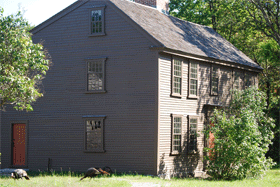
Further details of James Hall’s life in America after 1775 are supported by vital records, as well as a family document found in a carton of the personal papers belonging to his grandson James Ashton [Under-Lyne] Hall (1816-1845) many years after his premature death. In this more straightforward telling of the story we find that following the grazing of his shoulder James Hall deserted when he found it “convenient.” He then returned to Westford with John Hildreth and spent the next year working for him and his brother Ephraim Hildreth, 3rd. For a time he moved to neighboring Chelmsford and took up the blacksmithing trade with Phineas Chamberlain (1745-1813), whose house still stands today (shown above and in this report).

By 1779 James had grown so fond of his adopted country and its ambitions for independence that he took up the call for nine months’ service in the Continental Army. His time was spent in the Hudson Highlands at West Point with Col. Michael Jackson’s 8th Massachusetts Regiment, part of it during the “winter of the deep snow.” For this service he later received a pension.

One of the many transcribed period documents in Wilson Waters’s History of Chelmsford provides a further example of James Hall’s support for the cause: we find him listed in 1781 along with Chamberlain, his blacksmith mentor, and a class of men who provided financial incentive for another man’s service in the army.

Soon after, the lure of freshly established communities in Vermont drew James and his blacksmithing trade to Cavendish with other Westford veterans. He returned in January of 1784 to marry Thankful Hildreth, and brought her back to Cavendish that same winter. During the 1790s they returned to Massachusetts, residing in Acton and Westford, before settling one final time in Vermont shortly before the turn of the century. In 1822, while living with his son James Whoral Hall in Reading, Vermont, this veteran died at the age of 69.

Like so many of his fellow revolutionary soldiers, James Hall’s weather-worn memorial stone proudly establishes him as “A Soldier of the Revolution.” Not surprisingly, there is no mention of his service to the King, though it very prominently declares his Lancashire birth, as well as the fact that he “Emigrated” from mother England in 1774.
So was Pvt. James Hall of the 4th Regiment one of the three British soldiers killed in the fire at the North Bridge and buried in Concord? Or did his comrades simply think that he was killed, allowing him to take up a new life as a New Englander? If James Hall wasn’t buried in Concord, who was? Or were there two James Halls in the British column, one who died and one who deserted? Very interesting questions. Thanks, Dan!

Sunday, May 19, 2013

James Hall, “a British soldier”

Today I’m pleased to share with you the first half of an essay by Dan Lacroix. As a historical researcher, Dan has worked for years with the Westford Museum & Historical Society. As a reenactor with the Westford Colonial Minutemen, he also has a specialty in eighteenth-century house joinery (carpentry). And a while back Dan clued me in on a fascinating mystery from New England’s Revolution, so I asked him to write up some of his findings as a guest blogger.

About eight years ago my research into the lives of Westford’s Revolutionary War soldiers took an unexpected turn. A short passage in Edwin Hodgman’s 1883 History of Westford describes a past resident by the name of James Hall as “a British soldier, born at Ashton-under-line [Lyne], England, who during the retreat of the Regulars from Concord, April 19, 1775, voluntarily surrendered to the Provincials and came to Westford and worked for Ephraim Hildreth, 3rd, whose daughter he married in 1784.”

An interesting story in itself, but wasn’t James Hall also the name of one of the British soldiers from the 4th (King’s Own) Regiment killed at the North Bridge? The precise identities of those three soldiers have been debated for years, and I won’t be delving into that debate here. Though it may not be possible to conclusively prove that two men named James Hall are one in the same, there is considerable evidence supporting the core facts within some engaging nineteenth-century family stories.

One of Hodgman’s sources might have been an article in the Boston Journal from 26 Apr 1875, which was repeated with annotations two weeks later in the Lowell Daily Courier. Written by an accomplished lawyer and Civil War veteran, Capt. Henry B. Atherton (1835-1906, shown above), the article was based on family stories and traditions from his home town of Cavendish, Vermont, where James Hall, born 29 Sept 1753, ultimately settled and established his family.

From Atherton we learn that at about the age of twenty James “awoke with the fatal shilling of the recruiting sergeant in his pocket,” and then was “engaged with the rest of his regiment in laying roads in Scotland.” A six-week passage (with two of them becalmed off of Newfoundland) brought him to Boston Common with his regiment in 1774.

In true Centennial-era detail we learn of his experiences on April 19th of the following year:

At Concord, he was among those stationed at the bridge. As they were about to begin the retreat, Minuteman Wright of Westford called to them “Boys, don’t pull up the planks!” whereupon Hall took deliberate aim at Wright and shot, but failed to hit him.
And further,
On the retreat through Lincoln Woods, a shot from one of the Minutemen grazed his shoulder, and worn out with fatigue, he threw himself on the ground, his comrades exclaiming, “There goes Sergeant Hall; he is dead!”

After they passed, he rose and returned to the Wright Tavern in Concord. There he suffered no indignity, except that John Gray of Westford pulled off his military cap with its ostrich feathers, which he retained and subsequently gave to his daughters.
The colorful nature of the story aside, certain details immediately raise some questions.

TOMORROW: Details and discrepancies in the legend of James Hall.

Saturday, May 18, 2013

“Near this site was buried a British soldier”

Yesterday’s posting included a recent photograph of the monument marking the grave of two British soldiers who died in the skirmish at the North Bridge in Concord. That tablet, with lines by the poet James Russell Lowell, has been on the site for decades.

In recent years, as D. Michael Ryan’s article from 2000 describes, Concord installed a stone marker on the site linked to a third soldier said to be fatally wounded in that fight. Concord chronicler Lemuel Shattuck had described his burial according to the landmarks of his time, and local research in real estate records relocated the approximate spot.

Ryan’s article states that the names of the three British soldiers buried in those places are Thomas Smith, Patrick Gray, and James Hall. Minute Man National Historical Park, Wikipedia, and the Silver Whistle site that supplied the photo above say the same.

How did Ryan and other historians arrive at those three names? They looked at the muster rolls for the company of His Majesty’s 4th Regiment known to be at the North Bridge. They counted which men were listed as killed or missing after the Concord march. Three names of three privates—three bodies—case solved!

But a few years ago Dan Lacroix of Westford shared some research that convinced me that neither of those graves probably contains the remains of Pvt. James Hall of the 4th. You’ll see some of that research tomorrow. Dan is more careful about that conclusion than I am; for one thing, the name “James Hall” was common enough that it’s hard to rule out the possibility of two men with that name, a lucky confluence like Hezekiah Wyman. But see what you think. Is James Hall buried in Concord?

TOMORROW: Or, would you believe, Vermont?

Friday, May 17, 2013

“They came three thousand miles and died”

So how many British soldiers died at the North Bridge in Concord? How many were buried nearby? Those questions have answers, but not definite ones.

As I quoted earlier in the week, one of the British officers there, Lt. William Sutherland, described leaving two men “dead on the Spot.” But Capt. Walter Sloane Laurie reported losing three men overall. And Capt. Lawrence Parsons reportedly saw three men dead at the bridge as he later passed that spot—or was that count influenced by Laurie’s report?

When Zechariah Brown and Thomas Davis, Jr., described burying corpses of the regulars who died at the bridge, they said “neither” had been scalped, suggesting there were two. But their testimony was probably selective. Had another corpse already been moved away?

In 1827, Concord minister Ezra Ripley wrote that in the firing at the North Bridge “Two of the British were killed and several wounded,” with the dead still lying “near the bridge” when their comrades returned from Col. James Barrett’s. Furthermore:
The two British soldiers killed at the bridge were buried near the spot where they fell, both in one grave. Two rough stones mark the spot were they were laid. Their names were unknown. Several others were buried in the middle of the town.
Ripley wrote nothing about Ammi White and his hatchet.

In his 1835 history of Concord, Lemuel Shattuck wrote that “Three British soldiers were killed” at the bridge, but only two were “left on the ground” there and later interred nearby. “One of the wounded died and was buried where Mr. Keyes’s house stood,” Shattuck added. Many later authors have therefore written that two British soldiers were killed immediately at the bridge and another badly wounded, making it back to the center of Concord before dying there.

And who were the “Several others” that Ripley said were interred in central Concord? Shattuck reported that one was Pvt. John Bateman, who died under the care of Dr. John Cuming “at the house then standing near Captain Stacy’s”—Daniel Bliss’s house, according to other authors. (This despite Bateman giving a deposition in Lincoln, not Concord, on 23 Apr 1775.) Bateman “was buried on the hill,” Shattuck wrote.

Don Hagist has reported that Bateman was a grenadier in the 52nd Regiment. The companies at the bridge came from the 4th, 10th, and 43rd. So Bateman must have been fatally wounded in the British withdrawal from Concord, not at the bridge. (It’s notable that some founding settlers of Concord were named Bateman; perhaps people of that town brought him back out of some feeling of kinship.)

According to Shattuck, therefore, there were four British soldiers buried at three sites in Concord soon after 19 Apr 1775. According to Ripley, there might have been “Several others,” but that’s too vague to track down.

TOMORROW: Commemorations and looking for names.

Thursday, May 16, 2013

“Very barbarously broke his scull and let out his brains”

As I quoted two days ago, in the spring of 1775 five British soldiers testified to seeing one of their comrades with “the Skin over his Eye’s Cut and also the Top part of His Ears cut off” near the North Bridge in Concord. On 19 April, army officers were already interpreting that as a scalping.

The Massachusetts Provincial Congress published a deposition, quoted yesterday, in which two men who buried the British soldiers at the bridge denied any of them had been scalped. Did that lay the controversy to rest, along with the dead men?

No, it didn’t, because the Rev. William Gordon of Roxbury acknowledged the attack in a letter published in the Pennsylvania Gazette on 7 June 1775:
The narrative [from Gen. Thomas Gage] tells us that as Capt. [Lawrence] Parsons returned with his three companies over the bridge, they observed three soldiers on the ground, one of them scalped, his head much mangled, and his ears cut off, tho’ not quite dead; all this is not fiction, tho’ the most is. The Rev. Mr. [William] Emerson informed me how the matter was, with great concern for its having happened.

A young fellow coming over the bridge in order to join the country people, and seeing the soldier wounded and attempting to get up, not being under the feelings of humanity, very barbarously broke his scull and let out his brains, with a small axe (apprehend of the tomahawk kind) but as to his being scalped and having his ears cut off, there was nothing in it. The poor object lived an hour or two before he expired.
In addition to appearing in a major American newspaper, Gordon’s account was also published in a New England almanac for 1776.

Thirteen years later, Gordon (working with a ghostwriter) adapted his letters into The Rise, Progress, and Establishment, of the Independence of the United States of America. Still presented as a series of letters written as the war went on, that book said:
The fire was returned, a skirmish ensued, and the troops were forced to retreat, having several men killed and wounded, and lieutenant Gould (who would have been killed, had not a minister present prevented) with some others taken. One of their wounded, who was left behind, attempting to get up, was assaulted by a young fellow going after the pursuers to join them, who, not being under the feelings of humanity, barbarously broke his skull with a small hatchet, and let out his brains, but neither scalped him nor cut off his ears. This event may give rise to some malevolent pen to write, that many of the killed and wounded at Lexington, were not only scalped, but had their eyes forced out of the sockets by the fanatics of New-England; not one was so treated either there or at Concord. You have the real fact. The poor object languished for an hour or two before he expired.
In 1775, Gordon named Emerson as the eyewitness he heard about the event from. In 1788 he credited “a minister present” with saving Lt. Edward Thoroton Gould’s life, and that could only have been Emerson. And in both cases Gordon acknowledged that “a young fellow” had indeed hatcheted one of the wounded British soldiers.

Thus, very early on an American source, sympathetic to the Patriot cause, acknowledged this attack on a wounded man at the bridge and condemned it. Both that author and his source were ministers, and they clearly wanted their condemnation of that act in the public record. It was therefore very difficult for Americans to maintain the position implied by the Massachusetts Provincial Congress’s report, that nothing had happened.

Instead, later American authors offered excuses for that act. Some wrote that the young local was acting in self-defense, or out of mercy. Others said he was a black slave or a children, implying that the respectable people of Concord should not be responsible. In fact, he was Ammi White, a young militiaman who remained in Concord for years.

TOMORROW: The British soldiers buried at the bridge.

Wednesday, May 15, 2013

Burying the Bodies at the North Bridge

At the end of 19 Apr 1775, the people of Concord faced a big problem. Massachusetts was, of course, now in armed rebellion against the royal authorities holding the province’s capital. There were dead and dying royal soldiers in town. But Concord shared those problems with other towns.

The big problem specific to Concord was that one of those British soldiers had not only been shot but had obviously suffered a major head wound inflicted at close range. An inhabitant named Ammi White, born about 1754, had struck a wounded and defenseless man with his hatchet. The town’s minister, the Rev. William Emerson, had apparently seen him do this. See D. Michael Ryan’s article for more detail.

Concordians dug a grave for the soldiers who died near the North Bridge, put the bodies inside, and covered them up. But then Gen. Thomas Gage had a “Circumstantial Account” of the battle published in Boston, and (as quoted yesterday) it said that one soldier at the bridge had been “scalped, his head much mangled, and his ears cut off, though not quite dead.” So that required a response.

The Massachusetts Provincial Congress published its own report complaining about British soldiers’ behavior, particularly later in the day. That narrative also stated:
A paper having been printed in Boston, representing, that one of the British troops killed at the bridge at Concord, was scalped, and the ears cut off from the head, supposed to be done in order to dishonour the Massachusetts people, and to make them appear to be savage and barbarous, the following deposition was taken that the truth might be known.
We, the subscribers, of lawful age, testify and say, that we buried the dead bodies of the King’s troops that were killed at the North-Bridge in Concord, on the nineteenth day of April, 1775, where the action first began, and that neither of those persons were scalped, nor their ears cut off, as has been represented.

Zechariah Brown,
Thomas Davis, jun.

Concord, May 11th, 1775.
Those men gave their oath to magistrate Duncan Ingraham. As a merchant captain, he had been part of the genteel mob that attacked Loyalist printer John Mein in Boston in 1769. He retired to Concord in 1772 and two years later acted friendly enough with British army officers to have a Patriot mob attack him—symbolically, by attaching a sheep’s head and guts to his chaise.

By May 1775, however, Ingraham was firmly among the Patriots. The deposition he helped create deflected Gage’s specific charges: scalping and cutting off ears. Brown and Davis didn’t say anything about whether they’d noticed if one of those soldiers had suffered a terrible head wound. As with many other depositions that the Massachusetts Whigs collected in the 1770s, I think this testimony was the truth but not the whole truth.

TOMORROW: Did that bury the controversy?

Tuesday, May 14, 2013

British Corpses at the North Bridge

I’m returning to the Battle of Lexington and Concord for another series of essays. Later this week I’ll post some work by another researcher that I’ve been hoping to share for years. But first I want to lay the groundwork for that.

In the middle of the morning on 19 Apr 1775, three British army companies were holding the North Bridge in Concord while three others had marched to James Barrett’s farm to search for cannon, gunpowder, and other military stores.

The soldiers around the bridge were from the light infantry companies of the 4th, 10th, and 43rd Regiments. On a rise above them was a mass of provincial militia.

Aroused by the sight of smoke from the center of town, those provincial companies began to march down to the bridge. The king’s soldiers became alarmed. Some fired at the advancing men. The provincials fired back.

Lt. William Sutherland of the 38th Regiment, who had volunteered to accompany this mission, later wrote that he was wounded and withdrew under fire, “leaving two of those that turned out with me dead on the Spot, one of which I am told they afterwards Scalped.”

That claim of scalping came from the British soldiers who were at Barrett’s farm and marched back across the bridge some time later, after both sides had withdrawn from that spot. Capt. John Gaspard Battier of the 5th’s light company recorded this testimony:
Corpl. Gordon, Thos. Lugg, Wm. Lewis, Charles Carrier & Richd. Grimshaw in the presence of Captn. Battier of the 5th. Light Company do solemnly declare, when they were returning to Join the Grenadiers they saw a Man belonging to the Light Company of the 4th. regiment with the Skin over his Eye’s Cut and also the Top part of His Ears cut off
That’s one of the very few accounts of this battle that the British army gathered from its enlisted men.

News of that atrocity spread among the redcoats. Capt. Edward Thoroton Gould, taken prisoner in the afternoon, later testified that he’d heard the report “From a captain that advanced up the country.” Lt. Sutherland included it in his report for Gen. Thomas Gage, signed on 26 April. Ens. Jeremy Lister, writing after 1782, recalled seeing four soldiers’ bodies mutilated, clearly an exaggeration.

Soon after the battle Gen. Gage published a broadside offering a “Circumstantial Account of an Attack…on his Majesty’s troops,” which stated:
When Capt. [Lawrence] Parsons returned with the three companies over the bridge, they observed three soldiers on the ground; one of them scalped, his head much mangled, and his ears cut off, though not quite dead; a sight which struck the soldiers with horror.
Sutherland remembered two soldiers “dead on the Spot” while Parsons and his men saw three. The officer in charge of the British men at the bridge, Capt. Walter Sloane Laurie, later reported three privates killed, though he didn’t write when and where they died or where he’d last seen their bodies. Laurie didn’t write about a scalping—he reported only what he’d personally seen, and that attack allegedly happened after he’d led his surviving men back to Concord center. But plenty of other soldiers saw a mutilated corpse of one of their comrades.

TOMORROW: Burying the evidence.

Monday, May 13, 2013

Learning about the Jacob Whittemore House, 18 & 23 May

Minute Man National Historical Park contains eleven buildings that stood during the Battle of Lexington and Concord. The only one within the bounds of Lexington (just barely tucked in) is the Jacob Whittemore House, built around 1717, bought by the government in 1961, and renovated in 2005.

The family that lived in that house during the battle wasn’t wealthy and suffered various misfortunes, which contributed to their memories not becoming part of the traditional narrative of how the Revolutionary War began.

The Mass Humanities Foundation provided the Friends of Minute Man with funds to hire Polly Kienle as a Scholar-in-Residence to research those people. Her research, the park says, has “contributed to the development of new interactive exhibits about daily life in 1775 that invite visitors to the Jacob Whittemore House to explore 18th-century food and where it came from, clothing and what was worn when, and division of work within a rural 18th-century family.”

The house will be open to the public on a regular basis this summer from 29 June to 24 August, Thursday through Monday afternoons. Each day rangers will lead a family activity titled “Hats Off! A Homespun Tribute.”

In addition, Kienle will present her program titled “If these Walls Could Speak…” on Saturday, 18 May, as a part of a daylong event at the Jacob Whittemore House. This event, running 10:00 A.M. to 4:00 P.M., will also feature reenactors of the Lexington militia and His Majesty’s 10th Regiment of Foot. Rangers will lead tours of the nearby “Parker’s Revenge” site. It’s part of Lexington’s 300th anniversary. Kienle will repeat her program for visitors on five Sundays this year: 16 June, 21 July, 25 August, 22 September, and 20 October.

Finally, there will also be a panel discussion titled “Some Stayed Behind, to Protect Their Terrified Families” about the experiences of that house’s inhabitants during the battle, featuring Kienle and experts from various disciplines. That free public forum will take place from 6:00 to 7:00 P.M. on Thursday, 23 May, at Minute Man Visitor Center in Lexington.

Sunday, May 12, 2013

A Door into Harbottle Dorr’s Newspapers

A couple of years ago, I mentioned the newspapers that Boston hardware dealer and selectman Harbottle Dorr collected, annotated, and indexed during the Revolution. Three of the four big volumes have long been owned by the Massachusetts Historical Society. In 2011 the society bought the fourth.

The M.H.S. has now digitized the complete Harbottle Dorr Newspaper Collection so anyone can check it out. I got a sneak peek at that website earlier this year, and it promises to be a very valuable resource.

As shown in the advertisement above, Harbottle Dorr was a hardware merchant. But he had the  mind and soul of an archivist. Just above his own shop notice, you can see he penned a cross-reference from the essay by “Junius Americanus” to another item in the collection. He inserted such notes and highlights throughout his newspapers, along with occasional (one-sided) editorial commentary and educated guesses about who wrote pseudonymous essays.

Dorr also compiled an index with nearly 5,000 entries, covering both the newspapers and some pamphlets he thought deserved to be bound with them. The M.H.S.’s Beehive blog shared this glimpse of how Dorr indexed the articles:
  • Cold Water, the Pernicious effects of drinking too much in hot weather &c. 212
  • Dogs Mad, Symptoms of 11
  • Drowned Persons Recover’d 638
  • Earth opening & swallowing Person’s at Quebec 601
  • Mcdougal Capt. [Alexander] presented with venison (in Prison) 50
  • Rum Danger of drawing it by candlelight 192
  • Speaker of the House of Commons in Great Britain Sir John Cust died because the House would not let him go to ease the Calls of Nature; They Alter that Custom 85
  • Tea, Ladies of Boston sign not to drink any vid. Under Agreement 31.
  • Thunder Terrible, Broke on a Magazine & produced terrible Consequences. 418.
The index and archivists’ descriptions are searchable, producing one of the best doors into the collection. (The newspapers themselves aren’t transcribed.) Another entry is through the dates of important events. And if one has a citation to a Boston newspaper story from someone else’s footnote, it’s worth checking out whether Harbottle Dorr had anything to say about that item.

Saturday, May 11, 2013

Unabashed Gossip at All Things Liberty

If you’ve tired of rerunning my conversation with Marian Pierre Louis at Fieldstone Common, you can head over to All Things Liberty and find an interview with me in two parts. It contains secrets of finding historical sources, book recommendations, and bizarre biographical details.

Or you can just go straight to Don Hagist’s article on that site about British army officers missing their dogs. Seriously, I know I can’t compete with that.

All Things Liberty aims to be the popular online Journal of the American Revolution. It was co-founded by Todd Andrlik, who interviewed me, and Hugh T. Harrington. Ray Raphael, Thomas Fleming, and many other fine writers contribute to it.

Todd also assembled Reporting the Revolutionary War, which contains scores of images from period newspapers with analytical essays by me, Don, Ray, Tom, Hugh, and many more. A big, handsome hardcover book, it makes a fine gift for a graduate, parent, or anyone else who likes American history.

Friday, May 10, 2013

“King Hancock” After the Revolution

Yet another complication in interpreting the phrase “King Hancock” in 1775 is John Hancock’s later political career. In 1780 he became governor of Massachusetts. That prominence affected how people spoke about him, and quite possibly about how people remembered others speaking about him.

As careful as he was to maintain his political popularity, Hancock developed rivals and enemies. In the new republic, one easy way to attack a rich politician was to tag him as having monarchical ambitions. Samuel Breck, born in Boston in 1771, recorded a sarcastic reference to Hancock in a political verse:
Madam Hancock dreamt a dream;
She dreamt she wanted something;
She dreamt she wanted a Yankee King,
To crown him with a pumpkin.
According to Breck, the line about “a Yankee King” was a commentary on Hancock’s political ambitions in the early federal period, when he enjoyed being the most important officeholder in New England and supposedly took as little notice as possible of the national government.

Within a couple of decades after Breck’s memoirs were posthumously published in Philadelphia in 1863, authors were saying the British had sung those lines in Boston at the start of the Revolutionary War. But back in early 1775 there was no “Madam Hancock” wishing her husband to be a king. (Or, rather, “Madam Hancock” was John’s aunt Lydia.) Hancock didn’t marry Dolly Quincy until after the war began. Breck had actually written that British soldiers had sung other words to “Yankee Doodle,” which he didn’t record.

I suspect that later memories of Hancock as an American politician also colored John Adams’s 1815 recollection about the Continental Congress’s choice of commander-in-chief:
Who, then, should be General? On this question, the members were greatly divided. A number were for Mr. Hancock, then President of Congress, and extremely popular throughout the United Colonies, and called “King Hancock” all over Europe.
In fact, in June 1775 Hancock wasn’t popular “throughout the United Colonies”; he was well known in New England, and folks elsewhere might have heard about Gen. Thomas Gage’s proclamation offering amnesty to any rebel but him and Samuel Adams. But Hancock had become president of the Congress only on 24 May and had hardly enough time to grow “extremely popular.”

Adams carefully avoided saying any Americans referred to the man they supposedly admired as “King Hancock,” but he did claim that people “all over Europe” used that phrase. Most likely, however, few Europeans had ever heard of John Hancock before the Declaration of Independence. When he visited England as a young businessman, Hancock was heartily annoyed at how little respect he got; he was used to being the biggest frog in Boston’s Frog Pond.

No evidence besides Adams’s letter forty years after the fact suggests that any Congress delegates wanted to appoint Hancock commander-in-chief. As with other details of Adams’s recollection, what he wrote about “King Hancock” makes me doubt the reliability of his storytelling.

COMING UP: A myth about another king.

Thursday, May 09, 2013

“King Hancock” in Verse

I’ve been tracking appearances of the phrase “King Hancock” in Revolutionary sources, starting in 1770. A couple of those references were complimentary; most were sneering references from supporters of the royal government.

In the fall of 1778, John Hancock helped to command an expedition of Massachusetts, Continental, and French troops against the British military in Newport, Rhode Island. It failed.

That prompted the outwardly Loyalist New York newspaper printer James Rivington to publish a satire in the 3 Oct 1778 Royal Gazette that included this verse:

In dread array their tatter’d crew,
Advanc’d with colors spread Sir,
Their fifes play’d Yankee Doodle, doo,
King Hancock at their head Sir.
Frank Moore’s Diary of the American Revolution (1860) reprinted the whole poem and also quoted a letter from Joshua Longstreet dated 3 Sept 1778 which described “King Hancock, that insufferable piece of bravery, at their head.” Alas, no other author appears to have found Joshua Longstreet or his letters.

In his Songs and Ballads of the American Revolution (1855), Moore reprinted another Loyalist poem, this time celebrating the British capture of Charleston, South Carolina, in 1780. It began:
King Hancock sat in regal state,
And big with pride and vainly great,
Address’d his rebel crew:
“These haughty Britons soon shall yield
The boasted honors of the field.
While our brave sons pursue.”
That appears to have been a reference to Hancock as president of the Continental Congress at the time of the Declaration of Independence, though he had stepped down from that post in 1777. In the Carolinas the phrase “King Hancock” might also have brought up memories of the Tuscarora War of 1711-1715, when one Native leader was called King or Chief Hancock.

Unfortunately, I can’t find a period source for that second poem. Moore printed it with two paragraphs of annotation about the phrase “King Hancock,” which he said appeared in Loyalist newspapers about the same time. One paragraph was about Hancock and Samuel Adams as “malignant stars” and the other about Hancock traveling “attended by four servants, dressed in superb livery, mounted on fine horses richly caparisoned.” However, those paragraphs appear in two separate issues of the Pennsylvania Ledger, dated 7 and 11 March 1778—two years before the events in this verse.

To add to the confusion, William Wells’s Life and Public Services of Samuel Adams quoted the first of those paragraphs, citing Moore’s Diary—but linking it to the wrong footnote on that page and thus misdating it by two years. And when Lilian Whiting quoted the second item in Boston Days: The City of Beautiful Ideals (1902), she put the Loyalist criticism of Hancock’s ostentation into Samuel Adams’s mouth. So the whole situation is a citational mess.

But it’s clear that most printed references to “King Hancock” during the Revolutionary War came from people who opposed American independence.

COMING UP: After the war.

Wednesday, May 08, 2013

“Washington’s Old Headquarters” in Richmond

This detail from a postcard in Virginia Commonwealth University’s library collection shows a gentleman outside “Washington’s Old Headquarters” in Richmond, Virginia. That’s a stone house built in 1754. Here’s the same house in a photo from the Library of Congress.

As the latest issue of Colonial Williamsburg magazine explains in its “Then and Now” series, Gen. George Washington never actually used Richmond’s oldest standing house as his headquarters. He never seems to have been there in any capacity. And other myths surrounding the house are equally bogus. (Also check out the series entry on “Martha Washington’s Kitchen.”)

In our more enlightened time, the old stone building is now Richmond’s Museum of Edgar Allan Poe. Of course, Poe never lived or worked in the house, either. But as a fifteen-year-old military school cadet, Poe once stood near the house in an honor guard for Lafayette.

Tuesday, May 07, 2013

Two Talks at the Royall House & Slave Quarters

This spring the Royall House and Slave Quarters in Medford is hosting two lectures on slavery in the early republic.

On Wednesday, 15 May, Henry Wiencek will speak on his book Master of the Mountain: Thomas Jefferson and His Slaves.
In his provocative study, Wiencek argues that the author of the Declaration of Independence shifted his position on slavery for financial reasons, after becoming convinced that the only way to make a success of his debt-ridden plantation was through what he called the “silent profits” gained from those he enslaved.
Wiencek is also author of The Hairstons: An American Family in Black and White and An Imperfect God: George Washington, His Slaves, and the Creation of America. He is a son of Dorchester and graduate of Boston College High School.

This talk starts at 7:30 P.M. It costs $5, or free for Royall House and Slave Quarters members.

On the afternoon of Saturday, 8 June, literary historian Lois Brown offers a presentation titled “Marked with the furrows of time”: Belinda, the Royalls, and Accounts of Freedom. The Medford Historical Society explains how Belinda, enslaved to the Loyalist Isaac Royall, petitioned the Massachusetts legislature in 1783 for a pension from his confiscated estate.

Brown is a professor in the African American Studies Program and the Department of English at Wesleyan University. She is the author of Pauline Elizabeth Hopkins: Black Daughter of the Revolution.

Brown’s talk is part of an annual benefit for the site that runs from 3:00 to 5:00. It will include tours and exhibits, music, and refreshments. Tickets are $35 for members, $45 for non-members.

Monday, May 06, 2013

“I mean King Hancock.”

As I noted last month, a largely reliable British officer, Lt. Frederick Mackenzie, reported that some of the provincial troops shouted, “King Hancock forever!” on 19 Apr 1775. John Hancock went on to become president of the Continental Congress, thus the highest elected official of the United Colonies. Thus, if anyone was in position to be King of the new independent country, Hancock was.

Which brings me to an item in the 3 Sept 1777 Pennsylvania Journal. That Patriot newspaper published this account of fighting in upstate New York from Abraham Ninham, a leader of the Stockbridge Indians serving in the Continental Army. When it starts, Ninham and his men have captured some British soldiers:
On our way to our encampment, we thought we would take in with us as many Tories as we could find; and in order to find them out, we gave our prisoners their guns, taking out the flints. When we came near a house, we told our prisoners, “you must keep before us, and if you see any men you must cock your guns and present them at them, and demand who they are for, the King or country.”

They did so, and the Tories answered they were for the King, or they should have moved off long ago. They seemed to be glad to see the regulars, and told them, “You are our brothers.”

I knew one of the Tories as soon as I came in sight of him; I therefore put my hat over my face for fear the fellow should know me till the red coats had done their duty. After he had in a most strong manner declared he was for the King, I asked him further, “Will you be true to the King, and fight for him till you die?”

“O yes,” said the Tory.

Upon this he discovered his error, knew me, and immediately said, “What King do you mean? I mean King Hancock.”

“Ah,” said I; “we have found you out; we don’t know kings in America yet; you must go along with us.”
According to this anecdote (which isn’t necessarily accurate), a Loyalist thought that praising “King Hancock” would help him pass as a Patriot, but—ho ho!—the joke was on him. In becoming independent, the United States had adopted republican values and now disdained all kings.

COMING UP: “King Hancock” in verse.

Sunday, May 05, 2013

Unabashed Gossip at Fieldstone Common

Last month genealogist Marian Pierre-Louis and I gossiped by phone about children in Revolutionary Boston, the Vassall families of Cambridge, and other topics.

That was for an episode of Marian’s internet radio show and podcast Fieldstone Common, and you can hear the recording here. There are also a couple of photos of me on the episode’s webpage, and Marian’s introduction explains how I fell into historical research.

Saturday, May 04, 2013

The Slow Spread of Official News about Bunker Hill

In response to this week’s question about George Washington on 17 June 1775, the day of the Battle of Bunker Hill, a few people guessed he was in New York on the way to the siege lines. In fact, he didn’t leave Philadelphia until the morning of 23 June, a full week after he agreed to be commander-in-chief. His letters make clear that even he didn’t expect his departure to take that long.

Washington reached New York on 25 June, and there opened a dispatch from Boston with a report on the fighting in Massachusetts. (Adding to the chronological confusion, the letters Washington sent during his journey north all appear to be misdated by one day.) The dispatch that Washington read that day brings up another mystery.

News of the first shots at Lexington on the morning of 19 Apr 1775 reached New York on the afternoon of 23 April, according to the comprehensive table at the back of David Hackett Fischer’s Paul Revere’s Ride. So a little less than five days.

Yet the report on Bunker Hill arrived in New York eight days after the battle, even assuming that no dispatch rider departed until light on 18 June. Why the difference?

On 18 June, the day after the fight, the Massachusetts Provincial Congress appointed a six-man committee to “prepare a letter to the Continental Congress on the late attack of the king’s troops at Bunker’s hill, &c.” That committee included Joseph Hawley, James Warren, Dr. Benjamin Church, and James Otis, Sr.—all heavy hitters. But the congress was then officially leaderless with Dr. Joseph Warren missing and feared dead. On the afternoon of 19 June, the legislature chose James Warren (shown above, courtesy of the Museum of Fine Arts) as its new president.

On 20 June, the Provincial Congress reviewed its committee’s report on the battle, “paragraph by paragraph,” and ordered it to be copied and sent. Their dispatch referred to an “anonymous letter from Boston” numbering the British casualties at “about one thousand,” which turned out to be more accurate than the committee thought.

That was probably the letter that Washington opened in New York five days later. So the mail riders weren’t slow. The Provincial Congress delayed its report until its committee had a good sense of what had happened and/or could put a good spin on events. It thus seems likely that Gen. Washington and his party had heard brief, early rumors about the Bunker Hill battle before they reached New York City.

Friday, May 03, 2013

What Was Washington Doing During the Battle of Bunker Hill?

On Tuesday I posed the question of what George Washington was doing during the Battle of Bunker Hill, which occurred on the afternoon of 17 June 1775.

As several people noted, around that date the Continental Congress was making Washington the commander-in-chief of its new Continental Army. But that process took some time. The Congress voted to appoint a commander and offered Washington the post on 15 June, heard his acceptance on 16 June, and started drafting its formal commission and instructions on 17 June, as shown in its record here. It seems likely that once Washington accepted the post of commander, he stayed away from the Congress’s formal sessions. So where was he?

The most consistent source for Washington’s daily activities before the war are his diaries, which are otherwise bland and unenlightening. (He stopped keeping those diaries as soon as he took up his commission as general, making him perhaps the most frustrating diarist ever.) As shown here, Washington’s entry for 17 June 1775 was:
Dined at Burns’s in the Fields—spent the Evening at my Lodgings.
Washington also recorded dining at “Burns’s” or “Burn’s” on 1, 13, and 15 June. I think that dinner locale was most likely Patrick Byrne’s tavern on Front Street between Walnut and Spruce, known as “the Sign of the Cock.” Byrne (1734-1808) was an immigrant from Ireland, and his tavern shows up in other news of the era. But I’m not certain his address counted as “in the Fields” in 1775—any Philadelphians know?

Since Americans of this period ate dinner in the first half of the afternoon, and Philadelphia time was somewhat behind Boston time, Washington was probably eating at Byrne’s as the major fighting of the Battle of Bunker Hill began.

Two days before, Washington had “spent the Eveng. on a Committee”—that was the last day before he accepted the post of general, and I suspect he used the time to make clear what he wanted in other generals (Charles Lee, Horatio Gates), aides, and other support. But on 17 June, as the British consolidated their new territory on Bunker’s Hill and the provincials threw up hasty fortifications on the west side of Charlestown neck, Washington spent the evening privately.

As of midnight, three Boston 1775 readers answered the question correctly, citing Washington’s diary. Two people are our old friends and occasional guest bloggers Charles Bahne and Don Hagist, and the third is frequent commenter Joe Bauman. Congratulations to all three gentlemen!

I flipped a coin with Washington on it a couple of times, and it came up for Don. So I’ll be sending him a free copy of Nathaniel Philbrick’s new book Bunker Hill: A City, A Siege, A Revolution. Thanks, everyone!

TOMORROW: A question of timing.

Thursday, May 02, 2013

Q. & A. on Bunker Hill with Nathaniel Philbrick, part 2

Today Boston 1775 concludes a colloquy with Nathaniel Philbrick, author of Bunker Hill: A City, a Siege, a Revolution.

Q. What could the American commanders have done differently to win the battle? What could the British commanders have done differently to avoid such heavy losses? And how would a different outcome on 17 June 1775 have affected the siege of Boston or the war?

A. The most obvious failing of the American commanders had to do with the artillery regiment under Colonel Richard Gridley, who had the unfortunate habit of picking officers to whom he was related. With only one or two exceptions, the officers under Gridley’s command were both cowardly and ineffectual, and several of them were seen running scared from the scene of the battle.

Since most of the American troops were already terrified of the British cannons, it was especially unnerving to see their own artillery officers proving so pathetically incompetent. This led large numbers of soldiers to linger back on Bunker Hill, where they could avoid the battle to the south. For those fighting in the redoubt and along the breastworks and rail fence, it was infuriating to realize that hundreds, if not thousands of their own men were on the Charlestown peninsula but were providing them with no help.

Both Colonels William Prescott and John Stark were highly critical of Israel Putnam, who had stationed himself on Bunker Hill. Putnam seems to have chiefly occupied himself trying to build a fortification that might serve as a fallback position for those on the front line, but this was hardly a priority at this point in the battle when Prescott and Stark needed every soldier and musket they could get. According to Stark, if Putnam had done what he should have and gotten those lollygaggers to join the fighting, “he would have decided the fate of his country in the first action.”

On the British side, it might have all gone very differently if they had followed Henry Clinton’s advice and landed some soldiers to the north at Charlestown Neck, where they would have cut off the American retreat.

If the American army had been routed at Bunker Hill and the British had then pursued them into Cambridge, the war might have been effectively over before it even got started. If the Americans had decisively won the battle, it might have convinced the British ministry to agree to a compromise. The ironic thing is that both alternative outcomes would have meant that America remained a part of the British Empire.

Q. A movie studio has bought the dramatic rights to Bunker Hill. While acknowledging that authors have zero influence on casting, let’s imagine that you’re making that movie. You’ve spent a lot of mental time with several of the characters involved in the start of the Revolution. Cast a couple of those leading roles with well-known actors or actresses, past or present, and explain why they would be good choices.

A. I’m terrible at this kind of thing, but I’ll give it a try, limiting myself to actors/actresses from the past.

Errol Flynn as Joseph Warren. He’d bring a swashbuckling, action-hero charisma to the role that would be great, particularly when it comes to Warren delivering his Massacre-Day Oration in a toga and when he fights to the death at the redoubt on Breed’s Hill.

Katharine Hepburn as Mercy Scollay, Warren’s fiancĂ©e. Scollay was apparently very bright and high strung and Kate would be perfect; while we’re at it, let’s cast an older Spencer Tracy as her father John Scollay, chair of the Boston Selectmen.

Let’s go with a young Ernest Borgnine as Israel Putnam since you need a big athletic loveable guy with a wild streak.

I’d pick Laurence Olivier to be Thomas Gage and tell him to bring out his inner Hamlet.

I picture both Colonels Prescott and Stark as being thin and wiry and fairly humorless—maybe a dour Jimmy Stewart for Prescott and Max von Sydow as Stark?

See, I told you I was lousy at this kind of thing.

Hey, I don’t think that was so bad! At top: Olivier tries to channel Gen. John Burgoyne in The Devil’s Disciple. Below: Young Errol Flynn as Fletcher Christian in In the Wake of the Bounty.

TOMORROW: The Bunker Hill giveway. Answers accepted until midnight!

Wednesday, May 01, 2013

Q. & A. on Bunker Hill with Nathaniel Philbrick, part 1

Here’s the first part of my blog interview with Nathaniel Philbrick, author of the new book Bunker Hill: A City, a Siege, a Revolution.

Q. Your new book is titled Bunker Hill, but it describes the years before that battle on 17 June 1775 and continues to the end of the siege of Boston in 1776. How did you decide on the boundaries of your story? Did you start with the battle and expand, or did you set out to tell a story of the American Revolution and narrow in on that battle?

A. All of my books seem to be about communities under incredible stress and trauma, and from the first I wanted Bunker Hill to be about what the Revolution did to the inhabitants of Boston. I knew it had to end with the evacuation of the British, and it seemed natural that it begin after the Tea Party with the Boston Port Act and the arrival of General Gage and his army. Within those time constraints the Battle of Bunker Hill was the pivotal event—when a rebellion turned into a war.

Q. What aspect of the Battle of Bunker Hill did you find most surprising, or feel isn’t as well known as it should be? What misconceptions do you think people have about the battle, then or now?

A. I don’t think it’s generally understood what a confused and confusing event it was.

The Americans’ original plan was to postpone, if not stop altogether, an impending British attack by building a fort on Bunker Hill, which is on the north end of the Charlestown peninsula and would have commanded the approaches to Cambridge without directly threatening the British in Boston. But for reasons that are still not clear, William Prescott built his redoubt about a half mile to the south on Breed’s Hill, less than a cannon shot away from Boston. Instead of delaying a British attack, Prescott ended up provoking the bloodiest battle of the Revolution.

The amazing thing is that the battle went as well as it did for the Americans, and that’s led to another misconception. The British, not the Americans, actually won the battle, but they suffered casualties of almost fifty percent. As General Howe admitted, “The success is too dearly bought.”

So there you have it, a battle named for the wrong hill that was won by the war’s ultimate losers. No wonder people are confused.

Q. My favorite anecdote about the Battle of Bunker Hill revolves around Abijah Willard recognizing his in-law William Prescott on the edge of the redoubt. In The Whites of Their Eyes, Paul Lockhart raised doubts about that story, but you find it plausible. Would you please summarize the anecdote and the issues involved in judging its authenticity?

A. Early on in the battle a cannon ball decapitated one of Prescott’s men. Prescott could see that the rest of his soldiers, most of whom had no previous war experience, were badly shaken. In order to inspire them, he jumped up onto the fort’s parapet and began to strut back and forth, waving his sword and shouting at the British. Apparently Prescott was wearing a banyan—a long loose-fitting coat that must have been swirling about him like a cape.

Meanwhile, at that moment in Boston, General Thomas Gage was examining the American stronghold through his spyglass when he saw this maniac dressed in a banyan making a spectacle of himself. Standing beside Gage was a loyalist named Abijah Willard. Gage handed his spyglass over to Willard and asked if he knew who that crazy guy was. According to tradition, Willard recognized that it was none other than his brother-in-law William Prescott.

“Will he fight?” Gage asked.

“Yes, sir,” Willard replied. “He is an old soldier and will fight as long as a drop of blood remains in his veins.”

The story may seem too good to be true, but it comes from Prescott’s son, which is a pretty trustworthy source, I think. Paul Lockhart is justifiably skeptical of the anecdote, pointing out that given the distance and the fact that eighteenth-century spyglasses were pretty primitive compared to what we have today it would have been impossible for Willard to recognize any face that far away, especially with smoke in the air.

My theory is that given Prescott’s much-commented-on coat, a facial recognition was not required. I’ve played around a bit with eighteenth-century telescopes here on Nantucket and have come to believe that Willard recognized the coat, not the face, and said, “Aha, that’s my madman brother-in-law Bill.”

TOMORROW: More of this interview. And have you entered the contest for a copy of Bunker Hill?