J. L. BELL is a Massachusetts writer who specializes in (among other things) the start of the American Revolution in and around Boston. He is particularly interested in the experiences of children in 1765-75. He has published scholarly papers and popular articles for both children and adults. He was consultant for an episode of History Detectives, and contributed to a display at Minute Man National Historic Park.

Subscribe thru Follow.it


•••••••••••••••••


Sunday, May 22, 2016

Looking at a Lantern

This lantern is in the collection of the Bostonian Society. According to its description, these words are painted on the bottom:
This LANTERN was on the Northwest Bough, (opposite Frog-lane), of the LIBERTY TREE; Illuminated last night with several hundred Lanterns, on the arrival of the News of the “Repeal of the Infamous GEORGE GRENVILLE Stamp Act.” Boston May 21st 1766 Eleazer Johnson
There was indeed a Capt. Eleazer Johnson active in Boston Whig politics (as well as other men of the same name in Charlestown and Newburyport, just to muddy the waters).

The lantern was donated to the Bostonian Society in 1889 by “Heirs of J. H. Hunneman”—presumably Joseph Hewes Hunneman (1812-1887). He had a first cousin named Eleazer Johnson Hewes (1803-1856), so it’s likely the family knew Johnson.

(Those cousins were both descended from Shubael Hewes (1732-1813), a butcher in Revolutionary Boston. Shubael Hewes was far from a Whig activist. He testified for the soldiers after the Boston Massacre, and he supplied meat to the British army during the siege of Boston. Yet Shubael Hewes didn’t leave with that army, either. He stayed in Boston and managed to regain the confidence of his neighbors enough to be elected to town office in 1781 and later. Other members of the family were active Whigs, including little brother George R. T. Hewes.)

There were articles about this lantern and two similar ones in The Magazine Antiques in 1930 and 1934. Discussing this lantern last year, Bostonian Society historian Nat Sheidley wrote:
In many ways the Bostonian Society’s lantern is relatively undistinguished. Like most lanterns of the second half of the eighteenth century, it is made of tin and glass. It is large enough to accommodate two candles, but at just over 20 inches by just under 8 ½ inches it is not oversized. It is painted green, red, and gold, and the tinwork is well executed but not overly ornate.

A closer look, however, reveals much that is of interest. The lantern bears a carefully wrought crown of elm leaf finials, a clear reference to the Liberty Tree itself. Importantly, the same finials are found atop all three surviving lanterns that hung from the Liberty Tree in May 1766. This suggests that the lanterns were made as a set, either by a single tin worker or by multiple craftsmen working together. Clearly, the lanterns were not a spontaneous outpouring contributed by Boston residents; instead, they were part of a carefully planned commemoration of the repeal and of the Liberty Tree’s role in the defeat of the Stamp Act.
Of course, we should always ask questions about Revolutionary artifacts that surface during the Colonial Revival with no earlier documentation. One detail of the label that makes me dubious is the phrase “the LIBERTY TREE.” In all the contemporaneous references I’ve seen, Bostonians called that elm “Liberty Tree” with no definite article. (They did write “the Tree of Liberty.”)

On the other hand, would someone writing on this lantern decades later really care about which British politician had been prime minister when the Stamp Act passed? Would a person faking this lantern based on newspaper reports have omitted the detail of 108 lanterns, which would have given verisimilitude to an otherwise bald and unconvincing narrative? Instead, the lantern says it was one of “several hundred,” the sort of exaggeration someone might write in the heat of the moment.

We might ask, would Johnson really label a common lantern on 21 May 1766 with so much historic detail that we’d be studying it 250 years later? That actually seems plausible. As the newspaper descriptions of the repeal celebrations show, Bostonians really did feel they were living through an important moment when they had helped to return justice and harmony to the British Empire.

TOMORROW: Celebration and tragedy in Hartford.

Saturday, May 21, 2016

Lanterns on Liberty Tree

On the night of Monday, 19 May 1766, with fireworks going off all over Boston Common to celebrate the repeal of the Stamp Act, Whigs hung forty-five lanterns on Liberty Tree in the South End.

That number had plenty of political symbolism. The royal government had tried to suppress the 45th issue of John Wilkes’s magazine The North Briton in April 1763 for coming too close to criticizing King George III. That blew up into a controversy over freedom of the press, general warrants, and parliamentary privilege.

“No. 45” had thus become Whig shorthand for resisting oppressive measures by the royal government, even for people who were also proclaiming their loyalty to the king.

However, in the midst of all the other illumination in Boston that night, a mere forty-five lanterns evidently got lost in the branches of the big elm. Plus, once their obelisk burned up, the Loyall Nine needed another way to keep the party going at Liberty Tree.

It’s conceivable that other Boston politicians thought a Wilkesite number was too radical, but I’m not convinced. The town’s genteel Whigs tried to forge a long-distance alliance with Wilkes in the following years, and they continued to use “No. 45” symbolism; one famous example is the silver bowl that Paul Revere made and engraved in 1767.

I’m therefore inclined to take this Boston Gazette report at face value:
On Tuesday Evening some of the Sons of Liberty apprehending the Lanthorns hung on the Tree of Liberty, which the Night before amounted only to the ever memorable No 45, would have made a more loyal and striking Appearance if increased to the glorious Majority of 108, met and procuring that Number, disposed them on the Tree in a very agreeable picturesque Manner.
The “glorious Majority of 108” was the difference between the number of Members of Parliament who had voted to repeal the Stamp Act and the number who had wanted to retain it. As far as I can tell, American Whigs never celebrated a vote margin like that any other time. They probably chose that number because it was closest to how many lanterns they figured they could collect.

And that wasn’t all the decorating they did down in “Hanover Square”:
The Houses next adjoining and opposite were decorated with Figures characteristic of Those to whom we bear the deepest Loyalty and Gratitude: Here, an imperfect Portrait of their Majesties, our most gracious King and Queen—there, the Royal Arms;—here, the illustrious Campden, Pitt, Conway, Barre, and others of late so conspicuous in the Cause of Liberty and their Country:
Another report printed in the same newspaper said that on Tuesday Liberty Tree had been hung with lanterns “till the Boughs could hold no more,” and that the windows of nearby houses “were covered with illustrated Figures as large as the Life, the Colours all in a glow with the Lights behind them.”

In particular, the front windows of Thomas Dawes and Thomas Symmes displayed “An elegant Portrait of Mr. [William] PITT” with the inscription:
Hail, PITT! Hail, Patrons! Pride of GEORGE’s Days.
How round the Globe expand your Patriot Rays!
And the NEW WORLD is brighten’d with the Blaze.
Pitt was immensely popular in America, and he had strongly advocated repealing the Stamp Act. However, he wasn’t otherwise offering much help to the the Marquess of Rockingham’s Whig ministry. He refused to accept a cabinet post, but he would jump at the job of prime minister in July.

TOMORROW: Looking at a lantern.

[The photo above shows the Disney version of hanging lanterns on Liberty Tree from Johnny Tremain.]

Friday, May 20, 2016

Launching The Road to Concord, 2 June

I received two excellent packages from Westholme Publishing in the past week, and this photo shows me preparing a fine cup of Yorkshire Gold Tea to celebrate.

Yes, The Road to Concord is a real book now. I understand Amazon is shipping early orders, and the University of Chicago Press is supplying retailers. I’ve even started an Amazon author page.

The Massachusetts Historical Society has graciously offered to host the book launch. That’s a fitting place to share The Road to Concord since of the crucial documents behind it are in M.H.S. collections, and I first shared its thesis at the M.H.S.’s early American seminar series.

That launch will take place on Thursday, 2 June, starting with a reception at 5:30 P.M. followed by a talk and ceremony scheduled for 6:00 to 7:00. Here’s the event description, just added to the M.H.S. calendar:
In September 1774 Boston became the center of an “arms race” between Massachusetts’s royal government and emboldened Patriots, each side trying to secure as much artillery as they could for the coming conflict. Townsmen even stole four small cannon out of militia armories under redcoat guard. As Patriots smuggled their new ordnance into the countryside, Gen. Thomas Gage used scouts and informants to track down those weapons, finally locating them on James Barrett’s farm in Concord in April 1775. This book reveals a new dimension to the start of America’s War for Independence. MHS Fellow J. L. Bell, proprietor of Boston1775.net, will share highlights from The Road to Concord and describe how the society’s collections provided vital clues to this untold history.

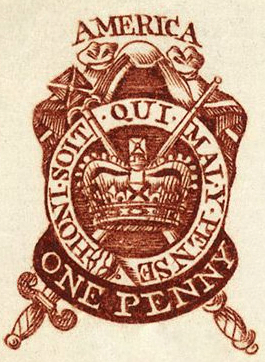
As a special treat, the U.S. Postal Service will join us for the Massachusetts unveiling of a new stamp commemorating the 250th anniversary of the end of the Stamp Act crisis, the first act of the American Revolution.
I’ve even managed to come up with a way to tie the Stamp Act crisis of 1765-66 to the “arms race” and four stolen cannon of 1774-75. It helps that pre-Revolutionary Boston was really a small town where nearly everyone was connected in some way to everyone else.

The event will be free; the M.H.S. asks people to register in advance. Copies of The Road to Concord will be on sale, and I’ll of course be happy to sign them and thank you for your interest and support.

Stamp Act Celebrations in Medford, Charlestown, and Cambridge

The same 26 May 1766 issue of the Boston Gazette that described Boston’s send-off to the Stamp Act in such detail also reported on celebrations in nearby towns. Militia companies played a big role in those activities.

Medford’s celebration appears to have started soon after news of the law’s repeal arrived the previous Friday, 16 May (though possibly one week later, depending on how one interprets the article).
…last Friday Evening, the Dwelling-House, Summer-House, &c. of the Hon. Brigadier General [Isaac] Royall were very handsomely illuminated, a Number of Chambers were fired, Rockets discharged, and Fireworks displayed, with many other Demonstrations of Joy—And the Military Company of Medford being that Day raised, they repaired in the Evening to the Brigadier’s House, and were generously entertained.

We also hear that a Number of other Houses in the said Town were illuminated, a large Bonfire made, and such Expressions of Joy as became a free & loyal People.
Royall’s house is still standing in Medford, and tomorrow has its own community open house.

Like Boston, Charlestown celebrated on Monday, 19 May.
At Noon the Independent Company belonging to Castle William muster’d, and discharged the Cannon at the Battery; and in the Afternoon the same Company met at the Long-Wharff, where a Number of the principal Gentlemen of the Town assembled, and the following Toasts were drank…
Charlestown’s toasts honored the King, Parliament, William Pitt, peace and harmony, and “All the True Sons of Liberty on the Continent.”

Cambridge held its celebration on Tuesday, 20 May:
last Tuesday in the Afternoon there was a great Assembly in the Meeting House, unto whom he [the Rev. Nathaniel Appleton] preached a most excellent Sermon, now in the Press, at the Desire of almost all that heard it, and at the Expence of General [William] Brattle, from the two last Verses of the 30th Psalm. The Solemnity began with Prayer, and was concluded by the young Gentlemen of the College singing two Anthems extreamly well suited to the joyful Occasion.

Immediately upon the Congregation’s coming out of the Meeting House, there was a Discharge of Field Pieces, &c. planted before General Brattle’s Door, many Gentlemen went to his House, and a vast Number of those of lower Rank, all Friends of Liberty, where the proper Healths were drank, accompanied with the discharge of the Cannon there…
The big homes, government buildings, and college buildings near the center of town were illuminated. In the evening there was a party for “many Gentlemen of the Town and many living out of the Town” at the courthouse. There was a “Bonfire (where Liquid was provided for every one that pleased to drink).” And there were fireworks “at the Charge of the Gentlemen of Cambridge.”

The following day, William Brattle led militia exercises on Cambridge common and hosted another banquet. He had been one of the most prominent opponents of the Stamp Act, skipping a Council meeting with Gov. Francis Bernard to lead a protest march with the Boston crowd.

Eight years later, however, Brattle had come around to supporting the royal government. As I discuss in the opening chapter of The Road to Concord, on 1 Sept 1774 he gave Gen. Thomas Gage’s troops the keys to the county militia’s gunpowder storehouse and two cannon—probably the same two fieldpieces that had been planted in front of his house (shown above) on 20 May 1766. That angered Brattle’s neighbors so much that he fled Cambridge forever.

TOMORROW: Illuminating Liberty Tree.

Thursday, May 19, 2016

John Hancock and “the Brilliancy of the Night”

The 19 May 1765 Boston Gazette offered a brief description of the very start of that day’s town-wide observance of the end of the Stamp Act. But the issue one week later devoted almost a full page to celebrating the celebration:
The Morning was ushered in with Musick, Ringing of Bells, and the Discharge of Cannon, the Ships in the Harbour and many of the Houses in Town being adorned with Colours

Joy smil’d in every Countenance, Benevolence, Gratitude and Content seemed the Companions of all. By the Generosity of some Gentlemen remarkable for their Humanity and Patriotism, our Goal was freed of Debtors.—
A later item in the paper credited the idea of paying off what the jailed debtors owed to “a fair Boston Nymph.” The action no doubt resonated strongly in a society that knew the Old Testament concept of a jubilee, not to mention a recent bankruptcy crisis.
At One o’clock the Castle and Batteries, and Train of Artillery fired a Royal Salute; and the Afternoon was spent in Mirth and Jollity.—In the Evening the whole Town was beautifully Illuminated:—

On the Common the Sons of Liberty erected a magnificent Pyramid, illuminated with 280 Lamps: The four upper Stories of which were ornamented with the Figures of their Majesties, and fourteen of the worthy Patriots who have distinguished themselves by their Love of Liberty.
The newspaper offered a detailed description of the obelisk shown yesterday and all the text painted on it. As I noted, its wooden frame was covered with paper rubbed with oil to become translucent so the structure could glow from within.
On the Top of the Pyramid was fix’d a round Box of Fireworks horizontally. About one hundred Yards from the Pyramid the Sons of Liberty erected a Stage for the Exhibition of their Fireworks, near the Work-House, in the lower Room of which they entertained the Gentlemen of the Town.

John Hancock, Esq; who gave a grand and elegant Entertainment to the genteel Part of the Town, and treated the Populace with a Pipe of Madeira Wine, erected at the Front of his House, which was magnificently illuminated, a Stage for the Exhibition of his Fireworks, which was to answer those of the Sons of Liberty:
The spring of 1766 marked the start of Hancock’s political career. In March the town meeting made him a selectman for the first time. In May a more exclusive town meeting elected him to the Massachusetts General Court. From then on, Hancock never lost a popular vote he really wanted to win.
at Dusk the scene opened by the Discharge of twelve Rockets from each Stage; after which the Figures on the Pyramid were uncovered, making a beautiful Appearance.—To give a Description of the great Variety of Fireworks exhibited from this Time till Eleven o’clock would be endless—the Air was filled with Rockets—the Ground with Bee-hives and Serpents—and the two Stages with Wheels of Fireworks of various sorts.

Mr. [James] Otis and some other Gentlemen who lived near the Common kept open House, the whole Evening, which was very pleasant; the Multitudes of Gentlemen and Ladies, who were continually passing from one Place to another, added much to the Brilliancy of the Night:

At Eleven o’clock the Signal being given by a Discharge of 21 Rockets, the horizontal Wheel on the Top of the Pyramid or Obelisk was play’d off, ending in the Discharge of sixteen Dozen of Serpents in the Air, which concluded the Shew.

To the Honor of the Sons of Liberty we can with Pleasure inform the World, that every Thing was conducted with the utmost Decency and good Order, not a Reflection cast on any Character, nor the least Disorder during the whole Scene.—

The Pyramid, which was designed to be placed under the Tree of Liberty, as a standing Monument of this glorious Æra, by accident took Fire about One o’clock, and was consumed:—The Lamps by which it was illuminated not being extinguished at the Close of the Scene it is supposed to have taken Fire by some of them.
That left the Sons of Liberty, or Loyall Nine, with no monument to install at Liberty Tree.

TOMORROW: While those men worked on that problem, there were celebrations in nearby towns.

Wednesday, May 18, 2016

“A View of the Obelisk”

On Monday, 19 May 1766, all of Boston was gearing up to celebrate the repeal of the Stamp Act at last.

The issue of the Boston Gazette published that day appears in the Harbottle Dorr collection at the Massachusetts Historical Society. It included a statement from the “Sons of Liberty” who had met on the evening of 16 May at “Hanover Square,” or the corner where Liberty Tree stood. They laid out their plan for a celebration with fireworks from “a Stage to be erected near the Work-House Gates.”

That item ended with a new announcement from the group:
I do therefore notify the Friends of Liberty, that an authentic Account of the Repeal of the Stamp Act is arrived, and the Gentlemen Select Men of Boston, have fix’d upon This Evening for the public Rejoicing, at whose Desire will be exhibited on the Common, an OBELISK—a Description of which is engraved by Mr. Paul Revere; and is now selling by Edes and Gill.——The signal of its Ending will be by firing a Horizontal Wheel on the Top of the Obelisk, when its desired the Assembly will retire.

By Order of the Committe,
May 19, 1766. (Signed) M. Y. Secretary.
The meeting-place and the links to Edes and Gill, printers of the Gazette, indicate that this notice came from the same group previously known as the Loyall Nine. No member of that group had the initials “M. Y.”—that was a pseudonym. Despite taking control of the town celebration, they were still keeping their names out of the papers.

Both the obelisk and the engraving are very detailed. At the top were sixteen portraits of British politicians and royals whom Americans praised as guardians of their traditional liberties, starting with George III and Queen Charlotte. Then there were many lines of poetry. At the bottom were four allegorical scenes of the king saving America from the Stamp Act monster (in our recent history comics workshops I pointed out that these pictures constitute “sequential art”).

To create the obelisk, those drawings and words were inked onto large sheets of (unstamped) paper which were affixed to a wooden frame and then soaked with oil to become translucent, so they could be illuminated from inside. I haven’t found a description of how tall the structure was, but it was meant to be impressive. The engraving also had explanatory captions at the top and bottom, every letter carved backwards into a sheet of copper.

All that work means that both the obelisk and the engraving must have been in preparation well before Boston received word of the Stamp Act repeal. Otherwise, there was only one work day between the Sons of Liberty meeting and the publication of that Gazette. That’s more evidence of how the town and its activists had been getting ready for this triumphant day since early April.

TOMORROW: The celebration at last.

Tuesday, May 17, 2016

“Unaffected Gaiety” on the Repeal of the Stamp Act

News that Parliament had repealed the Stamp Act arrived in Boston on 16 May 1766, as described yesterday. That quickly set off a public celebration.

The town’s newspaper printers collaborated on a broadside announcing the news from London (readable in more detail through the Massachusetts Historical Society).

The 19 May Boston Gazette reported:
It is impossible to express the Joy the Inhabitants in general were in, on receiving the above great and glorious News—

The Bells were immediately set a Ringing, and the Cannon fired under Liberty Tree and many other Parts of the Town. Colours were displayed from the Merchants Vessels in the Harbour, and the Tops of many Houses.

Almost every Countenance discovered an unaffected Gaiety on the Establishment of that Liberty which we were in the utmost Hazard of losing.
The “Cannon fired under Liberty Tree” must have been two small brass guns owned by the new Boston militia artillery company led by Adino Paddock. The “Colours” on display everywhere where variations on the British national flag.

The Whigs who had opposed the new tax so fervently weren’t the only ones glad that it was gone. John Temple, the Surveyor General of the Customs service in the port of Boston, must have been relieved to announce that he and his colleagues no longer had to worry about the unenforceable law.

Even Gov. Francis Bernard summoned his Council to share the news. He gave orders for the batteries in Boston, Charlestown, and Castle William to fire salutes in celebration of the news. He also invited those gentlemen to come to his official residence, the Province House, to toast the king’s health on the evening of Monday, 19 May.

That was perhaps a way to rise above the town’s official celebration, which at an afternoon meeting the selectmen scheduled for that same Monday evening. As a town meeting had already decided, there would be an illumination throughout Boston—candles in all the windows. (The governor authorized the Town House and Province House to be illuminated as well.) And there would be fireworks on the Common.

And those weren’t the last leaders heard from. On the evening of 16 May Boston’s “Sons of Liberty” had “a meeting…in Hanover Square,” near Liberty Tree, and “unanimously Voted”:
1. That their Exhibition of Joy on the Repeal of the Stamp Act be on the Common.

2. That the Fire Works be play’d off from a Stage to be erected near the Work-House Gates.

3. That there be an Advertisement published on Monday next, of the intended Exhibition, the place where, and the Time when it will end.
Thus, even as Bostonians prepared to celebrate their restored political unity with Britain, different levels of authority—the governor, the selectmen, and the Sons of Liberty or Loyall Nine—were jockeying to own the celebration.

Monday, May 16, 2016

Hancock and the Harrison

In 1763 the London merchant Jonathan Barnard took on Gilbert Harrison (d. 1790, his monument in the church at Newton Purcell shown here) as a full partner and successor.

One of Barnard and Harrison’s major customers in Boston was Thomas Hancock, who died the following year.

John Hancock inherited his uncle’s business and business contacts, and he started a busy correspondence with Barnard and Harrison. In late 1765 the Stamp Act threatened that relationship.

Hancock warned the Londoners on 14 October: “I have come to a Serious Resolution not to send one Ship more to Sea nor to have any kind of Connection in Business under a Stamp.” If any of his own ships arrived after 1 November, he would “Haul them up” instead of sending them back out.

In that same 14 October letter, however, Hancock announced that he had launched a new brigantine, owned in thirds by himself, Barnard and Harrison, and a Nantucket partnership named Barker and Burwell. As a tribute to his London contact, Hancock had named that ship the Harrison. “She sail'd for Nantuckett 11th Inst. compleatly fitted for the sea, and as pretty a Vessell & as well Executed as I ever saw a Vessell & I think tolerable Dispatch.”

Through November Hancock continued to complain about the Stamp Act, urging his London partners to lobby for its repeal. The next month, Hancock reported that officials in Boston weren’t enforcing the Stamp Act since the local Sons of Liberty had made sure there was no stamp master to distribute stamped paper. On 21 December he wrote to Barnard and Harrison:
This I hope you will receive by the ship Boston Packet. John Marshall, commar., which is now fully loaded with oyl, & have cleared him out at the Custom house, the officers certifying that no Stamps are to be had, which is actually the case, & you may rely the people on the Continent will never consent to the Grievous imposition of the Stamp Act. Our Custom house is now open as usual & clearance taken without stamps. That I apprehend there will be no risque on your side, here. I am under no apprehensions.
Despite his confidence, Hancock was facing a risk: the royal authorities could seize his ship and its cargo of whale oil for sailing without the proper paperwork.

The Boston Packet got through, and Barnard and Harrison assured Hancock that they had joined with other London merchants doing business with North America to urge the government to repeal the law. By early 1766 it was clear that such pressure was working.

On 26 February Hancock responded to that good news by writing:
I am very glad you have interested yourselves for us & wish your application may produce the Desired Effect. I am sure it is as much for the interest of Great Britain as ourselves to Ease our trade & in the case of the Stamp Act, there seems a necessity of Repealing it for almost to a man throughout the Continent, they are determined to oppose it, but I hope very soon to hear some good acct. from you. Do give me the earliest notice that the Parliament determines. I imagine the Brig Harrison will be the first Vessel here if the Stamp Act be repealed.
In early April the Harrison, captained by Shubael Coffin, left Britain for Boston. It carried loaf sugar and women’s stays for Samuel Eliot, “English and India Goods” for Frederick William Geyer, and the February London magazines for John Mein. And it carried a copy of the London Gazette with important news.

The Harrison reached Boston on 16 May 1766 after a voyage of six weeks and two days. The merchant John Rowe wrote in his diary:
Capt. Shubael Coffin arr’d from London abo. 11 of Clock & brot. the Glorious News of the total Repeal of the Stamp Act which was signed by his Majesty King George the 3d. of Ever Glorious Memory, which God long preserve & his Illustrious House.
The 19 May Boston Gazette noted:
It is worthy Remark that the Vessel which bro’t us the glorious News of the total Repeal of the Stamp Act is owned by that worthy Patriot, JOHN HANCOCK, Esq; who first ventured his Ship with a very rich Cargo for London, with a Clearance without the Stamp.
TOMORROW: Much rejoicing.

Sunday, May 15, 2016

“When we shall receive certain advice of the Repeal of the Stamp Act”

Like the Stamp Act itself, Parliament’s repeal of the Stamp Act was no surprise. The measure was debated in London for months, and colonists in North America eagerly awaited the results.

On 1 Apr 1766, Boston’s official records say, “A considerable Number of the Inhabitants of this Town Assembled at Faneuil Hall.” That was not to formula that town clerk William Cooper used to designate formal town meetings, which the selectmen usually called days in advance with a public warrant listing an agenda.

Nonetheless, those people proceeded as if they did constitute an official town meeting, electing James Otis, Jr., to preside as moderator. He announced:
that the probability of very soon receiving authentic Accounts of the absolute Repeal of the Stamp Act had occasioned the present Meeting; and as this would be an Event in which the Inhabitants of this Metropolis, as well as all North America, would have the greatest Occasion of Joy, it was thought expedient by many, that this Meeting should come into Measures for fixing the Time when those Rejoicings should be made, and the manner in which they should be conducted—whereupon it was——

Voted, That the Selectmen be desired when they shall hear the certain News of the Repeal of the Stamp Act to fix upon a Time for general Rejoicings; and that they give the Inhabitants seasonable Notice in such Manner as they shall think best——
On 21 April Bostonians “legally qualified and warned in Publick Town Meeting Assembled at Faneuil Hall” again to make that vote official. Otis moderated once more.
After the Warrant for calling the Meeting had been read—Some Resolves of the House of Commons relative to American Affairs, as also sundry Extracts from late Letters received from England were also read

After which the Town took into consideration the Article in the Warrant for calling the Meeting. (Vizt.) To agree on such Measures of Conduct as may be proper when we shall receive certain advice of the Repeal of the Stamp Act—whereup

Voted, That the Selectmen be desired when they shall have a certain account of the Repeal of the Stamp Act to Notify the Inhabitants of the Time they shall fix upon for the general Rejoicings & to publish the following Vote—Vizt.

Under the deepest Sense of Duty and Loyalty to our most gracious Sovereign King George, and in respect and Gratitude to the present Patriotick Ministry, Mr. [William] Pitt, and the Glorious Majority of both Houses of Parliament, by whose Influence under Divine Providence against a most strenuous Opposition, a happy Repeal of the Stamp Act so unconstitutional as well as grievous to his Majestys good Subjects of America is attained, whereby our incontestable Right of Internal Taxation still remains to us inviolate—

Voted, that at the Time the Selectmen shall appoint, every Inhabitant be desired to Illuminate his Dwelling House, and that it is the Sense of the Town, that the Houses of of the Poor, as well as those where there are sick Persons and all such parts of Houses as are used for Stores together with the Houses of those (if there are any) who from certain Religeous Scruples cannot conform to this Vote, ought to be protected from all Injury; and that all Abuses and Disorders on the Evening for Rejoycings by breaking Windows, or otherwise, if any should happen, be prosecuted by the Town—

Upon a Motion made and seconded Voted unanimously, That the Majestrates of the Town; The Selectmen; Fire-Wards; Constables and Engine Men, be desired to use their utmost Endeavours to prevent any Bone-Fires being made in any part of this Town, also the throwing of Rockets, Squibs, and other Fire Works in any of the Streets of said Town except the Time that shall be appointed for general Rejoicings, and that the Inhabitants be desired for the present to restrain their Children and Servants from going abroad on Evenings

Upon a Motion made and seconded, Voted, That for the Security of the Powder House on the Night of general Rejoicings the Selectmen be desired to Order two of the Fire Engines into the Common to be placed near said Magazine: and that the Roof thereof be well wet; and that the Air Holes be stop’t with Mortar and Brick or otherwise as they may Judge proper
Some of those measures were intended to preserve the town’s safety. Others were designed to preserve the town’s image, damaged by the riots against Andrew Oliver, Thomas Hutchinson, and other royal appointees in August 1765.

The meeting also appointed a committee to think about other ways for Boston “to testify their Gratitude to those Patriots on the other side of the Water to whose Endeavors it is owing that the Liberties of America are secured.” That committee was headed by John Erving and included several of the town’s most prominent merchants and politicians: John Rowe, Samuel Adams, John Hancock, the senior Royall Tyler, Thomas Cushing, and Joshua Henshaw. Boston was all set to hear good news.

Saturday, May 14, 2016

Ten Years of Boston 1775

This is the tenth anniversary of the day I launched Boston 1775. I dated a couple of introductory postings earlier than 14 May 2006 so they’d be easy to find, but that first posting was about an article I’d recently published in New England Ancestors. The next highlighted an article from the New Yorker about a widely reproduced portrait of a black sea captain being revealed as a fraud.

And every day since then I’ve posted something—sometimes written the night before, sometimes written weeks in advance, sometimes kindly written by someone else.

According to Google, Boston 1775 has garnered over 3,300,000 page views. The most hit-upon postings, no doubt determined by keywords in their titles and school assignments, are:
This blog turned out to provide my bona fides in the field of Revolutionary history since I don’t have a graduate education or institutional affiliation to point to. I’ve just laid out things I find interesting, and it’s gratifying to hear how interesting they are for others.

Boston 1775 opened doors for me. I got invited to speak on a panel about blogging at the Organization of American Historians meeting. I landed a contract to write a historical resource study for the National Park Service. The research behind my new book, The Road to Concord: How Four Stolen Cannon Ignited the Revolutionary War, started years before the blog, but Boston 1775 provides the platform for launching it.

I wasn’t expecting any of that. I just felt, back in 2004 or 2005, that I’d found some nifty stories that weren’t long or substantial enough to be print articles or papers. I thought it might be fun to share them on a website. My multitalented writing friend Greg Fishbone told me that I could achieve approximately what I wanted with PHP software configured to work like a blog.

That spurred me to look into blogging services to make the process easier. I realized that it would be easier to adapt to available templates than to ask Greg to engineer exactly what I pictured from scratch. I also realized that presenting material in blog form brought two advantages: I could add pages myself without having to work through a webmaster, and I wouldn’t have to launch a full site since no one expects a blog to be complete.

But still I didn’t do anything for months. Then in May 2006 I attended a conference where another writing friend, Mitali Perkins, told all of us in her workshop to just start blogging—find an area of your expertise and share it with the world. In Mitali’s case, she was writing about young immigrants and their books. She was already on her way to becoming a nationally known author and speaker.

After hearing Mitali, I came home and launched Boston 1775. And here we are, ten years later, looking ahead ten years to the sestercentennial of American independence. I can’t promise this blog will be around to see that anniversary, especially in daily form, but it feels like something to shoot for.

Friday, May 13, 2016

The “young Newenglander” and the Stamp Act

On 21 Nov 1765, the Halifax Gazette ran an item suggesting that the people of Nova Scotia opposed the Stamp Act, which had taken effect that month.

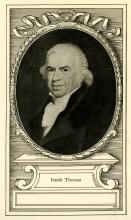
According to Isaiah Thomas’s History of Printing in America (1810):
This paragraph gave great offence to the officers of government, who called [printer Anthony] Henry to account for publishing what they termed sedition. Henry had not so much as seen the Gazette in which the offensive article had appeared; consequently he pleaded ignorance, and in answer to their interrogation informed them that the paper was, in his absence, conducted by his journeyman. He was reprimanded and admonished that he would be deprived of the work of government, should he in future suffer anything of the kind to appear in the Gazette.
Most of Henry’s business consisted of jobs for the provincial government, so losing that contract was a serious threat. But he didn’t bring his journeyman under control.
It was not long before Henry was again sent for on account of another offence of a similar nature; however he escaped the consequences he might have apprehended, by assuring the officers of government that he had been confined by sickness; and he apologized in a satisfactory manner for the appearance of the obnoxious publication. But his journeyman was summoned to appear before the Secretary of the Province; to whose office he accordingly went.
Now here we run into a problem knowing exactly what happened because the only account comes from Isaiah Thomas’s book, and the young journeyman causing trouble was Isaiah Thomas himself. Writing in Worcester more than forty years later, with those Halifax men distant and dead, he could tilt the story as he remembered it or wanted it remembered without fear of contradiction.

In this case, Thomas left out a pertinent fact about the royal secretary of Nova Scotia, Richard Bulkeley. That army veteran was also the major backer of the Halifax Gazette and for many years had overseen its news coverage. Bulkeley didn’t print the paper, but he had a legitimate interest in what appeared in it. (If a government official overseeing a newspaper seems like a conflict of interest, it was, but that was how most of Boston’s newspapers got launched in the early 1700s, too.)

Thus, when Bulkeley summoned Thomas to his office, he was both a government official and the young printer’s boss. But in his history of printing Thomas chose to present himself as up against royal authority alone:
Thomas was probably not known to Mr. Secretary, who sternly demanded of him what he wanted.

A.—Nothing, sir.

Q.—Why came you here?

A.—Because I was sent for.

Q.—What is your name?

A.—Isaiah Thomas.

Q.—Are you the young Newenglander who prints for Henry?

A.—Yes, sir.

Q.—How dare you publish in the Gazette that the people in Nova Scotia are displeased with the Stamp Act?

A.—I thought it was true.

Sec.—You have no right to think so. If you publish anything more of such stuff you will be punished. You may go, but remember you are not in New England.

A.—I will, sir.
Thomas still opposed to the Stamp Act. He just had to find other ways of expressing that opposition.

COMING UP: The death of liberty in America.

Thursday, May 12, 2016

Isaiah Thomas’s Second Job

In mid-1765 Isaiah Thomas was sixteen years old and apprenticed to the Boston printer Zechariah Fowle. But he was nowhere near Boston. Having worked for Fowle since he was seven, the teenager had gotten fed up and run away.

In Thomas’s own words later, “he went to Novascotia, with a view to go from thence to England, in order to acquire a more perfect knowledge of his business.” Benjamin Franklin had blazed that trail.

In Halifax, Thomas found work with “a Dutchman, whose name was Henry.” This was Anthony Henry, who was actually born in France of German parents. Henry had come to America as a fifer in the British army and settled in Halifax in 1760, taking over the colony’s main print shop the next year.

According to Thomas:

He was a good natured, pleasant man, who in common concerns did not want for ingenuity and capacity; but he might, with propriety, be called a very unskilful printer. To his want of knowledge or abilities in his profession, he added indolence…
Thomas clearly had no more respect for his new boss than for his previous one. He also deemed Henry’s shop antiquated and poorly equipped. But working there gave the teenager a taste of autonomy—Henry appears to have given him free run in printing the weekly Halifax Gazette.

On 1 November, the Stamp Act went into effect in all of Britain’s North American colonies. According to A Bibliography of Canadian Imprints by Marie Tremaine, the issue of the Halifax Gazette published on that date appeared on stamped paper. Its printer’s notice stated, “Advertisements are taken in and inserted as Cheap as the Stamp Act will allow.”

Later that month Thomas was a little more forthright about his opposition to the new law as he reported, “the People of this Province are disgusted with the Stamp Act.”

TOMORROW: And that was enough to get him and his boss in trouble.

Wednesday, May 11, 2016

“Marriage Is Taxing” and More at Old South, 19 May

Blood on the Snow isn’t the only historical theater debuting in Boston this month.

On Thursday, 19 May, the Old South Meeting House will host a performance of “Marriage Is Taxing” by Martha Lufkin. This one-woman comedy is “based on the rush to marry in the weeks before the Stamp Act took effect, to avoid the impending tax on marriage certificates.”

(Back here I looked at the reports from 1765 and 1766 of people accelerating or putting off marriage because of the new tax on the certificate that said a couple was legally able to marry. Not only were there such reports in New England newspapers, but, at least in some communities, there was a measurable shift in marriage patterns.)

Lufkin’s performance is just one part of an evening that the Old South is titling “Marriage, Taxes, and a Dose of Rebellion.” The evening begins at 6:30 P.M. with a light supper while musicians perform period tunes. The cost is $40 per person, including the meal, or $30 for Old South members. Go to this page for more information and tickets.

Tuesday, May 10, 2016

Blood on the Snow at the Old State House

As of last night, there are seats available for only three of the upcoming performances of Blood on the Snow, a historical play produced by the Bostonian Society in the Old State House.

Written by Patrick Gabridge, the drama depicts the aftermath of the Boston Massacre on the morning of 6 Mar 1770. Boston’s political leaders, headed by Samuel Adams, confronted acting governor Thomas Hutchinson and ranking army officer Lt. Col. William Dalrymple, demanding that they move the 29th and 14th Regiments from barracks in the center of town off to Castle William.

The play will be staged in the Council Chamber of the Old State House, the same room (albeit expanded) where Hutchinson was meeting with the governor’s Council that morning when Adams and his committee arrived. Expect many references to the distraught crowd outside. The nominal issues will be who is to blame for the fatal violence the night before, whether the governor or colonel have the authority to move the troops, and whether moving one regiment would satisfy the populace. The underlying dispute is, of course, the parameters of self-government.

This is an ambitious project, many months in the making, which aims to provide a new model for how to interpret historic sites. The society’s webpage for the show calls it “History on Stage,” and says, “this pilot production will be an initial test case for what we hope becomes a city-wide effort in future years.” Given the Old State House’s role as the seat of Massachusetts government, it could host recreations of several dramatic episodes in future years.

(The photo above, courtesy of the Boston Globe, shows the cast in rehearsal without costumes in the Council chamber.)

Monday, May 09, 2016

Scipio Moorhead’s “natural genius for painting”

Back in this post I mused on the mysteries of Scipio Moorhead, subject of Eric Slauter’s article “Looking for Scipio Moorhead” in Slave Portraiture in the Atlantic World. I wrote:
Slauter also notes that the only evidence we have for Scipio Moorhead as an artist is Phillis Wheatley’s poem “To S.M., A Young African Painter, on Seeing His Works.” A note on an early copy gives that painter’s full name, and Wheatley addressed another poem to the Moorhead family. But no one else mentioned Scipio Moorhead’s art in surviving documents, and no known examples have survived.
I still haven’t come across any Scipio Moorhead artwork, but I did find another contemporaneous remark about his artistic talent and activity.

The Rev. John Moorhead died in December 1773. Boston’s Presbyterian meetinghouse invited the Rev. David McClure to preach in his place for a while. McClure’s diary entry for 4 May 1774 reads:
Put up at the Widow [Sarah] Moorhead’s. Found the place convenient for study. The family small. The Widow is unhappily deranged. The distraction is of the melancholy cast, silent & averse to company or society. She was once an accomplished wit & beauty, tenderly beloved by her husband. Her distraction was thought to be the effect of an uncommon flow of spirits, and lively imagination, too intensely applied to reading and study.

One son and two daughters survive. The son, (Alexander) is now a surgeon in the british navy in Boston harbour. Her daughter Mary takes care of her poor mother, a negro young man does the housework. Scipio is an ingenious and serious African. He possesses a natural genius for painting, and has taken several tolerable likenesses.
Slauter noted conflicting hints about Scipio’s age, starting with his baptism in 1760. McClure’s reference to him as a “young man” in spring 1774 now stands alongside a reference to him as a “Negro man” late that year and a “likely Negro Lad” in a 1775 advertisement.

Sarah Moorhead was indeed a woman of intellect and talents. Her name appears on a pen portrait of the Rev. Cotton Mather (reproduction from Justin Winsor’s magisterial history of Boston shown above). People have often therefore speculated that she tutored Scipio in art.

It’s a pity that McClure attributed Sarah Moorhead’s depression to too much “reading and study” rather than, say, the death of her husband less than six months before.

Sunday, May 08, 2016

The Newport Watch

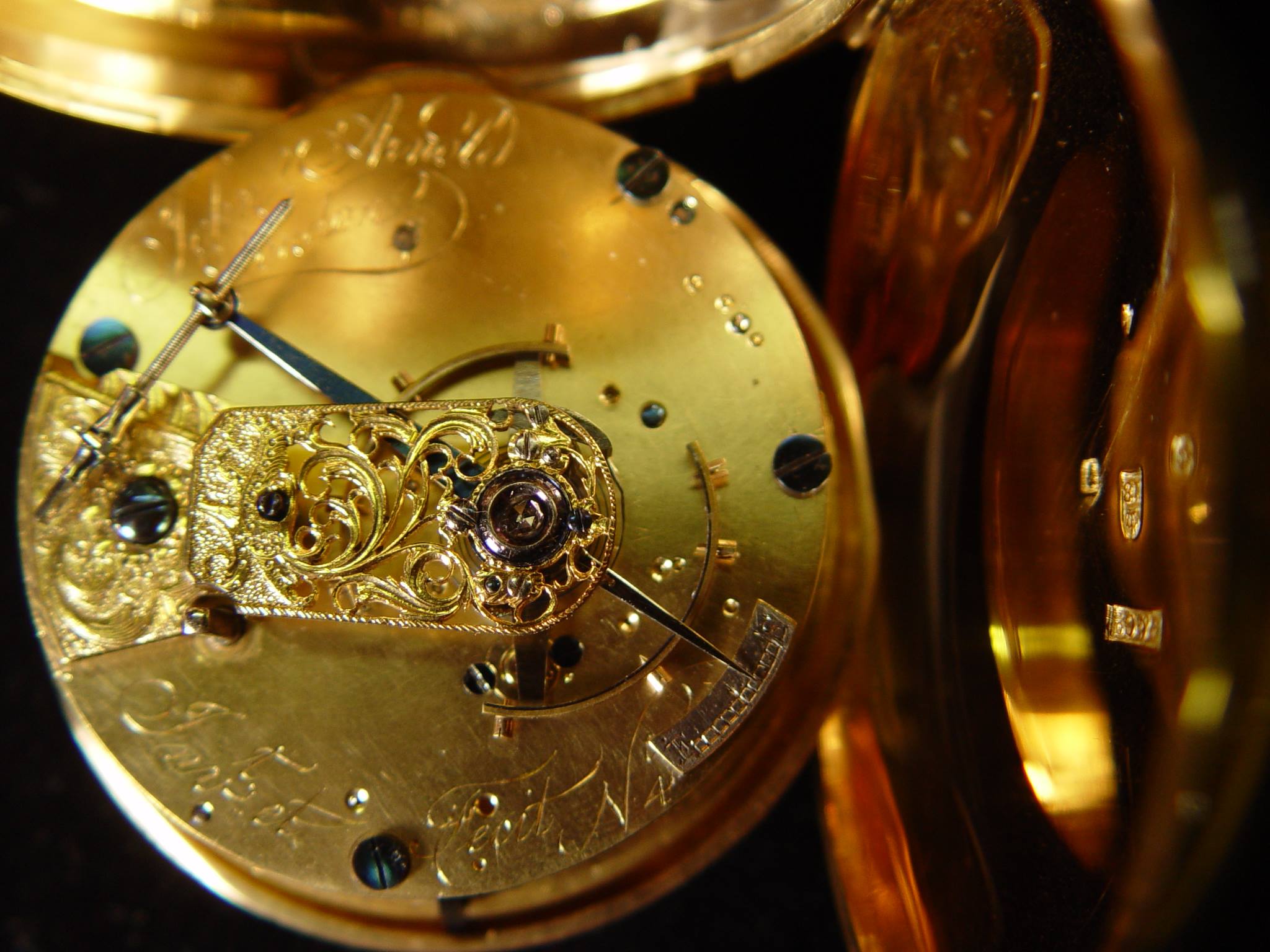
Last month the Newport Historical Society announced that Rory McEvoy, the curator of Horology at the Royal Observatory in Greenwich, had identified a pocket watch in its collections as an important timepiece from the 1770s.
Mr. McEvoy verified that the pocket watch was made by John Arnold of London and is #4 in a series of marine watches circa 1772. John Arnold was one of several men competing for the Board of Longitude prize to produce a chronometer that would ensure safe and accurate navigation. Only a few of these paradigm-shifting time pieces from this period of technological development are known and in public hands, and the discovery of Arnold’s #4 adds significantly to the scientific record. Arnold’s #3 is in the collections at the British Museum; #1, 2 and 5 in the series are missing.
Readers of Dava Sobel’s bestseller Longitude will recall that John Harrison (1693-1776) received a grudging award from the Board of Longitude for producing the first accurate method of calculating longitude at sea. George III had to intervene to get the aging inventor the bulk of his money.

John Arnold (1736-1799) was from the next generation of watchmakers. He introduced some new ideas and improved on others’ while making “see-saw escapement timekeepers.” Capt. James Cook took one of his watches on his 1772-75 cruise. Arnold made the #4 watch during that testing, using a “pivoted detent escapement.” He received £300 from the Board of Longitude for general good work.

In 1792 the Newport merchant Peleg Clarke bought the watch, probably during a trip to London. His descendants donated it to the Newport Historical Society 205 years later.

Saturday, May 07, 2016

Deerfield Conference on Buildings Archeology, 16 July

On Saturday, 16 July, Historic Deerfield is hosting a one-day conference on “Buildings Archaeology: An Integrated Approach to Understanding Historic Structures.”

The event description says:
The study of historic buildings to pinpoint the initial period of construction as well as later modifications relies on a variety of disciplines and areas of expertise that, when combined, build an accurate case for determining the evolution of a structure. The symposium will introduce the methods and materials available to those who work with, or live in, historic buildings.
Speakers and topics include:
  • Myron Stachiw, UMass-Amherst Historic Preservation Program, “Buildings Archaeology: From the Historic Structures Report to Historical Interpretation”
  • Robert Adam, “Decoding Carpenter’s Tool Marks and Layout Lines”
  • Tom Paske, “Decoding Building Chronology through Fastener Analysis”
  • John Vaughn, Architectural Conservation Services, “Decoding Paint: The Use of Paint Investigation for Relative Dating”
  • Bill Flynt, Historic Deerfield, “Decoding Construction History with Dendrochronology”
  • Claire Dempsey, Flynt Center, “Decoding Documents: Gathering the Data and Weighing the Evidence”
The conference will take place from 8:45 A.M. to 4:00 P.M. at the Deerfield Community Center. The cost is $85 for Historic Deerfield members, $95 for others. For full information and a registration form, download this P.D.F. document.

(Photo of a Deerfield building above courtesy of New England House Historian Marian Pierre-Louis.)

Friday, May 06, 2016

Franklin “integrated easily into parts of the British establishment”

The transformation of the house where Benjamin Franklin lived in London into a museum has prompted new public interest to his second career as a lobbyist.

George Goodwin, the museum’s Honorary Writer in Residence, has addressed the topic in Benjamin Franklin in London. Colin Kidd recently reviewed it for The Guardian:
In London he integrated easily into parts of the British establishment. He became a pillar of the Royal Society, to which he had already been elected, and formed close friendships with Francis Dashwood, 11th Baron le Despencer, and – notwithstanding his exiguous religious beliefs – with Bishop Jonathan Shipley and his family. Yet when Franklin ran into outright snobbery and chilling aristocratic hauteur, these – which existed aplenty – brought out a prickly, assertive pride in his artisanal origins. Franklin vacillated uneasily between a leather-apron identity as a tradesman who had risen in life through his own efforts, and a relaxed acceptance of inherited privilege and hierarchy. Although Goodwin records several instances of slights and putdowns, Franklin still possessed considerable clout. In 1763 his son William was appointed the royal governor of New Jersey.

During his years in London the focus of Franklin’s lobbying activities shifted from the Pennsylvania charter to the emerging crisis in relations between London and the colonies. While a policy of coercion prevailed, from which flowed a demand for American independence, the struggle in the highest circles of British policymaking between the proponents of coercion and conciliation was a close-run thing. There was nothing inevitable about independence. The chance play of personality – and especially a handful of wilfully obtuse characters such as Thomas Hutchinson, the governor of Massachusetts in the early 1770s, and the Earl of Hillsborough, the secretary of state for the colonies between 1768 and 1772 – played as large a part in the eventual estrangement of the colonies from Britain as the brute realities of geography.

George III emerges from Goodwin’s story not as a tyrant, but “most emphatically” as “a pedant”. Where did authority lie – with the British parliament, or with the parliament-like bodies found in the colonies? Franklin believed that the monarch was the “ultimate protector” of the colonial legislatures against the pretensions of Westminster. But George III was reluctant to overstep the bounds of British constitutional convention. The tyrant of patriot demonology was a straw man.
Franklin’s influence in London came to a crashing end in January 1774 when Solicitor General Alexander Wedderburn lambasted him in front of the Privy Council for leaking Gov. Hutchinson’s letters. Sheila Skemp’s The Making of a Patriot focuses just on that confrontation. Though Franklin remained in Britain for more than a year, he had lost his standing with all but the radical Whigs who were supporting America anyway. Franklin sailed back to America in the spring of 1775 and started his third career as an American politician and diplomat.

Thursday, May 05, 2016

How to Join the Massachusetts Army

On 5 May 1775, the Massachusetts Provincial Congress decided how militiamen would sign up for longer service in its army:
Resolved, that all officers & soldiers of the Massachusetts army now raising for the defence & security of the rights and liberties of this and our sister colonies in america, shall each & every of them excepting only the the General Officers repeat and take the folowing Oath: (viz)
I, A B, swear, I will truly & faithfully serve in the Massachusetts army, to which I belong, for the defence and security of the estates, lives and liberties of the good people of this & the sister colonies in america, in opposition to ministerial tyrany by which they are or may be oppressed, and to all other enemies & opposers whatsoever; that I will adhere to the rules & regulations of sd. army, observe & obey the generals & other officers set over me; and disclose and make known to said officers all traiterous conspiraces, attempts and designs whatsoever which I shall know to be made against said army or any of the english american colonies, so help me God
This text came from a document in the Massachusetts Archives and was published in a volume of the state’s Acts and Resolves in 1886. The text published in The Journals of Each Provincial Congress of Massachusetts in 1838 has the same words but regularized spelling and punctuation.

The congress left generals out of that oath since they would have no superior officers to answer to. It took another twelve days, and a suggestion that Gen. Artemas Ward really ought to have a commission, for the body to come up with an oath for those commanders:
Resolved, That the general officers of the Massachusetts army, now raising for the defence and security of the rights and liberties of this and our sister colonies in America, shall each and every of them repeat, take, and subscribe the following oath, to be administered by viz.:
I, A. B., do solemnly swear, that, as a general officer in the Massachusetts army, I will well and faithfully execute the office of a general, to which I have been appointed, according to my best abilities, in defence and for the security of the estates, lives, and liberties of the good people of this and the sister colonies in America, in opposition to ministerial tyranny, by which they are or may be oppressed, and to all other enemies and opposers whatsoever; that I will adhere to the rules and regulations of said army, established by the Congress of the colony of the Massachusetts Bay, observe and obey the resolutions and orders which are or shall be passed by said Congress, or any future congress, or house of representatives, or legislative body of said colony, and such committees as shall be by them authorized for that purpose; and that I will disclose and make known to the authority aforesaid, all traitorous conspiracies, attempts and designs whatsoever, which I shall know to be made, or have reason to suspect are making, against the army, or any of the English American colonies.
That text comes from the printed Journals of Each Provincial Congress. It didn’t conclude with “so help me God,” the only one of the three oaths the congress dictated that didn’t contain that formula. Whether that was an oversight or a significant decision is unclear.

The congress took another two days to finish Ward’s commission. A biographer of James Sullivan stated that he drafted the document, and the other two members of the committee never had biographers to dispute that. On 20 May Samuel Dexter administered the oath to Gen. Ward, and Dr. Joseph Warren as president of the congress delivered the commission. It’s an impressive-looking document.

Wednesday, May 04, 2016

Former H.M.S. Endeavour in Newport Harbor

This morning the Rhode Island Marine Archeology Project has scheduled an announcement about its possible discovery of H.M.S. Endeavour, the ship that Capt. James Cook sailed around the world in 1768-1771.

The Royal Navy sold that ship after Cook’s voyage, then bought it back when the Revolutionary War began, sent it to America, and finally scuttled it during the lead-up to the Battle of Rhode Island.

The organization’s webpage explains:
RIMAP has mapped 9 archaeological sites of the 13 ships that were scuttled in Newport Harbor in 1778, during the American Revolution. A recent Australian National Maritime Museum grant allowed RIMAP to locate historic documents in London that identify the groups of ships in that fleet of 13, and where each group was scuttled. One group of 5 ships included the Lord Sandwich transport, formerly Capt. James Cook’s Endeavour Bark.

RIMAP now knows the general area of Newport Harbor where those five ships were scuttled, and in previous work had already mapped 4 of the sites there. A recent analysis of remote sensing data suggests that the 5th site may still exist, too. That means the Rhode Island Marine Archaeology Project now has an 80 to 100% chance that the Lord Sandwich is still in Newport Harbor, and because the Lord Sandwich was Capt. Cook’s Endeavour, that means RIMAP has found her, too.

On May 4 RIMAP will describe its 2016 plans to confirm the 5th shipwreck in the limited study area, and will outline what must be done in the future to determine which of the 5 sites there is which ship. The next phase of the archaeological investigation will require a more intense study of each vessel’s structure and its related artifacts. However, before that next phase may begin, there must be a proper facility in place to conserve, manage, display, and store the waterlogged material removed from the archaeological sites.
The organization is therefore undertaking a fundraising campaign to complete the project properly.

The Daily Mail in London and Daily News in New York both picked up this story. And it’s probably bigger news in Australia, where the nation traces its British roots back to Cook’s arrival on the east coast in 1770.

(The painting above, courtesy of Wikipedia, shows the Endeavour as Cook left Britain in 1768, looking considerably better than it did in Newport ten years later.)

Tuesday, May 03, 2016

Cherubum and Seraphim at Old North Church

As an Anglican church, the Old North Church (formally Christ Church, Boston) was more flashily decorated than the town’s Congregationalist meetinghouses.

There are, for example, four hand-carved angels mounted on the gallery railing. Tom Dietzel recently shared a four-part online essay about them.

Those statues are thought to have been made in what is now Belgium in the early 1600s. In 1746 they were shipped across the Atlantic to a French territory—it’s not clear where. Unfortunately for the church expecting to receive those angels, that was during what British colonists called King George’s War. A Boston-based privateer named the Queen of Hungary captured the French merchant ship carrying the figures.

The captain of that privateer was a man from the Isle of Jersey named Thomas James Gruchy. He had settled in Boston and purchased a pew in Christ Church five years before. Returning to his home port considerably better off for his trouble, Gruchy agreed with five of his partners to give their church the angels and two “glass branches” or chandeliers (discussed here).

Gruchy returned to his busy mercantile career but appears to have suffered reverses in the 1750s. By 1759 he and his family had left Boston for good, and it’s not clear where he settled next.

Capt. Gruchy’s angels weren’t the only heavenly decoration at Old North. This winter the church was able to commission a historic paint analysis that peeked below its current decor, established in 1912 based on that era’s thoughts of what a colonial church should look like.

As part of that work, Brian Powell and Melissa McGrew of Building Conservation Associates exposed the painted head of a cherub they date to 1727. What’s more, they believe there are twenty more cherubs’ heads elsewhere under the paint. Powell will speak about that find and other details of the church’s eighteenth-century interior in a free public lecture on Wednesday, 11 May.

“Uncovering Cherubs: New Discoveries at Old North Church” is scheduled to start at 6:30 P.M. Afterwards the Boston Preservation Alliance Young Advisors will host “a facilitated discussion about the role preservation plays in interpretation at historic sites.” The event is free, but advance registration is required.

(Funding for the paint study and/or the lecture came from the Massachusetts Cultural Council, the Freedom Trail Foundation, the National Park Service, and the Marr Scaffolding Company.)

Monday, May 02, 2016

The Rev. David McClure’s 20th of April

Here’s another extract from the diary of the Rev. David McClure as the Revolutionary War began.

The last installment left the minister at the home of Joseph Mayo, a militia officer in Roxbury.
At the dawn of day, the Major & I mounted our horses, & rode to Roxbury street, anxious to know what had been done. The town was still as a grave yard, the people from the thick settled part, having moved out. A few militia men only, I saw there.

Determining to see what had been done on the rout of the enemy, I rode to Watertown, & from thence came on the road leading to Lexington. I went almost to the meeting house, where the first american blood was wantonly spilt, but the rain necessitated me to return. Dreadful were the vestages of war on the road.

I saw several dead bodies, principally british, on & near the road. They were all naked, having been stripped, principally, by their own soldiers. They lay on their faces. Several were killed who stopped to plunder, & were suddenly surprised by our people pressing upon their rear.

I went into a house in Menotomy, where was a stout farmer, walking the room, from whose side a surgeon had just cut out a musket ball, which had entered his breast, & glancing between the ribs, had lodged about half way to his back. He held the ball in his hand, & it was remarkable, that it was flattened on one side by the ribs, as if it had been beaten with a hammer. He was a plain honest man to appearence, who had voluntarily turned out with his musket, at the alarm of danger, as did also some thousands besides on that memorable day.

In the same room, lay mortally wounded, a british Officer, Lieut. [Edward] Hull, a youthful, fair & delicate countinance. He was of a respectable family of fortune, in Scotland. Sitting on one feather bed, he leaned on another, & was attempting to suck the juice of an Orange, which some neighbour had brought. The physician of the place had been to dress his wounds, & a woman was appointed to attend him. His breaches were bloody, lying on the bed.

I observed that he had no shirt on, & was wrapped in a coating great coat, with a fur cap on his head. I inquired of the woman, why he was thus destitute of cloathing? He answered, “when I fell, our people (the british) stripped off my coat, vest & shirt, & your people my shoes & buckles.” How inhuman his own men!

I asked him, if he was dangerously wounded? he replied, “yes, mortally.” That he had received three balls in his body. His countenance expressed great bodily anguish. I conversed with him a short time, on the prospect of death & a preperation for that solemn scene, to which he appeared to pay serious attention. He lived about a week, & the people conveyed his body in a Coffin to Charlestown ferry, where I happened to be present, & a barge from the Somerset, took it to Boston.
According to Abram English Brown’s Beneath Old Roof Trees, Lt. Hull of the 43rd Regiment was wounded at Concord’s North Bridge and then again during the British withdrawal. He was taken into the nearby house of young farmer Samuel Butterfield, and Butterfield’s wife Elizabeth cared for him and a less seriously wounded man from Framingham, Daniel Hemenway. Hull died on 2 May, and his body was sent in to Boston as McClure reported.

Hemenway survived to lobby the Massachusetts government to pay his medical bills and support. According to the petition that Ellen Chase transcribed in her Beginnings of the American Revolution, the ball that went through Hemenway’s chest also hit his thumb and “broak the bone to shivers.”
Not far from this house, lay 4 fine british horses. The people were taking off their shoes. One informed me, that a waggon loaded with provisions was sent from Boston, for the refreshment of the retreating army, under an escort of 6 Granidiers. They had got as far as this place, when a number of men, 10 or 12, collected, and ordered them to surrender. They marched on, & our men fired, killed the driver & the horses, when the rest fled a little way, & surrendered. Another waggon sent on the same business, was also taken that day. It was strange that General [Thomas] Gage should send them through a country, in which he had just kindled the flames of war, in so defenceless a condition.
Several sources describe the capture of those wagons, one usually credited to David Lamson and the “Old Men of Menotomy.” The fleeing soldiers reportedly surrendered to Ruth Batherick.
Saw 3 regulars, in beds in a house in Cambridge, one of them mortally wounded. Conversed with them on their melancholy situation. One of them refused to answer, and cast upon me a revengeful look. Perhaps he was a papist, & his priest had pardoned his sins. The houses on the road of the march of the british, were all perforated with balls, & the windows broken. Horses, cattle & swine lay dead around. Such were the dreadful trophies of war, for about 20 miles!

Sunday, May 01, 2016

Avant nous le déluge

Last month the Creators Project at Vice featured Viennese photographer Andreas Franke’s Stavronikita Project, part of his series “The Sinking World.”

As I understand Franke’s method, he dives down to shipwrecks and photographs them. Then he creates digital images combining those backgrounds with scenes of people that he stages in his studio. He places large prints of the resulting images back down on the shipwrecks for several months, where people with scuba gear can view them as they take on a patina of sea life. Finally, those prints are brought to the surface for drier displays and sales.

The Stavronikita was a Greek shipping vessel presently about thirty miles off Key West and eighty feet down. For that site Franke created images of what the Creators Project calls “French Revolution-esque bourgeoise,” though to me the people look very much of the Second Estate. The tableau above, for instance, is titled “Picnic for Three.” With the figures seemingly submerged, and coral starting to encrust their frame, it’s quite a metaphor for the French Revolution.